

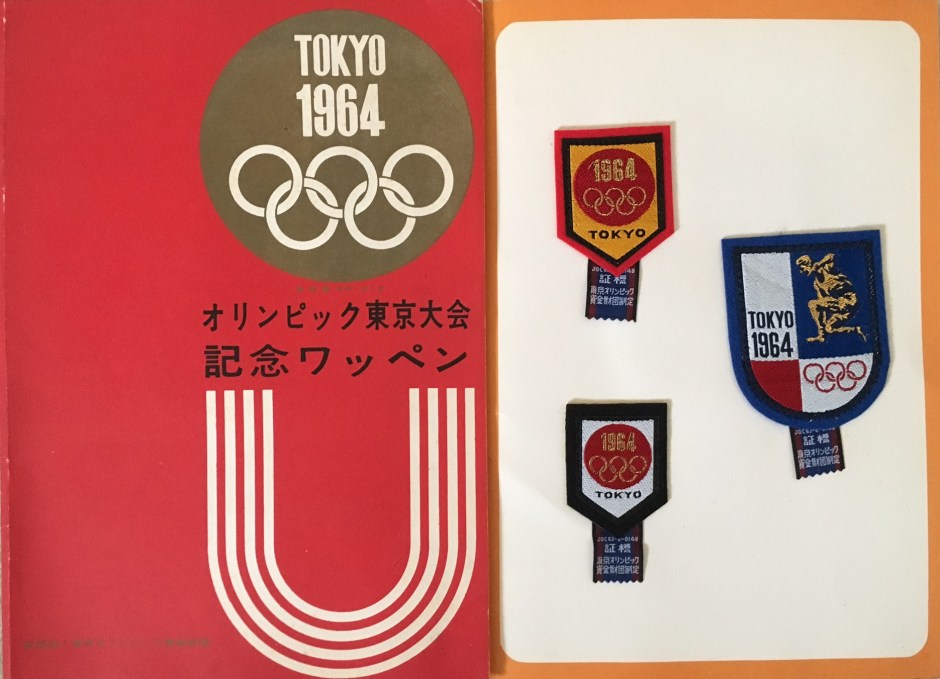

I was in Queens, New York a couple of weeks ago to clear out the home I grew up in. The house sold, we had to dump decades of stuff. One of the items that turned up and was most thankfully not thrown away was this commemorative collection of iron-on patches from the 1964 Tokyo Olympics. My father, who was on the NBC News team that helped broadcast the Tokyo Games, undoubtedly picked this up when he was there that October.
The title on the cover page called these items wappen (ワッペン), generally, iron-on patch, a word I was not familiar with. I learned that wappen is a German word that means “coat of arms”, which is why these Japanese patches have their particular shape and design.


This exercise made me think of all the foreign words that have become part of everyday Japanese, many that were imported during intense foreign interactions with the Japanese: the European influence in the Meiji Period, or the American occupation in the years after World War II.
Here are a few examples below:
- Abekku means a man and a woman who are dating, or romantically involved – a couple, in short. This word comes from the most romantic of romance languages, French. Abekku is derived from avec, which means “with”.
- Ankēto (アンケート) is the Japanese word for a survey, what you fill out when a company wants to know what you thought of its service, for example. This word comes from the Dutch word, enquête, which means “survey” as well, but originally derived from the French word of the same spelling that means “investigate”.
- Arubaito (アルバイト), which means part-time work in Japanese, is often abbreviated to baito (バイト). It derives from the word arbeit in German, which means “work”.
- Gipusu or gibusu (ギプス or ギブス), which means a plaster or plastic cast, used when one breaks a bone. This word comes from the German word gipsverband.
- “Oh-rai, oh-rai, hai stoppu“, is one of my favorite Japanese phrases, which is essentially a phoneticized version of the English words, “All right, all right, OK, stop!” which you hear very often in Japan when a man is directing a large truck to continue to back up into a parking area. This was likely a phrase that Japanese heard a lot during the American occupation in the late 1940s and early 1950s.
- Randosel (ランドセル) is the cute, leather daypack you see on the back of school children in Japan. It is derived from the Dutch word, ransel, or “backpack” in Dutch.
- Tempura (天ぷら), that uniquely Japanese dish of deep-fried seafood or vegetables is actually an import from Portugal. The Portuguese have a similar dish called tempero or temperara, which was likely brought over to Japan by Portuguese sailors and missionaries centuries ago.
So now that you’re an expert in Japanese words borrowed from overseas vocabularies, here is your test. If you understand this, who knows, maybe you can fake your way through a Japanese conversation one day.
I left my arbaito to go to my manshon. On the way I stopped at the konbini to buy some bata and biru. I dropped my hankachi there accidentally, and was so worried because it was mother’s gift to me. My mazakon kicked into high gear, so I ran to the depaato to find another hankachi just like the one I had. Unfortunately, while I was running across the street, a basu startled me with his kurakushon, and I fell. I tore a hole in my pantsu. Even worse, I broke my arm and had to wear a gipusu for a month. “Oh, mistake!“