ingrid-engel-kraemer-rome-1960-getty
Ingrid Engel Kraemer Rome 1960 Getty

I remember walking the streets of Dresden in then East Germany in 1985, noting how modern the city looked and felt compared to my previous destination of Prague. And yet, I was constantly reminded of the terrible toll World War II had on this city, as I strolled by buildings in elegant decay, reduced to skeletons by the incessant firebombing by the Allies some 40 years before.

One of the greatest female divers of the 20th century, Ingrid Engel-Krämer, was a little less than two years old when the sky rained fire on her home town.

When the 1960 Rome Olympics rolled around, East Germany was still in a tremulous existential state. Born of the ideological split between Allies at the end of the Second World War, the Potsdam Agreement dictated a “provisional border” that would separate Germany into East and West, the former to become The German Democratic Republic (GDR), and the latter the Federal Republic of Germany (FRG).

And yet, in 1960, tensions between the two Germanys, and their proxies in the global cold war battle, the Soviet Union and the United States, were still high. Author of the book, Rome 1960, David Maraniss quoted a US National Security Agency report stating that East Germany was “teetering on the brink of stability”, meaning that the possibility of East German government collapsing was diminishing rapidly. Of course, a year later, a wall was constructed on the East Berlin side, symbolizing in a very real way that East Germany was here to stay, making Germany, by default, the epicenter of Cold War hostility.

During the Rome Olympics, the GDR government declared that West German citizens would not be allowed to enter East Germany – this while over a 100,000 East Germans snuck through the border into West Germany. This ban was a reaction to an event in West Germany celebrating the return of World War II German POWs and their relatives. East Germany viewed this event as a celebration of Germany’s fascist past.

ingrid-engel-kraemer-carries-german-flag-at-rome-olympics-closing
Ingrid Engel Kraemer carries German flag at Rome Olympics closing ceremony

It was under this geo-political cloud that athletes around the world gathered in Rome for the 1960 Olympics. The condition by the International Olympic Committee for German athletes to compete was that they had to do so as a unified team, which meant competing under a specially created German Olympic flag. East and West German athletes on the whole got along as teammates on the field and in the Village. But, as Maraniss wrote, the press in each of the two Germanys turned Engel-Krämer’s stunning achievements in Rome into a proxy Cold War battle, not because Engel-Krämer, an East German, defeated an American, Paula Jean Myers-Pope, in the 10-meter platform dive, but because both East and West Germany claimed her as their own.

When Kraemer was competing to make the unified team, she felt that the West German press was very “unfriendly” to her; at least one journalist, but her account, cursed her because of politics. But now the West Germans were embracing her as a German first, one of their own. The Western newspapers covered her events with obvious national pride, as though there were no separation between East and West. Accounts in Die Welt and the Frankfurter Allgemeine Zeitung raised no questions about the judging and described the final dives in a way that left no doubt that Kraemer had again outperformed her competition. German fans, who dominated the Stadio del Nuoto audience during her events, cheered long and loud for her every effort.

Yet the warmth the West Germans showed Kraemer infuriated the East Germans, who thought the other side was trying to steal her show and diminish the ideological implications of her triumph. Kraemer’s victory was no accident, East Germany’s Neues Deutschland proclaimed. Rather, she owed her success to her “joyful life in the socialism of the German Democratic Republic.” The paper also complained that for all the copy Kraemer in the Western press, it was never mentioned that her father was an official of the SED and that the young diver herself was a member of the socialist mass youth organization.
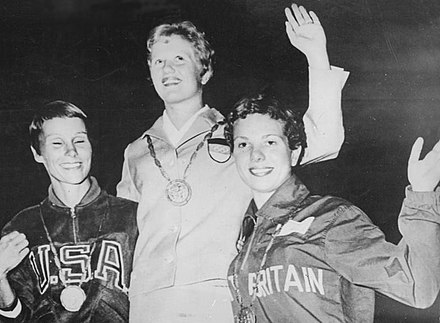
paula-jean-myers-ingrid-kraemer-and-elizabeth-ferris-in-rome
Paula Jean Myers, Ingrid Kraemer and Elizabeth Ferris in Rome springboard finalists

She started diving off a low board at the age of five, even before she knew how to swim. Starting from the age of eleven, she would join her friends at the Dresden diving club a few times a week and stay there until the early evening. Those were the early days of young Ingrid Engel-Krämer, who would unexpectedly become one of the stars of the 1960 Rome Olympics, winning gold in both the women’s 3-meter springboard and 10-meter platform diving competitions.

David Maraniss, in his seminal book Rome 1960: The Olympics That Changed the World, profiled Engel-Krämer, explaining that at the time, Americans were the dominant force in diving. In fact, until Engel-Krämer broke the streaks, women from Team USA had taken both gold and silver in the previous seven summer Olympics in the 10-meter platform, and gold in the previous 8 Olympiads in the 3-meter springboard.

In the springboard, Engel-Krämer was a runaway train, showing off a precision in her technique that she would become renown for. As Maraniss noted in a Die Welt article, she was so far ahead in the springboard that “she could have jumped into the water with only a little grace in the last round, and she would have won the gold medal.”

Could this wunderkind repeat in the 10-meter platform? Paula Jean Myers-Pope was confident that she would win back American glory in diving. And while the springboard event was a cakewalk for Engel-Krämer, the platform competition was a gritty end-to-end battle. As Maraniss explained, it came down to the final dives for both.

ingrid-engel-kraemer-rome-1960
Enjoying Rome.

Both Engel-Krämer’s and Myers-Pope’s dives were, as I understand it, similar – a backward flip followed by two-and-a-half somersaults. Myers-Pope apparently hit the water with more splash than Engel-Krämer, who entered the water, as Maraniss describes, with a “quiet snap into the blue pool”. Additionally, the judges felt that Engel-Krämer’s dive had a higher degree of difficulty, which brought protests from the US. But in the end, Engel-Krämer earned her second gold medal, and not by a small margin.

There was a time when little Ingrid was scared to ascend the tower, fearful of the fall and the pain. In fact, her skin was considered somewhat sensitive to the impact on the water. Her father crafted special vests made of rubber foam to protect her back and stomach. “I wasn’t courageous at all,” she was quoted as saying. “I had to work hard on it and only bit by bit managed to overcome it.” Even in Rome, according to Maraniss, it was the fear of pain that drove her to focus her thoughts on how to dive perfectly to minimize the impact of the water on her skin.

But in Rome in 1960, Engel-Krämer was the blonde sensation, the teenager who broke the American stranglehold on diving, and as the Western press referred to her as, the Dresden Doll.


ten-foot-tower_nyt
Could you stare into the abyss from 10 meters above, and leap? This video from the New York Times shows that the average person could not. (Click on the image.)
sammy-lee
The great American diver, Sammy Lee

In memory of Olympians or people significantly connected to the Olympics who passed away in 2016.

vera-caslavska_mexico-city
Triumphant Vera Caslavaska in Mexico City
sammy-lee-on-the-podium-1952-olympics
Sammy Lee on the podium (center) at the 1952 Helsinki Olympics
  • He was a doctor.
  • He was an officer in the US Army, serving in Korea.
  • He was an Olympian, a two-time gold medalist in platform diving.
  • And he was a coach of Olympians, both formally and informally, not just of American medalists, but of divers around the world.

He was Dr. Sammy Lee. And on December 2, 2016, this great man passed away.

I am an Asian American, and I am proud of the example my grandfather, and my father – both of whom are people I can openly say are my role models. But for Asian Americans, we sometimes complain about our lack of Asian American heroes on the big screen, in the big leagues, in the government. It’s a silly thought of course – examples abound and I won’t list them here (because I am Asian).

But if I were to mention one special role model in the sporting world, it would have to be Dr. Sammy Lee, a Korean American and a diving legend. To be honest, until I started my book project on the 1964 Tokyo Olympics, I was not so aware of him, although I was familiar with the name. However, when I met diving Olympians like Frank Gorman, Soren Svejstrup, Jeanne Collier, and Bob Webster, I realized that Sammy Lee transcended race, that he was a role model for the world, particularly for the world of diving.

sammy-leeHe inspired: He was the very best in platform diving in the world, winning the gold medal in the 10 meter dive at the 1948 London Games, and the 1952 Helsinki Games, in addition to being a medical doctor and an officer in the US Army.

He knew how to get the best out of you: In this article, two-time gold medalist Webster told me that Lee knew how to light a fire in your belly, how to believe in yourself, and how he would do it with equal parts pressure and humor. He was regimented in his training plan for you and he was strict in making you follow it, but he got results out of you.

He was committed to you, in many cases, for life: Lee took diving champion Greg Louganis into his home to train him for the 1976 Montreal Olympics. In this article, I wrote that he spent time coaching promising young divers who showed up without coaches, eventual champions like Gorman and Svejstrup, and always stayed in touch.

Collier told me that Lee would always have a camera and would make sure he took a picture of the divers he knew as they stood on the medal podium, and then send it to them. “He is one of the greatest people on the planet,” gushed Collier.

Said Svejstrup, who said that at a time in his career when he was inexperienced and unsure of himself, Lee stood up for him. “I was grateful, and of course I lost my heart to Sammy forever.”

Twenty-six sports were recommended as new additions to the 2020 Tokyo Olympics. As many of you now know, Tokyo2020 and the IOC selected five new competitions: baseball/softball, karate, skateboarding, sports climbing and surfing.

But there were others recommended that I was either surprised about or unfamiliar with. I’ve created a list below of all the “sports” that were considered officially by Tokyo2020 for the next Summer Games. I took the liberty to make sense of them by organizing them into four categories, which you could most certainly dispute.

sports-nominated-for-tokyo2020

The Olympics are, in a way, an endorsement of the international relevance of an organized sport or gaming activity. This year, there was a conscious emphasis to increase the youth following, so skateboarding (roller sports), sports climbing and surfing were added.

Baseball and softball were actually Olympic competitions from 1992 to 2008, so it probably was not a difficult decision with the Olympics returning to Asia, where baseball is very popular. However, tug of war, which was an Olympic competition from 1900 to 1920, did not make the cut.

I was faintly familiar with Netball, which is popular in Singapore where I lived a couple of years. It is a derivative of basketball, played mainly by women. But I was not familiar with Korfball, which originated in the Netherlands and is similar to basketball, but certainly not the same. First, the teams are composed of both 4 men and 4 women. Second, you can score from all angles around the basket. Third, there is no dribbling, and fourth, you can’t shoot the ball if someone is defending you. Watch this primer for details.

Orienteering is new to me, but then again, I was never in the Boy Scouts. Orienteering is a category of events that require the use of navigational skills, primarily with the use of a map and compass. Most are on foot, but some are under water, or in cars or boats. Think The Amazing Race, without all the cameras. The video gives you an idea of what this activity is like.

DanceSport is essentially competitive ballroom dancing, which is popular in Japan. The 2004 movie “Shall We Dance” with Richard Gere and Jeffifer Lopex is a re-make of the 1996 Japanese film of the same name. A film that you may know that focuses on the competitive side of dance (with a smattering of American football) is “Silver Linings Playbook” with Jennifer Lawrence, Bradley Cooper and Robert DeNiro.

And then there’s Bridge and Chess, what most people refer to as games as opposed to sports. I used to play chess a lot, since I grew up in the days of Bobby Fischer and Boris Spassky. And while I won second place in a chess tournament when I was 13, I would never experience the mentally and physically draining levels of tension that world-class chess masters go through. Still, is it a sport?

Does it matter?

roys-chess-trophy
The second-place chess trophy I won at a competition at the Manhattan Chess Club when I was 13 years old. (If you must know, there were only three competitors.)