Kon Ichikawa
From “The Games of the XVIII Olympiad Tokyo 1964”

Kon Ichikawa’s film, “Tokyo Olympiad“, is considered a classic documentary. Perhaps since Leni Riefenstahl’s famous film on the Berlin Olympics, it has become de rigeur to make a film about the Games so that audiences can re-live the excitement.

Planning for this film began in 1960, when the Japan Olympic Organizing Committee sent famed Japanese director, Akira Kurosawa to scout the Summer Games in Rome, and observe how the film on the Summer Games in Italy were produced. When Kurosawa and his team provided a budget estimate of about $1.5 million dollars, and also informed the committee that the receipts from distributing the Rome Olympic film was only half a million dollars, they realized they had to scale back.

hundred years of filmHaving said that the committee eventually selected Kon Ichikawa to be the director. And while the film is visually beautiful, Japan film historian, Donald Richie, writes in his book, “A Hundred Years of Japanese Film“, that so much, as they say, was left on the editing floor.

“Aesthetically, the picture is superb – a masterpiece of visual design,” writes Richie about this documentary by the renown Ichikawa. “One remembers the incisive use of slow motion during the track and field events; the beautiful repeated shots in the pole-vaulting competition; the fast zooms in the shot-put event, and the long, brilliant climax of the marathon – the work of the director and a staff of nearly six hundred people, including sixteen cameramen.”

“None of this, however,

TOKYO, JAPAN - OCTOBER 17:  (CHINA OUT, SOUTH KOREA OUT) Henry Carr (2nd L) of United States crosses the finishing line to win the gold medal in the Men's 200m at the National Stadium during the Tokyo Olympic on October 17, 1964 in Tokyo, Japan.  (Photo by The Asahi Shimbun via Getty Images)
TOKYO, JAPAN – OCTOBER 17: (CHINA OUT, SOUTH KOREA OUT) Henry Carr (2nd L) of United States crosses the finishing line to win the gold medal in the Men’s 200m at the National Stadium during the Tokyo Olympic on October 17, 1964 in Tokyo, Japan. (Photo by The Asahi Shimbun via Getty Images)

In Rome, the US men’s team did not take its customary gold in any of the 100 or 200-meter races. Along with Bob Hayes, Henry Carr returned sprint supremacy to the United States in Tokyo in 1964. Carr won gold in the 200-meter race as well as in the 4X400 relay competition.

Carr passed away on May 29, 2015.

In Tokyo, his running mate on that world-record setting 4X400 team, Ollan Cassell, told me nobody was going to take gold from Carr in the 200. “Mike Larrabee and I were practicing our 200 meter sprints, and Henry wanted to join. I told him that the times were really fast. He was not really dressed for a serious sprint as he was wearing his sweats and fat running shoes with no spikes. The coach even told Henry that he could hurt himself running without spikes. Henry then proceeded to finish ahead of both me and Mike. An Italian 200 meter runner was watching. He realized he would be running for second.”

Carr would go on to

BBC
BBC

They appear to waddle more than walk. But that’s how you attain speeds of 8 km per hour without ever having a foot leave the ground at any time.

Ken Matthews, the electrician from Erdington, England, tasted bitter disappointment in Rome, failing to complete the 20km walk at the Rome Olympics. Determined to compete in Tokyo, he clocked out at 5pm from the local power plant, and pounded the roads in training. As he said in this FT.com article, he gave himself “a thrashing”, building up his stamina and

16th December 1964:  Britain's Ken Matthews is supported by his wife Sheila after winning the 20 kilometre walk at the Tokyo Olympic Games in a record time of 1 hour 29 minutes 34 seconds.  (Photo by Central Press/Getty Images)
16th December 1964: Britain’s Ken Matthews is supported by his wife Sheila after winning the 20 kilometre walk at the Tokyo Olympic Games in a record time of 1 hour 29 minutes 34 seconds. (Photo by Central Press/Getty Images)

power in his legs.

And there he was, all alone as he entered the National Stadium on October 15, setting an Olympic record in the 20-kilometer walk.

And there she was, all of a sudden, on the track and embracing her husband, the Olympic champion.

As the Japan Times wrote

From curbed.com
From curbed.com

The Hotel Okura was part of the wave of new hotels built in anticipation of the hordes of tourists that would descend on Tokyo with the 1964 Summer Games. Based on the design of a Kyoto temple, the Hotel Okura was considered one of the poshest places in Asia. If you’ve seen the 1966 Cary Grant movie, “Walk, Don’t Run”, then you saw the Hotel Okura preening in a glow of newness and modernity.

But at the age of 53, it’s apparently time for architectural euthanasia. I’ve stayed at the Hotel Okura, a couple of times, most recently two years ago. Despite the obvious care with which management maintains the hotel, it is looking its age. I suppose a face lift was considered, but the true aim is probably more rooms in a prime location. The Hotel Okura’s 2nd coming will

Life Magazine, October 23, 1964

The USA team looked sharp in blue blazers over white slacks and skirts. But to cap it off, the men were given a typically American touch – a white cowboy fedora. Some knew it was the idea of President Lyndon Johnson, a proud Texan. Some loved the hat enough that when thousands of pigeons were released during the opening ceremony, they made sure to take them off and shield them from the inevitable bird droppings. Some were pleased they had something to keep their hair from getting dirty.

The bottom line is that athletes and officials from other countries wanted the American hats! Jeff Mullins was a member of the gold medal-winning men’s basketball team in 1964. Like every other athlete in the Olympic Village, he enjoyed the United Nations vibe, but couldn’t really communicate…except when they were bartering.

“Trading,” said Mullins, “was our form of communication. Bill Bradley got us started. He brought a whole bunch of Princeton beanies with him, and we tried to fill them with lapel pins for our pins – red, white and blue pins with a pearl in it.”

The Olympic Century - XVIII Olympiad - Volume 16
The Olympic Century – XVIII Olympiad – Volume 16

“And we always were trading up,” said the man who would go onto play for the champion Golden State Warriors in the NBA. “Our uniforms were popular. So were our basketball shoes. But the thing that was worth the most was the Western hat. None of us liked it,

don schollander_Life Magazine_30Oct1964

Don Schollander was Mark Spitz before Mark Spitz, winning four swimming gold medals and setting three world records at the 1964 Summer Olympics in Tokyo. At that time, the 18-year old blonde from Lake Oswego, Oregon was one of the most popular people in Japan. As a staff writer for the Greensboro Daily New put it, “The Japanese have gone wild over him. His mother and father have given to a Japanese orphanage some 80 boxes of gifts Don received from his Japanese fans.”

And yet, when he participated on a popular game show in America called “To Tell the Truth”, several months after the 1964 Games, two of three judges failed to identify the golden boy.

The one person who wasn’t selected by the judges was contestant #1, John Farrow, the sister of actress Mia Farrow.

Dramane Sereme, decathlete from Mali, cleared the minimum required height of 2.6 meters, but that's it. The winning decathlon vault was 2 meters higher. From
Dramane Sereme, decathlete from Mali, cleared the minimum required height of 2.6 meters, but that’s it. The winning decathlon vault was 2 meters higher. From “The Olympic Century – XVIII Olympiad – Vol 16.
Mali gained its independence from France in 1960 – four years later it joined the Olympic community at the XVIII Olympiad in Tokyo. The weirdly-shaped landlocked nation of West Africa had very little experience in or resources applied to organized sports. And yet, Mali sent three officials and two athletes to join the party.

22-year old Dramane Sereme was one of the two. A medical student in East Germany, Sereme was clearly considered a good athlete. But a decathlete? The decathlon is considered the most grueling of the athletic competitions, and the winner is crowned the “World’s Greatest Athlete”.

Well, in the first of the ten disciplines, Sereme finished the 100 meters race in 11.1 seconds, beating out athletes from Germany, the US and Canada. He was only 0.1 seconds behind the favored C. K. Yang of Taiwan, a close friend of Rafer Johnson, the man won the decathlon in Rome just ahead of Yang.

Next came the long jump, and Dramane must have leveraged his sprinter’s speed for a decent 6.51 meter leap, which dropped him to only 15th of 22. But reality must have begun to weigh heavily,

Dong Kih Choh, south Korean Featherweight

He just sat there. For nearly an hour. Sulking.

Dong Kih Choh was in the midst of the first round with a Soviet boxer named Stanislaw Sorokin at the 1964 Tokyo Summer Games, when the referee suddenly called off the fight.

According to David Wallechinsky’s “Complete Book of the Olympics,” after 1 minute 6 seconds of the 1st round of his quarterfinal bout against Soviet boxer Stanislaw Sorokin, Dong was disqualified for “holding his head too low”.

I don’t get it. Nothing a few good upper cuts can’t handle….

From XVIII Olympiad Volume 10
Japan Times, October 17, 1964

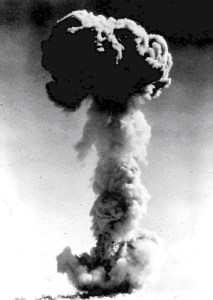
Communist China didn’t enter the Olympics until 1984 in Los Angeles, but they entered the nuclear race 20 years earlier in Olympic fashion.

The Tokyo Games began on October 10, 1964. Six days into the competition, on Friday, October 16, China exploded an atomic bomb. While the Chinese government released a statement promising never to be the first to use a nuclear weapon, this atomic test did not diminish the shock and fear that reverberated globally. On top of that, Japan being relatively close to mainland China, there were immediate concerns of radiation fall out in Japan.china's atomic bomb test

The ability for high performance athletes to focus is

From Melbourne in 1956 to Mexico City in 1968, Al Oerter was one of the most dominant performers in any sport, winning gold and breaking Olympic records in four successive Summer Games. In 1964, he had to overcome tremendous pain to win. As he was once quoted as saying, “I slipped one day in the wet weather, and I tore a fairly good portion of my rib cage. Given any other environment, I would have stopped. I don’t what it was. But I can remember saying ‘These are the Olympic Games and you’d die for them.’ I really felt that at that moment. I was there and I was going to do my best.”

Australian, Warwick Selvey also competed in the discus throw and shot put in Rome in 1960, as well as in the discus in Tokyo in 1964. Selvey told me that by studying a slow motion series of 20 or so frames of a single throw by Oerter, Selvey was able to reproduce his technique, with the help of his coach Alan Barlow in Melbourne.Warwick Selvey

“Al crouched close to the ground, lower than most men, so the drive through his legs was greater than others, creating a longer arm pull on the discus,” explained Selvey, who won 18 Australian Championships in athletic events. “When he did his turns in the discus ring, he transferred his weight from his left leg at the rear of the ring to the right leg in