zaha-hadid-japan-national-stadium-0

The sun rises every morning. And there are cost overruns at every Olympics.

Yes, people are shocked at the JPYY252 billion (USD2 billion) budget estimate declared upon presentation of the blueprint of the new National Stadium. This is a 55% increase over an earlier estimate.

But the truth is, national olympic committees know they need to provide lower overall cost estimates to win a bid, with the unspoken understanding that costs will be higher, often significantly. In the case of the new national stadium, dubbed somewhat unceremoniously as the “bicycle helmet”, the roof’s arches are of such a complicated design that its construction alone accounts for JPY76.5 billion (USD620 million) or 30% of the entire budget.

What’s even more interesting, according to this Japan Times article, is that the Japan Sports Council, an advisory panel within the Education Ministry is the owner of the stadium construction project, and not necessarily in synch with leaders of that Ministry.

Then again, politics as usual.

We don’t all let loose that mighty yalp in victory, jump on the pile, brother upon brother, bonding with a screaming universe that borders on the spiritual.

We sometimes go inwards, burrowing towards the source of the volcano, feeling the rumble grow. But we won’t show you. This moment isn’t for you.

When I read this passage below in “All Together“, by William Stowe, about his eight-man crew’s victory at theAll Together US trials for the chance to bring Olympic Gold back to America, I am reminded of the film “Miracle“, about the stunning 1980 victory of the men’s US ice hockey team over the USSR. In this scene, just after play-by-play announcer Al Michaels screams “Yes!”, the coach of the team, the legendary Herb Brooks, finds his way to the end of the bench, smiles at his wife, and then vanishes alone into the passageway under the stands.

He is alone. He is feeling the rumble grow. And he is happy.

Stowe had a similar experience, 16 years earlier. As he writes, his team has pulled off a mammoth, and somewhat unexpected victory to win the US trials.

We were all basking in our victory and had no reason to hurry in packing up the boat for its return to Philadelphia. I could only think about getting the USA uniform and being a part of the American team. Later when I got to my car in the parking lot, I looked around and saw that no one was watching. Only then did I let out the victory whoop, the one I had been holding back for hours, and dance a victory jig. I had no conception of what we would have to do and how hard we would have to train to best represent America in the Olympic games three months hence. I simply was savoring the moment.

Ulis Williams stumbles in the 4X400 relay finals_The Olympic Century - XVIII Olympiad - Volume 16
Ulis Williams stumbles handing off the baton to Henry Carr in the 4X400 relay finals_The Olympic Century – XVIII Olympiad – Volume 16

The baton hand off in relay races are critical. The slightest misplay and you lose. The US 4X100 relay team in Rome, which had the fastest time in the finals, was disqualified because of a mis-timed hand off between two runners.

So when you see a picture like the one above, you can imagine only disaster. American Ulis Williams was handing off to anchor Henry Carr in the finals of the 4X400 relay race in the 1964 Tokyo Olympics. As Ulis told me, he saw his closest competition fall in behind Williams to get the inside lane. That’s when Williams put on the jets around the curve approaching the exchange lane where the anchor awaited.

“I put on the speed and got five or six yards on him,” Williams explained to me. “Henry (Carr) took off, but he didn’t take off fast enough. He was too close on my approach, and I didn’t want to spike him. I took a chance and leaned forward to give him the baton, so I took a short step, didn’t plant my lead foot. I concentrated so much on handing him the baton that I slammed hard into the ground.”

It was a scary moment for lead runner, Ollan Cassell. “I dragged Ulis off because I didn’t want him to get a DQ for interference.” Williams said he tore the skin right off his upper thigh, but all he remembers is celebrating with his teammates at the finish line.

Carr successfully

From the book
From the book “XVIII Olympiad Tokyo 1964_Asahi Shimbun”

He came from nowhere. Japan was expecting gold in wrestling, judo and women’s volleyball, but not boxing.

Takao Sakurai (桜井 孝雄) won his first match in the bantamweight class against Brian Packer of Great Britain, but no one outside the Korakuen Ice Palace took notice. He won his second match with ease against Ghanian Cassis Aryee, but there was still no interest. But when Sakurai easily outpointed Romanian Nicolae Puiu, people finally began talking about the kid from Chiba.

Japan experienced glory in boxing for the first time in Rome, when Kiyoshi Tanabe won bronze in the middleweight class. But when Sakurai defeated Washington Rodriguez of Uruguay, Japan had a boxer in an Olympic finals for the first time.

His opponent in the finals was Chung Shin-Cho of South Korea. From the beginning, Sakurai peppered Chung with stinging right jabs and hammered with hard lefts throughout the contest. Chung went down three times before the referee stopped the fight at 1 minute 18 seconds of the second round.

Takao Sakurai on the podium
Takao Sakurai becomes the first Japanese to win gold in boxing, and remained the only one until Ryota Murata did so in London in 2012.

Sakurai was perceived as a very cool competitor, sometimes overly so. When a reporter suggested it was surprising that Sakurai wasn’t brimming with tears of happiness after winning the gold, he replied, “I haven’t had any water to drink, so no tears to cry”.

American lightweight gold medalist, Sam Mosberg, at the 1920 Antwerp Games was a spectator and was quoted as saying that Sakurai was the most outstanding boxer at the Tokyo Olympics. He was “very aggressive and willing to fight,” Mosberg was quoted as saying at the Hospitality Center of the Takashimaya Department Store. Why the 68-year old Olympian was interviewed at a department store, I have no idea. But finally, everybody knew who Takao Sakurai was.

Watch this video on Sakurai. It’s in Japanese, but

From NBC.Sports.com
From NBC.Sports.com

And here it is – the torch for the Rio Olympics!

Click on this link to see what it looks like.

The Rio torch beats the hatchet from Sochi, the Jai Lai sesta from Turin, and whatever the Vancouver torch is trying to represent.

See details about McIlroy’s ruptured anterior talofibular ligament – have no idea what that is, but it’s somewhere near the ankle.

In this image released Monday July 6, 2015 by world number one golfer Rory Mcilroy shows him as he poses on crutches and with his left leg in a medical support. McIlroy  ruptured a ligament in his left ankle while playing soccer less than two weeks before the start of his British Open title defense. The Northern Irish golfer gave no indication how long he would be out in the announcement Monday July 6, 2015 on his Instagram account, only saying that he is
In this image released Monday July 6, 2015 by world number one golfer Rory Mcilroy shows him as he poses on crutches and with his left leg in a medical support. McIlroy ruptured a ligament in his left ankle while playing soccer less than two weeks before the start of his British Open title defense. The Northern Irish golfer gave no indication how long he would be out in the announcement Monday July 6, 2015 on his Instagram account, only saying that he is “working hard to get back as soon as I can.” (Rory McIlroy via AP) MANDATORY CREDIT
From the book, “Tokyo Olympics Special Issue_Kokusai Johosha”. Gaston Roelants is splashing to the lead.

I love etymology – the origins of words. Some people say that the classic American phrase – hunky dory – originated in Japan, although there are multiple explanations for this expression.

The etymology of the athletic discipline, the steeplechase, apparently has a clearer history – a traditional race in Ireland where horses or runners raced from church to church, jumping over narrow streams and low stone walls.

In 1964, the Belgian, Gaston Roelants, was the best steeplechaser in the world. The European Champion, Roelants came to Tokyo as the favorite, and he didn’t disappoint. He won the finals of the 3,000-meter race over hurdles and puddles in 8 minutes and 30.8 seconds, an Olympic record at the time.

There is relatively little video on the 1964 summer games on the internet, but thankfully you find nuggets, like this amateur film of Roelants running in the Tokyo Olympics. Roelants is at the head of the pack.

If you are a runner

street rugby

When the new National Stadium opens for business, the first event won’t be the Olympics. Instead, the 2019 Rugby World Cup will christen the new stadium.

And in 2016, at Rio, rugby will return to the Olympics after a 92-year absence. To promote rugby in Japan, the Nihonbashi Neighborhood Association and Chuo Rugby Football Union held its inaugural Nihonbashi Street Rugby event on Sunday, July 5, in the heart of Ginza. Also partnering were the Australian and New Zealand Chamber of Commerce in Japan.

It was cool and damp, but spirits were high in this very high-paced and energetic version of rugby. Take a look at this video!

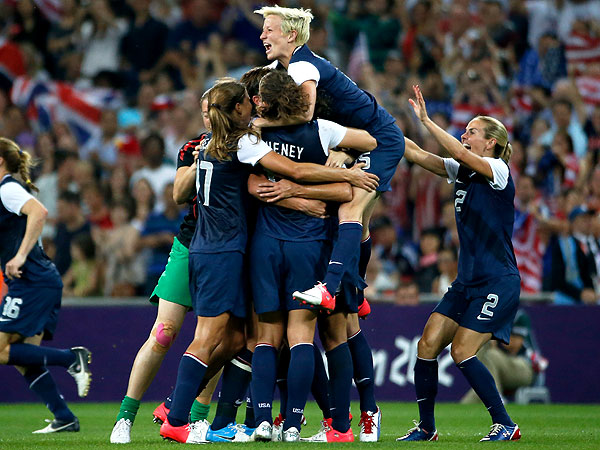
http://img2-1.timeinc.net/people/i/2012/news/120820/olympics-soccer-1-600.jpg http://mychannel957.com/u-s-womens-soccer-team-loses-world-cup-final-to-japan/
http://img2-1.timeinc.net/people/i/2012/news/120820/olympics-soccer-1-600.jpg
http://mychannel957.com/u-s-womens-soccer-team-loses-world-cup-final-to-japan/

America and Japan haven’t had such a rivalry since the trade wars of the 1980s and 1990s.

When the Women’s World Cup Finals start on Monday morning from 8am JST, more than a few Japanese will be calling in sick, joining colleagues at a sports bar, or making furtive glances at their phones as they begin their work day.

Japan and the US are facing off in a women’s soccer championship for the third time in a row. Four years ago, Japan won in the World Cup. Three years ago, the US won in the London Olympics. Who will win tomorrow?

Here’s the breakdown of this burgeoning rivalry from the New York Times.