It’s an oft-told tale of Black Americans triumphing overseas – soldiers, athletes and musicians – only to come back home to a world of discrimination and second-class citizenship.
In the Rome Olympics in 1960, Rudolph won gold in the women’s 100 and 200-meter races, as well as the 4×100 relay, and arguably became the most popular athlete in the world due to her beauty and charm. (That’s saying a lot since Cassius Clay was also on the scene.)
Nearly a month after the end of the Rome Olympics, it was announced by officials of her hometown, Clarksville, Tennessee, that October 4 would be “Wilma Rudolph Day”, and that according to ESPN, Tennessee Governor Buford Ellington, was going to lead the celebration. Tennessee at the time was a segregated state, a place where authorities or owners could require the separation of races in the activities of daily life, like drinking from a water fountain, riding a bus, or eating at a restaurant. And Governor Ellington was a man elected on his support of continued racial segregation.
Rudolph understood the leverage she had at that moment, and said she would accept only if all activities related to Wilma Rudolph Day were racially integrated. It was an offer that no matter where you stood on the political and racial divide, you could not refuse. Rudolph was not to be denied, and so that day was the first time in Tennessee that blacks and whites would be allowed to mix socially.
I found this letter to the editor in the Milwaukee Journal from October 22, 1960, where one Virginia Williams of Wisconsin wrote in praise of Rudolph as the finest of role models for black Americans.
JFK and Wilma in the Oval Office
Wilma Rudolph, the Negro girl from Clarksville, Tenn., who won three gold medals at the Olympics for her running, also won praise for her good looks and charming ways. This unassuming Negro girl, coming from a large family of average income, brought honor to her race and her country. She brought credit to her country as an ambassador of good will.
County Judge William Hudson spoke in Clarksville at an integrated banquet give for Wilma. With tears in his eyes he said: “If I can overcome my emotions, I’ll make you a speech. Wilma has competed with the world and brought home three medals. If you want to get good music out of a piano, you have to play both white and black keys.”
And in order for America to maintain her leadership in the world, she has to tap all of her resources, utilize all of them. Negroes need America and America needs them.
As one can imagine, race relations in America has improved, but it has been a bumpy road. A few years later, Sports Illustrated caught up with Rudolph on the eve of the 1964 Tokyo Olympics and see how domestic life was treating her. While she was busy being a mom, she was also out on the occasional protest.
It was different in May of 1963, when Wilma took part in two demonstrations at Shoney’s, which is considered one of Clarkesville’s finest restaurants although it does not have much more to offer than hamburgers. She was turned away, together with the other Negroes. “I cannot believe it!: she said to a reporter. “Remember the reception they gave me in 1960?” A few months later Clarksville was integrated. (Sports Illustrated, September 7, 1964)
Left-right: Wilma Rudolph, Lucinda Williams, Barbara Jones and Martha Hudson at the Rome Olympics
She was by then the Queen of Rome at the 1960 Summer Olympics. American sprinter, Wilma Rudolph, had already won gold in the women’s 100- and 200-meter sprints. But her teammates from the famed Tennessee State Tigerbelles had been left out of the medal count. The 4×100 was their chance to join Rudolph in Olympic glory. And Rudolph, as described in David Maraniss’ fantastic book, Rome 1960: The Olympics That Changed the World, promised to help them get the gold on one condition:
In the warm-up room before the race, the Tigerbelles huddled and prayed together. “Just get me that stick,” Rudolph, who would run the anchor leg, said at the end. “Just get me that stick, and we’re going to get on that stand. We’re going to win that gold medal!” her teammates could barely contain themselves; no jealousy now, just fire burning inside.
Maraniss went on to tell the story how her teammate, Lucinda Williams, in the third leg was going so fast heading into the exchange with the anchor, Rudolph, that they needed two attempts to get Rudolph the baton, at one point Rudolph needing to stop to grab it. In the fumbled exchange, Maraniss wrote that the team lost about a meter to the competition in that moment. But like a locomotive, Rudolph reached the leaders at about 60 meters, and then blew past them to win gold for the team.
Not only did the Tigerbelles share a momentous team victory, Rudolph’s star in Rome and the world went super nova, the first ever American to win three track gold medals in a single Games. When President Kennedy heard that Rudolph was in Washington DC a few months after her return from Rome, he invited Rudolph to the White House and spent so much time talking with her in the Oval Office that he kept his next appointment cooling his heels for thirty minutes.
But as a child, Rudolph, was not the radiant and confident person she was to become. She was born prematurely in 1940, and due to polio, had to deal with a left leg and foot that twisted unnaturally and made it difficult for her to walk. Doctors had her wear braces and special shoes, and she had to be carried from room to room by family members. As one could imagine, to be seen as so different from your family and friends must be so terribly hard on a child. Maraniss wrote:
As Wilma later described her early childhood, she was depressed and lonely at first, especially when she had to watch her brothers and sisters run off to school while she stayed home, burdened with the dead weight of the heavy braces. She felt rejected, she said, and would close her eyes “and just drift into a sinking feeling, going down, down, down.” Soon her loneliness turned to anger. She hated the fact that her peers always teased her. She didn’t like any of her supposed friends. She wondered whether living just meant being sick all the time, and told herself it had to be more than that, and she started fighting back, determined to beat the illness.
Maraniss went on to describe how Rudolph’s condition gradually improved to the point that she was able to secretly remove her braces so she could run around outside with her siblings. And then her parents did something wonderful, presenting Rudolph with a gift so ordinary and yet so life affirming that it transformed the shy, despondent girl into one filled with promise, bursting with energy.
Then one day her father, who did the shopping in the family, came home with regular shoes for Wilma, marking a dramatic change in her life. As Yvonne remembered the scene: “They were no longer the high-top shoes that she had to have with the braces. And my mother took her in to a room all by herself; she didn’t even let us know she had these shoes. And they put them on her, and she came out of the room, and she was beaming all over. It was like she was a whole new little girl. And after that it was like she knew she was not different, and it gave her more confidence at that point.”
After that, you couldn’t stop Rudolph from running. A blur on the basketball courts, she picked up the nickname “Skeeter” because she flitted about so quickly like a mosquito. Her head coach at Tennessee State, Ed Temple, marveled at this determined young woman, but also wasn’t sure if she had everything needed to be a champion. Just prior to the 100-meter finals, Temple hid in the tunnels of the Stadio Olimpico, barely able to see Skeeter in lane 3. Rudolph, a notorious slow starter, fell behind. But he also knew that Rudolph, like today’s sprinting God, Usain Bolt, finished like a locomotive.
According to Maraniss, Temple had to be told that Rudolph had won easily in a blazing 11 second, what would have been a world record if not for the wind. His reaction? “You’re joking.” I’m sure it was a remark born out of ambivalence, that moment when one thinks one has a champion, but is not really sure, until proof is presented on a shining platter. That moment, when Rudolph crossed the tape to become the fastest women in the world, marked that rite of passage for champions, when all doubt is erased, expectations and achievements merge, and all is right in the world.
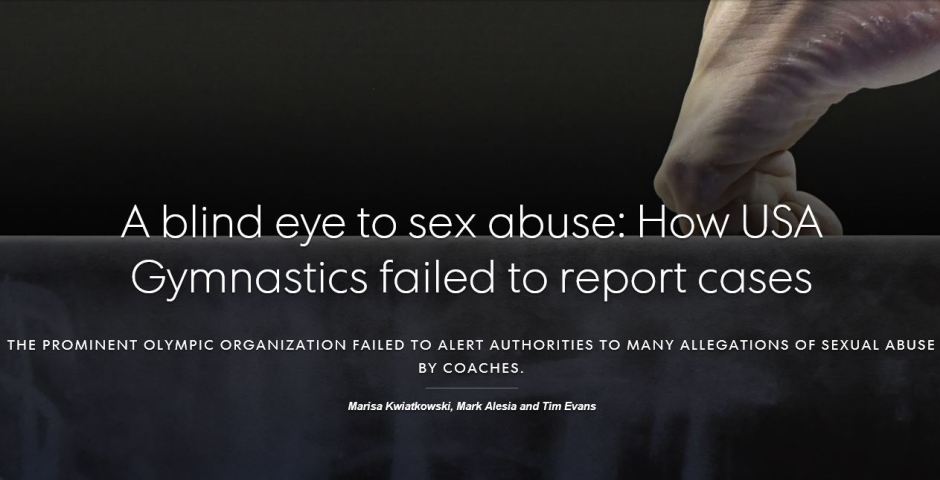
Thanks to The Indianapolis Star, we now know that leaders in USA Gymnastics, the governing body for gymnastics in America, were aware of coaches who sexually abused female gymnasts over the past two decades at least, many of whom were under-aged. We also know that USA Gymnastics did little to prevent further abuse unless a parent or the police pushed them to act.
According to The Indianapolis Star, USA Gymnastics have detailed and sometimes voluminous documentation on coaches accused of sexual abuse, but those documents have not yet been disclosed by USA Gymnastics. We know about these cases today primarily because the journalists of the Indy Star went through police and court records, uncovering details of the cases. They also learned about a so-called policy that provided the rationale for USA Gymnastics officials not to take any action despite knowledge of the abuse.
Current USA Gymnastics president, Steve Penny, in a court deposition said “to the best of my knowledge, there’s no duty to report if you are…if you are a third party to some allegation.” Penny’s predecessor, Robert Colarossi, stated that a reason not to report abuse to the police was “concern about potential damage to a coach’s reputation if an allegation proved false,” and that he “inherited an executive policy of dismissing complaints as ‘hearsay’ unless they were signed by a victim or victim’s parent – a policy that experts said could deter people from reporting abuse. It’s not clear exactly when that policy was created or by whom.”
The Leadership Council on Child Abuse & Interpersonal Violence is a nonprofit organization that focuses on scientifically research-based explanations for mental health issues. In one of their articles, entitled “Eight Common Myths About Child Sexual Abuse“, the Leadership Council gives insight into why many of us allow sexual abuse to continue.
Few people are aware of the true state of the science on child abuse. Instead, most people’s beliefs have been shaped by common misconceptions and popular myths about this hidden crime. Societal acceptance of these myths assists sex offenders by silencing victims and encouraging public denial about the true nature of sexual assaults against children. The Leadership Council prepared this analysis because we believe that society as a whole benefits when the public has access to accurate information regarding child abuse and other forms of interpersonal violence.
Here is the list of myths:
Myth 1: Normal-appearing, well educated, middle-class people don’t molest children.
Myth 2: People are too quick to believe an abuser is guilty, even if there is no supporting evidence.
Myth 3: Child molesters molest indiscriminately.
Myth 4: Children who are being abused would immediately tell their parents.
Myth 5: Children who are being abused will show physical evidence of abuse.
Myth 6: Hundreds of innocent men and women have been falsely accused and sent to prison for molesting children.
Myth 7: If asked about abuse, children tend to exaggerate and are prone to making false accusations.
Myth 8: By using repeated interviews, therapists or police can easily implant false memories and cause false accusations among children of any age.
I could only presume, but if we consider the leaders of USA Gymnastics to be of normal mental health, then they too accept many of the myths above as fact. In many cases, I’m sure they took the word of the coach’s over the children.
“Where’s the proof?”
“These are normal-appearing, well-educated men. Can’t be true.”
“If a child was really being abused, she would definitely have told her parents.”
“And what would happen if we falsely accused a coach? Oh, the shame.”
We were shocked to learn in 2002 of the cases of sexual abuse of children by Catholic priests, and that Church leaders dealt with the situation by rotating abusers to new parishes without explanation.
Many were outraged in 2011 by the fact that the president, the athletic director as well the football head coach at Penn State University were aware of allegations that the football team’s assistant head coach was molesting children, and did nothing.
And in 2016, we are again aghast about news that USA Gymnastics simply kept quiet despite case after case of sexual abuse allegations against coaches in its organization.
It is inconceivable to most parents that their child would be abused by people they know, and in whose care they entrust their child’s well-being. And yet, in the afterglow of the Rio Olympics, when the Final Five, the young American female gymnasts, dominated in the women’s gymnastics competition to easily take glory and gold in the team competition, we find USA Gymnastics in retreat.
According to The Indianapolis Star, officials of USA Gymnastics were aware of sexual abuse of female gymnasts, including pre-teens, for years, often doing nothing or acting only if asked.
USA Gymnastics were given a detailed complaint in 2011 about 2010 national Women’s Coach of the Year, Marvin Sharp, but only reported him to the police after a second allegation of abuse of a 12 year old, four years later.
USA Gymnastics apparently has a large dossier of complaints against a coach named Mark Shiefelbein, but the parents of a 10 year old abused by Shiefelbein, who went to the police, was surprised to learn that USA Gymnastics knew he was a serial sexual abuser and did nothing.
USA Gymnastics knew about a coach named James Bell and his cases of sexual abuse at least 5 years before being arrested for molesting three gymnasts in 2003.
USA Gymnastics was told by a gym owner in 1998 that a coach named William McCabe “should be locked in a cage before someone is raped”. Despite knowing of at least four complaints against McCabe, USA Gymnastics allowed him to coach for seven more years.
Kaylin Maddox Brietzke was a gymnast under the guidance of James Bell, and many years later in this interview, eloquently expresses the emotion of that vulnerability of her childhood and that betrayal by adults and authority she naturally trusted.
Any corporation that puts their reputation above safety, honestly is not something I want to be a part of at all. And I was a part of USA Gymnastics for a very long time. It doesn’t matter who you are protecting. It doesn’t matter that they are a part of your organization and you want to save face. How about saving me.
With the ouster of the owner of the Los Angeles Clippers, Donald Sterling, two years ago, and the more visible acts of support for causes like Black Lives Matter, the NBA appears to have more of an activist bent than most North American sports leagues. Thus, the reaction by NBA players and coaches to the election of Donald Trump for the presidency of the United States has been more predictable.
Gregg Popovich, one of the most successful coaches in NBA history, had this to say: “Right now I’m just trying to formulate thoughts. It’s too early. I’m just sick to my stomach. Not basically because the Republicans won or anything, but the disgusting tenure and tone and all of the comments that have been xenophobic, homophobic, racist, misogynistic.”
… all of a sudden you’re faced with the reality that the man who’s gonna lead you has routinely used racist, misogynist, insulting words. That’s a tough one. That’s a tough one. I wish him well. I hope he’s a good president. I have no idea what kind of president he’ll be because he hasn’t said anything about what he’s going to do. We don’t know. But it’s tough when you want there to be some respect and dignity, and there hasn’t been any. And then you walk into a room with your daughter and your wife who have basically been insulted by his comments and they’re distraught. Then you walk in and see the faces of your players, most of them who have been insulted directly as minorities, it’s very shocking. It really is.
Coach Kerr openly stated the million dollar question in team sports – how does a coach coach a team of whites, blacks and hispanics who are united by team purpose, but possibly divided by national purpose?
The NFL has a similar ratio of black players to the NBA. But the press has reported more comments from coaches in support of President-Elect Trump, compared to the NFL. Certainly, the most famous case is the coach of the New England Patriots, Bill Belichick, who tends to be tightlipped about anything he believes not relevant to his football team, and play on the field. And yet, Trump quoted a letter from Belichick to Trump on the eve of the presidential election, clearly seeing an opportunity to get more votes in the New England states.
My guess is Belichick would have preferred to keep the contents of his letter quiet, but when confronted, he did explain his relationship with Trump at a news conference. “Our friendship goes back many years. Anybody who spends more than five minutes with me knows I’m not a political person. My comments are not politically motivated. I have a friendship with Donald.”
The New England Patriots’ organization is famous for the strict control it imposes on its players in regards to talking with the press, and very little has been heard from the players, except for their star quarterback, Tom Brady, who is also known as a long-time personal friend of Donald Trump.
In terms of football, the words of Belichick and Brady are the most important on the team. But when your coach, your star quarterback and even the owner of the team are friends of Trump, what impact will this have on the team fabric, likely made up of a number of players who view Trump as a racist?
Rex Ryan and Donald Trump
The Buffalo Bills are not the New England Patriots. The Bill’s head coach, Rex Ryan, has openly supported Trump, even giving speeches for Trump at rallies in Buffalo.
“There’s so many things I admire about Mr. Trump, but one thing I really admire about him is—you know what—he’ll say what’s on his mind,” Ryan said in this Bleacher Report article. “And so many times, you’ll see people—a lot of people—want to say the same thing. But there’s a big difference: They don’t have the courage to say it. They all think it, but they don’t have the courage to say it. And Donald Trump certainly has the courage to say it.”
When Ryan was the coach of the New York Jets, my hometown team, it was clear that Ryan was seen as a player’s coach, the kind of guy you would run through the wall for. But supporting Trump may have an impact on team dynamics. In that same Bleacher Report article, a couple of Bills’ players were quoted anonymously that their coach’s comments did not sit well with them.
“Rex is such an open-minded guy, a really good person,” said the player, who asked not to be identified, fearing repercussions from the Bills. “But the fact he could back someone as closed-minded as Trump genuinely shocked me.” The player, who is black, emphasized that teammates’ frustration with their coach’s public endorsement was not universal. But in private discussions, he said, “Some of the African-American players on the team weren’t happy about Rex doing that.”
Indeed, said another black player on the Bills who requested anonymity to speak freely about tensions swirling with a combination of protests led by Colin Kaepernick and a combustible candidate: “I see Trump as someone who is hostile to people of color, and the fact that Rex supports him made me look at him completely differently, and not in a positive way.”
What’s interesting, although predictable perhaps, was the reaction of a particular player on the team, Richie Incognito. “I think that he can help this nation get back to a world superpower,” Incognito told B/R’s Tyler Dunne. “Where I think he could help is putting us first again and having that—it’s my mentality, too—having that tough attitude where you put America first and everyone’s thinking we’re the greatest nation in the world. Don’t mess with America. That toughness is where I identify with him.”
Incognito, a Caucasian, was suspended from his former team, the Miami Dolphins, after being identified as one of three harassers of a black teammate, Jonathan Martin, who asked to leave the team. It appears that Incognito’s bullying of Martin was incessant and racist, and included members of Martin’s family.
In the end, those who oppose Trump have had to come to grips with reality.
Doc Rivers, the head coach of the Los Angeles Clippers, said in this article that we need to accept and then take action, not just complain.
Listen, Donald Trump is going to be fine, all right, as president. That’s something I never thought I’d have to say, honestly. But at the end of the day he will be because I just believe America overall works. There’s a Congress and a Senate and it’s gonna work out. But if you don’t like it, you have two years from now to change it. Not (to change the) president, but you can change the Congress and you can change the Senate. So if you don’t like it, change it. And you change it by either running for office or voting… Don’t get mad — go do something.
Twenty-six sports were recommended as new additions to the 2020 Tokyo Olympics. As many of you now know, Tokyo2020 and the IOC selected five new competitions: baseball/softball, karate, skateboarding, sports climbing and surfing.
But there were others recommended that I was either surprised about or unfamiliar with. I’ve created a list below of all the “sports” that were considered officially by Tokyo2020 for the next Summer Games. I took the liberty to make sense of them by organizing them into four categories, which you could most certainly dispute.
The Olympics are, in a way, an endorsement of the international relevance of an organized sport or gaming activity. This year, there was a conscious emphasis to increase the youth following, so skateboarding (roller sports), sports climbing and surfing were added.
Baseball and softball were actually Olympic competitions from 1992 to 2008, so it probably was not a difficult decision with the Olympics returning to Asia, where baseball is very popular. However, tug of war, which was an Olympic competition from 1900 to 1920, did not make the cut.
I was faintly familiar with Netball, which is popular in Singapore where I lived a couple of years. It is a derivative of basketball, played mainly by women. But I was not familiar with Korfball, which originated in the Netherlands and is similar to basketball, but certainly not the same. First, the teams are composed of both 4 men and 4 women. Second, you can score from all angles around the basket. Third, there is no dribbling, and fourth, you can’t shoot the ball if someone is defending you. Watch this primer for details.
Orienteering is new to me, but then again, I was never in the Boy Scouts. Orienteering is a category of events that require the use of navigational skills, primarily with the use of a map and compass. Most are on foot, but some are under water, or in cars or boats. Think The Amazing Race, without all the cameras. The video gives you an idea of what this activity is like.
DanceSport is essentially competitive ballroom dancing, which is popular in Japan. The 2004 movie “Shall We Dance” with Richard Gere and Jeffifer Lopex is a re-make of the 1996 Japanese film of the same name. A film that you may know that focuses on the competitive side of dance (with a smattering of American football) is “Silver Linings Playbook” with Jennifer Lawrence, Bradley Cooper and Robert DeNiro.
And then there’s Bridge and Chess, what most people refer to as games as opposed to sports. I used to play chess a lot, since I grew up in the days of Bobby Fischer and Boris Spassky. And while I won second place in a chess tournament when I was 13, I would never experience the mentally and physically draining levels of tension that world-class chess masters go through. Still, is it a sport?
Does it matter?
The second-place chess trophy I won at a competition at the Manhattan Chess Club when I was 13 years old. (If you must know, there were only three competitors.)
Trump carries the torch in New York prior to the 2004 Olympics in Athens Bryan Bedder/Getty
Donald Trump will be the president of the United States from the beginning of 2017. The impact of this surprising and historic election will be particularly clear and significant regarding the role of government, US tax policies and decisions by the Supreme Court. Way down on the list is Trump’s impact on sport.
But this is a sports blog, so here we go.
One of the leading candidates for the 2024 Summer Olympic Games is Los Angeles. The support of US presidents has always been important to the selection committee. But rarely has the character of the president been an issue. The International Olympic Committee (IOC), the body that governs the Olympic Games and is the decision maker for which cities host the Games, is built on the values of diversity and inclusiveness. What president-elect Trump has said during the campaign could come back to haunt the US bid.
“An America that turns inward, like any country that turns inward, isn’t good for world peace, isn’t good for progress, isn’t good for all of us.” Bach also spoke in the summer about a “world of selfishness where certain people claim to be superior to others”. That was seen as a clear reference to Trump’s proposed plans that include potential restrictions on Muslim immigration and the deportation of millions of illegal immigrants.
The mayor of Los Angeles, Eric Garcetti, who is a Democrat and supporter of Hillary Clinton, Trump’s rival for the presidency, said in August in this Bloomberg article, “For some of the IOC members, they would say, ‘Wait a second, can we go to a country like that, where we’ve heard things that we take offense to?”’
But another IOC member and head of the World Anti-Doping Agency, Craig Reedie, put it this way. “It’s far too early to make any judgment. I would find it hard to believe everything said in a hotly contested election would come to pass. Let’s wait and see.”
There may be more practical issues the IOC may have to take into account, like who will pay for the significant security bill, according to the blog, Inside the Rings. “While Los Angeles doesn’t need the help of the White House to fund construction or other critical projects, the federal government still will need to spend as much as a $1 billion or more for security for the Games. Soon after Trump takes office in January, LA 2024 will need assurances from the new president that he is willing to make that commitment. Given the sharp political differences between Trump and the LA leadership, this is not a certainty.”
Is the American bid for 2024 in trouble? Will Paris or Budapest trump LA? Donald Trump gets inaugurated in January. The IOC votes on the selection of the 2024 Games in September. We shall see.
Mary Rand, from the book, XVIII Olympiad Tokyo 1964 Asahi Shimbun
“I went to Rome in 1960,” Mary Rand explained in this video interview. “I was favored to win the long jump there. Did one of the best qualifying jumps but in the finals I ran through the pit and everything went wrong. And so when we came back to England, the headlines were ‘Flop Flop Flop’. I kinda thought I’m going to pack it in.”
In 1960, Mary Rand was expected to win the gold medal in the women’s long jump, but the 20-year-old cracked under pressure in Rome, and came home to unwanted and unwarranted attention from the press. Here’s how The Times described the press reaction in 1960. “British athletes, you should be ashamed of yourselves,” wrote one newspaper over photographs of those deemed to have failed. Bignal (Rand’s maiden name) was the star failure.”
Rand thought she was done with athletics. After all, she was married with a small daughter. But the call of competition was strong, and Rand found herself preparing the Tokyo Games. When she qualified for the British Olympic Squad, and landed in Tokyo, she was four years older and wiser. And yet, the demons of past failure were still in her head.
In this wonderful profile Rand in the Sunday Times as a run-up to the 2000 Sydney Games, the writer describes a joyful Rand the night before her long jump competition, singing a lullaby she would sing to the daughter she left in London, refusing to allow her roommates to sleep.
“Mary, for crying out loud,” says Mary Peters from the next bed. Her roommates cannot be angry. She sings so beautifully and even now, so late at night, her effervescence bubbles. “I’ll teach you,” she says, “come on, ‘I ullowoost to halowav an alawold banjalawo’, try it.” And so in this small room at the 1964 Olympic Games, four British athletes serenade themselves to sleep.
Sleep? Singing brings them to life. “Mary, I’m going to bang a nail into the wall,” says [Ann] Packer, “and from it I’ll hang the medal you’re going to win. It’ll inspire us to get the other ones.” It’s just a bit of fun but Mary Rand shivers at the mention of winning.
But according to the writer, Rand does not want to sleep, for silence forces her to hear the voices of doubt in her head:
What are you going to do tomorrow Mary, flop like you did in Rome four years ago?”
Outside, Mary hears the rain fall, so loud it could be hailstones: “What will that do to the cinder track, Mary?” She hates not being able to control the voices.
Alone in the darkness, Mary talks to God. “Please,” she pleads, “let me do well tomorrow.
Mary Rand, from the book XVIII Olympiad Tokyo 1964 Asahi Shimbun
But as it turns out, the 24-year-old version of Rand was made of stronger stuff. In the video interview, Rand reflected on her attitude as she readied herself for the women’s long jump competition, and her refusal to allow her competitors to psych her out during the practice period.
The hardest thing in long jumping in the Olympics is everybody is trying to get their run-ups. The Russians. The Poles. They’re all pushing and shoving, you know? So you have to be pretty tough. I got a couple of jumps in. It was really cold and windy. It was a little nervewracking because in the back of your mind ‘Oh my gosh, this happened four years ago.’ And I know the press were thinking, ‘Is she going to fall apart again.’ And everything went right.
Rand did not run through her mark. She did not foul. She did not crash and burn. In fact, Rand dominated from start to finish in the six rounds of the finals. In the first round, she broke the Olympic record with a leap of 6.59 meters, 35 centimeters further than Diana Yorgova of Bulgaria. In the fifth round, she broke the spirit of all competitors with a world record jump of 6.76 meters.
Like many British and American athletes who were not used to the metric system, she had no idea what that meant in feet and inches. The world record at that time was 21 ft 11.75 in so she had to dig into her bag for the meter to fee conversion table to learn that she became the first woman ever to exceed 22 feet – 22 feet 2 1/4 inches to be exact.
After the completion of the 1964 Tokyo Olympics, Queen Elizabeth had lunch with hundreds of Olympians from TeamGB a few days after their return from Japan, and was most taken with Mary Rand, the sensational triple medalist. Rand won gold in the women’s long jump, silver in the pentathlon and bronze as a member of the women’s 4X100 relay team, leading a resurgence in British track and field.
The Queen is reported to have measured out 22 feet, 2 inches (6.76 meters), the length of Rand’s world record jump that resulted in Great Britain’s first gold of the Tokyo Olympics. According to an October 28, 1964 AP article, the Queen told her son, Prince Andrew, that was the length Rand jumped to win the gold. “‘He just couldn’t believe that anyone could jump that far,’ the queen laughingly told Mrs. Rand at a buffet lunch at the palace Tuesday.”
Mary Rand with daughter
Not that I am expert on the British Royal Family, but clearly the Queen was taken with Rand. To be fair, many were. She was not only an Olympic champion, she was also perceived as wholesome (with a dash of sensuality). In 1964, she was married and had a daughter and had a reputation for being “nice”, which back then was more positive in nuance. But she also drew the attention of famous rock and rollers. “Apparently Mick Jagger said he’d like to date me,” she says (in this Mirror article). “I wish he’d asked! But then again I was married to my first husband at the time and the mother of a young daughter.”
An Italian journalist gave a melting look at the long legs and swinging hips as Mary walked across the grass, then surveyed again the world-record long jump on the indicator board and reluctantly handed me back my binoculars, misty by now. He shook his head in amazement and pronounced the accolade, “All that and a mother too!’
If it was the sheer femininity that struck first, next must come the almost effortless superiority of Mary Rand. Under the pressure of modern sport no British man or woman has ever won an Olympic victory with such authority. Here at last was our Elliott, our Zatopek, our Wilma Rudolph. Our goddess of the arena.
Mary Rand in Kimono with Ann Packer
The somewhat sexist comments of the era aside, Mary Rand had a rare combination of grace, power and independence that made her arguably one of the most popular women in Tokyo. Her willingness to speak her mind and not to follow the norm may have also intrigued people.
When she was 17 years old, she developed a relationship with young man from Thailand living in England, nearly marrying much to the chagrin of those around her. The “scandal” of this relationship resulted in her being expelled from school.
When she was preparing for the Tokyo Olympics, she worked at the postal office in a Guinness factory in London, which fortunately gave her the opportunity to both earn wages and train for the Olympics. And one time, her involuntary need to tell jokes got her in a little trouble: She said in the Mirror article: “One of the benefits I got there was a free Guinness in the work’s canteen at lunchtime. I jokingly told a reporter I had a half pint every day as part of my training routine. The next thing I knew there were headlines about my drinking and I got a long lecture from my coach about putting on weight.”
But Allen wrote in his book that people found Rand’s openness charming:
There are few athletes easier to interview for she is completely honest. And her great sense of fun never allows her to have a moment’s conceit about all her ability in so many events. In her greatest moment of all, in the Olympic interview room, she still had time to grin at the incredulous look on the continental journalist’s face when she said she’d ‘had a rub from Johnny’ just before the long jump. Johnny Johnson is, of course, the dedicated masseur to the British athletics team. To Mary, as always ‘life is a bit of a giggle.’
“She would have to make a downward traverse of this ridge for about 14 or 15 meters — knowing that one mistake would send her plunging 5,000 meters on the northern, Chinese side or down to around 6,400 meters on the Nepalese side, where she could just see her Japanese Women’s Everest Expedition’s Camp II.”
That was the situation on May 16, 1975 that confronted Junko Tabei as she attempted to become the first woman to conquer Mount Everest, according to the Japan Times. Upset that there had been no mention of this treacherous path as she prepared for this ascent, she gritted her teeth, and with her Sherpa guide, made her way on a ridge with the narrowest margins for error.
Since Edmund Hillary became the first to reach the summit of Mount Everest in 1953, Tabei would become the 36th person. She would also become the first woman to climb the so-called Seven Summits: Kilimanjaro in Tanzania, Aconcagua in Argentina, McKinley (Denali) in Alaska, Elbrus in Russia, Vinson Massif in Antarctica, and Carstensz Pyramid in Indonesia.
There’s really no comparison between the Olympic-sponsored sports climbing events and the death-defying challenge of the Tabei’s of the world. But her spirit to ascend will always be an inspiration, at the climbing walls of the Tokyo Games and beyond.


#/media/File:Wilma_Rudolph,_Lucinda_Williams,_Barbara_Jones,_Martha_Hudson_1960.jpg)




You must be logged in to post a comment.