marny_jolly_with_sukarno_1_asian_games_1962_2
Mariana Jolly meets President Sukarno at the Asian Games in 1962, from the collection of Mariana Jolly

She was a 14-year old, and yet an artifact of colonial Asia – the daughter of British parents representing Singapore in The Asian Games. When Mariana Jolly was asked to join the national swimming team to represent Singapore at the Asian Games, she had no idea that she would catch the attention of the most powerful man in Indonesia.

“It was the Asian Games, but I was the only European there,” Jolly told me. “Sukarno organized a lot of these social events for the athletes, there were quite a few. And the first time, he took one look at me and came to me. He asked me if I was Dutch. I said ‘no’, and he smiled. I danced with him at a barbecue, and I sang to him in Malay at another party.”

Little did Jolly know that the Asian Games they joined ignited the heated feud between Indonesia and the IOC, resulting in the last-second decision by Indonesia and North Korea to boycott the 1964 Olympics in Tokyo.

marny_jolly_with_sukarno_2_asian_games_1962_2
Dancing with Sukarno, from the collection of Mariana Jolly

Post-war, post-colonial Asia was a mess, a political vacuum, a time of economic experimentation that led to social upheaval. In the midst of those turbulent times, Malaysia emerged as a new nation in 1963, bringing together the British colonies of Malaya, Singapore, North Borneo and Sarawak.

Indonesia in the early 1960s was an emerging political power in Asia, led by that country’s first president, Sukarno. Leading the fight against the colonial rulers from the Netherlands, Sukarno was imprisoned by the Dutch rulers, freed by invading Japanese forces in 1942, and then appointed President of Indonesia when Japan surrendered to the United States and the allies at the end of World War II.

After decades of fighting Dutch colonial rule, Sukarno was anti-imperialist, and by extension, anti-West. While he did secure billions of dollars in aid from the United States and the Kennedy administration, Sukarno cultivated strong ties with the People’s Republic of China (PRC) and the Soviet Union.

And to reflect Indonesia’s growing power and influence, Sukarno won the rights to hold the Asian Games in Jakarta in 1962. The Asian Games is held every four years like the Olympics, and brings together the best athletes of Asia. In 1962, the participating countries included the PRC, which was boycotting the Olympic Games, as well as nations in the Middle East. Sukarno decided to make a statement – he would not invite athletes from Israel, which was the enemy of so many of Indonesia’s allies in the non-aligned world, nor athletes from Taiwan, which the PRC did not recognize.

The International Olympic Committee (IOC), led by then president, Avery Brundage, took umbrage, reiterating the importance to separate politics from sports, and indefinitely

Jeanne & Ken Tokyo 1
Ken and Jeanne in Tokyo, from the collection of Jeanne Collier

He was a 19-year-old university student from Illinois. She was an 18-year-old high school student from Arizona. They would go on to be diving’s power couple in Tokyo as Ken Sitzberger won gold in the men’s 3-meter springboard diving competition, and Jeanne Collier took silver in the women’s 3-meter springboard competition.

Collier told me that there was some resistance by the coaches to their dating during final preparations for the XVIII Olympiad in Tokyo, but she said there was never really anything to worry about regarding their readiness.

We met in 1962 at a Nationals. He was from Chicago and I was from Phoenix. We had a letter writing campaign. He went to Indiana. I was still in high school. We got to know each other. So as we prepared for Tokyo, he and I hung out together. The coaches didn’t like that. But it was harmless. At that time, we would have time off, talk at meals, but the focus had to be on training.

Ken & Jeanne Wedding
Ken and Jeanne on their wedding day, from the collection of Jeanne Collier

And the results spoke for themselves. Not only did Sitzberger and Collier win medals at the Tokyo Summer Games, they did so in dramatic, come-from-behind fashion.

In Sitzberger’s case, he was trailing USA teammate Frank Gorman going into the penultimate 9th dive of the competition. While Gorman had his worst dive of the competition, Sitzberger had his best, leapfrogging Gorman into the lead. Despite a strong final dive from Gorman, Sitzberger was able to hold on to win. As his coach, Jerry Darda, was quoted as saying, Sitzberger was a confident person, who a year before, despite winning bronze at the Pan American Games, told Darda that he would win gold in Tokyo.

“Kenny said right-out: ‘I’m going to win the gold medal.’  I didn’t want to ruin his confidence, but I asked him how he could be sure.  He had barely made the team and missed fourth by only five points.  But Kenny had analyzed the whole thing, the strengths and weaknesses of the other divers who were ranked one, two, three in the world – they were his competition – and he knew they’d all be going to training camp for a few weeks before the Olympics.  He told me ‘Those guys are going to see me in training camp and that’s going to help me.  They’re going to feel a lot of extra pressure after they see me dive every day.  They’re going to realize I just don’t miss.'”

In Collier’s case, she was trailing her teammate Patsy Willard as they entered the final optional dives, the three dives where the level of difficulty can send you crashing out of the race, or propel you to victory. The reigning Olympic champion, Ingrid Engel-Kramer of East Germany, led the competition from start to finish, and took gold for the second consecutive Olympics. Willard had a 3-point lead on Collier entering the optional dives, as well as the experience of battling the Olympic pressures in Rome four years before. On top of that, Collier did poorly on her first optional dive – “a forward 2 ½ somersault, which was horrible.” But she pulled herself together for a come-back.

“I had a talk with myself. I had the highest degree of difficulty. I had my two highest difficulty dives left and they were to be my best dives.” Collier snatched silver from her

C K Yang
Subject: Yang Chuan-Kwang. 1960 Olympics. Rome, Italy. Photographer- George Silk Time Life Staff merlin-1140594

They called him the Asian Iron Man, a title befitting the only Asian ever to set a world record in the decathlon, the ten-event, two-day athletic event that is as grueling an athletic competition there is.

As the first non-Westerner to set a world record for the decathlon in 1963, experts pegged C. K. Yang as a heavy favorite to win gold in Tokyo in 1964, and prompted this profile in the August, 1964 edition of the popular magazine, Boy’s Life. In this article, they wrote about Yang’s humble origins, a small, sickly boy. Not mentioned in the article was that he was born in the poorest, most isolated part of mainland Taiwan – Taidong.

So when the arguably greatest athlete in Asian history provides his list of key behaviors for training for championship performance, the readers of Boy’s Life might have taken note:

  • Determination.
  • Discipline yourself.
  • Practice with a purpose.
  • Don’t just run and run, and then go home.
  • Watch people running.
  • Appreciate what your coaches are doing for you.

Let ‘s look at a couple in detail:

Determination. “Want to do it, know that you can do it, then DO IT!”

Yang came up with Nike’s famous marketing phrase years before the company was created…but he knew from experience that being determined is a good part of the battle. When he made the cut to represent Taiwan in the Asian Games in 1954, he was probably going to compete in the broad jump or the high jump. When he went to his country’s training camp in preparation of the Asian Games, he began fiddling with other disciplines. Yang hurldle UCLAHe explained this in detail in this Sports Illustrated article:

Yang’s curiosity and competitive drive moved him to experiment with other events, hitherto strange to him. He set up a bicycle and used it as an impromptu hurdle. He read a Japanese book on hurdling – Yang speaks and reads Japanese fluently because of his schooling under the Japanese occupation – and studied its illustration. “I tried to bring the whole thing together in my mind,” he said, but his coach became irritated because Yang was not concentrating on his jumping. Yang said, “I told him I just can’t jump every day. If I practice hurdling today, maybe tomorrow I can jump more higher.” And I did. I jumped 2 or 3 inches higher.

And as the article continues, Yang did the same for javelin, the discus and the shotput, excelling in this new events to the point where the coach had to say, “How’d you like to try decathlon?”

Appreciate what your coaches are doing for you. Appreciate the fine equipment you have to work with, and then give your best. I came all the way to this country to take advantage of the coaching and equipment available here. Through track I have received an education, and because of this, I have given track everything I have.

Drake and Yang
Yang, and his coach at UCLA, Ducky Drake, to his right

In the Sports Illustrated article, Yang tells this touching story about how people need to have empathy for others who try so hard. He explained to the author of the article, Robert Creamer, that people made fun of him when he was about 15, and he suddenly grew. He was so tall and thin compared to his friends that people derisively nicknamed him “Bamboo”, and laughed at him, which Yang was understandably sensitive to. He told this story about how his baseball coach helped him gain his confidence.

In practice when I throw the ball I was – so funny form, you know? I couldn’t throw hard. The athletes start laughing at me. I was so happy to join them, and I was so embarrassed when they laugh at me. The coach was mad. He bawled them out who laughed, and he said, “if you laugh at people someday he will be much better than you are. You better not laugh at people. You never know. He have a long way to go, and maybe he can learn faster than you and someday laugh at you. Put yourself in that position. Suppose people laugh at you. How do you respond to them? How do you feel?” Said, “think about it.” And they didn’t laugh at me anymore.

C K Yang Sports Illustrated Cover
World’s Best Athlete – C. K. Yang December 23, 1963 X 9612 (X 9456) credit: Mark Kauffman – contract (BG Eric Schaal)

Before there was Jeremy Lin or Yao Ming, Tiger Woods or Se Ri Park, Nomo or Ichiro, or even Bruce Lee for that matter, there was C. K. Yang.

Iconic Asian athletes are far and few between, but Yang Chuang-Kwang, or C. K. Yang as he was popularly known, was called The Greatest Athlete in the World several times in the late 1950s and early 1960s.

Competing in three Olympics as a decathlete – Melbourne in 1956, Rome in 1960 and Tokyo in 1964, Yang of Taiwan set an indoor record for the pole vault in 1963, set the world record in the decathlon later that year, and still is the only Asian to ever hold the world record in that category. And in an epic, down-to-the-wire finish, Yang lost the gold medal to his best friend and biggest competitor, Rafer Johnson of the United States, at the Rome Summer Games.

He did not win the championship, but he made an entire nation, and quite possibly, an entire race proud. And there was one person in particular who was immensely proud – Mr S. S. Kwan.

Yang sat down with Robert Creamer of Sports Illustrated for a lengthy interview, and in this article, Yang expressed his keen gratefulness to Kwan, who was a successful architect and businessman who supported Yang’s development. In fact, Kwan, who was the president of the China National Amateur Athletic Federation in Taiwan, personally financed Yang’s travel and living expenses when Yang visited the United States to get experience in AAU meets.

Ducky Drake
Ducky Drake

Eventually, it was recommended that Yang stay in the US, where he enrolled at UCLA to train under the renowned coach, Ducky Drake, and become teammates with rising star, Rafer Johnson. Kwan supported it all.

“He (Kwan) was like a father, you know,” Yang told Creamer. “And then at Rome, I got second place, Mr. Kwan was so happy. I never saw him so happy as he was at Rome. He said, ‘Ahh! Now I have


rikidozan unleashed

Rikidozan was one of the most well-known people in Japan in the 1950s. Starting out as a sumo wrestler, Rikidozan made his mark taking on American wrestlers, and defeating them. This time is only a few years removed from the end of the American occupation, a psychologically disorienting time as Japanese swung from superior overlords in Asia to beaten and despairing at the end of the Pacific War. Taking on the Americans in the ring and knocking them into submission (even if they were to script), built up the morale of the Japanese, and made Rikidozan a national hero of unparalleled stature.

The picture below is a testament to Rikidozan’s pulling power. In the 1950s in Japan, black and white televisions were available, but were still too expensive for the common person. Movie theaters were booming, but they could not show live broadcasts. So when there was a major event broadcast live, the major Japanese networks like NHK and NTV would set up televisions at train stations, temples, shrines and parks and invite people to watch free of charge. And no one pulled in the crowds like Rikidozan.

street corner tv 3
AP Photo/Max Desfor

One December evening in 1963, Rikidozan was at a night club called The New Latin Quarter in downtown Tokyo when he apparently bumped into another person as he was leaving the rest room. Rikidozan apparently demanded that the other person, a gangster named Katsushi Murata, to apologize. Murata did not, Rikidozan wrestled Murata to the ground, and Murata sent a knife blade into the wrestler’s abdomen. Rikidozan died a week later.

Ten months later, on October 23, on the second-to-last day of the Tokyo Olympics, Japan was again reminded of Rikidozan when they read the news that Murata had been sentenced to 8 years in prison.

The Tokyo Olympics lifted the spirits of Japanese throughout the country in those magical two weeks in October, 1964. Rikidozan, the Father of Japanese Pro Wrestling, had already been doing that for years.

Snell in 800 meters in Tokyo
Peter Snell ahead of George Kerr of Jamaica, Wilson Kiprugut of Kenya (bronze) and Bill Crothers of Canada (silver)

Peter Snell was confident. He had ran a time trial run of 800 meters in 1 minute and 47 seconds, a very fast time in 1964, despite the poor conditions of the track. This is when he knew he was peaking at the right time, and thought, not only could he win the 800, but also the 1500 meter competition at the Tokyo Olympics.

In the finals of the 800 meters, Snell drew the first lane, which he thought was unlucky because he would have to either “go like a madman and hit the front so you can maneuver with the field behind you and allow only as many pass as you want, or you can start slowly and try to work your race from the back of the field,” he wrote in his autobiography, No Bugles No Drums. “Either way can be troublesome and an in-between start can cause all sorts of jostling and tangling.”

With that understanding, Snell chose the first option with the intent of just trialing the lead runner, Wilson Kiprigut of Kenya, who was expected to jump out to a fast start. By sticking to the shoulder of the pacesetter, he would be able to avoid being boxed in and slowed. As it turned out, Kiprigut did not race out to the lead, and Snell ended up boxed in amidst a group at the front.

With 250 meters, Snell’s plan was to go all out. But he was trapped.

My pre-race plan had called for a sustained sprint from about 250-to-go. Now the whole position was confused. I was running easily within myself and, unlike Rome, where the circumstances were similar, I felt I was capable of dropping back out of the box, going around the field and still being able to challenge. That’s what I had to do. This involved two separate moves: a surge from the rear of the field to about fourth position with a clear run three or four wide which took me to the end of the back straight; then a second and final effort as I fought past Kiprugut and Kerr, who were locked together, and sprinted desperately into the curve. It was desperate because my plan had gone wrong and my run was coming late against fast finishers.

Snell on the victory stand_800 meters
Crothers, Snell and Kiprugut

But soon, desperation gave way to elation. Snell hit the tape, setting an Olympic record. Despite having to drop back and swing wide to take the lead, Snell still relaxed at the end, as he wrote, “subconsciously” holding back for the 1500 meter competition to come.

Watch this video highlighting Snell’s exciting victory in the 800 meter race in Tokyo.

Peter Snell
Peter Snell of New Zealand, from the book “The Olympic Century – XVIII Olympiad”


Peter Snell was the 800-meter Olympic champion, coming out of relative obscurity to set an Olympic record at the 1960 Olympic Games in Rome and win the gold medal. But in Tokyo in 1964, Snell was not only the favorite in the 800 meters, he and many others were expecting him to compete and win in the more glamorous 1500-meter race.

While our stereotypical view of Olympic champions are they are super confident and expect to win, the reality is that many oscillate between expectations of victory and the inevitability of disaster. Peter Snell of New Zealand may have exemplified the latter.

As British Olympic reporter, Neil Allen, noted in his book, Olympic Diary Tokyo 1964, Snell was shy and filled with doubt prior to the start of competition.

Two years ago the shy New Zealander and I had sat on the grass in Geraldon, Western Australia, and I had listened to him ponder, with worried brow, his problems in training for the forthcoming Commonwealth Games. Now he was behaving as though he was the last man in the world to hold the records for 800 meters, 880 yards and the mile, the last man you could imagine had won the Olympic 800 meter title four years ago.

“Running both events here might take it out of me, you know,” he said, staring at the ground. “My training was going so badly back at the beginning of last month that I got to the pitch where I couldn’t care less about the Olympics. There are times when you wonder how on earth you could run a 4:30 mile. You no longer have the ability to punish yourself.”

After a successful trial run in the 800 meters, Snell decided he would go for both the 800 and 1500 meter championships. He understood the ramifications of having to run heats in both races, with the possibility that the effort and strain of competing in both could mean doing poorly in both. And those doubts would not go away, as Snell wrote in his autobiography, No Bugles, No Drums.

My most nerve-racking period of the Games was the night before my first race. I’d made the decision to try for the double and promptly that night all sorts of doubts crowded into my mind in a sleep-wrecking procession. Quite seriously I wondered whether the decision was the right one. I felt I could produce a really good performance over 1500 meters. But if I ran in the 800 meters first, there was a strong possibility that not only could I run out of a place in that event – or even fail to qualify at all – I could find myself too tired for the 1500. I could, through tackling both, miss out on both. Was I being too greedy?

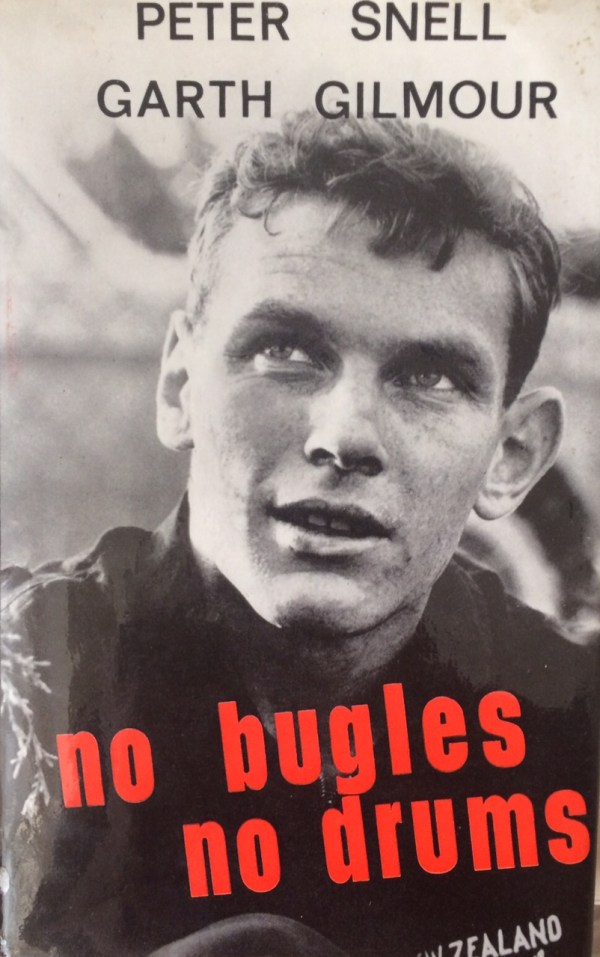
No Bugles No Drums

National Olympic Stadium and underground tunnell
Blueprint for the National Olympic Stadium for the 1964 Olympics, including underground tunnel. Source: Japan Sport Council

In his book, No Bugles No Drums, Olympic track legend, Peter Snell of New Zealand, wrote about an underground tunnel at the National Olympic Stadium, where he competed at the 1964 Olympic Games.

“Ten minutes before the gun, we were led through an underground tunnel which took us right underneath the track diagonally to a point at the beginning of the back straight. Then a walk around to the start.”

Ollan Cassell, lead runner on the US 4X400 men’s team that won gold in Tokyo, also noticed the underground tunnel. “The Japanese thought of everything,” he wrote in his book Inside the Five Ring Circus. “They even built a tunnel under the stadium track so athletes and official going to their events on the infield did not cross the track.”


National Olympic Stadium and underground tunnell 2
A picture of the 1964 tunnel at that time. Considerable work had been done afterwards to hide the pipes and cables. Source: Japan Sport Council

Cassell asked me to confirm that his memories were correct, so I did some digging. After a few emails exchanged between me and The Japan Sport Council, the government body that manages and operates some of the largest sports facilities in Japan, including the National Olympic Stadium, I was pleasantly surprised to get confirmation on the tunnel.

Not only that, the Japan Sport Council was kind enough to provide a schematic and photos.

An underground tunnel that allows officials and athletes to get to the infield or across the stadium without crossing a track seems like a great idea. You would think that all stadiums would be designed that way. But Cassell wrote to me that in fact Tokyo’s National Olympic Stadium was unique. “I have attended every Games since then, thru 1996 and never found anything like what they did. I missed 2000 and 2004 but attended all other games and did not hear anything about a tunnel from those who attended the 2000 and 2004 games.”

The National Olympic Stadium has been torn down, a new one set to rise (once a plan is finalized). But the old one apparently had a trick under its sleeve. It will be missed. To see what the stadium looked like just before it was torn down, check out these 360 views of the stadium.

National Olympic Stadium 360

Flying Dutchmen 1964_Olympic_Report2_800_rdax_60

They came in 18th overall in the Flying Dutchman (FD) competition, but they came in first in the hearts of the Japanese.

Stig Lennart Käll and his younger brother Lars Gunnar Käll were sailing in the third race of seven in the 1964 Tokyo Olympics FD-class competition when they saw another boat ahead of them capsize, and of the two crew members floating in the middle of the Sagami Bay. Making a fairly quick decision, the Käll brothers steered their way towards the sailor in the water and plucked Australian Ian Charles Winter out of the water. Then they proceeded to the capsized Australian boat, Diablo, to rescue the second member of that crew, John Gregory Dawe, pulling him into the Swedish boat, Hayama.

Swedish yacht saves Austrlian yacht

According to the Japan Times on October 21, 1964, the exploits of the Swedish FD crew were publicized nationally in the Japanese press, sparking a barrage of gifts to be sent by grateful well-wishers to the sailing Olympic Village in Oiso, not far from the Enoshima Harbor where the sailing competition was taking place.

Their behavior also led to the creation of the Fair Play Prize. The first winners of this prize – the Käll brothers.

The Swedes still placed 12th out of 20 in that particular race. Seven others, including the Australian boat, did not finish the race. Of the six other races in the competition, this had by far the highest number of boats that could not finish. And yet, the Swedish brothers not only finished, they beat out one other boat – this despite taking time to rescue the Australians, and taking on considerable extra weight with the two new crewmen.

Stig Kall
Stig Lennart Käll
Iolanda Balas in Tokyo_Tokyo Olympiad 1964_Kyodo News Service
From the book, XVIII Olympiad Tokyo 1964 Asahi Shinbum

One of the most dominant female athletes in history passed away this week. Iolanda Balaș was not only the first Romanian woman to win an Olympic gold medal, she was the sole world record holder of the high jump for over thirteen years, setting a new record 12 times in that span from June 1958 to July 1961.

Balaș won her first gold medal during that period at the Rome Olympics in 1960. She had not missed a jump in the entire competition, and so had extra jumps. After winning the competition at 1.73 meters, she went after the Olympic record. Leaping 1.77, 1.81 and 1.85 meters, she broke the Olympic record three times before calling it quits.

At Tokyo in 1964, Balaș did it again, not missing a jump, and winning the gold medal at the height of 1.82 meters. Again, with bullets to spare, she took a shot at the Olympic record and broke it twice, first at 1.86 meters, and then finally at 1.90. She reached this incredible height, apparently, despite a torn tendon.

Balaș was 79.

Watch her emerge victorious in Rome in this video.