Mary Rand and Whillye White in the UK 2
Mary Rand and Whillye White in the UK

It was February 19, 1965, a few months after the Tokyo Olympic Games. A collection of international track stars, many fresh from medaling in Tokyo, gathered at Madison Square Garden in New York City for the AAU National Indoor Track Championships.

Billy Mills, the first and only American to win the gold in the 10,000 meters in the Olympics, won the three-mile race. In a rematch of the Tokyo Olympics men’s long jump, USSR’s Igor Ter-Ovesyan outdistanced America’s Ralph Boston. Tamara Press repeated as champion in the shot put. Iolanda Balas of Romania continued her dominance in the high jump. And Mary Rand was also in town.

But the women’s long jump champion of the 1964 Tokyo Olympics faded quickly in Madison Square Garden, crashing out in the preliminary rounds by fouling two of her three jumps. The runway for the long jump did have a quirky quality: there were two take-off boards on the runway, the white indicators that tell the athlete exactly how far they can step before they launch themselves into the air. But she didn’t feel that was the reason for her poor performance, as she wrote in her autobiography, “Mary Mary“.

We were having problems because on the long jump approach there were two take-off boards very close to each other. You had to pass over the first one just before taking off, which was a bit distracting. I wasn’t jumping particularly well. In fact I was fed-up with my jumping more than irritated by the other board.

Mary Rand second stripe
Mary Rand jumping from the second take-off board. Click on the image to watch the actual video.

So Rand was in her hotel room when she heard a knocking on her door. It was American long jumper, Whillye White, silver medalist in the long jump at the 1956 Melbourne Games, and silver medalist in the 4X100 relay at the 1964 Tokyo Olympics. White came to explain to Rand that she had protested the outcome of the preliminary round because the first take-off stripe should not have been on the track in the first place. White said to Rand that she had told officials that the first stripe upset her, and it must have upset the other competitors as well, and that she said Rand could join the other six in the finals.

I might have said something about it being “stupid” – but I would never have dreamed of protesting. I said I wouldn’t come back unless it was absolutely all right with all the other jumpers, because it did mean that I might go ahead and win. But Willye had already put it to all the other athletes, I was told, and they had all agreed.

So Rand returned, and she landed a jump of 20 feet 4 inches, over a foot shorter than her Olympic record in Tokyo, but good enough for first place in New York. Thanks to Whillye White!

Mary Rand at home

When you emerge victorious far from home, people may say that the hometown folks are all so excited about your accomplishments. But you don’t understand that until you finally make it home. Just in the recent Rio Olympics, the greetings that Joseph Schooling got in Singapore and the Fijian Rugby 7’s team got on their return home were beyond what any average citizen can comprehend.

Even back in 1964, decades before the internet brought us instantaneous news, in many cases, Olympic medalist often returned home as conquering heroes. The same was true for Brit Mary Rand, who won three medals at the Tokyo Olympics: a gold in the long jump, a silver in the pentathlon and a bronze in the 4×100 relay. But in the 1960s, athletes had to deal with the extra burden of deciding whether to go professional or not, regaled with offers that often seemed irresistible.

Along with her fellow members of TeamGB, Rand landed after a long flight from Japan, had a champagne breakfast at 6 am, and were told they had to ready for lunch at Buckingham Palace, to meet the Queen of England.

As Rand related in her autobiography, “Mary Mary“, the Queen said she explained to her son, Prince Andrew, how far Rand had jumped by measuring out the Olympic record of 6.52 meters on the floor in the palace. The conversation about the Queen’s son reminded Rand that she still had not seen her own daughter, Alison. They had not seen in each other in weeks, and so Rand’s description of the mother-child reunion is charming:

She came into the room with Diane. She looked at me and I could see she wanted to come to me, but she was looking at me as if to say, “If you think I’m going to make a fuss of you when you’ve been away this long, you’re wrong.” But she came over, and then she in my arms, I was terribly cut-up and I had to hold back the tears so as not to upset her.

There were the ticker tape parades, first in Henley, and then in her hometown of Wells. Then came the invitations to dinners and luncheons, opening and to shows….and as she explained of her quandary: “you were really expected to do all these things – it was very hard to say no – and a woman can’t just turn up in the same old dress each time.”

Mary Rand_Mary Mary 3
From the autobiography, Mary Mary

Mary Rand was not only a hero, she was marketable. Seen as part sexy siren and girl next door, accentuated by being Great Britain’s first female gold medalist, commercial opportunities came flying her way. But going commercial would come at a cost.

I could make money if I wanted to, straightaway. In Tokyo I’d get a telegram offering me a contract to feature in advertisements. Every day a lot more offers were coming in. Possibly there was much as GBP20,000 to be made. Of course it would mean giving up my amateur status and never competing again. But when you love a sport it’s hard to resign yourself to just suddenly giving up forever. You’re scared of committing yourself and then eventually thinking, one fine morning, how great it would be to get out on with our new house, there lots of financial commitments to be met, and the money was very tempting.

Fortunately, she found an agent who helped think it through. Were there opportunities out there that would not jeopardize her amateur status and maintain her potential to continue competing? One job they settled on quickly – a column for the Sunday Mirror, which paid her to write about housekeeping. She was safe as long as she didn’t write about athletics! (Yes, those days are long gone.)

When Rand was in Cannes for the debut of Kon Ichikawa’s film on the 1964 Tokyo Olympics at the film festival, she was approached with a very intriguing idea by film producers:

The idea was for a series of ‘women James Bond’ films. They said they thought I’d be great as a female 007, with my build and athletic ability. It was a fantastic idea, they said, it could be a huge success, on the other hand it could be a complete flop. They talked about locations like the South Sea Islands, the South Pole, Japan. It was terribly exciting but I was wary too. I wasn’t sure how provocative I was going to have to be in the roles – and how long it would mean being away from home. I told them I’d have to talk it over with my husband.

Rand was actually offered a contract for the female Bond films. When she examined the details, she realized that she would be away from home for such long stretches that it would take her away from what she wanted to be: a mother, and an athlete.

So it was no for “Rand. Mary Rand.”

Carlo Airoldi
Carlo Airoldi

He wasn’t high born. He was a farmer from Origgio, Italy. And he could run, and run, and run – Forrest Gump-style. In the 1890’s, Carlo Airoldi was one of the best long-distance runners in Europe. In 1895, the year before the inaugural Olympics in Athens, Airoldi won the Milano-Barcelona footrace, a 12-leg competition of 1,050 kilometers!

So when Airoldi heard about the Athens Olympics, he likely thought a 42-kilometer marathon would not be a problem at all. Unfortunately, there was another problem. He was not a man of means like the majority of athletes attending the Athens Olympics. He could not afford to take trains or ships from Italy to Greece.

So he decided to walk. Two thousand kilometers. So that he could run 42.

He convinced an Italian magazine, La Bicicletta, to sponsor his expenses in exchange for his story. He figured if he walked and jogged some 70 kilometers a day, he could make it to Athens in a month. So, according to this article in Italian, he departed Milan on February 28, 1896, taking his first steps in the cold and windy winter weather. The book, The Olympics: A Very Peculiar History, explains that after making it 700 kilometers to Ragusa, Yugosloavia, Airoldi bought a ticket for a boat to Pattras in Western Greece, before walking another 200 kilometers to Athens.

It took Airoldi a little over a month, but he made it!

Carlo-Airoldi--il-librodi-manuel-sgarella
Not quite the build you’d expect of a marathon runner….

Airoldi arrived in the Greek capital in early April, just in time for the start of the Olympic Games. Unfortunately for him, these weren’t the Games of the ancient Greeks. These were the Games of Baron Pierre de Coubertin, who believed in the purity of amateur athletics, that only those who were not tainted by victory prizes were allowed to compete.

When asked by members of the organizing committee whether he have ever received money in a competition, Airoldi replied sincerely that he indeed had, the previous year, after winning the Milan-Barcelona race a year before. Perhaps, as the Italian article explains, there was also concern that this renown distance runner from Italy was a threat to the favored Greeks in the marathon. Whatever the reason, a shocked Airoldi was declined eligibility to run in the marathon.

“If only they could walk a mile in my shoes…,” he may have thought.

marathon to athens map
Marathon to Athens

Albin Lermusiaux of France, jumped out to the lead, but eventually relented to the Greek heat, and quit the footrace at the 32 kilometer mark, carried the rest of the way by horse-drawn cart. Then the Australian, Edwin Flack, jumped to the lead, only to fall at the 37 kilometer mark.

At these first modern Olympic Games in Athens, on April 10, 1896, 80,000 people sat in the Panathenaic Stadium waiting, listening to updates brought in by messengers on bicycles or horses. This was the scene of the very first marathon, an event created for the first Olympic Games. A colleague of Pierre de Coubertin, Michel Bréal, transformed a legendary story of a man named Pheidippides into an Olympic event. In 492 BC, Pheidippides ran from a place called Marathon to Athens, a distance of about 42 kilometers, to deliver new of a Greek victory over Persia, in what is called the Battle of Marathon.

So when the spectators in Panathenaic Stadium saw who was first to enter the stadium, an explosive cheer split the sky. A Greek named Spyridon Louis was to win the final event of the first modern Olympic Games in the spiritual home of the Olympics. Here is how David Goldblatt, author of the book, The Games: A Global History of the Olympics, described the significance of that moment:

It proved to be the most important event of the games, generating the kind of modern mythological hero and collective stadium spectacle that raised the 1896 Olympics above the level of a country-house games weekend or a mere historical recreation…. The man who entered the stadium first was the Greek, Spyridon Louis. The crowd went wild. The king and the crown prince descended to the track to run alongside him and, when the had finished the race, members of the royal entourage and the organizing committee embraced and kissed him.

Coubertin was also impressed, according to Goldblatt. “Egad! The excitement and the enthusiasm were simply indescribably. One of the most extraordinary sights that I can remember. Its imprint stays with me.”

Spyridon Louis

Louis was not a man of wealth. He made his wages by transporting mineral water his father mined to buyers in Athens. After his victory, Louis was showered with gifts, but continued to live a simple life of a farmer and later as a police officer.

Four years prior to his death in 1940, forty years after his momentous victory in the marathon, he could still remember that moment of glory with happiness.

That hour was something unimaginable and it still appears to me in my memory like a dream … Twigs and flowers were raining down on me. Everybody was calling out my name and throwing their hats in the air …

Cotswold Games

Robbie Brightwell was a 16-year old student in Shropshire, England, and was straining to keep his eyes open while doing research in his local library when he came upon an old magazine and was struck by a picture of runners in a competition sometime in the late 19th century. As he related in his autobiography, Robbie Brightwell and His Golden Girl, he was surprised to see that in an area called Much Wenlock, not far from his own, there was a sporting event called “The Olympics”.

Intrigued, Brightwell, who went on to captain Britain’s track and field team at the 1964 Tokyo Olympics, began impromptu research into the Much Wenlock Games, and learned that Baron de Coubertin, at the age of 27, came to Much Wenlock and met an 81-year-old English physician, who planted the idea for what we now recognize as the Modern Olympics.

But as is true with any great endeavor, new ideas and initiatives are often built on earlier iterations. According to The Games: A Global History of the  Olympics by David Goldblatt, events held in both England and France could be considered precursors to Coubertin’s Olympics.

The Cotswold Games: In the early part of the 17th century, fairs and festivals were a common part of the English country lifestyle. One of the biggest in England was the Cotswold Games in Chipping Camden, a mixture of fun and sports, contests and gambling. As can be seen in the poster for the Cotswold Games, also known as the “Cotswold Olimpicks”, there was a mock castle created on a hill, in front of which was the main theater for the events. Developed by Robert Dover, a “charismatic and charming man”, the Cotswold Games featured “hare coursing and horse racing, wrestling and shin kicking, stick fighting and hammer throwing.” Dover established this country fair in 1612 and was able to organize the Cotswold Games for about 30 years. Unfortunately for Dover, and perhaps the community of Chipping Camden, the 1630s saw a shift from the hedonistic reign of King James I to a more conservative, puritanical approach of Oliver Cromwell, who overthrew the King in 1645. That put an end to the Cotswold Games.

The Republican Olympiad: When the French monarchy was overthrown in the French Revolution of 1789, leaders of the new republic were excited about change to come. One of the leaders of the revolution, Charles Gilbert Romme, devised a way to update the calendar for a new, enlightened France. With five days added to the year, with the inclusion of another day added to a Leap Year, which would take place every four years. According to Goldblatt, “Romme thought that the lead day might be a good occasion for staging public festivities and games: ‘we suggest calling it the French Olympiad and the final year the Olympics Year.” In 1796, the first Republican Olympiad was held in Paris, where hundreds of thousands came out for games, music, dancing, running and wrestling. Winners of competitions won wreaths of laurels, pistols, sabres, vases and watches. The Republican Olympiad continued for two more cycles, but died out before the start of the 19th century.

Benefit of Mr Kite and John Lennon
John Lennon in front of poster that inspired “Being for the Benefit of Mr. Kite”

Pablo Fanque’s Travelling Circus Royal: As Goldblatt noted, the Olympics were often more often associated with circuses in the 18th and 19th centuries in England. One of the most popular traveling circuses was called Pablo Fanque’s travelling Circus Royal, which offered an “unrivalled equestrian troupe” and ” new and novel features in the Olympian Games.” Pablo Fanque was said to be the most popular circus proprietor in a golden age of circuses in Victorian England, and was quite accomplished not only as an equestrian, but also as a master of the corde volante. But as you may be able to tell, Fanque’s association to the Olympics is peripheral at best. His association to The Beatles may be stronger. The album, Sergeant Pepper’s Lonely Hearts Club Band” featured a song called “Being for the Benefit of Mr. Kite“, the lyrics of which are primarily lifted from an 1843 poster marketing Fanque’s Circus Royal.

The Much Wenlock Olympian Games: Dr Penny Brookes of Shropshire, England, agreed with the thinking of the time, that it was important to promote “the moral, physical and intellectual improvement of the inhabitants of the town…by the encouragement of outdoor recreations and by the award of prizes annually at public meetings for skill in athletic exercises and industrial attainments.” The first Much Wenlock Olympic Games were held in 1850. While these Olympic Games were a rural fair, they also had a firm sporting focus. In addition to fun events like wheelbarrow and sack races, both amateurs and professionals competed in cricket, football, archery, hurdling, running, shooting, cycling and a pentathlon. Large cash prizes were awarded.

When Baron de Coubertin, was told about the Much Wenlock Olympic Games, he made it a point to visit and meet Dr Brookes, a seminal act in the origin story of the modern Olympic Games.

William Penny Brookes in 1876 Photo WENLOCK OLYMPIAN SOCIETY


Olympia ancient greece_artist's rendition
Artist’s rendition of the site of the ancient Olympia Games


Today, the modern-day Olympics are held over a two-week period, or 16 days because it covers three full weekends.

But back in the day, way way back in the day – say over 2500 years ago – The Olympia Games were a five-day affair, as is explained in the book, The Games: A Global History of the Olympics, by David Goldblatt.

Opening Day: Today, an athlete a judge or official and a coach take an oath symbolically for all athletes, judges and coaches at the opening ceremonies of an Olympiad, promising to uphold the spirit of sportsmanship. Here is the athlete’s oath, for example: “In the name of all competitors, I promise that we shall take part in these Olympic Games, respecting and abiding by the rules that govern them, committing ourselves to a sport without doping and without drugs, in the true spirit of sportsmanship, for the glory of sport and the honour of our teams.”

In the 5th century BC, athletes, trainers and their families took an oath “that they would be guilty of no foul play and that they would be fair and not accept bribes.” But as we find inconsistency at times between what athletes promise to do and what they actually do, we find human behavior hasn’t changed much over the millennia. According to Goldblatt, “there was plenty of cheating and plenty of bribery.” He went on to say that the many statues of Zeus that adorned the area of the sporting grounds were paid by with fined for rule breakers.

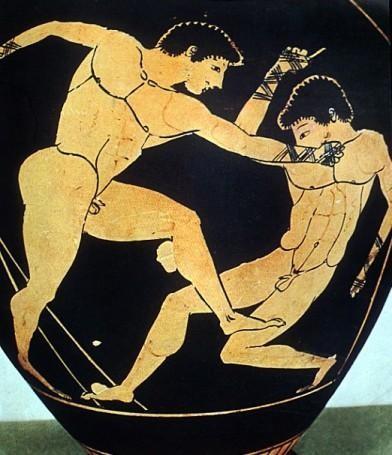
boxing in ancient greece
Greek boxer surrendering by raising of index finger

Day Two: According to Alan Carter’s book, The Olympic Glory That Was Greece, the second day was devoted to competitions for boys. The morning saw heats after heats of foot races as the qualifiers are shrunk down to the finalists. The victor receives a palm leaf, and his family and home town are honored by his grand accomplishment. The afternoon sees competitions in wrestling and boxing for the boys, as well as what could be considered a mixed-martial art called the pankration. Carter described it as “training for warriors who would be engaging in hand to hand confrontation with the enemy and Sparta was particularly associated with the sport.” In the pankration, you could bite or gouge eyes.

Day Three: On the third day, according to Carter, spectators enjoyed chariot races at the hippodrome. There were some six variants of chariot races – two and four-horse competitions, two mules, or foals as well – and they ran anywhere from 3,500 to 14,000 meters long. Below is a clip from the 1959 film Ben Hur, which is supposedly Rome in AD 26, over 680 years after the establishment of the four-horse chariot race. If the chariot races in Olympia were anything like this, I could see why this was a must-see event!

Day Four: Goldblatt wrote that day four was the day for generalists, when the pentathlon was held. The pentathlon then was made up of five events: the discus throw, the long jump, the javelin throw, a foot race and wrestling. According to Goldblatt, the competitors faced off in a footrace, the discus, the javelin and a jump that may have included weights. The winner was often determined after these four events. In the a winner could not be decided, wrestling was the tie breaker. The order and the way the winner was decided apparently is unclear and still debated.

Again, due to the sketchiness of the historical accounts, there is debate as to what happened on the fourth day. According to Carter, Day Four was a festive days, starting with the slaughter of 100 oxen in honor of Zeus. This was followed by the premier events, the stadion (200 yard foot race), the diaulos (400-yard foot race), followed by wrestling, boxing and pankration.

Day Five: Goldblatt wrote that day five is running, wrestling, boxing and “pankrating” (if I can turn that into a gerund). But Carter wrote that it is about pomp and circumstance, focusing on awarding the victors at the Temple of Zeus. The winners are announced with trumpets and declarations of their names and hometowns. They are given a palm leaf to hold and a wild olive branch to wear as a crown. After that, its feasting and partying into the night.

Running a stade in Greece
A picture of a stade in Greece, on my tour of Europe in August, 1985
It was the first week of August, 1985. I was in Greece. And it was hot.

On a tour of Europe with some 50 American students ranging in age from 15 to 50, I was tired after half a day in a boat and buses. We had left Corfu, where we got about the beautiful resort island on Vespas, caressed by cool breezes and enchanting vistas. When we arrived in Delphi, close to midnight, the camping grounds were not ready to receive us, so we slept on a gravel lot.

Delphi was home to the Oracle, a priestess of Pythia who consulted to the rich and famous from the 7th century BC to the 4th century BC. But we didn’t visit the Oracle. Perhaps, hot and tired, I didn’t care. We did visit an ancient sports stadium, where the professor leading this band of students arranged foot races for us.

In ancient Greece, the most common foot race was a stade, which is about 200 yards (180 meters), and which was the length of a stadium. Our professor had us race the length of the stadium…and back…essentially the length of four soccer pitches…in the August mid-day sun. Two of our number passed out. I don’t recall my race. Maybe I passed out too.

Our mighty tour leader, Prof. Emmanuel Fenz, cheering us on.
But if I had known then what I knew now, I would have been ecstatic to be there! This was Greece – the birthplace of the Olympics. And Delphi was home to one of four athletic competitions, collectively regarded as the Panhellenic Games:

  • The Pythian Games: based in Delphi, the Pythian Games were held in honor of Apollo every four years – this was the location where Apollo was said to have killed a monstrous python.
  • The Nemean Games: based in the northeastern part of the Peloponnese, Nemea is where the Nemean Lion lurked, slayed by Heracles; the Nemean Games were held biannually in honor of Zeus.
  • The Isthmian Games: named after the Isthmus of Corinth, a narrow strip of land which connects Peloponnese with the rest of Greece, the Isthmian Games were like the Nemean Games,  held the same two years as the Pythian Games; these games were held in honor of Poseidon.
  • The Olympian Games: located in an area called Olympia, near the town of Elis on the Peloponnese peninsula, this was the first of the four quadrennial Games, starting in the 8th century BC. Of the four Games, this was the biggest and most prestigious. While the Olympian Games are dedicated to Zeus, it is at the Temple of Hera where the custom of igniting the Olympic flame takes place.

The order of these Games were as follows:

  1. Olympian Games
  2. Isthmian Games
  3. Nemean Games
  4. Isthmian Games

Over time, the word “olympiad” became a unit of time, a four-year period, a historical point of reference no doubt noted by the founder of the modern Olympic Games, Baron de Coubertin.

For a wonderful modern-day journey of these four locales, read this New York Times article, An Olympic Odyssey: Where the Games Began, by Bill Hayes.

Mel Pender_100 meter_1968
Mel Pender starting strong in 100-meter finals at the 1968 Mexico City Olympics_from the collection of Mel Pender

I cannot explain why I came in sixth place in the 1968 Olympics when the 100 meters was my best event. I could have won that race, and thought I should have. My start was great! I was out in front, but it was like I lost all my momentum and fell way behind.

So wrote Mel Pender in regards to his 100-meter finals at the 1968 Mexico City Olympics, as described in his autobiography, Expression of Hope – The Mel Pender Story. In fact, 1968 was in one respect a repeat of 1964 – a sixth place finish in the 100-meter finals. As Pender is painfully aware, there is no acclaim for the Sixth Fastest Man in the World.

But one significant difference between 1968 and 1964 was that at the Tokyo Olympics, Pender was running with a torn muscle in his ribcage, and was hospitalized after the individual 100 meters. In 1968, Pender had one more chance for a medal, as a member of the 4×100 meter relay team. And yet, while he was officially penciled in as the runner of the second leg, there was talk not only of replacing the injured lead-off man, Charlie Greene, but also Pender because of his age and his sixth-place finish in the individual finals.

Ronnie Ray Smith, Mel Pender, Charlie Greene, Jimmy Hines

And then there was the tension of race on Team USA. On October 16, Tommie Smith and John Carlos took first and third place in the 200-meter finals, and more famously, bowed their heads and lifted their fists in protest on the medal stand as the American anthem played. Their silent plea for equality and justice for Blacks in America created in an uproar in Mexico City and around the world. The IOC president, Avery Brundage, banned Smith and Carlos from the Olympic Village, and thus the Games.

As Pender recalled in his autobiography, Brundage “referred to black male athletes as boys. ‘If those boys act up, I’m going to send them home…’ was what he said publicly and privately. When the black athletes heard about this, it was more than we could stand. Remember, in April of 1968, Dr. Martin Luther King was assassinated in Tennessee.”

Members of the US track team, particularly black athletes, with the support of their head coach, Stan Wright, protested Brundage’s decision. But Pender, and other members of the US military had an extra burden, told in no uncertain terms that they “could not be part of the demonstrations based on the oath of service we took.”

Ronnie Ray Smith, Mel Pender, Charlie Greene, Jimmy Hines_2

So, for Pender, Mexico City was not just a sports event, and the 4×100 meter relay was not just a race. It was to Pender, perhaps, an expression of hope, an opportunity to shine a spotlight of achievement for black Americans, and a shot at redemption for the five-foot-five man from Lynnwood Park. The 4×100 relay, an event of immense speed that requires split-second precision in the baton hand offs, was America’s to win or lose.

I took my position on the oval track, awaiting the baton from leadoff man Charlie Greene. Charley ran the first leg, and when he handed the baton to me, we were trailing a bit. Passing the baton was clean. I was in a good Lane; I think was the third lane. It was without those curves that you made you feel like you’re running sideways. I ran the second leg, which proved to be the fastest of the four, and gave our team the lead. When I pass the baton to Ronnie Ray, he did his job, and we maintained the lead. When Ronnie Ray handed off the baton, Jim Hines brought it home.

Greene, Pender, Ray and Hines set a new world record of 38.24 seconds.


Mel Pender Bob Hayes_1964 100 meter finals
Mel Pender in outermost lane, and Bob Hayes in innermost lane at the 100-meter finals of the 1964 Tokyo Olympics.

American sprinter, Trent Jackson, easily won his 100-meter heat at the 1964 Tokyo Olympics. Mel Pender qualified with ease. Jackson won his quarter0final heat as well, while Pender tied for first in his, and thus they both made the top 16, and joined favorite, Bob Hayes, in the semi-final heats.

For some reason, Jackson had his worst time, and did not come close to making the final 8. Pender finished fourth in his semi-final heat, barely qualifying for the finals. And he looked ugly in the process, tumbling to the cinder track in pain. Bob Hayes noted in his autobiography, Run, Bullet, Run, that Pender was carted off on a stretcher.

As Pender reveals in his autobiography, Expression of Hope – The Mel Pender Story, he had torn muscles around his rib cage, which created intense pain when he ran. How did he get the injury? It’s one of those inexplicable things you hear every so often – meaningless horseplay. Pender told me that he and his friend, Trent Jackson, were “messing around…when he punched me in the stomach. We were just messing around, but it caused some internal bleeding. This was right after the first race and before the semi finals.”

He said that a doctor had given him injections to kill the pain, and advised Pender not to run. On the verge of the 100-meter finals to declare the fastest man in the world, there was no way Pender was going to disqualify himself just because he was in pain around the chest. In fact, when Hayes said to Pender, “Hey shorty, you’re just going to watch my behind,” Pender put on a brave face, and replied, “better watch mine.”

According to Hayes, he went up to Pender in lane 8 just before the start of the finals and said, “‘Mel, I ain’t saying good luck to nobody to beat me, but I hope I finish first and you finish second. ‘Mel turned to me and said, ‘I’m finishing first and you finish second.’ Mel and I both knew he didn’t have a chance because of the his injury, and he showed fantastic courage just by running with the pain he had.”

Mel Pender injured
Mel Pender collapsing at the end of the semi-finals of the 100-meter competition at the 1964 Tokyo Olympics_from the collection of Mel Pender

So Pender ran. Stationed in the outside lane, Pender shot out of the blocks. But all attention quickly shifted to the innermost lanes where Bob Hayes and Enrique Figuerola were pulling away. Of course, as you can see in this video, Hayes continues to pull away to win the gold, tying the world and Olympic records of 10 seconds flat.

Pender finished in sixth. According to a October 20, 1964 article in the US Military newspaper, Stars and Stripes, the Army sergeant was devastated.

I promised my wife and daughter I’d bring them home a gold medal. If there would have been more time between the semi-finals and the finals of the 100, I think I could have won it. In the last run I just couldn’t get that little kick. I was in front of Jerome (Harry Jerome of Canada) and Figuerola (Enrique Figuerola, Cuba) at about 70 meters mark when the pain got so bad that I lost stride and didn’t know if I could make it to the finish line.

Pender was quoted as saying that he hoped his coach would allow him to run in the 4×100 meter relay, which I believe would have been unlikely the condition he was in. “I’d run from here (the hospital in Tachikawa) to the Olympic Village if they’ll just give me the opportunity to compete.”

Orville Rogers and Dixon Hemphill
Orville Rogers, left, races Dixon Hemphill at the 2017 USATF Masters Indoor Track & Field Championships on February 18 in the 60-meter sprint. Dave Albo

It wasn’t quite as slow as watching water boil. But it was certainly more exciting!

Orville Rogers faced off against Dixon Hemphill in the 60-meter dash at the USATF Masters Indoor Track & Field Championships in Albuquerque, New Mexico on February 18, 2017. Rogers trailed Hemphill for most of the race, but Rogers caught Hemphill in the last 10 meters to win by 0.05 seconds in an amazing finish.

The world record in the 60-meter sprint is 6.39 seconds, held by American Maurice Greene. Roger’s winning time was 18 seconds flat. That’s right 18. But there is a good reason for this slow race. Hemphill is 99 years old. And he beat a relative whipper snapper in Hemphill, who is only 92.

Here’s how SB Nation described the above video: “What makes this video so great is the fact it’s so much slower than what we’re used to seeing. You might blink three times when Usain Bolt tears down the track, but watching a sprint unfold over 18 seconds is compelling.”

Any regrets?

“I think had I leaned a little bit, I would have won,” Hemphill, 92, told Runner’s World on February 21