Nigel Talton likely imagined himself breaking the tape at a championship track meet, or even the Rio Olympics, but he probably didn’t imagine himself winning a sprint at SunTrust Park…between innings at Atlanta Braves games…in a teal-colored spandex suit with big blue goggles.
But when you’re an aspiring track star, you do what you must to pay the bills.
Working two jobs in order to afford to keep training in track, the 26-year-old from Fort Valley, Georgia had a moment on Friday, June 9, 2017 that most people or companies can only dream of – a video that goes viral.
Talton’s job is to play a superhero-like character called The Freeze, who races from the left field pole at SunTrust Park, around the warning track in front of the outfield fence to a finish line in right center field, against a fan who has a 200-foot head start. The Freeze almost always wins, but in this particular case, the fan celebrated just before reaching the finish line, only to be passed by The Freeze. The fan’s shock and subsequent face plant made the video must-see viewing, and made The Freeze a star.
According to track blog, FloTrack, while Talton is employed part-time by the Atlanta Braves as a ground keeper and The Freeze, he is a legitimate sprinter, with solid personal bests, including 10.47 in the 100 meters and 21.66 in the 200. But as FloTrack explained, world-class track is a highly competitive world. “Talton came out of college as an accomplished athlete, but in the cutthroat world of track and field, his times were not good enough to secure a sponsorship.”
And yet, Talton loves to run and does not want to give up on his dreams. In fact, he aims to make the 2018 World Indoors. “I just want to make a team before I’m done,” said Talton. “My route to that path was detoured, and this came upon me, so right now I’m just continuing to train… just training and saving up for next year.”
Nigel Talton and his alter ego The FreezeExcept for the elite, most of those who have finished with college and the support it provides for track and field athletes have to enter the rat race. People like Talton have to scrape by to continue the dream.
“I just want to have the opportunity to train as a professional track runner,” Talton said in FloTrack. “I wish there was a program for us athletes. It’s so hard for us athletes that don’t have sponsors that have potential. It’s very hard, that’s why I work two jobs. I’m going to continue to keep my faith and continue working for the indoor season… It’s not about me, I’m just doing it to inspire others and to entertain.”
There’s no doubt that RaceTrac, the company that operates convenience stores throughout the southern part of the US, and sponsors this between-inning activity for the Atlanta Braves, has lucked into a marketing bonanza in promoting a frozen drink called “Numbskull.” The question is, can Talton leverage his 15-minutes of fame into sponsorship, and make it a little easier for this world-class sprinter to take his game to the next level.
“I never know what’ll happen out of this ‘Beat The Freeze’ contest,” Talton said in this Washington Post article. “I’m just blessed and waiting, waiting for whatever opportunity come across my way.”
Phil Knight and Bill Bowerman, co-founders of Blue Ribbon Sports (BRS) had thrown down the gauntlet. Despite being in a successful relationship since 1964 with Japanese sports shoe manufacturer, Onitsuka Tiger, and in the middle of an exclusive 3-year agreement to market the increasingly popular Onitsuka Tiger sneakers in the United States, the relationship in early 1973 had disintegrated.
At the end of 1971, BRS produced and sold sneakers under its own brand – Nike, thus challenging the integrity of their agreement with Onitsuka. But it was BRS which fired the first legal shot, filing a suit against the Kobe-based manufacturer, Onitsuka Company. As explained in Sneaker Wars Part 8, Knight and Bowerman believed that Onitsuka had breached their agreement by soliciting other distributors in America before the end of their agreement. Onitsuka then countersued claiming that their trademarks were violated and that they did not solicit other partners in the US until after BRS began marketing Nikes.
According to Kenny Moore in his book, Bowerman and the Men of Oregon, BRS and the leaders of Nike were facing an existential crisis. “If Onitsuka won, BRS would lose the exclusive right to sell the shoes Bowerman had designed. ‘This lawsuit,” Bill said, ‘is win or die.'”
You can read up on the details of the trial in Moore’s book and various articles on the internet. In the end, a federal judge ruled in Blue Ribbon Sports’ favor, although allowing both companies to market the same shoes in the US, under the condition that BRS had the right to sell them under the trademarked names, including the Cortez, according to this article in The Oregonian.
In the end, Onitsuka Company agreed to pay BRS an out-of-court settlement to end their legal conflict. It took a while to agree to an amount acceptable to both parties, but they finally did. When it came time to sign the agreement and receive payment, Phil Knight and a member of his company’s board, Doug Houser, went to meet the lawyers from Onitsuka company. Houser went on to explain the bizarre interaction that ensued:
The Onitsuka lawyer explained the unorthodox payment method as the result of the difficulty of transferring money out of Japan. He encouraged Knight and Houser to sign some documents.
“And I said, ‘Is that X dollars?'” Houser said.
“And they gulped and said, ‘Well no. It’s illegal to bring that much money out of Japan. And we couldn’t’ bring it all. That’s all you get. But it’s a lot of money and you ought to sign.’ They knew we were desperate and needed money badly.
“But it was grossly unprofessional. Grossly wrong. Morally wrong. Everything about it stunk.
“And Knight said, ‘Eff you. We’re out of here.’
“And we left the conference room and went out into the lobby, punched the elevator button and just like in the movies, just when the elevator opened, the conference room door opened and they hollered, ‘Don’t leave. We’ve got the rest of the money.’
“So we went back into the conference room, they opened a door to an adjoining conference room where there was a second steamer trunk and they said, ‘Now sign the papers.’
After they had officials from BRS’ bankers count the money to assure that their agreed-upon amount was paid in full, Knight signed the papers that brought an end to their legal conflict, and breathed new life into BRS. From that point on, Nike, the goddess of Victory and an emerging brand, began to spread her wings and fly.
It’s the end of 1969. Blue Ribbon Sports (BRS) is selling Tigers well enough that he, the CEO, Phil Knight, decides to finally become a full-time employee of his own company. BRS has had a fruitful relationship with Japanese sneaker manufacturer, Onitsuka Tiger. The shoe that BRS co-founder, Bill Bowerman, designed – The Cortez – became a dominant running shoe in the run-up to the 1972 Munich Olympics, taking advantage of a running and jogging boom in America.
In the last month of the last year of the tumultuous 1960s, Knight makes his annual trip to Kobe, Japan, to meet the founder and head of Onitsuka Tiger, and later the global brand Asics, Kihachiro Onitsuka. They renew their vows by signing a three-year contract, giving Blue Ribbon Sports rights to market Onitsuka Tigers in the United States, with the condition that BRS sells Tigers exclusively.
The problem for BRS – while they enjoyed the success of selling Tiger shoes, they realized that their contract limited their business range to distributorship, and thus created an increasingly uncomfortable level of dependency on a single manufacturer of sneakers.
The problem for Onitsuka – while they were able to breach the huge American market via BRS, they realized that every year they continued to market in the US through this relatively small and inexperienced player, they were likely leaving millions of dollars on the table unless they expanded the number of distributors in the American market.
Onitsuka was apparently hearing from other American shoe distributors that the potential for US growth was huge, so he realized he had to push harder into the international markets, particularly the US. With that understanding, he hired an aggressive international sales director, Shoji Kitami, to realize his “Onitsuka of the World” strategy, according to Kenny Moore, author of the book, Bowerman and the Men of Oregon. So despite the three-year agreement of exclusivity, midway through, Kitami met with as many as 18 other shoe distributors in America.
Knight was concerned that Kitami’s actions were going to lead to a contractual dispute, but Kitami viewed the exclusive nature of their agreement as shackles. Acoording to Moore, as discussions between Knight and Kitami became more contentious, Kitami suggested that Onitsuka Tiger and Blue Ribbon Sports form a joint venture, with Onitsuka holding a 51-percent share of the company.
This was a moment of truth. According to Moore, “the choice was between surrendering the company to Onitsuka or making their own shoes.” And when they thought about it, they were liking less and less their submissive role as middle man. Bowerman had designed a successful shoe – the Cortez – that they could not get manufactured by other companies. And ironically, while Kitani was saying that they need to expand the number of distributors in American to sell more shoes, Knight and Bowerman would scratch their heads since Onitsuka was regularly guilty of not manufacturing sneakers fast enough to meet demand. BRS would put in an order and Onitsuka would routinely export fewer shoes than ordered. How were they going to meet the other distributors’ demands if they couldn’t even meet the demands of their sole distributor?
Knight and Bowerman realized they needed to prepare for a break up with Onitsuka. Soliciting the help of a large Japanese trading company – Nissho Iwai – BRS were able to find another shoe manufacturer as well as secure financing for the initial manufacture of new BRS branded shoes, including 6,000 pairs of The Cortez, which Kihachiro Onitsuka believed to be their own design. This was the chance they needed.
As Moore quoted Knight as saying, “we have them right where we want them. Onitsuka is too slow to react to product development ideas we give them. They never ship what we order. And they’d probably yank the distributorship at the end of the contract in 1972 anyway. What we need is a brand we can control, because we have everything else, the shoes, the top runners. This is the best thing that could ever happen to us.”
The logo design was set to grace the new sneaker. Barbara Smit claims in her book, Sneaker Wars, that a design student was paid $35 when he presented the “inverted comma” design, which later was dubbed, The Swoosh. Knight wanted to call the new brand, Dimension 6. As the deadline for producing the sneaker boxes approached, they still did not have a brand name, other than Dimension 6. That is until Jeff Johnson, Nike’s first full-time employee, woke up with an image of Greek goddess of victory in his head. So with a little forceful nudging under the gun of a production deadline, Knight reluctantly agreed to the name, Nike. After all, it was a short name, one that easily fit on a shoe box.
So in the winter of 1971, the Nike brand was born.
When you walk through Meiji Shrine, a peaceful oasis of green in the middle of Tokyo, your pulse rate drops and you forget the hustle bustle of one of Asia’s most dynamic mega-cities. Its location next to the National Stadium for the 1964 Tokyo Olympics and the Olympic Village made the wooded park of Meiji Shrine a wonderful place for runners to train, a la middle distance double gold medalist, Peter Snell.
When images of the planned National Stadium for the 2020 Olympics were released, there was a mixture of groans and puzzlement. Globally renown architect, Zaha Hadid, presented a design of sleek modernity. Frankly, I thought it looked like a bicycle helmet, somewhat out of place in its surroundings.
National Stadium and Meiji Shrine on Google Maps
Then suddenly, in July, 2015, Prime Minister Shinzo Abe scratched plans for the design of the new National Stadium planned for the 2020 Tokyo Olympics. It was revealed that the estimated cost of the stadium ballooned from JPY252 billion, from the original proposal of JPY130 billion, an approximate difference of USD1 billion. Scrapping Hadid’s design meant a massive delay, resulting in a particularly embarrassing broken promise. Plans to have the new national stadium host the 2019 Rugby World Cup also had to be scrapped, resulting in a move of the tournament to Yokohama.
TOCOG quickly put together another search for a stadium designer. And suddenly, Kuma Kengo, whose design was selected, was in the spotlight. Not only will the cost of the Kengo stadium be closer to the originally proposed estimate (JPY150 billion), the design of the stadium will more seamlessly blend into the environment.
Kuma has built a reputation for his use of wood, and plans to employ wood, particularly wood grown in all prefectures of Japan, to fashion a stadium that folds into the relatively green surroundings, as he explains in this Nippon.com interview:
Instead of the old-fashioned idea of putting up a huge monument, my idea is to create a stadium that people will remember as part of the Meiji Shrine outer gardens, the wooded area in which it’s located. And we’re planning to uncover the Shibuya River, which was put underground during the rapid-growth years, and have it flow at surface level through the stadium grounds. I believe that creating something sustainable for future generations, with the surrounding nature open to the public, is a more important considerations than the physical shape of the edifice, and so that’s what I’ve been focusing my efforts on.
Kuma was 10 years old when the 1964 Olympics came to Tokyo. He remembers witnessing the rapid growth of the post-war years, and being amazed in particular by the two complementary buildings of the Yoyogi National Gymnasium, built for the aquatic and basketball events. According to the Nippon.com article, he remembers often visiting the First Gymnasium designed by legendary architect, Tange Kenzo. “The light shining down from the windows in the high ceiling made the water of the pool sparkle. I was captivated by this sublime sight, and that was what made me decide that I wanted to become an architect.”
Over the years, Kengo has become known for his use of wood in his designs, in ways that recall times when wood was the primary construction material, layered, and exposed to the elements. Design website, Icon, describes Kengo’s work in detail:
Kuma’s approach is perhaps best illustrated by a series of buildings he has built in and around a small town called Yusuhara on Japan’s southern Shikoku island. The Yusuhara Town Hall (2006) sits under a roof and frame of Japanese cedar in a traditional structural arrangement, but one that gives off more than a hint of high-brutalism in the strong articulation of its thick beams and columns. The outside features a series of timber panels of various dimensions, alternating with glazed panels – a genuinely interesting take on the “barcode” facade.
Yusuhara hotel and shops
A small hotel and market (2010) that Kuma built nearby is just as unconventional, with a curtain wall on the main facade made of straw bales and bamboo that can actually be opened out to allow light and ventilation through – a very odd combination of rustic material and hi-tech detailing. But the wooden bridge building (ICON 101) that Kuma built over a road to link a spa and hotel on the outskirts of the town is stranger still. Here is a version of traditional Japanese roof construction blown up to super-large scale, a series of single wooden elements all overlapping and stepping up towards the bridge itself. It is this radical re-imagining of a historic building material or method of construction that one sees time and time again in Kuma’s work.
I’m truly excited for the debut of Kengo Kuma’s national stadium. I feel it will not only be appreciated for its uniquely Japanese sensibilities, but will be a lasting legacy of the 2020 Games, a fitting complement to its green surroundings, particularly the peaceful Meiji Shrine.
“I want to go beyond the era of concrete,” Kuma, 62, said in this Japan Times interview. “What people want is soft, warm and humane architecture. We will show the model of a mature society in the stadium. That’s the way to live a happy life relying on limited natural resources from a small land.”
Feyisa Lilesa with his wife Iftu, son Sora and daughter Soko, after winning the 2017 United Airlines NYC Half (photo by Jane Monti for Race Results Weekly)
Since the time he left Rio de Janeiro, with a silver medal in the marathon from the Summer Olympic Games, Feyisa Lilesa has not been able to enjoy the triumphant return home to an adoring populace like most other Olympian medalists.
Instead, he lives a life a self-exile.
When he crossed the line to finish his marathon achievement in Rio, he crossed another line by extending his arms and crossing them in the shape of an X, with fists clenched. It was a clear sign to his country men and women in Ethiopia that Lilesa was outraged with his government, his arms raised in protest against his country’s leaders for the treatment of the country’s largest ethnic group which he belongs to – the Oromo. According to reports, hundreds of Oromo have been killed by Ethiopian troops, and thousands of others have been injured, arrested or disappeared, according to a report by Human Rights Watch.
While the Ethiopian government has said Lilesa would be welcome back with arms wide open, he does not believe that. And in his new home in the arid desert of Arizona in the United States, in his lonely jogs, he is constantly reminded that a government agent of Ethiopia might be lurking to do him harm.
“There is nothing I could do to stop it if someone wanted to do something to me out there,” he says through an interpreter in a May 1 Sports Illustrated article. “I am alone, just like I am alone in this country. All I can do is stay strong and keep going.”
The time I first wrote about Lilesa in December, 2016, he truly was all alone, as he left his family behind when he defected to the United States. And according to the Sports Illustrated article, a remarkable interview, his wife, Iftu, let him know what a painful decision he had made when he first talked with her on the phone.
When Iftu called, he could not pick up the phone. He didn’t know what to say. It took him two days to call her back. There was fear and anger in her voice. “Why didn’t you tell us what you were doing?” she demanded. “You gave us this good life, and now our lives aren’t as good. What plan did you have? You’ve risked everything. Why did you make this decision?” She knew her husband had been pained for years. She knew that he felt stifled, that he’d kept quiet for fear of reprisal. She knew he had visited imprisoned protesters and had given clothing and training shoes to needy Oromo. Deep inside, she knew the answers to her questions.
She knew what is in his heart. And according to this fascinating article, Lilesa was thinking that he could make a difference if he was able to get a medal in Rio. This act of defiance was not a spontaneous act of a tired athlete who had just run hard for over two hours. It was premeditated.
Preparing for Rio, Lilesa felt desperate to call attention to a crisis largely ignored by the international community. He needed a medal. Only gold, silver and bronze finishers would get significant media coverage. He had won big races in Europe, the United States and Asia, including the Tokyo Marathon at the start of 2016. But he wasn’t a heavy favorite in Rio. His time in Tokyo had been 2:06:56, only the 31st-fastest marathon of the year. Rio would be the race of his life — a race for his people. He kept his plan a secret, even from his wife and children. If he’d told them, he would have been swallowed by emotion. If he had felt Iftu’s sorrow, he might have lost his nerve.
Feyisa Lelisa reunited with his familyafter six months of self exile
But he did not lose his nerve. And when given other opportunities – the Honolulu Marathon in December, 2016, or the London Marathon in April, 2017, Lilesa will cross his arms to show he is still thinking of his family members and friends who have suffered and perished. But now, he no longer is running this political marathon alone. On Valentine’s Day of 2016, Lilesa was re-united with his wife and children.
On Feb. 14 — six months after Feyisa said goodbye to them in Africa — his children leap into his arms in the Miami International Airport. Soko, a girl sharp and willful, seems beyond her years. Sora stands close. Near the baggage claim in the bright airport, they laugh and tease, and Feyisa picks them up and cuddles them. Moments later, he holds Iftu in a tight embrace. Tears stream from her brown eyes. With both hands, he wipes them away. Tears well in his own eyes, but he does his best to stand straight and keep them from falling.
Lelisa feels that tears will demonstrate weakness, for he does not want the government to believe that he is succumbing to the pressure.
Lelisa is not weak. He is stronger. But he is not happy.
“It is much better now, with my wife and children,” Lilesa says. “But if you put this on a scale of 1 to 100, I am only at 15 percent happiness. I am in exile, not for myself first and foremost but for my people. And my people are suffering. Going through hell. The situation has gotten worse. I have told you that right now I do not want to cry. The day I will cry is when my people win justice and freedom. That day, I cry nonstop, out of joy.”
The Players Tribune is a internet forum devoted to the athlete’s perspective. Hounded and misquoted by the press, Derek Jeter believed athletes needed a place for them to tell their story in their own words.
One of the features of The Players Tribune is Letter to My Younger Self, an opportunity for athletes to reflect on their youth, and what their current self would have told their younger self.
Kobe Bryant‘s advice to the high school prodigy that he was is interestingly of a financial nature, and somewhat insightful. He explains that giving your friends and loved ones things, nice things, expensive things, is not doing your friends and family a favor. In fact, two-time Olympic gold medalist, and five-time NBA champion, Bryant would tell his younger self that giving things away is an act of selfishness, and not a responsible way to take care of those you care for.
You love them, and they were always there for you growing up, so it’s only right that they should share in your success and all that comes with it. So you buy them a car, a big house, pay all of their bills. You want them to live a beautiful, comfortable life, right? But the day will come when you realize that as much as you believed you were doing the right thing, you were actually holding them back. You will come to understand that you were taking care of them because it made YOU feel good, it made YOU happy to see them smiling and without a care in the world — and that was extremely selfish of you. While you were feeling satisfied with yourself, you were slowly eating away at their own dreams and ambitions. You were adding material things to their lives, but subtracting the most precious gifts of all: independence and growth. Understand that you are about to be the leader of the family, and this involves making tough choices, even if your siblings and friends do not understand them at the time.
When you’re young, you’re care free and often pain free. But the aches and pains of the full-time athlete can take its toll. To world-class athletes, it’s often the mental stress that is the bigger test.
According to three-time Olympic medalist between 1996-2004, Brandi Chastain of the US women’s soccer team, and four-time Olympian, Jackie Joyner-Kersee, managing pain and injury is a key to maturing as an athlete.
Brandi Chastain
The mental and physical challenges of rehabbing your body will test your patience. Have faith in those moments — they will define your future perseverance. No athlete knows what’s on the other side of significant injuries. Live all of your questions and trust the process. You’ll return a better player, a better teammate, a better person. – Brandi Chastain in The Player’s Tribune
Yes, your leg will be black and blue, and the torn muscle will bring pain unlike anything you’ve ever felt before. Yes, you’ve never been seriously injured before. However, it will be essential that you listen to your physical therapist when they tell you that you’ll be OK. The only thing that will hold you back is a lack of mental toughness at the time. – Jackie Joner-Kersee in The Player’s Tribune
And finally, if these athletes were to tell their younger selves to give pause, it would be for their parents, who unconditionally and thanklessly chauffeured them to practice and back, practice and back, practice and back.
2012 London Olympic semi-finalist, Caroline Wozniacki, wrote about the early morning drives to tennis practice, and how she wished she were more in the moment, more appreciative of those moments in the car.
He’ll wake up early to drive you to the tennis club at 6 a.m. so you can practice before all the matches start. Then, at eleven at night, he’ll jump back in the car with you and take you back to the club so you can practice after the day’s matches have ended. Appreciate everything your family does for you during your childhood. They will sacrifice so much for you. Do yourself a favor and make the most of those car rides. Soak in all the lessons and guidance that Dad provides you — and not just the stuff about tennis. Pay attention to what he is trying to instill in you about life. He and Mom will always stress the importance being a good person, of treating people right, of being respectful and kind. Let that sink in. Allow it to shape who you become. – Caroline Wozniacki in The Player’s Tribune
My favorite player on my home team ice hockey team, the New York Rangers, is goalie Henrik Lundquist. The two-time Olympian and gold medalist from the 2006 Turin Winter Games, Lundquist also remembers the long hours his parents drove him through all kinds of weather so he and his brother could play hockey.
Starting tomorrow, your parents will begin their journey, too. They will drive you and your brother hours and hours across Sweden to play hockey. They’ll drive through huge snowstorms. They’ll drive after long days at work. And their reward at the end of those drives will be to sit in cold rinks for hours — helping you get dressed, then watching you play, then helping you get undressed. Years later, when you think back on this time in your life as a grown man with a child of your own, you will finally appreciate what an incredible sacrifice your parents made for you and Joel. – Henrik Lundquist in The Player’s Tribune
The first ever winner of the marathon, Spyridon Louis, was said to have made a pit stop at his uncle’s tavern for a glass of wine before winning gold at the 1896 Athens Olympics.
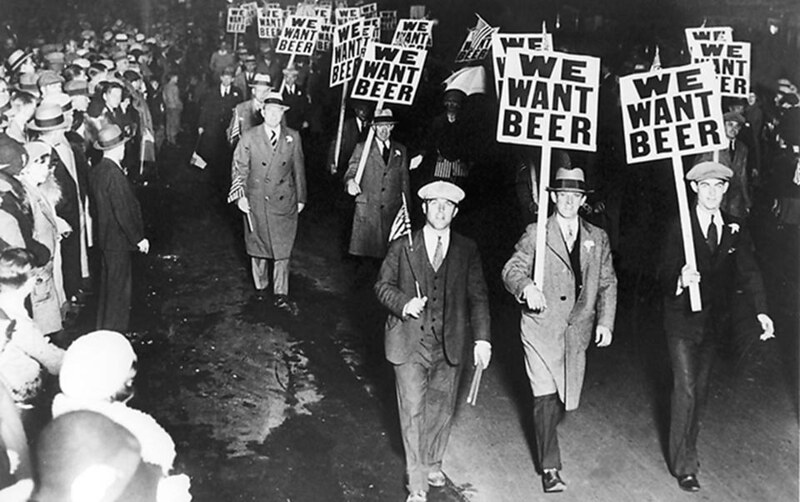
But discus thrower, Jules Noël, was a beneficiary of the US government’s decision to suspend the importation and imbibing of alcohol.
From 1920 to 1933, it was illegal to produce, import, transport and sell alcoholic beverages. This teetotaler era in the United States, known as Prohibition, happened to be in force during the 1932 Olympics hosted in Los Angeles, California. But according to David Wallechinsky and Jaime Loucky in their book, The Book of Olympic Lists, “in the interests of international goodwill the US government suspended its prohibition against alcoholic beverages to allow French, Italian and other athletes to import and drink wine.”
Anti Prohibition Protest in New York City in 1932.
Frenchman, Noël, believed that “wine was an essential part of his diet,” according to sports-reference.com. Apparently, the world record holder and eventual gold medalist in the discus throw, John Anderson, led nearly the entire competition. But in the fourth and final round, after Anderson’s leading throw of 49.49 meters, Noël was reported to send a discus way past Andersen’s best throw at the time. But apparently, “the officials were watching the pole vault and did not see it land. Noël was given an extra throw but could not produce his top throw again and he would eventually place fourth.”
Before his mighty but unofficial throw, Noël was said to be “swigging champagne with his compatriots in the locker room between rounds at the discus event.”
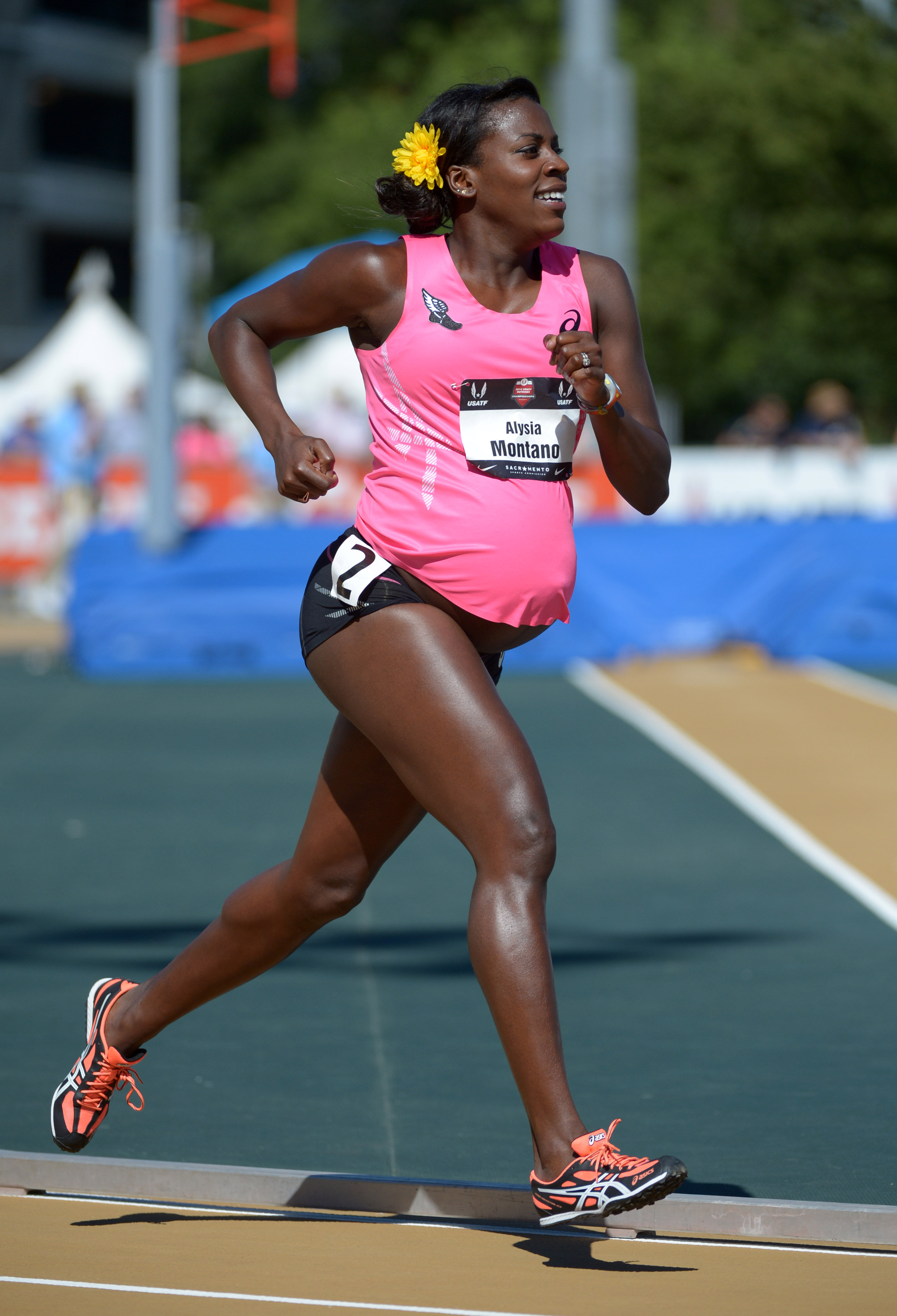
Alysia Montaño competing at the 2014 USA Outdoor Championships
Athletes are always pushing the boundaries – doing and accomplishing things that most others would not try or even think of doing.
When Alysia Montaño was considering whether to compete in her fourth straight USA Outdoor championship in 2014, she made a decision to do so – a daring decision considering she was 8 months pregnant!
This link, which shows a list of athletes who competed in the Olympics while pregnant, is filled with names of people who were 5-months pregnant or less. I wrote about the famed Flying Dutchwoman, Fanny Blankers-Koen, who was three-months pregnant when she won four gold medals at the 1948 London Olympics. Today, it is more and more common to hear about athletes competing while pregnant.
But Montaño race at 8 months was eyepopping. She was not out to win the 800 meter competition at the USA Outdoor Championship. In fact, she completed her race 35 seconds off her personal best. Her objective, as she related in this CNN interview, was to show the world what it looks like for a pregnant woman to be working, even as late as 8 months.
I recognized it was unlikely for people to see a pregnant woman running, in general. I wanted people to recognize that fitness and pregnancy is a really good thing, and this is what it looks like being a professional woman, whether my profession happens to be a professional athlete, or a businesswoman who has to go in an office and work 9 to 5. This is what it looks like for me as a professional athlete and wanted people to see that.
Of course, everyone wonders, is it safe? And Montaño has explained in many interviews that she did consult with her doctors, who not only said it was safe, it is a very good idea for women who are pregnant to exercise. Montaño explained that the immediate concern in running is not to fall. But like walking down the street, when a pregnant woman’s center of gravity is different from when she is not pregnant, she has to always remember to keep the posture upright. Montaño concentrated on doing so during the race.
In Montaño’s interview with ABC News, Senior Medical Contributor Dr. Jennifer Ashton explained that “pregnancy is not a disease,” and “we have to remember, pregnancy, labor and delivery – we have to train for them.”
As explained in this article, only one out five pregnant women exercise according to a study commissioned by the International Olympic Committee, and that “The American Congress of Obstetricians and Gynecologists (ACOG) recommends at least 150 minutes per week of moderate-intensity aerobic activity for women with uncomplicated pregnancies (although contact sports, scuba diving, sky diving, hot yoga or activities with risk of falling should be avoided, reads the organization’s opinion).”
Said Dr. Raul Artal, who co-authored the report, “pregnancy should not be a state of confinement but rather an opportunity for women to continue an active lifestyle or to adopt an active lifestyle if they were not active before.”
Amber Miller competing at the 2011 Chicago Marathon
Amber Miller certainly didn’t confine herself. At the age of 27, while 39 weeks pregnant, Miller ran in the 2011 Chicago Marathon. It was not publicized, but when people realized she was pregnant, she got a lot of double takes and words of encouragement, as noted in this New York Times Well blog post.
Miller finished the race three hours off her personal best, in 6 hours and 25 minutes, mixing in walking with running. But then after the marathon, she embarked on a second one. While running she experienced contractions. Eight hours after completing the marathon, she gave birth to a baby girl. Which of the two was more difficult? “I don’t feel anything from the marathon, but I do feel what you’d expect after giving birth,” she said the day after.
So for all the mothers who have toughed it out, by just having children, Happy Mother’s Day!
My dear Father, my dear Mother, I enjoyed the delicious three-day tororo soup, the dried persimmons, and the rice cakes. My dear Brother Toshio, and my dear Sister, I enjoyed the delicious sushi. My dear Brother Katsumi, and my dear Sister, I enjoyed the delicious wine and apples. My dear Brother Iwao, and my dear Sister, I enjoyed the delicious shiso herbal rice, and the nanban zuke pickles. My dear Brother Kikuzo, and my dear Sister, I enjoyed the delilcious grape juice and Yomeishu wine. I enjoyed them. And thank you, my dear Sister, for the laundry you always did for me. My dear Brother Kozo and my dear Sister, I thank you for the rides you gave me in your car, to and fro. I enjoyed the delicioius mongo-cuttlefish. My dear Brother Masao, and my dear sister, I am very sorry for all the worries I caused you. Sachio-kun, Hideo-kun, Mikio-kun, Toshiko-chan, Hideko-chan, Ryosuke-kun, Takahisa-kun, Miyoko-chan, Yukie-chan, Mitsue-chan, Akira-kun, Yoshiyuki-kun, Keiko-chan, Koei-kun, Yu-chan, Kii-chan, Shoji-kun: May you grow up to be fine people. My dear Father and my dear Mother, your Kokichi is too tired to run anymore. Please forgive him. He is sorry to have worried you all the time. My dear Father and Mother, Kokichi would have liked to have lived by your side.
These were the handwritten words of Kokichi Tsubaraya, one of two notes he left as explanation for why he took his life in his dormitory room of the Ground Self Defense Forces. Tsuburaya was a soldier, but he was also a Japanese icon, winning the bronze medal in the marathon at the 1964 Tokyo Olympics. As he wrote, he was simply “too tired to run anymore”. As described in a previous post, injuries and heartbreak may have led to Tsuburaya’s demise.
Suicide rates, while decreasing in recent years, thankfully, have been traditionally high in Japan compared to other countries. Perhaps there is a romanticism connected with suicide in the deep recesses of Japanese culture. So when some of Japan’s most celebrated writers, Nobel Prize winners Yukio Mishima and Yasunari Kawabata, read the suicide note of Kokichi Tsuburaya, they swooned at the simple yet striking words of the athlete. Mishima viewed Tsuburaya’s notes as “beautiful, honest and sad.” And as Makoto Ueda explained in his book, Modern Japanese Writers and the Nature of Literature, Kawabata was even jealous of the quality of Tsuburaya’s poetry.
Kawabata was deeply moved upon reading this suicide note. After citing it in its entirety, he offered to explain why: “in the simple, plain style and in the context of the emotion-ridden note, the stereotyped phase “I enjoyed” is breathing with truly pure life. It creates a rhythm pervading the entire suicide note. I tis beautiful, sincere, and sad.” Kawabata then observed that this suicide note was not inferior to similar notes written by reputable writers, despite the fact that Tsuburaya was an athlete who boasted no special talent in composition. Kawabata even felt ashamed of his own writings, he said, when he compared them with this note.
Another giant of Japanese literature, Kenzaburo Oe, was also impressed by the suicide note of Tsuburaya. At a series of talks Oe gave at the University of California, Berkeley in April 1999, he talked about how Tsuburaya’s suicide note was a wonderful cultural marker of the 1960s, a reflection of Japan in a state of transition during a period of intense social, economic and political change. Let me quote Oe at length here:
We know from this note that Kokichi Tsuburaya was from a big family. The many names he mentions probably do not evoke any particular feeling in a non- Japanese, but to a person like myself—especially to one who belongs to an older generation of Japanese—these names reveal a naming ideology of a family in which authority centers around the paternal head-of-household. This family-ism extends to the relatives. There is probably no large family in Japan today where children are named so thoroughly in line with traditional ethical sentiments. Tsuburaya’s suicide note immediately shows the changes in the “feelings” of the families of Japanese these past thirty years.
The many foods and drinks he refers to also tell of the times. Twenty years had passed since Japan’s defeat, and it was not a society of food shortages. But neither was it the age of satiation and Epicurean feasting that began ten years later. The year Tsuburaya died was the year that Nikkeiren, the Japan Federation of Employers’ Association, tried to counter the spring offensives—the annual demand by labor unions for wage hikes and improved working conditions—by arguing that the sharp increase in prawn imports was evidence of a sufficient rise in the standard of living. More consumers were eating imported frozen prawns. Business administrators keep an eye on such trends. And I think that honestly expresses the eating habits of Japanese people at this time.
Domestically, 1968 saw the rage of student rebellions, most noted among which were the struggles at Tokyo University and Nihon University. Outside of Japan, there was the May Revolution in Paris, and the invasion of Soviet troops into Prague. In retrospect, we clearly see that the world was full of premonitions of great change.
Against this backdrop, a long distance runner of the Self-Defense Forces— itself a typical phenomenon of the state of postwar Japan’s twisted polysemous society—turned his back on the currents of such a society, alone prepared to die, and wrote this suicide note. In the note, the young man refers to specific foods and drinks, he encourages his nephews and nieces to grow up to be fine people; he is overwhelmed by the thought of his parents’ loving concern for him and writes that he knows their hearts must never have rested in their worry and care for him. He apologizes to them because, having kept running even after the Olympics with the aim of shouldering national prestige, he became totally exhausted and could no longer run. He closed his note with the words: “My dear Father and Mother, Kokichi would have liked to live by your side.”
Tsuburaya was a man of his times, celebrated in 1964 for his accomplishments as an athlete. Today he is also remembered for his eloquence in representing the Every Man in Japan, a poet who is said to have captured the essence and the angst of those times.
But as related in this post, Tsuburaya was a man of commitment, and he promised he would work hard to ensure he was ready to compete and do better at the 1968 Olympics in Mexico City. Not only did Tsuburaya feel that added weight to make up for the “loss” of silver, so too did his seniors at Tsuburaya’s place of employment, Japan’s Ground Self Defense Forces.
Tsuburaya did indeed train hard. And yet, somehow, he also found time for courtship, as explained in Ichiro Aoyama’s book, The Lone Runner – The Kokichi Tsuburaya Story. He had a met a girl named Eiko before the Tokyo Olympics, and he wanted to marry her after the Tokyo Games. His coach at the Self Defense Forces athletics school, Hiro Hatano, was supportive of the proposed marriage. Tsuburaya’s parents too approved of their son’s plans to marry Eiko.
One would assume that further approval would be unnecessary, but in 1966, coach Hatano’s boss expressed his dissatisfaction with the union. Perhaps Hatano’s boss thought that Tsuburaya needed to keep his focus 100% on his training – I’m not clear yet on the specifics. But in a country where hierarchy determines status and power, and in the context of a military culture where the norms of hierarchy are amplified even more, Hatano’s boss had the power to overrule a personal decision of someone in his organization.
Perhaps, in an exercise of power that feels cruel, Hatano’s boss brought Hatano, Eiko and Eiko’s mother together to inform them that the marriage to Tsuburaya would have to wait until after the Games in Mexico City so that Tsuburaya could focus solely on his training. Tsuburaya was not present in that meeting.
Eiko was devoted to Tsuburaya and wanted to wait until they could get married. But Eiko’s mother was no longer supportive, worried that marriage to a famous man like the marathon bronze medalist who had the weight of a nation’s expectations on his shoulder would only lay unknown burdens on the shoulders of the wife. Perhaps more of a concern, Eiko’s mother was not confident that a marriage to Tsuburaya was a sure thing in two years, and was worried that Eiko, at the age of 22, could lose other opportunities to marry well in that period.
Tsuburaya (left) and gold medal weighlifter Yoshinobu Miyake (right) celebrating their Tokyo Olympic medals.
In the end, the proposed marriage of Kokichi and Eiko was broken off. Tsuburaya’s coach and manager, Hatano, was left with the unfortunate task of informing Tsuburaya. Hatano protested these decisions to his own boss to the point where he ended up being demoted and removed as Tsuburaya’s coach. Tsuburaya thus had to train on his own, likely feeling quite alone. Very quickly, injuries began to plague Tsuburaya – first the return of the intense pain of the slipped disc, and then an injury to an achilles tendon, which required surgery in 1967.
At the end of 1967, Tsuburaya returned to his hometown of Sukagawa, Fukushima for the long holiday break that bridges the old year with the new. Tsuburaya’s father was pained with news that he wasn’t sure he should share with his son. But he thought it best to tell his son before he found out on his own – that his former fiancé, Eiko, had gotten married. Kokichi replied “Oh, Eiko-san is married. That’s good for her.” The son pretended that he was OK with the news, but his father could tell that his son was shocked and saddened.
Tsuburaya returned to his Self Defense Forces base after his time with family during the New Year’s break. And on January 8th, 1968, he slit his wrist and died in his dorm room.
Note: Special thanks to my researcher, Shiina Ishige, for her in-depth research that contributed heavily to the writing of this post.




You must be logged in to post a comment.