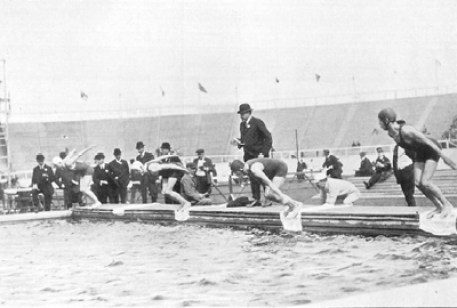
When it opened in time for the opening ceremonies of the 1908 London Games, The White City Stadium sat 68,000 people, although it could fit another nearly 30,000 standing spectators. It had an oval running track, about 7 meters wide. And between the running track and the stands was a cycling track that was another 11 meters wide.
The oval tracks were so wide that, in addition to space for athletic events like archery and hammer throwing, there was enough room for a swimming and diving pool!
Unfortunately, the 1908 Olympics was the stadium’s high point. In 1927, it was sold to the Greyhound Racing Association, literally going to the dogs. The stadium no longer exists, torn down in 1985 to make way for the headquarters of the BBC.
BBC Television Centre takes shape in the late 1950s with White City Stadium nearby
Dawn Fraser was on top of the world, after winning gold and silver medals, adding to her haul of 8 medals over three Olympiads. She was honored with the task of carrying the Australian flag in the closing ceremony on Saturday, October 24.
But it was Friday, and the night was still young. And when you’re Dawn Fraser, you can’t help but let a bit of the larrikin out.
The competitions were over and the party was on at The Imperial Hotel. The Australian swim team had gone home already, but Fraser had the entire Australian hockey team to party with. As she described in her book, Below the Surface – Confessions of an Olympic Champion, “at one stage one of the Olympic officials was wearing a kimono while the owner of the kimono was dancing about in a large Australian dressing gown.”
Around 2:30 am, a little less than 12 hours prior to when Fraser was scheduled to march into the National Olympic Stadium carrying her country’s flag, a plan was being hatched. Fraser and her friends were going to embark on a shady tradition of sorts in the Olympics – pinching flags.
A friend of hers, whom she refers to as an official, tells her that he’s found an ideal place to “pick up some good flags.” Fraser, the official and a hockey player slip away from the party, and walk through the darkened Tokyo streets until they arrive at the Emperor’s Palace. Again, here’s how Fraser explains it in her autobiography, Below the Surface:
We followed the moat for a while, and suddenly we were in the middle of a large flutter of flags. The flagpoles were sprouting like exclamation marks all round us. We chose a fine big Olympic banner with the five circles on it, and one of my companions bunked himself up on the shoulders of the other. They swayed around a little, and they swore once or twice; but finally they pulled the flag loose. ‘Quick,’ said one of them. ‘Cop this.’ I took the flag. ‘Go for your life,’ said the other. ‘The demons are coming.’
The “demons” were the police. Fraser tried to hide in a large shrub, but the police found her and started beating on her feet with a baton, so she threw the flag away and ran again. She saw a bicycle and hopped on it to get her further from the police “yelping and whistling” behind her. After all, she was making her escape on a policeman’s bike. That’s when she saw the Palace moat, and thought she could disappear into its darkness. “I figured that no policeman would ever catch me once I hit the moat,” she wrote.
Australian swimmer Dawn Fraser on a bicycle, from the book The Olympic Century XVIII Olympiad
In the panic, she ran into a brick wall, jumped 8 feet down into the moat onto more concrete and badly twisted her ankle. That’s when the police caught her.
At the Marunouchi Police Station, to where she was taken, no one would believe that she was not only an Olympic athlete, but that she was the world-famous Dawn Fraser. She had no identification on her, so the best she could do in the middle of the night was to contact a friend to bring her identification, and vouch for her. This friend was Lee Robinson, who was filming a documentary about Dawn Fraser. He brought the ID and the
Medallists in the 100 metres freestyle swimming event at the Tokyo Olympics, 15th October 1964. Left to right: silver medallist Sharon Stouder of the U.S.A., third time gold medallist Dawn Fraser of Australia and bronze medallist Kathleen Ellis, also of the U.S.A. Fraser is holding up her lucky kangaroo mascot. (Photo by Central Press/Hulton Archive/Getty Images)
No woman had ever won gold in three successive Olympics in the same event, but Dawn Fraser of Balmain, Australia was gunning for it.
Fraser’s breakthrough was at the Melbourne Olympics in 1956 as she beat her fellow Australians in the 100-meter freestyle, becoming an overnight sensation. Then in Rome, the American swimming team was a rising power, but Fraser stared them down to win the 100 meters. In Tokyo, the Americans were expected to win everything. And they came close. But Fraser, at the age of 27, beat 15-year old Sharon Stouder, and 17-year old Kathy Ellis to assure her status as one of the Olympiad’s greatest heroes.
But heroes often must pass painful trials to complete their journey. 1964 proved to be an emotional roller coaster for Fraser, beginning with a disaster for Fraser only 8 months before the Tokyo Olympics.
In February, Fraser was peaking, setting the world record in the 100 yards, and winning the 220 yard title at the National Championships in Sydney. One evening shortly after those championships, she and her family were enjoying an evening out. She had a car and offered to drive her sister home, accompanied with her mother and her friend, Wendy Walters. Here is how she describes the fatal crash in her autobiography, “Below the Surface“, that ended her mother’s life:
I was driving about 40 miles an hour. I’d been driving for 10 years, and I knew that this was about my limit with my mother on board; she was nervous about speed. We were sweeping around a curve on a highway called General Holmes Drive when I saw what looked like the cabin of a truck dead ahead. At the same moment, Wendy, who was next to me in the front seat, called out, ‘Look out, Dawn.’ I remember pulling the wheel hard to the right, and I think I must have hit the brakes hard. I learned a long time later that the driver of the truck we hit had parked his vehicle while he went fishing nearby in the Cook’s River. But my recollections of the crash are vague: a gigantic close-up of the cabin in our headlights, a high screech of tires on bitumen, and a terrible crash.
Walters had injuries to her face, while Fraser and her brother Ken recovered from injuries after arriving at the hospital unconscious. Fraser’s mother, however, was killed in the accident.
Over my last few days in the hospital, I was trying to sort my life out again, trying to adjust to the idea that my mother wasn’t there anymore. I couldn’t believe that it had all happened. And I kept blaming myself, because I had been driving the car. My mother was 68, and I was completely devoted to her; I don’t think I really knew how close we were until the accident, and then it was too late. My family kept trying to talk me out of my depression, telling me that it was foolish to accept the blame.
Fraser had pretty much given up on going to Tokyo. She was depressed, feeling guilty. She was at the wheel. She was responsible. On top of that, she had to wear an uncomfortable steel brace for nine weeks that kept her neck and back immobile, forcing her to turn her whole body just to talk to someone to her side. But recover she did, returning to the water
Belgium put in their bid for the 1920 Olympics in 1912. Little did they know that Archduke Ferdinand would be assassinated in 1914, sparking World War I. Germany overran Belgium, clearly overriding any planning for the Olympics. In fact, the Olympics in 1916 were cancelled.
But when the war ended in 1919, Antwerp was selected to hold the 1920 Summer Games.
Over 9 million soldiers died in World War I. Around 7 million civilians died as a result of the war. The invasion of Belgium by Germany is often called “The Rape of Belgium“, during which over 27,000 Belgians were killed by German soldiers, an additional 62,000 died of hunger or due to lack of shelter, and one and a half million Belgians fled the country.
Aileen Riggin was part of the first ever US women’s team in the Olympics, which competed at the 1920 Antwerp Games. She got to Belgian in the SS Princess Matoika, which was known as the Death Ship as it had transported war dead from Europe to the US. In the book, Tales of Gold, Riggin shared memories that showed the war was still very much in the minds of people living and competing in Antwerp. As Riggin was a 14-year-old girl at the time, I simply cannot imagine how she felt.
“When we were not training, we went on several trips around Antwerp in our truck, and one was to the battlefields. The mud was so deep that we could not walk, so we stopped along the line and bought some wooden shoes and learned how to walk in them. They were not too comfortable but they did protect our feet from the mud. I do not know how we happened to be allowed on the battlefields, because they had not yet been cleared.”
“In places they were still the way they were in 1918, when the Armistice was declared. We even picked up shells and such things and brought them home as souvenirs. There were trenches and pillboxes and things like that scattered about the fields, and we looked into some of them, and they were deep in water. There were some German helmets lying on the field, and we brought some home with us. I picked up a boot and dropped it very hurriedly when I saw that it still had remains of a human foot inside. It was a weird experience, and we were glad to leave. It must have taken them another year to clear off the battlefields from the way we saw them. They were in shambles.”
Aileen Riggin on the victory stand, from the book “Tales of Gold”How a war devastated country could take on an international event while still in a “shambles” is hard to imagine. But the Belgian authorities did what they could, improvising in some ways. For example, the diving competition was held in a large ditch at the base of an embankment, created as a form of protection if a war were to come to Belgium. Riggin, who competed as a diver, describes the venue.
“On our second day in Antwerp an army truck came to drive us to the stadium where we were to swim. Words fail me in describing our first view of this place. I had never seen anything like it. it was just a ditch. I believe they had had rowing races there at one time. There were boardwalks around the pool – I have to call it a pool – to mark the ends. In the center
She’s not an athlete. She’s an IT consultant from Chicago. And she had just seen the documentary, “Back on Board: Greg Louganis“, the HBO documentary about the diving legend. When she sees the scene of Louganis walking though the Swimming Hall of Fame, passing by a series of Wheaties cereal boxes on display, he says “never got a Wheaties box – “In that moment,” Sondgerath writes, “I was inspired to start a campaign asking General Mills to ‘Put Greg Louganis on the Wheaties Box’.
Julie Sondgerath went to Change.org and submitted a petition that over 40,000 people signed on to, including me. Six months later, on April 5, Sondgerath got word: “I’m proud to announce that the campaign was a success!,” wrote Sondgerath on change.org. “Today, Wheaties will have a press release to unveil a WheatiesLegends Campaign to begin with a legacy photo of Greg Louganis on the Wheaties box! Congratulations to Greg, as well as Janet Evans and Edwin Moses! I can share with you that he is beside himself with excitement!”
No other man has won gold in both the 3-meter springboard and 10-meter platform in two consecutive Olympics, doing so in Los Angeles in 1984 and Seoul in 1988. Louganis had often wondered that the reason he didn’t get on the Wheaties box, or perhaps other financially lucrative sponsorship deals, was the rumors at the time that he was gay. In fact, Louganis is now openly gay, having come out in 1994.
General Mills has downplayed the reasons for now placing Louganis on the box. They said that there are many athletes who deserve to be recognized, which is why they also chose to create boxes for Olympic legends Janet Evans and Edwin Moses. The New York Times quotes Mike Siemienas, manager of brand media at General Mills, saying that the choices
In the film, Batman Vs Superman, two iconic comic book characters are brought face to face, setting up the inevitable debut of the Justice League from the DC universe. In the series, the Avengers, countless super-heroes of the Marvel universe have been brought together much to the delight of geeks and fanboys.
In the 1912 Olympics in Stockholm, Sweden, there was a super-hero team up of sorts when Jim Thorpe and Duke Kahanamoku were selected for the US Olympic Team. Thorpe is considered one of the greatest athletes the world has ever known. At the 1912 Olympics, Thorpe won, amazingly, both the pentathlon and the decathlon.
Jim Thorpe(left) and Duke Kahanamoku (right) in 1912
Duke Kahanamoku of the then American territory of Hawaii helped popularize surfing beyond his Honolulu shores. At the 1912 Olympics, he won the 100-meter finals becoming the fastest swimmer in the world.
Like most super-heroes, Thorpe and Kahanamoku were the outsiders. The Native Indian Thorpe and the Hawaaiin Kahanamoku were relatively dark skinned, and were seen as exotic by mainstream America, as explained by David Davis in his wonderful biography of Kahanamoku called Waterman: The Life and Times of Duke Kahanamoku. Davis shared a typical headline from the Detroit Free Press, which accompanied a picture of Kahamoku and a black athlete, Howard Drew: Two Dark-Skinned Athletes with American Team”
The head of the US Olympic squad, John Sullivan, was typical of the times – he believed in the superiority of white athletes, and male athletes. But as Davis explained, he was also
Ken and Jeanne in Tokyo, from the collection of Jeanne Collier
He was a 19-year-old university student from Illinois. She was an 18-year-old high school student from Arizona. They would go on to be diving’s power couple in Tokyo as Ken Sitzberger won gold in the men’s 3-meter springboard diving competition, and Jeanne Collier took silver in the women’s 3-meter springboard competition.
Collier told me that there was some resistance by the coaches to their dating during final preparations for the XVIII Olympiad in Tokyo, but she said there was never really anything to worry about regarding their readiness.
We met in 1962 at a Nationals. He was from Chicago and I was from Phoenix. We had a letter writing campaign. He went to Indiana. I was still in high school. We got to know each other. So as we prepared for Tokyo, he and I hung out together. The coaches didn’t like that. But it was harmless. At that time, we would have time off, talk at meals, but the focus had to be on training.
Ken and Jeanne on their wedding day, from the collection of Jeanne Collier
And the results spoke for themselves. Not only did Sitzberger and Collier win medals at the Tokyo Summer Games, they did so in dramatic, come-from-behind fashion.
In Sitzberger’s case, he was trailing USA teammate Frank Gorman going into the penultimate 9th dive of the competition. While Gorman had his worst dive of the competition, Sitzberger had his best, leapfrogging Gorman into the lead. Despite a strong final dive from Gorman, Sitzberger was able to hold on to win. As his coach, Jerry Darda, was quoted as saying, Sitzberger was a confident person, who a year before, despite winning bronze at the Pan American Games, told Darda that he would win gold in Tokyo.
“Kenny said right-out: ‘I’m going to win the gold medal.’ I didn’t want to ruin his confidence, but I asked him how he could be sure. He had barely made the team and missed fourth by only five points. But Kenny had analyzed the whole thing, the strengths and weaknesses of the other divers who were ranked one, two, three in the world – they were his competition – and he knew they’d all be going to training camp for a few weeks before the Olympics. He told me ‘Those guys are going to see me in training camp and that’s going to help me. They’re going to feel a lot of extra pressure after they see me dive every day. They’re going to realize I just don’t miss.'”
In Collier’s case, she was trailing her teammate Patsy Willard as they entered the final optional dives, the three dives where the level of difficulty can send you crashing out of the race, or propel you to victory. The reigning Olympic champion, Ingrid Engel-Kramer of East Germany, led the competition from start to finish, and took gold for the second consecutive Olympics. Willard had a 3-point lead on Collier entering the optional dives, as well as the experience of battling the Olympic pressures in Rome four years before. On top of that, Collier did poorly on her first optional dive – “a forward 2 ½ somersault, which was horrible.” But she pulled herself together for a come-back.
“I had a talk with myself. I had the highest degree of difficulty. I had my two highest difficulty dives left and they were to be my best dives.” Collier snatched silver from her
What does it take to go from London to Rio on human power? Physically fit, mentally strong, well organized fanatics on a mission.
On January 9 of this year, 2 men and 2 women got on their bikes and cycled over 2,400 miles from Olympic Park in London to Lagos, a port town in southern Portugal. On January 31, they left Lagos and started rowing a 8.6 meter long boat called a Rannoch R45, which can house four or five people uncomfortably, allowing three people to row at the same time. They are currently close to the halfway mark rowing a total of 3,600 miles with the intent of hitting land at Recife, Brazil. From there, they will cycle down the Brazilian coast to Rio de Janeiro, which should take another four weeks.
The mission is raise awareness of the upcoming Rio Olympics, making the literal connection between the past 2012 Olympic venue with the future 2016 venue. But on the way, they are raising funds for cancer research, as well as their journey’s operations.
The four team members are:
Susannah Cass: a 27-year old PhD student of botany from Dublin
Jake Heath: a 29-year old podiatrist from Twickenham
Mel Parker: a 27-year old fundraiser for a children’s charity from Gloucestershire
Luke Richmond: a 31-year-old cross-fit and Olympic lifting coach from Australia
And their posts on the journey rowing south 24 hours a day are fascinating:
Luke Richmond, Day 1-3: It was a brutal first day and night, sea sickness had three of us spewing all at once, only Jake seemed un effected. I was sure I was about to die.
Jake Heath, Day 1-6: The trip so has been life changing already, because I have realized how much you can push your body, if you can keep breaking things down on the small tasks, like the two hour stretch in front of you. I am currently switching inwith Luke every two hours for 24 hours a day, as we row our way across to Brazil. The girls are also switching with each other, every two hours, but staggered by one hour with us, so everyone gets to spend some time together.
Jake Heath, Day 7&8: We have been on what seems like a giant conveyor belt of water and big waves. It’s all good and going in the right directions for us to reach the canaries in two days and then push on to Cape Verde straight after. The sea swells are pretty big and at night they can catch you off guard and just crash over your head. Last night Captain Susannah caught a high wave, which went all over her, but I luckily was out of the rowing seat having a stretch and remained bone dry. Carbon copy thing happens to Mel the next I shift, this time I was getting a drink and avoided it once again. I know what you are thinking? I promise I am actually doing some of the rowing!
Mel Parker, Day 18: Imagine your bed is 1m by 1m, around your little square of bed you have everything tied to the walls – your wardrobe, toiletries and a few days food. Above you you’ve got all the comms and electronics you could need to get you safely across an ocean. Behind your head you have the worlds noisiest neighbour, which sounds like a robotic Jurassic park, but is working hard to make sure you’re steering in the right direction.
If you’re interested in making a donation to help the MacMillan Cancer Support organization fight cancer, go to this link.
If you’re interested in following the exploits of this fantastic four, here is a link to their blog – Row2Rio. And stay tuned!
“I am, indeed, a king, because I know how to rule myself.” – Pietro Aretino
There’s a powerful message in the Under Armour “Rule Yourself” campaign. Being the best is hard work!
The most recent iteration of the Rule Yourself campaign features the greatest swimmer of all time, Michael Phelps, who hopes to add to his record number of gold medals at the Rio Olympics later this year. But as the commercial is trying to convey, Phelps’ achievements didn’t come only because he has natural talent, but because he applied an unnatural effort, sacrificed, and then achieved.
A few weeks ago, Under Armour released a commercial featuring members of the US women’s gymnastics team, also putting on display the rigorous training regimen of athletes competed to reach the highest levels of excellence.
There was a time people would say there is genius in the world, that the Mozarts and Tiger Woods of the world were born with talent. They were the chosen ones. There may very well be genetic advantages that can be parsed out. But a more likely explanation is that they worked hard at their craft. And in fact, research has shown that the greatest of the great, in any discipline, have often applied at least 10,000 hours of practice.
One of the populizers of this hypothesis is the acclaimed journalist, Malcolm Gladwell, who has developed a knack for featuring the best of the best in his stories. In the book, Outliers: The Story of Success, he writes extensively about the 10,000 hour rule, and quotes author and neurologist, Daniel Levitin to explain.
“The emerging picture from such studies is that ten thousand hours of practice is required to achieve the level of mastery associated with being a world-class expert – in anything,” writes the neurologist Daniel Levitin. “In study after study, of composers, basketball players, fiction writers, ice skaters, concert pianists, chess players, master criminals, and what have you, this number comes up again and again. Of course this doesn’t address why some people get more out of their practice sessions than others do. But no one has yet found a case in which true world-class expertise was accomplished in less time. It seems that it takes the brain this long to assimilate all that it needs to know to achieve true mastery.”
Ten thousand hours.
It is as large a number as it seems. If 10 years is 3650 days, and thus 87,000 hours, then to get to 10,000 hours over ten years, you would have to spend nearly 3 hours a day training or practicing. Imagine a 20-year-old woman who makes the Olympic Games. From the age of 10, she’s spending finding time on the rink once or twice day, with longer days on the weekends…for ten years. This doesn’t include the travel time for her and her parents, the pain, the emotional highs and lows, the struggle to maintain school attendance and grades, and an even more heightened sense of self and insecurity as she struggles in her quest through puberty and her teens.
They make it look easy. But it isn’t. For first, you must rule yourself.
They came in 18th overall in the Flying Dutchman (FD) competition, but they came in first in the hearts of the Japanese.
Stig Lennart Käll and his younger brother Lars Gunnar Käll were sailing in the third race of seven in the 1964 Tokyo Olympics FD-class competition when they saw another boat ahead of them capsize, and of the two crew members floating in the middle of the Sagami Bay. Making a fairly quick decision, the Käll brothers steered their way towards the sailor in the water and plucked Australian Ian Charles Winter out of the water. Then they proceeded to the capsized Australian boat, Diablo, to rescue the second member of that crew, John Gregory Dawe, pulling him into the Swedish boat, Hayama.
According to the Japan Times on October 21, 1964, the exploits of the Swedish FD crew were publicized nationally in the Japanese press, sparking a barrage of gifts to be sent by grateful well-wishers to the sailing Olympic Village in Oiso, not far from the Enoshima Harbor where the sailing competition was taking place.
Their behavior also led to the creation of the Fair Play Prize. The first winners of this prize – the Käll brothers.
The Swedes still placed 12th out of 20 in that particular race. Seven others, including the Australian boat, did not finish the race. Of the six other races in the competition, this had by far the highest number of boats that could not finish. And yet, the Swedish brothers not only finished, they beat out one other boat – this despite taking time to rescue the Australians, and taking on considerable extra weight with the two new crewmen.




 One of the populizers of this hypothesis is the acclaimed journalist, Malcolm Gladwell, who has developed a knack for featuring the best of the best in his stories. In the book,


You must be logged in to post a comment.