kasumigaseki-country-club
Kasumigaseki Country Club in Kawagoe City, Japan. (Photo by Streeter Lecka/Getty Images)

“The enjoyment of the rights and freedoms set forth in this Olympic Charter shall be secured without discrimination of any kind, such as race, colour, sex, sexual orientation, language, religion, political or other opinion, national or social origin, property, birth or other status.” – Principle 6 of the Olympic Charter

Principle 6 was challenged by Russia in the lead up to the 2014 Sochi Winter Olympics when:

  • a Russian judge would not allow construction of a Pride House, which is where athletes who are lesbian, gay, bisexual or transgender (LGBT) can gather during an Olympic Games, and
  • a law was passed that banned “propaganda of non-traditional sexual relationships” among minors, which was perceived to outlaw any reference to LGBT.

The associated homophobic violence in Russia and the uproar in media outside of Russia left the IOC wondering what they could do to give teeth to Principle 6. But it’s likely they only really started considering the seriousness of the situation when a group of over 50 current and former Olympians banded together to start a campaign asking the Russian government to reconsider the law on “gay propaganda”. They called this campaign, the Principle 6 Campaign.

The IOC got the message. According to The Guardian, the IOC established a new clause to the host city contract. So when a city bids for an Olympic Games, their bid mush show they are complying with this clause: “Any form of discrimination with regard to a country or a person on grounds of race, religion, politics, gender or otherwise is incompatible with belonging to the Olympic movement.”

Perhaps unfortunately, the host city contract did not have these “teeth” in 2007 when Sochi won the bid for 2014. But any city wanting to bid in the future have to show their country is not blatantly exercising discrimination.

Japan is not a country that blatantly discriminates. While it is considered one of the most meritocratic countries in the world, there are times when non-Japanese have various cultural or legal issues, or females wonder whether they are getting treated fairly. But it is subtle and discussion today is more common and open on the issues and how to improve them.

Which brings us to golf.

yuriko-koike-speaking-about-kasumigaseki-country-club
Tokyo governor Yuriko Koike, has asked the proposed course for the golf tournament at the 2020 Olympics, Kasumigaseki Country Club, to admit women members Credit: Aflo/REX/Shutterstock

For the first time in history, Tokyo has a female governor, Yuriko Koike. In addition to taking a microscope to the ballooning Tokyo2020 budget, she poked the ribs of an organization that does not allow women to enjoy full membership – the Kasumigaseki Country Club. Under ordinary circumstances, it is unlikely that a governor would want to take on a private association over female membership as a top ten priority. But Japan will be hosting the 2020 Summer Games, and Kasumigaeki CC is slated to be the venue for golf. Suddenly, the country club became an easy target.

Why?

Because the governor can exercise what is known in Japan as “gai-atsu”, or the tactic of

jamaica-4x100-beijing
Nesta Carter, second from left, tested positive for doping following Jamaica’s relay gold win at the 2008 Summer Olympics in Beijing. (Kevin Frayer/The Associated Press)

The 4×100 relay is a team sport in the strictest ways – all four individuals have to do their part, either by executing exactly to plan and training, or by following the rules to ensure minimum eligibility. If one individual fails, the entire team fails. There is very little room for error.

At the 2008 Beijing Olympics, Usain Bolt made history running the third leg in the 4×100 men’s relay, becoming the first person ever to win gold in the 100-meter, 200-meter and 4×100 men’s relay in the same athletics event. Not only that, he achieved all three victories in world record time.

But in late January of 2017, it was announced that his teammate, Nesta Carter, had tested positive for a banned stimulant (methylhexaneamine). In 2008, after the finals, Carter’s urine test came up negative. But due to the shocking news last year of systematic state-sponsored doping in Russia, the IOC asked for re-testing of results going back ten years, as the tools to uncover traces of banned substances has improved significantly over the years. Dozens of athletes have now tested positive, many of them medalists, including Carter. And because Carter has been disqualified, so too has the entire Jamaican 4×100 team.

Many who love and respect Bolt feel Bolt’s record has been tarnished, perhaps unfairly. And when Bolt and his teammates won gold in the 4×100 relay at the Rio Olympics, he became the first person ever to win the 100-meter, 200-meter and 4×100 men’s relay in three straight Olympics – the so-called Triple Triple. Well, that golden symmetry has been disturbed with the removal of the 4×100 gold in Beijing.

But most people will agree, the loss of the relay gold will not hurt Bolt’s immense legacy. Even Bolt believes that to be the case. “I think I’ve accomplished a lot. This hasn’t changed what I have done throughout my career. I have worked hard and pushed and done things that no one has done before. I have won three gold medals over the 100m and 200m, which no one has ever done before.”

trinidad-and-tobago-silver-at-beijing
Trinidad and Tobago trading up from silver to gold

The part of this story that does not get played up, the happy side of this story, is the medalists who move up the medal table:

Trinidad and Tobago: a traditional powerhouse in sprinting, took Olympic gold in the 4×100 meter relay for the first time. While they could have whooped it up, there is so much respect for Usain Bolt amidst the Caribbean nations, that the celebration in Trinidad and Tobago was somewhat muted, as represented in the comments of Trinidad’s gold-medalist, Richard Thompson. “Bolt’s achievements have been recorded in the annals of athletics and no one can take that away. Rather than lament for the Jamaican team, I prefer to focus all my energy on lauding my Trinbagonian athletes who ran a ‘clean’ race.”

Japan: At the Rio Olympics, Japan took silver in the men’s 4×100 relay, second only to mighty Jamaica, in a surprise. The Japan team had bested their country’s top men’s relay track result, bronze at the Beijing Olympics. But now, the men’s sprint team from 2008 are now equal to the 2016 – silver medalists. And heading into the Tokyo2020 Olympics, young runners have even greater reason to be inspired to train hard, run clean and dream.

Brazil: Perhaps the happiest group in these medal re-shuffles are the fourth-place finishers who wake up one morning to find out they are now bronze medalists. They missed the pomp and circumstance of standing on the medal podium and seeing their flag raised in front of billions of people. They may have missed financial opportunities that come with a medal finish right after the Olympics. But they now have something they didn’t expect to have – a medal. As Bruno de Barros, a member of Brazil’s 4×100 relay team, said “It’s a great sense of happiness, despite the time lapse, which isn’t really important. The feeling of being an Olympic medalist is the same. In fact, after waiting so long, it’s worth more.”

shinji-takahira-handing-off-to-nobuharu-asahara-of-the-now-silver-medal-winning-mens-relay-team-from-japan
Shinji Takahira handing off to Nobuharu Asahara of the now silver-medal winning men’s relay team from Japan.
ingrid-engel-kraemer-carries-the-unified-german-teams-olympic-banner-at-1964-tokyo-olympics_the-olympic-century-the-xviii-olympiad
Ingrid Engel Kraemer carries the unified German Team’s Olympic Banner at 1964 Tokyo Olympics, from the book, The Olympic Century The XVIII Olympiad

Before the 1960 Rome Olympics, very few people knew who Ingrid Krämer was. After her victories in the women’s 3-meter springboard and 10-meter platform diving competitions in Rome, she was the face of German sport. According to Der Spiegel in an article in 1964, the newly emerged blonde superstar, Krämer, was inundated by requests for marriage.

Krämer, who eventually accepted a proposal by weightlifter, Hein Engel, proved she was no fluke. In fact, she proved to be the most dominant female diver in the world, by talking gold in springboard and platform by double digit points over her second place competitors at the 1962 European Championships. So when the 1964 Olympics began, Engel-Krämer was a frontrunner.

In the 3-meter springboard competition, Engel-Krämer’s competition were two Americans named Jeanne Collier and Patsy Willard, who aimed to restore glory to the United States and prevent the East German Engel-Krämer from repeating her gold medal victory in Rome. But Engel-Krämer was dominant in the springboard again, taking gold handily.

According to the book, Olympic Games 1964 Innsbruck – Tokyo, edited in German by Harald Lechenperg, Engel-Krämer’s advantage was precision.

People say of the former Olympic victor, Mrs. Engel, that she has no longer possesses the elegance she used to have. Well, her strongest point was never elegance, but sureness. Ingrid Engel dives with a precision of movements which is lacking in everyone else. She makes no mistakes. It is easy to slip up on springboard diving when the body, as if touched by magic, turns, twists and moves about its own axis.

Dresden, Heirat Ingrid Krämer, Hein Engel
Ingrid Kraemer and Heins Engel

Collier told me that if not for a single dive, she could have challenged Engel-Krämer for gold at the Tokyo Olympcis. Collier’s first of the competition’s ten dives was horrible, scoring a horrible 4.5 of ten. But her final two dives, which had high degrees of difficulty, allowed her to pass her teammate to win gold. “Ingrid Kraemer was a beautiful diver,” Collier told me, “and deserved to win. She was the most consistent.”

By taking gold in the springboard, Engel-Krämer would reach the heights of famed diver Pat McCormick, who was then the only woman to have won gold medals in both springboard and platform in two consecutive Olympics. But Lesley Bush of America would have none of that. While the competition was close, Engel-Krämer would take silver.

According to Lechenperg, Bush was relatively unknown, someone who had only taken up platform diving three years prior to the Olympics. But she executed on her plan. “Leslie Bush knows the recipe for success: safety first. She takes the lead during the first compulsory dives. Later on she lets go of it. The “iron” Ingrid now for the first time shows her nerves. She risks everything with one dive, but the judges only give her 16.80 points. Leslie Bush has won.”

British journalist, Christopher Brasher, wrote in his book, A Diary of the XVIIIth Olympiad, that Engel-Krämer may have been a reluctant participant in the Olympics, which could have affected her performance.

I have heard that she didn’t really want to come to Tokyo. She was married a year ago to one of East Germany’s best weightlifters, Heinrich Engel. They are both students at University and the combination of being a Hausfrau and a student doesn’t leave her much time for training. But east of the iron curtain it is only too easy for the authorities to put some gentle pressure on a reluctant athlete. With many of the necessities of life, to say nothing of the luxuries, in short supply, the stars of sport are often given preferential treatment – so it pays to keep on competing.

ingrid-engel-kraemer-tokyo1964_xviii-olympiad-tokyo-1964_asahi-shinbun
Ingrid Engel Kraemer Tokyo1964, from the book,XVIII Olympiad Tokyo 1964_Asahi Shimbun

Der Spiegel offered another explanation why Engel-Krämer was not able to repeat her gold-medal ways in the platform dive – she was a bit too curvaceous. Here is a Google translation of part of that article:

Thus the German, as the first jumper in the world of the double-screw somersaults – a one-and-a-half-turn about the longitudinal axis of the body, with a simultaneous twisting of the body and its transverse axis – succeeded just as accurately as an ordinary head-jump. A 10-meter jump case takes at most 2.1 seconds, a jump from the three-meter board even less. Ingrid Engel-Krämer made her work very quickly.

In Tokyo, Ingrid Engel-Krämer was no longer able to finish her turn so early. A disadvantage that cannot be compensated by training and energy in the long term is the following: the best in the world does not have the ideal figure for her sport. Ingrid Engel-Krämer is only 1.58 meters tall, but weighs 56 kilograms and tends to fullness. “She is as wide as high,” her first coach mocked.

Still, three golds out of four makes Engel-Krämer one of the greatest divers of the 20th century. Despite references to her looks and her moniker, the Doll from Dresden, Engel-Krämer jumped hundreds of times every week, climbing the tower steps 10-meters, smacking into the water painfully, pausing about three minutes and doing that again, over and over. As the Der Spiegel article mentioned regarding her 500 jumps a week, Engel-Krämer become so good that legendary American diving Olympic champion and coach, Sammy Lee admitted that “On a bad day, she’s still good.”

tokyo-2020-anime-ambassadors
Tokyo 2020 Anime Ambassadors

A big part of the pitch for the 2020 Games by the Japan Olympic Committee to the IOC in 2013 was that the Tokyo Olympics would appeal to youth. Along those lines, new sports added to the Games in 2020 are skateboarding, surfing and rock climbing.

At the Tokyo 2020 preview at the end of the Rio Olympics closing ceremony, the world was pleasantly surprised by the emergence of Prime Minister Abe as the world-renown game character, Super Mario.

And last week, Tokyo2020 announced the lineup of its anime ambassadors for the Tokyo Olympics. They include such globally recognized characters as Sailor Moon, Goku from Dragon Ball, Crayon Shin-chan and a classic character that was a huge hit in Japan in the 1950s and was broadcast in the US in the 1960s, Astro Boy.

Anime, the catch-all phrase for Japanese produced comics or animated television or film, has enjoyed a boom internationally. It is a multi-billion dollar industry in the United States alone. Japanese manga in English can be found liberally in bookstores or online. Japanese anime film directors like Hayao Miyazaki and Osamu Tezuka are global icons. And of course, illustrated characters from Japanese games, television programs and films are re-drawn in daydream doodles, their costumes adorned, and their merchandise snapped up the world over.

So yes, who will begrudge the TOCOG (Tokyo Olympic Organizing Committee) the opportunity to make a few extra gazillion yen with Tokyo2020-Sailor Moon bags, and Tokyo2020-Dragon Ball hats.

You can buy your Tokyo2020 swag here.

astro-boy
I am a proud owner of a Osamu Tezuka Astro Boy original, drawn for my father in the early 1970s.
ingrid-engel-kraemer-rome-1960-getty
Ingrid Engel Kraemer Rome 1960 Getty

I remember walking the streets of Dresden in then East Germany in 1985, noting how modern the city looked and felt compared to my previous destination of Prague. And yet, I was constantly reminded of the terrible toll World War II had on this city, as I strolled by buildings in elegant decay, reduced to skeletons by the incessant firebombing by the Allies some 40 years before.

One of the greatest female divers of the 20th century, Ingrid Engel-Krämer, was a little less than two years old when the sky rained fire on her home town.

When the 1960 Rome Olympics rolled around, East Germany was still in a tremulous existential state. Born of the ideological split between Allies at the end of the Second World War, the Potsdam Agreement dictated a “provisional border” that would separate Germany into East and West, the former to become The German Democratic Republic (GDR), and the latter the Federal Republic of Germany (FRG).

And yet, in 1960, tensions between the two Germanys, and their proxies in the global cold war battle, the Soviet Union and the United States, were still high. Author of the book, Rome 1960, David Maraniss quoted a US National Security Agency report stating that East Germany was “teetering on the brink of stability”, meaning that the possibility of East German government collapsing was diminishing rapidly. Of course, a year later, a wall was constructed on the East Berlin side, symbolizing in a very real way that East Germany was here to stay, making Germany, by default, the epicenter of Cold War hostility.

During the Rome Olympics, the GDR government declared that West German citizens would not be allowed to enter East Germany – this while over a 100,000 East Germans snuck through the border into West Germany. This ban was a reaction to an event in West Germany celebrating the return of World War II German POWs and their relatives. East Germany viewed this event as a celebration of Germany’s fascist past.

ingrid-engel-kraemer-carries-german-flag-at-rome-olympics-closing
Ingrid Engel Kraemer carries German flag at Rome Olympics closing ceremony

It was under this geo-political cloud that athletes around the world gathered in Rome for the 1960 Olympics. The condition by the International Olympic Committee for German athletes to compete was that they had to do so as a unified team, which meant competing under a specially created German Olympic flag. East and West German athletes on the whole got along as teammates on the field and in the Village. But, as Maraniss wrote, the press in each of the two Germanys turned Engel-Krämer’s stunning achievements in Rome into a proxy Cold War battle, not because Engel-Krämer, an East German, defeated an American, Paula Jean Myers-Pope, in the 10-meter platform dive, but because both East and West Germany claimed her as their own.

When Kraemer was competing to make the unified team, she felt that the West German press was very “unfriendly” to her; at least one journalist, but her account, cursed her because of politics. But now the West Germans were embracing her as a German first, one of their own. The Western newspapers covered her events with obvious national pride, as though there were no separation between East and West. Accounts in Die Welt and the Frankfurter Allgemeine Zeitung raised no questions about the judging and described the final dives in a way that left no doubt that Kraemer had again outperformed her competition. German fans, who dominated the Stadio del Nuoto audience during her events, cheered long and loud for her every effort.

Yet the warmth the West Germans showed Kraemer infuriated the East Germans, who thought the other side was trying to steal her show and diminish the ideological implications of her triumph. Kraemer’s victory was no accident, East Germany’s Neues Deutschland proclaimed. Rather, she owed her success to her “joyful life in the socialism of the German Democratic Republic.” The paper also complained that for all the copy Kraemer in the Western press, it was never mentioned that her father was an official of the SED and that the young diver herself was a member of the socialist mass youth organization.

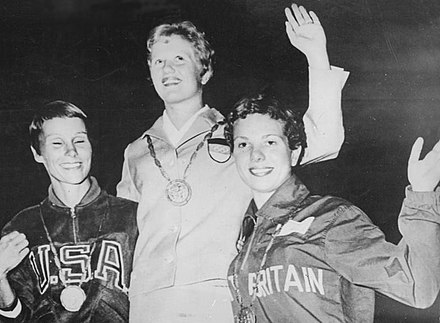
paula-jean-myers-ingrid-kraemer-and-elizabeth-ferris-in-rome
Paula Jean Myers, Ingrid Kraemer and Elizabeth Ferris in Rome springboard finalists

She started diving off a low board at the age of five, even before she knew how to swim. Starting from the age of eleven, she would join her friends at the Dresden diving club a few times a week and stay there until the early evening. Those were the early days of young Ingrid Engel-Krämer, who would unexpectedly become one of the stars of the 1960 Rome Olympics, winning gold in both the women’s 3-meter springboard and 10-meter platform diving competitions.

David Maraniss, in his seminal book Rome 1960: The Olympics That Changed the World, profiled Engel-Krämer, explaining that at the time, Americans were the dominant force in diving. In fact, until Engel-Krämer broke the streaks, women from Team USA had taken both gold and silver in the previous seven summer Olympics in the 10-meter platform, and gold in the previous 8 Olympiads in the 3-meter springboard.

In the springboard, Engel-Krämer was a runaway train, showing off a precision in her technique that she would become renown for. As Maraniss noted in a Die Welt article, she was so far ahead in the springboard that “she could have jumped into the water with only a little grace in the last round, and she would have won the gold medal.”

Could this wunderkind repeat in the 10-meter platform? Paula Jean Myers-Pope was confident that she would win back American glory in diving. And while the springboard event was a cakewalk for Engel-Krämer, the platform competition was a gritty end-to-end battle. As Maraniss explained, it came down to the final dives for both.

ingrid-engel-kraemer-rome-1960
Enjoying Rome.

Both Engel-Krämer’s and Myers-Pope’s dives were, as I understand it, similar – a backward flip followed by two-and-a-half somersaults. Myers-Pope apparently hit the water with more splash than Engel-Krämer, who entered the water, as Maraniss describes, with a “quiet snap into the blue pool”. Additionally, the judges felt that Engel-Krämer’s dive had a higher degree of difficulty, which brought protests from the US. But in the end, Engel-Krämer earned her second gold medal, and not by a small margin.

There was a time when little Ingrid was scared to ascend the tower, fearful of the fall and the pain. In fact, her skin was considered somewhat sensitive to the impact on the water. Her father crafted special vests made of rubber foam to protect her back and stomach. “I wasn’t courageous at all,” she was quoted as saying. “I had to work hard on it and only bit by bit managed to overcome it.” Even in Rome, according to Maraniss, it was the fear of pain that drove her to focus her thoughts on how to dive perfectly to minimize the impact of the water on her skin.

But in Rome in 1960, Engel-Krämer was the blonde sensation, the teenager who broke the American stranglehold on diving, and as the Western press referred to her as, the Dresden Doll.


ten-foot-tower_nyt
Could you stare into the abyss from 10 meters above, and leap? This video from the New York Times shows that the average person could not. (Click on the image.)
han-yue
Han Yue of China

If you asked who’s the fastest on two wheels, you’d probably think there’s a sprint cyclist somewhere who has a record. In fact, the fastest man to sprint 200 meters with a flying start is Francois Pervis of France, who chomped up 200 meters in 9.347 seconds. Then there’s Gong Jinjie of China who pedaled 250 meters in 18.282 seconds from a standing start.

But there’s a new kid in town, Han Yue of China. He’s the fastest on two wheels, except his vehicle of choice is a Mini Cooper. That’s right. He set his speed record using only the wheels on the left side of his car. On January 18, 2017 Han set a Guinness World Record for the “Fastest Side-Wheelie Lap of the Nurburgring Nordshleife.” (No, I won’t write that again.) He was wheels up for 22.81 kilometers, and sped around the track in 45 minutes and 59 seconds.

You can watch a bit of Han’s incredible driving chops here.

In a somewhat meaningless associative leap, I wondered if motor racing had ever actually been an Olympic sport. And in fact, it was.

The 1900 Olympics, otherwise known as the II Olympiad, were held in Paris, France, after the debut of the modern Olympiad in Athens four years before. The Olympics were not the super-organized extravaganzas then as they are today. In fact, the II Olympiad basically piggy-backed on the 1900 World’s Fair. There were no opening and closing ceremonies in this longish Olympics that went from May to October, and there were quite a few events that debuted and ended with the 1900 Olympics, including ballooning, cricket, croquet as well as automobile racing.

Although considered an unofficial Olympic event, there were actually an abundance of motor racing events. For example the 2 seater car under 400 kg, and of course 2 seater car over 400 kg, the 7 seater car, the taxi – electric / petrol, the delivery van 500 to 1200 kg electric / petrol, and yes, even the fire truck race.

To be honest, I’d pay to see a fire truck race.

motor-racing-at-the-1900-olympics
Motor racing at the 1900 Olympics in Paris.

Another interesting aspect to the motor car competition at the Olympics was that the competitors were classified primarily by the auto manufacturer, not the driver. So as you can see in the official results, the winners of these events are not clear. What is clear is that the home team had a distinct advantage as France took home practically every medal.

That is, excepting the fire truck race. For some reason, the name of the winner is known – Gilbert Brown of the USA.


The Answer to the Question in the Title: No one. Only the silver medal was awarded. No, I have no idea why.

olympic-shoplifters-headline-yomiuri
From The Yomiuri, October 7, 1964

The world was coming to Tokyo in 1964, and Japan wanted to make sure that Tokyo was the friendliest, cleanest and safest city anybody would ever set foot in.

In order to make it safe, one of the actions the Tokyo police took was to lock up all known and suspected pickpockets. Over a three-month campaign prior to the commencement of the Games, the police rounded up 230 pickpockets, resulting in a drop in incidents from 400 in April to 120 in September.

Unfortunately, one can never quite expect the unexpected.

Apparently, there was a rash of shoplifting in the popular stores inside the Olympic Village. The culprits? The Olympic athletes.

As the kid said to Shoeless Joe Jackson, “Say it ain’t so, Joe!”

village-shopping-2
From the report, The Games of the XVIII Olympiad 1964

Here’s how the The Yomiuri started off an article on October 7, 1964. “Although shoplifting is not among the listed events in the Olympics some athletes adept in the old sleight-of-hand game are establishing unofficial records in the village out in Yoyogi, much to the chagrin of shop clerks.”

The article explains that there were a total of 16 shops selling a wide variety of good, including clothing, jewelry and electronics. The most popular items – whether legitimately purchased or quietly absconded – were electronics, specifically transistor radios. Watches, pearl necklaces, ball point pens and silk handkerchiefs apparently also went missing.

Radios were priced at JPY1,000 to 8,000, watches at JPY7,000, and the stolen necklaces going for as high as JPY45,000. Back then, that’s significant money.

According to one shop manager interviewed in the article, “the customers engaged the attention of shop hands by communicating in writing while accomplices, all members of an undisclosed team, slipped the tiny radios into their pockets. The manager said he could not identify the culprits because none of the shop employees saw them in the act.”

“‘We were sorry we were off guard, believing all the athletes to be ladies and gentlemen representing their country,’ he bemoaned.”

village-shopping
From the report, The Games of the XVIII Olympiad 1964
pat-hickey
Pat Hickey

I suppose selling tea wasn’t quite doing it for Minoru Ikeda. This enterprising tea dealer from Utsunomiya, Tochigi was indicted during the 1964 Tokyo Olympics for scalping tickets, according to The Japan Times of October 20, 1964.

Ikeda bought the tickets fair and square, 60 through his local Japan Travel Bureau office and through direct mail orders to the Tokyo Olympic Committee. Apparently he pulled in a cool JPY150,000 in profit, re-selling four third -lass track and field tickets for the outrageous price of JPY10,000 each. I actually have a third-class ticket from those Games, and it states the price is JPY1,000. According to the article, Ikeda sold 52 more tickets for another JPY200,000.

But that pales in comparison to the reports that came out of the 2016 Rio Olympics when a senior member of the International Olympic Committee, Pat Hickey, was arrested on August 17, 2016, for ticket touting, or scalping.

Hickey was imprisoned for 11 days in Bangu Prison, and was released, primarily due to the fact that he was a 71-year-old in poor health, and his passport had been taken away. After about 4 months in Brazil, Hickey was allowed to return to Ireland, no longer the head of the Olympic Council of Ireland (OCI), a position he had resigned soon after his arrest.

scalping
The Japan Times, October 20, 1964.

Hickey had been the head of the OCI since 1989 and had apparently ruled Irish Olympics with a firm hand. And as an executive board member of the IOC, Hickey received such benefits as a USD900 per diem during Olympic Games. But that apparently wasn’t enough. Since Hickey apparently he collaborated with the organizations that was responsible for the selling of Olympic tickets in Ireland, he and Kevin Mallon (another person arrested in Rio), had access to the most valuable tickets at the Rio Games, the opening and closing ceremonies.

According to The Guardian, police seized over a thousand such tickets, which would could be sold at exorbitant prices. The article claims that Mallon’s company, THG, was looking to pull in a profit of USD10 million. That is definitely an improvement on JPY200,000, even accounting for inflation!

Hickey, who asserts his innocence in the charges, is awaiting the start of court deliberations on his case in Rio. If found guilty he could face prison time.

If you want to be the best, you need to train like the best. Here is a link to a great self-help article on the strength and flexibility exercises that Olympians use. In trying to understand these exercises, I did an image search so that you can see what the article is trying to describe.

olympian-exercises-1
Recommended by Carrie Gaerte

Carrie Gaerte is a physical therapist and athletic trainer for USA Gymnastics, and she recommends the seated spinal stretch, the reclined half-pigeon and the achilles extension.

olympian-exercises-2
Exercises recommended by Team USA water polo athletes

Water polo athletes, Kami Craig, Courtney Mathewson and KK Clark build their strength and endurance with these routines: the leveled plank, the dumbbell step up, and the step jump.

olympian-exercises-3
Exercises recommended by coach of gold medal-winning wrestler Helen Maroulis

The coach of gold-medal winning wrestler, Helen Maroulis, recommends push ups, the dumbbell row and the pause squat in Maroulis’ training regimen.

Go on. Get crackin’!