Roy_summer vacation_1967 maybe
Roy, sometime between the Tokyo and Mexico City Olympic Games.

On this, the last day of 2015, I’d like to thank everyone for their support of my blog – The Olympians. I have posted at least once every day since I started the blog on May 1. Out of about 300 posts, I’ve selected 25 that I personally like, in good part because I’ve had the great fortune to talk with the people mentioned in these stories.

  1. A Helicopter View of US-USSR Relations, Olympic Style
  2. American Gymnast Makoto Sakamoto and Memories of Home: Post-War Shinjuku
  3. Arnold Gordon (Part 1): Befriending Judy Garland at Manos in Shinjuku
  4. The Banning of Headgear in Boxing: The Convoluted World of Protecting Our Athletes
  5. Clumsy Handoff, Beautiful Result: A World Record Finish for the American 4X400 Relay Team in Tokyo
  6. Coach Hank Iba: The Iron Duke of Defense Who Led the Men’s Basketball Team to Gold in 1964
  7. Creativity by Committee: The 2020 Olympic Emblem and the Rio Olympic Mascots?
  8. Crowded, Noisy, Dirty, Impersonal: Tokyo in the 1960s
  9. The Dale McClements’ Diary: From Athlete to Activist
  10. Doug Rogers, Star of the Short Film “Judoka”: A Fascinating Look at Japan, and the Foreigner Studying Judo in the 1960s
  11. Escape from East Berlin in October 1964: A Love Story
  12. Escape from Manchuria: How the Father of an Olympian Left a Legacy Beyond Olympic Proportions
  13. Fame: Cover Girl and Canadian Figure Skater Sandra Bezic
  14. Frank Gorman: Harvard Star, Tokyo Olympian, and Now Inductee to the International Swimming Hall of Fame
  15. The Geesink Eclipse – The Day International Judo Grew Up
  16. India Beats Pakistan in Field Hockey: After the Partition, the Sporting Equivalent of War
  17. The Narrow Road to the Deep North
  18. On Being Grateful: Bob Schul
  19. Protesting Via Political Cartoons: Indonesia Boycotts the Tokyo Olympics
  20. The Sexist Sixties: A Sports Writers Version of “Mad Men” Would Make the Ad Men Blush
  21. “Swing” – The Danish Coxless Fours Found It, and Gold, in Tokyo
  22. Toby Gibson: Boxer, Lawyer, Convict
  23. Vesper Victorious Under Rockets Red Glare – A Dramatic Finish to One of America’s Greatest Rowing Accomplishments
  24. What it Means to Be an Olympian: Bill Cleary Remembers
  25. Who is that Bald-Headed Beauty: The Mystery of the Soviet Javelin Champion

What would a blog be without a list! Here is my countdown to the Top Fifteen Sports Stories of 2015. Over the next five days, I will share three stories each day that involved the Olympic Games, Olympians or Olympians to be. Here are number 13 – 15, featuring Mayweather, Rousey and Kobe.

Manny Pacquiao-vs Floyd Mayweather-2015-Fight-of-the-Century

FIFTEEN – Olympian Floyd Mayweather Defeats Manny Pacquiao: In the long-awaited match in May, Mayweather won the welterweight championship fight in a unanimous decision over Pacquiao. Mayweather is a bronze medal winning champion at the 1996 Atlanta Summer Games.

Ronda Rousey Holly Holm tale of the tape

FOURTEEN – Olympian Judoka Ronda Rousey loses to Holly Holm: In an attempt to defend her Ultimate Fighting Championship, Holm ends Rousey’s streak of 12 victories in a row in November. Rousey won a bronze medal for the United States in judo (-70kg).

Kobe Bryant USA_Basketball_Dunk_Wallpaper_Olympics

THIRTEEN – Two-time Olympian Kobe Bryant Announces Retirement: Bryant won gold with the US Men’s basketball team in Beijing in 2008 and in London in 2012.


Doug Rogers_Judoka_10828_LG
Doug Rogers in the documentary, “Judoka”, by director Josef Reeve

“So far in my film career, I’ve been an SS trooper, a submarine commander, and the fastest gun in the East,” said Doug Rogers of his part-time work in Japan in the early 1960s. “But I’m getting tired of being the villain. I want to be a hero for a while.”

And so, he became the hero. Doug Rogers not only won a silver medal in the first Olympic Judo championship ever at the Tokyo Summer Games in 1964, he starred in a short black and white documentary by director Josef Reeve – “Judoka“. (This link takes you to the full-length high def version.)

Rogers moved to Tokyo at the age of 19 in 1960 after learning all he could about judo in Montreal, Canada. The birthplace of Judo, Japan, was where judoka from all over the world aspired to train. Rogers was part of a small but growing number of foreign judoka desiring to train in the Kodokan, and grapple with the university students and policemen who made up the most competitive pool of judo talent in the world.

The documentary is a wonderful look inside the mind of Rogers as he reflects on his five years in Japan, on the judo training regimen, and more broadly, on life in Tokyo in the mid-1960s. The scenes of Rogers resting in his small apartment, walking his neighborhood streets and attempting to get in a crowded train are impactful, cleanly framed on black and white film.

Judoka_Rogers Outside his Apt
Screen capture of Rogers outside his apartment, from the documentary, “Judoka”

It’s the training scenes, up close with occasional slow motion takes, that demonstrate the intensity of the judoka’s training – the opening scene when they are running barefoot shouting “ichi…ni”, when they are doing push-ups, or when they are sending each other tumbling to the mat. Rogers talks about how fortunate he was to be able to train under legendary judoka sensei, Masahiko Kimura. Kimura’s training regimen was brutal, but effective. Rogers explained that they would do 600 push ups a day, sometimes a thousand, explaining that they all knew it was unreasonable to push their bodies that far, except that, they did indeed get stronger.

As Rogers said in the film, “No one before Kimura, no one after. I’m the only Westerner he ever taught. He said I could be champion. In fact he says I must be champion. I don’t think Kimura recognizes physical limitations. He just trains beyond whatever happens to come up. For me, he says he stays up nights thinking of ways to make me stronger, better. With him I can win now.”

The humbleness of the documentary’s production is echoed by the humility of Rogers’ words, when he ruminates on life in Japan. The film is only 18 minutes long, and yet you get a quick sense from the narrative that Rogers grew from a boy to a man in Japan. In a wonderful passage where he and another judoka named Morita are filmed at an empty Budokan (the stadium built for the Olympic Judo championships in 1964), Rogers reflects on how his thinking matured.

“I went into judo trying to be tough and be strong. But I found as you get more and more skillful, the desire to act big and tough, sort of works the other way. I know I have the skill now. I don’t have to talk about it.”

Doug_Rogers,_Isao_Inokuma,_Parnaoz_Chikviladze,_Anzor_Kiknadze_1964
Doug Rogers (far left), Isao Inokuma, Parnaoz Chikviladze and Anzor Kiknadze at the 1964 Olympics

Rogers would go on to become a judo champion as a member of the Takushoku University team in the All-Japan University Championships, as well as at the World Championships in Rio de Janeiro in 1965. He

endo_yukio_3
Japanese gymnast, Yukio Endo celebrates his gold medal victory in the parallel bars in 1964, with teammate Shuji Tsurumi, who won silver, in an era when the Japanese ruled in men’s gymnastics.


Officials in Japan are aiming for 16 gold medals at the 2020 Tokyo Olympic Games.

“Medals will encourage athletes,” Olympics minister Toshiaki Endo was quoted as saying in this November 27 Japan Times article. “It will be better to have a goal, so that the state can support (those who would be able to) offer hopes and dreams to children.”

Fifty-six years ago, on the eve of the start of the 1964 Summer Games in Tokyo, Kenkichi Oshima, head of the Japanese Olympic delegation, said basically the same thing, stating that Japan must win at least 15 gold medals as “an encouragement to this country’s upcoming generation.”

The Japanese team pulled in 16 gold medals in 1964, with the third highest medal haul in those games. It is common for the host country to do well in the medals race, but the Japanese team continued its success vis-a-vis other countries through the early 1980s, as you can see in this table.

Japan Medal Table.PNG

But as the number of countries rose, as did the level of competitiveness, Japan began to slip in the medal rankings between 1988 and 2000. With a renewed effort, Japan matched its 16 gold medals in Athens, and more recently in London grabbed 38 overall medals, more than it had ever done before.

Over the years, judo, gymnastics and wrestling have been Japan’s strongest competitive advantages, with assists from weightlifting and archery, but in recent years, Japan has become a power in swimming.

Is a target of 16 gold medals in 2020 reasonable for the third largest economy in the world? Rio in 2016 will give us a clue.

Tadahiro Nomura with His Three Gold Medals
Tadahiro Nomura (left), a three-time Olympic judo champion at 60 kg, attends a Monday news conference in Osaka. | KYODO

He won gold medals in the 1996 Atlanta Games, the 2000 Sydney Games and the 2004 Athens Games in the extra lightweight (-60kg) judo division. No other judo-ka has ever accomplished such consistency for so long.

On August 31, Tadahiro Nomura (野村忠宏) announced his retirement from competitive judo at the age of 40. As he was quoted in this Kyodo news report, “I began to feel my physical limit,” the 40-year-old Nomura said at a news conference. “I’ve done everything I can. I have no regrets.”

In addition to his three consecutive Olympic golds, he also won gold in the Judo World Championships in 1997, as well as bronze in the 2003 World Championships in Osaka. The man from Nara, Japan often won in spectacular fashion. He employed a seoi-nage technique, a throw where the thrower’s feet get in between the opponent’s legs in lightning fashion, and the thrower is able to toss the opponent over his back and shoulder with unexpected ease.

See the video below for a visual explanation, which is in Japanese, but fairly self-explanatory. A more detailed explanation of the seoi-nage in English can be found at this link.

Nomura comes from judo pedigree – his uncle Toyokazu Nomura was the gold medalist in the -70 kg division of the 1973 Games in Munich, while his father coached Shinji Hosokawa to gold at the 1984 Games in Los Angeles.

Japan continued to dominate and Tina Trstenjak won Slovenia’s first-ever world title at the World Judo Championships in Kazakhstan on Thursday.

Source: Japan dominating at judo worlds | The Japan Times

Team picture of 1964  US Judo Team from DC Judo; from left to right: Paul Maruyama, Jim Bregman, George Harris, Ben Nighthorse Campbell)
Team picture of 1964 US Judo Team from DC Judo; from left to right: Paul Maruyama, Jim Bregman, George Harris, Ben Nighthorse Campbell

Paul Maruyama grew up in Tokyo with three other brothers who were always fighting each other. His mother, a Seattle-born Nisei, was fed up and said, “if you’re going to fight, then fight at the dojo.” She dragged the brothers to a neighborhood judo dojo, where the brothers all started their journey to black belt. For Paul, his journey would continue as member of the US Judo Olympic team in 1964, and Head Coach of the 1980 and 1984 US Judo Olympic Teams.

Competing at the Olympic level is a challenge. But Paul Maruyama readily acknowledges that his efforts and accomplishment pale in comparison to those of his father.

After the United States dropped an atomic bomb on Hiroshima on August 6, 1945, the Soviet Union invaded Manchuria, where the Japanese had a significant colonial population. The Soviet army captured Japanese Imperial Army soldiers and sent them to labor camps in Siberia, while non-combatant Japanese who were in many cases pioneer families who volunteered to cultivate farmlands in Manchuria, were trapped on the Asian continent, denied exit by the Soviet Union.

Maruyama’s father, Kunio Maruyama, had made his way to Japan with two other men, Hachiro Shinpo and Masamichi Musashi. As Paul Maruyama describes in his book, Escape from Manchuria, the three men maneuvered covertly out of Manchuria. They were on a mission to inform the government in Japan that some 1.5 to 1.7 million Japanese were unable to leave the former Japanese colony, where thousands were dying daily due to disease and starvation, as well as at the hands of Soviet soldiers, and revenge-seeking Chinese and Manchurian mobs.

Escape from Manchuria coverThe three then had to convince the head of the Supreme Commander of the Allied Powers (SCAP), General Douglas MacArthur, that an urgent rescue was needed. It took over two years, but by August 1948, three years after the end of the second world war, American warships had repatriated over a million Japanese. So many more remained – children abandoned or taken in by Chinese families, Japanese women married to Chinese and their children who were not considered Japanese citizens, as well as men who were imprisoned in Siberia.

What a legacy! Think about it. The greatest growth in Japan’s

From the book, “Tokyo Olympics Special Issue_Kokusai Johosha”

He was 6 foot 6 inches or nearly 2 meters tall. When Anton Geesink entered a judo tournament, in a time when there were no weight classes and a 120-kilogram giant like Geesink could compete against a 70-kilo judo-ka, he intimidated. Geesink was a European storm, and the Japanese could hear it coming in the early 1960s. In 1961, Geesink defeated the Japanese champion Koji Sone, ending Japanese domination in the sport.

In 1964, it seemed pre-ordained that Geesink would make it to the finals. But the Japanese held out hope that Akio Kaminaga, would rise to the occasion and uphold national pride. And there they were, in the Budokan, facing off. Ada Kok, winner of two silver medals in swimming at the Tokyo Olympics, was there to witness. Kok is Dutch, and as a reward to medalists, the Dutch Olympic Committee invited Kok to watch her compatriot, Geesink, in the judo open weight finals.

Geesink vs Kaminaga_Tokyo Olympiad 1964_The Kyodo News Service
Geesink asking the crowd to quiet down. From the book “Tokyo Olympics Special Issue_Kokusai Johosha”

“I had just turned 16, so I accepted this invitation as something normal. It was just a fight to me at the time. But on reflection, I realized I was watching a culture shock of sorts, going throughout Japan. The Budokan was silent. Quiet. I could hear people crying. It was like a solar eclipse had suddenly blackened out all of Japan. It was a feeling of doom.

“But of course, it was tremendous for us, the Dutch. And I remember the Dutch officials were elated, and wanted to jump on

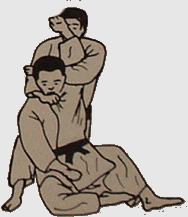
katahajime_180x210Training in the martial arts can be brutal. Olympian Syd Hoare felt this keenly when he moved from his home country of England to Japan to study judo with the very best. Wrenched knees, broken noses, dislocated shoulders, ripped-off toe nails – doesn’t matter. Stay calm, and carry on.

One of the more notorious training routines of judo (back in the day) was to purposely strangle someone to unconsciousness. This was partly done to teach the judoka how to revive the unconscious. It was also done to educate (to not get oneself in a position to be strangled, I suppose).

Hoare-Syd-A-slow-boat-to-Yokohama-a-Judo-odyssey1Hoare, who represented Great Britain at the 1964 Summer Games, wrote in his wonderful book, “A Slow Boat to Yokohama”, how his training in England included the “kata-hajime” strangle technique. Here is a somewhat chilling description.

“Then it was my turn to strangle my partner out but he was one of the fighters. Even as I was putting my hands in place for the kata-hajime strangle, he tensed his neck, preventing me from taking the full position. So, I softly started again, and then locked it on hard and quickly. Immediately he grabbed my hands and tried to tear them away from his throat, but the strangle was on securely. He began to flail around gagging and choking. At one point he arched violently

“Are there any people here tonight who were at the first Beatles show at Budokan? That’s a lot of people! Put your hands up. Hi guys! Good to see you again!”

And then the legend, the forever boyish Paul McCartney launched into “Another Girl”, performing at the Budokan on April 28.

The Beatles were the first entertainers ever to perform at the Nippon Budokan, on June 30, 1966, some 49 years ago. The Budokan was planned and built very quickly,