australia surf brands

Surfing is as Australian as vegemite. Champion surfers from Australia are commonplace. The image of an Aussie lifeguard on his surfboard to the rescue is now clichéd. Some of the biggest brands in surfing wear – Quicksilver and Billabong – are Australian. And even though the UGG Australia is an American brand, the company was started by an Australian surfer.

Australia is over 5,600 miles away from Hawaii. But when Duke Kahanamoku came to Australia in 1914, the locals must have thought he was from another planet. Kahanamoku was world famous, which is saying a lot for that time. Born in Honolulu, Hawaii, a natural on the water, Kahanamoku was such an amazing swimmer that he got on the US Olympic team and won a gold medal in the 100 meters, and a silver in a relay race at the 1912 Stockholm Olympics.

Duke Kahanamoku surfing in Australia
Duke Kahanamoku, Cronulla Beach Australia, 7th February 1915

Thanks to the stunning photos of Kahanamoku standing erect on his board while riding the waves in Hawaii, and his accomplishments at the Olympic Games, Kahanamoku was invited to compete in swimming events in Australia and New Zealand. He had heard that surfing on the beaches of Australia was illegal, so he didn’t bring his board. But when he arrived and was told that surfing was in fact legal, he said he would build a board himself. According to author David Davis in his wonderful biography of Kahanamoku, Waterman, Kahanamoku went to a lumberyard, got the wood he wanted, and shaped an eight-and-a-half foot “round-nosed, square-tailed board”.

Kahanamoku wowed them. Davis quotes The Sunday Times (Sydney), from December 27, 1914:

Duke Kahanamoku in Australia
Duke Kahanamoku at the Freshwater Clubhouse, Australia, with the board he made on arrival

“Kahanamoku was the ‘human motor boat,’ wrote one observer. ‘So lightning like was the movement that all one could see was a dark figure – it might have been a post for all that the spectators knew – flying through space. We had known him only by repute; we had seen him in pictures in one of his famous attitudes – standing on his surf board, being borne shorewards on the crest of a wave, a smile on his dusky countenance, and there were a lot of us who imagined the poster to be grossly exaggerated; too theatrical, in fact. But we are wrong. The man on the poster is the Duke all right, but the picture errs on the side of modesty.'”

It is legend that Kahanamoku was the first to surf on Australian shores. But that is not the case. Brothers, William and Tommy Walker of Australia appear to have purchased a surfboard in Hawaii and brought it back to Sydney before Duke was on the scene. But there is no doubt that Kahanamoku, his presence, demeanor and skill, made him and surfing a phenomenon.

“Kahanamoku was the first expert to surf in Australian waters,” wrote Davis. “And, as he had done previously in places like Atlantic City and Southern California, his skill at ‘walking on water’ inspired numerous followers. At least three of the young people whom he directly touched on the 1914-1915 trip – Claude West, “Snow” McAlister, and Isabel Letham – grew up to become influential figures in Australian circles. Once

White City Stadium 1908

It is huge. Olympian in fact.

When it opened in time for the opening ceremonies of the 1908 London Games, The White City Stadium sat 68,000 people, although it could fit another nearly 30,000 standing spectators. It had an oval running track, about 7 meters wide. And between the running track and the stands was a cycling track that was another 11 meters wide.

Cycling at White Citsy Stadium_1908

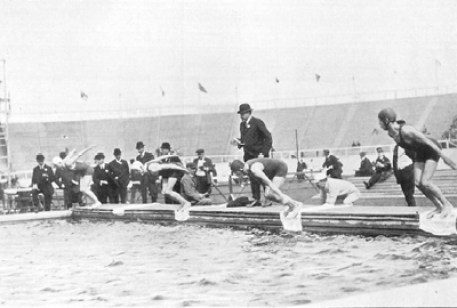
The oval tracks were so wide that, in addition to space for athletic events like archery and hammer throwing, there was enough room for a swimming and diving pool!

Swimming at White City Stadium_1908

Unfortunately, the 1908 Olympics was the stadium’s high point. In 1927, it was sold to the Greyhound Racing Association, literally going to the dogs. The stadium no longer exists, torn down in 1985 to make way for the headquarters of the BBC.

White City Stadium circa 1950s
BBC Television Centre takes shape in the late 1950s with White City Stadium nearby
Stouder Fraser Ellis in Tokyo
Medallists in the 100 metres freestyle swimming event at the Tokyo Olympics, 15th October 1964. Left to right: silver medallist Sharon Stouder of the U.S.A., third time gold medallist Dawn Fraser of Australia and bronze medallist Kathleen Ellis, also of the U.S.A. Fraser is holding up her lucky kangaroo mascot. (Photo by Central Press/Hulton Archive/Getty Images)

No woman had ever won gold in three successive Olympics in the same event, but Dawn Fraser of Balmain, Australia was gunning for it.

Fraser’s breakthrough was at the Melbourne Olympics in 1956 as she beat her fellow Australians in the 100-meter freestyle, becoming an overnight sensation. Then in Rome, the American swimming team was a rising power, but Fraser stared them down to win the 100 meters. In Tokyo, the Americans were expected to win everything. And they came close. But Fraser, at the age of 27, beat 15-year old Sharon Stouder, and 17-year old Kathy Ellis to assure her status as one of the Olympiad’s greatest heroes.

But heroes often must pass painful trials to complete their journey. 1964 proved to be an emotional roller coaster for Fraser, beginning with a disaster for Fraser only 8 months before the Tokyo Olympics.

In February, Fraser was peaking, setting the world record in the 100 yards, and winning the 220 yard title at the National Championships in Sydney. One evening shortly after those championships, she and her family were enjoying an evening out. She had a car and offered to drive her sister home, accompanied with her mother and her friend, Wendy Walters. Here is how she describes the fatal crash in her autobiography, “Below the Surface“, that ended her mother’s life:

I was driving about 40 miles an hour. I’d been driving for 10 years, and I knew that this was about my limit with my mother on board; she was nervous about speed. We were sweeping around a curve on a highway called General Holmes Drive when I saw what looked like the cabin of a truck dead ahead. At the same moment, Wendy, who was next to me in the front seat, called out, ‘Look out, Dawn.’ I remember pulling the wheel hard to the right, and I think I must have hit the brakes hard. I learned a long time later that the driver of the truck we hit had parked his vehicle while he went fishing nearby in the Cook’s River. But my recollections of the crash are vague: a gigantic close-up of the cabin in our headlights, a high screech of tires on bitumen, and a terrible crash.

Walters had injuries to her face, while Fraser and her brother Ken recovered from injuries after arriving at the hospital unconscious. Fraser’s mother, however, was killed in the accident.

Over my last few days in the hospital, I was trying to sort my life out again, trying to adjust to the idea that my mother wasn’t there anymore. I couldn’t believe that it had all happened. And I kept blaming myself, because I had been driving the car. My mother was 68, and I was completely devoted to her; I don’t think I really knew how close we were until the accident, and then it was too late. My family kept trying to talk me out of my depression, telling me that it was foolish to accept the blame.

Fraser had pretty much given up on going to Tokyo. She was depressed, feeling guilty. She was at the wheel. She was responsible. On top of that, she had to wear an uncomfortable steel brace for nine weeks that kept her neck and back immobile, forcing her to turn her whole body just to talk to someone to her side. But recover she did, returning to the water

Aileen Riggin 1920_wikipedia
Aileen Riggin at the 1920 Antwerp Games

Belgium put in their bid for the 1920 Olympics in 1912. Little did they know that Archduke Ferdinand would be assassinated in 1914, sparking World War I. Germany overran Belgium, clearly overriding any planning for the Olympics. In fact, the Olympics in 1916 were cancelled.

But when the war ended in 1919, Antwerp was selected to hold the 1920 Summer Games.

Over 9 million soldiers died in World War I. Around 7 million civilians died as a result of the war. The invasion of Belgium by Germany is often called “The Rape of Belgium“, during which over 27,000 Belgians were killed by German soldiers, an additional 62,000 died of hunger or due to lack of shelter, and one and a half million Belgians fled the country.

Aileen Riggin was part of the first ever US women’s team in the Olympics, which competed at the 1920 Antwerp Games. She got to Belgian in the SS Princess Matoika, which was known as the Death Ship as it had transported war dead from Europe to the US. In the book, Tales of Gold, Riggin shared memories that showed the war was still very much in the minds of people living and competing in Antwerp. As Riggin was a 14-year-old girl at the time, I simply cannot imagine how she felt.

“When we were not training, we went on several trips around Antwerp in our truck, and one was to the battlefields. The mud was so deep that we could not walk, so we stopped along the line and bought some wooden shoes and learned how to walk in them. They were not too comfortable but they did protect our feet from the mud. I do not know how we happened to be allowed on the battlefields, because they had not yet been cleared.”

“In places they were still the way they were in 1918, when the Armistice was declared. We even picked up shells and such things and brought them home as souvenirs. There were trenches and pillboxes and things like that scattered about the fields, and we looked into some of them, and they were deep in water. There were some German helmets lying on the field, and we brought some home with us. I picked up a boot and dropped it very hurriedly when I saw that it still had remains of a human foot inside. It was a weird experience, and we were glad to leave. It must have taken them another year to clear off the battlefields from the way we saw them. They were in shambles.”

Aileen Riggin On the Victory Stand
Aileen Riggin on the victory stand, from the book “Tales of Gold”
How a war devastated country could take on an international event while still in a “shambles” is hard to imagine. But the Belgian authorities did what they could, improvising in some ways. For example, the diving competition was held in a large ditch at the base of an embankment, created as a form of protection if a war were to come to Belgium. Riggin, who competed as a diver, describes the venue.

“On our second day in Antwerp an army truck came to drive us to the stadium where we were to swim. Words fail me in describing our first view of this place. I had never seen anything like it. it was just a ditch. I believe they had had rowing races there at one time. There were  boardwalks around the pool – I have to call it a pool – to mark the ends. In the center

2004 Athens Olympics

Reports are that only 50% of tickets to the Summer Games in Rio de Janeiro, starting on August 5, have been sold. For the Paralympics in September, only 12% have been sold.

The Brazilian economy is shrinking during its worst recession in 25 years. The President of Brazil is under threat of impeachment for a decision to include an ex-President in her cabinet, someone under investigation for receiving bribes in the Petrobras corruption scandal. The Zika virus continues to spread in Brazil, a disease where there is now “strong scientific consensus” that it is a cause of microcephaly in newborns.

Those perhaps are the biggest factors that will result in many empty seats of a possible 7.5 million that are available for the Rio Olympics.

What’s interesting is that empty seats at Olympic Games is a recurring headache and embarrassment for Olympic organizing committees.

At the 2004 Games in Athens, “only about two-thirds of the 5.3 million tickets were sold“. At the 2008 Games in Beijing, organizers claimed that all 6.8 million tickets were sold, and yet empty seats blotted arenas throughout the Games. And at the 2012 Games in London, where pledge after pledge was made by organizers to fill the seats, and that “more than 20 million applications were made for the 6.6 million available seats”, the London organizing committee could not prevent the empty-seat phenomenon.

Empty Seats at Gymnastics Competition at London Games
2012 London Games

Athens and Rio share a common issue in that their economies may not be vibrant enough to drive local ticket sales. But Beijing and London do. Other factors are at play, resulting in tickets going unused. This article from The Guardian regarding empty seats at the London Games indicates that a few groups who are granted reserved seating, often the best seats in the house, just don’t show up:

  • Accredited members of the Olympic family, which include international sports federations, IOC officials and corporate sponsors,
  • Guests of corporate sponsors who receive tickets more for their affiliation with the sponsor and less regarding their interest in the Games
  • Members of the press, who may be less interested in heats and preliminary rounds
  • Athletes, particularly in the first week of the Games as all athletes are preparing or competing

Beijing pointed to another group – agencies that buy and re-sell tickets to people overseas or to people locally anticipating a spike in demand during the Games. Westerners in

marny_jolly_with_sukarno_1_asian_games_1962_2
Mariana Jolly meets President Sukarno at the Asian Games in 1962, from the collection of Mariana Jolly

She was a 14-year old, and yet an artifact of colonial Asia – the daughter of British parents representing Singapore in The Asian Games. When Mariana Jolly was asked to join the national swimming team to represent Singapore at the Asian Games, she had no idea that she would catch the attention of the most powerful man in Indonesia.

“It was the Asian Games, but I was the only European there,” Jolly told me. “Sukarno organized a lot of these social events for the athletes, there were quite a few. And the first time, he took one look at me and came to me. He asked me if I was Dutch. I said ‘no’, and he smiled. I danced with him at a barbecue, and I sang to him in Malay at another party.”

Little did Jolly know that the Asian Games they joined ignited the heated feud between Indonesia and the IOC, resulting in the last-second decision by Indonesia and North Korea to boycott the 1964 Olympics in Tokyo.

marny_jolly_with_sukarno_2_asian_games_1962_2
Dancing with Sukarno, from the collection of Mariana Jolly

Post-war, post-colonial Asia was a mess, a political vacuum, a time of economic experimentation that led to social upheaval. In the midst of those turbulent times, Malaysia emerged as a new nation in 1963, bringing together the British colonies of Malaya, Singapore, North Borneo and Sarawak.

Indonesia in the early 1960s was an emerging political power in Asia, led by that country’s first president, Sukarno. Leading the fight against the colonial rulers from the Netherlands, Sukarno was imprisoned by the Dutch rulers, freed by invading Japanese forces in 1942, and then appointed President of Indonesia when Japan surrendered to the United States and the allies at the end of World War II.

After decades of fighting Dutch colonial rule, Sukarno was anti-imperialist, and by extension, anti-West. While he did secure billions of dollars in aid from the United States and the Kennedy administration, Sukarno cultivated strong ties with the People’s Republic of China (PRC) and the Soviet Union.

And to reflect Indonesia’s growing power and influence, Sukarno won the rights to hold the Asian Games in Jakarta in 1962. The Asian Games is held every four years like the Olympics, and brings together the best athletes of Asia. In 1962, the participating countries included the PRC, which was boycotting the Olympic Games, as well as nations in the Middle East. Sukarno decided to make a statement – he would not invite athletes from Israel, which was the enemy of so many of Indonesia’s allies in the non-aligned world, nor athletes from Taiwan, which the PRC did not recognize.

The International Olympic Committee (IOC), led by then president, Avery Brundage, took umbrage, reiterating the importance to separate politics from sports, and indefinitely

TEN-SPO-SHARAPOVA
Russian tennis player Maria Sharapova speaks at a press conference in Los Angeles, on March 7, 2016.  / AFP / ROBYN BECK (Photo credit should read ROBYN BECK/AFP/Getty Images)

The world was shocked when world #11 and five-time grand slam singles champion, Maria Sharapova, was suspended from tennis competition for use of a banned substance, meldonium. The tennis world reacted with scorn for the former world #1 women’s tennis player:

  • John McEnroe: “It would be hard to believe that no one in her camp, the 25 or 30 people that work for her, or Maria herself, had (any) idea that (meldonium had been banned).”
  • Jennifer Capriati: “I didn’t have the high priced team of [doctors] that found a way for me to cheat and get around the system and wait for science to catch up.”

Capriati is making the most powerful case against doping from an athlete’s perspective. Taking banned or illegal drugs to enhance performance is cheating. And to not call out cheats is unfair to those who are not taking drugs that give advantage.

Sponsors dropped Sharapova like an overripe fruit with maggots inside. All except Head, the racquet manufacturer.

According to this statement from HEAD, “We question WADA’s decision to add meldonium to its banned substances list in the manner it did; we believe the correct action by WADA would have been to impose a dosage limitation only. In the circumstances we would encourage WADA to release scientific studies which validates their claim that meldonium should be a banned substance.”

WADA is the World Anti-Doping Association, the international governing body that establishes what athletes may or may not put into their bodies. The president of WADA, Dick Pound responded to HEAD’s statement to the BBC:

“First and foremost, Head is a manufacturer and seller of tennis rackets, among other things. So far as I’m aware, it’s not a medical expert and not in a position to amend the world anti-doping code. As for its view as a commercial racket seller as to whether meldonium should be on the list of prohibited substances or not, quite frankly I prefer the scientific opinion of medical experts to the commercial interest of somebody telling tennis rackets using a player who is subject to whatever discipline is called for under the world anti-doping code. A complete conflict of interest on its part, combined with a lack of knowledge of the particular substance.”

SPORTS-WADA-ESP-POUND
World Anti-Doping Agency (WADA) president Canadian lawyer Dick Pound / AFP PHOTO/PIERRE-PHILIPPE MARCOU (Photo credit should read PIERRE-PHILIPPE MARCOU/AFP/Getty Images)

That is a powerful and damning retort from Pound, whose efforts helped lead to the suspension of Russia’s entire track and field team from international competition, including the upcoming 2016 Rio Olympics.

And yet, this is what confuses me. There doesn’t seem to be any consensus among “medical experts” as to whether meldonium actually enhances performance in athletes.

This New York Times article explains the science of how meldonium works. In short, burning glucose in your body releases more energy than burning fat. The “science” states that meldonium will work to encourage the burning of glucose, not fat. So when you’re oxygen starved, a situation many high-performance athletes find themselves in when they exert themselves, the meldonium will give them a glucose burn and a bigger burst of oxygen.

Meldonium box
A box of meldonium pills, legally marketed as Mildronate primarily in Eastern Europe.

The same New York Times article, entitled “Effects of Meldonium on Athletes are Hazy“, quotes Dr Eric Brass of UCLA, who questions the correlation between meldonium and greater athletic performance.

“In general, if one is involved in short-duration, sprint-type activity, one tends to use glucose because it is more available and it is an efficient way to generate energy quickly,” said Dr. Eric Brass, a professor of medicine at U.C.L.A. Still, Brass said it was not clear if that was what was really happening in athletes. “The science behind many of these performance-enhancing compounds is limited, biased and subject to misinterpretation,” he said. Several of the studies on meldonium were done on rats and published only in Russian.

This is why doping stories outrage me and put me to sleep at the same time. I definitely

Greg Louganis and his Wheaties box

She’s not an athlete. She’s an IT consultant from Chicago. And she had just seen the documentary, “Back on Board: Greg Louganis“, the HBO documentary about the diving legend. When she sees the scene of Louganis walking though the Swimming Hall of Fame, passing by a series of Wheaties cereal boxes on display, he says “never got a Wheaties box – “In that moment,” Sondgerath writes, “I was inspired to start a campaign asking General Mills to ‘Put Greg Louganis on the Wheaties Box’.

Julie Sondgerath went to Change.org and submitted a petition that over 40,000 people signed on to, including me. Six months later, on April 5, Sondgerath got word: “I’m proud to announce that the campaign was a success!,” wrote Sondgerath on change.org. “Today, Wheaties will have a press release to unveil a WheatiesLegends Campaign to begin with a legacy photo of Greg Louganis on the Wheaties box! Congratulations to Greg, as well as Janet Evans and Edwin Moses! I can share with you that he is beside himself with excitement!”

Put Greg Louganis on a Wheaties Box

No other man has won gold in both the 3-meter springboard and 10-meter platform in two consecutive Olympics, doing so in Los Angeles in 1984 and Seoul in 1988. Louganis had often wondered that the reason he didn’t get on the Wheaties box, or perhaps other financially lucrative sponsorship deals, was the rumors at the time that he was gay. In fact, Louganis is now openly gay, having come out in 1994.

General Mills has downplayed the reasons for now placing Louganis on the box. They said that there are many athletes who deserve to be recognized, which is why they also chose to create boxes for Olympic legends Janet Evans and Edwin Moses. The New York Times quotes Mike Siemienas, manager of brand media at General Mills, saying that the choices

opening ceremony 1896 Olympics
Panathenaic Stadium a the 1896 Athens Olympics

Pierre de Fredy, Baron de Coubertin‘s dream had come true. He had a singular passion to revive the ancient Olympic games, bring nations together in peace, athleticism and sportsmanship, creating the first ever international sports body, the International Olympics Committee, and then organizing the first modern Olympic Games.

It was 120 years ago today when tens of thousands packed a stadium in Athens, Greece, the birthplace of the Olympics to witness an international sporting event of a scale never seen before. While only 10 nations and 64 athletes competed at the 1896 Athens Games, the 2012 London Games had over 200 nations represented and over 10,700 participants.

100m Athens 1896
100 meters at the Athens Games

With the first Olympiad, a bar was set with every finish. And from that point on, performance was measured on beating the best scores set at a global scale. Coubertin proposed the Latin words, “Citius, Altius, Fortius” as the Olympic motto, which means “Faster, Higher, Stronger”.

The Olympics created a revolution of sports measurement, creating new goals and aspirations for people all over the world. Below is a comparison of results in the years 1896 and 2012. Yes, this is a period of 116 years, but every year, thousands of people were driven by the very best scores established at international and then national sporting events.

1896 vs 2012 results

One of my favorite New York Times videos is one that explains how fast the fastest man in the world has become, comparing every Olympic champion since Thomas Burke in 1896 to Usain Bolt in 2012. As this video dramatically shows, Bolt would have beaten Burke by over 18 meters, or 60 feet!