Snell in 800 meters in Tokyo
Peter Snell ahead of George Kerr of Jamaica, Wilson Kiprugut of Kenya (bronze) and Bill Crothers of Canada (silver)

Peter Snell was confident. He had ran a time trial run of 800 meters in 1 minute and 47 seconds, a very fast time in 1964, despite the poor conditions of the track. This is when he knew he was peaking at the right time, and thought, not only could he win the 800, but also the 1500 meter competition at the Tokyo Olympics.

In the finals of the 800 meters, Snell drew the first lane, which he thought was unlucky because he would have to either “go like a madman and hit the front so you can maneuver with the field behind you and allow only as many pass as you want, or you can start slowly and try to work your race from the back of the field,” he wrote in his autobiography, No Bugles No Drums. “Either way can be troublesome and an in-between start can cause all sorts of jostling and tangling.”

With that understanding, Snell chose the first option with the intent of just trialing the lead runner, Wilson Kiprigut of Kenya, who was expected to jump out to a fast start. By sticking to the shoulder of the pacesetter, he would be able to avoid being boxed in and slowed. As it turned out, Kiprigut did not race out to the lead, and Snell ended up boxed in amidst a group at the front.

With 250 meters, Snell’s plan was to go all out. But he was trapped.

My pre-race plan had called for a sustained sprint from about 250-to-go. Now the whole position was confused. I was running easily within myself and, unlike Rome, where the circumstances were similar, I felt I was capable of dropping back out of the box, going around the field and still being able to challenge. That’s what I had to do. This involved two separate moves: a surge from the rear of the field to about fourth position with a clear run three or four wide which took me to the end of the back straight; then a second and final effort as I fought past Kiprugut and Kerr, who were locked together, and sprinted desperately into the curve. It was desperate because my plan had gone wrong and my run was coming late against fast finishers.

Snell on the victory stand_800 meters
Crothers, Snell and Kiprugut

But soon, desperation gave way to elation. Snell hit the tape, setting an Olympic record. Despite having to drop back and swing wide to take the lead, Snell still relaxed at the end, as he wrote, “subconsciously” holding back for the 1500 meter competition to come.

Watch this video highlighting Snell’s exciting victory in the 800 meter race in Tokyo.

Peter Snell
Peter Snell of New Zealand, from the book “The Olympic Century – XVIII Olympiad”


Peter Snell was the 800-meter Olympic champion, coming out of relative obscurity to set an Olympic record at the 1960 Olympic Games in Rome and win the gold medal. But in Tokyo in 1964, Snell was not only the favorite in the 800 meters, he and many others were expecting him to compete and win in the more glamorous 1500-meter race.

While our stereotypical view of Olympic champions are they are super confident and expect to win, the reality is that many oscillate between expectations of victory and the inevitability of disaster. Peter Snell of New Zealand may have exemplified the latter.

As British Olympic reporter, Neil Allen, noted in his book, Olympic Diary Tokyo 1964, Snell was shy and filled with doubt prior to the start of competition.

Two years ago the shy New Zealander and I had sat on the grass in Geraldon, Western Australia, and I had listened to him ponder, with worried brow, his problems in training for the forthcoming Commonwealth Games. Now he was behaving as though he was the last man in the world to hold the records for 800 meters, 880 yards and the mile, the last man you could imagine had won the Olympic 800 meter title four years ago.

“Running both events here might take it out of me, you know,” he said, staring at the ground. “My training was going so badly back at the beginning of last month that I got to the pitch where I couldn’t care less about the Olympics. There are times when you wonder how on earth you could run a 4:30 mile. You no longer have the ability to punish yourself.”

After a successful trial run in the 800 meters, Snell decided he would go for both the 800 and 1500 meter championships. He understood the ramifications of having to run heats in both races, with the possibility that the effort and strain of competing in both could mean doing poorly in both. And those doubts would not go away, as Snell wrote in his autobiography, No Bugles, No Drums.

My most nerve-racking period of the Games was the night before my first race. I’d made the decision to try for the double and promptly that night all sorts of doubts crowded into my mind in a sleep-wrecking procession. Quite seriously I wondered whether the decision was the right one. I felt I could produce a really good performance over 1500 meters. But if I ran in the 800 meters first, there was a strong possibility that not only could I run out of a place in that event – or even fail to qualify at all – I could find myself too tired for the 1500. I could, through tackling both, miss out on both. Was I being too greedy?

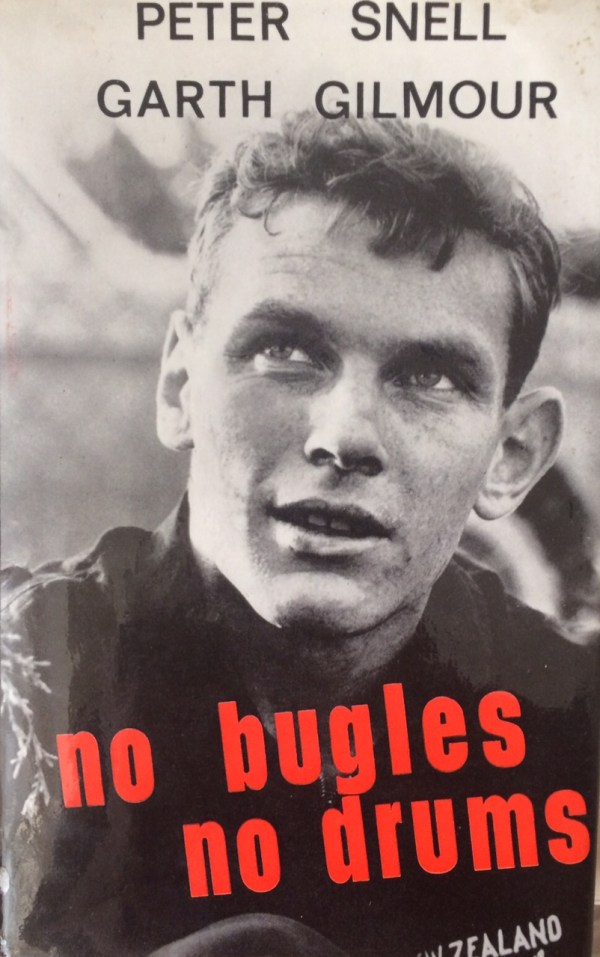
No Bugles No Drums

Row2Rio route map

What does it take to go from London to Rio on human power? Physically fit, mentally strong, well organized fanatics on a mission.

On January 9 of this year, 2 men and 2 women got on their bikes and cycled over 2,400 miles from Olympic Park in London to Lagos, a port town in southern Portugal. On January 31, they left Lagos and started rowing a 8.6 meter long boat called a Rannoch R45, which can house four or five people uncomfortably, allowing three people to row at the same time. They are currently close to the halfway mark rowing a total of 3,600 miles with the intent of hitting land at Recife, Brazil. From there, they will cycle down the Brazilian coast to Rio de Janeiro, which should take another four weeks.

The mission is raise awareness of the upcoming Rio Olympics, making the literal connection between the past 2012 Olympic venue with the future 2016 venue. But on the way, they are raising funds for cancer research, as well as their journey’s operations.

Row2Rio Foursome

The four team members are:

  • Susannah Cass: a 27-year old PhD student of botany from Dublin
  • Jake Heath: a 29-year old podiatrist from Twickenham
  • Mel Parker: a 27-year old fundraiser for a children’s charity from Gloucestershire
  • Luke Richmond: a 31-year-old cross-fit and Olympic lifting coach from Australia

And their posts on the journey rowing south 24 hours a day are fascinating:

  • Luke Richmond, Day 1-3: It was a brutal first day and night, sea sickness had three of us spewing all at once, only Jake seemed un effected. I was sure I was about to die.
  • Jake Heath, Day 1-6: The trip so has been life changing already, because I have realized how much you can push your body, if you can keep breaking things down on the small tasks, like the two hour stretch in front of you. I am currently switching in Row2Rio in boatwith Luke every two hours for 24 hours a day, as we row our way across to Brazil. The girls are also switching with each other, every two hours, but staggered by one hour with us, so everyone gets to spend some time together.
  • Jake Heath, Day 7&8: We have been on what seems like a giant conveyor belt of water and big waves. It’s all good and going in the right directions for us to reach the canaries in two days and then push on to Cape Verde straight after. The sea swells are pretty big and at night they can catch you off guard and just crash over your head. Last night Captain Susannah caught a high wave, which went all over her, but I luckily was out of the rowing seat having a stretch and remained bone dry. Carbon copy thing happens to Mel the next I shift, this time I was getting a drink and avoided it once again. I know what you are thinking? I promise I am actually doing some of the rowing!
  • Mel Parker, Day 18: Imagine your bed is 1m by 1m, around your little square of bed you have everything tied to the walls – your wardrobe, toiletries and a few days food. Above you you’ve got all the comms and electronics you could need to get you safely across an ocean. Behind your head you have the worlds noisiest neighbour, which sounds like a robotic Jurassic park, but is working hard to make sure you’re steering in the right direction.

If you’re interested in making a donation to help the MacMillan Cancer Support organization fight cancer, go to this link.

If you’re interested in following the exploits of this fantastic four, here is a link to their blog – Row2Rio. And stay tuned!

Australian and New Zealand flags
Do you know which is which?

Yes, I agree: I can never remember which one is the Australian flag, and which is the New Zealand flag.

Apparently, heads of state for both countries have been seated or presented in front of the other country’s times more than a few times.

To presumably improve brand recognition of his country, as well as do away with the Union Jack in the upper left-hand corner, Kiwi prime minister, John Key has put it to the people in a referendum whether to keep the current flag, or go with a new version, seen below.proposed new zealand flagProposed in place of the Union Jack is the fern leaf, certainly a more popular symbol of the nation, most commonly seen internationally on the dark jerseys of the intimidating national rugby team, The All Blacks. Unfortunately, according to this article, New Zealanders regard the proposed design with ambivalence, at best. Many want change for the same reasons as the prime minister, but not to the one that is often called, not so affectionately, a beach towel. In fact, according to a recent poll, times may be a-changin’, but perhaps not for the Kiwi flag.

…it doesn’t appear that replacing the country’s flag is actually all that popular with New Zealanders. In a poll conducted in February, 70 percent of the population said they were against the change, though 16 percent of those voters specifically only oppose the new silver fern design.

So which flag will New Zealand Olympians see when they win gold in Rio for the 2016 Summer Games? We’ll find out on March 24, the final day that New Zealanders can vote in this referendum.

UPDATE- March 24, 2016: The people voted status quo. The Union Jack is Happy Jack.

New Zeanad Flag choices
Four choices for the public in December, 2015.
National Olympic Stadium and underground tunnell
Blueprint for the National Olympic Stadium for the 1964 Olympics, including underground tunnel. Source: Japan Sport Council

In his book, No Bugles No Drums, Olympic track legend, Peter Snell of New Zealand, wrote about an underground tunnel at the National Olympic Stadium, where he competed at the 1964 Olympic Games.

“Ten minutes before the gun, we were led through an underground tunnel which took us right underneath the track diagonally to a point at the beginning of the back straight. Then a walk around to the start.”

Ollan Cassell, lead runner on the US 4X400 men’s team that won gold in Tokyo, also noticed the underground tunnel. “The Japanese thought of everything,” he wrote in his book Inside the Five Ring Circus. “They even built a tunnel under the stadium track so athletes and official going to their events on the infield did not cross the track.”


National Olympic Stadium and underground tunnell 2
A picture of the 1964 tunnel at that time. Considerable work had been done afterwards to hide the pipes and cables. Source: Japan Sport Council

Cassell asked me to confirm that his memories were correct, so I did some digging. After a few emails exchanged between me and The Japan Sport Council, the government body that manages and operates some of the largest sports facilities in Japan, including the National Olympic Stadium, I was pleasantly surprised to get confirmation on the tunnel.

Not only that, the Japan Sport Council was kind enough to provide a schematic and photos.

An underground tunnel that allows officials and athletes to get to the infield or across the stadium without crossing a track seems like a great idea. You would think that all stadiums would be designed that way. But Cassell wrote to me that in fact Tokyo’s National Olympic Stadium was unique. “I have attended every Games since then, thru 1996 and never found anything like what they did. I missed 2000 and 2004 but attended all other games and did not hear anything about a tunnel from those who attended the 2000 and 2004 games.”

The National Olympic Stadium has been torn down, a new one set to rise (once a plan is finalized). But the old one apparently had a trick under its sleeve. It will be missed. To see what the stadium looked like just before it was torn down, check out these 360 views of the stadium.

National Olympic Stadium 360

Petrobras 3

Brazil is facing the worst economy in 25 years. The Zika virus is feeding fears, particularly for expectant mothers. And while the Rio Olympics are presenting an opportunity to shine the international spotlight on Brazil, the underclass are generally feeling that the only people who will benefit from the Games will be the fortunate rich and powerful.

And then, there is Petrobras, a government entity embroiled in a bid rigging scandal between officials in the state-owned energy company and construction companies that wish to win Petrobras projects. A secret cartel of construction companies work with Petrobras officials to select the construction company, purposely agree to exorbitant payments, after which the construction companies kick back payments back to the collaborating Petrobras officials, who use that money to fund friendly politicians, which is helpful for a state-owned organization. It is estimated that the scandal has resulted in over USD5 billion changing hands in various illegal transactions. That’s astounding.

Petrobras bidness 2

I have not done this explanation justice, which is why I want to point you to this very clear and effective explanation of the Petrobras Scandal, and the historical and political context, by Zach Beauchamp.

In Brazil right now, if anything can go wrong, it seems it will go wrong – just on the verge of commencing Brazil’s greatest party of them all, the Olympic Summer Games in Rio.

But one thing we can say about the Petrobras Scandal, something that Beauchamp points out at the end of his article. This scandal, which has been tabloid fodder for months in

NCAA-March-Madness

It’s March Madness in the United States, which means that basketball fans all over the country have filled in their brackets, and are moaning over the college teams that let them down, or the ones who have won to live another day.

While high school superstars at times skip college and go straight to the pros (ie: Kobe Bryant, LeBron James), many great ones make their mark at the university level, and a few go on to win an NCAA championship. Both my neighborhood college, St John’s, and my alma mater, University of Pennsylvania, have made it to the famed Final Four, but neither has won an NCAA championship.

After all, only one team can be champion….which makes this list absolutely amazing. Only seven people in history have won championships at the NCAA level, the NBA level, and at the international level, i.e. The Olympics.

  • Quinn Buckner: Olympic Champion: 1976, NCAA Champion: 1976 (Indiana University), NBA Champion: 1984 (Boston Celtics)
  • Magic Johnson: Olympic Champion: 1992, NCAA Champion: 1979 (Michigan State University), NBA Champion: 1980, 1982, 1985, 1987-88 (Los Angeles Lakers)
  • K. C. Jones: Olympic Champion: 1956, NCAA Champion: 1955-56 (University of San Francisco), NBA Champion: 1959-66 (Boston Celtics)
  • Michael Jordan: Olympic Champion: 1984, 1992, NCAA Champion: 1982 (University of North Carolina), NBA Champion: 1991-93, 1996-98 (Chicago Bulls)
  • Clyde Lovellette: Olympic Champion: 1952, NCAA Champion: 1952 (University of Kansas), NBA Champion: 1954 (Minneapolis Lakers), 1963-64 (Boston Celtics)
  • Jerry Lucas: Olympic Champion: 1960, NCAA Champion: 1960 (The Ohio State University), NBA Champion: 1973 (New York Knicks)
  • Bill Russell: Olympic Champion: 1956, NCAA Champion: 1955-56 (University of San Francisco), NBA Champion: 1957, 1959-66, 1968-69 (Boston Celtics)

And if you look closely, you’ll see that K. C. Jones and Bill Russell played together on championships teams with the University of San Francisco, the US Men’s Olympic squad in Melbourne, as well as 8 championship seasons with the Boston Celtics. On top of that both won two championships each with the Celtics as a coach.

And one more amazing fact: On that 1963-64 Boston Celtic team – the one that defeated the San Francisco Warriors in 5 games – three of these seven immortals played together: K. C. Jones, Bill Russell, and Clyde Lovelette.

1964 Boston Celtics

Se Ri Pak

In the years Before Se Ri Pak, professional women’s golf in Korea was essentially non-existent. In the years After Se Ri Pak, women’s golf exploded.

Se Ri Pak, the 38-year old golfer from Daejeon, South Korea, recently announced her retirement. “I learned a lot and I’m trying to share all my skills and all these dreams,” she said. “So that’s where I plan to be the next step of my life. I just want to make dreams come true.”

Pak is already making dreams come true. In fact, one could say, she was the dream for young Koreans, and by extension young Asian women, in the game of golf. When golf returns to the Olympics since its last appearance in 1904, 60 of the best golfers in the world will compete, with a limit of the top four from each country. In the current 2016 Olympic rankings for female golfers, South Koreans make up an amazing four of the top 7 golfers who qualify for Rio. And if you look even closer, 9 of the top 15 are Asian.

“I remember watching [Pak] on TV,” said Christina Kim, a South Korean-American golfer. “She wasn’t blond or blue-eyed, and we were of the same blood…. You say to yourself, ‘If she can do it, why can’t I?'”

In the book, The Talent Code: Greatness Isn’t Born. It’s Grown, Daniel Coyle wrote about Kim, Korean golfers and Se Ri Pak, and called the explosion of talent in Korea an “ignition”. You could be dedicated to developing a skill by practicing consistently and earnestly. But you don’t burn for excellence. You don’t understand what it means to drive yourself to perfection. You never portray your desire as a willingness to die to be the very best.

Until a Hero emerges.

Se Ri Pak 1998.jpg

In South Korea, Se Ri Pak emerged. When she hit the professional stage, Korean women were ignited! Coyle writes,

For South Korea’s golfers, it was the afternoon of May 18, 1998, when a twenty-year old named Se Ri Pak won the McDonald’s LPGA Championship and became a national icon. (As one Seoul newspaper put it, “‘Se Ri Pak is not the female Tiger Woods; Tiger Woods is the male Se Ri Pak.”) Before her, no South Korean had succeeded in golf. Flash-forward to ten years later, and Pak’s countrywomen had essentially colonized the LPGA Tour, with forty-five players who collectively won about one-third of the events.

As Coyle explains, ignition is “an awakening”, “lightning flashes of image and emotion”, “the set of signals and subconscious forces that create our identity; the moments that lead us to say that is who I want to be.”

“I am, indeed, a king, because I know how to rule myself.” – Pietro Aretino

There’s a powerful message in the Under Armour “Rule Yourself” campaign. Being the best is hard work!

The most recent iteration of the Rule Yourself campaign features the greatest swimmer of all time, Michael Phelps, who hopes to add to his record number of gold medals at the Rio Olympics later this year. But as the commercial is trying to convey, Phelps’ achievements didn’t come only because he has natural talent, but because he applied an unnatural effort, sacrificed, and then achieved.

A few weeks ago, Under Armour released a commercial featuring members of the US women’s gymnastics team, also putting on display the rigorous training regimen of athletes competed to reach the highest levels of excellence.

There was a time people would say there is genius in the world, that the Mozarts and Tiger Woods of the world were born with talent. They were the chosen ones. There may very well be genetic advantages that can be parsed out. But a more likely explanation is that they worked hard at their craft. And in fact, research has shown that the greatest of the great, in any discipline, have often applied at least 10,000 hours of practice.

outliersOne of the populizers of this hypothesis is the acclaimed journalist, Malcolm Gladwell, who has developed a knack for featuring the best of the best in his stories. In the book, Outliers: The Story of Success, he writes extensively about the 10,000 hour rule, and quotes author and neurologist, Daniel Levitin to explain.

“The emerging picture from such studies is that ten thousand hours of practice is required to achieve the level of mastery associated with being a world-class expert – in anything,” writes the neurologist Daniel Levitin. “In study after study, of composers, basketball players, fiction writers, ice skaters, concert pianists, chess players, master criminals, and what have you, this number comes up again and again. Of course this doesn’t address why some people get more out of their practice sessions than others do. But no one has yet found a case in which true world-class expertise was accomplished in less time. It seems that it takes the brain this long to assimilate all that it needs to know to achieve true mastery.”

Ten thousand hours.

It is as large a number as it seems. If 10 years is 3650 days, and thus 87,000 hours, then to get to 10,000 hours over ten years, you would have to spend nearly 3 hours a day training or practicing. Imagine a 20-year-old woman who makes the Olympic Games. From the age of 10, she’s spending finding time on the rink once or twice day, with longer days on the weekends…for ten years. This doesn’t include the travel time for her and her parents, the pain, the emotional highs and lows, the struggle to maintain school attendance and grades, and an even more heightened sense of self and insecurity as she struggles in her quest through puberty and her teens.

They make it look easy. But it isn’t. For first, you must rule yourself.

Donald and Ivana Trump

The US presidential nomination process is a source of anxiety and entertainment for people outside the United States. This year is no exception, particularly with the rise of Donald Trump. While Trump has built an amazingly robust brand that represents, to his fans and supporters, success, straight talk and no-nonsense bias for action, he is also seen by others as arrogant, uninformed and dishonest.

Ah, but this blog is about the Olympics. So what’s the angle?

In April, 1977, Trump married a Czech model named Ivana Zelníčková in New York City. They met in Montreal at the 1976 Olympic Games, where Ivana was a successful model. Trump was immediately enamored of Ivana, and as was his wont, would boast. “By the age of six, (Ivana) was winning medals, and in 1972 she was an alternate on the Czechoslovakian ski team at the Sapporo Winter Olympics,” wrote Trump in his book Trump: The Art of the Deal. Apparently, he talked about his super model, super athlete wife in this manner countless times.

Ivana Trump_ Spy Magazine

But as written in this profile piece on Ivana in the May, 1989 edition of Spy Magazine, Ivana’s story was a tad embellished by The Don, as she admitted to calling him in the article.

Just to be clear, it doesn’t appear that Ivana was saying that she was an alternate on the Czech Olympic squad. Trump was the one waxing poetic about his beautiful bride.

Is Trump exuding success or dishonesty? I’ll leave that to you.