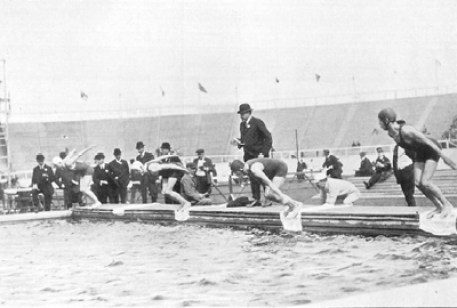
When it opened in time for the opening ceremonies of the 1908 London Games, The White City Stadium sat 68,000 people, although it could fit another nearly 30,000 standing spectators. It had an oval running track, about 7 meters wide. And between the running track and the stands was a cycling track that was another 11 meters wide.
The oval tracks were so wide that, in addition to space for athletic events like archery and hammer throwing, there was enough room for a swimming and diving pool!
Unfortunately, the 1908 Olympics was the stadium’s high point. In 1927, it was sold to the Greyhound Racing Association, literally going to the dogs. The stadium no longer exists, torn down in 1985 to make way for the headquarters of the BBC.
BBC Television Centre takes shape in the late 1950s with White City Stadium nearby
Dawn Fraser was on top of the world, after winning gold and silver medals, adding to her haul of 8 medals over three Olympiads. She was honored with the task of carrying the Australian flag in the closing ceremony on Saturday, October 24.
But it was Friday, and the night was still young. And when you’re Dawn Fraser, you can’t help but let a bit of the larrikin out.
The competitions were over and the party was on at The Imperial Hotel. The Australian swim team had gone home already, but Fraser had the entire Australian hockey team to party with. As she described in her book, Below the Surface – Confessions of an Olympic Champion, “at one stage one of the Olympic officials was wearing a kimono while the owner of the kimono was dancing about in a large Australian dressing gown.”
Around 2:30 am, a little less than 12 hours prior to when Fraser was scheduled to march into the National Olympic Stadium carrying her country’s flag, a plan was being hatched. Fraser and her friends were going to embark on a shady tradition of sorts in the Olympics – pinching flags.
A friend of hers, whom she refers to as an official, tells her that he’s found an ideal place to “pick up some good flags.” Fraser, the official and a hockey player slip away from the party, and walk through the darkened Tokyo streets until they arrive at the Emperor’s Palace. Again, here’s how Fraser explains it in her autobiography, Below the Surface:
We followed the moat for a while, and suddenly we were in the middle of a large flutter of flags. The flagpoles were sprouting like exclamation marks all round us. We chose a fine big Olympic banner with the five circles on it, and one of my companions bunked himself up on the shoulders of the other. They swayed around a little, and they swore once or twice; but finally they pulled the flag loose. ‘Quick,’ said one of them. ‘Cop this.’ I took the flag. ‘Go for your life,’ said the other. ‘The demons are coming.’
The “demons” were the police. Fraser tried to hide in a large shrub, but the police found her and started beating on her feet with a baton, so she threw the flag away and ran again. She saw a bicycle and hopped on it to get her further from the police “yelping and whistling” behind her. After all, she was making her escape on a policeman’s bike. That’s when she saw the Palace moat, and thought she could disappear into its darkness. “I figured that no policeman would ever catch me once I hit the moat,” she wrote.
Australian swimmer Dawn Fraser on a bicycle, from the book The Olympic Century XVIII Olympiad
In the panic, she ran into a brick wall, jumped 8 feet down into the moat onto more concrete and badly twisted her ankle. That’s when the police caught her.
At the Marunouchi Police Station, to where she was taken, no one would believe that she was not only an Olympic athlete, but that she was the world-famous Dawn Fraser. She had no identification on her, so the best she could do in the middle of the night was to contact a friend to bring her identification, and vouch for her. This friend was Lee Robinson, who was filming a documentary about Dawn Fraser. He brought the ID and the
Medallists in the 100 metres freestyle swimming event at the Tokyo Olympics, 15th October 1964. Left to right: silver medallist Sharon Stouder of the U.S.A., third time gold medallist Dawn Fraser of Australia and bronze medallist Kathleen Ellis, also of the U.S.A. Fraser is holding up her lucky kangaroo mascot. (Photo by Central Press/Hulton Archive/Getty Images)
No woman had ever won gold in three successive Olympics in the same event, but Dawn Fraser of Balmain, Australia was gunning for it.
Fraser’s breakthrough was at the Melbourne Olympics in 1956 as she beat her fellow Australians in the 100-meter freestyle, becoming an overnight sensation. Then in Rome, the American swimming team was a rising power, but Fraser stared them down to win the 100 meters. In Tokyo, the Americans were expected to win everything. And they came close. But Fraser, at the age of 27, beat 15-year old Sharon Stouder, and 17-year old Kathy Ellis to assure her status as one of the Olympiad’s greatest heroes.
But heroes often must pass painful trials to complete their journey. 1964 proved to be an emotional roller coaster for Fraser, beginning with a disaster for Fraser only 8 months before the Tokyo Olympics.
In February, Fraser was peaking, setting the world record in the 100 yards, and winning the 220 yard title at the National Championships in Sydney. One evening shortly after those championships, she and her family were enjoying an evening out. She had a car and offered to drive her sister home, accompanied with her mother and her friend, Wendy Walters. Here is how she describes the fatal crash in her autobiography, “Below the Surface“, that ended her mother’s life:
I was driving about 40 miles an hour. I’d been driving for 10 years, and I knew that this was about my limit with my mother on board; she was nervous about speed. We were sweeping around a curve on a highway called General Holmes Drive when I saw what looked like the cabin of a truck dead ahead. At the same moment, Wendy, who was next to me in the front seat, called out, ‘Look out, Dawn.’ I remember pulling the wheel hard to the right, and I think I must have hit the brakes hard. I learned a long time later that the driver of the truck we hit had parked his vehicle while he went fishing nearby in the Cook’s River. But my recollections of the crash are vague: a gigantic close-up of the cabin in our headlights, a high screech of tires on bitumen, and a terrible crash.
Walters had injuries to her face, while Fraser and her brother Ken recovered from injuries after arriving at the hospital unconscious. Fraser’s mother, however, was killed in the accident.
Over my last few days in the hospital, I was trying to sort my life out again, trying to adjust to the idea that my mother wasn’t there anymore. I couldn’t believe that it had all happened. And I kept blaming myself, because I had been driving the car. My mother was 68, and I was completely devoted to her; I don’t think I really knew how close we were until the accident, and then it was too late. My family kept trying to talk me out of my depression, telling me that it was foolish to accept the blame.
Fraser had pretty much given up on going to Tokyo. She was depressed, feeling guilty. She was at the wheel. She was responsible. On top of that, she had to wear an uncomfortable steel brace for nine weeks that kept her neck and back immobile, forcing her to turn her whole body just to talk to someone to her side. But recover she did, returning to the water
She’s not an athlete. She’s an IT consultant from Chicago. And she had just seen the documentary, “Back on Board: Greg Louganis“, the HBO documentary about the diving legend. When she sees the scene of Louganis walking though the Swimming Hall of Fame, passing by a series of Wheaties cereal boxes on display, he says “never got a Wheaties box – “In that moment,” Sondgerath writes, “I was inspired to start a campaign asking General Mills to ‘Put Greg Louganis on the Wheaties Box’.
Julie Sondgerath went to Change.org and submitted a petition that over 40,000 people signed on to, including me. Six months later, on April 5, Sondgerath got word: “I’m proud to announce that the campaign was a success!,” wrote Sondgerath on change.org. “Today, Wheaties will have a press release to unveil a WheatiesLegends Campaign to begin with a legacy photo of Greg Louganis on the Wheaties box! Congratulations to Greg, as well as Janet Evans and Edwin Moses! I can share with you that he is beside himself with excitement!”
No other man has won gold in both the 3-meter springboard and 10-meter platform in two consecutive Olympics, doing so in Los Angeles in 1984 and Seoul in 1988. Louganis had often wondered that the reason he didn’t get on the Wheaties box, or perhaps other financially lucrative sponsorship deals, was the rumors at the time that he was gay. In fact, Louganis is now openly gay, having come out in 1994.
General Mills has downplayed the reasons for now placing Louganis on the box. They said that there are many athletes who deserve to be recognized, which is why they also chose to create boxes for Olympic legends Janet Evans and Edwin Moses. The New York Times quotes Mike Siemienas, manager of brand media at General Mills, saying that the choices
Ken and Jeanne in Tokyo, from the collection of Jeanne Collier
He was a 19-year-old university student from Illinois. She was an 18-year-old high school student from Arizona. They would go on to be diving’s power couple in Tokyo as Ken Sitzberger won gold in the men’s 3-meter springboard diving competition, and Jeanne Collier took silver in the women’s 3-meter springboard competition.
Collier told me that there was some resistance by the coaches to their dating during final preparations for the XVIII Olympiad in Tokyo, but she said there was never really anything to worry about regarding their readiness.
We met in 1962 at a Nationals. He was from Chicago and I was from Phoenix. We had a letter writing campaign. He went to Indiana. I was still in high school. We got to know each other. So as we prepared for Tokyo, he and I hung out together. The coaches didn’t like that. But it was harmless. At that time, we would have time off, talk at meals, but the focus had to be on training.
Ken and Jeanne on their wedding day, from the collection of Jeanne Collier
And the results spoke for themselves. Not only did Sitzberger and Collier win medals at the Tokyo Summer Games, they did so in dramatic, come-from-behind fashion.
In Sitzberger’s case, he was trailing USA teammate Frank Gorman going into the penultimate 9th dive of the competition. While Gorman had his worst dive of the competition, Sitzberger had his best, leapfrogging Gorman into the lead. Despite a strong final dive from Gorman, Sitzberger was able to hold on to win. As his coach, Jerry Darda, was quoted as saying, Sitzberger was a confident person, who a year before, despite winning bronze at the Pan American Games, told Darda that he would win gold in Tokyo.
“Kenny said right-out: ‘I’m going to win the gold medal.’ I didn’t want to ruin his confidence, but I asked him how he could be sure. He had barely made the team and missed fourth by only five points. But Kenny had analyzed the whole thing, the strengths and weaknesses of the other divers who were ranked one, two, three in the world – they were his competition – and he knew they’d all be going to training camp for a few weeks before the Olympics. He told me ‘Those guys are going to see me in training camp and that’s going to help me. They’re going to feel a lot of extra pressure after they see me dive every day. They’re going to realize I just don’t miss.'”
In Collier’s case, she was trailing her teammate Patsy Willard as they entered the final optional dives, the three dives where the level of difficulty can send you crashing out of the race, or propel you to victory. The reigning Olympic champion, Ingrid Engel-Kramer of East Germany, led the competition from start to finish, and took gold for the second consecutive Olympics. Willard had a 3-point lead on Collier entering the optional dives, as well as the experience of battling the Olympic pressures in Rome four years before. On top of that, Collier did poorly on her first optional dive – “a forward 2 ½ somersault, which was horrible.” But she pulled herself together for a come-back.
“I had a talk with myself. I had the highest degree of difficulty. I had my two highest difficulty dives left and they were to be my best dives.” Collier snatched silver from her
My favorite team in sports, The New York Mets, were actually up and coming, after 13 years of supreme suckiness. Hope springs eternal, but it was especially true for Mets fans in April of 1985.
And when Sports Illustrated came out with the story, “The Curious Case of Sidd Finch”, I was ecstatic. Really, the Mets have a prospect who can throw a fastball 168 mph (270 kmh)? He wore one shoe, he played the French horn – well these eccentricities were proof that it had to be true. After all, there were pictures of him, and his locker was between those of George Foster and Darryl Strawberry. After 13 years in the wasteland, our savior had come!
George Plimpton wrote the piece that set off a media firestorm. TV news crews were sent to Florida to interview the mystery pitcher on the Mets. But no one could find him. And then two weeks later (remember, this is pre-social media), New York Mets fans woke up.
April Fools.
Writing an April Fools story is walking a fine line between incredulity and credulity. It’s got to be believable enough, and yet outlandish enough to make you go, “Say what?” Here are a few April Fools’ stories regarding the Olympics.
On April 1, 2014, this video was released announcing that skateboarding would be an Olympic sport in 2016. A day later, it was revealed to be a prank. Of course, as we know now, skateboarding is actually one of the five new sports that Tokyo 2020 is recommending for the 2020 Games.
Last year, twelve-time Olympic medalist over five Olympic Games, Dana Torres, announced she was coming out of retirement to compete at the Rio Games. Yes, she was 47. But yes, she was a swimming legend and still in fantastic shape.
“I am, indeed, a king, because I know how to rule myself.” – Pietro Aretino
There’s a powerful message in the Under Armour “Rule Yourself” campaign. Being the best is hard work!
The most recent iteration of the Rule Yourself campaign features the greatest swimmer of all time, Michael Phelps, who hopes to add to his record number of gold medals at the Rio Olympics later this year. But as the commercial is trying to convey, Phelps’ achievements didn’t come only because he has natural talent, but because he applied an unnatural effort, sacrificed, and then achieved.
A few weeks ago, Under Armour released a commercial featuring members of the US women’s gymnastics team, also putting on display the rigorous training regimen of athletes competed to reach the highest levels of excellence.
There was a time people would say there is genius in the world, that the Mozarts and Tiger Woods of the world were born with talent. They were the chosen ones. There may very well be genetic advantages that can be parsed out. But a more likely explanation is that they worked hard at their craft. And in fact, research has shown that the greatest of the great, in any discipline, have often applied at least 10,000 hours of practice.
One of the populizers of this hypothesis is the acclaimed journalist, Malcolm Gladwell, who has developed a knack for featuring the best of the best in his stories. In the book, Outliers: The Story of Success, he writes extensively about the 10,000 hour rule, and quotes author and neurologist, Daniel Levitin to explain.
“The emerging picture from such studies is that ten thousand hours of practice is required to achieve the level of mastery associated with being a world-class expert – in anything,” writes the neurologist Daniel Levitin. “In study after study, of composers, basketball players, fiction writers, ice skaters, concert pianists, chess players, master criminals, and what have you, this number comes up again and again. Of course this doesn’t address why some people get more out of their practice sessions than others do. But no one has yet found a case in which true world-class expertise was accomplished in less time. It seems that it takes the brain this long to assimilate all that it needs to know to achieve true mastery.”
Ten thousand hours.
It is as large a number as it seems. If 10 years is 3650 days, and thus 87,000 hours, then to get to 10,000 hours over ten years, you would have to spend nearly 3 hours a day training or practicing. Imagine a 20-year-old woman who makes the Olympic Games. From the age of 10, she’s spending finding time on the rink once or twice day, with longer days on the weekends…for ten years. This doesn’t include the travel time for her and her parents, the pain, the emotional highs and lows, the struggle to maintain school attendance and grades, and an even more heightened sense of self and insecurity as she struggles in her quest through puberty and her teens.
They make it look easy. But it isn’t. For first, you must rule yourself.
The Rehabilitation Lunch for the 1956 Dutch Olympic Team, organized by the Dutch Olympic Committee at the Kurhaus Hotel in Scheveningen, Holland.
“Melbourne is THE black page in the Olympic History of the Netherlands,” wrote Ada Kok in an email to me. Kok was not only a two-time Olympian in 1964 and 1968, she was the President of the Dutch Olympians Association for 11 years.
And when she was president, you could join the association only if you were an Olympian. Thus, the unfortunate members of the 1956 Dutch National Team were forbidden from competing once the Dutch government decided to boycott the Melbourne Games. As related in a previous post, some of the Dutch national team, including world-record swimmer, Cocky Gastelaars, were already in Melbourne preparing when the decision was made.
Ada Kok and Cocky Gastelaars
“Some athletes were already present in Melbourne to train and they were whistled back home by the Dutch Olympic Committee and the Dutch Government,” wrote Kok. “For Cocky this was a traumatic decision as this was her chance to win a gold medal being a world-record holder. But not only was Cocky disappointed. Then, we had a lot of potential gold medal winners who were part of this Dutch Olympic Melbourne Team in 1956. The sad thing was they all just received a telegram to announce the Olympic Team was not travelling to Melbourne, and for those who were already in Melbourne, they were ordered to leave the Olympic Village, not to wear their Olympic outfits anymore and travel home immediately.”
Kok provided me with a copy of that telegram dated November 7, 1956, seen below.
DUTCH OLYMPIC TEAM HEIDELBERG-VICTORIA-ASUSTRLIA
AT EXTRAORDINARY MEETING THE DUTCH OLYMPIC PARTICIPATION TO WITHDRAW DUE TO HUNGARY STOP LEAVE OLYMPIC VILLAGE – FIND OTHER PLACE TO STAY STOP WEAR CIVILIAN CLOTHES – IF IMPOSSIBLE REMOVE BADGE STOP WAIT FOR PAULEN LEAVING 11 NOVEMBER FLIGHT 845 FOR FURTHER INSTRUCTIONS STOP CANCEL ALL HOTEL RESERVATIONS BUT RESERVE HOTEL WINDSOR PAULEN AND CHARLES LEAVING 15 NOVEMBER SORRY ALL THE BEST
NOC (National Olympic Committee )
To a world-class athlete preparing years for this moment, the telegram above must have been a dagger in their backs. “No further explanation,” wrote Kok. “This was so sad! And this caused over the years a lot of bad feelings among the Dutch Olympians from 1956.”
It took a while, but in 2014, a step was taken to recognize these athletes whose lives were so abruptly and rudely changed that day in November 1956. Erica Terpstra, who was the President of the Dutch Olympic Committee, worked with Ada Kok to arrange a day of
You are one of the fastest swimmers in the world, having broken the world record twice prior to the Olympic Games. You’re going to be confident and excited for the fight.
So much can happen to an athlete before the competition begins: bad news from home, illness, an injury. But rarely do you arrive at the venue of the Olympic Games, prep for the competitions, only to be told to go home. It happened to the Indonesians and North Koreans at the 1964 Tokyo Games, and surprisingly to me, the Dutch in the 1956 Melbourne Games.
When the Soviet Union invaded Hungary in late October, 1956, in order to help suppress an anti-government uprising, there was an international outcry. As a result, the Netherlands, Spain and Switzerland decided to boycott the Summer Games in Melbourne held only a few weeks later. This came as a shock. In one case, a world-record holder and nearly sure-medalist swimmer from Rotterdam, Cornelia Maria (Cocky) Gastelaars, was asked to retreat at a time of possible victory.
My first disappointment after moving into the Olympic Village came when the Dutch government ordered the Netherlands team to withdraw from competition. The international situation was tense then, first with Suez and then with the Hungarian revolution, and the Dutch felt that it was no time for running, jumping, swimming and other frivolous pastimes. This meant that Lorraine and I would be deprived of our main opposition from overseas – Cockie Gasterlaars. You may think that we should have welcomed the news that a big danger was out of the reckoning: all I know is that we were bitterly disappointed, the more so because Cockie was actually in Melbourne and living at the Village when the news of Holland’s withdrawal arrived.
Cockie spoke excellent English, and we talked often during the first weeks in the Village. She had held the world 100-meter record twice during the year, and she wept once when she told me how much she wanted to compete. Another time she checked through the list of entries with me and told me that an American girl, Shelley Mann, and a Canadian girl called Grant had been swimming good times; but I think we both knew that the real struggle would have been between Cockie, Lorraine and me.
Fraser went on to win the 100-meter freestyle championship in Melbourne in world record time. But she is not sure that would have been the result had the Dutch team not boycotted the Games.
The day the Dutch team moved out, I saw Cockie Gastelaars. “You were wonderful,” she said. And I told her it might have been a different result if she’d been swimming. She was a sweet, shy girl and very brave; it must have been awful to have been deprived of the chance to compete just when she was at the peak of her career. We swapped badges, pins and finally addresses. We said we’d write, and we told each other that we’d be bound to meet in the water sometime, somewhere.
POSTSCRIPT: October 29, 2016. I had the honor of interviewing Cocky Gastelaars on October 10. I learned that, in fact, she never was in Australia when the Dutch government announced the boycott. She was still at home. And of course, she was very disappointed. But she did not meet Dawn Fraser until a year after the Melbourne Olympics when she took a trip to Australia.
Watching the build up to the 100-meter backstroke finals at the 1964 Olympic Games must have been like being in a pressure cooker. In the first preliminary heat, American Ginny Duenkel set the world record. In the next heat, American Cathy Ferguson broke Duenkel’s record. And finally, in the third heat, French women, Kiki Caron, set the world record yet again.
On October 14, 1964, three women who set three world records the previous day, were about to face off. As Ferguson wrote in the book, “Tales of Gold“, each of us had set a new world record, but only a fraction of a second separated us. In the finals, that would make the difference between gold and bronze.”
And so, in the pressure cooker of the National Gymnasium, the three record holders held even at the 50-meter mark when Ferguson began to pull ever so slightly ahead. In the end, Ferguson won the race at 1 minute 7.7 seconds, setting yet again, a world record.
You can see her crying on the podium as she hears the national anthem play, not only happy to win, but relieved it was all over.
I quit competitive swimming right before the ’68 Games. People ask me why I didn’t go on. But I knew I couldn’t win anymore, and when you know you can’t win, you can’t go on. I was only 19, but I just couldn’t get up for the races.
Most people do not understand just how much training takes out of you. It’s lonely in the pool. Just think of the countless hours in the water when you scarcely talk to another human being. All you have is that black line. It becomes your best friend. How many people can take that for more than six or seven years? I can remember being so tired at the end of the day that there was no way I had any energy left over to talk to the other kids.
Ferguson understood that her training and eventual triumph was worth it as her competitions and achievements took her to amazing places to meet incredible people. But her life, the life of a high-performance athlete can take its toll. In fact, when she was interviewed in the mid-1980s for the book “Tales of Gold“, she commented that athletes also need a program to help them transition out of life as an athlete.
I feel very strongly that we need some kind of detraining program for our former athletes. The East Germans have a program that helps their athletes get ready to move back into a normal life. It was very hard for me to be totally in the world of swimming and then, all of a sudden, to be completely out of it, then try to put that piece back in, only to find it doesn’t fit.
I felt quite empty when I left swimming. The thing I substituted for that programmed life was my first marriage. I was 19, and my husband was 26. in some ways I was probably 26 as well, but I had missed many of the experiences of being a teenager. Traveling all over the world and meeting important people was a fantastic experience, but I also needed those experiences that help one grow emotionally. When I was swimming, I was pretty much in control, but when I stepped out of that warm, secure cocoon, I didn’t control everything in my environment. I couldn’t control my husband, and I couldn’t control what was happening to me. At the time, I loved him dearly, but there was a needed growth period. Unfortunately, we both used marriage as a kind of sublimation for something else. I didn’t quite understand it then, but all I really needed was just to become “normal” again.
Cathy Ferguson (center); Art Rickerby/Time Life Pictures/Getty Images
Apparently, that is something psychologists and the International Olympic Committee are coming to grips with. That the more you commit to the goal of achieving at the highest levels, the more people surrender their own personal identity to what is now being called the “Athletic Identity”. Psychologist, Chris Shambrook, explains this phenomenon in the book, The Secret Olympian.
There is a whole area of research around a concept called Athletic Identity. Athletic Identity is all about how closely my identity is allied to my performances as an athlete. If I am my results. If I am my performance. If I’ve handed ‘me’ over to that – that puts me in a very, very challenging place when the results and the performances aren’t there anymore. And it’s doubly challenging because you have to get pretty close to handling your personality over to that (mentality) in order to give yourself the best chance of winning. But it leaves you very vulnerable afterwards.




 One of the populizers of this hypothesis is the acclaimed journalist, Malcolm Gladwell, who has developed a knack for featuring the best of the best in his stories. In the book,


You must be logged in to post a comment.