The US Olympic team in Tokyo, 1964 Olympic Games, Standing L-R: Dan Drown, Ron Crawford, Stan Cole, Bib Saari, Ralph Whitney, George Stransky, Coach Urho Saari. Bottom L-R: Tony van Dorp, Chick Mcllroy, David Ashleigh, Ned Mcllroy, Paul Mcllroy. Source: The history of USA Water Polo in the Olympic Games.
They were tied 1-1 with the Yugoslavians at the 1964 Tokyo Olympics. Along with Hungarians and the Soviet Union, Yugoslavia was part of a European domination of a sport – water polo. The United States were not on the same par as Yugoslavia at that time. They had never played any teams outside the United States until those Games. And yet, there they were, tied 1 apiece with the Yugoslavians.
“Our first game was against Yugoslavia,” said Daniel Drown, who was on that USA squad. They were supposed to be huge. When we came out of the tunnel at the pool, we didn’t think they looked that big. Then we went to shake their hands and their shortest guy was 6ft 3, and their biggest were 6ft 7. They were huge!”
The US team played even throughout the first half with the Yugoslavians. And in the second half, they caught a break – one of the Yugoslavians was ejected with four minutes remaining, which meant they would be down one man until the US scored. Despite the advantage, the US played tentatively. “We have an extra guy,” said Drown. “If we score, it will be the biggest upset. But everybody was afraid. No one would take the shot. Finally, one of their guys scored and they won 2-1.”
The US water polo team would go on to beat Brazil 7-1, but lose to the Netherlands, and thus fail to advance to the finals.
Drown remembers thinking, “we didn’t deserve to win. We were playing way over our heads.” But he knows the US team played brilliant defense. And he believes the fledgling US water polo program benefited from the coaching of Urho Saari.
“Saari believed in conditioning, absolute conditioning,” said Drown. “His philosophy was to work us so hard, so that you were sick to your stomach, and you couldn’t eat after a workout. But when it came time to play in a game, we may not have been as good as the other team, but we would be in better shape. We would think, ‘why couldn’t we win?'”
According to this article, Saari was an innovator in water polo. “Saari insisted that more emphasis should be placed on swimming, rapid ball-handling and changes in offensive and defensive tactics. He frowned on rough play and thought that teams should be less dependent on scoring done by the center-forward.”
Legendary El Segundo swimming coach Urho Saari. Daily Breeze file photo by Jack Wyman
“We would play 3 on 3 keep away for long periods of time, which disciplined you,” explained Drown. “One person had the ball and one would receive and he had better be open, and the third guy better be getting open. Everybody is constantly moving to get away from whomever is guarding them.”
“Saari would also run every night a scrimmage for 90 minutes four on four. He would referee it. When you did something wrong, you could see clearly when something was wrong. They threw to an open space and you
Sazae-san is one of the most well-known comic characters in Japan. Created, written and illustrated by Machiko Hasegawa from the 1940s to the 1970s, Hasegawa’s characters are as much a part of the average Japanese psyche as the Yomiuri Giants, a platter of soba, or Natsume Soseki.
Hasegawa wrote about the everyday lives of an average Japanese family, the Isonos. Her genius was to illustrate normal activities as vignettes, and controversial topics in sweet and innocent frames. I found many examples of this in a recently published book of her cartoons translated into English, called “The Best of Sazae-san – The Olympic Years“. It was a delight to read about the issues the average citizen in Tokyo were dealing with in the 1960s.
Here is one comic strip that deals with an issue linked to the Olympics.
Cities all over the world were building highways and expanding roads into avenues to accommodate the explosion of automobiles on the road. Tokyo was no exception. And when Tokyo was selected as the host of the 1964 Summer Olympics in 1959, urban planners saw this as an opportunity to transform Tokyo.
One of the roads that passed through a somewhat wealthy, somewhat sleepy part of Tokyo, was called Aoyama Doori (Aoyama Road). Aoyama Doori connected Shibuya and Ginza, and was one of the noisiest and busiest thoroughfares in the city. In addition to the expectation that traffic would get worse was the general expectation that infrastructure changes related to the Olympic Games would accelerate the pace of change and pain. City planners insisted that Aoyama Doori be widened dramatically, from 22 meters to 40 meters.
Watch this video from the 2:15 minute mark to 7 minute 45 second mark to see what Aoyama Doori was like in the early 1960s.
Dealing with the tremendous change was a challenge to the citizens of Tokyo, the most populous city in the world. The change created tremendous stress for its citizens. Hasegawa recognized this stress. But in her sweet particular way, she laced her negativity with sentimentality. Why is Sazae-san’s younger brother, Katsuo against the widening or building of a road in the cartoon? Not because of the impact to people and commerce, but because of the impact on a bird’s nest.
“Against the widening of the road!” Screenshot from the EdX video for the course “Visualizing Postwar Tokyo, Part 1”
It’s not one of the biggest races in Japan, but it Is probably the oldest.
The Lucky Men Race has been held at Nishinomiya Shrine on January 10 since the Edo Period (1603~1868). As the clock strikes 6 AM, the gates of the shrine burst open as thousands of men pour through, hoping to be first to make it to the main hall and be crowned “fuku-otoko” (福男) the “Luckiest Man”.
Michinari Mizuta (center) Luckiest Man 2016As you can see in the video, it’s a mad dash, about 230 meters, as thousands of men run full throttle through the shinto shrine located in Hyogo, which is a prefecture in the Western part of Japan. The first three people to make it into the arms of shrine personnel at the end of the race are the winners, although the first place winner is the “lucky man”. This year, a 16-year-old high school student named Michinari Mizuta was crowned champion. This was the third attempt for Mizuta, and as they say, threes the charm.
And of course, I’m sure this story reminds you of my favorite Emerson, Lake and Palmer song – Lucky Man.
They skate at speeds up to 40 miles per hour with 42-cm razor-sharp blades on their feet. And when you’re coming around a curve at high speed, and you lose your edge and go flying, your feet often go up in the air.
“Everything is neck to neck, and everybody is side by side. You have to be ready and prepared for anything and anybody coming by you.”
But part of the thrill is the risk, the danger of injury. Case in point is J. R. Celski, a 19-year-old up-and-comer who was priming fro the Vancouver Olympics. He was competing in a race he did not have to, turned a corner, lost control, his right blade slashing through muscle in his left leg, just below the knee, blood streaming onto the ice. Here is Celski describing the accident:
From the Asahi Graf Tokyo Olympics Edition_November 1, 1964
This ad for rifles in Japan was published in November 1, 1964 issue of the Asahi Graf, their Tokyo Olympic special issue. Admittedly, I was shocked to see it.
After all, Japan is famous for the low number of guns in the country, and the related number of deaths due to firearms. Following the end of World War II, the Allied Occupation under the Supreme Commander for the Allied Powers (SCAP) banned the possession of firearms and swords by citizens. Even after the Allied Forces restored sovereignty of the country to the Japanese, the basics of the Allied laws were kept in place. In fact, the laws became stricter in the late 1950s, prohibiting owners from even carrying them – this was done after gang fights involved firearms and swords legally possessed by the people involved in the fights.
This article links to a CNN report on how difficult it is to license a gun in Japan – it took the person in the report a year to get a license, having to jump through bureaucratic loopholes designed to discourage almost any would-be owner.
I suppose there is a firearms market for hunters and sportsmen in Japan, but it would be miniscule. Having said that, there are two major firearms manufacturers in Japan according to this blog: Howa, which provides the Japanese military with rifles, and Miroku, which provides handguns to the Japanese police forces.
The company in the ad, K. F. C., or Kawaguchiya Firearms Company, was/is the sales company that owned/owns the firearm manufacturer, Miroku, which currently manufactures Winchester and Browning firearms under license. And according to various American shooting enthusiast discussion groups, made-in-Japan rifles have a very good reputation for quality.
George Hungerford and Roger Jackson after winning gold in the coxless pairs in Tokyo.They were an afterthought, really.
Canada’s rowing eight was coached by Glen Mervyn, a protégé of the famous Frank Read, who coached the eight crew that got Canada’s only medal at the Rome Olympics – silver. George Hungerford and Roger Jackson were thrown together in the coxless pair, without a coach, in a “clunker of a boat”, only weeks before flying to Tokyo for the XVIII Olympiad.
Hungerford was supposed to row in the vaunted eight, but fell ill, and then, got kicked off the premier crew. That decision led to other decisions. A rower named Wayne Pretty assumed Hungerford’s spot on the eight. And since Pretty had been in the coxless pair boat, Jackson was left without a teammate. With the rowing roster set at 15, and the coxless pair considered a lesser priority to Team Canada, Hungerford and Jackson were asked to pair up to provide representation in this event at the Olympics, assuming Hungerford could get in good enough condition in time to compete.
“When I was selected to the eights, it was a dream come true,” Hungerford told me. But when he was diagnosed with mononucleosis in July, 1964, he was told to rest for four weeks. “It was a depressing time for me. And four weeks later my doctor told me the symptoms were gone, but my chance to join the eights was gone.”
But if they wanted to go to Tokyo, Hungerford and Jackson had to make it work. Team Canada’s expectations for coxless pairs was low. And when Hungerford and Jackson got into a shell to train, they didn’t immediately click on the water. “No, there wasn’t an instant connection,” said Hungerford. “We had to come to terms with our issues. We yelled and screamed at each other after the first few rows. But we realized that if we we’re going to Tokyo we had to put these differences aside and work together.”
Despite the bad luck that brought the two together, Hungerford observed one good bit of fortune – “As it turned out, physically we were a perfect match. We were the same height, same weight, same mental toughness and determination.” Their determination drove them to train hard, harder than anyone else in the remaining weeks to Tokyo.
And their hard work paid off in another bit of fortune. Upon arriving in Tokyo, Canada was able to borrow a boat from the Americans. And it turned out to be a George Pocock shell, a hand-crafted boat from the most reputable craftsman of his time in the US. As Hungerford explained, while everyone else was already in top condition and thus focusing on their mental preparation, Jackson and Hungerford worked hard on their rowing. “We had a full endurance training program in the last week. We were doing interval training, only 500 meter sprints. We hadn’t done a full 2000 meters and we wanted to do a time trial so we asked the eights coach to time us. We knew we had the ‘swing’. We had a sense the boat was moving, the boat was working for us. But after the 2000 meter time trial, the coach told us his watch wasn’t working properly so we didn’t know how fast we were.”
They didn’t know, until they entered the first heat, which they won. After the heat “The coach told me his watch wasn’t really broken, but he hadn’t believed it the first time he timed us,” said Hungerford. “We had the fastest time of all the heats. That put us directly in the finals – no repechages. That gave us confidence. With four or five days between the trials and finals, we kept training and we rowed our hearts out. Rowing and sleeping. Rowing and sleeping. Endurance over 2000 meters was critical.”
The Germans and the Dutch were favorites in the coxless pair competition. But once you get to the finals, you have a one in six chance, was how Hungerford and Jackson were thinking. Unfortunately, they started the race by catching a “crab” – one of the oars didn’t hit the water the right way getting the boat off to a slow and awkward start. But another boat had false started so Jackson and Hungerford got a second chance and had a good start.
At 900 meters into the 2000-meter course, they decided to go for it with a power 30 – 30 extraordinarily hard strokes up. “The boat just flew,” said Hungerford. “We were neck and neck up to 900, but then we took a length and a half on the other boats. It was a fantastic feeling. The boat was just moving, an incredible feeling, an adrenaline rush knowing we had the lead. Now we had to not let the other boats catch us. The Dutch boat was challenging. The last 200 meters was hell. Our tanks were drained at 1500 meters – I don’t know where we found that inner strength in the last 500.”
“They might have caught us if the race was longer. I was starting to fade so Roger had to adjust. We’re rowing as a pair in a sensitive boat, sensitive to one rower overpowering the other. You have to perfectly synchronize. If one loses strength the other has to match, match each other in all respects. It was challenging. As Roger told me, he had heard this burst come from the stands. They were calling out in German for the German crew, which was also coming on strong. But as Roger said, ‘there was no bloody way we were going to lose’.”
In fact, they won. Canadian’s only gold medal of the 1964 Tokyo Olympics came thanks to a pair of rowers who through sickness and circumstance were thrust together in a shotgun marriage. And there they were, jelly legged, nothing left in the tank, standing at the winner’s podium with gold suspended from their necks, listening to the Canadian anthem, the only medal ceremony it was played in Tokyo.
“It was an incredible moment for us,” said Hungerford.
When it was time to leave Tokyo, to pack everything up and say goodbye to a life-changing experience, the Pocock shell, a championship shell, was returned to the American team. The boat had no name. But when they gave the boat back, it had a new decoration on the bow – a decal with the Canadian flag.
Poster promoting pachinko in the Olympic Village_ from the book “Asahi Graf Tokyo Olympics_November 1964”
When I first came to Japan in 1986, I was struck by the brashness of the pachinko parlor – the martial music blaring, the blast of nicotine rushing through the doors as they opened, accompanied by the high-pitched sound of ball bearings slipping, sliding and colliding with glass, metal pins, and other balls across dozens of machines.
Like bowling and surfing in Japan, pachinko started in the West, its origins thought to be in the 18th century French game, “Bagatelle”, and then the early 20th century game American adaptation, “Corinth Game”. As further explained in this detailed History of Pachinko, the Corinth Game came to Japan in the 1920s, providing ways for children to win candy or fruit in local shops. Children would call the game “pachi-pachi” as that was the sound they heard as the ball made its way through the playing surface.
After the Second World War, pachinko served society as a means to get access to daily necessities, as well as inexpensive entertainment for adults at a time when Japan fought its way out of the rubble and desperation of a lost war. Here’s how author and Japanologist, Robert Writing described it in his book, “Tokyo Underworld“:
Pachinko Parlor in Japan_circa 1960s
“In the postwar years, the prizes became daily necessities like coffee, canned fruit, sugar, soap, and domestic cigarettes like Golden Bat. Since it cost so little to play and was the essence of simplicity itself, the popularity of pachinko skyrocketed. By 1953, there were over a million machines housed in some 50,000 pachinko parlors, all filled to capacity, day and night. Critics complained the pachinko boom was creating a nation of idiots and that it also increased the crime rate. Indeed, people were so eager to try it, they would literally steal for the money to play.”
So you can see why the picture at the top of the post surprises me – pachinko in the early 1960s was less a shining example of Japanese culture and more a vice to cover up. I wish I could read the poster’s text – I could not good enough resolution to understand what virtues of pachinko the officials were playing up – but I’m sure the allure of the bells and whistles called out to more than a few of the highly competitive Olympians…at least for a try.
I like flea markets so I found myself roaming one in Yoyogi, which happened to be right next to the beautiful National Gymnasium. The site is composed of two complementary structures, the main building where the swimming and diving events were held during the 1964 Tokyo Games, and the Annex, which is where basketball games were held.
After browsing the goods on the crisp winter day two Sundays ago, I thought I’d see up close what I had already written about. The larger structure of the Kenzo Tange-designed buildings was closed. But fortunately, the Annex was hosting an event, the 27th Annual Women’s Gymnastics Club, a free event, so I suddenly found myself in the stadium where Jerry Shipp, Mel Counts, Luke Jackson, Jeff Mullins, Bill Bradley and Larry Brown, to name a few, won their gold medal for the United States basketball team.
US Men’s Basketball team vs Peru_from the book “Tokyo Olympics Special Issue_Kokusai Johosha”
Inside, pre-teen and teenage girls were performing rhythm gymnastics for family and friends, who sat in the dark and intimate stadium, the floor standing in brilliant lighted relief. The Annex seats only 4,000, so I could understand how the basketball games were hot tickets. Of course, the fact that there are only 4,000 seats means there is not a bad seat in the house. You can see that in the pictures.
Panoramic view of the inside of the National Gymnasium Annex
Thankfully, the annex, which is a sixth the size of the national gymnasium, will be one of several sites from the 1964 Games used in the next Tokyo Games. In 2020, the annex will be the site of the handball competition. But since 1964, basketball has become an international phenomenon, and women’s basketball, also growing in popularity, has been added to the mix. With that in mind, basketball in 2020 will be played in the Saitama Super Arena, which has a maximum seating capacity of 22,500 when basketball is in the house.
Cabral (center-left, pointing) sights the Brazilian mainland for the first time on 22 April 1500.In March of the year 1500, the Portuguese explorer, Pedro Álvares Cabral, left Lisbon and led a fleet of 13 ships and 1500 men to India. Instead of going straight South, and taking the turn around the Cape of Good Hope at the bottom of Africa before heading up the African coast to India, Cabral went southwest.
India was the land of riches, where spices like pepper made men rich. But southwest Cabral headed, and about six months after leaving Portugal, they dropped anchor in a natural harbor they named “Porto Seguro”, or Safe Port. The Portuguese traded with the locals, whom they called “Indians”, hunted, fished and foraged for food stocks, and held Christian Mass. They built a 7-meter tall cross made of wood, thus establishing their claim as Christians and men of the Portuguese Kingdom. A few weeks later, Cabral led the fleet on to India and riches, thus becoming the first explorer to venture across four different continents: Europe, Americas, Africa and Asia.
Since the early 15th century, Portuguese explorers have spanned the globe seeking items of value and territories to possess. The Portuguese Empire dotted Africa and Asia: Timor and Malacca in Southeast Asia, Macau in China, Goa in India, and what are now called Angola and Mozambique in Africa, for example.
And while Portugal never established any permanent stronghold in Japan, Portugal has had an impact on Japan since the 16th Century, when Portuguese traders turned the sleepy port town of Nagasaki into a bustling center for international commerce. For the first time, Japanese were exposed to tobacco, bread and Christianity.
Nagasaki CastellaWhile Christianity never took root in Japan, other customs did, as evidenced by words now considered Japanese (see source here):
Buranko (ブランコ): From the Portuguese word balancé or baloiço, “buranko” is the word for “swing” in English.
Castella (カステラ): From the Portuguese “Pão de Castela”, which means “bread from Castile”, a region in Spain, is today the word for a popular Japanese sponge cake, often found in gift shops in Nagasaki.
Tempura (天麩羅): And most famously, this classic example of popular Japanese cuisine, tempura, came to Japan via the Portuguese missionaries in Nagasaki, who would cook up a Portuguese dish called “peixinhos da horta“, commonly green beans dipped in batter and then fried. One etymological explanation, according to Wikipedia, is that
The word “tempura”, or the technique of dipping fish and vegetables into a batter and frying them, comes from the word “tempora”, a Latin word meaning “times”, “time period” used by both Spanish and Portuguese missionaries to refer to the Lenten period or Ember Days (ad tempora quadragesimae), Fridays, and other Christian holy days. Ember Days or quattuor tempora refer to holy days when Catholics avoid red meat and instead eat fish or vegetables.
Peixinhos da horta, the Portuguese ancestor of Japanese tempuraAnd now you know the rest of the story.
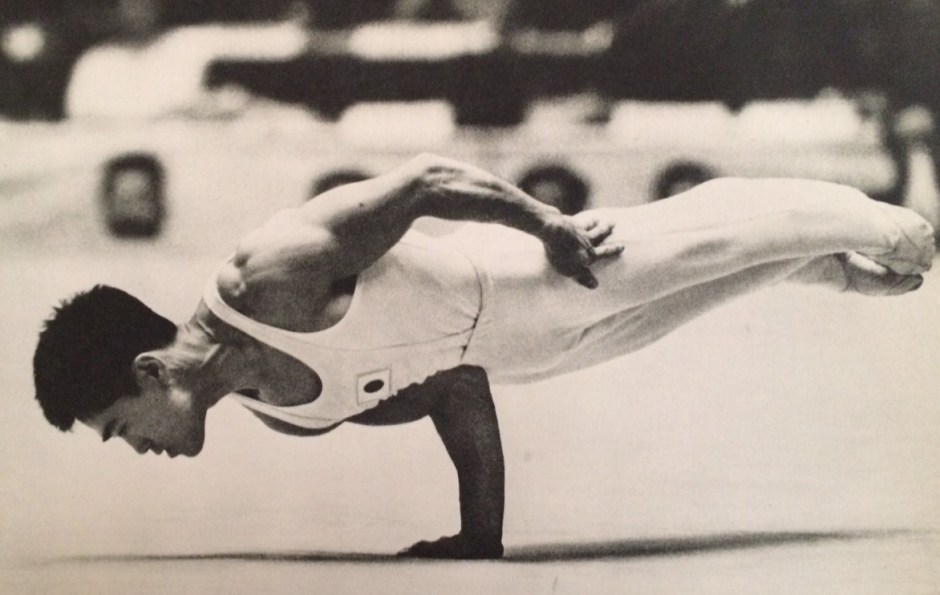
Yukio Endo, from the book Tokyo Olympiad_Kyodo News Agency
By the time the 1964 Tokyo Olympics rolled around, gymnast Boris Shakhlin of the Soviet Union had won nine Olympic medals in Melbourne and Rome, including four gold medals in 1960. Until 1980, his total Olympic medal haul of 13 was the most by any male athlete until 1980.
Shakhlin certainly had an opportunity to continue his championship ways in Tokyo. Except that Yukio Endo, and perhaps all of Japan, stood in his way.
Boris Shakhlin, from the book XVIII Olympiad Tokyo 1964_Asahi Shimbun
Endo won the men’s individual all-around gymnastics competition, which includes compulsory and optional events in six events: the vault, floor exercise, pommel horse, rings, parallel bars and horizontal bar. After all was said and done, Endo had a total score of 115.95 out of a total 120 points, edging out three competitors who tied for second with scores of 115.40.
In other words, 0.55 separated gold from silver. The problem is, Endo had what could be described as an awful effort on the pommel horse optional. As American gymnast Dale McClements described in her diary at the time, “Endo sat on the horse 2 times and dismounted with bent legs.”
According to the Japan Times, Endo had a considerable lead over his teammate Shuji Tsurumi and Shakhlin before the pommel horse optionals. “Japanese spectators were biting their nails fearing that the last moment error would cost Endo the gold medal. The event was halted 10 minutes as Japanese team manager Takashi Kondo made a strong appeal to the judges that the faults should not be counted too much. While the Russians glowered, spectators burst into cheers when the judges finally raised their scoring flags. All four were unanimous giving Endo 9.1 scores which assured him of the gold medal.”
Yukio Endo, from the book, Tokyo Olympiad_Kyodo News Agency
Another American gymnast who witnessed Endo’s performance, Makoto Sakamoto, told me that the pommel horse is arguably the hardest of the six disciplines. “It’s the most difficult event to stay on. There are so many opportunities to fall and slip off. You can hit a slick spot, or you sit down. He missed! I remember saying, ‘Darn it, the best gymnast in the world is crumbling.’ Then he got a 9.15, and I thought, ‘what a gift!’ Anyone else would have gotten an 8.2 or 8.4. He got a 9.15.”
In other words, the 0.55 edge would have disappeared if Endo had not


You must be logged in to post a comment.