Flushing Meadows_five
Me, several years after the closing of the New York World’s Fair in Flushing Meadows.

First things first. Novelist and futurist, Isaac Asimov had a caveat. If the world is destroyed by a thermonuclear war, his predictions would be meaningless. Got it.

isaac asimov
Isaac Asimov

Since there has been no nuclear war of significance, here are a few of the predictions Asimov made in the New York Times in August, 1964. Asimov visited the huge, big-tent event in the world that year that was not the Tokyo Olympics – the World’s Fair in New York, which happened to be in my backyard of Flushing, Queens.

By 2014, electroluminescent panels will be in common use. Ceilings and walls will glow softly, and in a variety of colors that will change at the touch of a push button. A quick search reveals that available in the marketplace is electroluminescent advertising displays (which are paper-thin flexible panels), electroluminescent paint, electroluminescent wallpaper, and something more commonly known, electroluminescent fashion.

There is an underground house at the fair which is a sign of the future. Suburban houses underground, with easily controlled temperature, free from the vicissitudes of weather, with air cleaned and light controlled, should be fairly common. The reason Asimov gives for this idea is Man’s urge to control its environment, as well as expand the amount of land to grown more food to feed a growing world population. But another reason will be the Mega-city Trend, the continued massive migration to big cities that puts tremendous pressure on the infrastructure. Singapore, where I lived for a few years, has a population of 5.5 million people on a land mass of 710 square km, a country half the size of Los Angeles. The Red Dot, as it is affectionately called, will be considerably more dense as the government predicts the population to grow to 7 million in the near future. Singapore has built upwards with its skyscrapers, and outwards with land-fill areas, but is now planning underground working facilities on a scale not commonly seen. Designs for the 300,000 square-meter Underground Science City will be 30 to 80 meters below the surface, with plans to hold a working population of over 4,000.

Singapore Underground Science City
The planned Singapore Underground Science City

Robots will neither be common nor very good in 2014, but they will be in existence. The I.B.M. exhibit at the present fair has no robots but it is dedicated to computers, which are shown in all their amazing complexity, notably in the task of translating Russian into English. It will be such computers, much miniaturized, that will serve as the “brains” of robots. The way Asimov describes robotics, and I suppose, artificial intelligence is far less aggressive than his imagination in his novels. I haven’t read that many Asimov works, but I do know that he was one of the most significant minds behind a philosophical framework or set of rules regarding the relationship between Man and Robot: The Three Laws of Robotics. Additionally, I recall his brilliant character, Hari Seldon in Asimov’s Foundation Series, a man who developed psychohistory, a precursor, to me, of what we now call Big Data.

If you want to watch something historic, as well as geeks geeking out, here’s an incredible video of IBM’s Watson beating two humans at Jeopardy. The two humans are Jeopardy champions.

Much effort will be put into the designing of vehicles with “Robot-brains” vehicles that can be set for particular destinations and that will then proceed there without interference by the slow reflexes of a human driver. I suspect one of the major attractions of the 2014 fair will be rides on small roboticized cars which will maneuver in crowds at the two-foot level, neatly and automatically avoiding each other. Two obvious parallels to today’s technology: self-driving cars, which are all the rage, as well as maglev technology. By 2020, there are some who claim that Japan will have significant driverless transportation on the roads when the Olympians arrive.

The maglev train, which is already operational in Shanghai, will connect Tokyo to Osaka in an hour, achieving a speed of 500 kph, although it won’t be in operation until 2027.

Pictograms for Women and Drinking Water
Pictograms used at the 1964 Tokyo Olympics, from the book, “The Games of the XVIII Olympiad Tokyo 1964 – The Official Report of the Organizing Committee”
If you don’t speak Japanese, travelling in Japan is a challenge. You’re in a train, you pull into a station, you peer through the window as the train decelerates desperately trying to figure out what station you’re at, scanning for English, any English at all.

The next best thing to words are symbols. The signs for men and women’s toilets come in a gazillion varieties, but they are most often a variation of a theme. Symbols, if done right, can cut to the chase.

foreign friendly pictograms

With a continued increase in foreign tourists to Japan, and a spike in international guests in Tokyo during the 2020 Olympics expected, the Geospatial Information Authority of Japan (GSI) released a new set of map symbols which they believe will be more intuitively understood by visitors. The old map symbols included an “X”. In the West, “X” may mark the spot of treasure, but in Japan, it meant police station. The old map represented a temple with a swastika, which is too much of an emotional jolt to many with its strong association with Nazism, despite its far longer association with Hinduism and Buddhism.

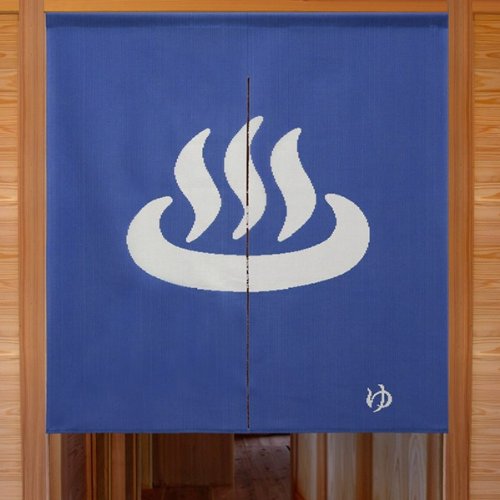
Fortunately, the GSI decided not to replace the symbol for onsen. The three wavy steamy lines bathing in an oval is a personal favorite.

onsen symbol

The pictograms of today were born out of the pictograms of the 1964 Tokyo Olympics. These Games were the first to be held in Asia, and Japan realized they had a language problem. In addition to translation, designers figured that use of symbols would be a powerful and efficient way to get foreigners to the right place. In fact, the Tokyo Olympics proved to be filled with design opportunities for the best in the country as the ’64 Games were essentially the first time an Olympic Games systematically used pictograms to represent each of the sporting events, or direct people to places.

As this blog post states, “…for such a huge national event, needless to say the design side of things was very important too and it engaged the talents of the industry heavyweights at the time.” One of the heavyweights was Yoshiro Yamashita, who designed these event symbols.

events pictograms 1964

The symbols that represented facilities were said to have been created by a team of ten designers.

pictograms at Tokyo Olympics_The Games of the XVIII Olympiad Tokyo 1964 Report
From the book, “The Games of the XVIII Olympiad Tokyo 1964 – The Official Report of the Organizing Committee”

Sazae-san_Looking Out for the Sad Student

I really didn’t expect to see such a dark scene in a Sazae-san comic strip. But there it was.

Sazae-san notices a sad student walking out of the school grounds where exam results were posted. Sazae-san is so concerned that she follows the student, and is relieved to see her return safely home. What was Sazae-san worrying about? Maybe this young woman would be so distraught she would try to do harm to herself.

In Japan, these exam results determine whether you get into the school you want: Tokyo University, Kyoto University, Keio University or Waseda University, for example. Graduating from those prestigious schools will likely determine your short-term career, as well as your long-term life prospects. Parents, grandparents and the children themselves realize that a lot is riding on their chances to pass these university exams.

Japan has always had relatively high suicide rates, as you can see in the chart below. These days, Japan’s rate is about 60% higher than the global average. Back when Machiko Hasegawa was penning these Sazae-san cartoons, the suicide rate was significantly higher.

Suicide deaths per 100000 trend

So suicides were a concern of the day. And while it is unclear whether there was a strong correlation between suicides and young people under tremendous academic pressure, it certainly was in the cultural conversation. Here are two more cartoon strips from the book The Best of Sazae-san – The Olympic Years“, illustrating the fear that one student has just trying to learn whether he passed a university exam or not, and another showing the level of deception that Sazae-san’s brother Katsuo is willing to go to in order to explain how he is doing in school to his father.

Sazae-san_I passed telescope

Sazae-san_I Passed

sebastian coe_head of IAAF.png

How do you clean up corruption when it is perceived that all parties are steeped in it?

According to this powerful opinion piece by Juliet Macur of the New York Times, better to go with the devil you know, than the devil you don’t.

She writes how the head of WADA (the World Anti-Doping Agency), Dick Pound, has consistently been blunt and hardline with regards to corruption in athletics, particularly as it relates to doping. (She cites in the article a hysterical quote from Pound about a famous cyclist’s testosterone levels as a case in point.) But for some reason, when it comes to the fate of IAAF leader, Sebastian Coe, Pound somehow found it in his heart to praise and support, not tear down. As Macur wrote, “What had WADA done with the real Dick Pound?”

Coe took gold in the 1500 meters in 1980 and 1984, was elected as an MP in the British Parliament, and has been a leader in the International Amateur Athletics Federation since 2007, recently becoming the head of the IAAF last August. To be honest, it’s a lousy time to be the head of the IAAF, which is under a dark cloud of suspicion.

SEbastian Coe wins gold in 1500 in Los Angeles
Sebastian Coe wins gold in the 1500 meter race at the 1984 Los Angeles Olympic Games

There are allegations of gifts made in exchange for awarding the 2019 world track and field championships to Doha, Qatar. There is the state-sponsored doping program in Russia that was conveniently ignored by the IAAF but eventually exposed by WADA, resulting in Russia’s track and field being banned from international competition, including the Rio Olympics in August. There is the suspected doping of Kenya’s runners, whose performance at the World Athletics Championships in Beijing last August was so superlative, they topped the medals tables for the first time ever.

And finally, there is Coe himself, who very reluctantly disassociated himself from his long-time paid association with Nike. The IAAF awarded the 2021 Athletics World Championships to Eugene, Oregon in the US, with apparently a formal bidding process. Oregon is definitely a hotbed for track, so Eugene’s selection is not a surprise. But Oregon is also the home to Nike. There’s no real indication that Nike, and thus Coe, had anything shady to do with the selection process. But taken all together, the IAAF is not currently a poster child for transparency and ethical decision making.

But as Macur explains, “It can be difficult to find purity at the top of international sports. In track and field, Coe, the former middle-distance star and Olympic champion, just might be the best option. He should serve his punishment for not speaking out against pervasive doping in track and field. His sentence: to clean up his dirty sport.”

Macur goes on to quote 5,000-meter runner and champion, Lauren Fleshmen as saying that Coe probably didn’t know all the corrupt things going on in the IAAF because of its

zhabotinsky mexico city

In 1960 and 1964, weighlifting champion, Yury Vlasov, marched into the stadium in the Olympic opening ceremonies holding the Soviet flag aloft with one hand, some 15kg over several hundred meters.

But at those Games in Tokyo, he surrendered his championship to Leonid Zhabotinsky, a monster of a man nearly 2 meters tall and 160 kilograms. A man who had a flair for the dramatic, Zhabotinsky may have psyched out the champion, Vlasov, as related in this previous post.

And so with the passing of the torch, came also, the passing of the ceremonial bearing of the flag in the Olympics. That’s Zhabotinksy above in Mexico City, continuing Vlasov’s traditional one-handed feat of strength.

On Thursday, the Big Zhabo, a hero to a young Arnold Schwarzenegger, as related in this NY Times obit, passed away at the age of 77.

Yukijirushi butter ad_Asahai Graf Tokyo Olympics Special Issue_November 1964
An ad for butter and cheese by the dairy company, Yuki Jirushi. From the November 1964 Asahi Graf, Tokyo Olympics Special Edition

A derogatory term in Japan for foreigners at the turn of the 20th century was “batta-kusai” (バタ臭い), literally “stinks of butter”.

In the 16th and 17th centuries in Japan, when the Portuguese and Dutch established relations and trade with the Tokugawa Shogunate, the Japanese were exposed to non-Japanese who had meat and milk in their diets. The Japanese, due to the influence of Buddhism and Shintoism, were forbidden from eating meat, and thus by extension, dairy products. On top of that, Japanese were generally lactose intolerant.

Because of the fundamental differences in diet, the Japanese thought, quite simply, that Westerners, with the residue of beef, milk and cheese in their systems, reeked.

Milking at a small farm in Japan 1933_Mainichi Photo Gallery
Milking at a small farm in Japan in 1933_Mainichi Photo Gallery

But when Emperor Meiji came to power in the late 19th Century, the emperor and his government embarked the country on a massive modernization campaign to make not only the Japanese military, science and industry equal to the levels of excellence in the Western industrialized world, but also the size and strength of Japanese people.

According to this article, the Meiji Government not only lifted the ban on meat and dairy-products consumption, they put the word out, quietly, that the Meiji Emperor also enjoyed meat, cheese and milk.

Jersey cows arrive to Japan from New Zealand 1953_Mainichi Photo Gallery
Jersey Cows arrive from New Zealand to a farm in Japan in 1953, from the Mainichi Photo Gallery

Clearly, the Meiji Government was also picking up advanced marketing techniques, such as celebrity endorsements to sell products. But when the 1960s rolled around, using data to back your claims was all the rage. The advertisement at the top of the page was published in November, 1964 in Asahi Graf’s Tokyo Olympics Special Issue. The headline text states, “These Children Will be the Strength of Japan in the Future”. The company making this statement is “Yuki-Jirushi”, one of the dairy products companies (along with Meiji) established by the Emperor Meiji.

The statistics shared in the ad show how, from 1955 to 1962, the height of the average 5-year old went from 104 to 106.1 cm tall while the average individual daily consumption of dairy products (I suppose they mean butter and cheese) went from 0.8 grams to 5.4 grams.

Distirbution of Milk Containers 1955_Mainichi Photo Gallery
Distribution of milk containers in Japan in 1955, from the Mainichi Photo Gallery

A few years later, an AP article from May, 1969 cited a government survey indicating the trend was continuing. “A ministry survey showed the average height of 11-year-old boys has increased by 4.6 inches over the past 68 years. Girls of the same age had an increase of 5.4 inches. During the 1900-1968 period, the 11-year-old boys gained 13.6 pounds and the girls 18.9 pounds in weight, the survey said.”

The article went on to explain that the Allied Occupation under the

Armin Hary edges out David Sime in 100 meters
German Armin Hary (left) edges silver medalist David Sime third from left in the 100 meter finals at the Rome Olympic Games in 1960.

American David Sime, who lost to Germany Armin Hary in a photo finish in the 100 meters race at the 1960 Olympics, passed away on January 12. He was 79.

This obit in the New York Times is a good summary of his life, the championship runner who played baseball at Duke, and then opted to go to Duke University School of Medicine instead of playing for the Detroit Lions in the NFL.

In addition to just missing out on gold at the Rome Olympics, Sime was recruited by the CIA to encourage a Soviet athlete to defect. You can find my write up on Sime and Russian broad jumper Igor Ter-Ovanesyan here.

drug den clearance picture

I can’t get this image out of my mind. It seems so foreign to the spirit of athletic competition on the one hand, and yet it is as entwined in world-class competition as excellent coaches and dedicated training.

Doping.

The image I am referring to is a particular odious one, described in the book, The Dirtiest Race in History: Ben Johnson, Carl Lewis and the 1988 Olympic 100m Final, by Richard Moore. The Second World Athletics Championships were held in Rome, Italy in August 1987, a year prior to the 1988 Summer Olympic Games in Seoul Korea. Ben Johnson has set a world record in the 100 meters with a time of 9.83 seconds, beating rival Carl Lewis who also had a personal best of 9.93 seconds.

Moore related a story told by Doug Clement, a former Olympic middle-distance runner who was a coach and a doctor for the Canadian Olympic Association, and was at those World Athletics Championships in Rome.

Stadio dei Marmi
The Stadio dei Marmi, Rome.

Next to the Olympic Stadium was one of Mussolini’s smaller excesses, the Stadio dei Marmi, the Stadium of the Marbles, filled with statues depicting athletes in classical poses, which during the championships was being used as a warm-up area. ‘Inside it was a catacomb-like area, lots of little rooms,’ recalls Clement. ‘They were dark and dingy, there were multiple caves. There were syringes everywhere. All over the floor. It was like a drug den.’

It was a drug den – and a metaphor for the sport. In the sunshine of the Stadio Olympico the triumphant championships were played out in front of 75,000 people; near by, in the shadows of the statues that adorned the Stadio dei Marmi, lay the dingy reality.”

A year later, Ben Johnson won the gold medal at the Seoul Olympic Games in 1988, only to have it stripped from him after testing positive for drugs in his system.

ben johnson.,_Koreajpg

Roth Saari Hetz on the Podium_Asahi Graf_30October1964
Left to Right: Roy Saari, Dick Roth, Gerhard Hetz, silver, gold and bronze medalists of the 400 meter individual medley at the 1964 Tokyo Games

“I can withstand pain. In fact, I love pain.”

Olympic champion, Dick Roth, referred to pain as his advantage. The 1964 gold medalist in the 400-meter individual swimming medley believed he could tolerate more pain than almost any of his competitors. And when you’re an Olympic-level swimmer, a combination of holding your breath and stretching your body to its physical limits creates oxygen debt.

Oxygen is vital to breaking down glucose to provide your body with energy. But when the body can’t get enough oxygen to create energy, it releases lactic acid, a substance that can create energy without oxygen. When there is more lactic acid in your blood than can be burned off, you get pain. And the more intense your physical activity, the more intense the pain can be.

Dick Roth with medal

And Roth’s pain was intense. As described briefly in an earlier post, Roth was one of the young American swimmers favored to do well in his swimming event. But literally hours after the Opening Ceremonies of the Tokyo Summer Games, Roth was tossing and turning in discomfort and then tremendous pain.

Roth got himself out of bed at 6 am, got to the Olympic Village infirmary. The nurse poked and probed. The swim team doctor did blood tests and then left him alone in his bed. He was 24 hours from competing in the Olympic Games. “This was not the way to calm me down,” thought Roth. Then finally, they told him. He was going to be transported to a US Army Hospital in Western Tokyo and have his appendix removed.

“I was so blown away they had to bring in a counselor to calm me down,” wrote Roth. “The ambulance ride to Tachikawa is a blur. The only thing I remember is pulling up to the hospital entrance and thinking I was going to die.”

The doctors told Roth that they would have to take out his appendix ASAP. He said no. They somehow prepped Roth for the operation and asked a member of the US Olympic Committee to sign off on the operation since Roth was still a minor at 17, but the USOC didn’t want to take responsibility. They eventually tracked down Roth’s parents who of course wanted to OK the operation. But their son was adamant. “My parents came in to see me before they signed, thank god. I begged them not to let the doctors take it out. I really wanted to swim. What if they were wrong? So began hours of debate back and forth with phone calls to the States for third and fourth opinions. In the end, my parents made a deal to take all responsibility, an unbelievably tough decision.”

The Roths and the doctors agreed that Roth would not exercise except to swim in the heats and that he would have blood tests every four hours. Roth was back in the Olympic Village that evening and went to sleep. The next day, he swam relatively poorly in the heats, 15 seconds slower than his personal best, but still made it into the finals.

“Everyone is on the same level physically,” Roth told me. “So it is all mental. On any given day anyone can win. We all knew about pain. You had to swim through the pain. I would get myself into oxygen debt and when I couldn’t add 2 and 3, when I thought I couldn’t go any further, I knew I was in the right place.”

And as he was resting in bed waiting for the finals to begin, he wrote that pain was a part of his mental preparation. “All that day I swam the race in my mind and felt the pain over and over and over. I was obsessive. But I got to watch my confidence build back up. I remember it very clearly.”

What Roth didn’t remember clearly was the 400 meter finals race, which is 100 meter sprints in four different styles: butterfly, backstroke, breaststroke and freestyle. “I really don’t remember the race very well,”

Sazae-san_You Didn't Do Your Homework Thief

Japan is an incredibly safe city. With over 13 million strangers jampacked together, you might think that the crime and violence that plague other cities in the West might be evidenced in Tokyo. But that isn’t the case.

I won’t go into factors here. But I was surprised to see that in the world of Sazae-san in the early 1960s, crime was not an unknown quantity. In the cartoon at the top of the page from the book The Best of Sazae-san – The Olympic Years“, Sazae-san jokes about the incompetence of a con-man. In the cartoons below, the illustrator Machiko Hasegawa is able to make light of kidnapping and theft.

Sazae-san_Don't Worry I Won't Kidnap You


Sazae-san_It Was a Cheapie

The reality is, crime may very well have been on the minds of many Japanese in Tokyo at the time. As this line graph of violent crime rates from 1950 to 1996, Japan actually had higher rates of violent crime than Sweden, the United States and the UK in the late 1950s early 1960s. That was likely a product of the post-war years as Japan was crawling its way out of a decimated landscape, both economically and physically.

Total Violent Crime Rates 1950 to 1996
From the book, The Great Disruption, by Francis Fukuyama

Another popular signal of this anxiety was the powerful 1963 film, “High and Low”, by director Akira Kurosawa, starring actor Toshiro Mifune as a rich industrialist who must come to grips with the kidnapping of a child. Here is a wonderful summary and analysis of the film by New York Times film critic, A. O. Scott.