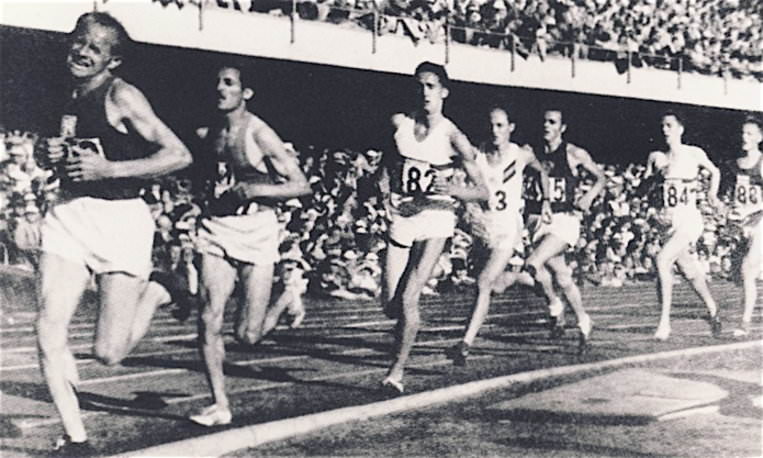
emil-zatopek-and-frank-sando-at-helsinki-olympics_circled
While legendary Emil Zatopek leads the pack in the 10,000 meter race at the 1952 Helsinki Olympics, Frank Sando, with only a sock on his left foot, ended up fifth.


It was 1952, at the Helsinki Olympics, there was no brighter star than Emil Zatopek of Czechoslovakia. But sharing a part of the shade under the towering figure of Zatopek was a Brit named Frank Sando. Somewhere early in the 10,000-meter race (at the end of the first or third lap depending on which report you read), Sando was spiked by a trailing runner and lost his left shoe. Sando kept running.

In fact, Sando ran nearly the entire 29-minute race, with bare left foot. And he incredibly came in fifth, running steadily in one of the more grueling of Olympic competitions, breaking the British record and coming within 3.6 seconds of a bronze medal.

It was 1960 when a man from Ethiopia topped that feat (as it were). Abebe Bikila became the first black African to win a gold medal, winning the marathon in Olympic record time….shoeless.

Abebe Bikila in Rome
Abebe Bikila winning gold in the marathon in Rome in 1960.

There have been many other cases of runners losing a shoe in a race, but usually the loss of the shoe impacts the performance of the runner negatively. When someone prepares hundreds of hours for a particular running competition, it is with the understanding that the shoes will hold up. There is no training without shoes. And when an athlete is suddenly without a shoe, it will be painful. The soft skin of the bottom of the foot will peel away. The tendons and muscles that support the ankles and calfs and hamstrings will feel the effects of a suddenly altered running style, one instinctively designed to avoid pain.

But there are also people who, today, run barefoot regularly, who believe that un-shod approach is the natural way to ambulate, and better for a body that did not evolve over the millenia with Nike’s or Adidas shoes on foot. (See Barefoot Runners Society.) Barefoot runners not only enjoy barefoot running, they believe it improves their overall foot and leg condition and diminishes arthritic pain.

According to this siteAccording to this site, these are the potential benefits if you take up barefoot running regularly:

  • May strengthen the muscles, tendons and ligaments of the foot and allow one to develop a more natural gait.
  • By removing the heel lift in most shoes, it will help stretch and strengthen the Achilles tendon and calf muscle which may reduce injuries, such as calf strains or Achilles tendinitis.
  • Runners will learn to land on the forefoot rather than the heel. The heel strike during running was developed due to the excessive padding of running shoes, but research shows this isn’t the most effective natural running stride. Landing on the heel causes unnecessary braking on every stride. The most efficient runners land on the mid-foot and keep their strides smooth and fluid. Landing on the forefoot also allows your arches to act as natural shock absorbers.
  • It may improve balance and proprioception. Going barefoot activates the smaller muscles in the feet, ankles, legs, and hips that are responsible for better balance and coordination.
  • Running barefoot helps one improve balance, but it also helps them stay grounded and connected with your environment. A person can learn to spread their toes and expand the foot while it becomes a more solid and connected base that supports all movements.

And for the competitor, there is a potential benefit regarding increased speed, perhaps one of the more important factors for a competitive runner. According to this article in Runner’s World, research has shown that the simple matter of reducing the weight your feet and legs have to carry can have a significant impact on your running speed. This article quotes long-distance runner, Bruce Tulloh, who cites the research of Dr Griffith Pugh. Dr Pugh’s huge claim to fame was to be the doctor to the team that first climbed Mt Everest.

zola-budd
The South African long-distance runner, Zola Budd, who ran barefoot under the British flag in the 3,000-meter race at the 1984 Los Angeles Olympics.

“Dr. Pugh had me run repetition miles, to compare the effect of bare feet, shoes, and shoes with added weight. He collected breath samples. It showed a straight-line relationship between weight of shoes and oxygen cost. At sub-5:00 mile pace, the gain in efficiency with bare feet is 1 percent, which means a 100m advantage in a 10,000m. In actual racing, I found another advantage is that you can accelerate more quickly,” Tulloh said.

But if you’re not dealing with pain in your feet or legs, and you have never trained in barefoot, there is no real great advantage to start doing so. When you first run barefoot, as most of us can clearly imagine, it will hurt. The bottom of your feet will be chocked by the impact, particularly the moment you step on a pebble, a thorn, or a piece of glass. In addition to punctures and lacerations, the chance of achilles tendonitis, calf strain and plantar fasciitis are high. Then there’s the frostbite if you run in the cold….

My intent is not to pull your leg, or put my foot down on the merits of running unshod. If you have itchy feet and yearn to feel the dirt and grass as it caresses and cushions your overly protected puppies, then perhaps it’s time to stop dragging your feet. Go ahead, dig in your heels and put your best foot forward.

evander-holyfield-adn-kevin-barry
Holyfield knocking out Barry and then Barry being awarded victory.

He was the dominant heavyweight boxer of the 1990s, successfully earning the heavyweight title three times, something accomplished previously only by Muhammad Ali.

But unlike Ali, who was an Olympic champion, winning gold at the 1960 Rome Olympic Games, glory escaped Evander Holyfield at the 1984 Olympic Games.

The youngest of nine children from Almore, Alabama, Holyfield grew up in a crime-infested neighborhood, finding respite as a seven-year old in boxing. Winning at every level as a pre-teen and teenager, Holyfield rose to international prominence by winning silver at the 1983 Pan American Games in Caracas, Venezuela. In 1984, he found himself representing the United States on the boxing team at the Los Angeles Olympics as their light heavyweight contender.

While spectators did not know much of Holyfield at the commencement of the Games, they certainly were aware of the rock solid boxer whose punishing body shots with the right, and hooks to the face with the left were making a case that Holyfield was destined for gold. He mowed down the competition in increasingly ruthless fashion, with the referee stopping the contest early in his first two bouts. Holyfield knocked out his quarterfinal opponent in the first round, setting up a match with Kevin Barry of New Zealand.

Holyfield dominated the fight. Blocking most of Barry’s punches, Holyfield landed hooks and body blows fairly regularly. Barry was cautioned a few times for clinching by holding the back of Holyfield’s neck, as that was his only way of slowing Holyfield down. A telling moment came in the middle of the first round when Holyfield landed what the announcer called a “stinging left”, which turned Barry’s legs to jelly. The referee, Gligorije Novicic of Yugoslavia, reached in to break the fighters apart, but Holyfield managed to land another solid right. Barry was given a standing eight, and looked to be in trouble as the first round ended.

The second round started somewhat cautiously for the first 30 seconds, until Holyfield landed two lefts to Barry’s gut, the Kiwi’s knees buckling momentarily. Barry, stopped Holyfield’s momentum by again holding the back of his neck. After that Holyfield began to land shots to the head and body relentlessly until the fight was stopped when the referee deducted a point from Barry’s scorecard for, I believe, hitting Holyfield late after telling them to stop. Soon after that, Novicic stopped the fight to caution Holyfield for something that seemed unclear. Soon after Barry was cautioned for a couple of rabbit punches to Holyfield’s head. Soon after Barry is cautioned for holding the back of Holyfield’s neck. Another caution for Barry. And again, another point stripped off of Barry’s score.

The fight essentially deteriorated into a herky jerky rhythm of starts and stops, primarily due to the Novicic’s need to caution and warn Barry. Then suddenly, the fight was over.

With fewer than 20 seconds left in the second round, with Barry holding the back of Holyfield’s neck yet again, Holyfield delivers a hard right to Barry’s mid-section, and at the moment Holyfield lands a second right to Barry’s stomach, the referee shouts “stop”. A split second later, Holyfield delivers a crushing left hook to Barry’s right check that sends the New Zealander to the mat. Barry gets up, but the referee counts him out.

Barry has been knocked out.

But he hasn’t lost.

kevin-barry-and-evander-holyfield

Soon after, the referee calls Holyfield over and says something that sends Holyfield away in clear disgust. Novicic has disqualified Holyfield, apparently for punching Barry after saying “stop”. And just like that, the fight is over and Barry has won the fight. And when the two boxers are standing at the side of the referee, and raises the right hand of Barry in victory, Barry grabs Holyfield’s right arm and lifts it in the air. For all to see, Barry wants people to know he thought Holyfield was the winner.

Ironically, there were no real winners in the light-heavyweight competition in Los Angeles. Holyfield was disqualified, and therefore lost his chance to advance to the gold medal round. And ironically, because Barry was knocked out with a shot to the head, the rules dictated that he was “automatically rendered ineligible to fight for 28 days”, according to this article.In other words, no gold medal match for him either.

The result was extraordinary. The gold medal went to Anton Josipovic of then-Yugoslavia, who did not have to throw a punch to earn the right to the top of the medal podium.

The result was protested by the United States and the protest was denied. But in an unusual act of sympathy or compromise, the protest committee agreed to award the bronze medal to Holyfield despite his disqualification.

When Josipovic accepted his gold medal, he did what he thought everyone knew. He pulled Holyfield up to the top step. When Holyfield stepped off the podium, he was smiling widely, a classy finish to a boxer who would go on to win his next 28 fights as a professional, and become one of the world’s greatest boxers of all time.

josipovic-and-holyfield
Screenshot from video of Josipovic and Holyfield on the medal podium
toda-rowing
Toda Rowing Course in 1964

At the Tokyo International Sports Week, the organizers saw this rehearsal of the XVIII Olympiad a year later as an opportunity, not only to see what operational issues existed, but also to provide Japanese athletes with a chance to compete in a high-pressure event with international stars with world-beating expectations.

Of the approximately 4,000 athletes invited to participate in this competition of 20 events, the same ones that would be held at the Olympics in 1964, over 3,400 were Japanese, including some 1,300 who were expected to compete a year later. For the Japanese athlete, rare was the opportunity to compete in international events.

But that was also true for some of the visiting foreign athletes. More importantly, it was an opportunity for several hundred foreign athletes and officials to see what Japan and its sporting facilities were like in advance of thousands of other competitors who would come to Japan for the first time in 1964.

And in the case of the United States men’s eight rowing crew, who all came from the Vesper Boat Club in Philadelphia, Pennsylvania, their participation in the Tokyo International Sports Week was an opportunity to gain crucial intelligence about the rowing course.

The Toda Rowing Course in Saitama Prefecture was actually constructed in the 1930s in preparation of the 1940 Tokyo Olympics. Due to the impending issues of world war at the time, the organizers despite working so hard to win the right to host the Olympics, decided to decline. The IOC failed to organize a Games, not only in 1940, but also 1944.

But in 1963, the Toda Rowing Course was open for competition. And when the coach of the US men’s eight team, Allen Rosenberg, got a close look at the course, he gleaned a bit of intelligence that would shape the training and the makeup of the team over the course of the year. According to Bill Stowe, in his book, All Together, about the victorious Vesper 8, that intelligence would help the team build a psychological edge over their chief competitors of the Ratzeburg Rowing Club, the men’s eight team from Germany who were the reigning champions of the Rome Olympics.

Rowing in Tokyo gave Rosenberg and Rose the opportunity to study the rowing course which proved invaluable a year later. For the most part the European rowing courses are laid out to take advantage of prevailing tailwinds and the Ratzeburg style of rowing is short in the water and a high stroking cadence, both advantageous with a tailwind. However, the Toda course did not seem to have a prevailing wind and headwinds were not uncommon. This early knowledge of the anticipated conditions for 1964 helped Vesper to design both a crew and a style that could present an advantage over the Germans on that knowledge alone.

vespers
Vesper 8 pulling ahead at the 1964 Tokyo Olympics.

A year later, on October 15, 1964, six teams line up in the dimming light of early evening. As Rosenberg had anticipated and prepared for, a strong headwind was blowing. His team was built for headwinds and power, and whether the Americans had an advantage or not was less important than whether they believed it was an advantage. Stowe believed it was.

The headwind provides an advantage to longer stroking, and also to the bigger oarsmen whose weighty momentum and extra strength propel the shell into the wind. Lighter crews tend to drag when their oars are not in the water because of the wind resistance on the blades. High stroking crews are at some disadvantage as well because the oars are out of the water more often, the headwind pushing against them. At least that’s the theory and I am not about to argue that point.

As night descended, America’s eight rose, in rhythm, pulling away and earning the gold.


The “Pre-Olympics”, AKA 1963 Tokyo International Sports Week Part 1: A Dress Rehearsal of Olympic Proportions

The “Pre-Olympics”, AKA 1963 Tokyo International Sports Week Part 2: How Was Their English? It Depends on Their Interpretation

The “Pre-Olympics”, AKA 1963 Tokyo International Sports Week Part 3: Hal and Olga Connolly Accept A Most Gracious Invitation

opening-ceremony_tokyo-international-sports-week-3
Mainichi Daily New_October 1963

Olga Fikotova Connolly is a five-time Olympian, and a gold medalist in the discus throw at the 1956 Olympics Games. Her romance and eventual marriage to Harold Connolly, four-time Olympian and champion hammer thrower at the same Melbourne Games is a shining part of Olympic lore.

In 1962, Harold, a teacher by profession, took the family to Finland when he accepted a Fulbright grant to teach English as a second language. Olga hoped to compete in her third Olympiad, at the Tokyo Games, but was consumed by family life, giving her little time to train and get in world-class condition. “My body was not in shape for discus throwing and my dream to compete in Tokyo began to seem unrealistic,” she wrote in a summary of events she had provided to a student researching the Tokyo Olympics.

But sometimes fate gives one a friendly push. Out of the blue, the Connolly’s were informed that officials representing the Tokyo Olympic Organizing Committee would visit them in Finland. And at the appointed time, “three superbly mannered gentlemen speaking flawless English visited our home.”

They told the Connolly’s of the committee’s plan to stage a large-scale rehearsal of the Olympics a year in advance (what was officially called The Tokyo International Sports Week). With warmth and smiles, the officials requested the participation of Harold Connolly in this competition because as they said, he was “truly one of the most respected competitors in the track and field throwing events and fully deserving of the honor.”

hal-and-olga-connolly-at-the-olympic-village
Harold and Olga Connolly at the Olympic Village in October, 1964.

The organizers were reported to have spent about USD one million to organize the Sports Week, a good chunk spent in recruiting and paying for the expenses of over 340 foreign athletes and officials to participate in this Olympic rehearsal. The fact that they visited certain foreign athletes to personally invite them is an act of extraordinary respect. And that respect was not limited to Harold Connolly, as Olga went on to write:

And so, I was pouring tea and offering pastry, and participating in the conversation, all that time having to exercise self- discipline not to show how much I would like see Tokyo also. However, the leader of the delegation noticed. When conversation slowed down, he reached his hand to me and said gently: “Naturally, Olga, you an Olympic champion; and, therefore, if your health permits we expect you also to participate in this pre-Olympic competition. We want you to visit Tokyo and be a part of this event”.

Overcome by his kindness, I could not keep my tears back, but had to speak the truth. “Thank you very much, but I am not in shape”, I said. “It would be charity that I cannot accept.” The officials laughed, spoke to one another for a moment and came up with a plan where I could travel to schools and exercise with kids, learn about them and they learn about me, because many have not ever seen a western woman athlete.”

So at the Tokyo International Sports Week, Harold Connolly competed in the hammer throw, and Olga Connolly visited schools. “Kids found me very tall and climbed up in my arms to touch my hair that was different than theirs. I answered multitude of questions through the interpreter, happily drank ocha at train stations, learnt to eat with hashi.”

And so, she was smitten with Japan, a spark reignited. Thanks to Sports Week, she was committed to the Olympic movement more than ever before, and happily made her return as a representative of the US track team in 1964 at the Tokyo Olympic Games.

The “Pre-Olympics”, AKA 1963 Tokyo International Sports Week Part 1: A Dress Rehearsal of Olympic Proportions

The “Pre-Olympics”, AKA 1963 Tokyo International Sports Week Part 2: How Was Their English? It Depends on Their Interpretation

drone-shot-surfing
Expect incredible drone shots of surfing at the 2020 Tokyo Olympics.

One of my favorite toys as a kid was Verti-bird, a Mattel product from 1973 in which you operated a mini-helicopter to stop the bad guys. You had to control the helicopter’s lift and descent as well as speed, but it was connected to a wire so its flight was limited to a circular route.

But it was very cool!

Today, drones are the modern-day Verti-bird. This is a very weak comparison because drones today are in the middle of cutting-edge advancements in logistics, the military, security, news and sports coverage.

I remember talking with a photographer who covered the sailing events at the 1964 Tokyo Olympics and he mentioned that it is hard for people unfamiliar with yacht competitions to show interest because of how hard it is to capture these competitions visually. Perhaps drones will change that.

Fox Sports made a commitment last year to provide broadcasts of golf and super cross using perspectives provided by drones. This has been made possible by adjustments to Federal Aviation Administration (FAA) guidelines in the US, which now allows the use of drones for commercial use.

Because drones, when controlled by a skilled technician, can provide unique angles, particularly from above a stadium or an athlete, or close ups of athletes who are far from areas where cameramen or spectators watch.

Drones can currently move at speeds of 64 kph (40 mph). They can venture as far as 1.2 kilometers (.75 miles) away from the controller, which is a pretty wide berth. And battery life for a drone is about 20 minutes. These specs are true as of this writing, but I’m sure it’s already an outdated reality as this technology will advance rapidly.

Yes, there are fears that a drone will plop out of the sky and interfere with an athlete’s performance. People will point to the drone falling just behind a skiier at the Sochi Olympics. But the benefit, in terms of the birds-eye-view images and up-close perspectives in sports where such access was not possible, will outweigh the risk.

Expect to see incredibly creative use of drones at the 2020 Tokyo Olympics.

drone-shot-sailing

opening-ceremony_tokyo-international-sports-week-2
Kanto Matsuri at the Tokyo International Sports Week_Mainichi Daily NewsOctober 1963

Hayes Jones was in Japan for the 1964 Tokyo Olympics. He had been to Japan before, but he had not quite mastered the local language. According to Sports Illustrated, he was getting food in one of the dining areas of the Olympic Village, and said to the Japanese working behind the counter one of the few words he had mastered.

“Hai.”

Why Jones, the winner of the gold medal in the 110-meter hurdles at those ’64 Games, was saying “yes” in order to get served, is unclear. But since he wasn’t getting served, he doubled down.

“Hai! Hai!”

As SI told it, “the Japanese responded immediately to this new American game. He laughed and said, ‘Hat! Hai!’ The two stood there shouting hais at each other over the counter until Jones finally said, ‘Hey, man, come on. Give me some salad!’ Instantly he was provided with enough lettuce and tomatoes for 10 men, which occasioned another round of hais, a few bows and a perplexed look on the part of the American.”

There is no dishonesty in saying that in Japan in 1964 the number of people who could speak English was relatively low. Organizers knew that in 1963, in the aftermath of the so-called “pre-Olympics”, a week-long rehearsal in preparation of the real Olympiad to be held exactly a year later. The feedback regarding the interpreters available was harsh.

Apparently, the organizers of the officially named Tokyo International Sports Week (TISW) had recruited interpreters from local universities and overestimated their abilities. The fact that the organizers provided the students with little training also contributed to the lack of readiness. This was particularly true regarding the students understanding of specialized sports jargon. Another issue was that the organizers limited their search to students who spoke either English or French, when in fact the athletes at Sports Week needed to be understood in Russian, German, French, Spanish or Italian for example.

interpreters-in-the-middle
Middle two are official interpreters

As a result of this feedback post-Sports Week, the organizing committee made a few changes:

  • They recruited an additional 140 interpreters who spoke Spanish, German and Russian.
  • They expanded their talent pool beyond universities, openly recruiting interpreters from the general public via examination. Seven thousand five hundred people applied in the ten-day registration period.
  • They ensured that 750 interpreters of the now five core languages of English, French, Spanish, German and Russian would be allocated to the Olympic Village, particularly in the transportation waiting areas and reception areas.
  • As national olympic committees (NOC) expressed a desire to bring their own interpreters, particularly of those languages not in the five core languages, the organizers decided to create a new category called auxiliary interpreters. They allowed an NOC to bring in one local language interpreter for every 30 athletes on the team. Over 200 auxiliary interpreters from 65 countries were given credentials for the ’64 Games.
  • In such a multi-lingual environment as the Olympics, people who spoke three or more languages were highly valued. The organizers did not have to recruit these specialists as apparently requests to volunteer poured into the office after the end of the 1960 Rome Olympics. The organizers ended up inviting 13 foreign multi-linguist interpreters, people who did not speak Japanese, but eventually were found to be very helpful in the press center and the Olympic Village.

Were there language issues at the 1964 Tokyo Olympics? Of course. Were these issues disruptive? Absolutely not, thanks to the efforts and preparation of the organizers and the diligence of the interpreters. Here is how the organizers summarized the performance of the interpreters at the XVIII Olympiad in their report, “The Games of the XVIII Olympiad Tokyo 1964 – The Official Report of the Organizing Committee“:

The preparation of the interpreters was completed early September, one month before the commencement of the Games. Beginning on 15th September, the day of the opening of the Olympic Village, 1,230 interpreters began their activities at their designated posts, whenever they were needed. Both men and women were uniformed differently from other personnel, in distinctive black doeskin blazer with white hemming, so that they might be easily recognized. There were perhaps occasions when the original plans and the practical results did not precisely coincide. As a whole, however, the young amateur interpreters recognized well the significance of the Olympic Games as a festival of youth, and was convinced that each one of them was in fact an ‘ambassador of goodwill’. With this conviction they made up for any linguistic efficiency. They laboured long hours day and night, they performed their duties well, without any incident worthy of mention.

Theirs was a significant role in the  of the Olympic Games in Tokyo. The expenses defrayed by the Organizing Committee for the recruitment, training, and management of the services of the interpreters amounted to 150 million yen (US$416,666).

interpreter-mami-machida
One of the many interpreters at the 1964 Tokyo Olympics_Asahi Graf_Oct23_1964


The “Pre-Olympics”, AKA 1963 Tokyo International Sports Week Part 1: A Dress Rehearsal of Olympic Proportions

The “Pre-Olympics”, AKA 1963 Tokyo International Sports Week Part 3: Hal and Olga Connolly Accept A Most Gracious Invitation

opening-ceremony_tokyo-international-sports-week
Tokyo International Sports Week in October 1963_Mainichi Daily News

The Autumn sky was not clear and blue, but cloudy and gray. Most of the athletes were dressed up smartly, some in normal track suits. When the athletes marched into the National Stadium, there appeared to be huge gaps within and between teams, as opposed to the immensely dense succession of national teams usually expected on their heroic march at the commencement of an Olympic Games. And in this case, they marched past the Crown Prince, not the Emperor of Japan. The jets maneuvered and etched out the five rings of the Olympic emblem, but the circles weren’t quite right.

No one carried a torch into the stadium and lit an Olympic cauldron.

In fact, you couldn’t even see the word Olympics anywhere. This was not a sporting event sanctioned by the International Olympic Committee (IOC), so no one could officially use the label “pre-Olympics”, which were what most people were calling the event.

But that was just fine. After all, this was not the opening ceremony of the 1964 Tokyo Olympiad, it was the opening ceremony of the Tokyo International Sports Week in 1963, exactly one year before the start of the actual Olympics.

Demonstrating the wisdom and extraordinary planning capability of the Tokyo Olympic Organizing Committee (OOC) in the early 1960s, they committed to running a dress rehearsal of the Olympics a year in advance. At a budget of USD1 million, the OOC organized a competition for 20 different sports, invited about 4,000 athletes from 35 different countries, including over a dozen world-record holders.

There were, of course, issues, according to the Mainichi Daily News.

At the yachting events in Hayama, the Thai team (led by a Prince Bira of Thailand) were regaled by the Costa Rican flag at the venue, which employs the same pattern and colors, but the colored stripes are in different orders.

  • The canoeing venue at Lake Sagami was too far away, the 4-hour bus ride a headache.
  • The shotput balls, which were manufactured in Japan, were apparently too small.
  • The high jumpers found the soft rubber clumps in their landing area to be unsafe, particularly after the world’s best female high jumper, Iolanda Balas, sprained her ankle in it after a jump.
  • The walls that provided back drop at the shooting site were brown, which caused eye strain, as opposed to yellow or gray which the shooters were more accustomed to.
  • Taxis were hard to get a hold of at the stadium.
  • And most prominently, the interpreters on site were not effective.

All of which proves why it was so important to have a rehearsal, so that the organizers could note potential issues when the real Games come to town. Perhaps more significant, a major objective of the Tokyo International Sports Week was to infuse confidence in the organizers, the IOC and probably the entire nation of Japan – after all, there was some doubt that Japan could pull off the first Olympic Games in Asia.

iolanda-baras-at-tokyo-international-sports-week
Iolanda Baras complained of the landing area at TISW_Mainichi Daily News_October 1963

After the completion of the dress rehearsal, any doubt disappeared. The 7-day Tokyo International Sports Week was a success.

According to Sports Illustrated, over 20,000 police and over 1,200 firemen were mobilized by the Tokyo Metropolitan Government during the Sports Week. And when the 68,000 spectators spilled out of the National Stadium at the end of the Opening Ceremony on October 11, 1963, it reportedly took only 18 minutes to do so (which is mindboggling), and about 50 minutes to restore traffic to normal conditions around the National Stadium on a Friday afternoon.

Here’s how the Mainichi Daily News put it:

The criticisms from the foreign and Japanese delegations and press, in fact, came as a “blessing” to the Tokyo Olympic organizers, who had intended the TISW “actually and truly as a rehearsal or trial” and nothing more. The lessons they learned are to their advantage in preparing for next year’s Olympics. Reflecting and weighing the evaluations, good and bad, the OOC is rolling up its sleeves to remedy these flaws and to improve, whatever possible, on the countless details that need to be perfected by Olympic time next year. Many of the suggestions have already been accounted for. The Japanese have demonstrated that they have the ability to stage a big-scale sports festival by their splendid organization of the spectacularly successful Third Asian Games in Tokyo five years ago. And they can do it again. The world can be confident that the Japanese with their ingenuity and determined efforts and favored by experiences in the TISW will clear all hurdles successfully to realize their hopes and dreams to make Asia’s first Olympic Games the greatest ever held.


The “Pre-Olympics”, AKA 1963 Tokyo International Sports Week Part 2: How Was Their English? It Depends on Their Interpretation

The “Pre-Olympics”, AKA 1963 Tokyo International Sports Week Part 3: Hal and Olga Connolly Accept A Most Gracious Invitation

chen-shih-hsin
Chen Shih-hsin of “Chinese Taipei”

At the 2004 Athens Olympics, Chen Shih-hsin won Taiwan’s first ever gold medal. But as the taekwando lightweight stood on the podium after accepting her medal, neither the national anthem she listened to, nor the flag she saw rising were Taiwanese. They were symbols of a compromise Taiwan accepted when the IOC agreed to have Taiwan compete under the name “Chinese Taipei”, recognition that the People’s Republic of China was the only lawful representative of China.

National flags and anthems can be problematic at times because of the emotion they evoke.

We learned of another example recently.

One of the golfers in the world, Rory McIlroy, decided to forego with the Rio Olympics in August, stating that his concerns over the zika virus were enough to keep him home. McIlroy was not alone in that decision, but it was only recently learned that the mosquito-borne virus was not his chief issue. He stated recently in an interview with the Sunday Independent that the IOC told him that if he decided to attend the Rio Games he would have to decide under which flag he would compete: the flag of Great Britain or of Ireland.

rory-mcilroy-in-northern-ireland
Rory McIlroy

McIlroy is from Northern Ireland, which is part of the United Kingdom, but not part of Great Britain. I won’t go into the politics of this area, primarily because I don’t understand it well enough to try. But McIlroy felt the decision to participate in the Olympics was a decision to openly declare allegiance to a particular sovereignty, something he felt uncomfortable with.

“Not everyone is driven by nationalism and patriotism,” he told the Independent. “All of a sudden it put me in a position where I had to question who I am. Who am I? Where am I from? Where do my loyalties lie? Who am I going to play for? Who do I not want to piss off the most?” he said.

“I started to resent it and I do. I resent the Olympics Games because of the position it put me in, that’s my feelings towards it, and whether that’s right or wrong, it’s how I feel.”

Apparently, McIlroy explained his feelings in a series of texts to his friend and gold medalist of the Rio Olympic golf competition, Justin Rose.

Justin, if I had been on the podium (listening) to the Irish national anthem as that flag went up, or the British national anthem as that flag went up, I would have felt uncomfortable either way. I don’t know the words to either of them; I don’t feel a connection to either flag; I don’t want it to be about flags; I’ve tried to stay away from that.

andre-agassi-and-steffi-graf
Andre Agassi and Steffi Graff

Quarterback Tom Brady and Super Model Gisele Bundchen are. So are Tennis great Serena Williams and Reddit founder Alexis Ohanian. Then there is golf icon Tiger Woods and ski champion Lindsey Vonn, as well as Olympian greats Nadia Comaneci and Bart Connor. These are Sports’ Power Couples, a duo of envious capabilities and qualities that will cause entire rooms to turn heads.

But perhaps the greatest sports power couple of all time is the love match of tennis legends, Andre Agassi and Steffi Graf.

Andre Agassi, the charismatic, enigmatic tennis tour de force of the 1990s and oughts is one of 8 men to have a career grand slam, having won eight grand slam titles over the course of the four major tournaments: the Australian Open, the French Open, Wimbledon and the US Open. To win the biggest tournaments on three different surfaces – hard court, grass and clay – is a testament to versatility and greatness. Additionally, Agassi won gold in men’s singles tennis at the 1996 Olympic Games in Atlanta, thus making him the first and only man to earn the informal title of Career Golden Slam, until Rafael Nadal accomplished that with combined Olympic victory in 2008, and US Open victory in 2010.

Steffi Graf tops the accomplishments of her husband. The German superstar of the 1980s and 1990s is arguably the greatest female tennis player of all time. Over her career, Graf has won 22 Grand Slam singles titles (tied with Serena Williams), and in one incredible year, she pulled off a purist’s dream. In 1988, Graf won the Australian, the French, Wimbledon and the US Open, capping it off by winning the gold medal in women’s singles at the 1988 Seoul Olympics.

A Golden Slam. Until Steffi Graf, no one, man or woman, had ever done that.

steffi-graf-and-andre-agassi-family

usolympic-team-portraits-1964_1
From the “United States Olympic Book”

The pictures are the first two pages of photo profiles of Americans on the US Olympic squad, from the summary report of American performance at the 1964 Tokyo Olympic Games. As you can see and likely understand, America at the time demographically was generally perceived to be white. But it was changing, as minority groups, be they black, latino or Asian for example, were growing in size. Consequently, their representation in American Olympic squads were also growing.

But this was 1964, and race relations were beginning to brew, and get attention. In fact, it was October 14, 1964, the fifth day of the Tokyo Olympics, when the powers that be in Norway awarded Dr. Martin Luther King Jr the Nobel Peace Prize.

usolympic-team-portraits-1964_2
Note James Bregman’s head shot in the upper right-hand corner

In 1964, diversity and inclusion were not buzzwords in corporate America. They were in some ways an alien concept, something that you might only visualize if you happen to be passing through the United Nations when it was in session. But there was one shining example of that on Team USA in 1964 – the Judo team – represented by a Caucasian Jew (James Bregman), a person of Native American Indian descent (Ben Nighthorse Campbell), a Japanese-American (Paul Maruyama) and an African American (George Harris).

Judo is not a team sport. It is very much mano-a-mano, and while you learn from others, training can be done independently. In other words, in the case of the 1964 Team USA judo squad, their diverse make up did not necessarily contribute to their actual performance beyond the fact that they were all good friends, four of the few foreigners who ventured to the mecca of judo in Tokyo to live and train.


ben-campbell
L to R: George Harris, James  Bregman, Yoshihiro Uchida, Paul Maruyama, Ben Nighthorse Campbell


But for James Bregman, who won a bronze medal in the middleweight class at the 1964 Games, the “rainbow team” was an inspiration to him.

“I grew up in a black ghetto,” Bregman told me. “I was a Jewish kid with white skin who was picked on by black kids who were brutes. I actually experienced segregation. My father had a grocery store in Green Valley, Virginia, and we lived above it on the second floor. Behind our store was Drew Elementary School, only two blocks away. I could play basketball with the other kids there, but in the 1950s I couldn’t go to that school. Instead, they bussed me out to Fairlington Elementary School in a white neighborhood 30 minutes away.”

Bregman didn’t object to being bussed out – he said he really wasn’t conscious of the socio-economic context of race relations at that time. But he did know that he was beat up in his neighborhood. Very often the bullies would be black, but Bregman told me that he was brought up not to judge, that he should be respectful to everybody and that a few bad guys did not represent an entire group.

And yet, he was getting beat up nonetheless.

Bregman was a small boy, often sick, dealing with bronchitis and asthma as a child. His parents thought that keeping him active indoors would help, so he got lessons in baton twirling, tap dancing, gymnastics, acrobatics as a kid. But one day, his parents learned of a judo club in the officers’ athletic club at the Pentagon in Washington D. C. that also was open to the public. Bregman’s parents took him to the club and suddenly, he was hooked on judo. And the officer’s club was also eye opening, the closest he would come to being inside the United Nations.

Although the Officer’s Athletic Club was located in Virginia, it was not segregated since the Pentagon was the Federal Government’s military headquarters. You had black, whites, hispanics, Japanese, Chinese, people from embassies all over the world. The club membership was multi-racial, multi-cultural, multi-religious. From the time I was 13 years old, those were the people I hung out with. Maybe it was subliminal, but it gave me an understanding that hatred based on these externalities was ridiculous.

In fact, what Bregman understood, as did his teammates on the US judo team, what brought them together was far more substantial than what set them apart. Harris, Campbell, Maruyama and Bregman had all trained together in Japan for 3 or 4 years, their tight friendship forged in the common experience of two-a-day training – relentless, punishing and exhausting training. According to Bregman, they were more interested in becoming waza-shi, or highly proficient in judo technique, than winning competitions.

Bregman felt that his team was the representation of an ideal America, a team built on merit and performance, not race or religion. “Being on the rainbow team had a tremendous impact on me personally. This team represented America, not the one I grew up in, but one I wanted to live in.”

Judoka James Bregman Part 1: To Be a Waza-shi

Judoka James Bregman Part 2: The Stoic Professionalism of Judo