cat-and-mouse-1

It’s a cat and mouse game, the chemists on the side of the cheaters, and the chemists on the side of the authorities. And like hackers in cyberspace, the well-financed black hats in the shadows will often times be one step ahead of the rule-makers and the enforcers.

But doping detection technology improves, and what was once untraceable is now visible. A considerable number of urine samples were taken on athletes, samples that were considered clean in 2008 in Beijing and 2012 in London. With the revelations of state-sponsored doping in Russia, sports officials decided it was time to re-test samples from previous Olympics to see whether any medal winners had gotten away with cheating. For certain Olympians, the results have been traumatic…others euphoric.

According to this New York Times article, 75 athletes have been declared cheaters as traces of the anabolic steroids Turinabol and Stanozolo. As the article explained, the “findings have resulted in a top-to-bottom rewriting of Olympic history.”

The article cited the case of American high jumper, Chaunté Lowe, who finished sixth in her competition at the 2008 Beijing Olympics. Eight years later, when the urine samples were re-tested, two Russians and a Ukrainian who had finished ahead of Lowe in 3rd, 4th and 5th place were disqualified for doping. As a result, Lowe, who originally finished 6th, was suddenly a medalist.

As she was quoted as saying in the NYTImes article “I kept doing the math,” said Ms. Lowe, who originally finished sixth. “Wait: 6, 5, 4. … Oh my gosh — they’re right. I started crying.”

chaunte-lowe-in-2012
Chaunté Lowe in 2012

Nearly a decade later, out of her prime, Lowe should be receiving her bronze medal at the age of 32, way too late to take advantage of the “benefits” that come with a medal. For one, she may have been viewed as an athlete worth continued investment, and could have gone onto greater glory at the 2012 London Games at the age of 28. Or she could have managed her way into sponsorships in the strong afterglow upon her return from Beijing. At the very least, she could have been celebrated among her peers or in her hometown in a fleeting ego-affirming way or, who knows, in a life-changing way.

With the advancement of technology an assumption, taking samples during a given Games will continue to be key. Dr. Olivier Rabin of the World Anti-Doping Agency (WADA) was quoted in the article as saying, “Science progresses every day. Just over the past probably five years, the sensitivity of the equipment progressed by a factor of about 100. You see what was impossible to see before.”

However, the Rio Olympics demonstrated how poor planning and execution can lead to a large number of untested Olympians. In other words, years from now, WADA may not be able to catch all the cheats. Will Tokyo2020 be able to execute on the growing demands for testing?

The cat and mouse game continues….

chapecoense-players-who-did-not-travel
Players who did not travel on the fatal flight paid tribute to their teammates at the club’s stadium in Chapecó. Photograph: Douglas Magno/AFP/Getty Images

“We ask for permission to approach, we have a fuel problem!”

“Nine thousand feet! “Vectors! Vectors!”

Those were, according to this article, reported to be the last words of the pilot who, on November 29, suddenly lost control of a plane carrying 77 people, including members of the Chaepecoense soccer team. The Chapecoense team was travelling from Sao Paulo, Brazil to Medellin, Colombia when their Avro RJ85 jet crashed, killing all but 6 fortunate passengers, three of them members of the team of 22.

Up to that moment, Chapecoense was living large, playing the role of lovable upstart, making the finals of the Copa Sudamericana, a major soccer tournament in South America. From a small town called Chapeco in Western Brazil, the Chapecoense Warriors were playing well against the rich teams since the end of the Rio Olympics in August, strong teams like Argentina’s Independiente and San Lorenzo. But tragedy struck unexpectedly and football fans across South America mourned, but none more so painfully than the hometown fans. Here’s how The Guardian described it:

Among townspeople, there is a sense that the loss of most of their plucky team of giantkillers wasn’t just a local tragedy, but something bigger: the loss of a tight, well-organised, and competent unit that stood out for its unexpected success in a country that has lost its way.

A Chapecoense fan at the vigil in Chapecó.png

This is a deeply divided nation which in the past year has been roiled by a debilitating recession, a gargantuan corruption scandal and the divisive impeachment of an unpopular leftwing president. At times it has seemed that Brazil is no longer sure how to manage itself; Chapecoense was a small team that knew exactly what it was doing.

In the history of aviation disasters involving sports teams, soccer squads have had more than their fair share of tragedies. As listed in this article, there was the crash in Turin Italy in 1949 that claimed the lives of 22 members of the Tornio soccer club. Nine years later, 8 members of Manchester United were among 23 deaths in a crash outside Munich airport in Germany. And in 1987, a plane carrying members of Alianza Lima crashed in the Pacific Ocean, killing 16 players and the team coach.

Olympic teams have not been spared. The United States ice figure skating team lost its entire 18-member team when it’s plane to Prague, Czechoslovakia crashed in Belgium. And then there was the US men’s boxing team, a group of 22 boxers aspiring to a shot at the 1980 Moscow Olympics, before the American government mandated a boycott of those Games. I wrote about that tragedy here.

The video below was taken just after their draw with San Lorenzo, which sent them to the Copa Sudaamericana finals, which was cancelled. Their elation only compounds the horrific sense of loss.

a-boat-named-roy-1
The 5.5 meter boat, Roy, (far right) sailing in the 1964 Tokyo Olympics. (Photo by Fusanori Nakajima)
Ryoichi “Roy” Yamaguchi was a pioneer in sailing in Japan, establishing Japan’s first competitive fleet of yachts in the 1950s, and was instrumental in developing a generation of sailors in Japan. As the Tokyo Olympics were approaching in 1963, he commissioned marine architects Sparkman and Stephens to create a 5.5 meter boat to be entered into the 1964 Olympics sailing competition. Yamaguchi would then captain it in the Games.

But just as the boat was completed, Yamaguchi passed away on September 22, 1963 at the age of 42. Yamaguchi was not only one of the biggest figures in Japan sailing, he was also the president of a Japanese engineering firm called Tomoe Kogyo, which was apparently going to be the sponsor for the boat, and the provider of the JPY15 million for the boat’s construction. With Yamaguchi’s death, it was unclear whether Tomoe Kogyo would continue its sponsorship with the loss of the captain.

a-boat-named-roy-2According to the Mainichi Daily News Article from October 9, 1964, a friend of Yamaguchi’s came to the rescue. Danish yachtsman, Kaj Wolhardt, a long-time friend of Yamaguchi, bought the completed boat for JPY5million, and then donated it to Japan. Apparently efforts for the leaders of Tomoe Kogyo to reimburse Wolhardt fell on deaf ears. But as a result, the boat commissioned by Yamaguchi was in Japan.

In stepped another friend of Yamaguchi and employee of Tomoe Kogyo, Fujiya Matsumoto, who took over the leadership of the boat so that it could be entered into the 5.5 meter sailing competition at the Tokyo Olympics. He decided to name the boat “Roy”, after the nickname Yamaguchi picked up in his international travels.

In fact, according to the article, a portrait of Roy Yamaguchi would be in the hull of the boat. Wolhardt flew to Japan for the Tokyo Olympics, so he could pay his respects, and see the “Roy” sail into competition.

roy-yamaguchi-and-fujiya-matsumoto-in-california
Ryoichi “Roy” Yamaguchi second from left standing. Fujiya Matsumoto bottom left.
According to an obituary on Yamaguchi in this sailing newsletter from 1963, Yamaguchi was the most influential person in sailing in Japan, and not only had an impact on what kinds of boats would compete in the 1964 Olympics, he nearly single-handedly developed snipe and dragon class sailing in Japan at the time.

Today, the trophy for an international women’s sailing competition is named after Yamaguchi.

A boat named “Roy”. I like that.


Note: This is a revised version of a blog post from May, 2015.

wilma_rudolph

When you see a champion, there is almost always a role model.

For Olympic champions like Florence Griffith Joyner, Jackie Joyner-Kersee and Evelyn Ashford, the role model is Wilma Rudolph, the first American woman to win three gold medals in a single Olympic Games. Crowned the fastest women in the world at the 1960 Rome Olympics, Rudolph easily won the gold in the 100-meter and 200-meter sprints, and anchored the American 4×100 team to victory.

Due to her modest grace and her apparent beauty, as well as a life story of overcoming difficult odds to become the best in the world, Rudolph was in the early 1960s the most famous female athlete in the United States, if not the world.

And while she is well known for helping to integrate her hometown of Clarksville, Tennessee when she insisted on the relaxation of segregation laws during her Clarksville Welcome Home celebrations, she has perhaps had a more lasting impact on the success of women, particularly black women, in sport.

wilma-rudolph-1960

At the banquet in her honor during “Wilma Rudolph Day” on October 4, 1960, she made this statement: “In every effort I have been motivated by one thing: to do justice to those who believe in me and to use my physical talents to the glory of God and the honor of womanhood.” David Maraniss, in his book Rome 1960, pointed out that phrase as a symbol of Rudolph’s true lasting influence.

…it was the last phrase of her banquet speech – the honor of womanhood – that resonated deepest and longest. She was by no means the first great woman Olympian, but a unique combination of personal and cultural forces – her style and attractiveness, her candor and pride in who she was and where she was from, the leg braces of her childhood, the fact that she flashed onto the scene so brilliantly at the first commercially televised Olympics, her international esteem – made her a powerful symbol of the rise of women in sports. If there were a Mount Rushmore of women athletes, her profile would be one of the four chiseled faces. “For every woman athlete who came after, she was the person who opened the door,” Ed Temple said later. “Wilma opened that door, and for all women, not just in track and field. She had that smile. She had that charisma.”

Maureen M. Smith wrote the book, Wilma Rudolph: A Biography, and proclaimed, “Wilma Rudolph’s story is more than the races she won and world records she established. It is the story of a young woman who overcame tremendous obstacles that should have kept her from ever experiencing athletic success, and yet she is the epitome of triumph.”

Here was a woman that women, particularly black women, could look up to with pride, and set as the bar for achievement. When Rudolph passed away in November, 1994, here’s what Joyner-Kersee had to say about her idol.

She was someone I could always talk to. She was very inspirational. She was always in my corner. If I had a problem, I could pick up the phone and call her at home. It was like talking to your sister or your mother, someone you knew for a lifetime. I always thought of her as being the greatest, and not only athletically. You respected her as a woman.

jackie-joyner-kersee-with-medals
Jackie Joyner-Kersee with medals

None other than 1960 Olympics teammate and USA team captain, Rafer Johnson, wrote in his autobiography, The Best That I Can Be, that Rudolph’s contribution cannot be overlooked.

One of the most important changes has been the advancement of female athletes. In my day, the public suffered under the assumption that women could not compete in the same sports as men, or had to be protected if they did. I remember women’s basketball, for instance, when each team had an offensive and defensive unit so the players did not have to run full court. Most of the male athletes I knew had great respect for their female counterparts; we were not surprised to see the strides women have made since Wilma Rudolph dazzled the world in Rome.

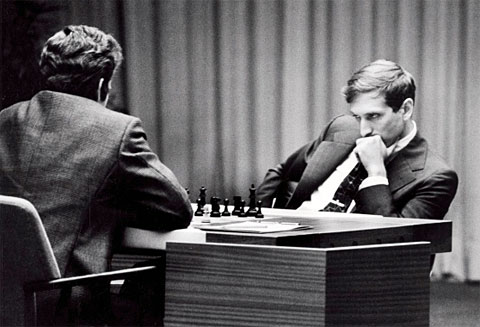
spassky-fischer
Boris Spassky and Bobby Fisher
I was only 8, going on 9.

My sports consciousness was not yet developed. Although the New York Mets had won the World Series in 1969, the New York Knicks had won the NBA Championships in 1970, and the New York Jets won the Super Bowl in 1970, I don’t have any memories of those amazing moments in New York sports history.

It was chess that first got my competitive juices flowing.

It was July, 1972, and before the Munich Olympics took center stage, the biggest global “sporting” event of the year was the World Chess Championship. Yes. Chess.

bobby-fischer-teaches-chess
I owned and treasured this book as a kid.
Bobby Fischer was taking on Boris Spassky for chess supremacy in Reykjavik, Iceland. But it was more than a chess match. It was the Cold War, and the 1972 championship featured an opportunity for a maverick chess savant from Brooklyn, New York, Bobby Fischer, to take down the best chess player in the Soviet Union, and thus the world, Boris Spassky.

I had learned chess from my father and I played games with friends at schools, so I was proficient enough to follow along. But chess players weren’t the only ones tuning into public television to watch two people sit at a table and not move most of the time – a good part of the American public were as well. Why? Because it was democracy vs communism, capitalism vs socialism, America vs the Soviets.

It was not just my sports consciousness that was switched on, it was a political consciousness. Like everyone around me, I wanted the American to beat the Russian. Bobby Fischer was my genius boy from New York. I had his book, Bobby Fischer Teaches Chess. I even went to chess classes at the famed Manhattan Chess Club where he had played.

I just watched the film, Pawn Sacrifice, and it brought back those memories of my youth. The film went into the quirks and paranoia of Fischer, which is today well documented and known, but for me, a kid from Queens, I had no idea. All I knew was that Fischer had to beat Spassky.

And Fischer did, most gloriously and dominantly.

wilma-rudolph-and-richard-nixon-in-nashville_1960
Wilma Rudolph and Richard Nixon in Nashville_1960

It’s an oft-told tale of Black Americans triumphing overseas – soldiers, athletes and musicians – only to come back home to a world of discrimination and second-class citizenship.

Wilma Rudolph broke the mold.

In the Rome Olympics in 1960, Rudolph won gold in the women’s 100 and 200-meter races, as well as the 4×100 relay, and arguably became the most popular athlete in the world due to her beauty and charm. (That’s saying a lot since Cassius Clay was also on the scene.)

Nearly a month after the end of the Rome Olympics, it was announced by officials of her hometown, Clarksville, Tennessee, that October 4 would be “Wilma Rudolph Day”, and that according to ESPN, Tennessee Governor Buford Ellington, was going to lead the celebration. Tennessee at the time was a segregated state, a place where authorities or owners could require the separation of races in the activities of daily life, like drinking from a water fountain, riding a bus, or eating at a restaurant. And Governor Ellington was a man elected on his support of continued racial segregation.

Rudolph understood the leverage she had at that moment, and said she would accept only if all activities related to Wilma Rudolph Day were racially integrated. It was an offer that no matter where you stood on the political and racial divide, you could not refuse. Rudolph was not to be denied, and so that day was the first time in Tennessee that blacks and whites would be allowed to mix socially.

I found this letter to the editor in the Milwaukee Journal from October 22, 1960, where one Virginia Williams of Wisconsin wrote in praise of Rudolph as the finest of role models for black Americans.

kennedy-and-wilma-rudolph
JFK and Wilma in the Oval Office

Wilma Rudolph, the Negro girl from Clarksville, Tenn., who won three gold medals at the Olympics for her running, also won praise for her good looks and charming ways. This unassuming Negro girl, coming from a large family of average income, brought honor to her race and her country. She brought credit to her country as an ambassador of good will.

County Judge William Hudson spoke in Clarksville at an integrated banquet give for Wilma. With tears in his eyes he said: “If I can overcome my emotions, I’ll make you a speech. Wilma has competed with the world and brought home three medals. If you want to get good music out of a piano, you have to play both white and black keys.”

And in order for America to maintain her leadership in the world, she has to tap all of her resources, utilize all of them. Negroes need America and America needs them.

As one can imagine, race relations in America has improved, but it has been a bumpy road. A few years later, Sports Illustrated caught up with Rudolph on the eve of the 1964 Tokyo Olympics and see how domestic life was treating her. While she was busy being a mom, she was also out on the occasional protest.

It was different in May of 1963, when Wilma took part in two demonstrations at Shoney’s, which is considered one of Clarkesville’s finest restaurants although it does not have much more to offer than hamburgers. She was turned away, together with the other Negroes. “I cannot believe it!: she said to a reporter. “Remember the reception they gave me in 1960?” A few months later Clarksville was integrated.  (Sports Illustrated, September 7, 1964)

wilma_rudolph_lucinda_williams_barbara_jones_martha_hudson_1960
Left-right: Wilma Rudolph, Lucinda Williams, Barbara Jones and Martha Hudson at the Rome Olympics

She was by then the Queen of Rome at the 1960 Summer Olympics. American sprinter, Wilma Rudolph, had already won gold in the women’s 100- and 200-meter sprints. But her teammates from the famed Tennessee State Tigerbelles had been left out of the medal count. The 4×100 was their chance to join Rudolph in Olympic glory. And Rudolph, as described in David Maraniss’ fantastic book, Rome 1960: The Olympics That Changed the World, promised to help them get the gold on one condition:

In the warm-up room before the race, the Tigerbelles huddled and prayed together. “Just get me that stick,” Rudolph, who would run the anchor leg, said at the end. “Just get me that stick, and we’re going to get on that stand. We’re going to win that gold medal!” her teammates could barely contain themselves; no jealousy now, just fire burning inside.

Maraniss went on to tell the story how her teammate, Lucinda Williams, in the third leg was going so fast heading into the exchange with the anchor, Rudolph, that they needed two attempts to get Rudolph the baton, at one point Rudolph needing to stop to grab it. In the fumbled exchange, Maraniss wrote that the team lost about a meter to the competition in that moment. But like a locomotive, Rudolph reached the leaders at about 60 meters, and then blew past them to win gold for the team.

Not only did the Tigerbelles share a momentous team victory, Rudolph’s star in Rome and the world went super nova, the first ever American to win three track gold medals in a single Games. When President Kennedy heard that Rudolph was in Washington DC a few months after her return from Rome, he invited Rudolph to the White House and spent so much time talking with her in the Oval Office that he kept his next appointment cooling his heels for thirty minutes.

But as a child, Rudolph, was not the radiant and confident person she was to become. She was born prematurely in 1940, and due to polio, had to deal with a left leg and foot that twisted unnaturally and made it difficult for her to walk. Doctors had her wear braces and special shoes, and she had to be carried from room to room by family members. As one could imagine, to be seen as so different from your family and friends must be so terribly hard on a child. Maraniss wrote:

As Wilma later described her early childhood, she was depressed and lonely at first, especially when she had to watch her brothers and sisters run off to school while she stayed home, burdened with the dead weight of the heavy braces. She felt rejected, she said, and would close her eyes “and just drift into a sinking feeling, going down, down, down.” Soon her loneliness turned to anger. She hated the fact that her peers always teased her. She didn’t like any of her supposed friends. She wondered whether living just meant being sick all the time, and told herself it had to be more than that, and she started fighting back, determined to beat the illness.

Maraniss went on to describe how Rudolph’s condition gradually improved to the point that she was able to secretly remove her braces so she could run around outside with her siblings. And then her parents did something wonderful, presenting Rudolph with a gift so ordinary and yet so life affirming that it transformed the shy, despondent girl into one filled with promise, bursting with energy.

Then one day her father, who did the shopping in the family, came home with regular shoes for Wilma, marking a dramatic change in her life. As Yvonne remembered the scene: “They were no longer the high-top shoes that she had to have with the braces. And my mother took her in to a room all by herself; she didn’t even let us know she had these shoes. And they put them on her, and she came out of the room, and she was beaming all over. It was like she was a whole new little girl. And after that it was like she knew she was not different, and it gave her more confidence at that point.”

wilma-rudolph-100-meters-gold-rome

After that, you couldn’t stop Rudolph from running. A blur on the basketball courts, she picked up the nickname “Skeeter” because she flitted about so quickly like a mosquito. Her head coach at Tennessee State, Ed Temple, marveled at this determined young woman, but also wasn’t sure if she had everything needed to be a champion. Just prior to the 100-meter finals, Temple hid in the tunnels of the Stadio Olimpico, barely able to see Skeeter in lane 3. Rudolph, a notorious slow starter, fell behind. But he also knew that Rudolph, like today’s sprinting God, Usain Bolt, finished like a locomotive.

According to Maraniss, Temple had to be told that Rudolph had won easily in a blazing 11 second, what would have been a world record if not for the wind. His reaction? “You’re joking.” I’m sure it was a remark born out of ambivalence, that moment when one thinks one has a champion, but is not really sure, until proof is presented on a shining platter. That moment, when Rudolph crossed the tape to become the fastest women in the world, marked that rite of passage for champions, when all doubt is erased, expectations and achievements merge, and all is right in the world.

sam-the-eagle-spoonWho collects spoons?

Good friends in Los Angeles pleasantly surprised me recently with a couple of gifts, including a souvenir spoon from the 1984 Los Angeles Olympics. The mascot, Sam the Eagle, adorned in a loud red-white and blue had, proudly holds the Olympic torch aloft at the tip of the spoon’s handle.

After marveling at the thoughtfulness of my friends, and this artifact from my university years, my mind lept to that simple question.

Who collects spoons?

Spoon collecting, as I now know, has a long tradition. In the mid-1800’s in Europe, merchants would sell spoons, and likely other utensils, with images of famous people or local landmarks on the handles or in the bowls of the spoon. Wealthy Americans who travelled in Europe would make it a habit to collect souvenir spoons wherever they went.

In the late 19th century, souvenir spoons became a big business in the United States, triggered by two particularly popular souvenir spoon lines, One was the George and Martha Washington series, manufactured by a company called Galt & Bros initially in honor of the 100th anniversary of America’s first president.

The second hit series was the Salem Witch Spoon series, featuring, well, a witch. An American jeweler went to Germany and saw a wide variety of ornate and unusually designed spoons, and decided that America was ready for a souvenir spoon recalling the 17th century witch hunts of Salem, Massachusetts. According to this PBS article, by the mid 1890’s, there was an unprecedented boom in spoon collecting. With the advancement of mass manufacturing of the industrial age, and a collapse in the silver market, spoon collection was affordable to the growing middle class while still maintaining that hint of posh.

salem-witch-spoon

Here’s how the magazine Antiques and Art described the boom:

At the end of the year 1890, there were only about five souvenir spoons patented or in production in America; by May 1891, there were hundreds on the market. More patent designs were issued for souvenir spoons during this decade than for the entire period from 1790 to 1873 or after 1900. The 1890s witnessed cutting-edge innovation in the making of souvenir spoons: this decade saw the production of cast spoons (i.e. souvenir spoons made according to the lost wax process); the perfection of engraving and bright cut decoration; the introduction of embossed designs in spoon bowls and on handles; and, the production of exquisite enameled spoons which today are considered miniature works of art.

Apparently, spoon collecting is still obsession for many people today.

For a detailed display of one person’s own spoon collection, watch this unusually framed video.

XXIII Olympic Summer Games

In the 1970s, after the tragic Munich Olympics in 1972, and the financially disastrous Montreal Olympics in 1976, there were not many cities that had an appetite for the 1984 Olympics. In fact, Los Angeles may have been the only real bid, and thus were able to extract significant financial concessions from the IOC. LA Olympic Committee head, Peter Ueberroth then kept costs low by getting corporate sponsors to contribute massively. In fact Corporate America played a huge role in bringing financial accountability and world-class production values to the Olympics.

In the case of the Olympic mascot, Ueberroth was able to rely on a trusted member of corporate America, Disney. While Disney was a bidder for the mascot design project, it was true that one of the member of the Los Angeles Olympic Organizing Committee’s executive committee was Card Walker, then chairman of the board of the Disney Corporation. Thus it was no surprise that Disney won the bid.

The design of the Olympic mascot was handed to legendary artist and publicity art director, Bob Moore, whose work has been seen in such films as Fantasia, Bambi and Dumbo. In the early stages of the design process, Moore and his team worked on ideas that would emphasize the sunny Pacific Coast environment and weather, or symbols of the state, California. As a matter of fact, they thought they could use the Golden Bear, which is California’s state animal…until they realized that following on the popular Moscow Games mascot, Misha the Bear, would be more than a small cold war embarrassment.

bob-moore
Bob Moore

According to this detailed explanation of the development of the 1984 Olympic mascot from Mouse Planet, Moore’s team of 30 artists drew up animated versions of orange and palm trees, cactuses, bisons, snakes and turtles. Apparently, a beefed-up bison standing on two legs looked awkward and was abandoned. I suppose that was true for the humanoid cactus….

In the end, the bald eagle became the symbol of choice, with its associations to freedom, independence and fighting spirit. In fact, Sam the Eagle, as the mascot was eventually called, represented the very motto of the Olympic Games “Citius, Altius, Fortius”, which is Latin for faster, higher, stronger. How a “short, stubby, cuddly little eagle” as Mouse Planet describes Sam represents faster, higher, stronger is debatable, the idea that the stuffed toy would sell millions was not. As Mouse Planet explains, 43 companies ended up licensing to sell Olympic branded products. Sam the Eagle was featured on t-shirts, cups, pins, keychains, watches, picture frames, even Frisbees and spoons.

Sam the Eagle soared, as did the American Olympic Team, at the 1984 Los Angeles Games. Although Misha the Bear may have had a word or two for Sam the Eagle….

imperial-hotel-ad-1964
An ad from the book, Tokyo Olympics Official Souvenir 1964
The Imperial Hotel in Tokyo in the 1960s was a stunning structure. Designed by the legendary architect, Frank Lloyd Wright, the Imperial Hotel’s lava rock facing, the abundance greenery and the dominant reflection pool makes me think of Angkor Wat or the Taj Mahal on a more intimate scale.

Known in Japan as the Teikoku Hotel, the Wright designed structure was built in the early 1920’s, opening up on September 1, 1923, the day of Japan’s most powerful earthquake ever, one that resulted in the flattening of Tokyo and over 140,000 deaths. Wright had already left Japan several months before, but was proud when told that the Imperial Hotel remained standing.

The ad above was published in the 1964 Tokyo Olympics Official Souvenir book, an item recently rescued from the damp and dingy garage of my old house in Queens we recently sold. The text in the ad makes the classic Japanese pitch to westerners, how their offerings are a perfect blend of East meets West.

While the ad was placed to attract guests, there was actually little need for advertising. A tremendous shortage of hotel rooms in Tokyo were expected during the 1964 Olympics. According to the official report of the Tokyo Olympic Organizing Committee post-Olympiad XVIII, the International Olympic Committee, the various national Olympic committees and international sports federations were going to send a significantly large number of foreign guests to Tokyo, and they would be in need of a dwindling number of accommodations in September and October, 1964.

frank-lloyd-wright-in-japan

Worried about meeting the needs of their important guests, the Imperial Hotel agreed, in 1962, to allocate 250 beds for the International Olympic Committee and the national Olympic committees. 750 beds were set aside by the Daiichi Hotel for the various international sports federations and their visitors. Nearly 600 additional beds were also reserved for the dignitaries by nine other hotels, including the Hotel New Otani, Fairmont Hotel and the Haneda Tokyu Hotel.

In the years and months leading up to the Games, the hotels tried hard to get the various committees and federations to provide more exact numbers of guests. The hotels were facing increasing pressures to accommodate more tourists, but they had already made commitments for the Olympic officials. Special liaison offices were created in each hotel to help confirm the exact number of guests who were planning to arrive.

In the end, many of the hotels got screwed, or perhaps a better way to say, they took one for the team. The Fairmont Hotel and Haneda Tokyu Hotel ended up filling 26% of the allocated rooms for national Olympic committee members and their guests, clearly given overly ambitious numbers. Other hotels suffered the same fate, although the Imperial Hotel, no doubt hosting the crème de la crème of the International Olympic Committee, were able to achieve 93% occupancy of rooms allocated to the Olympic and sports federation officials.

By the late 1960s, the Wright-designed structure was falling into decay, part of the building sinking into its foundation. The number of rooms was woefully short of economic viability for a downtown Tokyo hotel as well. The hotel was closed at the end of 1967, and demolished to make way for a high-rise structure.

For those nostalgic for the Wright-designed hotel, take a trip to Inuyama in Aichi prefecture, near Nagoya. There is a place called Meiji-mura, of the Meiji Village Museum, where historic buildings from Japan’s past are reconstructed, restored and preserved, including the entrance and facade of the Imperial Hotel.

meiji-mura-wright-imperial-hotel
The façade and reflection pool of the original Imperial Hotel in Meiji-mura