XXIII Olympic Summer Games

In the 1970s, after the tragic Munich Olympics in 1972, and the financially disastrous Montreal Olympics in 1976, there were not many cities that had an appetite for the 1984 Olympics. In fact, Los Angeles may have been the only real bid, and thus were able to extract significant financial concessions from the IOC. LA Olympic Committee head, Peter Ueberroth then kept costs low by getting corporate sponsors to contribute massively. In fact Corporate America played a huge role in bringing financial accountability and world-class production values to the Olympics.

In the case of the Olympic mascot, Ueberroth was able to rely on a trusted member of corporate America, Disney. While Disney was a bidder for the mascot design project, it was true that one of the member of the Los Angeles Olympic Organizing Committee’s executive committee was Card Walker, then chairman of the board of the Disney Corporation. Thus it was no surprise that Disney won the bid.

The design of the Olympic mascot was handed to legendary artist and publicity art director, Bob Moore, whose work has been seen in such films as Fantasia, Bambi and Dumbo. In the early stages of the design process, Moore and his team worked on ideas that would emphasize the sunny Pacific Coast environment and weather, or symbols of the state, California. As a matter of fact, they thought they could use the Golden Bear, which is California’s state animal…until they realized that following on the popular Moscow Games mascot, Misha the Bear, would be more than a small cold war embarrassment.

bob-moore
Bob Moore

According to this detailed explanation of the development of the 1984 Olympic mascot from Mouse Planet, Moore’s team of 30 artists drew up animated versions of orange and palm trees, cactuses, bisons, snakes and turtles. Apparently, a beefed-up bison standing on two legs looked awkward and was abandoned. I suppose that was true for the humanoid cactus….

In the end, the bald eagle became the symbol of choice, with its associations to freedom, independence and fighting spirit. In fact, Sam the Eagle, as the mascot was eventually called, represented the very motto of the Olympic Games “Citius, Altius, Fortius”, which is Latin for faster, higher, stronger. How a “short, stubby, cuddly little eagle” as Mouse Planet describes Sam represents faster, higher, stronger is debatable, the idea that the stuffed toy would sell millions was not. As Mouse Planet explains, 43 companies ended up licensing to sell Olympic branded products. Sam the Eagle was featured on t-shirts, cups, pins, keychains, watches, picture frames, even Frisbees and spoons.

Sam the Eagle soared, as did the American Olympic Team, at the 1984 Los Angeles Games. Although Misha the Bear may have had a word or two for Sam the Eagle….

imperial-hotel-ad-1964
An ad from the book, Tokyo Olympics Official Souvenir 1964
The Imperial Hotel in Tokyo in the 1960s was a stunning structure. Designed by the legendary architect, Frank Lloyd Wright, the Imperial Hotel’s lava rock facing, the abundance greenery and the dominant reflection pool makes me think of Angkor Wat or the Taj Mahal on a more intimate scale.

Known in Japan as the Teikoku Hotel, the Wright designed structure was built in the early 1920’s, opening up on September 1, 1923, the day of Japan’s most powerful earthquake ever, one that resulted in the flattening of Tokyo and over 140,000 deaths. Wright had already left Japan several months before, but was proud when told that the Imperial Hotel remained standing.

The ad above was published in the 1964 Tokyo Olympics Official Souvenir book, an item recently rescued from the damp and dingy garage of my old house in Queens we recently sold. The text in the ad makes the classic Japanese pitch to westerners, how their offerings are a perfect blend of East meets West.

While the ad was placed to attract guests, there was actually little need for advertising. A tremendous shortage of hotel rooms in Tokyo were expected during the 1964 Olympics. According to the official report of the Tokyo Olympic Organizing Committee post-Olympiad XVIII, the International Olympic Committee, the various national Olympic committees and international sports federations were going to send a significantly large number of foreign guests to Tokyo, and they would be in need of a dwindling number of accommodations in September and October, 1964.

frank-lloyd-wright-in-japan

Worried about meeting the needs of their important guests, the Imperial Hotel agreed, in 1962, to allocate 250 beds for the International Olympic Committee and the national Olympic committees. 750 beds were set aside by the Daiichi Hotel for the various international sports federations and their visitors. Nearly 600 additional beds were also reserved for the dignitaries by nine other hotels, including the Hotel New Otani, Fairmont Hotel and the Haneda Tokyu Hotel.

In the years and months leading up to the Games, the hotels tried hard to get the various committees and federations to provide more exact numbers of guests. The hotels were facing increasing pressures to accommodate more tourists, but they had already made commitments for the Olympic officials. Special liaison offices were created in each hotel to help confirm the exact number of guests who were planning to arrive.

In the end, many of the hotels got screwed, or perhaps a better way to say, they took one for the team. The Fairmont Hotel and Haneda Tokyu Hotel ended up filling 26% of the allocated rooms for national Olympic committee members and their guests, clearly given overly ambitious numbers. Other hotels suffered the same fate, although the Imperial Hotel, no doubt hosting the crème de la crème of the International Olympic Committee, were able to achieve 93% occupancy of rooms allocated to the Olympic and sports federation officials.

By the late 1960s, the Wright-designed structure was falling into decay, part of the building sinking into its foundation. The number of rooms was woefully short of economic viability for a downtown Tokyo hotel as well. The hotel was closed at the end of 1967, and demolished to make way for a high-rise structure.

For those nostalgic for the Wright-designed hotel, take a trip to Inuyama in Aichi prefecture, near Nagoya. There is a place called Meiji-mura, of the Meiji Village Museum, where historic buildings from Japan’s past are reconstructed, restored and preserved, including the entrance and facade of the Imperial Hotel.

meiji-mura-wright-imperial-hotel
The façade and reflection pool of the original Imperial Hotel in Meiji-mura

sexual-abuse-of-underaged

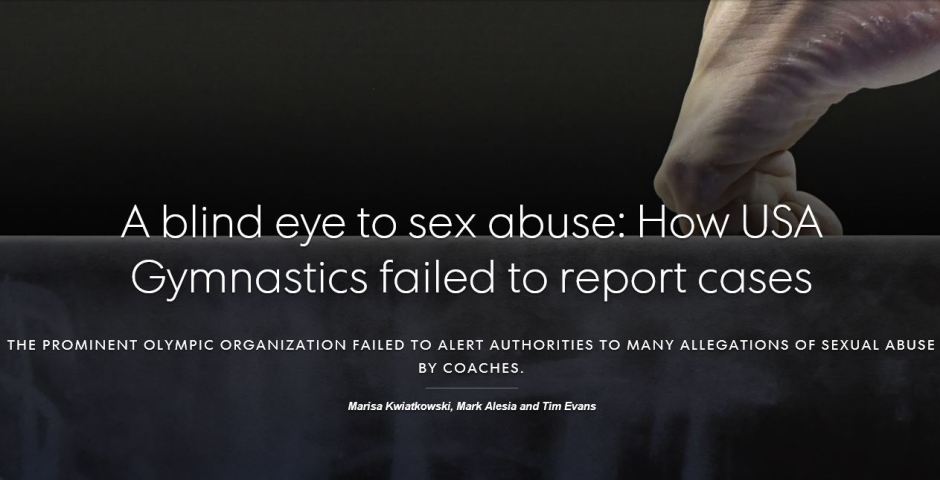
Thanks to The Indianapolis Star, we now know that leaders in USA Gymnastics, the governing body for gymnastics in America, were aware of coaches who sexually abused female gymnasts over the past two decades at least, many of whom were under-aged. We also know that USA Gymnastics did little to prevent further abuse unless a parent or the police pushed them to act.

According to The Indianapolis Star, USA Gymnastics have detailed and sometimes voluminous documentation on coaches accused of sexual abuse, but those documents have not yet been disclosed by USA Gymnastics. We know about these cases today primarily because the journalists of the Indy Star went through police and court records, uncovering details of the cases. They also learned about a so-called policy that provided the rationale for USA Gymnastics officials not to take any action despite knowledge of the abuse.

Current USA Gymnastics president, Steve Penny, in a court deposition said “to the best of my knowledge, there’s no duty to report if you are…if you are a third party to some allegation.” Penny’s predecessor, Robert Colarossi, stated that a reason not to report abuse to the police was “concern about potential damage to a coach’s reputation if an allegation proved false,” and that he “inherited an executive policy of dismissing complaints as ‘hearsay’ unless they were signed by a victim or victim’s parent – a policy that experts said could deter people from reporting abuse. It’s not clear exactly when that policy was created or by whom.”

child-abuse-stats

The Leadership Council on Child Abuse & Interpersonal Violence is a nonprofit organization that focuses on scientifically research-based explanations for mental health issues. In one of their articles, entitled “Eight Common Myths About Child Sexual Abuse“, the Leadership Council gives insight into why many of us allow sexual abuse to continue.

Few people are aware of the true state of the science on child abuse. Instead, most people’s beliefs have been shaped by common misconceptions and popular myths about this hidden crime. Societal acceptance of these myths assists sex offenders by silencing victims and encouraging public denial about the true nature of sexual assaults against children. The Leadership Council prepared this analysis because we believe that society as a whole benefits when the public has access to accurate information regarding child abuse and other forms of interpersonal violence.

Here is the list of myths:

  • Myth 1:  Normal-appearing, well educated, middle-class people don’t molest children.
  • Myth 2:  People are too quick to believe an abuser is guilty, even if there is no supporting evidence.
  • Myth 3:  Child molesters molest indiscriminately.
  • Myth 4:  Children who are being abused would immediately tell their parents.
  • Myth 5:  Children who are being abused will show physical evidence of abuse.
  • Myth 6:  Hundreds of innocent men and women have been falsely accused and sent to prison for molesting children.
  • Myth 7:  If asked about abuse, children tend to exaggerate and are prone to making false accusations.
  • Myth 8:  By using repeated interviews, therapists or police can easily implant false memories and cause false accusations among children of any age.

I could only presume, but if we consider the leaders of USA Gymnastics to be of normal mental health, then they too accept many of the myths above as fact. In many cases, I’m sure they took the word of the coach’s over the children.

  • “Where’s the proof?”
  • “These are normal-appearing, well-educated men. Can’t be true.”
  • “If a child was really being abused, she would definitely have told her parents.”
  • “And what would happen if we falsely accused a coach? Oh, the shame.”

Yes. Oh, the shame.


For facts and more myths on child abuse in America, see The National Child Traumatic Stress Network Fact sheet.

The Silent Shame Part 1: USA Gymnastics Ignored Sexual Abuse Allegations

The Silent Shame Part 3: New Sexual Abuse Allegations for USA Gymnastics

indianapolis-star-headline

We were shocked to learn in 2002 of the cases of sexual abuse of children by Catholic priests, and that Church leaders dealt with the situation by rotating abusers to new parishes without explanation.

Many were outraged in 2011 by the fact that the president, the athletic director as well the football head coach at Penn State University were aware of allegations that the football team’s assistant head coach was molesting children, and did nothing.

And in 2016, we are again aghast about news that USA Gymnastics simply kept quiet despite case after case of sexual abuse allegations against coaches in its organization.

It is inconceivable to most parents that their child would be abused by people they know, and in whose care they entrust their child’s well-being. And yet, in the afterglow of the Rio Olympics, when the Final Five, the young American female gymnasts, dominated in the women’s gymnastics competition to easily take glory and gold in the team competition, we find USA Gymnastics in retreat.

The Indianapolis Star investigated these allegations and compiled over 50 accounts of sexual abuse of children under the care of USA Gymnastics’ coaches. And two lawsuits have been filed by ex-athletes against former USA Gymnastics team doctor, Larry Nassar, who is being accused of sexual abuse in over 20 cases since 1999. In one of the lawsuits, Bela and Martha Karolyi, team coordinators for the national team of USA Gymnastics, are cited as leaders who created a toxic culture of abuse and cover up.

According to The Indianapolis Star, officials of USA Gymnastics were aware of sexual abuse of female gymnasts, including pre-teens, for years, often doing nothing or acting only if asked.

  • USA Gymnastics were given a detailed complaint in 2011 about 2010 national Women’s Coach of the Year, Marvin Sharp, but only reported him to the police after a second allegation of abuse of a 12 year old, four years later.
  • USA Gymnastics apparently has a large dossier of complaints against a coach named Mark Shiefelbein, but the parents of a 10 year old abused by Shiefelbein, who went to the police, was surprised to learn that USA Gymnastics knew he was a serial sexual abuser and did nothing.
  • USA Gymnastics knew about a coach named James Bell and his cases of sexual abuse at least 5 years before being arrested for molesting three gymnasts in 2003.
  • USA Gymnastics was told by a gym owner in 1998 that a coach named William McCabe “should be locked in a cage before someone is raped”. Despite knowing of at least four complaints against McCabe, USA Gymnastics allowed him to coach for seven more years.

Kaylin Maddox Brietzke was a gymnast under the guidance of James Bell, and many years later in this interview, eloquently expresses the emotion of that vulnerability of her childhood and that betrayal by adults and authority she naturally trusted.

Any corporation that puts their reputation above safety, honestly is not something I want to be a part of at all. And I was a part of USA Gymnastics for a very long time. It doesn’t matter who you are protecting. It doesn’t matter that they are a part of your organization and you want to save face. How about saving me.


The Silent Shame Part 2: Why Would / How Could Leaders of USA Gymnastics Stay Silent in the Face of Sexual Abuse Allegations?

The Silent Shame Part 3: New Sexual Abuse Allegations for USA Gymnastics

viktor-chizhikov
Viktor Chizhikov

Viktor Chizhikov is bitter, even today. His creation, Misha the Bear, emerged as the best out of 40,000 submissions for a contest to select the mascot for the 1980 Moscow Olympics.

The mascot born out of the Communist bloc’s greatest power, the Soviet Union, ironically became the first to be a globally commercial success. And Chizhikov said that he was promised the copyright, didn’t get it, and thus never saw any royalties from the stuffed toys, t-shirts and television programs related to Misha the Bear. “I hate to talk about mascots,” he told The Wall Street Journal. “This is like a thorn in my heel.”

The renowned author of over 100 children’s books in the Soviet Union, Chizhikov insists he was promised copyright ownership over Misha. He has taken various parties to court for use of Misha, particularly over television programs that feature the famous bear.

And when the Winter Olympics came to Russia in 2014, Chizhikov was indignant over one of the Sochi mascots, Mishka the Bear. According to Inside the Games, he told a radio program the following:

It’s exactly the same as mine: the eyes, the nose, the mouth, the smile, though it’s askew. They pulled around all the details of my bear. The eyes are rounded the same way, the nose is a little altered and the smile has the same characteristics.

I can’t help but wonder what property rights or IP rights law was like in the Soviet Union, a state based on the ideology that the means of production are socially owned. But Chizhikov may be tilting at windmills, or at least fighting the wrong front. According to the Wall Street Journal article, it is not the national organizing committee that owns the IP rights to such items as the design of a mascot, it is the International Olympic Committee (IOC).

In the end, Chizhikov said he received about 2,000 rubles (about USD1,600 at the time) for his original design of Misha…as well as credit for kicking off the race for commercial cash, even before the famously profitable 1984 Los Angeles Olympics.

misha-the-bear

The headlines in the United States in the late 1970s and early 1980s was of economic malaise, Three Mile Island, the Iran hostage crisis, the Soviet invasion of Afghanistan and the presidential campaign pitting incumbent Jimmy Carter against Ronald Reagan.

It was the Cold War, and the temperature was below zero. And yet, then president of stuff toy manufacturer and importer, Dakin & Co., Harold A. Nizamian, thought the planned mascot for the 1980 Moscow Olympics was charming. So he bought the license to create a stuffed bear and began producing and selling “Misha the Bear“.

Dakin began producing 240,000 Misha the Bear toys a month in early 1979, and the bear was selling. According to this Inc. article, Nizamian implies that he had global licensing rights as he claims the “the Russians were delighted and tried to buy it from us”.

But when the United States government announced that America would boycott the Moscow Olympics in protest of the Soviet invasion of Afghanistan, and forbade American companies to do business in relation to the Olympics, orders were cancelled, and Misha was suddenly a victim of a bear market.

misha-the-bear-dakin-adI actually had one of those bears. I remember getting a whole bunch of Moscow Olympic swag because NBC had the US broadcast rights for those Games, and my father was working for NBC at the time.

What’s fascinating about Misha the Bear is that ironically, this lasting symbol of the Soviet Union is one of the best known of all Olympic mascots in the world, its image gracing t-shirts, coffee mugs, pins, posters, and toys. In other words, the Soviet Union created the first commercially viable and globally popular Olympic mascot.

According to the Huffington Post, “no other mascot has done more for its country than Misha from Moscow. As the smiling tiny bear touted as Russia’s cuddly ambassador to the world, Misha served as a warm child-friendly sight as the peak of the Cold War. His image, starkly different from the traditionally gruff bear common in Russian lore, propelling Olympic merchandise sales forward while 55 nations boycotted the games.“

It is said that Misha the Bear’s farewell during the Closing Ceremonies was one of the most memorable moments of the 1980 Moscow Games.

As for Dakin, Nizamian had $1 million dollar’s worth of Misha the Bear sitting in his warehouse. So what did he do?

Nizamian decided to give the bear a new nationality and a new lease on life. He removed the belt and reintroduced Misha in an assortment of T-shirts. “I Am Just A Bear,” one read; another proclaimed “U.S.A. Olympic Hockey Bear,” trading on the stunning victory by the United States at the winter Olympics. “It moved fairly well,” he explains. “We were able to dispose of about half of our stock by using that vehicle.” Dakin donated another 100,000 bears to the Special Olympics, a competition for handicapped children, and sold the final 100,000 to liquidators.

carmelo-anthony-favela-2
Carmelo Anthony in Santa Marta, a favela in Rio de Janeiro.

Carmelo Anthony is a New Yorker, now playing for my hometown team, the New York Knicks. I’m proud that he is a Knick, but as I grew up a St Johns Redmen fan, and he led Big East rival Syracuse to an NCAA championship, I wasn’t an immediate fan.

When Anthony joined the Knicks after essentially demanding a trade from Denver, I looked on the deal with tremendous skepticism. The Knicks have floundered in the Carmelo years, although that floundering began way before he arrived. Skepticism has turned to apathy, and my expectations for my Knicks have dropped.

But my respect for Anthony has continued to climb. He has been a proud Olympian, representing the US men’s basketball team a record four times, helping the US to three gold medal championships in the past three Olympics. More importantly, Melo has been willing to speak out on social matters important to him, an uncommon trait for well-paid athletes.

During the Rio Olympics, a day after Ryan Lochte told the world that he and fellow swimming teammates were held up at gunpoint at a Rio gas station, Carmelo Anthony was visiting one of the more notorious favela in Rio, Santa Marta. Favela are where the poorest of the inner city in Brazil live, their lives influenced by the vice of the drug trafficking economy.

Anthony, with a few friends, went with cameras, and without security to hang out with citizens of Santa Marta. It was a couple of days after the USA defeated France by a unexpectedly slim margin, and a day before their opening match in the knockout round with Argentina. The US team’s mission was far from complete, but my guess is that Anthony worked this out with the coach so that he could fulfill a dream to visit a favela. He admitted that he had seen the film, City of God, dozens of times, and as a child of the inner city growing up in Baltimore, he wanted to see what life was like in Santa Marta.

“This was on my bucket list, to be honest with you; specifically to go to the favelas — forever,” said Anthony, staying on a nearby cruise ship with his teammates. “I just always wanted to see and experience that. Growing up in Baltimore, and knowing what that was like, in my own favela, you know what I mean? So I wanted to go and experience that for myself. I wanted to touch that.”

carmelo-anthony-favela

One of the more powerful images in social media during the Rio Olympics was Carmelo Anthony sitting in a plastic chair in the middle of the favela, his blaring red clothes and cap in contrast to the multi-colored canvas of the favela apartments behind him. What he wrote below his Instagram picture was a statement of empathy and ease, one that I’m sure enamored him with many in Brazil.

“I discovered that what most people call creepy, scary, and spooky, I call comfy, cozy, and home.”

This image and statement was in direct contrast to the image painted by Lochte, who reinforced the perception that Rio was a scary, violent place. You can see how people quickly picked up on the contrast between Lochte and Anthony here.

Anthony walked around, played basketball with the neighborhood kids, and brought smiles to people in the favela. I think that when stars combine acts of unexpected kindness with a consistent articulation of their values, you get a more authentic view of them as people. So now I’m glad and proud that Melo is a member of the New York Knicks. There’s more to life than winning championships. (But I wouldn’t mind if he does.)

collett-and-matthews-1972-munich-olympics
Wayne Collett (left) and Vince Matthews (Associated Press/File 1972)

They stood there casually, one barefoot, hands on hips, the other in thoughtful repose, right hand stroking the chin. You would think they were waiting for the bus.

But Wayne Collett and Vince Matthews were actually standing on the winners podium at the 1972 Munich Olympics, their medals for their silver and gold medal finishes in the 400 meter sprint around their necks, and the American national anthem playing.

Avery Brundage, the president of the International Olympic Committee, viewed the behavior of Collett and Matthews as abhorrent and immediately banned them from the Olympic Games. This may have seemed like déjà vu to Brundage as he had made the same decision four years earlier in Mexico City, when Tommie Smith and John Carlos accepted their medals after the 200 meter finals, and raised their black-gloved fists into the air, reflecting their anger at the state of race relations in America.

The day after Brundage’s decision to kick Collett and Matthews out of the Munich Olympic Village, a white bed sheet was suspended from the windows of the American team’s dormitory. According to Ollan Cassell in his book Inside the Five Ring Circus, the bed sheet read, “Down with Brundage”. Cassell reveals that the person who dropped this flag of protest was Vince Matthews.

The head coach of the US track team at the 1972 Munich Olympics was Bill Bowerman, the legendary coach at the University of Oregon. With Smith injured and Collett and Matthews suspended, he knew he would not be able to field a 4X400 relay team. Clearly the men would have been a near-lock for gold if not for the suspensions. According to Kenny Moore’s book, Bowerman and the Men of Oregon, Bowerman was upset with the behavior of Collett and Matthews, but he did not believe they deserved to be suspended.

“Matthews and Collett made asses of themselves,” as Bill would put it, “jiving around and talking, giving the impression they didn’t want to be ramrod straight. That was unfortunate but no big deal. I felt they hadn’t meant to be disrespectful during the anthem. Jesse Owens talked with them afterward and felt the same. He was arranging for them to apologize, but before they could, Brundage had Matthews and Collett suspended and sent from the Village.”

“You cannot expect on an Olympic squad of sixty to have everybody act like army privates,” Bill said later. “They’re great athletes. They’re great individuals. The fact that some of them did things that the press objected to didn’t bother me too much. They’re vivid, alive, human animals. They’re keenly interested, very competitive, and all different. So why not accept that and enjoy it?”

bill-bowerman-at-heyward-field-in-oregon
Bill Bowerman at Hayward Field in Oregon

So Bowerman said he would talk to Brundage the next day and see if an apology might convince Brundage to change his mind. Bowerman did meet with Brundage, and despite the fact that Palestinian terrorists had just broken into the Olympic Village and taken Israeli athletes hostages, Bowerman and Brundage were able to manage a discussion on Collett and Matthews. And as related in Bowerman’s biography, Brundage accepted Bowerman’s apology on behalf of his athletes and accepted their reinstatement on condition that the USOC agreed.

Bowerman, and his partner in this negotiation, Jesse Owens, rushed to a gathering of USOC members to tell them the wonderful news, that Brundage had actually reversed his decision and that all they needed was USOC’s endorsement. But Bowerman was surprised to learn that more than the IOC, the USOC was even more outraged, and had already voted to support Brundage’s original decision to kick Collett and Matthews out of the Olympics. According to the Bowerman bio, the presiding officer of the USOC, Clifford Buck gave as rationale, “Well, they insulted the American flag.”

And so, Collett and Matthews were suspended and the heavily favored 4X400 relay team never made it on the track.

Years later in 1992, Collett told the Los Angeles Times the following:

“I love America. I just don’t think it’s lived up to its promise. I’m not anti-American at all. To suggest otherwise is to not understand the struggles of blacks in America at the time.’’

waldemar-baszanowski
Waldemar Baszanowski of Poland at the 1964 Tokyo Olympics.

It’s a game of grams. Waldemar Baszanowski of Poland and Valdimir Kaplunov of the Soviet Union battled through the three events that make up weightlifting competition: the military press, the snatch and the clean & jerk.

The world record holder at the time, Baszanowski, trailed behind two other favorites, teammate Marian Zielinski and Kaplunov, after the completion of the military press. But Baszanowski got back into a tie for the lead with the Russian after the snatch. In the final round, both Baszanowski and Kaplunov ended lifting the same weight in the clean and jerk, resulting in a world record tie, a total of 432.5 kg over the three weightlifting events.

After the final lift, the final ruling was out of their hand. Here’s how Neil Allen in his book, Olympic Diary Tokyo 1964, told the story.

The moment of victory was most unclear in the weightlifting over at Shibuya Hall where Poland’s Waldemar Baszanowski beat Russian Vladimir Kaplunov by the margin of 10.5822 oz. (300 grams) This was the difference in his body weight and that of Kaplunov and it was the only way of dividing two men who both broke the world lightweight record with a total lift of 953 1/2 lb. (432.5kg) Baszanowski held the previous record of 947 3/4 lb. (429.9kg) But it was only after an enervating tactical battle, and records beaten in all three movements, that he was able to give the mixed smile of relieve and exhilaration which is the right of the champion.

That’s right – the tiebreaker in weightlifting is the difference in body weight. The lighter of the two, in this instance was Baszanowski. Only three hundred grams separated gold from silver.

While Baszanowski would win gold convincingly four years later in Mexico City, Kaplunov in 1964 may have been wondering what he had for breakfast that fateful day.

manpower-talent-shortage-2016
From the 2016/2017 Manpower Talent Shortage Survey

Another study has revealed another issue in planning for Tokyo2020. According to a Japanese Sports Agency panel, there are concerns that Japan won’t have the necessary manpower to ensure drug testing is handled effectively and in a timely fashion.

According to a recently released report, Tokyo2020 will need approximately 200 analysts rotating in round-the-clock shifts every day during the Olympic Games, in order to complete an estimated 6,500 tests. Each test has to be completed within 24 hours of receipt of the sample.

Currently, there is only one lab in Japan that can conduct drug tests to the standards of the World Anti-Doping Agency (WADA), and they employee 15 analysts. Their turnaround time for a drug test is 10 days.

I have no doubt that Tokyo2020 will figure out how to efficiently and effectively process the required drug tests by the time the Tokyo Olympics roll around, but it will not be easy to find the talent. As a Human Resource professional working in Japan, I am fully aware of how fierce the war for talent is in this country. Manpower.com, in its most recent Talent Shortage Survey, announced that the country where employers are having the most difficulty filling roles is Japan, by far. In fact, Japan has been the most difficult country since 2010.

Japan, in comparison to other countries in Asia, has a significantly low level of English capability, which impacts all organizations in Japan that require involvement in international endeavors or global markets. The technical sales, managerial, IT, engineering or design skills may exist in Japan in abundance, but the inability to communicate efficiently in a common global language like English can often slow down the pace of cross-boundary projects. And one of the biggest cross-boundary projects to hit Japan, perhaps the biggest, will be the 2020 Olympics.

Right now, the number of people in the Tokyo Organizing Committee of the Olympic and Paralympic Games (TOCOG) who can interact with members of the IOC and individual National Organizing Committees has got to be low – in other words, so much is dependent on the few people who can speak English.

In 2020, who will be the ones who will coordinate with all of the visiting national teams, the international press, the highly technical demands of the dozens of international sports federations, the thousands of foreign athletes, and the tens of thousands of foreign tourists that arrive en masse for a few weeks in July, 2016?

More interestingly, what innovative ideas will emerge in the coming four years that will help Japan meet the demanding requirements of Tokyo 2020? What technologies will emerge as game changing? What tweaks to hiring or immigration policies will be revealed?

The Olympics can be a wonderful opportunity for change and growth in Japan.