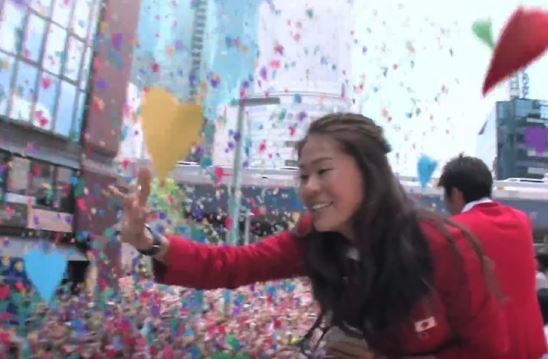
Screenshot from the 2020 Olympics Tokyo promotional video
I finally took a look at the promotional videos made by the cities vying for the 2020 Summer Games: Istanbul, Tokyo and Madrid.
In my mind, Istanbul and Madrid’s Olympic committees focused on the cities, and thus their videos felt like the tourism promotion videos you might see on CNN. My views aren’t too different from those on this Reddit thread.
The theme of the Istanbul is “Shine Bright Like a Diamond”, the lyrics from Rihanna’s song, Diamonds – the mosques in sun and shadow, the sparkling harbor waters, bustling markets, mixed in with image of infrastructure, high-end shopping, and a very occasional sports reference.
Madrid’s campaign video is more comprehensive in what it showed: high speed rail, modern cityscapes and traditional architecture, universities, greenery, music and dance, shopping and nightlife. And there was even a smattering of sports: amateurs playing golf, on bikes, skateboarding, playing basketball, runners.
Tokyo’s theme was “Discover Tomorrow”, thoroughly vague. But the images are clearly on athletes, dominated by competitors at the London Olympics, as well as amateur athletes in Japan, interspersed with iconic locales of Tokyo. You feel the intensity of the athletes and the emotions of the spectators, the animated winged-heart providing a thematic visual throughout the video.
I’m biased I know. But the Tokyo promotional video is the best of the three.
Screenshot from the Tokyo candidate city promotional video.
In the 1970s, after the tragic Munich Olympics in 1972, and the financially disastrous Montreal Olympics in 1976, there were not many cities that had an appetite for the 1984 Olympics. In fact, Los Angeles may have been the only real bid, and thus were able to extract significant financial concessions from the IOC. LA Olympic Committee head, Peter Ueberroth then kept costs low by getting corporate sponsors to contribute massively. In fact Corporate America played a huge role in bringing financial accountability and world-class production values to the Olympics.
In the case of the Olympic mascot, Ueberroth was able to rely on a trusted member of corporate America, Disney. While Disney was a bidder for the mascot design project, it was true that one of the member of the Los Angeles Olympic Organizing Committee’s executive committee was Card Walker, then chairman of the board of the Disney Corporation. Thus it was no surprise that Disney won the bid.
The design of the Olympic mascot was handed to legendary artist and publicity art director, Bob Moore, whose work has been seen in such films as Fantasia, Bambi and Dumbo. In the early stages of the design process, Moore and his team worked on ideas that would emphasize the sunny Pacific Coast environment and weather, or symbols of the state, California. As a matter of fact, they thought they could use the Golden Bear, which is California’s state animal…until they realized that following on the popular Moscow Games mascot, Misha the Bear, would be more than a small cold war embarrassment.
Bob Moore
According to this detailed explanation of the development of the 1984 Olympic mascot from Mouse Planet, Moore’s team of 30 artists drew up animated versions of orange and palm trees, cactuses, bisons, snakes and turtles. Apparently, a beefed-up bison standing on two legs looked awkward and was abandoned. I suppose that was true for the humanoid cactus….
In the end, the bald eagle became the symbol of choice, with its associations to freedom, independence and fighting spirit. In fact, Sam the Eagle, as the mascot was eventually called, represented the very motto of the Olympic Games “Citius, Altius, Fortius”, which is Latin for faster, higher, stronger. How a “short, stubby, cuddly little eagle” as Mouse Planet describes Sam represents faster, higher, stronger is debatable, the idea that the stuffed toy would sell millions was not. As Mouse Planet explains, 43 companies ended up licensing to sell Olympic branded products. Sam the Eagle was featured on t-shirts, cups, pins, keychains, watches, picture frames, even Frisbees and spoons.
Sam the Eagle soared, as did the American Olympic Team, at the 1984 Los Angeles Games. Although Misha the Bear may have had a word or two for Sam the Eagle….
An ad from the book, Tokyo Olympics Official Souvenir 1964The Imperial Hotel in Tokyo in the 1960s was a stunning structure. Designed by the legendary architect, Frank Lloyd Wright, the Imperial Hotel’s lava rock facing, the abundance greenery and the dominant reflection pool makes me think of Angkor Wat or the Taj Mahal on a more intimate scale.
Known in Japan as the Teikoku Hotel, the Wright designed structure was built in the early 1920’s, opening up on September 1, 1923, the day of Japan’s most powerful earthquake ever, one that resulted in the flattening of Tokyo and over 140,000 deaths. Wright had already left Japan several months before, but was proud when told that the Imperial Hotel remained standing.
The ad above was published in the 1964 Tokyo Olympics Official Souvenir book, an item recently rescued from the damp and dingy garage of my old house in Queens we recently sold. The text in the ad makes the classic Japanese pitch to westerners, how their offerings are a perfect blend of East meets West.
While the ad was placed to attract guests, there was actually little need for advertising. A tremendous shortage of hotel rooms in Tokyo were expected during the 1964 Olympics. According to the official report of the Tokyo Olympic Organizing Committee post-Olympiad XVIII, the International Olympic Committee, the various national Olympic committees and international sports federations were going to send a significantly large number of foreign guests to Tokyo, and they would be in need of a dwindling number of accommodations in September and October, 1964.
Worried about meeting the needs of their important guests, the Imperial Hotel agreed, in 1962, to allocate 250 beds for the International Olympic Committee and the national Olympic committees. 750 beds were set aside by the Daiichi Hotel for the various international sports federations and their visitors. Nearly 600 additional beds were also reserved for the dignitaries by nine other hotels, including the Hotel New Otani, Fairmont Hotel and the Haneda Tokyu Hotel.
In the years and months leading up to the Games, the hotels tried hard to get the various committees and federations to provide more exact numbers of guests. The hotels were facing increasing pressures to accommodate more tourists, but they had already made commitments for the Olympic officials. Special liaison offices were created in each hotel to help confirm the exact number of guests who were planning to arrive.
In the end, many of the hotels got screwed, or perhaps a better way to say, they took one for the team. The Fairmont Hotel and Haneda Tokyu Hotel ended up filling 26% of the allocated rooms for national Olympic committee members and their guests, clearly given overly ambitious numbers. Other hotels suffered the same fate, although the Imperial Hotel, no doubt hosting the crème de la crème of the International Olympic Committee, were able to achieve 93% occupancy of rooms allocated to the Olympic and sports federation officials.
By the late 1960s, the Wright-designed structure was falling into decay, part of the building sinking into its foundation. The number of rooms was woefully short of economic viability for a downtown Tokyo hotel as well. The hotel was closed at the end of 1967, and demolished to make way for a high-rise structure.
For those nostalgic for the Wright-designed hotel, take a trip to Inuyama in Aichi prefecture, near Nagoya. There is a place called Meiji-mura, of the Meiji Village Museum, where historic buildings from Japan’s past are reconstructed, restored and preserved, including the entrance and facade of the Imperial Hotel.
The façade and reflection pool of the original Imperial Hotel in Meiji-mura
Viktor Chizhikov is bitter, even today. His creation, Misha the Bear, emerged as the best out of 40,000 submissions for a contest to select the mascot for the 1980 Moscow Olympics.
The mascot born out of the Communist bloc’s greatest power, the Soviet Union, ironically became the first to be a globally commercial success. And Chizhikov said that he was promised the copyright, didn’t get it, and thus never saw any royalties from the stuffed toys, t-shirts and television programs related to Misha the Bear. “I hate to talk about mascots,” he told The Wall Street Journal. “This is like a thorn in my heel.”
The renowned author of over 100 children’s books in the Soviet Union, Chizhikov insists he was promised copyright ownership over Misha. He has taken various parties to court for use of Misha, particularly over television programs that feature the famous bear.
And when the Winter Olympics came to Russia in 2014, Chizhikov was indignant over one of the Sochi mascots, Mishka the Bear. According to Inside the Games, he told a radio program the following:
It’s exactly the same as mine: the eyes, the nose, the mouth, the smile, though it’s askew. They pulled around all the details of my bear.The eyes are rounded the same way, the nose is a little altered and the smile has the same characteristics.
I can’t help but wonder what property rights or IP rights law was like in the Soviet Union, a state based on the ideology that the means of production are socially owned. But Chizhikov may be tilting at windmills, or at least fighting the wrong front. According to the Wall Street Journal article, it is not the national organizing committee that owns the IP rights to such items as the design of a mascot, it is the International Olympic Committee (IOC).
In the end, Chizhikov said he received about 2,000 rubles (about USD1,600 at the time) for his original design of Misha…as well as credit for kicking off the race for commercial cash, even before the famously profitable 1984 Los Angeles Olympics.
The headlines in the United States in the late 1970s and early 1980s was of economic malaise, Three Mile Island, the Iran hostage crisis, the Soviet invasion of Afghanistan and the presidential campaign pitting incumbent Jimmy Carter against Ronald Reagan.
It was the Cold War, and the temperature was below zero. And yet, then president of stuff toy manufacturer and importer, Dakin & Co., Harold A. Nizamian, thought the planned mascot for the 1980 Moscow Olympics was charming. So he bought the license to create a stuffed bear and began producing and selling “Misha the Bear“.
Dakin began producing 240,000 Misha the Bear toys a month in early 1979, and the bear was selling. According to this Inc. article, Nizamian implies that he had global licensing rights as he claims the “the Russians were delighted and tried to buy it from us”.
But when the United States government announced that America would boycott the Moscow Olympics in protest of the Soviet invasion of Afghanistan, and forbade American companies to do business in relation to the Olympics, orders were cancelled, and Misha was suddenly a victim of a bear market.
I actually had one of those bears. I remember getting a whole bunch of Moscow Olympic swag because NBC had the US broadcast rights for those Games, and my father was working for NBC at the time.
What’s fascinating about Misha the Bear is that ironically, this lasting symbol of the Soviet Union is one of the best known of all Olympic mascots in the world, its image gracing t-shirts, coffee mugs, pins, posters, and toys. In other words, the Soviet Union created the first commercially viable and globally popular Olympic mascot.
According to the Huffington Post, “no other mascot has done more for its country than Misha from Moscow. As the smiling tiny bear touted as Russia’s cuddly ambassador to the world, Misha served as a warm child-friendly sight as the peak of the Cold War. His image, starkly different from the traditionally gruff bear common in Russian lore, propelling Olympic merchandise sales forward while 55 nations boycotted the games.“
It is said that Misha the Bear’s farewell during the Closing Ceremonies was one of the most memorable moments of the 1980 Moscow Games.
As for Dakin, Nizamian had $1 million dollar’s worth of Misha the Bear sitting in his warehouse. So what did he do?
Nizamian decided to give the bear a new nationality and a new lease on life. He removed the belt and reintroduced Misha in an assortment of T-shirts. “I Am Just A Bear,” one read; another proclaimed “U.S.A. Olympic Hockey Bear,” trading on the stunning victory by the United States at the winter Olympics. “It moved fairly well,” he explains. “We were able to dispose of about half of our stock by using that vehicle.” Dakin donated another 100,000 bears to the Special Olympics, a competition for handicapped children, and sold the final 100,000 to liquidators.
From the 2016/2017 Manpower Talent Shortage Survey
Another study has revealed another issue in planning for Tokyo2020. According to a Japanese Sports Agency panel, there are concerns that Japan won’t have the necessary manpower to ensure drug testing is handled effectively and in a timely fashion.
According to a recently released report, Tokyo2020 will need approximately 200 analysts rotating in round-the-clock shifts every day during the Olympic Games, in order to complete an estimated 6,500 tests. Each test has to be completed within 24 hours of receipt of the sample.
Currently, there is only one lab in Japan that can conduct drug tests to the standards of the World Anti-Doping Agency (WADA), and they employee 15 analysts. Their turnaround time for a drug test is 10 days.
I have no doubt that Tokyo2020 will figure out how to efficiently and effectively process the required drug tests by the time the Tokyo Olympics roll around, but it will not be easy to find the talent. As a Human Resource professional working in Japan, I am fully aware of how fierce the war for talent is in this country. Manpower.com, in its most recent Talent Shortage Survey, announced that the country where employers are having the most difficulty filling roles is Japan, by far. In fact, Japan has been the most difficult country since 2010.
Japan, in comparison to other countries in Asia, has a significantly low level of English capability, which impacts all organizations in Japan that require involvement in international endeavors or global markets. The technical sales, managerial, IT, engineering or design skills may exist in Japan in abundance, but the inability to communicate efficiently in a common global language like English can often slow down the pace of cross-boundary projects. And one of the biggest cross-boundary projects to hit Japan, perhaps the biggest, will be the 2020 Olympics.
Right now, the number of people in the Tokyo Organizing Committee of the Olympic and Paralympic Games (TOCOG) who can interact with members of the IOC and individual National Organizing Committees has got to be low – in other words, so much is dependent on the few people who can speak English.
In 2020, who will be the ones who will coordinate with all of the visiting national teams, the international press, the highly technical demands of the dozens of international sports federations, the thousands of foreign athletes, and the tens of thousands of foreign tourists that arrive en masse for a few weeks in July, 2016?
More interestingly, what innovative ideas will emerge in the coming four years that will help Japan meet the demanding requirements of Tokyo 2020? What technologies will emerge as game changing? What tweaks to hiring or immigration policies will be revealed?
The Olympics can be a wonderful opportunity for change and growth in Japan.
In 1936, Japan won the right to host the 1940 Olympic Games in Tokyo. In 1938, Japan forfeited that right. While it would have been an honor being the first nation to host an Olympic Games, the Japanese government came to the conclusion they had other priorities.
Haniwa version
Since the “Mukden Incident” (in Japan) or the “Liutiaohu Incident” (in China), relations between Japan and China continued to worsen. In September, 1931, the Japanese military blew up a Japanese railway in South Manchuria. The explosion did very little damage, but provided the pretext for the Imperial Japanese Army to invade China in an attempt to find the “terrorists”. The years of occupation culminated in the Second Sino-Japanese War, a conflict that resulted in millions if not tens of millions of deaths from 1937 to 1945.
But prior to Japan’s invasion of China, the organizing committee for the 1940 Tokyo Olympics began its preparations. And one of the first things they did was to hold a contest for the best poster depicting the pride and excitement of the upcoming Olympic Games in Japan. One could surmise, based on past posters of Olympic Games in Berlin, Los Angeles, and Amsterdam, and Paris, that the imagery would be a celebration of the Classic human body – Greek-like and beautiful.
Japan’s Olympic art for the 1940 Games took more of a historical bent.
There were two second prizes awarded, one to the designer of a poster that used the Haniwa as the main object. (The designer of the poster is either Ayao Yamana or Kiichi Akabane.) The Haniwa are clay figures that were buried with the dead in the 3rd to 6th centuries in Japan – otherwise known as the Kofun Period. As Wikipedia explains, this was an era when “a highly aristocratic society with militaristic rulers” thrived.
Norio Kuroda version
First prize went to Norio Kuroda, who designed a poster featuring Emperor Jinmu. Jinmu was said to be the first emperor, the one who had created Japan. And since 1940 was reported to be the 2600th anniversary of the founding of Japan by Emperor Jinmu, his image was certainly a fitting symbol for Japanese pride.
Wada Senzo version
Having said that, the organizing committee for the 1940 Tokyo Olympics decided to take a pass on that according to an article called “Tokyo’s 1964 Olympic Design” by Jilly Traganou. She went on to say that the organizers decided to forgo Kuroda’s work and commission designer, Wada Senzo, “who had studied Western-style painting in Japan and Europe. Wada’s poster superimposed the figure of a heroic, almost militant-looking athlete onto the figure of Nioh, the Benevolent King, familiar to the Japanese as the Buddhist temple gatekeeper, who was known to ward off evil spirits.”
You’ve seen Nioh, if you’ve been to a large Japanese temple. Nioh would be one of two intimidating-looking dudes. He partners with fellow guardian, Kongorikishi, who stand guard over the Buddha.
But alas, for all their power, Nio and Kongorikishi, could not thwart the brewing storm of war in China, and indeed, in the rest of Asia, Africa, the US and Europe, nor the cancellation of the 1940 Olympics.
Dr Katsuya Takasu and the 2016 Nigerian soccer team in Rio.
They were training in Atlanta since early July, and expected to fly into Rio de Janeiro a few days prior to the opening of the Olympic Games. But when it was time for the Nigerian soccer squad to leave, they learned that the Nigerian government had not paid for their tickets to Brazil. Days were ticking down to their opening match on August 4, and still tickets had not been secured. Perhaps an indication of financial issues, the Nigerian coach had actually gone unpaid the previous five months.
Finally, funds were transferred, tickets were purchased and the Nigerian “dream team” as their fans called them landed in the jungle city of Manaus, Brazil at 2:19 pm on Thursday afternoon. Their first game was to take place less than 7 hours later against Japan. Exhausted, tense from the monumental worry that they might not make it to the stadium in time for their opening match, the Nigerians took the field. And to add insult to injury, the organizers played the wrong national anthem for Nigeria.
I watched that game against Japan. I had no idea what the Nigerian team had been through. But I do recall a very fast and energetic match – four goals were scored in the first two minutes, two apiece by each team. One would think, based on what we now know, that Nigeria would have faded into the Brazilian night. But in the second half, Nigeria continued to attack, tacking on three more goals to lead 5-2. Japan would indeed take advantage of Nigeria’s tired legs towards the end to pull within one, but Nigeria emerged victorious 5-4.
Takasu is a cosmetic surgeon who runs Takasu Clinic. For those of us who live in Japan, you can’t help but see his commercials, the latest one of him flying in a helicopter in Dubai, interacting with foreigners, punctuated at the end with him smiling into the camera saying his trademark “Yes! Takasu Clinic!”
He’s a cosmetic surgeon, so maybe you can forgive him for creating these somewhat solipsistic commercials. But no doubt, he’s an interesting person. Putting his money where his mouth is, he invested in surgery in his own face to demonstrate how dramatically younger he could make you look. In fact, he recorded his transformation and showed the world how he did it. It’s not a video for the weak of heart.
Of course, doctors are known to play golf. Takasu took that to an incredible level by setting a Guinness World Record for a pair of golfers – completing 261 holes in 12 hours (with the aid of a golf cart).
But more seriously, Takasu is generous with his money, and has developed a reputation as a philanthropist. In 1995, Takasu organized cosmetic surgeons in the aftermath of the 1995 Great Hanshin earthquake in Japan, which killed over 6,000 people. He arranged for free plastic and reconstructive surgery to victims of the earthquake.
When Takasu heard about the plight of the Nigerian Dream Team, he launched into action. He went to the Nigerian Embassy in Tokyo with the intent of asking their help in sending the team USD200,000, with incentive bonuses if they medaled. He realized that it would be better if he hand delivered the contribution, so he promised to fly to Brazil and root them on to victory.
Nigeria beats Japan in soccer in Rio.
As it turns out, Nigeria went on to defeat Sweden to make it to the quarterfinals, and then Denmark to make it to the semifinals. They finally lost to Germany, but then defeated Honduras to earn a bronze medal. Takasu arrived to award the Nigerian team a magnanimous sum of USD390,000.
The outpouring of gratitude from Nigerians was overwhelming. Oma Akatuba, a German-based Nigerian journalist, said this in his video.
This video is specially dedicated to a man who is not a Nigerian, to a man who is not an African, but saw something good in Nigeria. He saw something good in Nigerian football at a time when the Nigerian team at the Olympic Games was completely abandoned by the Minister of Sports, the Nigerian Football Federation, and of course the Nigerian government. This man came into the picture and donated a heavy sum of money to the Dream Team of Nigeria, winning bronze at the just-concluded Olympic Games in Brazil, Rio 2016. His name is Dr Katsuya Takasu.
For more enthusiasm from Nigeria, watch this rather entertaining video report from Adeola Fayehun, who begins her broadcast with a joyful “Praise him! Praise him!” in reference to Takasu.




You must be logged in to post a comment.