Eiji Tsbarya and his Ultraman creations
Eiji Tsuburaya and his Ultraman creations
Ultraman is 50 years old! He’s still battling kaiju! And he hasn’t aged a bit.

It was July 17, 1966 when the first episode of Ultraman aired on Japanese televisions. Since then, Ultraman has been re-packaged in close to 40 different television series or movies, and is an internationally recognized phenomenon, on the same level as Pokemon, Hello Kitty and Doraemon.

Ultraman is the brainchild of Eiji Tsuburaya, who at the time was producing a newly launched series called “Ultra-Q“, what might be called a Japanese version of the television series Twilight Zone or Outer Limits, which were popular in the early 1960s.
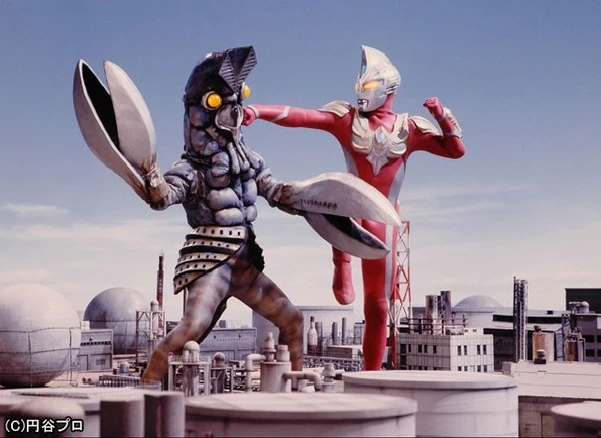
Ultraman baltan seijin

Ultra-Q was not unpopular, but the broadcaster, Tokyo Broadcasting System did some research and discovered that the kids loved the episodes with all of the giant monsters (known in Japanese as “kaijyu“). This was particularly true thanks to the popularity of the Godzilla movies. As it turned out, Tsuburaya understood that. After all, he was the co-creator of the Godzilla movies. So after the first season of Ultra-Q ended, Tsuburaya decided to devote his series to kaiju, by introducing a character that would forever defend the world from the bad ones.

In one of those quick feats of legerdemain, Tsuburaya changed the name of his series from Ultra-Q to Ultraman. Broadcast in color, Ultraman burst on to the scene, and thus was born a cultural icon that all Japanese in their 40s, 50s and 60s can remember with nostalgic bliss.

But where did Tsuburaya get the term “ultra” from? That takes us back a couple of more years to 1964 and the Tokyo Olympics. Japan had just begun its run of men’s gymnastics dominance, by winning the team gold at the 1960 Rome Summer Games. They were expected to do well on their home turf in 1964, but they knew they would have tough competition, particularly with the Soviet Union. In an interview of the Helsinki Olympics medalist and member of a committee dedicated to strengthening gymnastics in Japan, Tadao Uesako, the Japanese newspaper, Daily Sports, revealed Japan’s gymnastics strategy.

Ohno Hayata Mitsukuri Endo Yamashita
Men’s gold medal gymnastics team from Japan: Takashi Ohno, Takuji Hayata, Haruhiro Yamashita, Takashi Mitsukuri, Yukio Endo, from the book Tokyo Olympiad 1964, Kyodo News Service
In 1964, international scoring for gymnastics worked on a three-level scale of A, B and C, where level C was considered the highest level of difficulty for a particular discipline or routine. It was Uesako’s view that Japan’s gymnasts were aspiring to levels beyond C, or as he called it, “Ultra-C“. And from that article, another foreign word (or in this case, prefix) entered the Japanese lexicon.

So there you have it – Tsuburaya made the leap from “Ultra-C” to “Ultra-Q”, thanks to the Japanese men’s gymnastics squad that took gold, ultimately sticking the landing on Ultraman.

Happy Birthday Ultraman!

This is a wonderful commercial from Olympic global sponsor, VISA, featuring 15 Olympians making their way to Rio. Go to this link to confirm who the athletes are.

There was a time when Visa, the credit card company, was considered an after-thought in high-end travel and entertainment transactions compared to American Express. AMEX had the global brand cache that Visa craved, even though Visa was more readily accepted in three times more locations than AMEX.

There was a time when the IOC was barely afloat financially. The Olympics have been a powerful marketing opportunity for companies big and small from the 1950s to the 1980s, but the rights to market their products using the five rings were usually up to the local National Olympic committees (NOC) who sold the rights.

The International Olympic Committee were concerned not only regarding their financial situation, but also of the ability to control the Olympic brand if they were dependent on the local NOCs, who were perceived by the IOC to prioritize money over brand integrity. For example, the IOC did not like that a tobacco company was employing the Olympic brand in selling cigarettes during the 1964 Tokyo Olympics.

The IOC, motivated by the financial success of the 1984 Los Angeles Olympics, as well as the ability of USOC chairman, Peter Ueberroth, to sign up corporate sponsors, decided it was time to create a global Olympic sponsorship program that would make IOC the sole negotiator for marketing rights at all Olympiads. This would prove to be a challenge because NOCs, regardless of whether they had marketing chops or not, were resistant to give up power to the global authority, the IOC. On top of that, countries like the US, were concerned that the significant number of sponsors were American corporations, which would mean that American companies would inevitably end up funding athletes in countries like the Soviet Union (this at a time before the fall of the Wall, and the emergence of Glasnost).

Olympic turnaroundOver the course of countless negotiations, the IOC eventually banged out an agreement that would satisfy NOC small and large alike. Thus was born the TOP Program (The Olympic Partner), IOC’s designation for its global sponsors, who have exclusivity within their given industry to market their products and services at a given Olympics. But according to Michael Payne, who wrote the brilliant marketing book called Olympic Turnaround: How the Olympic Games Stepped Back from the Brink of Extinction to Become the World’s Best Known Brand And a Multi-Billion Dollar Global Franchise, very few corporations, initially, were willing to bite.

Coca Cola, Kodak and FedEx signed up, but for a while, those were the only corporations willing to take on the a most serious financial commitment to be the exclusive global sponsors at the 1988 Winter and Summer Olympics. Then IOC leader, Juan Antonio Samaranch appealed to the chairman of AMEX, James Robinson, to no avail. AMEX did not think they had any competitor willing to ante up, so they were willing to wait out the IOC for a better deal.

But then, circumstances colluded to bring Visa to the IOC. According to Payne, Visa had a change in marketing heads. And the new marketing head saw an opportunity to use the Olympic brand to make their customers aware of how far and wide Visa was accepted, and snatch market share from AMEX. By the time all the analysis was said and done, the line that convinced the VISA board to foot a US$14.5 million bill for TOP status was this: Visa was “going to stick the blade into the ribs of American Express”.

Was it worth the gamble? According to Payne, who was a member of the team that helped build the TOP program, the answer was yes.

For Visa, the payoff was dramatic. Global sales volume for the first three years of its Olympic partnership increased 18 percent against its own forecast of 12 per cent. Results from direct response campaigns and other promotions were 17 per cent higher when Olympic imagery was used. Card volume increased by 21 per cent during periods of Olympic promotion. Consumers who were aware of Visa’s Olympic sponsorship had dramatically better views of Visa, doubling their perception of Visa as a good corporate citizen: a 50 per cent increase in attitudes of overall best card and used for international travel.

Prime Minister David Cameron
Prime Minister David Cameron to step down.

On Thursday, June 23, we learned of the surprising affirmation by its citizens to remove the United Kingdom from the roll call of the European Union. This monumental vote, often called Brexit, has shaken economists and politicos around the world like a slow-motion punch to the gut, one much of the world watched hit in agonizing disbelief.

I’m not a political scientist or an economist, so I will leave the significantly more important impacts of Brexit on the global economy and political stability to others. I will instead focus on Brexit’s impact on sport. As a few of you may already know, the Ryder Cup, the biennial Europe-vs-US golf tournament, to be held in the US in the Fall, will go on despite the fact that six of the nine players of Team Europe are British.

As was explained in this nifty and swift Ryder Cup press release, “the criteria for being European in Ryder Cup terms is a geographical one (ie from countries who make up the continent of Europe) not a political or economic one (ie countries who make up the EU).”

Whew.

Great Britain balloon
Going it alone.

But in the long-term, there are potential negative consequences of Brexit, particularly on the state of sports in the United Kingdom.

  • Potential Loss of European Stars: Membership in the EU means citizens in member nations can work in any other member nation without a work permit. There is currently speculation that some 400 European players who currently have the automatic right to play soccer in England in the Premier League may have difficulty getting visas to continue their play. If that is the case in the coming years, fewer stars from the Continent may play in GB, thus begging the question, will the quality of play in British soccer gradually diminish?
  • Probable Loss of Funding: The EU has a funding arm to develop grassroots sports throughout the Union called Erasmus+, which splits some €265million across the 28 member nations in the period from 2014 to 2020. According to this article, “British organisations received around €1.3m in Erasmus+ sports funding, a significant amount at the grassroots level.”
  • Possible Loss of Opportunity to Host Premier Sporting Events: More than 500,000 visitors from former fellow EU member countries visited England during the 2012 London Olympics, who spent some 300 million in pounds. Brexit right now makes Great Britain a less attractive venue to host a European or global athletic event as visa requirements will make entry to Great Britain slower, likely encouraging athletes and tourists alike to opt for easier options. Organizers of super sporting events may re-think any plans for London.

With a loss of stars, funding and world-class sporting events, thanks to Brexit, the United Kingdom will likely have to work harder to maintain sporting excellence in the decades to come.

Rio Olympics silver gold and bronze medals

Brazil is the home to the Amazon Rain Forest, so diverse in fauna and flora that Brazil is considered a “megadiverse country”, one that demands greater global attention in preserving its biological riches. With the ultimate global party – the 2016 Olympic Games – about to commence in Rio de Janeiro, authorities are ensuring that messages about environmental protection are given priority.

On June 14, Rio 2016 and Brazilian Mint held a press conference to display the medals to be awarded to top three finalists in the Olympic and Paralympic competitions to be held in August and September this year.

The talking points:

  • The nearly 2,500 gold, silver and bronze medals were produced according to strict sustainability criteria.
  • The gold medals were formed by gold that was extracted without the use of mercury.
  • Thirty percent of the silver and bronze medals are made up of recycled materials.
  • Half of the plastic in the ribbons that will suspend the medals were made from recycled plastic bottles.

What caught my eye? The fact that mercury wasn’t used in the mining of gold. I know mercury is a substance humans generally want to avoid direct exposure to. One of Japan’s most infamous environmental health cases and lawsuits are based on a Japanese company in Kumamoto that routinely released mercury into Minamata Bay, causing thousands of cases of mercury poisoning. In Japan, that condition is called Minamata Disease.

What I didn’t know was that mercury has become a popular tool for mining gold. Chemically, mercury and gold attract, or as the scientists would say, mercury amalgamates to gold. This small understanding of chemistry has motivated miners to use mercury in a variety of ways to separate gold specs from rock and dust.

The video below on artisanal gold mining demonstrates the process. First miners pick away at walls of rock with the understanding that gold nuggets an gold dust are in the seams. Large chunks of rock are then handcrushed, and then crushed further by mechanized processes. When the rock has been reduced to pebbles and dust, water is added. At this stage, mercury, which is a liquid element easily purchased, is added to the mix.

Mercury and gold attract, form an amalgam, and thus are easily gathered from the gold-mercury-water slush.

While coming into contact with mercury is not a good idea, as the workers inevitably do in this process, the next step is the most life threatening. The amalgams are then heated so that the gold can be separate from the amalgam. Essentially, the mercury is burned off, released in fumes. It is those fumes that are inhaled by the workers.

The end of the video leads to a conclusion that makes me wonder why gold is so important in the first place: one ounce of gold is mined from one ton of ore using mercury amalgamation techniques. It is good that the 2016 Rio Olympic gold medals are not mined from that poisonous process. But like blood diamonds, poison gold needs to be outlawed.

Rio Medals Predictions Table

Who’s going to win the medal haul at the 2016 Rio Olympics? Today there are predictive models for everything: what film will win Best Picture at the Oscars, who will win a presidential campaign, and of course, what team will win a given sporting championship. The Olympics are also fair game.

Already, various experts and organizations have made their predictions on which nations will take home the lion’s share of the gold, silver and bronze medals at the 2016 Summer Games. As the website Topend Sports notes, the results of four well-known Olympic prognosticators have similar conclusions: The USA and China will vie for domination, while Russia, Great Britain and Germany make hay as well. In Asia, Japan is expected to do well as a prelude to the 2020 Games in Tokyo. Unfortunately, but perhaps not surprising, host Brazil is not expected to finish in the top ten.

But predictions are predictions – most of these based on past performance data. As the site LiveScience wrote, “there are still variables left unaccounted for.” Until recently, the Russian track and field team were considered viable participants. But on June 17, 2016, the IAAF threw the monkey wrench into the Russian dream machine by declaring the entire Russian track and field team banned from the 2016 Rio Olympics due to state-sponsored doping of Russian athletes.

At the London Olympics four years ago, Russian track and field athletes took home a total of 18 medals, of which 8 were gold. That will drop Russia’s medals chances drastically, and boost the totals of its rivals.

As Nobel Prize winning nuclear physicist, Niels Bohr, famously said, “prediction is very difficult, especially if it’s about the future.”

feral cat in rio
A napping stray cat on the Escadaria Selarón staircase

On September 12, 1964, a month prior to the opening of the 1964 Tokyo Olympics, the Mainichi Daily News published the last of a 15-part UPI series entitled, “Great Cities of the World”. The article was entitled “Rio: The City of Marching For Tomorrow”, a meaningless title really. The theme was a familiar one for emerging markets at the time: a fascinating city in a far-off land that was growing rapidly into prominence.

Below are a few of the highlights from that article about the city of Rio de Janeiro that provide us with hints to what has changed, and what has not over the past 52 years.

The Same

  • Corruption: “Rio is still Brazil’s center of political intrigue and corruption.” The article goes on to state that the laws are made in the recently established government seat, Brasilia, but that “the deals are made in elegant Copacabana Beach apartments owned by leading politicians, or by their mistresses, distant relatives or front men.” For sure, this is still true.
  • Industry: “Rio, outside the big coffee-and-automobile complex of Sao Paulo, has managed to win a positions in the textile, food processing and electronics industries.” Coffee and cars are still big exports for Brazil, as are textiles, electronics, aircraft, iron ore and orange juice.
  • Umbanda: “Umbanda claims 30,000 followers in Rio, but the signs would indicate more.” This uniquely Brazilian religion, a fusion of Roman Catholicism, African traditions, and indigenous American beliefs, is still a viable religion, with estimates of 400,000 followers in Brazil, with many of them likely in Rio.
  • Feral Cats: “No reformer has yet suggested doing away with Rio’s half-wild stray cats, numbering countless thousands, which dominate every park, alley and quiet street and no one is likely to attack them. A lot of Cariocas believe cats have ‘the souls of people.'” Rio, apparently, is still a cat haven.


Not the Same

  • Population: The population in 1964 was 3million. Today, Rio is creaking with a population over 11 million.
  • Maracana Stadium: Rio still goes crazy for soccer and plays big games in the Maracana Stadium. However, back in 1964, the stadium held an astounding 230,000 people. After the stadium was renovated and re-opened in 2013, it now seats 78,000.
  • Guanabara Bay: “The sparkling blue beauty of Guanabara Bay…”: That certainly isn’t a phrase bandied about these days.


guanabara bay pollution
Guanabara Bay

Always

Fun in the Face of Solemnity and Challenge: As was true in 1964, it is still true today: the symbol of devout Catholic belief, Christ the Redeemer, is seen as a symbol of faith and peace, and at the same time, an expression of sweet cynicism. As the article stated, “‘He’s not giving His blessings,’ Cariocas like to wisecrack. ‘He is shrugging His shoulders.'”

christ the redeemer

NBC Rio logo

The National Broadcasting Company (NBC) aired the 1964 Tokyo Olympics Games in America, the first time events were broadcast live via satellite. With a 13-hour time difference between New York and Tokyo, the opening ceremonies of the Games on October 10 appeared on American televisions in the middle of the night. After that, NBC offered about an hour of highlights after prime time, fearful of eating into the ratings of their lucrative evening programming.

NBC didn’t get high marks for their coverage, and eventually lost the Games to ABC, which became the network of the Olympics over the late 60s and 1970s. Thanks to ABC’s coverage, the Olympics emerged as a premier marketing opportunity for sponsors and broadcasters. In America, the three networks fought furiously for broadcast rights.

NBC currently owns US broadcasting rights through 2032, having bid an incredible $7.65 billion dollars for the Summer and Winter Games through that period. With so much riding on the Games, not only for NBC, but obviously also for Brazil, the IOC and the athletes, it’s no surprise that commentators around the world are casting doom and gloom on the upcoming Rio Olympics. A doctor in Canada has even called for the postponement of the Games until the zika virus threat is deemed less of a risk.

It’s also possible that the entire track and field team from the Soviet Union will be banned from participating in the Rio Olympics due to state-sponsored doping. Michael Colangelo of the blog, The Fields of Green, recently wrote that the lack of Russian competition will strike a great blow on the success of the Rio Olympics, particularly on the viewer ratings of NBC. “The problem is that as doping seems to become more prolific — with Russia essentially running a doping program at a national level — bans and bad news could affect the television ratings this year and beyond.”

Colangelo went on to write, “It’s a balancing act and the only loser right now is NBC. As the Olympics get closer, the IOC and its partners will have to work to make sure that all parties’ investment in the games is worthwhile. That seems close to impossible right now.”

That was actually a concern in 1984. As you may recall, the United States and over 60 other countries boycotted the 1980 Moscow Olympics, primarily due to the Soviet Union’s invasion of Afghanistan. Four years later, 15 nations led by the Soviet Union boycotted the Los Angeles Olympics. Michael Payne, who wrote the fascinating book called “Olympic Turnaround“, said that the American Broadcasting Company paid a then-record $225 million for rights for the Summer Games in Los Angeles and the Winter Games in Sarajevo, and that ABC bean counters started shouting that the sky was falling when the boycott was announced.

Roone Arledge
Roone Arledge


And then stepped in ABC Sports President and Olympic broadcasting legend, Roone Arledge. Like Henry V in Shakespeare’s eponymous classic play, Arledge faced down the naysayers, according to Payne, and stated with conviction that the Los Angeles Games would be a moment of triumph.

By early 1984, ABC’s financial leaders were running scared about a potential ratings collapse due to the Soviet-led boycott, and attempted to renegotiate terms. Arledge argued that the Soviets had done them all a favor, as the boycott would only allow Americans to win even more gold medals. “They would not lose viewers, they would gain them.”

Arledge was right, ABC’s coverage of Los Angeles set new ratings records. From Los Angeles in 1984 onwards the Olympic Games began to have a dramatic effect on the US advertising market. More than half of the advertising available for all sports for all networks for the entire yea was spent on the Olympics over two weeks. “We’d not only captured the market, we’d suck it dry,” Roone Arledge observed.

Roy_1965 maybe
Roy, around 1 years old

On May 1, 2015, I kicked off my blog, The Olympians, with the intent of providing at least one blog post every day. Here we are, 365 days, over 10,000 visitors, nearly 20,000 views later, and I have kept my promise. Many thanks to all those who have helped me along the way!

Below are 20 of my favorite posts in 2016:

  1. The 1962 Asian Games: How Cold War Politics Sparked Heated Debate, Leading to the Indonesian Boycott of the 1964 Games
  2. “Do it Again. Again. Again.”: The Uncompromising Mindset of an Olympic Champion
  3. The Dutch Boycott of the 1956 Olympic Games Part 2: Rehabilitation
  4. The Hijab and The Turban: Why American Fencer Ibtihaj Muhammad is Important  
  5. Dr Jega: The Fastest Man in Asia Learns that Life Works in Mysterious Ways
  6. Duke Kahanamoku Part 1: Surfing’s Johnny Appleseed Inspires Australia’s Pioneering Surfers and an Entire Sports Culture
  7. Japanese Face Off in Australia on the 15th Anniversary of Pearl Harbor
  8. Ken Sitzberger and Jeanne Collier: Diving’s Power Couple in 1964
  9. The Pain and Joy of Pain: Dick Roth and the Gold that Almost Wasn’t
  10. The Perfectionist’s Dilemma: The All-or-Nothing Life of Hurdler Ikuko Yoda
  11. Rare Canadian Gold in Tokyo: George Hungerford and Roger Jackson Win the Coxless Pairs
  12. The Record-Setting Row2Rio Team: Following in the Footsteps (Sea legs?) of Christopher Columbus
  13. Remembering the 3.11 Earthquake and Tsunami, My Ancestors, and the Tokyo Olympic Cauldron
  14. Sazae-san Part 3: Suicides and The Pressure Cooker of Japanese Education
  15. Simple is Best: Finally, The New Tokyo 2020 Olympic and Paralympic Logos
  16. Singaporean Cyclist Hamid Supaat and the Big Chill: Competing on the World Stage
  17. The “Six-Million-Dollar-Man” and “Real Steel” Scenarios: Science and Technology Blurring the Lines and Creating New Ones  
  18. Tommy Kono: Out of an Internment Camp Rises Arguably the Greatest Weightlifter of All Time    
  19. Unbroken: The Truly Epic Story of Louis Zamperini Finally Shown in Japan
  20. Worrying Willy and Paradise Pete: How the US Army Prepped Recruits for Japan in the 1950s

Click here for my favorite posts from 2015! Again, many thanks for all your support!

2004 Athens Olympics

Reports are that only 50% of tickets to the Summer Games in Rio de Janeiro, starting on August 5, have been sold. For the Paralympics in September, only 12% have been sold.

The Brazilian economy is shrinking during its worst recession in 25 years. The President of Brazil is under threat of impeachment for a decision to include an ex-President in her cabinet, someone under investigation for receiving bribes in the Petrobras corruption scandal. The Zika virus continues to spread in Brazil, a disease where there is now “strong scientific consensus” that it is a cause of microcephaly in newborns.

Those perhaps are the biggest factors that will result in many empty seats of a possible 7.5 million that are available for the Rio Olympics.

What’s interesting is that empty seats at Olympic Games is a recurring headache and embarrassment for Olympic organizing committees.

At the 2004 Games in Athens, “only about two-thirds of the 5.3 million tickets were sold“. At the 2008 Games in Beijing, organizers claimed that all 6.8 million tickets were sold, and yet empty seats blotted arenas throughout the Games. And at the 2012 Games in London, where pledge after pledge was made by organizers to fill the seats, and that “more than 20 million applications were made for the 6.6 million available seats”, the London organizing committee could not prevent the empty-seat phenomenon.

Empty Seats at Gymnastics Competition at London Games
2012 London Games

Athens and Rio share a common issue in that their economies may not be vibrant enough to drive local ticket sales. But Beijing and London do. Other factors are at play, resulting in tickets going unused. This article from The Guardian regarding empty seats at the London Games indicates that a few groups who are granted reserved seating, often the best seats in the house, just don’t show up:

  • Accredited members of the Olympic family, which include international sports federations, IOC officials and corporate sponsors,
  • Guests of corporate sponsors who receive tickets more for their affiliation with the sponsor and less regarding their interest in the Games
  • Members of the press, who may be less interested in heats and preliminary rounds
  • Athletes, particularly in the first week of the Games as all athletes are preparing or competing

Beijing pointed to another group – agencies that buy and re-sell tickets to people overseas or to people locally anticipating a spike in demand during the Games. Westerners in