Robinson Leonard Ali
Sugar Ray Robinson, Sugar Ray Leonard and Muhammad Ali in Las Vegas in 1977. Both Leonard (1976) and Ali (1960), won gold medals in their respective Olympics before going on to glory at the professional ranks.
In 1988, when tennis debuted at the Seoul Olympic Games, allowing professionals to enter the competition, the gold medalist in individual play was Miloslav Mecir of Czechoslovakia. While he defeated Stefan Edberg, whom Mecir had lost to at Wimbledon that year, the Olympic tournament was missing quite a few stars of the time: Mats Wilander, Ivan Lendl, John McEnroe, Boris Becker for example. As I understand it, the Olympics provided no ranking points or remuneration so many of the pro stars were not motivated to be an Olympian.

In 1992, when FIBA allowed professionals to participate in the Olympics, many of the teams were transformed with players from the NBA and other international professional leagues excited to be Olympians. With Michael Jordan, Magic Johnson, and Larry Bird headlining a team of unprecedented talent, Team USA swept through the competition with ease to win gold.

In May, 2016, the International Boxing Organization (IBO) will vote whether to allow professionals to compete in the Olympic Games going forward. Presumably, the reason is the same for every other international sports governing body – the very best in their sport should compete at the Olympics.

So if the IBO gives pro boxers the thumbs up for the Olympics, will the reaction by the pros be like tennis in 1988, or like basketball in 1992?

The Philippines have never won a gold medal in the Olympics. So why not Manny Pacquiao? Even though he was prepared to hang up his gloves after his next fight with Timothy Bradley in April, he has publicly said that he would step up if asked. “It would be my honor to represent the country in the Olympics,” Pacquiao told Agence France-Presse. “If I would be asked to represent boxing, why not? I would do everything for my country.”

manny pacquiao
Manny Pacquiao thinking about Rio.
Will others pros step up into the ring in Rio?

This isn’t clear yet – some will be bothered by the lack of financial incentives, and others may be enticed by the national glory. But one thing is clear – boxing is a brutal sport. And as pointed out in this discussion board devoted to boxing, people don’t just lose in boxing matches…they can get beat up. And if you’re a pro, you’re sacrificing potentially lucrative but limited paydays to possible injury. If you’re an amateur, you may end up getting battered way more than what a fellow amateur could do to you.

David Wottle on Winners Podium
02 Sep 1972, Munich, Germany — Hand over heart, America;s David Wottle stands on winner’s podium after receiving the Gold Medal in the Olympic men’s 800 meter race here today 9/2, with Soviet Silver Medal winner Evgeni Arzhanov in front of him, and Mike Boit (left) of Kenya, the Bronze medalist, behind. — Image by © Bettmann/CORBIS
You couldn’t miss him. In the finals of the 800 meter race at the 1972 Olympic Games in Munich, he was the only one wearing a cap. And he was all the way in the back of the pack.

But Dave Wottle did not remain in the back. The Kenyans were setting the pace. Then the Soviet star, Yevgeniy Arzhanov, took the lead with two hundred meters to go, and Wottle of Bowling Green State University is in fifth at the beginning of his kick. As the American broadcasters shout excitedly in this particularly partisan call, Wottle passes one runner after another until nipping the Soviet at the tape to win gold.

Most athletes would bask in the warmth of victory – either jumping in jubilation, or smiling endlessly with a quiet sense of accomplishment. Instead, Wottle wore an expressionless mask, perhaps one of shock. And when he stepped up to the winner’s podium, he made a mistake in etiquette that ruined this championship moment for him.

As the American national anthem played, Wottle forgot to remove his cap. And as he mentioned in this profile in the book, Tales of Gold, “I suppose what most people will remember about me as an Olympic athlete is that I was the one who wore a golf cap while running and also that I forgot to take it off on the victory stand. That episode just dampened my whole Olympic experience. I was never so embarrassed in my life! It should have been the happiest day but it wasn’t; I was simply too embarrassed to be totally happy.”

It was 1972, four years removed from the black-fisted protests of Tommie Smith and John Carlos on the medal podium in Mexico City, a time when the US was stuck in the quagmire of the Vietnam War, and only a few days before Palestinian terrorists broke into the Olympic Village, taking the Israeli team hostage, and eventually killing them. When people saw Wottle with his white cap on, and his right hand on his left breast, covering the USA patch, they may have wondered what he was protesting. The Vietnam War perhaps?

Wottle was mortified. He said he had absolutely no ill will in wearing the hat, that he simply forgot to take it off.

As Milton Richman wrote in the State Journal-Register, a local Springfield, Illinois newspaper, “The cap sells for 75 cents. You can get it for 35 cents wholesale. Dave Wottle wears it practically everywhere. He wears it when he runs. He wears it when he trains. He

Bud Collins and Dick Enberg
NBC announcer Bud Collins, left, with Dick Enberg in the television booth at the All England Club for the 1982 Wimbledon. Photo: Walter Looss JR. /Sports Illustrated/Getty Images

I was a big tennis fan when I was growing up in Queens, New York, getting lessons at Cunningham Park, and playing with friends on the awful concrete court on the grounds of the Queens General Hospital. And I remember in the 1970s watching Breakfast at Wimbledon on NBC, with Bud Collins, when Bjorn Borg was the dominant male tennis player of the time, routinely defeating Jimmy Connors, Guillermo Vilas and Roscoe Tanner. And I remember the epic five-setter in 1980 when John McEnroe lost to Borg at Wimbledon. Bud Collins was always there.

Collins passed away on March 4, 2016.

But what I just learned is that Bud Collins, who essentially began his journalistic career as a college student for his school paper, went, somewhat on a whim, to the 1948 London Olympic Games as a spectator. The goal was to cheer on a fellow Baldwin-Wallace College student, William Harrison Dillard.

A few years ago, Collins wrote this wonderful article for ESPN, recalling his early days in Berea, Ohio, where he literally delivered newspapers (Cleveland Plain Dealer) on the Baldwin-Wallace campus and its environs as a 14-year old. When he became a BW student, world-class hurdler Dillard also decided to join BW. Dillard could have gone to Ohio State, the alma mater of Jesse Owens, the last American to win Olympic gold in the 100 meters in 1936, but as Collins relates in the article, Dillard wanted to stay closer to home.

harrison dillard 1948
William Harrison Dillard in 1948 at the London Summer Games.


Collins continues to write this amazing story of how Dillard was pretty much expected to win gold in the 110 meter hurdles easily at the re-boot Olympics in 1948, the first Olympics since Berlin in 1936, postponed for 12 years due to world war. (in fact, Dillard served in the US military, seeing significant action on the Italian front.) But for some reason, at the Olympic trials, Dillard competed poorly and would not be asked to compete as a hurdler. He did place third in the 100 meters, so was put on the team to possibly compete in the 400-meter relay team.

So when young Bud Collins, and his editor on the school paper, decided to use their savings and borrow money so they could go to London, there was only a slim possibility of watching their buddy, “Bones” Dillard, compete at the 1948 Olympic Games. As it turned out, in a London still climbing out of the rubble of World War II, Dillard was crowned the fastest man in the world, and a budding journalist named Bud Collins was there.

Thank you Bud, for the memories.

Ma Junren and his Army
Chinese Track coach Ma Junren and his “Army”

Old letters from our youth can trigger warm memories or nascent insecurities. Some should be published for their form and insightfulness. Others should be lost to eternity.

The Chinese government may have wished for the latter for one particular letter that has unveiled yet-another possible example of state-sponsored doping. Russia’s athletics team is banned from competing in the 2016 Rio Olympics, and Kenya’s team is under threat of ban. Now China is facing scrutiny over allegations that Ma Junren, the coach of China’s female middle- and long-distance runners, forced performance-enhancing drugs on his team of runners.

While the news broke in early February of this year, the source of the news was a letter written in 1995, signed by nine members of Ma Junren’s team. The women on this team, who also faced intolerable physical and verbal abuse from their coach, delivered the letter to an investigative reporter they respected, Zhao Yu. Nineteen years later, this letter was finally published in a book by Zhao Yu, unnoticed by the public, until a Chinese sports website called Sports.qq.com shared the letter this month. Here is part of that letter:

What we have told you about how Coach Ma verbally and physically abused us for years is true. It is also true that he tricked and forced us into using large quantities of banned drugs for years. We have a heavy heart and very complicated feelings in exposing him.

The person who is said to have written this letter is Wang Junxia, who was coached by Ma until 1995. Under Ma, Wang set records and won titles in marathons, 10ks, 3ks and 1500 meter races. In 1995, Wang and her teammates left their coach. In 1996, at the Atlanta Summer Games, Wang won gold in the inaugural women’s 5,000 meter race, as well as silver in the 10,000 meter competition.

Wang Junxia at the Atlanta Summer Games
Wang Junxia at the 1996 Summer Games in Atlanta

And now, due to this recently publicized revelations, what Wang wrote in that letter 21 years ago may ring true: “We are concerned that our motherland’s reputation will be harmed, and we are also concerned about ‘how much gold’ there will be in our gold medals that were earned through blood and sweat.”

Go to this New York Times article for the full text of the letter.

Charlotte and Godfrey Rampling
Charlotte Rampling with father Godfrey Rampling at his 100th birthday celebration
On Sunday, February 28 in the United States, The Academy Awards showcased five women for Best Actress: Cate Blanchett in Carol, Brie Larson, in Room, Jennifer Lawrence in Joy, Charlotte Rampling in 45 Years and Saoirse Ronan in Brooklyn.

And the winner is…..Brie Larson!

Rampling was definitely in the running – although nominated for the first time in her career, she has had a long and successful run as a model and actress.

Unfortunately, right after the Oscar nominations were announced, Rampling dropped the baton. In 2016, for the second year in a row, there were no nominees of color in the major acting categories. This prompted calls for a boycott of the Academy Awards. That in turn prompted Rampling to speak out on her own in a French talk show, saying that talk of boycotting the Academy Awards because no Blacks were nominated is “racist to whites.” She continued by saying, “One can never really know, but perhaps the black actors did not deserve to make the final list.”

Coincidentally (or perhaps ironically), Rampling’s father, Godfrey Rampling, competed in the Berlin Olympics in 1936 as a 400-meter sprinter. While finishing fourth in the individual men’s 400-meter competition, he and his team from Great Britain won the 4X400 relay finals, in good part due to Godfrey Rampling’s stunning burst to take the lead from Canada in the second leg, enabling Team GB to win gold.

OLYMPICS Rampling 19
Olympics – Britain’s Oldest Olympian Godfrey Rampling celebrates his 100th Birthday – Bushey House…A collect picture showing Godfrey Rampling (second left) competing in the 1936 Berlin Games. PRESS ASSOCIATION Photo. Picture date: Saturday May 15, 2009. Britain’s Oldest Olympian Godfrey Rampling celebrates his 100th birthday today with a party at Bushey House, Bushey. Photo credit should read: Anthony Devlin/PA Wire.
These were of course the Olympics that pitted the position of Arayan superiority against all who were not of Arayan stock, a backdrop that reflected the spotlight on black American sprinter, Jesse Owens. And while I have no idea what thoughts Godfrey Rampling had on race, the thoughts of his daughter, Charlotte, dully echo those from Berlin…in my opinion.

Fortunately, (black) comedian Chris Rock was the host of the 2016 Academy Awards, and if anyone could respond to the Charlotte Ramplings of the world, it was Chris Rock. Here is a transcript of his opening monologue at the Oscars, which walks a fine line, attacks the extremes of the argument, and makes us laugh and think.

People living in Japan are used to Hollywood films coming out months after their US release date. But it’s unusual for a movie to come out a year after its release.

Finally, on Saturday afternoon, I got to watch the film Unbroken.

Zamperini in front of photo of Berlin GamesDirected by the actress, Angelina Jolie, Unbroken is the incredible story about Louis Zamperini, whose life defies belief. He was an Olympian in the 1936 Olympics, who finished eighth in the 5,000 meters final, but did so in such dramatic fashion that Adolph Hitler sought him out to shake his hand.

He was a bombardier on a B-24 fighting in the Pacific War, was a survivor not only of a crash on a rescue mission in the middle of the Pacific Ocean, but also 47 days on a life raft without food or water.

His life up to that point is a miracle, but when he was finally found and captured by Japanese troops on the Marshall Islands, he embarked on a more brutal path as a prisoner of war in various camps in Japan. The brutality he and other POWs endured is portrayed in the movie fairly graphically.

Japan Film Unbroken
Moviegoers wait before Angelina Jolie’s “Unbroken” opens in front of a movie theater in Tokyo, Saturday, Feb. 6, 2016. “Unbroken” has opened more than a year after the rest of the world in Japan, the country where the main character endures as a prisoner of war and where some have called for a boycott of the movie. (AP Photo/Koji Sasahara)

It was this depiction of the Japanese overlords, among other things, that was feared to provoke right-wing groups if the film were to be shown in Japan. But one year later, after countless appeals by Jolie to bring the film to Japan, Toho-Towa finally decided to distribute the film after a delay, and a small art-house theater in Shibuya called Theater Image Forum which seats only 64 people, decided to show the film.

According to the AP report, the “distributor said in a statement that it decided to go ahead with the showing because various views on war should be expressed, and because it was unnatural for a movie about Japan not to be shown in the country.”

Bravo.

Too bad that only 2 theaters in all of Tokyo are showing the film.

The film itself is a Hollywood biopic – in other words, a traditional telling of a great person’s life – a chronologically told tale of the person’s significant moments, with flash backs here and there. But because Zamperini’s life story is epic, it’s impossible not to be impressed.

Perhaps the most striking was not the performance of Jack O’Connell, who portrayed Zamperini in the film. It was of the Japanese singer turned actor, Miyavi, who was at times electrifying as a POW camp authority whose sadistic nature made life, as it were, intolerable for the prisoners.

miyavi as watanabe in unbroken
Miyavi in Unbroken

Zamperini’s life after the war was a personal challenge – how does one digest the horrors he faced and emerge a fully functioning member of a peace-time society? And yet, he did, and came to realize that forgiveness was the only way out of his personal pit of lifelong trauma. As the movie, as well as this documentary by CBS on Zamperini depict, the man, unbroken, did return to Japan in 1998. He carried the Olympic torch for a kilometer at a ceremony leading up to the Nagano Winter Games. And the Torrance Torch, as he was once called as a high school track phenom, shone bright once again.

(Go to the 33 minute mark for that wonderful moment.)


1956 Dutch Olympic Team Rehabilitation lunch at Kurhaus Hotel in Scheveningen
The Rehabilitation Lunch for the 1956 Dutch Olympic Team, organized by the Dutch Olympic Committee at the Kurhaus Hotel in Scheveningen, Holland.

“Melbourne is THE black page in the Olympic History of the Netherlands,” wrote Ada Kok in an email to me. Kok was not only a two-time Olympian in 1964 and 1968, she was the President of the Dutch Olympians Association for 11 years.

And when she was president, you could join the association only if you were an Olympian. Thus, the unfortunate members of the 1956 Dutch National Team were forbidden from competing once the Dutch government decided to boycott the Melbourne Games. As related in a previous post, some of the Dutch national team, including world-record swimmer, Cocky Gastelaars, were already in Melbourne preparing when the decision was made.

Ada and Cocky
Ada Kok and Cocky Gastelaars

“Some athletes were already present in Melbourne to train and they were whistled back home by the Dutch Olympic Committee and the Dutch Government,” wrote Kok. “For Cocky this was a traumatic decision as this was her chance to win a gold medal being a world-record holder. But not only was Cocky disappointed. Then, we had a lot of potential gold medal winners who were part of this Dutch Olympic Melbourne Team in 1956. The sad thing was they all just received a telegram to announce the Olympic Team was not travelling to Melbourne, and for those who were already in Melbourne, they were ordered to leave the Olympic Village, not to wear their Olympic outfits anymore and travel home immediately.”

Kok provided me with a copy of that telegram dated November 7, 1956, seen below.

telegram Dutch boycott

DUTCH OLYMPIC TEAM                                                                                                              HEIDELBERG-VICTORIA-ASUSTRLIA

AT EXTRAORDINARY MEETING THE DUTCH OLYMPIC PARTICIPATION TO WITHDRAW DUE TO HUNGARY STOP LEAVE OLYMPIC VILLAGE – FIND OTHER PLACE TO STAY STOP WEAR CIVILIAN CLOTHES – IF IMPOSSIBLE REMOVE BADGE STOP WAIT FOR PAULEN LEAVING 11 NOVEMBER FLIGHT 845 FOR FURTHER INSTRUCTIONS STOP CANCEL ALL HOTEL RESERVATIONS BUT RESERVE HOTEL WINDSOR PAULEN AND CHARLES LEAVING 15 NOVEMBER SORRY ALL THE BEST

NOC  (National Olympic Committee )

To a world-class athlete preparing years for this moment, the telegram above must have been a dagger in their backs. “No further explanation,” wrote Kok. “This was so sad! And this caused over the years a lot of bad feelings among the Dutch Olympians from 1956.”

It took a while, but in 2014, a step was taken to recognize these athletes whose lives were so abruptly and rudely changed that day in November 1956. Erica Terpstra, who was the President of the Dutch Olympic Committee, worked with Ada Kok to arrange a day of

gastelaars and fraser
Cocky Gastelaars and Dawn Fraser

You are one of the fastest swimmers in the world, having broken the world record twice prior to the Olympic Games. You’re going to be confident and excited for the fight.

So much can happen to an athlete before the competition begins: bad news from home, illness, an injury. But rarely do you arrive at the venue of the Olympic Games, prep for the competitions, only to be told to go home. It happened to the Indonesians and North Koreans at the 1964 Tokyo Games, and surprisingly to me, the Dutch in the 1956 Melbourne Games.

When the Soviet Union invaded Hungary in late October, 1956, in order to help suppress an anti-government uprising, there was an international outcry. As a result, the Netherlands, Spain and Switzerland decided to boycott the Summer Games in Melbourne held only a few weeks later. This came as a shock. In one case, a world-record holder and nearly sure-medalist swimmer from Rotterdam, Cornelia Maria (Cocky) Gastelaars, was asked to retreat at a time of possible victory.

Dawn Fraser, legendary Olympic champion swimmer from Australia , told this story in her autobiography, Below the Surface – The Confessions of an Olympic Champion.below the surface cover

My first disappointment after moving into the Olympic Village came when the Dutch government ordered the Netherlands team to withdraw from competition. The international situation was tense then, first with Suez and then with the Hungarian revolution, and the Dutch felt that it was no time for running, jumping, swimming and other frivolous pastimes. This meant that Lorraine and I would be deprived of our main opposition from overseas – Cockie Gasterlaars. You may think that we should have welcomed the news that a big danger was out of the reckoning: all I know is that we were bitterly disappointed, the more so because Cockie was actually in Melbourne and living at the Village when the news of Holland’s withdrawal arrived.

Cockie spoke excellent English, and we talked often during the first weeks in the Village. She had held the world 100-meter record twice during the year, and she wept once when she told me how much she wanted to compete. Another time she checked through the list of entries with me and told me that an American girl, Shelley Mann, and a Canadian girl called Grant had been swimming good times; but I think we both knew that the real struggle would have been between Cockie, Lorraine and me.

Fraser went on to win the 100-meter freestyle championship in Melbourne in world record time. But she is not sure that would have been the result had the Dutch team not boycotted the Games.

The day the Dutch team moved out, I saw Cockie Gastelaars. “You were wonderful,” she said. And I told her it might have been a different result if she’d been swimming. She was a sweet, shy girl and very brave; it must have been awful to have been deprived of the chance to compete just when she was at the peak of her career. We swapped badges, pins and finally addresses. We said we’d write, and we told each other that we’d be bound to meet in the water sometime, somewhere.

POSTSCRIPT: October 29, 2016. I had the honor of interviewing Cocky Gastelaars on October 10. I learned that, in fact, she never was in Australia when the Dutch government announced the boycott. She was still at home. And of course, she was very disappointed. But she did not meet Dawn Fraser  until a year after the Melbourne Olympics when she took a trip to Australia.


For Part 2, go to this link:

The Dutch Boycott of the 1956 Olympic Games Part 2: Rehabilitation

barkley and johnson draped in american flag
Picture of Charles Barkley and Magic Johnson with the American flag draped over their shoulders to cover the Reebok logos on their jacket. Barkley and Johnson had agreements with other footwear brands. John Stockton and Chris Mullin, 1992 Dream Team teammates, look on.

Here’s a fascinating article from Yahoo Sports about the sports footwear industry and the NBA, and a few facts:

Fact #1: Only 10 NBA players currently have their own “signature shoe” with a US-based brand. In case you’re interested, they are: LeBron James, Kobe Bryant, Kevin Durant and Kyrie Irving at Nike; Chris Paul, Russell Westbrook and Carmelo Anthony at Jordan Brand; Derrick Rose and Damian Lillard at adidas (James Harden’s shoe will launch in 2017); and Stephen Curry at Under Armour.

Fact #2: A shoe deal for an NBA lottery pick (a person who is in the top 5 or 10 of the NBA draft of high school, college or available international players) could mean earning from USD200 to 700K per year. The article points out that Andrew Wiggins, who signed a 3-year contract with the Cleveland Cavaliers for over USD17million, also signed a 5-year agreement with adidas for another USD11 million.)

Fact #3: Every player in the NBA has a relationship with a sneaker brand; even the benchwarmers, players looking just to make a training camp roster, can get what is called a “merch” deal. Such an agreement with a footwear marketer gets them a free allotment of footwear for practices and games.

Fact #4: Sneaker brands scout out basketball prospects at the college and high school levels, just like basketball scouts do

Fact #5: Nike has dominant share of the NBA player market, as 68% of the 300+ players wear the Swoosh. Adidas is number 2 at 15.6% with about 70 players wearing the three stripes.

For past stories in “The Sneaker Wars” series, see below:

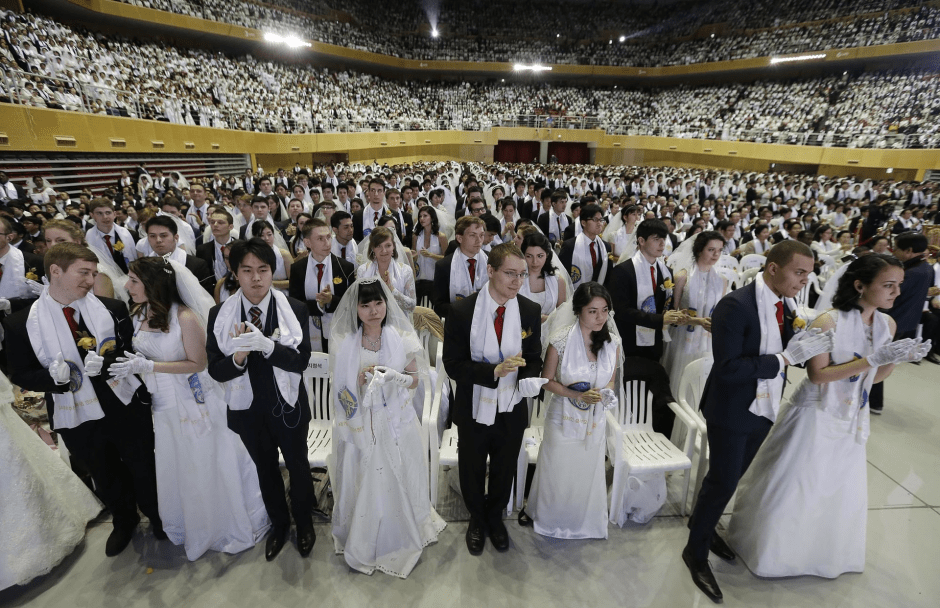
unification mass wedding_February 2016

On Saturday, February 20, approximately 15,000 couples, or 30,000 people were married at a single event called The Holy Marriage Blessing Ceremony, in GapYeong, South Korea. Popularized by Unification Church founder, Reverend Sun Myung Moon, 3,000 of those couples were married in Korea, while the other 12,000 participated via the internet.

One third of the 3,000 couples who were married in the Church’s CheongShim Peace World Center were renewing their vows. But about 800 of the couples agreed to be matched by the Church, a custom that Reverend Moon had heavily endorsed in the past. In fact, these unions have often brought strangers of different nationality or race together.

Rev. Moon, who passed away in 2012, had presided over some of the biggest mass weddings ever, including 30,000 couple in Washington DC in 1997, and 40,000 couples simultaneously in Korea, US, Brazil and Venezuela in 2009.

The Unification Church and its mass marriages are not without their controversy. To nameHiroko Yamasaki one, since this is a blog about the Olympics, is the case of Hiroko Yamasaki (山崎浩子), who was a member of the Japanese rhythmic gymnasitics team at the 1984 Los Angeles Summer Games. Along with a well-known singer and actress, Junko Sakurada, Yamasaki was married at a mass wedding presided over by Rev. Moon, along with 20,000 people from 130 countries, in August of 1992.

According to this account from the newspaper, The Australian, Yamasaki disappeared. No one knew where she had gone, not even her new husband, Hideyuki Teshigawara. Months later, Teshigawara filed a missing person’s report to the police, which led to a nation-wide search for the Olympian.

And then suddenly, one day, Yamasaki appeared, on television, saying “Everything was a mistake.” She went on to say, “I was placed in a world of delusion where people’s minds were being controlled. So I still cannot figure out to what extent the affection I felt towards Teshigawara was real.”

Over two decades later, Yamasaki is now the national coach of the Japanese women’s rhythmic gymnastics team.

FIG Rhythmic Gymnastics World Championships 2014
Hiroko Yamasaki (JPN), SEPTEMBER 26, 2014 – Rhythmic Gymnastics : Japan’s ?Reinforcement Coach Hiroko Yamasaki during the FIG Rhythmic Gymnastics World Championships 2014 in Izmir, Turkey. (Photo by Takahisa Hirano/AFLO)