Lee Calhoun in 1960
The finish of the 100m hurdles at the Olympic games in Rome in 1960, just won by Lee Calhoun from the USA ahead of Willie Mae also from the USA.

Lee Calhoun was the 110-meter hurdles champion at the 1956 Melbourne Games. And like many other athletes in the post-war years, he was not financially well off. He was about to get married, but he wanted to keep his dream alive of repeating his gold-medal success at the 1960 Rome Games.

For many athletes in America up until about the 1980s, this meant sacrifice, scrimping and saving to maintain just enough to get by and be able to train. In 1958, Calhoun intended to marry his college sweetheart, but was under no illusion of being able to afford anything special.

His fiancé, Gwen Bannister, had an idea. Based on a tip from Calhoun’s college coach, LeRoy T. Walker, Bannister would apply for participation on the popular game show, “Bride and Groom”. On this program from the 1950s, couples would actually get married, revel in their wedding gifts presented on the show, and then be sent off on an all-expenses paid honeymoon.

Bride and Groom_NBC title screenshot

As she explained to David Maraniss in his wonderful book Rome 1960: The Olympics that Changed the World, Bannister said that Calhoun was not a party to the idea, but was all for it when he heard about it. “If they enjoyed your letter, they would put you on the show. Mine must have been a humdinger,” Gwen told Maraniss. “I didn’t tell Lee about it until I knew for sure. He thought it was wonderful. We knew we didn’t have anything; didn’t even have a job. [But] it was my choice. Lee didn’t have anything to do with it.”

Lee Calhoun cardThen fell the heavy hand of the AAU, the Amateur Athletic Union, which was the overarching governing body for sports in America recognized by the IOC. Only a week before Lee Calhoun and Gwen Bannister were to be married on television, Dan Ferris of the AAU informed the couple that Calhoun would no longer be considered an amateur if he appeared on “Bride and Groom”. As Maraniss explained, “Calhoun was unduly benefiting from his status as an athlete and that the couple would not have been invited on Bride and Groom had he not been a track star.”

Calhoun thought the judgment was unfair, “that anyone could be on the TV show, not just athletes.” So Lee and Gwen rolled the dice and got married on Bride and Groom.

Calhoun was suspended from competing in track and field for a year. Fortunately, he was able to continue his Olympic journey after the suspension, go to Rome, and win gold in 110-meter hurdles.

Neal Horan pushing Vanderlei de Lima at the 2004 Athens Games Marathon

No Brazilian had ever won Olympic gold in the marathon, and there he was, in first place at the home of the marathon, Greece, competing in the 2004 Athens Summer Games.

With only 7 kilometers to go, Vanderlei Cordeiro de Lima was in the lead by a healthy 25 to 30 seconds when a man in a green vest, red skirt and green socks burst out of the crowd from de Lima’s right, grabbed de Lima and proceeded to push him all the way off the road and into the shocked crowd watching the race.

de Lima pushed his way out and back into the race, but lost a precious 15 to 20 seconds. And as you can see after he returned to the race, he was clearly disgusted with what had happened. (Be amazed as you watch the incident unfold around the 20 second mark in this video.)

In the end, de Lima was eventually passed by gold medalist Stefano Baldini of Italy and silver medalist Mebrahtom Keflezighi of the US. De Lima finished third, 42 seconds behind Keflezighi and 1 minute 16 seconds behind Baldini.

Would de Lima have won the marathon championship if not for literally being sidetracked? It’s hard to know. While the IOC declined an appeal by the Brazilian Athletics Federation to award de Lima with a gold medal, they did present him with the Pierre de Coubertin medal for sportsmanship. (The first one was awarded at the 1964 Tokyo Games.)

The perpetrator was Cornelius “Neil” Horan, a defrocked Roman Catholic priest from Ireland. Horan made the headlines the previous year by running onto the track at the 2003 British Grand Prix, running hard down the track in the direction of oncoming Formula 1 cars darting to their right to avoid Horan. (Be amazed again as Horan makes his appearance 10 seconds into the video below.)

Dorothy Tyler Odam in Berlin
Dorothy Odam-Tyler competing in Berlin in 1936.

Dorothy Odam-Tyler of London competed in four Olympics, which is an amazing fact. But she did so over a 20 year-period in a land devastated by war. A world record high jumper, Tyler-Odam won the silver medal in the 1936 and 1948 Olympics, the only athlete to have won medals before and after the Second World War.

World War II took place from 1939 to 1945, resulting in the deaths of over 60 million people. Quite ironically, the host cities selected for the XI Olympiad in 1936, the XII Olympiad in 1940, and the XIII Olympiad in 1944 were respectively Berlin, Tokyo and London – the capitols of the three of the most prominent players in the Second World War.

As it turned out, Olympics of 1940 and 1944 were cancelled due to war. In other words, the Olympic spirit, or rather the Olympic legend of suspending war in order to conduct an Olympiad was not able to overcome the nationalism and militarism of the mid-20th century.

In 1936, war was not imminent. Adolf Hitler had come to power in Germany, but had not yet made explicit his need for “elbow room”. Thus the 1936 Games in Berlin were his opportunity to show the world that the German way was the way of the future.

Dorothy Odam, as she was known in 1936, was still only 16 years old when she appeared in Berlin. According to Mike Fleet in his wonderful biography of the English high jumper entitled Thanks and No Thanks Mr Hitler, Odam-Tyler had an eye-opening experience. “The politically uniformed teenager had a further rude awakening, as hundreds of Hitler Youth members marched about proudly swinging their swastika armbands, many with shovels and brooms at the slope of their shoulders.”

thanks and no thanks mr hitler

Despite the militaristic atmosphere and the grandeur of the opening ceremonies, the teenager was able to keep her emotions intact, and battle to, essentially, a tie in the high jump. Utilizing a scissor-jump approach, Odam-Tyler was one of three of the remaining athletes to jump 1.6 meters on her first attempt. Only two others were able to clear that height, but not without failed attempts.

Unfortunately, the rules were not in Odam-Tyler’s favor, according to Fleet. In today’s world, Odam-Tyler would have been considered the winner for making the top height with the least number of missed attempts. But in 1936, they re-set the bar higher. In the next round, Ibolya Csak of Hungary was the only one to clear 1.62 meters. Odam-Tyler cleared 1.6 meters again, taking silver, and becoming the first British woman to win an Olympic medal.

During the war years, Odam-Tyler worked for the Royal Air Force in the war effort, still finding time to train. She was now married to Dick Tyler, but they were soon separated as he joined a tank regiment that served first in North Africa, and then in Burma. And fortunately, they both survived the war.

Dorothy Odam-Tyler was now 28, and the Olympic Games were scheduled for the summer of 1948 in London. Her motivation was to win gold and wipe out the memory of her loss in Berlin 12 years before. And despite the time that had been sacrificed to war instead of training and competition, the bar continued to be raised, literally, in what was a thrilling competition.

As the field thinned, only three remained at 1.62 meters, including American Alice Coachman and French women Micheline Ostermeyer. At 1.64, Ostermeyer failed to make the cut. Odam-Tyler and Coachman continued their duel. First they both cleared 1.66 meters, setting an Olympic record. Then they both cleared 1.68. But at 1.70 meters, both failed in their three attempts. Due to the tie-breaking rules, Coachman was declared the winner, and became the first black woman to win an Olympic gold medal.

As for Odam-Tyler, she won her two silver medals in two Olympiads 12 years apart, bookending one of the most violent and largest wars in the history of mankind. One could

electrically stimulated muscles_Cybathlon
Wheelchair racers whose legs are paralyzed, but whose leg muscles are electro-stimulated to move


We cringe when we hear about yet another doping case in sports. Dopers are cheaters! We hope that international bodies like World Anti-Doping Agency (WADA) can stay close with the shadow chemists who continue to devise new ways to mask the fingerprints of performance enhancing agents.

We thrill to see a double amputee sprint on carbon-fiber blades, but we worry if they will one day far outpace sprinters who race on legs they were born with. Unfair advantage!

The truth is science and technology, if it had a will of its own, is ever eager to advance, solve problems, and push the inside of the envelope. The infamous Oscar Pistorius was allowed to compete at the 2012 Olympics on his blades, running in the 400 meter and 4X400 meter competitions. Technology in this case did not afford the runner an advantage to take him to the elite levels of sprinting.

But we all know, it’s a matter of time. The “Six-Million Dollar Man” Scenario, where a given person with various prostheses and enhancements will be “better than he was. Better….stronger….faster.” The Six Million Dollar Man debuted on American television in 1973. If the main character, Steve Austin, wanted to participate in the 1976 Olympic Games, he would have won gold in almost every athletic event. Why he wasted time as a secret agent for the OSI is beyond me.

The Six Million Dollar Man

So what does the future hold? Clearly, engineers, scientists and entrepreneurs will continue to look for ways for people with disabilities to return to so-called “normalcy”. They will also look for ways to give “normal” people super-human abilities. In the case of organized sports, the nature of competition will continue to change. In fact, it already has.

When technology creates a totally different standard of performance, new competitions arise, as was explained in this Wired Magazine article from 2012.

When such devices are perfected to the point that they can be used for athletic purposes, we’ll be looking at an entirely new concept of sport. It’s doubtful the Olympics will ever feature exoskelletally assisted runners or weightlifters, but what’s to say that a different type of venue won’t arise for such a thing? “I think that once the technology is proven to exceed normal human function, then the stage will be set for the introduction of a whole new type of enhanced sporting entertainment,” said Matthew Garibaldi, director of the Orthotic and Prosthetic Centers for the Department of Orthopaedic Surgery at UC San Francisco.

In fact, two competitions that put technology front and center have emerged. As explained in this Inverse.com article, the Swiss Federal Institute of Technology in Zurich organizes a competition called the Cybathlon, the next one scheduled on October 6. It’s similar to the Paralympics, in which disabled people use technology, like a prosthesis, and the athlete

australia surf brands

Surfing is as Australian as vegemite. Champion surfers from Australia are commonplace. The image of an Aussie lifeguard on his surfboard to the rescue is now clichéd. Some of the biggest brands in surfing wear – Quicksilver and Billabong – are Australian. And even though the UGG Australia is an American brand, the company was started by an Australian surfer.

Australia is over 5,600 miles away from Hawaii. But when Duke Kahanamoku came to Australia in 1914, the locals must have thought he was from another planet. Kahanamoku was world famous, which is saying a lot for that time. Born in Honolulu, Hawaii, a natural on the water, Kahanamoku was such an amazing swimmer that he got on the US Olympic team and won a gold medal in the 100 meters, and a silver in a relay race at the 1912 Stockholm Olympics.

Duke Kahanamoku surfing in Australia
Duke Kahanamoku, Cronulla Beach Australia, 7th February 1915

Thanks to the stunning photos of Kahanamoku standing erect on his board while riding the waves in Hawaii, and his accomplishments at the Olympic Games, Kahanamoku was invited to compete in swimming events in Australia and New Zealand. He had heard that surfing on the beaches of Australia was illegal, so he didn’t bring his board. But when he arrived and was told that surfing was in fact legal, he said he would build a board himself. According to author David Davis in his wonderful biography of Kahanamoku, Waterman, Kahanamoku went to a lumberyard, got the wood he wanted, and shaped an eight-and-a-half foot “round-nosed, square-tailed board”.

Kahanamoku wowed them. Davis quotes The Sunday Times (Sydney), from December 27, 1914:

Duke Kahanamoku in Australia
Duke Kahanamoku at the Freshwater Clubhouse, Australia, with the board he made on arrival

“Kahanamoku was the ‘human motor boat,’ wrote one observer. ‘So lightning like was the movement that all one could see was a dark figure – it might have been a post for all that the spectators knew – flying through space. We had known him only by repute; we had seen him in pictures in one of his famous attitudes – standing on his surf board, being borne shorewards on the crest of a wave, a smile on his dusky countenance, and there were a lot of us who imagined the poster to be grossly exaggerated; too theatrical, in fact. But we are wrong. The man on the poster is the Duke all right, but the picture errs on the side of modesty.'”

It is legend that Kahanamoku was the first to surf on Australian shores. But that is not the case. Brothers, William and Tommy Walker of Australia appear to have purchased a surfboard in Hawaii and brought it back to Sydney before Duke was on the scene. But there is no doubt that Kahanamoku, his presence, demeanor and skill, made him and surfing a phenomenon.

“Kahanamoku was the first expert to surf in Australian waters,” wrote Davis. “And, as he had done previously in places like Atlantic City and Southern California, his skill at ‘walking on water’ inspired numerous followers. At least three of the young people whom he directly touched on the 1914-1915 trip – Claude West, “Snow” McAlister, and Isabel Letham – grew up to become influential figures in Australian circles. Once

White City Stadium 1908

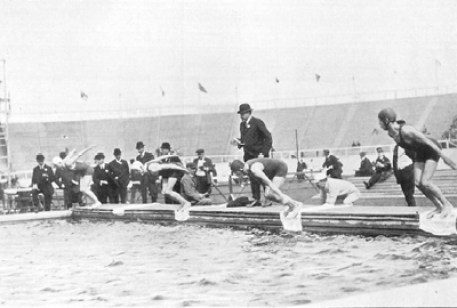
It is huge. Olympian in fact.

When it opened in time for the opening ceremonies of the 1908 London Games, The White City Stadium sat 68,000 people, although it could fit another nearly 30,000 standing spectators. It had an oval running track, about 7 meters wide. And between the running track and the stands was a cycling track that was another 11 meters wide.

Cycling at White Citsy Stadium_1908

The oval tracks were so wide that, in addition to space for athletic events like archery and hammer throwing, there was enough room for a swimming and diving pool!

Swimming at White City Stadium_1908

Unfortunately, the 1908 Olympics was the stadium’s high point. In 1927, it was sold to the Greyhound Racing Association, literally going to the dogs. The stadium no longer exists, torn down in 1985 to make way for the headquarters of the BBC.

White City Stadium circa 1950s
BBC Television Centre takes shape in the late 1950s with White City Stadium nearby
Stouder Fraser Ellis in Tokyo
Medallists in the 100 metres freestyle swimming event at the Tokyo Olympics, 15th October 1964. Left to right: silver medallist Sharon Stouder of the U.S.A., third time gold medallist Dawn Fraser of Australia and bronze medallist Kathleen Ellis, also of the U.S.A. Fraser is holding up her lucky kangaroo mascot. (Photo by Central Press/Hulton Archive/Getty Images)

No woman had ever won gold in three successive Olympics in the same event, but Dawn Fraser of Balmain, Australia was gunning for it.

Fraser’s breakthrough was at the Melbourne Olympics in 1956 as she beat her fellow Australians in the 100-meter freestyle, becoming an overnight sensation. Then in Rome, the American swimming team was a rising power, but Fraser stared them down to win the 100 meters. In Tokyo, the Americans were expected to win everything. And they came close. But Fraser, at the age of 27, beat 15-year old Sharon Stouder, and 17-year old Kathy Ellis to assure her status as one of the Olympiad’s greatest heroes.

But heroes often must pass painful trials to complete their journey. 1964 proved to be an emotional roller coaster for Fraser, beginning with a disaster for Fraser only 8 months before the Tokyo Olympics.

In February, Fraser was peaking, setting the world record in the 100 yards, and winning the 220 yard title at the National Championships in Sydney. One evening shortly after those championships, she and her family were enjoying an evening out. She had a car and offered to drive her sister home, accompanied with her mother and her friend, Wendy Walters. Here is how she describes the fatal crash in her autobiography, “Below the Surface“, that ended her mother’s life:

I was driving about 40 miles an hour. I’d been driving for 10 years, and I knew that this was about my limit with my mother on board; she was nervous about speed. We were sweeping around a curve on a highway called General Holmes Drive when I saw what looked like the cabin of a truck dead ahead. At the same moment, Wendy, who was next to me in the front seat, called out, ‘Look out, Dawn.’ I remember pulling the wheel hard to the right, and I think I must have hit the brakes hard. I learned a long time later that the driver of the truck we hit had parked his vehicle while he went fishing nearby in the Cook’s River. But my recollections of the crash are vague: a gigantic close-up of the cabin in our headlights, a high screech of tires on bitumen, and a terrible crash.

Walters had injuries to her face, while Fraser and her brother Ken recovered from injuries after arriving at the hospital unconscious. Fraser’s mother, however, was killed in the accident.

Over my last few days in the hospital, I was trying to sort my life out again, trying to adjust to the idea that my mother wasn’t there anymore. I couldn’t believe that it had all happened. And I kept blaming myself, because I had been driving the car. My mother was 68, and I was completely devoted to her; I don’t think I really knew how close we were until the accident, and then it was too late. My family kept trying to talk me out of my depression, telling me that it was foolish to accept the blame.

Fraser had pretty much given up on going to Tokyo. She was depressed, feeling guilty. She was at the wheel. She was responsible. On top of that, she had to wear an uncomfortable steel brace for nine weeks that kept her neck and back immobile, forcing her to turn her whole body just to talk to someone to her side. But recover she did, returning to the water

Aileen Riggin 1920_wikipedia
Aileen Riggin at the 1920 Antwerp Games

Belgium put in their bid for the 1920 Olympics in 1912. Little did they know that Archduke Ferdinand would be assassinated in 1914, sparking World War I. Germany overran Belgium, clearly overriding any planning for the Olympics. In fact, the Olympics in 1916 were cancelled.

But when the war ended in 1919, Antwerp was selected to hold the 1920 Summer Games.

Over 9 million soldiers died in World War I. Around 7 million civilians died as a result of the war. The invasion of Belgium by Germany is often called “The Rape of Belgium“, during which over 27,000 Belgians were killed by German soldiers, an additional 62,000 died of hunger or due to lack of shelter, and one and a half million Belgians fled the country.

Aileen Riggin was part of the first ever US women’s team in the Olympics, which competed at the 1920 Antwerp Games. She got to Belgian in the SS Princess Matoika, which was known as the Death Ship as it had transported war dead from Europe to the US. In the book, Tales of Gold, Riggin shared memories that showed the war was still very much in the minds of people living and competing in Antwerp. As Riggin was a 14-year-old girl at the time, I simply cannot imagine how she felt.

“When we were not training, we went on several trips around Antwerp in our truck, and one was to the battlefields. The mud was so deep that we could not walk, so we stopped along the line and bought some wooden shoes and learned how to walk in them. They were not too comfortable but they did protect our feet from the mud. I do not know how we happened to be allowed on the battlefields, because they had not yet been cleared.”

“In places they were still the way they were in 1918, when the Armistice was declared. We even picked up shells and such things and brought them home as souvenirs. There were trenches and pillboxes and things like that scattered about the fields, and we looked into some of them, and they were deep in water. There were some German helmets lying on the field, and we brought some home with us. I picked up a boot and dropped it very hurriedly when I saw that it still had remains of a human foot inside. It was a weird experience, and we were glad to leave. It must have taken them another year to clear off the battlefields from the way we saw them. They were in shambles.”

Aileen Riggin On the Victory Stand
Aileen Riggin on the victory stand, from the book “Tales of Gold”
How a war devastated country could take on an international event while still in a “shambles” is hard to imagine. But the Belgian authorities did what they could, improvising in some ways. For example, the diving competition was held in a large ditch at the base of an embankment, created as a form of protection if a war were to come to Belgium. Riggin, who competed as a diver, describes the venue.

“On our second day in Antwerp an army truck came to drive us to the stadium where we were to swim. Words fail me in describing our first view of this place. I had never seen anything like it. it was just a ditch. I believe they had had rowing races there at one time. There were  boardwalks around the pool – I have to call it a pool – to mark the ends. In the center

2004 Athens Olympics

Reports are that only 50% of tickets to the Summer Games in Rio de Janeiro, starting on August 5, have been sold. For the Paralympics in September, only 12% have been sold.

The Brazilian economy is shrinking during its worst recession in 25 years. The President of Brazil is under threat of impeachment for a decision to include an ex-President in her cabinet, someone under investigation for receiving bribes in the Petrobras corruption scandal. The Zika virus continues to spread in Brazil, a disease where there is now “strong scientific consensus” that it is a cause of microcephaly in newborns.

Those perhaps are the biggest factors that will result in many empty seats of a possible 7.5 million that are available for the Rio Olympics.

What’s interesting is that empty seats at Olympic Games is a recurring headache and embarrassment for Olympic organizing committees.

At the 2004 Games in Athens, “only about two-thirds of the 5.3 million tickets were sold“. At the 2008 Games in Beijing, organizers claimed that all 6.8 million tickets were sold, and yet empty seats blotted arenas throughout the Games. And at the 2012 Games in London, where pledge after pledge was made by organizers to fill the seats, and that “more than 20 million applications were made for the 6.6 million available seats”, the London organizing committee could not prevent the empty-seat phenomenon.

Empty Seats at Gymnastics Competition at London Games
2012 London Games

Athens and Rio share a common issue in that their economies may not be vibrant enough to drive local ticket sales. But Beijing and London do. Other factors are at play, resulting in tickets going unused. This article from The Guardian regarding empty seats at the London Games indicates that a few groups who are granted reserved seating, often the best seats in the house, just don’t show up:

  • Accredited members of the Olympic family, which include international sports federations, IOC officials and corporate sponsors,
  • Guests of corporate sponsors who receive tickets more for their affiliation with the sponsor and less regarding their interest in the Games
  • Members of the press, who may be less interested in heats and preliminary rounds
  • Athletes, particularly in the first week of the Games as all athletes are preparing or competing

Beijing pointed to another group – agencies that buy and re-sell tickets to people overseas or to people locally anticipating a spike in demand during the Games. Westerners in

Greg Louganis and his Wheaties box

She’s not an athlete. She’s an IT consultant from Chicago. And she had just seen the documentary, “Back on Board: Greg Louganis“, the HBO documentary about the diving legend. When she sees the scene of Louganis walking though the Swimming Hall of Fame, passing by a series of Wheaties cereal boxes on display, he says “never got a Wheaties box – “In that moment,” Sondgerath writes, “I was inspired to start a campaign asking General Mills to ‘Put Greg Louganis on the Wheaties Box’.

Julie Sondgerath went to Change.org and submitted a petition that over 40,000 people signed on to, including me. Six months later, on April 5, Sondgerath got word: “I’m proud to announce that the campaign was a success!,” wrote Sondgerath on change.org. “Today, Wheaties will have a press release to unveil a WheatiesLegends Campaign to begin with a legacy photo of Greg Louganis on the Wheaties box! Congratulations to Greg, as well as Janet Evans and Edwin Moses! I can share with you that he is beside himself with excitement!”

Put Greg Louganis on a Wheaties Box

No other man has won gold in both the 3-meter springboard and 10-meter platform in two consecutive Olympics, doing so in Los Angeles in 1984 and Seoul in 1988. Louganis had often wondered that the reason he didn’t get on the Wheaties box, or perhaps other financially lucrative sponsorship deals, was the rumors at the time that he was gay. In fact, Louganis is now openly gay, having come out in 1994.

General Mills has downplayed the reasons for now placing Louganis on the box. They said that there are many athletes who deserve to be recognized, which is why they also chose to create boxes for Olympic legends Janet Evans and Edwin Moses. The New York Times quotes Mike Siemienas, manager of brand media at General Mills, saying that the choices