Rampling was definitely in the running – although nominated for the first time in her career, she has had a long and successful run as a model and actress.
Unfortunately, right after the Oscar nominations were announced, Rampling dropped the baton. In 2016, for the second year in a row, there were no nominees of color in the major acting categories. This prompted calls for a boycott of the Academy Awards. That in turn prompted Rampling to speak out on her own in a French talk show, saying that talk of boycotting the Academy Awards because no Blacks were nominated is “racist to whites.” She continued by saying, “One can never really know, but perhaps the black actors did not deserve to make the final list.”
Coincidentally (or perhaps ironically), Rampling’s father, Godfrey Rampling, competed in the Berlin Olympics in 1936 as a 400-meter sprinter. While finishing fourth in the individual men’s 400-meter competition, he and his team from Great Britain won the 4X400 relay finals, in good part due to Godfrey Rampling’s stunning burst to take the lead from Canada in the second leg, enabling Team GB to win gold.
Olympics – Britain’s Oldest Olympian Godfrey Rampling celebrates his 100th Birthday – Bushey House…A collect picture showing Godfrey Rampling (second left) competing in the 1936 Berlin Games. PRESS ASSOCIATION Photo. Picture date: Saturday May 15, 2009. Britain’s Oldest Olympian Godfrey Rampling celebrates his 100th birthday today with a party at Bushey House, Bushey. Photo credit should read: Anthony Devlin/PA Wire.These were of course the Olympics that pitted the position of Arayan superiority against all who were not of Arayan stock, a backdrop that reflected the spotlight on black American sprinter, Jesse Owens. And while I have no idea what thoughts Godfrey Rampling had on race, the thoughts of his daughter, Charlotte, dully echo those from Berlin…in my opinion.
Fortunately, (black) comedian Chris Rock was the host of the 2016 Academy Awards, and if anyone could respond to the Charlotte Ramplings of the world, it was Chris Rock. Here is a transcript of his opening monologue at the Oscars, which walks a fine line, attacks the extremes of the argument, and makes us laugh and think.
The cover of Men’s Club (July 1964), the men’s fashion magazine of choice in the 1960s in Japan
They dressed like the nonchalant well-groomed elite of Ivy League students. But they were seen as delinquents.
Such was the state of men’s fashion in 1964, when the international community descended on Tokyo for the Olympic Games.
The photos in this post of men in the fashion of the times is from a magazine called Men’s Club, published in July, 1964. They were members of the Miyuki-zoku, a group of fashion-conscience young men who would see and sometimes buy the latest jackets and slacks at relevant stores on the Ginza, particularly on Miyuki Street.
The Ivy Look, Men’s Club_July 1964
Tokyo in the mid-1960s was undergoing rapid change, and magazines like Men’s Club were filling a void in the life of young men. Men in their 40s and older, in other words, the parents of the Miyuki-zoku, came of age in the war years, and lived through post-war poverty and significant socio-political change. Their tastes in fashion were uniform and conservative. They looked down on women who wore colorful and stylish dresses and accessories, as the early adopters in Japan were the pan pan girls who tended to seek out American military companionship. And they looked down on men who took on American airs, wore their hair slicked back and listened to rock and roll.
Bermuda shorts were all the rage in 1964_Men’s Club_July 1964
As described in this fantastic article by W. David Marx called The Climb of Ivy: The styles of the American Ivy League transform the fashions of 1960s Japan, “The basic male wardrobe went to extremes of conformity: a single charcoal-gray or navy-blue suit, dark tie, white shirt, and dark shoes. White shirts outsold colored ones more than twenty to one. A striped shirt was enough to get a worker in trouble. And ready-to-wear clothing was not an option. Men dismissed non-tailored garments as tsurushi or tsurushinbo, meaning ‘something hung up,’ with the sting of a racial slur.”
Into the void stepped Kensuke Ishizu, who was the leading voice on Japan’s first men’s fashion magazine, “Otoko no Fukushoku”, and creator of the fashion brand, Van. He took a trip to the United States to see American fashion firsthand, and more specifically, how the these people called “Ivy Leaguers” dressed. He visited Princeton University and took loads of pictures of men around campus. Wrote Marx,
Kensuke Ishizu
These elite, athletic students demonstrated how dapper a young man could look in ready-to-wear clothing. The clothes looked neat and fit closely to the body. Ishizu especially liked that the style relied on natural materials such as cotton and wool, which could be worn for a long time and easily cleaned. Japanese students in the late 1950s had little pocket money, but Ivy clothing would be a good investment—durable, functional, and based on static, traditional styles.
As explained in Marx’s article, Ishizu was inspired by a whole line of Ivy fashion that young men could buy off the rack. He started by copying the design of a Brooks Brothers suit as the first in a long line of fashion statements in his Van line of clothes. Eventually, groups of young men would gather and discuss the proper or authentic way to dress Ivy style. One particular group called themselves the Traditional Ivy Leaguers Club, who read Otoko no Fukushoku religiously, and obsessed over the rules of proper dress as well as minute details of stitching or material that set the Ivy look apart from all others. They were so influential, Ishizu featured this club in a story in his magazine, newly rebranded as “Men’s Club”.
From Men’s Club_July 1964
The key to the magazine and the industry’s success was the articulation of the “do’s” and “don’ts” of Ivy fashion. Young men wanted to be different, but in order to be cool, they felt they needed to do it exactly right. Ishizu and members of the Traditional Ivy Leaguers Club, particularly co-founder Toshiyuki Kurosu, became the arbiters of Ivy fashion. Again, Marx explains:
In the pages of Men’s Club, Kurosu became the unofficial headmaster of the Ivy school. He ran an Ivy Q&A column in the back of the magazine. He told readers, for example, not to wear ties with their sports shirts and to avoid tie tacks and cufflinks with blazers, while also advocating for the mentality of Ivy: an easy East Coast nonchalance. Kurosu warned a reader threatening to wear a button-down collar with the buttons undone, “It has to feel natural. It’s the absolute worst if other people think you’ve left them intentionally unbuttoned.” Kurosu, a twenty-something who had never lived in the United States, was playing referee with confidence that came from years of research—but also a good measure of bluffing.
Perhaps one of the most influential books in the history of men’s fashion in Japan is called
The Rehabilitation Lunch for the 1956 Dutch Olympic Team, organized by the Dutch Olympic Committee at the Kurhaus Hotel in Scheveningen, Holland.
“Melbourne is THE black page in the Olympic History of the Netherlands,” wrote Ada Kok in an email to me. Kok was not only a two-time Olympian in 1964 and 1968, she was the President of the Dutch Olympians Association for 11 years.
And when she was president, you could join the association only if you were an Olympian. Thus, the unfortunate members of the 1956 Dutch National Team were forbidden from competing once the Dutch government decided to boycott the Melbourne Games. As related in a previous post, some of the Dutch national team, including world-record swimmer, Cocky Gastelaars, were already in Melbourne preparing when the decision was made.
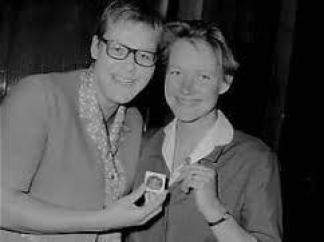
Ada Kok and Cocky Gastelaars
“Some athletes were already present in Melbourne to train and they were whistled back home by the Dutch Olympic Committee and the Dutch Government,” wrote Kok. “For Cocky this was a traumatic decision as this was her chance to win a gold medal being a world-record holder. But not only was Cocky disappointed. Then, we had a lot of potential gold medal winners who were part of this Dutch Olympic Melbourne Team in 1956. The sad thing was they all just received a telegram to announce the Olympic Team was not travelling to Melbourne, and for those who were already in Melbourne, they were ordered to leave the Olympic Village, not to wear their Olympic outfits anymore and travel home immediately.”
Kok provided me with a copy of that telegram dated November 7, 1956, seen below.
DUTCH OLYMPIC TEAM HEIDELBERG-VICTORIA-ASUSTRLIA
AT EXTRAORDINARY MEETING THE DUTCH OLYMPIC PARTICIPATION TO WITHDRAW DUE TO HUNGARY STOP LEAVE OLYMPIC VILLAGE – FIND OTHER PLACE TO STAY STOP WEAR CIVILIAN CLOTHES – IF IMPOSSIBLE REMOVE BADGE STOP WAIT FOR PAULEN LEAVING 11 NOVEMBER FLIGHT 845 FOR FURTHER INSTRUCTIONS STOP CANCEL ALL HOTEL RESERVATIONS BUT RESERVE HOTEL WINDSOR PAULEN AND CHARLES LEAVING 15 NOVEMBER SORRY ALL THE BEST
NOC (National Olympic Committee )
To a world-class athlete preparing years for this moment, the telegram above must have been a dagger in their backs. “No further explanation,” wrote Kok. “This was so sad! And this caused over the years a lot of bad feelings among the Dutch Olympians from 1956.”
It took a while, but in 2014, a step was taken to recognize these athletes whose lives were so abruptly and rudely changed that day in November 1956. Erica Terpstra, who was the President of the Dutch Olympic Committee, worked with Ada Kok to arrange a day of
You are one of the fastest swimmers in the world, having broken the world record twice prior to the Olympic Games. You’re going to be confident and excited for the fight.
So much can happen to an athlete before the competition begins: bad news from home, illness, an injury. But rarely do you arrive at the venue of the Olympic Games, prep for the competitions, only to be told to go home. It happened to the Indonesians and North Koreans at the 1964 Tokyo Games, and surprisingly to me, the Dutch in the 1956 Melbourne Games.
When the Soviet Union invaded Hungary in late October, 1956, in order to help suppress an anti-government uprising, there was an international outcry. As a result, the Netherlands, Spain and Switzerland decided to boycott the Summer Games in Melbourne held only a few weeks later. This came as a shock. In one case, a world-record holder and nearly sure-medalist swimmer from Rotterdam, Cornelia Maria (Cocky) Gastelaars, was asked to retreat at a time of possible victory.
My first disappointment after moving into the Olympic Village came when the Dutch government ordered the Netherlands team to withdraw from competition. The international situation was tense then, first with Suez and then with the Hungarian revolution, and the Dutch felt that it was no time for running, jumping, swimming and other frivolous pastimes. This meant that Lorraine and I would be deprived of our main opposition from overseas – Cockie Gasterlaars. You may think that we should have welcomed the news that a big danger was out of the reckoning: all I know is that we were bitterly disappointed, the more so because Cockie was actually in Melbourne and living at the Village when the news of Holland’s withdrawal arrived.
Cockie spoke excellent English, and we talked often during the first weeks in the Village. She had held the world 100-meter record twice during the year, and she wept once when she told me how much she wanted to compete. Another time she checked through the list of entries with me and told me that an American girl, Shelley Mann, and a Canadian girl called Grant had been swimming good times; but I think we both knew that the real struggle would have been between Cockie, Lorraine and me.
Fraser went on to win the 100-meter freestyle championship in Melbourne in world record time. But she is not sure that would have been the result had the Dutch team not boycotted the Games.
The day the Dutch team moved out, I saw Cockie Gastelaars. “You were wonderful,” she said. And I told her it might have been a different result if she’d been swimming. She was a sweet, shy girl and very brave; it must have been awful to have been deprived of the chance to compete just when she was at the peak of her career. We swapped badges, pins and finally addresses. We said we’d write, and we told each other that we’d be bound to meet in the water sometime, somewhere.
POSTSCRIPT: October 29, 2016. I had the honor of interviewing Cocky Gastelaars on October 10. I learned that, in fact, she never was in Australia when the Dutch government announced the boycott. She was still at home. And of course, she was very disappointed. But she did not meet Dawn Fraser until a year after the Melbourne Olympics when she took a trip to Australia.
Picture of Charles Barkley and Magic Johnson with the American flag draped over their shoulders to cover the Reebok logos on their jacket. Barkley and Johnson had agreements with other footwear brands. John Stockton and Chris Mullin, 1992 Dream Team teammates, look on.
Fact #2: A shoe deal for an NBA lottery pick (a person who is in the top 5 or 10 of the NBA draft of high school, college or available international players) could mean earning from USD200 to 700K per year. The article points out that Andrew Wiggins, who signed a 3-year contract with the Cleveland Cavaliers for over USD17million, also signed a 5-year agreement with adidas for another USD11 million.)
Fact #3: Every player in the NBA has a relationship with a sneaker brand; even the benchwarmers, players looking just to make a training camp roster, can get what is called a “merch” deal. Such an agreement with a footwear marketer gets them a free allotment of footwear for practices and games.
Fact #4: Sneaker brands scout out basketball prospects at the college and high school levels, just like basketball scouts do
Fact #5: Nike has dominant share of the NBA player market, as 68% of the 300+ players wear the Swoosh. Adidas is number 2 at 15.6% with about 70 players wearing the three stripes.
For past stories in “The Sneaker Wars” series, see below:
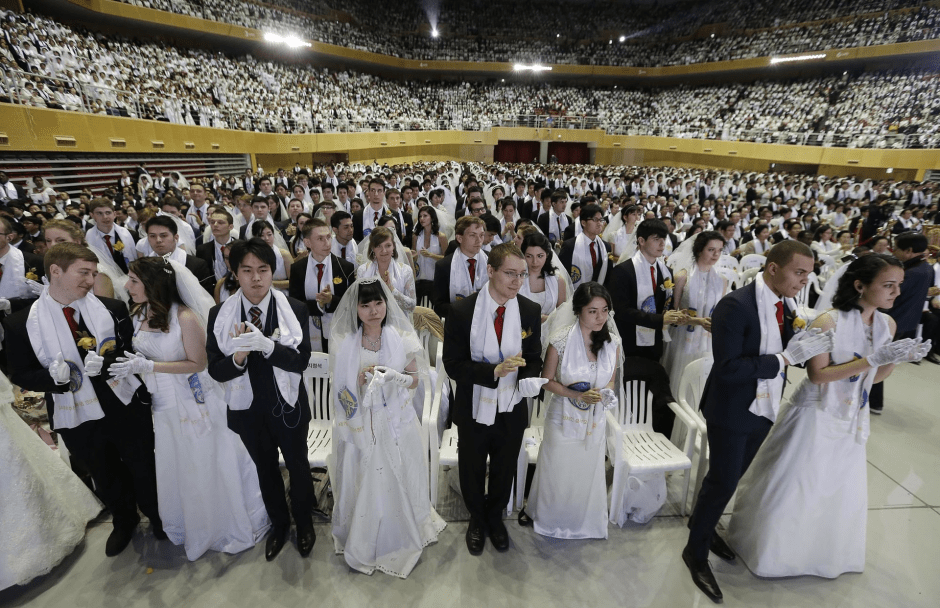
On Saturday, February 20, approximately 15,000 couples, or 30,000 people were married at a single event called The Holy Marriage Blessing Ceremony, in GapYeong, South Korea. Popularized by Unification Church founder, Reverend Sun Myung Moon, 3,000 of those couples were married in Korea, while the other 12,000 participated via the internet.
One third of the 3,000 couples who were married in the Church’s CheongShim Peace World Center were renewing their vows. But about 800 of the couples agreed to be matched by the Church, a custom that Reverend Moon had heavily endorsed in the past. In fact, these unions have often brought strangers of different nationality or race together.
Rev. Moon, who passed away in 2012, had presided over some of the biggest mass weddings ever, including 30,000 couple in Washington DC in 1997, and 40,000 couples simultaneously in Korea, US, Brazil and Venezuela in 2009.
The Unification Church and its mass marriages are not without their controversy. To name one, since this is a blog about the Olympics, is the case of Hiroko Yamasaki (山崎浩子), who was a member of the Japanese rhythmic gymnasitics team at the 1984 Los Angeles Summer Games. Along with a well-known singer and actress, Junko Sakurada, Yamasaki was married at a mass wedding presided over by Rev. Moon, along with 20,000 people from 130 countries, in August of 1992.
According to this account from the newspaper, The Australian, Yamasaki disappeared. No one knew where she had gone, not even her new husband, Hideyuki Teshigawara. Months later, Teshigawara filed a missing person’s report to the police, which led to a nation-wide search for the Olympian.
And then suddenly, one day, Yamasaki appeared, on television, saying “Everything was a mistake.” She went on to say, “I was placed in a world of delusion where people’s minds were being controlled. So I still cannot figure out to what extent the affection I felt towards Teshigawara was real.”
Over two decades later, Yamasaki is now the national coach of the Japanese women’s rhythmic gymnastics team.
Hiroko Yamasaki (JPN), SEPTEMBER 26, 2014 – Rhythmic Gymnastics : Japan’s ?Reinforcement Coach Hiroko Yamasaki during the FIG Rhythmic Gymnastics World Championships 2014 in Izmir, Turkey. (Photo by Takahisa Hirano/AFLO)
One of the seven FIFA officials arrested walks from the Baur du Lac hotel following a dawn police raid_New York Times
FIFA, the world organizing body for football, and famously the organizer of the World Cup, is based in Zurich, Switzerland. But when authorities quietly escorted 7 FIFA executives out of a posh hotel in Zurich where a FIFA executive meeting was being held in May, 2015, it was due to the work of the FBI in the United States. I thought, “Wow”, that’s influence. Why is the US driving this and not another country, perhaps one more steeped in football lore where the loss of purity in sport would rankle more deeply.
I’m still not clear on this, but according to this thorough and fascinating piece from ESPN, the roots of the investigation that led to arrests at FIFA began in an FBI Bureau in Brooklyn, New York. When FIFA announced in December, 2010 that not only did Russia win the right to host the 2018 World Cup, but that Qatar won that honor as well for 2022, suspicions ran particularly high that something fishy was up.
As the article explains, “even the laziest ExCo members lived like kings. They each received $200,000 annual stipends, along with liberal per diems every time they went to Zurich. And they controlled the votes that decided where the most watched event in sports, the World Cup, would be played. This selection process seemed engineered for bribery, the FBI agents thought.”
Chuck Blazer and Sepp Blatter in better days.
The FBI first focused their attention on a member of the FIFA ExCo who happened to be based in New York, Chuck Blazer. He’s a large man, whom Russian President Vladimir Putin joked looked like Karl Marx, and was so caught up in cloak-and-dagger, stab-you-in-the-back FIFA politics, and so sick from the ravages of diabetes and cancer, that he turned. Blazer became the FBI’s inside man, recording conversations with other FIFA leaders for over a year, providing a “wealth of information” on the inner workings of a scandalous organization.
Another primer for the FIFA scandal is this piece from 60 Minutes, which features the lead FBI investigator John Burretta, as well as the long-standing thorn in the side of FIFA and the IOC, BBC journalist Andrew Jennings. Jennings’ talk on corruption in FIFA had fallen on deaf ears for years before he finally found redemption in these arrests.
Of all the things I learned, here’s the bit that got me. Not only did Blazer live in the luxurious Trump Tower (rent $18,000 a month), he had a smaller apartment next door, “reportedly for his cats”.
One of the greatest weightlifters the world has ever seen started his career in an internment camp during World War II.
Tommy Kono, the only Olympic weightlifter to have set world records in four different weight classes, won gold in the 1952 Olympics in Helsinki, gold in the 1956 Melbourne Games, as well as silver in Rome in 1960.
But at the age of 12, Kono and his family were removed from their home in Japanese Alley in Sacramento, California, and relocated to Tule Lake Segregation Center, which is at the northern-most part of California, near the Oregon border.
Kono and his family were assigned to Tule Lake because of geographically proximity to Sacramento. But of the ten concentration camps designated to hold over 110,000 Japanese or American of Japanese ancestry upon enactment of President Roosevelt’s Executive Order 9066, Tule Lake was the maximum-security camp that came to house those considered most disloyal or disruptive. (The order was issued exactly 74 years ago on February 20, 1942.)
Little Tommy Kono, skinny, terribly shy, and sickly due to asthma, had to grow up in a camp that housed the most disruptive inmates in a facility that was overpopulated, unsanitary and squalid.
Strangely enough, it may have been the best thing to happen to him personally.
Tommy Kono Photo by Y Ishii Jan 19 1957
Tule Lake is high above sea level, and as Kono told me, “it was a dried up lake, where no bushes or trees would grow.”For the first time, Kono could breathe free and easy, and enjoyed good health for the first time in a long time.
At the age of 11, Kono was 4 ft 8 and a half inches tall and weighed 74 and a half pounds. In other words, he was scrawny. But his friends in the camp were weight training enthusiasts, and as this article explains, they “gave him a fifteen-pound barbell and the advice, ‘It’s good for you, keep lifting it up, lots of times.'”
Weight training was an activity he could do to improve his health, see measurable results, and feel good about himself. Kono told me this was the positive side, the meritocratic side of camp life for him. “There was nothing there (to distract me). No stuff hindering me. You have to understand when you’re in Tule camp you are like everybody else. I got to be in pretty good shape.”
After World War II ended, Kono and his family were not compelled to go to Japan. Kono went back to high school in Sacramento, continued his weight training at a local YMCA until he was drafted into the US Army. So despite the fact that his loyalty was questioned only 8 years earlier, he was considered loyal enough to join the US military in 1950. That was when the Korean War was raging. Kono was targeted to be a cook in South Korea in support of the troops. He had heard that North Korean snipers were targeting cooks in particular – the logic being that if the cook went down, so too would morale.
Fortunately, Kono was breaking California weightlifting records and winning tournaments. When the US Army found out Kono was a really good weightlifter, they decided to move him to safer grounds where he could train for a possible spot on the US team in Helsinki.
Kono had come a long way. He told me that he had difficulty explaining what it was like to lift 300 pounds to a layman in the street. To show how strong he was, he instead would take a hot water bottle (those thick red rubbery things that kept you warm when you were sick as a child) and blow them up. “I blew up hot water bottles with my mouth. First they’re red, then it becomes pink, then white, until it finally bursts!”
This from a boy who had trouble breathing in asthmatic fits.
Kono admits to having an inferiority complex as a teenager, being so small and sickly. And not only did weightlifting improve his health and strength, it introduced him to the world of body building. Kono not only was an Olympic champion, but he was also a body builder champion, who won three Mr Universe titles in 1955, 1957 and 1961. A young Arnold Schwarzenegger considered Kono a role model.
“In Europe, everybody lifts weights.” Kono told me. “It’s a common thing. Arnold was a weightlifter living on the outskirts of Vienna. He saw me in 1961. He was 13 years old. He decided that ‘if that little guy can win Mr. Universe, I could do that too.’ He started training hard, he won Junior Mister World, and eventually he won the big one.”
Three high school friends from Yokohama are on a mission as they take the train to downtown Tokyo. In Goro Miyazaki‘s film, From Up on Poppy Hill (コクリコ坂から), it’s 1963, the Olympics are a year away, and Tokyo is crowded with people, congested with cars, and filled with the sounds of jackhammers and creaking of cranes.
Change is coming to Tokyo, for good and for bad. A subplot focuses on the high school students who are protesting the decision to demolish an old mansion that houses the various clubs that make the school’s social tapestry: the philosopher’s club, a newspaper, a group that forecasts the contents of future exams. A small group of students eventually change the views of the majority who had previously believed that “out with the old and in with the new” applied to all places and things. This sweeping change in views saves the club house.
Certainly, that was a powerful societal theme in Tokyo in the 1960s – How do we change and modernize so that the international community looks upon Japan with respect and admiration, while still maintaining who we are as Japanese?
“For a successful Olympics, make Tokyo beautiful.”
The main plot is a love story between Umi, a girl who lost her father in the Korean War, and Kazuma, a boy who’s real father is a mystery, but was at first suspected to be the same as Umi’s. The mystery unravels as Umi and Kazuma ask questions about their past, learning of the pain and angst of their parents’ generation who lived and died in the turmoil and confusion of the Pacific and Korean wars.
And yet, because this is a story of young love, the tone is upbeat and sweet. The son of acclaimed anime director and screen writer of this film, Hayao Miyazaki, applies a rosy sentimental touch to the times. The film opens with a springy, jazzy tune called “The Breakfast Song”, that speaks of the optimism that comes with the day’s first meal.
The scene when Umi and Kazuma’s love first blooms enters with the bouncy hit song of that time, Kyu Sakamoto’s “Ue o Muite, Arukou” (aka: The Sukyaki Song). You can see that in this clip below (with English subtitles).
The home field of my New York Mets, CitiField, displays over 20 sponsors in this particular view. You wouldn’t see any ads in an Olympics venue.
For the International Olympic Committee, the “Clean Venue” policy has been inviolate. No advertisements or hint of commerce is allowed to be seen on or within the Olympic stadium. Not even the top global sponsors are allowed to show their logos in the stadium despite paying millions to market using the Olympic brand. They do so, somewhat ironically, because the Olympic brand, with the clean venue as a symbol, represents ideals beyond consumerism.
As Steve Jones of head of Coca Cola’s Marketing in the 1990s put it, “A clean field of play is an Olympic equity. One of your core assets. The field of play is an important branding space that you own. Own every inch of it! Sharing your branding space dilutes the Olympic brand. Don’t compromise your greatest opportunity to build brand power. There is no valid loss of revenue argument when the risk is loss of brand equity.”
Thus, the IOC aggressively protects the Olympic brand, and can at times seem obsessive. Michael Payne, author of the great sports marketing book, Olympic Turnaround, wrote about how McDonalds, a TOP Olympic sponsor, perhaps somewhat intentionally, snuck their logo into the eyesight of thousands, if not millions, during the Opening Ceremonies of the 1996 Atlanta Summer Games. Payne, who was a member of the IOC’s marketing team, got a phone call just as the ceremonies were under way.
“Have you seen the broadcast image of the athletes coming over the ramp?” screamed the brand protection manager. “What are we supposed to do about the McDonald’s sign?”
I ran around the stadium to see the problem myself. There, as the athletes marched over the ramp, in the distance was a large elevated McDonald’s neon sign. It provided a perfect backdrop for each nation as they came into the stadium. The sign might have been in the distance, located by the temporary McDonald’s restaurant at the Olympic Park, but on television it looked like it was attached to the main stadium. The sign had to be switched off – and fast.
The McDonald’s restaurant was near the Olympic sponsor hospitality village. I called the IOC manager at the village, and told her to get over to the McDonald’s restaurant and find someone to turn off the lights. She got to the restaurant, by the time the athlete parade had reached the letter c, and Cambodia was stumbling down the ramp. She found it closed and locked up. Understandably, all members of staff were in the stadium watching the ceremonies.
“Then break in,” I yelled to the IOC manager – by now we were up to Denmark in the athletes’ parade, and there was no way for the television cameras to avoid the neon advertising sign. “They will arrest me”, she pleaded.
“They will arrest all of us if we do not get that sign switched off now.” so an IOC manager proceeded to break into a partner’s restaurant to get their sign switched off.”
There was a break in, the logo went dark, and the IOC apologized to McDonald’s for the break in, although it’s unclear how the lights of the logo were left on.
Now, I’m sure this happened. But I have looked closely at the video of the 1996 opening ceremonies in Atlanta, and I just don’t see the McDonald’s sign. Admittedly, this youtube is not a high resolution video.
Fortunately, i was saved by a reader who provided me with a photo of the shining Mickey D logo. Thank you tylerkochman!






 As Steve Jones of head of Coca Cola’s Marketing in the 1990s put it, “A clean field of play is an Olympic equity. One of your core assets. The field of play is an important branding space that you own. Own every inch of it! Sharing your branding space dilutes the Olympic brand. Don’t compromise your greatest opportunity to build brand power. There is no valid loss of revenue argument when the risk is loss of brand equity.”
You must be logged in to post a comment.