Fans remained inside the Stade de France after the soccer game between France and Germany amid confusion caused by the attacks in the area. Credit Christophe Ena/Associated Press

A suicide bomber, who had a ticket to the football match between France and Germany at the Stade de France on the evening of Friday the 13th, was denied entry to the stadium after a frisk search. Moments later, he detonated his bomb, one of three to go off outside the stadium in Paris where the Prime Minister of France sat as a spectator. On a most unfortunate day, that perhaps was a bit of fortune.

Inside the stadium, according to this New York Times report, the game went on.

The coaches for both national teams decided not to inform their respective teams about the horrifying occurrences taking place nearby, probably because the events were just unfolding and they were unclear regarding the extent of the violence in Paris. When added to poor cell reception due to the concentration of people at the football game, and possibly also the increased data traffic as a result of the terrorist attacks, people on the pitch and the stands remained in enough of a fog to allow their focus to stay on the game.

The beginning of the New York Times video demonstrates the confusion at the stadium.

NY Times Video on Paris Attack

France won the game on a late goal. By that time, the reality of the terrorist attacks had become clearer and the players were informed. But as the NY Times reported, the atmosphere during the game was surreal. “It was so weird,” said Cyril Olivès-Berthet, who was covering the match for the French sports newspaper L’Équipe. “The players were running and doing their game, and the fans were chanting their normal chants, ‘Aux Armes, Aux Armes,’ a typical chant that is a warrior thing about taking arms and going to war. When France scored the second goal late in the game, they all waved their flags and the players celebrated like they always do.”

It can be debated endlessly whether the coaches made the right choices to inform the players, or whether officials made the right choice to allow the game to continue. That is not important. Showing strength in the face of adversity, effectiveness in uncovering the culprits, and wisdom in decisions related to retaliation or reaction – that is important.

My thoughts go out to all impacted by the terrorist attacks in Paris.

Four gold medal winners China’s Fan Yilin, from left, Madison Kocian of the U.S., Russia’s Viktoriia Komova and Russia’s Daria Spiridonova pose after their uneven bars exercise at the women's apparatus final competition at the World Artistic Gymnastics championships at the SSE Hydro Arena in Glasgow, Scotland, Saturday, Oct. 31, 2015. (AP Photo/Matthias Schrader)
Four gold medal winners China’s Fan Yilin, from left, Madison Kocian of the U.S., Russia’s Viktoriia Komova and Russia’s Daria Spiridonova pose after their uneven bars exercise at the women’s apparatus final competition at the World Artistic Gymnastics championships at the SSE Hydro Arena in Glasgow, Scotland, Saturday, Oct. 31, 2015. (AP Photo/Matthias Schrader)

15.366 – you would think that a score to the thousandth would be hard to tie, but it can happen. At the World Gymnastics Championship in Glasgow, Scotland, as many as six judges managed to put up scores that placed FOUR gymnasts at exactly 15.366 in the uneven bars final.

And so, Russians, Viktoria Komova and Daria Spiridonova, China’s Fan Yilin, and American Madison Kocian all received gold medals and then listened to three national anthems in succession.

The International Olympic Committee does not like ties in gymnastics, so has a tie breaker based on so called “start values” and “execution marks”, but to many, including FIG (the International Gymnastics Federation), ties are the right call. And yet, four? American Gabby Douglas finished fifth, and this is what she had to say according to AP: “I’ve never seen that before,” said reigning Olympic champion Gabby Douglas, who finished fifth. “I was just like really judges? Come on now!”

Tatyana McFadden shattered the women’s wheelchair course record.

Source: Kenyans sweep New York City Marathon for third straight year

A GE advertisement in Life Mgazine, October 9, 1964

During the American occupation of Japan, American soldiers and their families lived in Washington Heights, a fabricated neighborhood of American houses, with American lawns and American kitchens in Tokyo. Japanese who got a glimpse inside these homes were astonished by the size of the rooms, the roar of the cars and the gleam of the white goods in the kitchen.

My mother, who was born and raised in Tochigi, Japan, met my father in 1957, got married in 1958 in Tokyo, and then took a ship back to the United States. They settled in Kentucky, where my father worked as a reporter for the Louisville Times, and my mother began life as an American housewife.

I think my father was kinda being cheeky when he took this picture, but hey, their new kitchen was probably the size of the apartment he rented out in Tokyo.

Louisville #3

CARTOON: Indonesia Withdraws from Tokyo Olympics, Warta Bhakti- 10 October 1964, p1

The day before the opening ceremony of the Tokyo Olympic Games, North Korea and Indonesia decided to boycott the Games. This decision was expected by many as the previous months had seen conflict between Indonesia and major international sports governing bodies.

Indonesia had hosted a regional sporting event called the Asian Games in 1962, refusing entry of athletes from Israel and Taiwan. As a result, The IOC (symbolized by IOC president Avery Brundage in the cartoons) suspended Indonesia, the first time they had ever done so. In reaction to that, Indonesia organized the GANEFO Games, “The Games of the New Emerging Forces”, which explicitly stated that politics and sports were intertwined.

CARTOON: Just wait until it collapses, Warta Bhakti- 26 September 1964

As the time got closer and closer to October 1964, Indonesia was getting impatient to receive formal indication from the Tokyo Olympic Organizing Committee (TOOC) that they would be allowed to participate in the Tokyo Olympics. Indonesia actually was invited to the Olympic Games, but were told by the IOC and TOOC as well as the international governing boards of swimming (FINA) and athletics (IAAF), that athletes who participated in the GANEFO Games could not participate in the Olympics.

CARTOON: We are Not Begging Tokyo, Warta Bhakti - 5 July 1964
CARTOON: We are Not Begging Tokyo, Warta Bhakti – 5 July 1964

On October 9, both North Korea and Indonesia decided to pull their entire teams out of Japan.

While it must have been an incredible disappointment to Indonesian athletes in Tokyo then told to return home on the eve of the Olympics, the press in Jakarta made it clear that the boycott was the right decision. The anti-IOC, anti-Western, anti-colonial backlash was

Kohei Uchimura performs on the pommel horse during the men's all-around final competition at the world championships in Glasgow, Scotland, on Friday. Uchimura won his sixth straight title in the event. | AP
Kohei Uchimura performs on the pommel horse during the men’s all-around final competition at the world championships in Glasgow, Scotland, on Friday. Uchimura won his sixth straight title in the event. | AP

This isn’t about history for Kohei Uchimura. This is about national pride, the perpetual chase of perfection and respect for his own considerable gifts.

Whether the Japanese star is the greatest male gymnast ever remains up for debate, though perhaps not for much longer. The sixth world title he won Friday night came with as much ease as any of the five that came before it.

There was never a doubt. Not from the near flawless opening floor exercise at the start of the night to the slightly watered down high bar routine that ended with Uchimura nailing the landing as if his feet were suctioned to the mat.

When his final score of 92.332 points was posted — more than 1.6 better than Cuban teenager Manrique Lardue and China’s Deng Shudi — the relentlessly self-controlled 26-year-old held up six fingers and flexed. It’s as close as he’ll ever get to a humble brag.

Source: ‘King Kohei’ soars to sixth straight world title | The Japan Times

France24 Report on Rio

This is a fascinating report from France24 on the state of Rio de Janeiro one year prior to the start of the Olympic Games. More than anything else, security is the biggest concern for the government and for residents. Brazil is considered one of the most unequal societies in the world, and the gap between the haves and the have nots so great that drug gangs, crime and violence have been a constant background to life in Rio.

While the government has beefed up its police force with the addition of 37 additional special protection units, violence between gangs, and between gangs and police continue. Four thousand have already died from such violence in 2015, many happens when the torch is extinguished, the banners taken down, and the excitement gives way to thoughts of making ends meet in the coming years.

Yoichi Masuzoe, Governor of Tokyo, speaking at the American Chamber of Commerce

Yoichi Masuzoe was in his first year of high school, and a competitive sprinter in the 100 meters, running it in 11 seconds. And he remembers watching the Tokyo Olympics on television. And like the uplifting spectacle of the wedding between Crown Prince Akihito and Princess Michiko in 1959, the Olympics raised the spirits of a nation, including the future governor of Tokyo.

On September 24, 2015, Governor Yoichi Masuzoe, gave a talk for the American Chamber of Commerce of Japan called “City for the Ages: The Magnetism of Tokyo in 2020 and Beyond.” I had never seen the Tokyo governor speak before, but he was definitely in full pitch mode, charming the packed room with the greatness of the food and drink in Japan, which almost everybody in the audience already had an appreciation for. It was the governor’s vision of Tokyo as a pedestrian and biker paradise that raised eyebrows and hopes.

He remembers the brightness of the Tokyo Games, but he also remembers the dust of the construction and the shadows created by the highways that started to snake through the city. He bemoaned what he called the “motorization” of Tokyo, how the smaller rivers were filled by rubble from the war, covered over by roads. As governor of Tokyo, what he pledged to the audience was a drive for the “de-motorization” of Tokyo. He said he would push for a significant increase in bicycle lanes, as well a plan like Boris Bikes in London. He said he would push for the elimination of the highways he believes blight the center of the city.

The Edobashi Interchange 1964, from
The Edobashi Interchange 1964, from “The Games of the XVIII Olympiad Tokyo 1964”

He said that the city of Tokyo today, with its highways, its loss of riverways, and its roads packed with cars, was due to an infatuation with money. Making money is important, he emphasized to the chamber of commerce members. But he emphasized that the pursuit of money should not come at the expense of time – time to enjoy a cup of coffee in a more pedestrian-friendly Shibuya, time to have a satisfying family life and a successful career, particularly for women, time to walk, bike and even boat around the safest, cleanest metropolis in the world.

It’s a lofty vision. It’s an Olympian vision. Will the Tokyo governor get us there? Visit us in 2020 and see for yourself!

From the book,
Is this Arnold Gordon? From the book, “XVIII Olympiad Tokyo 1964”

I wrote in a very recent post about the closing ceremony at the XVIII Olympiad in Tokyo about how an orderly march turned into a disorderly lovefest, which the athletes remember with great fondness. I also wrote about a mysterious character who appeared from nowhere in the National Stadium wearing the number “351” on his shirt and ran along the track. The AP report I referenced stated that the man was Arnold Gordon, a citizen of Sierra Leone.

In this interview from the BBC in its coverage of the London Games in 2012, a man named Arnold Gordon talks about how he (and apparently two others) made their way through security to crash the party as it were. My guess is that Gordon is not from Sierra Leone as the AP cites, but from England. Not only did he have wondrous encounters with Judy Garland, as described here, Gordon joined the biggest party in Japan simply by walking on the field. Here is how he told the story.

We decided we would gate crash the closing ceremony so three of us got dressed up in track suits and sneaked into the stadium. They caught the other two, but I was able to run around the stadium, waving to the crowd. They were shouting, urging me on. And I waved and I waved and I ran and ran until was caught and dragged off, out of the stadium.

You can find the above interview starting at the 1 hour 1 minute mark of this program called, Saturday Live BBC.

Per David Price,
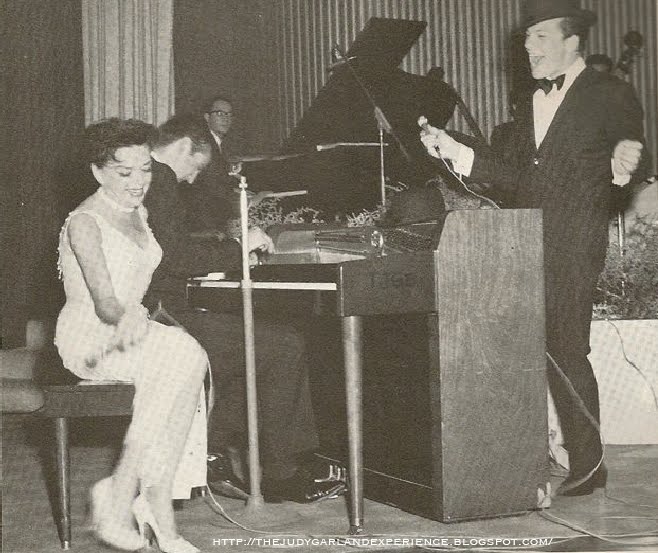
Per David Price, ” June 23, 1964 … joining the Allen Brothers for a song during the opening night of their of their Tokyo Hilton engagement.”

Arnold Gordon was having a blast. He made his way from England to Tokyo so he could to the Tokyo Games in 1964. He hitchhiked from Paris to Pakistan, took a boat to India and then another boat from Bombay to Tokyo. He got to see boxing and gymnastics, as well as enjoy the nightlife in the area around the Olympic Village.

According to this fascinating interview of Gordon, taped by the BBC as part of the run up to the London Olympics in 2012, Gordon told this tale. You can find it starting at the 1 hour 1 minute mark of this program called, Saturday Live BBC.

I was living in Shinjuku, which was the great center of Tokyo, where everything was happening, I was sharing a house with some Australians. Now and again some of the athletes when they finished their running and jumping or whatever they did would come around to our house, and sit and drink beer. I remember a couple of Russian athletes were brought down to our house because it was a getaway from being watched and being looked after.

We would go out and eat and drink. It was wonderful. There were so many people there. Lots of artists who were working therein cabarets and shows. And we would meet after midnight at a restaurant called Manos, which was run by a rather crazy Russian. It was where we went to eat Russian food. People would come down after they finished their acts. The atmosphere was quite fun. One of the artists who was appearing in Tokyo at the time was Judy Garland. And she used to come down there after she finished her cabaret act. We got to know her very well. We got to sit and talk with her. She used to buy us drinks. It was a small group of foreigners so you got to know each other very well. In fact, one of my best friends, Peter, in fact eventually married her daughter Liza. So we mixed very well.

One evening they were playing one of her records, old vinyl, so she went up to the DJ and grabbed the vinyl off the turntable and said that’s a horrible recording. I can sing better than that. And then she sat at the piano, and sang “Over the Rainbow”. I’ll never forget it. Just thinking about it gives me shivers down my spine. It really was magical. Everybody stopped and listened to her. OK her voice was not as good as it used to be before, but it was Judy Garland singing to us, “Over the Rainbow”. But to see her, she was a bit short and dumpy. Not as attractive as she was earlier in life. But she was a feisty, fun person to be with. She sat at the piano and sang. Even today, 40 years later, I can still feel a tingle when I hear Judy Garland singing as if she is only singing to us. Oh it takes me right back, to my youth. It really does.