When I was younger so much younger than today

I never needed anybody’s help in any way

But now these days are gone, I’m not so self assured

Now I find I’ve changed my mind and opened up the doors.

Help! By John Lennon and Paul McCartney

In 1964, Japan was younger, so much younger than today. They were bursting with energy, building a new, modern country, one the world would soon see during the Olympics to be friendly, proud, caring, technologically advanced and joyful.

In 1964, the Beatles invaded America, their dream destination, their exuberance boundless – needing absolutely nobody’s help in any way. From their press conferences, to their hotel escapades, to their appearance on the Ed Sullivan show, to their trips to Washington DC and Florida, the four lads from Liverpool were the four mates Americans wanted to hang out with. And as Ron Howard’s film – The Beatles Eight Days a Week – shows, John, George, Paul and Ringo sincerely enjoyed hanging out with each other.

the-beatles-landing-at-haneda
The Beatles Landing at Haneda Airport

I watched this film last week. I can’t say if it was a great film or not. But Howard rightfully kept all the attention on the Beatles and their music. As a lifelong fan, I could not help but smile incessantly throughout. The film, particularly the first half that focused on 1964, was a portrait of The Beatles as the personification of joyfulness.

The Beatles did not relegate their time to the US only. As it turned out, the record deals they agreed to actually paid them little, so they needed to tour to earn themselves the riches they deserved. In 1964, they premiered in the US in February, and then in the middle of the year, went on a 27-day tour of Denmark, Holland, Hong Kong, Australia and New Zealand, where they performed in a total of 37 shows. Then in August, they returned to the US and powered through a 30-concert tour in 23 cities. Everywhere they went, they were mobbed.

the-beatles-ascending-the-stage-at-the-budokanAs brilliant author, Malcolm Gladwell, explained in Ron Howard’s film, The Beatles were a phenomenon that rode the wave of a new global teen culture, driven by the popularity of the Fab Four. When Olympians the world over gathered in Tokyo in October, 1964, the majority of the Olympians, many teenagers or only years removed from that age group knew The Beatles, and sang their songs.

Diana Yorgova, a Bulgarian long jumper who participated in the 1964 Tokyo Games, wrote to me that she would take a break from the intensity of her training by going to the music hall, a place inside the women’s dormitory. She would listen to the music she liked, and one of her favorite albums was “With the Beatles“, which had come out in November, 1963. While watching ikebana lessons nearby, and taking in the sweet fragrances of the flowers, she would listen to her favorite songs: All My Loving, Please Mister Postman, Hold Me Tight, I Wanna Be Your Man.

Ada Kok, a Dutch swimmer who won two silver medals at the 1964 Tokyo Olympics in the 100m butterfly and 4x100m medley, was also a Beatles’ fan. In the confines of the women’s dormitory, she told me that the Dutch and the Australians had a particularly raucous party after the swimmers celebrated their medal hauls. Kok said they celebrated by singing Beatles songs the entire time.

But alas, all good things….

The 1964 Tokyo Olympics is considered the last pure Games, the last innocent Olympics. Security was not an issue, doping was not so prevalent, the under-the-table sponsorship payments were not so obvious – a good time was had by all.

But the roiling geo-political and social undercurrents were just getting noticed. And as we saw at the Mexico City Olympics in 1968, with the massacre of hundreds just prior to the opening ceremonies, and the murders of 11 Israelis by Palestinian terrorists inside the Olympic Village at the Munich Olympics in 1972, the world had made its transition from joyfulness and purity to cynicism and insecurity.

But now those days are gone, and I’m not so self assured.

In 1966, The Beatles came to Tokyo, playing four shows on June 30 and July 1. After the amazing reception that foreigners got during the Olympics in October 1964, one would think the most popular people in the world would get the very best of welcomes from the Japanese. But as the Howard’s film showed, The Beatles walked into an ambush.

Scheduled to play the Budokan, opened in time for the Olympics, the Beatles would be the first musicians to perform there. The increasingly vocal right wingers in Japan did not take kindly to a group of foreigners coming to Japan to perform music that would, perhaps, despoil The Budokan, a venue they believed should be reserved for only Japanese martial arts. The shows went on, mixed in with the normal Beatlemania response, but tainted by a high level of security and caution for the Beatles in Japan.

security-at-the-budokan-for-the-beatles
Security at the Budokan

The second half of the 1960s was challenging for The Olympics, for the Beatles, for everybody. An Age of Innocence had ended.

Help me if you can, I’m feeling down

And I do appreciate you being round

Help me, get my feet back on the ground

Won’t you please, please help me, help me, help me, ooh
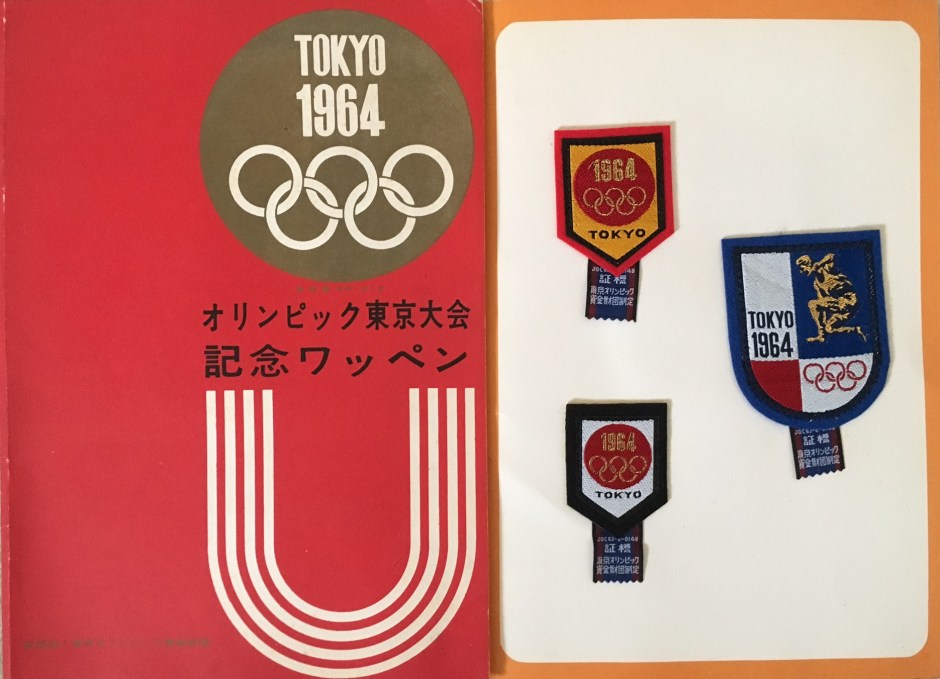
tokyo-olympics-wappen-1

I was in Queens, New York a couple of weeks ago to clear out the home I grew up in. The house sold, we had to dump decades of stuff. One of the items that turned up and was most thankfully not thrown away was this commemorative collection of iron-on patches from the 1964 Tokyo Olympics. My father, who was on the NBC News team that helped broadcast the Tokyo Games, undoubtedly picked this up when he was there that October.

The title on the cover page called these items wappen (ワッペン), generally, iron-on patch, a word I was not familiar with. I learned that wappen is a German word that means “coat of arms”, which is why these Japanese patches have their particular shape and design.

tokyo-olympics-wappen-2

This exercise made me think of all the foreign words that have become part of everyday Japanese, many that were imported during intense foreign interactions with the Japanese: the European influence in the Meiji Period, or the American occupation in the years after World War II.

Here are a few examples below:

  • Abekku means a man and a woman who are dating, or romantically involved – a couple, in short. This word comes from the most romantic of romance languages, French. Abekku is derived from avec, which means “with”.
  • Ankēto (アンケート) is the Japanese word for a survey, what you fill out when a company wants to know what you thought of its service, for example. This word comes from the Dutch word, enquête, which means “survey” as well, but originally derived from the French word of the same spelling that means “investigate”.
  • Arubaito (アルバイト), which means part-time work in Japanese, is often abbreviated to baito (バイト). It derives from the word arbeit in German, which means “work”.
  • Gipusu or gibusu (ギプス or ギブス), which means a plaster or plastic cast, used when one breaks a bone. This word comes from the German word gipsverband.
  • Oh-rai, oh-rai, hai stoppu“, is one of my favorite Japanese phrases, which is essentially a phoneticized version of the English words, “All right, all right, OK, stop!” which you hear very often in Japan when a man is directing a large truck to continue to back up into a parking area. This was likely a phrase that Japanese heard a lot during the American occupation in the late 1940s and early 1950s.
  • Randosel (ランドセル) is the cute, leather daypack you see on the back of school children in Japan. It is derived from the Dutch word, ransel, or “backpack” in Dutch.
  • Tempura (天ぷら), that uniquely Japanese dish of deep-fried seafood or vegetables is actually an import from Portugal. The Portuguese have a similar dish called tempero or temperara, which was likely brought over to Japan by Portuguese sailors and missionaries centuries ago.

So now that you’re an expert in Japanese words borrowed from overseas vocabularies, here is your test. If you understand this, who knows, maybe you can fake your way through a Japanese conversation one day.

I left my arbaito to go to my manshon. On the way I stopped at the konbini to buy some bata and biru. I dropped my hankachi there accidentally, and was so worried because it was mother’s gift to me. My mazakon kicked into high gear, so I ran to the depaato to find another hankachi just like the one I had. Unfortunately, while I was running across the street, a basu startled me with his kurakushon, and I fell. I tore a hole in my pantsu. Even worse, I broke my arm and had to wear a gipusu for a month. “Oh, mistake!

jt-ad-cigarette-manners_throw-away
Japan Tobacco 2011 ad series, entitled “Smoking Manners for Adults”; they had been releasing similar ads since the early 1960s.

When I first moved to Japan, the first pleasant surprise was the everyday practice of taking my shoes off before entering a home. After doing that for a while, it nearly disgusted me when I came back to New York where everywhere was parading around the house in the shoes that stepped in all kinds of you-know-what outside.

I also noticed how many white cars there were on the road, and that they gleamed with newness. Then I noticed all cars on the roads looked new, nary a dent or smidge of mud to be seen. And of course, you have to look hard to find garbage on the ground, even in highly congested megalopolis of Tokyo.

So it came as no surprise to read this short article in the October 11, 1964 Japan Times.

No Litterbugs

Spectators at the opening ceremony were generally well-mannered, garbage men at the National Stadium said Saturday night. Trash collected at the stadium after the opening rites was more than 12 tons, but there were few “litterbugs”, they said.

People were given a polyethylene trash bag at the entrance. Printed on the bag was a direction in English: “Please use this etiquette bag for tidying around you.”

Three hundred waste baskets and 250 ashtrays were placed in the stadium and most people used them. In addition, a finger-sized aluminum cylinder with a cap was given to each to be used as a portable ash tray.

When I read that last line about 18 months ago, it was a bit hard for me to imagine what that cylinder looked like….until last week, when I visited four-time Olympian, Andras Toro, in California. Toro, who was an Olympian in Japan in 1964, happened to have a couple, and they looked like this.

ashtrays-from-1964_1

In the cylinder is a message from the benefactor, International Lions Club, District 302, based then in Nihonbashi Tokyo. It wasn’t a message against smoking, this despite a report the next day that four out of every ten youths started smoking before the age of 20, or the fears of cancer. No, it was a message of cleanliness, and fire prevention.

LET’S BANISH CIGARETTE BUTTS FROM ALL THE STREETS IN THE WORLD

This is a cigarette butt container. Please use it in the stand while watching games. Many of these were donated to Tokyo Olympic Games Organizing Committee by All Tokyo Lions Clubs of International Club 302 District and their members for you people coming to see the Olympic Games. We are advocating a campaign in an effort to

STOP THROWING BUTTS AWAY. SMOKE WHERE AN ASH-TRAY IS.

We are sure you may think it strange that we have to advocate such a thing now in the capital of Japan that is proud of being a civilized country. We don’t blame you at all if you do.

But, What a shame! There are not a few people as you see smoking while walking and throwing cigarette butts away in the streets in this biggest city in the world – Tokyo. Now we will present a very interesting fact to you. Take a look a t the following table indicating that FIRES CAUSED BY CIGARETTES are never, superseded by fires of other origins even in other notable cities in the world.

Well, what do you think. Surprising there are so many fires caused by cigarette, isn’t it? That is why we vote for and our sincerest and outspoken prayer…..LET’S BANISH FROM THE WORLD SMOKING AND THROWING BUTTS IN THE STREET.

Now that’s a message that still resonates today!

jt-ad-cigarette-manners-olympics


from-1964-to-2020
A sign at Haneda Airport in Tokyo, the point of arrival of most Tokyo Olympians in 1964

Bob Schul planted the seed in my brain.

At the end of a wonderfully long interview in early 2015, the 1964 gold medalist of the 5,000 meter track competition mentioned it would be nice if Olympians who participated in the 1964 Tokyo Games could return to the Tokyo for the 2020 Games. He wasn’t suggesting that the government or anyone pay for their expenses. He was just wondering, wouldn’t it be nice if they could get assistance in finding accommodations or meals, for example.

That would be nice.

But it would be nicer, frankly, incredibly inspiring actually, to find a way to bring ALL 1964 Tokyo Olympians back in 2020. I have interviewed over 70 Olympians from the 1964 Tokyo Summer Olympics. I would estimate well over 90% of them, without prompting, described their time in Japan and at the Olympics as a wonderful and special experience. Many have said they would love to come back to Japan for a visit, particularly in 2020.

Imagine the stories that these Olympians would tell about 1964, about their memories of Japanese graciousness, resiliency, efficiency, and pride. There is little doubt that bringing the 1964 Olympians would result in a mutual lovefest. There could be opportunities for fundraisers dedicated to the 1964 Olympians, educational opportunities for Olympians to share their memories at schools or museums. And it would be another opportunity for embassies and chambers of commerce to embrace their heroes from 1964, reliving their stories, and reinforcing cultural impressions.

How many Olympians would that be? Allow me to make assumptions (and use admittedly somewhat cold and clinical language about life expectancy).

logos-1964-and-2020

According to this article in The Daily Mail, British athletes were offered free admission to certain events at the 2012 London Olympics. It was estimated that around 125 Olympians were eligible (ie: still alive). Since there were 404 Brits representing their nation at the 1948 Games, one could say that 31% of that group of Olympians were alive in 2012.

But the gap between the 1964 Olympics and the 2020 Olympics is smaller – 56 years to be exact. In other words, assuming an average Olympian age of 25, most 1964 Olympians would be in their mid-70s to mid-80s. Because of that, we could assume that more than 31% of all 1964 Tokyo Olympians could be healthy and ambulatory and interested in coming to Japan in 2020. For the sake of generating an estimate, let’s say 40%. That would mean, of the 5,151 worldwide Olympians who participated in the 1964 Games, a little over 2,000 Olympians could be here in Japan in 2020!

But alas, this is still only a dream. If London organizing committee’s offer were expanded to all 4,100 Olympians from 1948, it’s possible they would have had to extend their offer to over 1,200 Olympians. I am not aware of such a program to bring all the 1948 Olympians back to the 2012 Games, but I imagine the organizing committee considered it, and I’m sure they knew the challenges. How do you contact all those Olympians? How would you finance it? At a time of peak capacity for the city, how do you accommodate so many people who deserve respectful attention and may have special needs due to their age?

Good questions all.

But it all starts with a dream.


日本語

9-11-flag-salt-lake-city-olympics

It was the morning of September 11, 2011 when Mitt Romney was driving past the Pentagon in Washington DC. The Pentagon was on fire, the smoke so extensive it filled Romney’s car. Romney was the head of the Salt Lake City Olympics Committee at that time, and was in DC to lobby, coincidentally, for more government support with security for the upcoming Winter Games to be hosted in Utah.

Romney immediately got on the phone with his COO, Fraser Bullock to talk “about the fact that in less than five months, we were going to host the world and how were we going to keep everyone safe.”

The Salt Lake City Winter Olympics went on to become, from a sports and business perspective, a relative success compared to other Olympics. But prior to the start of the Games, with 9/11 heavy on organizers’ and casual spectators alike, security was a major priority.

In fact, even if 9/11 had not occurred, the organizers and the US government had already invested heavily in security. After all, it was only about 5 and a half years earlier that a pipe bomb went off in Centennial Olympic Park in Atlanta on the evening of the ninth day of the XXVI Olympiad. Over 100 people were injured, including two who died.

romney-bush-rogge
Mitt Romney, President George Bush and IOC Head Jacques Rogge
While the budget for security in Atlanta was $101 million, it more than doubled to $225 million for the Salt Lake City Games, according to this New York Times article. The Winter Games that year saw a security presence unlike any other Games. More importantly, a wide variety of federal, state and local authorities were coordinated in a manner that had been unprecedented, the result of painful lessons learned about the consequences of various relevant agencies not coordinating information and efforts pre and post 9/11. Here are a few or the major decisions to boost security at Salt Lake City 2002, according to the Times article:

  • Secret Service agents will be used to secure all areas used for Olympic events. In the past, their role was confined to protecting the president and other dignitaries. The expanded presence represents the federal government’s largest security investment, $27.2 million, according to the government report.
  • For the first time in an Olympics in the United States — this is the eighth since 1904 — all law agencies, as well as military commanders, will operate as part of a unified Utah Olympic Public Safety Command.
  • Airspace over northern Utah will be heavily guarded, with AWACs surveillance planes on routine missions, F-16’s from nearby Hill Air Force Base on alert and added radar operating at Salt Lake City International Airport, where plans call for commercial traffic to be stopped at various times, including the opening and closing ceremonies.
  • In another new effort, the State Department and the Immigration and Naturalization Service are pooling resources to create an instant check on foreign visitors through a database that will let Customs officers determine immediately whether an Olympic athlete or official is on a United States watch list.
  • In addition, military forces will be stationed in and around the city. Mr. Romney said the commitment could reach up to 10,000 troops, including more than 2,000 from the Utah National Guard, the largest call-up ever in the state.

On February 8, only 151 days after September 11, the Salt Lake City 2002 Winter Games commenced. In memory of the events that took place that beautiful Tuesday morning in New York, the tattered American flag that was recovered from the ruins of the Twin Towers was brought into the Stadium amidst an honor guard of Port Authority, NYPD and NYFD personnel who were in New York that day, with helicopter rotors thumping in the background.

Bullock said that there were objections from influential people about injecting a potentially powerful political statement like this particular American flag being displayed in an event that purports to be politically agnostic. But Bullock said that Romney had to twist a few arms to get to that decision because it “was the right thing to do.” And when the flag appeared, Bullock said, “the world really came together. It was a special moment for everyone.”

aska cambridge in rio
Aska Cambridge

When around 98% of a nation is perceived to be of the same ethnicity, it stands to reason that nationality and ethnicity are viewed as one and the same.

But Japan has been a magnet for those seeking opportunity as well as for Japanophiles, particularly since the economy boomed in the 1980s. As the influential Japanese television entertainment industry increasingly viewed diversity as a way to get more viewers, Japanese-speaking foreigners became more popular. Children of mixed marriages, those who essentially grew up Japanese, have now become de rigeur on Japanese television.

I was one of those foreigners who came to Japan in the 1980s, but because I am of Japanese ethnicity, I have been able to blend in. I get neither fingers pointed at me, nor praise for my Japanese proficiency. But even though my cultural background is American, I can see why the attention of Japanese still, to this day, perk up when a non-Japanese is in their midst. The non-Japanese is such a tiny population that they really do stick out. Like the majority of the film, Lost in Translation, the minority experience for the “gaijin” in Japan is clichéd. And yet true.

So when the Japanese men’s 4X100 relay team very unexpectedly took silver at the Rio Olympics, losing only to the vaunted team from Jamaica, it was a very special moment for Japan. Not only did the Japanese excel in an area they are not customarily strong in – the sprint – a 23-year-old named Aska Cambridge (ケンブリッジ飛鳥), the child of a Japanese mother and a Jamaican father – was a proud member of those Japanese speedsters. He ran for the Japanese squad, he speaks fluent Japanese, and yet, he doesn’t fit the everyday look of what most Japanese perceive as Japanese.

Mashu Baker and his mother
Mashu Baker and his mom.

When a 21-year-old Japanese won judo gold in the 90kg weight class at the Rio Olympics, Japan cheered. At the 2012 London Games, no Japanese won gold in judo, the most Japanese of all the Olympic competitions. In fact, no Japanese had won the 90kg weight class since it was introduced in 1980. So who brought back the glory? A person named Mashu Baker (ベイカー茉秋), the son of a Japanese mother and an American father.

At first glance, he looks Japanese. But it’s the name that sticks out. Baker is clearly not a Japanese name, and it is written in the press in katakana, the script reserved for foreign words. Interestingly, the first name “Mashu”, while spelled out in Chinese characters, was likely chosen because of its close approximation to the name “Matthew”. I don’t know what’s written on his US passport, but it’s possible the Bakers decided they wanted their son to be identified in Japan as a “ha-fu”, a child of mixed parentage.

“Ha-fu” over the decades, perhaps centuries, have on the whole experienced more prejudicial than preferential treatment. But I do not underestimate the power of role models. I am sure that the brilliant examples of Aska Cambridge and Mashu Baker will continue to help revise how Japanese, and the rest of the world, perceive what a Japanese is.

And that’s a good thing.

Rick Barry
Rick Barry and his underhanded free throw technique
In Malcolm Gladwell’s podcast, Revisionist History, he tells the story of Wilt Chamberlain and one of the most incredible basketball games ever played. His Philadelphia Warriors beat the New York Knicks on March 2, 1962 by the score of 169 to 147, and Chamberlain, incredibly, scored 100 points in that game.

As Gladwell points out, a good reason he got to 100 was because he knocked down 28 free throws, missing only 4. That’s an accuracy rate of 87.5%. And he did it shooting underhanded, as I explained in the previous post.

This is a technique that Rick Barry, considered one of the 50 Greatest Players in history, employed. Barry held until recently the record for career free throw percentage at over 90%, where the overall NBA free throw average over the decades is around 75%. For every 100 free throws, Barry accumulated 15 more points than the average NBA player. Imagine if Chamberlain hit free throws on the par of Barry. As Chamberlain’s coach once said, according to Gladwell, “if you shot 90% we might never lose.”

But the next year, Chamberlain gave up on the technique. Barry and Chamberlain knew each other as their careers overlapped. And Barry would kid Chamberlain for conceding a huge number of points by not using the underhanded throw. Why did he give it up?

Well we call this technique the “granny throw” because it looks like you’re shooting “like a girl”, or “like a sissy”. Before Barry was coached by his father to shoot underhanded, Barry himself was worried about shooting underhanded. And he also hated being called a sissy. But he got results. And that’s all that mattered to Barry. But Chamberlain, despite seeing the results himself, could not stick to the plan. And according to Gladwell, Chamberlain wrote in his autobiography the following:

I felt silly, like a sissy, shooting underhanded. I know I was wrong. I know some of the best foul shooters in history shot that way. Even now, the best one in the NBA, Rick Barry, shoots underhanded. I just couldn’t do it.

In other words, as Gladwell explained, “Chamberlain had every incentive in the world to keep shooting free throws underhanded, and he didn’t. I think we understand cases where people don’t do what they ought to do because of ignorance. This is not that. This is doing something dumb even though you are fully aware that you are doing something dumb.”

The underhanded free throw – clearly an easy way for almost any coach to add more points per game – remains a technique banished to the dustbin of history because people were afraid of how they looked.

And yet, I believe there is a coach out there, perhaps of a division three college in the US, or a poorly performing team in the Spanish professional league, or of a national team of a small country, that’s thinking….”I will do anything to squeeze more points out of my boys.” Maybe it’s someone new to coaching basketball and indifferent to how the players or the fans feel as long as they get results.

My guess is there will come a time when we see an entire team shooting free throws granny style, hitting 82%, then 85%, then maybe even 90% of their foul shots. And when it becomes clear that their 1-point, 2-point victories are because they hit 18 of their 20 free throws underhanded, who knows how long it will take before another coach feels he or she has nothing to lose except a few laughs from the stands in the early going.

That coach may one day say, “I may be stupid, but I’m not dumb.”

Wilt Chamberlain 100
On March 2, 1962, Wilt Chamberlain scored 100 points in a game.
Australia has yet to medal in men’s basketball in the Olympics. And they fell so agonizingly close in their one-point loss to Spain in the bronze-medal match at the 2016 Rio Olympics. You can’t blame their free-throw shooting, as they went 13 of 15 for the game. That’s an excellent 86.7%. Spain on the other hand could have had a far easier victory if they had shot better from the free-throw line, as they hit only 15 of 22 free throws.

Perhaps more critically, Croatia loss to Serbia by three points, while shooting a decent 78.9%. This was out of 38 attempts to Serbia, which only had 25 attempts, which meant that as a team, Croatia was effective at getting fouled and getting to the free throw line. If only they had hit three more free throws, Croatia could have had a shot at gold against the Americans instead of Serbia.

Coaches are always scheming to figure out how to gain more points than the other team, either via offensive or defensive schemes. But when it comes to the free-throw, the coach can only hope and pray that the shooter has practiced enough to hit the free throw with regularity. After all, no is guarding you. It’s just you against the basket.

The question is, would an improvement in free throw shooting impact a team’s win-loss percentage?

Let’s look at the 2015 Detroit Pistons, which shot 66.8% collectively for the season. They hit 1,399 free throws over 2,095 attempts. Now if they hit 80% of their free throws, like the New York Knicks did that season, the Pistons would have had a total of 1,676 successful free throws, or 277 more points, or 3.4 more points per game over an 82-game season. Would that have taken considerably higher than their 44-38 win-loss for 2015? Possibly, perhaps enough to help them finish ahead of the Indiana Pacers for second place and avoid a first-round meeting with the Lebron James-led Cleveland Cavaliers.

In other words, if you had an idea how to instantly improve free-throw shooting percentage by 10 to 20% points, you would think any NBA or national team coach would be hiring you for tons of money to teach them your secret. You would think so, wouldn’t you?

Wilt Chamberlain shooting the granny shot
This is how Chamberlain shot free throws in the 1961-62 season.
And yet, as Malcolm Gladwell recently explained in his fascinating podcast, Revisionist History, basketball coaches and players at all levels of basketball have resisted one of the proven, most effective ways to make free throws. In this podcast, Gladwell told the well-known story of Wilt Chamberlain of the Philadelphia Warriors, and the game on March 2, 1962 when he scored 100 points against the New York Knicks. What is less well-known is that Chamberlain hit 28 free throws, still an NBA record.

Chamberlain had improved his free-throw shooting from 50% to a career-best 61% that season. In that 100-point game, he hit 28 of 32 for an amazing 87.5%. What is even more amazing, he did it using the “granny throw”. That is the technique basketball great Rick Barry made famous.

It’s a throw that starts with both arms hanging naturally in front of the body. Then with an easy upward swing of the arms, and simultaneous flick of both wrists, the ball is lofted lightly toward the hoop. Barry hit 90% of his free throws over his career with that technique, the best in NBA history at the time of his retirement. And Chamberlain hit the century mark that wonderful night in Philly over 54 years ago because of that technique.

But after that season, Chamberlain gave it up, and reverted back to being a very poor free-throw shooter, a rate which waffled between 38 to 50%. Why would he abandon a huge part of his offensive weaponry? Why would one of the most fouled players in NBA history give up easy points by shooting his free throws holding the ball as everyone else does, starting from around his forehead?

Ah…the answer is both complex and simple, and I defer to the great Gladwell to tell this stunning story about why people and pride get in the way of results. See my next post.

Fu Yuanhui
Far left, China’s Fu Yuanhui, bronze medalist in the 100-meter backstroke
When you think of Brazil, you think of samba, you think of Carnivàle, you think of joy. And the Rio Olympics had its share of joyful moments.

Here are a few of my favorite examples:

Fu Yuanhui: The Chinese may have had an off-par Olympics in terms of medal haul, at least to them, but Chinese swimmer, Fu Yuanhui, became an overnight sensation. While the Chinese expect gold from every one of their athletes, the Chinese and the rest of the world fell in love with the 20-year-old bronze medalist in the 100-meter backstroke. There were few more expressive, more unfiltered, more joyful than the young woman from Hangzhou. Watch the clip for a few examples of why Fu Yuanhui lit up the Twitterverse with delight.

Justin Rose: The golfer on Team GB was outspoken in his criticism of other professional golfers foregoing the Olympic re-boot of golf after over a century. Justin Rose won gold in men’s golf, stating “It’s right up there with anything I’ve achieved in the game.” Rose won on skill and determination. But on the 189-yard par-3 fourth hole in the first round of the tournament, Rose walked into a bit of luck with his 7-iron, nailing the first ever Olympic hole in one. Watch the video to see Rose’s pleasant surprise.

David Katoatau: If you have never heard of the Republic of Kiribati, you may be excused. This nation of 33 atolls and reef islands spread out over 3.5 million square kilometers lies on the equator in the middle of the Pacific Ocean. On one of those islands resides David Katoatau, who came in 15th at the 2008 Beijing Games in the 85kg weight class, and 17th at the 2012 London Olympic Games in the 94kg weight class. At the Rio Olympics, Katoatau managed only 14th in the 105kg weight class, but came in first in the Olympic dance competition. In his last failed attempt in Rio, Katoatau fell over, rolled on his back, flipped himself up, hugged the weights, and started the most joyful funky dance you’d ever see from a weightlifter.

Monica Puig: If you weren’t following tennis in the Olympics closely and tuned on the television for the women’s finals, you would be wondering, Who is Monica Puig? Even casual fans of tennis would likely have recognized Australian Open champion, Angelique Kerber, but you could be excused if you didn’t know the unseeded Puig. 

However, every time Puig won, her home country of Puerto Rico began to rumble and roar. In an economic mess, Puerto Ricans have had little to cheer about in recent months. But as Puig continued her march to the medal round, an entire country stopped to watch. With monumental expectations on her shoulders, Puig did the unthinkable – she upset Kerber. Her medal was gold, her tears were of joy.

Monica Puig's tears of joy
Monica Puig cries tears of joy.
Brazil’s Soccer Team: When Neymar sent the winning penalty kick at the finals of the Olympic soccer championships, not only did Neymar collapse in tears of joy, the entire country of Brazil exploded in celebration.

Sports Fest 1

Mitsui Fudosan won the rights to be the Japan Olympic Committee’s exclusive real estate Tokyo 2020 Gold Partner. That shuts out companies like Mitsubishi Jisho (Mitsubishi Estate, in English) from marketing themselves using the Tokyo 2020 logos, or even the word, Olympics, and of course, the five-ring Olympic logo.

But there are ways companies get around the strict licensing rights dictated by the IOC. They market themselves by association.

From August 4 to 22, Mitsubishi Jisho sponsored Sports Fes Marunouchi, essentially in the middle of the Ginza, Tokyo’s established business, entertainment, shopping district, very near the famed red-bricked Tokyo Station. The Sports Fes featured over two weeks of athletic displays, Olympian appearances, and interactive sporting activities, all on the most expensive streets in Japan.

Sports Fest 2

On the Sunday afternoon I went, I saw people watching the Rio Olympics on the big screen, as well as adults and kids testing to see how high they can jump, how low they can extend their arms, how fast they can throw a basketball. And I got to see London Olympian and fencing silver medalist, Kenta Chida, in a display of fencing so close, I could have jumped into the match from my front-row seat.

Sports Fest 3

Except on the large-screen TV where NHK was broadcasting the 2016 Rio Olympics, you didn’t see the word Olympics, or the Tokyo 2020 logo, or the five-ring Olympic logo anywhere. Mitsubishi Jisho is not an official sponsor, and is forbidden from doing so. But it’s clear to everyone why Mitsubishi Jisho is sponsoring the Sports Fes Marounouchi. By holding this event during the Rio Olympics, and inviting former Japanese Olympians to talk about their experiences and display their skills, this Japanese real estate firm is basking in the golden glow of the Olympics, so hard to contain behind the curtains of IOC contracts and rules.

Sports Fest 6
Men’s individual foil silver medalist at the 2012 London Olympics, Kenta Chida.

Does this rankle the official real estate sponsor of Tokyo 2020, Mitsui Fudosan? Most likely, yes. But these are the Olympics, a premier symbol of competition. And the competition doesn’t end with the athletes. Companies in Japan will be battling for our mindshare in the coming years. And if necessity is the mother of invention, then I look forward to the creative ways non-sponsors guerilla market themselves, as we embark on the road to Tokyo 2020

Watch the video below for an up-close display of foil fighting. En garde!