The Rio Olympics are over, the Olympic flame extinguished. But before the final lights of the closing ceremony dimmed, Japan sent the world an invitation. After the traditional handover of the Olympic flag from the mayor of Rio to the governor of Tokyo, Japan gave the world a sneak peek, showing why everyone should be excited about coming to Tokyo in 2020, July 24 to August 9. The closing ceremony is an opportunity for the host of the next Olympics to whet the appetite of Olympians, wannabes and sports fans alike. And Japan did not disappoint.
The show at the end of the Rio Olympics closing ceremony was hippy, cutie, techie, sexy, targeting the hippocampus of youth the world over fascinated with Japan, it’s machines, its pop music, it’s kulture of kawaii.
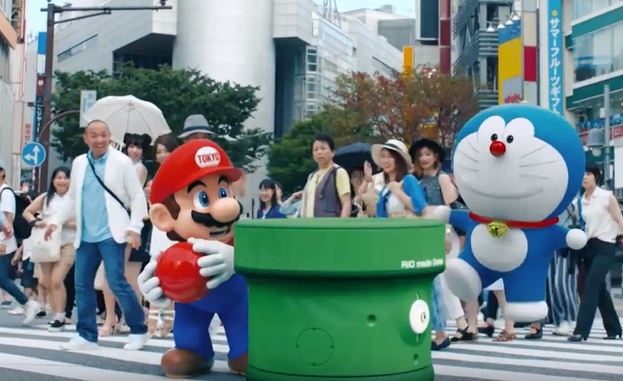
An introductory video took us on a jazzy tour of Tokyo, starting us off at the famed zebra crossing in Shibuya. We see the red Super Komachi bullet train which harkens back to the first bullet train introduced 9 days before the start of the 1964 Tokyo Olympics. We see the Sky Tree, Tokyo’s newer, bigger tower, although it can never replace the iconic Tokyo Tower, built just prior to the 64 Games. We see Pacman, Doraemon and Hello Kitty, and athletes lined up in profile, reminiscent of the famous athlete posters designed by Yusaku Kamekura for the 1964 Games.
And we see Japan Prime Minister, Shinzo Abe, in a car, in a hurry to get from Tokyo to Rio. He can’t get there in seconds….unless of course, he turns in to Super Mario, who ends up taking a plunge down an animated tunnel, landing on the other side of the world in Rio. Abe likely had to be heavily convinced, or plied with much alcohol, to appear in a Super Mario costume in the middle of Maracana Stadium. But he did, figuring that if the Queen of England didn’t mind being parodied for the London Olympics opening ceremonies, then maybe he shouldn’t either.
Yes, that’s Prime Minister Shinzo Abe, making sure he’s seen in a Super Mario costume for as little time as possible.
The video was the prelude to a display of art, dance and technology that was both precise and frenetic, ending in a Tokyo tableau, framed by, what else, that unmistakable silhouette of Mount Fuji. At show’s end, Prime Minister said, “See you in Tokyo!”
So, will we see you in Tokyo? We certainly hope so!
Very unexpectedly, against such traditionally strong competition as Jamaica, America, Canada and Trinidad and Tobago, Japan sprinted to second place at an Asian record of 37.60 seconds, a fair distance behind champions Jamaica, but ahead of the United States and Canada.
No sprinters from Japan had ever done so well. Famous for long distance runners, particularly with its share of marathon Olympic champions, Japan had only one sprinting exception: a bronze medal finish in the men’s 4×100 relay at the 2008 Beijing Olympics. As Andre De Grasse, who won silver in the 200 meters and bronze in the 100 put it, “Japan probably surprised us a little bit. We didn’t expect to see them up there. But congrats to them as well.”
After all, at the beginning of the track and field competition in Rio, there was very little to indicate that Japan had the talent to medal in any sprint competition, as seen early on in the men’s individual 100 meter heats.
Aska Cambridge and Usain Bolt face off in the final let of the 4×100-meter relays final.
In Heat 8, Yamagata came in second with a time of 10.20, qualifying behind South African Akani Simbine. In the semis, Yamagata finished fifth in his heat with a very solid run of 10.05 seconds, but did not qualify for the finals. Iizuka, who did not compete in the 100 meters, failed to qualify in the 200 meters with a time of 20.49 seconds.
In Heat 7 with Usain Bolt, Kiryu placed fourth, his time of 10.23 not good enough to quality for the individual finals. Cambridge qualified with the second fastest time in Heat 4 at 10.13 seconds, behind Canadian star, De Grasse. In the semis, Cambridge did even worse with a run of 10.17 and crashed out of the running for the finals, finishing last in his heat.
Fortunately for Japan, the individual sprints were one thing – the team sprints were another. In the two preliminary relay heats, Japan was not intimidated. In heat 1 of the 4X100 men’s relay, the United States team bested China, which set an Asian record time of 37.82. Japan won the second heat, not only topping the Jamaican team (sans Bolt), but also setting a new Asian record time of 37.68 seconds.
After the heats were completed, the eight teams competing in the men’s 4×100 relay were set. In order of lanes 1 to 8 were Great Britain, Brazil, The US, Jamaica, Japan, China, Canada, and Trinidad and Tobago. But in the finals, most of the teams were able to conserve the energy of their super stars in the heats, while Japan stuck to their four thoroughbreds. The Japanese were in lane 5, next to the Jamaicans, as the lead runners settled into their starting blocks.
Yamagata exploded out of the blocks, which is what you want from your lead runner. He seemed to gain ground vis-a-vis the lead runner for China in lane 6, but exchanges between runners for the Canada and Jamaica seemed to have happened a split second before Japan’s.
Yamagata passed off to Iizuka, who was Japan’s 200-meter runner. The runner of the second leg has to run in the baton exchange lanes twice, which means he runs about 125 meters. You want someone who’s speedy at longer distances, so Yamagata fit the bill. When Iizuka took off at the 100-meter mark, it appeared nearly all teams were tied.
Iizuka passed the baton to Kiryu for the third leg. The third leg is often a make or break leg. Not only does the runner in the third leg have to run 125 meters, he also has to ensure a smooth baton exchange while rounding a curve. Kiryu handled that responsibility to perfection. At the 300-meter point, Jamaica, Japan, China, Canada, as well as Trinidad and Tobago were looking equal, with a slight edge to Jamaica, Japan and Canada. Great Britain and Brazil had fallen significantly off the pace in the inside lanes, while the USA seemed to be slow on the exchange.
The fourth leg, or anchor, is often run by the swiftest on the team. Cambridge was the anchor, and his personal best was 10.1 seconds. Not only did he have the fastest time for Japan in 2016, he was seen as capable of going faster. As we all know, or could expect, Bolt was a runaway freight train and Jamaica was heading for its inevitable golden finish. But Japan’s Cambridge burst out of the exchange, and for a while appeared even to keep pace with Bolt.
The new giants of Japan.
While gold was out of the question, Cambridge’s job was to hold onto silver. Trayvon Bromwell of the American team exploded through the anchor leg and was pushing hard for second, so desperate that he went flying to the track while crossing the finish line.
The citizens of Japan, fortunate to be able to watch this race on a lazy Sunday morning, worked themselves into a frenzy as the race came to a finish, holding their collective breath as their hearts caught up with their eyes.
And then Japan erupted. Cambridge crossed the line in front of Bromwell. Japan had taken silver.
“Nippon! Nippon!” the announcer from NHK shrieked as Cambridge flew past the finish line. The Japanese quartet instantly became the new giants of Japan. We expected the Japanese men’s gymnastics team to do well. We expected the Japanese women’s wrestlers to do well. We did not expect the Japanese men’s sprinters to beat the Americans, the Canadians and push the legendary Jamaicans and Usain Bolt.
But the Silver Samurai did. And heading into the 2020 Tokyo Olympics, pre-teens and teenagers all across the islands of Japan will be saying, “maybe, just maybe, that could be me.”
The Debutante Ball is over. And Brazil is looking very good.
Despite all the issues that have arisen in Brazil in the run-up to August 5 – the impeachment of its President on corruption charges, the collapse of its economy, the constant news of the polluted Guanabara Bay, the shocking news of the impact of the zika virus, rumbles of possible riots by the underclass – the opening ceremonies at Maracanã Stadium went off pretty much without a hitch.
And there were a few big moments. Let me focus on three:
Sex: Carlos Nuzman is the president of the Rio Organizing Committee, and former member of the International Olympic Committee. He and his teammates likely helped inspire generations of volleyball fans in 1964 when he was on the men’s Brazilian team in Tokyo, where the sport debuted as an Olympic event. There he was on his country’s biggest stage on Friday, bubbling with excitement, exorcising all of the repressed worries he told countless people in the press not to be concerned with.
We never give up, we never give up. Let’s stay together when differences challenge us.
But to add a bit of spice to the formality of the opening speeches, Nuzman made one of those slips of tongue that the head of the IOC will never forget. Nuzman was responsible for introducing Thomas Bach, and said it was his honor “to hand over to the president of the IOC, the Olympic champion Thomas Bach, who always believed in the sex…success of the Rio 2016 Games.”
OK, Bach will always cherish that moment I’m sure…and it’s what’s on the mind of half the athletes at the moment anyway. (It’s been heavily reported that 450,000 condoms have been made available in the Olympic and Paralympic villages.)
Beauty: I’m a Jets fan. I hate Tom Brady. That goes with the territory. While Brady is one of the best quarterbacks in the history of the NFL, an instant hall of famer, his wife is arguably even more famous globally. Super Model, Gisele Bündchen, who was born in in Southern Brazil, travelled to London at 17. She was plucked out of the crowd of wannabes to make it on the catwalk for designer Alexander McQueen. From that point, Bündchen was a star, becoming a mainstay on the cover of Vogue and the body of Victoria’s Secret.
And so, in a moment of exquisite simplicity, the organizers brought together Brazil’s most famous song and its most famous face. First the crowd heard the massively familiar bossa nova rhythm and melody of The Girl from Ipanema, performed by Daniel Jobin, the grandson of the music’s writer, Antonio Carlos Jobim. From the other end of the stadium emerged the super model, coming out of retirement to make her final catwalk. Probably her longest catwalk ever, Bündchen sashayed some 150 meters across the entire stadium floor to the roars (and photo flashes) of 78,000 ecstatic fans.
Gisele Bündchen – click on this image to see a video of the moment.
Glory Restored: It was the marathon event at the 2004 Olympics, in the birthplace of the race, Greece. Brazilian, Vanderlei Cordeiro de Lima, of Cruzeiro de Oeste, was leading the marathon race with 7 kilometers to go when a strangely dressed spectator burst onto the road and just as suddenly pushed de Lima off the course. As I have described in a previous post, de Lima looked disgusted as he made his way back onto the course and continue on with the race. At the end of the 42-kilometer footrace, de Lima finished in third. There were attempts to give him a gold medal, but it is likely that since de Lima was still in first with a decent lead, the IOC decided to keep the results as is.
No doubt, this incredibly quirky incident was hard to forget for Brazilians, and particularly de Lima, who could have been on the top step of the awards podium, with a gold medal around his neck, listening to his national anthem. Instead, he listened to the Italian anthem, consoled with a medal of bronze.
Fast forward to 2016. The most famous athlete in Brazil, the legendary Pelé is rumored to be too ill to participate in the opening ceremonies. Up steps de Lima, who took the sacred flame from Brazilian basketball star, Hortência de Fátima Marcari, and carefully climbed the 28 steps to the Olympic cauldron. He raised the flame high with two hands to immense cheers, turned to the cauldron and ignited it, and the hearts of 78,000 people in the Stadium.
As the cauldron climbed into the night, to become the centerpiece of an incredible metal sculpture that turned the sacred flame into a swirling solar spectacle, de Lima was probably feeling the pride and joy he could’ve, should’ve, would’ve felt, if not for that crazy man in Greece in 2004. As the fireworks exploded around and above Maracanã Stadium, de Lima’s heart, I’m sure, was full.
Vanderlei Cordeiro de Lima lighting the Olympic cauldron.
The lighting of the cauldron at the 1992 Barcelona Olympics.The Olympics live on symbols. The five colored rings that represent the five continents of the world. The doves that represent peace. The gold, silver and bronze medals that symbol achievement at the highest sporting levels.
One of the most dramatic symbols of the Olympic Games has been the lighting of the Olympic cauldron that symbolically represents the Games ancient Greek origins, the beginning of the Games, and by extension, the suspension of hostilities in times of conflict and the coming together of the world’s athletes in competition and fair play. The cauldron lighting of the 1964 Tokyo Olympics most poignantly emphasized the need for world peace.
While this particular ceremony started at the 1936 Berlin Olympics, it was at the 1992 Barcelona Games where organizers raised the bar significantly in creating the Wow factor, that moment when you’ve seen something spectacular, something you would not have imagined or expected. In this case, it was paralympian archer, Antonio Rebollo, who shot a flaming arrow some 60 meters over a cauldron that rose seven-stories high, igniting the gases accumulating over the cauldron, and sending chills and thrills across the world.
In 1996, the organizers of the Atlanta Olympics had all sorts of issues with the planning of the cauldron lighting, but one thing they got right was having Muhammad Ali do the honors. Spectacle had to wait four more years for Sydney to bring goosebumps tot the world. An island nation, surrounded by water, Australia brought fire and water together in spectacular fashion. 400-meter sprinter, Cathy Freeman, stood in a pool of water. When she placed it to the watery surface, a ring of fire curled around her, the cauldron rising out of the water like a spaceship, making its way majestically to its home at the top of the stadium.
In 2008, China amazed the world with its spectacular opening ceremonies, highlighted by its impossible-to-imagine sky run, performed by legendary gymnast, Li Ning. Rising high above the crowd, suspended on wires, Ning appeared to run along the stadium wall for 500 meters before applying his torch and igniting another flame that spiraled up into a spectacular ignition of the cauldron.
What new spectacle and symbolism will the Rio Olympics bring? Our hearts are already a-flutter in anticipation.
Why do we love the Olympics? Why will the Rio Olympics succeed despite the political, environmental, security and health issues hanging over the Games like a black cloud on the verge of bursting?
Because we love what The Olympics make us feel, what the five colored rings represent: hope, dreams and inspiration, friendship and fair play, and the joy we have in making an effort.
After the 1996 Olympics Games in Atlanta, considered one of those most commercially blatant Olympics in the modern age, and the bid-rigging scandals of the Salt Lake City Games, the International Olympic Committee believed they had to reassert and protect the brand by reminding the world what the true value of the Olympics were. Thus was born the Celebrate Humanity campaign.
Enrolling TBWA, Chiat Day and their legendary worldwide creative director, Lee Clow, the man who developed the commercial that launched the Macintosh (“Think Different”), the IOC launched a series of public service announcements on television that dominated the airwaves leading up to the 2000 Sydney Games.
With the unmistakable voice of Robin Williams bringing both joy, tenderness and strength to the images, the Celebrate Humanity ads were everywhere – on your TV, radio, on your in-flight screen, in your magazines. Incredibly, broadcasters were even asking the IOC how much they had to pay to air the spots, according to Michael Payne, who tells this story of the Olympic brand in his book, Olympic Turnaround.
The campaign included seven short films that represent the Olympic values, symbolizing them, for example, in the 400-meter sprinter, Derek Redmond of Great Britain who pulled a hamstring during the competition at the 1992 Barcelona Olympics, but gamely limped onto the finish line, or the Nigerian women’s 4×100-meter relay team who celebrate their bronze medal effort after first thinking they had finished fourth.
Watch them and be inspired.
Courage
Strength is measured in pounds. Speed is measured in seconds. Courage… You can’t measure courage.
Bronze
Just a reminder: At the Olympic Games, you don’t have to come in first to win.
Smile
When you smile, I smile, that’s the deal. I’ll not walk past you, and not look you in the eyes, and not acknowledge you. Instead we’ll pass each other and say hello. Not with our words–they’re not the same–but with our faces. I meet you and see there is good in your eyes. There’s passion in your heart and there’s a friendly hello in your smile, and for the first time we can relate and appreciate each other. That’s all it takes. That’s where it starts. Because I know that you will smile and I will smile. And all the rest is easy.
Adversary
You are my adversary, but you are not my enemy. For your resistance gives me strength, your will gives me courage, your spirit ennobles me. And though I aim to defeat you, should I succeed, I will not humiliate you. Instead, I will honor you. For without you, I am a lesser man.
Have you ever pushed yourself to exhaustion in a workout?
Have you ever pushed yourself to exhaustion, want to stop, but push yourself even further?
Have you ever pushed yourself to the point where your body rebels, and whatever liquids or solids are in your stomach shoot up your system and out your mouth in an acidy expulsion?
I can say yes, to the first two questions, but for Olympians, the answer to #4 is yes, on a daily basis.
Watch the above video to see how hard Team USA Olympians push themselves in the quest for gold and glory.
I get to the pool by about five o’clock, do about 45 minutes of prep work, and then I’m in the water at 6am. We see the sunrise in the morning when we’re already halfway through our practice. – Natalie Coughlin, swimmer and 12-time Olympic medalist
It’s all about training when no one is watching. It’s all about training on holidays because I know most people aren’t training when they’re on holidays. – Carli Lloyd, two-time gold medalist in soccer
Nothing is….”Oh this is fun! I enjoy the pain, the lactic acid, the burn that flows through my veins!” None of that. You don’t want any of that. – Dawn Harper-Nelson, two-time 100-meter Olympic medalist
As Olympians finalize their preparations for the 2016 Rio Olympics, parents of Olympians too are gearing up for the emotional roller coaster. At times, mothers can have an outsized impact on the development of their children – think Duke Ellington, Richard Nixon or Norman Bates.
In homage to one of their biggest customer segments, global fast-moving consumer goods company, P&G, has continued its “Thank You Mom” campaign, launching one of its most talked-about commercials two months ago. Hollywood director, Jeff Nichols, was hired to create its flagship commercial as a run-up to the Games. And while he took an uncharacteristically dark turn in theme, the commercial proved to be a viral hit.
The 2-minute commercial, Strong, tells the stories of athletes whose mothers protected them, sheltered them, comforted them during difficult or even dangerous times: a tornado, a car crash, air turbulence, bullying.
Yes, there are violins that help pull at your heartstrings.
The Belgian has the lead, 30 meters on the Ethiopian struggling to stay in the race. With only a lap to go, we are clearly on the brink of….wait…my goodness! Two people have wandered onto the track, a girl and a boy…what are they doing on the track? They’re just walking, staring at their phones…and here come the leaders waving their arms, shouting. LePlante and Kidane veer to the right and pass them…they’re just standing there! Now the rest of the pack is shouting at them as they past the boy and the girl n their right and left…. OK, finally an official has come to escort them off the track. We saw this happen two days ago, when a teenage boy from Canada walked onto the mat during the semi-finals of the bantamweight wrestling competition. Could this be, yet again, another Pokémon Go attack?
On July 13, the Mayor of Rio de Janeiro, Eduardo Paes, wrote on his Facebook page on July 13 that he welcomes Nintendo to roll out the gaming phenomenon, Pokémon Go. “The whole world is coming here. Come too!”
With everything going wrong in Brazil, the mayor knows that Pokémon Go is right now the hottest item in pop culture, so just talking about it is easy publicity for the upcoming Rio Olympics. Launched to phenomenal fanfare in Japan, the game starring such characters as Pikachu, Squirtle and Fennekin, Pokémon Go is scheduled for launches in Asia. Unfortunately, with scant few weeks left, it does not appear that Pokémon Go will be making it to Brazil any time soon.
I guess they’ll just have to settle for the Olympics.
Aleka Katselli creating the sacred flame, from the book Tokyo Olympiad 1964, Kyodo News Service
Aleka Katselli was 12 when she was handpicked to be a priestess of the Temple of Hera in Olympia, Greece. She was with the High Priestess, Koula Prastika, who lit the first sacred flame for the Olympics in 1936, which then travelled by torch to Berlin, where it was used to light the Olympic cauldron – the first time this ceremony had taken place.
Katselli holding the sacred flame aloft, from the magazine Orimpiku Tokyo Taikai Tokushyuu, No. 2, by Tokyo Shimbun
As a child in 1936, Katselli remembers little. But in 1956, Katselli was 28 when she became high priestess, and was responsible for generating a flame from the sun, and making sure this sacred flame was passed to the long line of torch bearers who would transport the gift of Prometheus to a land that would embark on world peace through sport.
Lighting the Olympic flame is one of the most sacred moments of my life. What is important is to believe, to believe in the bottom of your heart that what I do at this moment is very sacred. You must believe. Especially here in Japan, when they say the flame is sacred, they really believe it as I believe it.
She told The Mainichi Daily News that the ceremony in Olympia is “not just a dance. It is a solemn walk which must be choreographed with the utmost dignity, grace and precision. Participants begin rehearsing the steps one week before the actual ceremony.”
It is likely that Katselli appeared that she truly believed the flame to be sacred. High Priestesses are often from the acting profession so that they can display a regal bearing worthy of channeling spirits from the beginning of time.
In fact, Katselli was a prominent actress in Greece, starring in the film of the 1962 Greek Tragedy, Electra, written by Euripedes, which could be considered base material for Shakespeare’s Hamlet. Katselli portrayed Queen Klytemnestra, who conspired with King Aegisthos to murder her previous husband, King Agamemnon.
Katselli also had a role in the 1960 film, Never on Sunday, which many Olympians at the 1964 Tokyo Olympics would have been familiar with. Produced for the film of the same name, “Never on Sunday”, would win an Oscar for Best Original Song, the first ever for a foreign-language film, and would go on to become a pop classic covered by Bing Crosby, Lena Horne, Doris Day and Andy Williams among many others. Enjoy the version below by Connie Francis.
Just days after the rescue, four of Four of the heroes pose for a picture. From left to right: Gerry Vultee, Owen Hale, Bill Herwig and Duke Kahanamoku. ,Courtesy of Paul Burnett
It was a lazy weekend at Newport Beach in Los Angeles on June 14, 1925. Three-time Olympic gold-medal-winning swimmer, Duke Kahanamoku, had just woken up and stepped out of his tent on the beach at 6:40 in the morning for a swim. When he looked out onto the choppy waters of the Pacific Ocean, he saw a disaster unfold. A yacht named Thelma, carrying 17 people heading out to sea looking for tuna did not see the checkered flag, indicating unsafe waters.
Suddenly, a squall struck and waves as high as twenty feet high, were pounding the Thelma, and Kahanamoku watched the yacht list at a 45 degree angle on top of high waves, glass breaking, rigging and men flying overboard. Kahanamoku grabbed his surfboard and lept into the frothy waves.
Kahanamoku grabbed one man, then two, then a third, plopping them all on his surfboard before heading back to shore. By then, two of his camp friends, Owen Hale and Jerry Vultee, met him halfway and took the three survivors to safety. Back went Kahanamoku, as thrillingly relayed by David Davis in his biography of Kahanamoku, entitled Waterman.
Duke turned around, inhaled mightily, and jumped on his board. He dug into the water toward the Thelma. He secured two flailing fishermen and maneuvered them onto his board, then kicked towards Hale, Vultee, and safety. (Local meteorologist Antar) Deraga telephoned for assistance while his wife and a nurse, Mary Grigsby, wrapped the survivors in blankets and tried to resuscitate the unconscious men. Two bystanders, Charlie Plummer of Balboa and William McElhannon from Santa Ana, assisted in the rescue. For a third time, Kahanamoku turned to the sea. He picked up stragglers and placed them on his board until, finally, he could do no more.
Of the 17 on the Thelma, 12 were rescued, 8 saved solely by Kahanamoku.
Kahanamoku said little of this superhuman feat. But said J. A. Porter, chief of police in Newport Beach, “The Duke’s performance was the most superhuman rescue act and the finest display of surfboard riding that has ever been seen in the world.”
While surf lifesaving has become a profession as well as an international sporting competition, particularly in Australia, Davis explains that Kahanamoku himself wrote that his actions over 90 years ago made the surfboard de riguer for beach lifeguards.
“{The rescue] helped sell lifeguard service on the wisdom of keeping paddleboards at he guard towers. The boards soon became standard equipment on the emergency rescue trucks as well as at the towers. In short, some good sometimes comes from the worst of tragedies.”



You must be logged in to post a comment.