Life Magazine_Emperor and Empress 3

These are fascinating pictures of Emperor Hirohito and the Empress in the summer of 1964. Taken from the September 11, 1964 issue of Life Magazine, these black and white photos reveal the Emperor to be a somewhat ordinary man, grandfatherly, academic. In fact, the couple looks like they’re having fun looking for mollusks.

The magazine even quotes the Emperor describing the “umi ushi” they found. “This is an easygoing chap, not in the least alarmed at being caught.”

Life Magazine_Emperor and Empress 1

Americans who saw this set of pictures in Life Magazine were probably surprised to see a totally different Emperor Hirohito. Perhaps their memory of him was a leader who sent suicide dive bombers to attack Pearl Harbor, or drove soldiers to kill themselves in the name of the Emperor rather than be captured by Allied forces. But to see the Emperor at all in the 1960s was due to efforts by the Supreme Command of the Allied Powers (SCAP), the entity that governed Japan in the post-war years, as well as members of the Japanese government.

After World War II, in the immediate aftermath of Japan’s defeat at the hands of overwhelming American military firepower, one would think there would be too much concern over what to eat, where to sleep, and how they will cope the next day for people to care about the Emperor, and whether the imperial family as an institution should be maintained.

And yet, support for continuing the imperial throne was strong, a survey in October, 1945 revealing “widespread enthusiasm or deep awe and veneration comparable to that of the war years,” according to John Dower in his seminal book, Embracing Defeat. While forceful calls for the dethronement of Emperor Hirohito and elimination of the imperial system in Japan were common in America and other allied nations, the head of SCAP, General Douglas MacArthur, agreed that it was important to keep the emperor in place.

Life Magazine_Emperor and Empress 2

Dower quoted a memo from Brigadier General Bonner Fellers to MacArthur about the reasons why the Emperor should remain as a symbol of Japan, emphasizing the fact that the Emperor, by going on the radio and announcing Japan’s defeat and need to lay down arms, “hundreds of thousands of American casualties were avoided and the war terminated far ahead of schedule.” in the case of trying the Emperor for war crimes, Fellers argued that “the governmental structure would collapse and a general uprising would be inevitable.”

SCAP was therefore insistent that Hirohito remain as Emperor, and not be tried for war crimes. In place of a deity as the head of Japan, SCAP sought to “humanize” the Emperor. A big part of those efforts were sending the Emperor on tours across the nation to meet the people in 1946. SCAP made sure pictures were taken and film was shot to document the Emperor walking amidst his people, a scenario unthinkable during and before the war years.

Life Magazine_Then Crown Prince Akihito Crown Princess Michiko and Current Crown Prince
Then Crown Prince Akihito Crown Princess Michiko and Current Crown Prince
Sonja Henie_TIME Magazine Cover_July 17, 1939
Sonja Henie on the cover of TIME Magazine, July 17, 1939

A skate, according to Mr. Webster, is a contrivance for the foot, consisting of a keel-like runner attached to a plate or frame, enabling the wearer to glide rapidly over the ice. This definition, good enough so far as it goes, is, in the light of recent developments, plainly deficient. It is evidence that the times move faster than the dictionary, and that the dictionary is not yet aware of Sonja Henie.

For this blood daughter of the Norse has during recent months demonstrated unmistakably that a skate is something more than what Mr. Webster’ says it is. To her it has proved the means to fame, fortune, movie stardom and the plaudits of kings. With it she has glided swiftly not merely over the ice, but also into one of the most extraordinary of all motion picture careers.

J.D. Shapiro of Arkansas Gazette, January 23, 1938 had an opportunity to interview Sonja Henie, a retired figure skater whose three straight Olympic gold medals and ten straight world championships in individual figure skating propelled her to the heights of Hollywood. Henie would leverage her sporting accomplishments and become one of the most famous people on the planet in the 1930s and 1940s, a movie and professional skating star, who earned millions of dollars in the process.

At the time of the interview, Henie’s third feature film – “Happy Landing” – was about to debut, and she was about to leave with 80 other skaters on a lucrative national tour of her own ice skating show, called the “Hollywood Ice Revues.” Thanks to her first two films, Henie had already earned hundreds of thousands of dollars. Her first film “One in a Million,” had already made 20th Century Fox more money than any of its other films released in 1936, while her second film, “Thin Ice,” was the fifth biggest box office hit of 1937.

Sonja Henie_One in a Millions
Sonja Henie in One in a Million

According to the Shapiro interview, skating stardom and Hollywood famedom was the goal all along.

“I said to myself,” she explains, “I’ll win 10 skating championships, then I will go into the movies,” She won the championships. Now she is in the movies. So what is strange about it? Sonja it seems has always been like that. She usually knew what she wanted. She usually go it. At seven years old, she told us recently, she wanted a pair of skates for Christmas. Her parents didn’t want to give them to her because they thought she was too young, but in the end she got them. Soon she wanted to win a Norwegian championship. She did, at 11. Next she fastened her eye on a world championships, and she got it, at 14. After that she decided to triumph in the Olympics, and nothing could stop her.

And when it came to the world of film, she targeted 20th Century Fox, led by Darryl F. Zanuck, who according to this Vanity Fair article, had a nose for talent outside the acting world and was willing to take a chance on non-conventional ideas and people. Henie’s business partner, Arthur Wirtz, who created the ice revue business for Henie in New York, would help Henie bring an ice show to Hollywood with the hopes of getting the studio heads’ attention.

Sonja’s father, Wilhelm, then went to see media mogul, William Randolph Hearst with an offer – the Henie’s would donate $5,000 to a charity of Hearst’s choice if his mistress and actress, Marion Davies, would sponsor Sonja’s ice shows. They agreed, and two shows were produced, and the stars came out to the spectacle: Mary Pickford, Douglas Fairbanks, Spencer Tracy, Clark Gable and Myrna Loy – Hollywood royalty of the time.

Sonja Henie and Tyrone Power in The Second Fiddle

And at the second show, Zanuck showed up. According to Shapiro, Zanuck signed Henie to a five-year contract, instantly making her one of the highest paid actresses of her time.

At the release of her first picture, “One in a Million”, Sonja Henie, walked arm in arm with Hollywood leading man, Tyrone Power at the film’s premier at the Roxy Theater in New York City. The one-and-a-half meter tall woman from Oslo, Norway was a giant of giants.

Here is Sonya Henie in Fly on Ice, her last theatrical film in 1958.

Cecilia Colledge
British skater Cecilia Colledge

In February 1936, there was universal expectation that Sonja Henie, aka The Ice Queen of Norway or The White Swan, would win her third gold medal in the women’s individual figure skating competition at the Gamisch-Partenkirchen Winter Olympics in Germany.

After all, Henie was just 23, and had already won the previous 2 Olympic and previous 9 world championship figure skating competitions. But up-and-comers, as always, are always nipping at the heels of champions. According to sports-reference.com, a 15-year-old Brit named Cecilia Colledge burst onto the scene by being the first female figure skater to execute a double Salchow, propelling her to victory at the European Championships only three weeks before in Berlin, Germany.

Additionally, Colledge had such strong appeal that Henie was no longer the only darling on ice. According to this article in The Independent, the powers-that-be in Nazi Germany were fans:

Sonja Henie_1936 Garmisch-Partenkirchen Olympics_Hitler
Sonja Henie at the 1936 Garmisch-Partenkirchen Olympics, meeting der Fuhrer, Adolph Hitler

The British team manager, T.D. Richardson, wrote that the 40,000 spectators who filled the outdoor stadium to capacity, included Adolf Hitler and other top Nazis. “Goering, in particular, could not keep his eyes off Cecilia. He asked me all about her on several occasions.”

After the first part of the competition – compulsory figures – Henie was ahead. But to the Norwegian’s surprise, not by much. Henie was not pleased.

In 1936 in the twin villages of Garmisch-Partenkirchen in southern Germany, Colledge was only a few points behind Henie after the school figures section. The closeness infuriated Henie, who, when the result for that section was posted on a wall in the competitors’ lounge, swiped the piece of paper and tore it into little pieces.

Fortunately, in the free skating part of the competition, Henie may have gotten the star treatment. While the first place competitor should skate last, it might follow that the second place competitor would skate second to last. Instead, Colledge was asked to skate second of the 26 total number of skater. As The Independent states, in the subjective world of figure skating, there is a distinct advantage to skating later in the day.

The early start was seen as a disadvantage, with the audience not yet whipped into a clapping frenzy and the judges known to become freer with their higher marks as the event proceeded. (Years later, a fairer, staggered draw was adopted to counteract this situation.)

Additionally, as sports-refernce.com details, Colledge’s nerves may have gotten the best of her, as she fell early in her free skate program, resulting in a good, but not great average score of 5.7. Henie, who benefited from the energy and excitement of a crowd waiting to see the Ice Queen crowned champion for a third time in a row, skated without error, well enough to maintain her hold on first, and the golden medal.


Sonja Henie_1936 Garmisch-Partenkirchen Olympics
Sonya Henie competing at the 1936 Winter Olympics

She was still relatively unknown to the world. But at the 1927 figure skating world championships, the young Norwegian managed to be thick in the middle of controversy. Sonja Henie, at the age of 14, won her first world championships, the five judges deciding 3 votes to 2 that young Henie was the best.

Unfortunately, the optics were poor as three of the five judges were Norwegian, and their votes carried the day, as explained in The Complete Book of the Winter Olympics 2014 Edition. As a result of Henie’s victory, the International Skating Union came to their senses and created a rule that there can no longer be more than one judge from a single country at an international competition.

A year later, Henie showed she needed no partisan assistance at the 1928 Sankt Moritz Winter Olympics. Henie was not considered a favorite as the field was strong with 20 skaters, and yet she won handily, making her the youngest figure skater to win gold at the age of 15.

To get to that level, she clearly had to get started early. Her father, Wilhelm Henie (pronounced like “penny”), was a good athlete who competed as a speed skater and a cyclist, and so encouraged his children to take up sports. At the age of 4, according to this Vanity Fair article, Sonja Hennie was on skis. At the age of 5, she took up ballet, as well as skating, and much to her parents’ surprise, she won a children’s skating competition on borrowed clamped-on blades.

Once Sonja and her parents realized that she was a natural on ice, they placed her on a diet and a program. The diet was “raw eggs and rare steaks,” a lifetime delight, and the program was three hours practice in the AM and two hours in the PM, sans school. Thanks to the resources of her furrier father, figure skating and ballet coaches were at little Sonja’s service.

Sonja Henie was at the 1924 Chamonix Winter Games competing against 7 others, including world champion and eventual gold medalist Herma Planck-Szabo. Despite the small field, Henie finished dead last in eighth place. At the incredibly young age of 11, half the age of the gold and silver medalist and a third of the age of the bronze medalist, Henie was clearly a bit over her head. She was said to have repeatedly skated to the rinkside asking for her coach’s advice during her routine.

Sonja Henie_1924 Chamnoix Winter Olympics
Sonja Henie at the 924 Chamonix Winter Olympics

But the transformation of Henie, from rough to polish, began in those four years between Chamonix in 1924 and St. Moritz in 1928. According to the Vanity Fair article, in addition to the considerable improvement in her technical skills, Henie re-created not only her own image, but the image of the figure skater as beauty and art personified.

Here was a huge visual shift—from masculine to feminine, from prose to poetry. Just as the ballerina’s pointe shoes were pink, suddenly the female ice skater’s boots were white, redolent of fairy and folk tales, of youthful purity and Nordic power. Sonja had single-handedly pulled figure skating into the realm of metaphor—and where there is metaphor, there can also be art. In “The Pavlova of the Ice,” film footage shot in 1928 (and available on YouTube), she is skating outdoors, her slow-motion leaps and spins set against snow-dusted mountains that are nothing short of Wagnerian.

The most significant part of this “visual shift” was parting ways with long skirts that all the women skaters wore to very short ones. Not only was Henie’s short skirt stunning and sensational to spectators used to more modest wear, it was revealing in ways that showed off the power and technical level of her spins and spirals, “and allowed her to perform tricks – the single axel, for instance – that had previously belonged to male skaters.”

Sonja Henie_1928 St Moritz Winter Olympics
Sonja Henie at the 1928 St Moritz Winter Olympics

At the age of 23, she had been to four Olympics, won three gold medals in three consecutive Olympiads, and 10 consecutive world championships in a row, and was arguably one of the most famous people in the world. And yet, her rising star was yet to hit its zenith.

1956 Olympics in Stockholm equestrian events

The Stockholm Olympics were held in July, 1912, the fifth Olympiad of the modern era.

But there was also a Stockholm Olympics in June, 1956, and only equestrian events were held at this particular event. Why? Because the actual host of the 1956 Olympiad was Melbourne, and Australia is famous for its tight quarantine control, a custom that goes back decades.

According to Wikipedia, Australia “had a strict six-month pre-shipment quarantine on horses,” and authorities insisted from 1953 that they would not allow horses enter Australia, even for the Olympics, which were to be held four months later, from November 22 to December 8. So, in 1954, the IOC decided that instead of cancelling the equestrian events, they moved them to Stockholm, Sweden instead.

As a result, the 1956 Olympiad was the first and last to be held in two different hemispheres in the same year, and 1956 saw posters that featured two different cities. The one above is the equestrian part of the 1956 Olympics in Stockholm, while the one below is the standard poster for the Melbourne Games.

1956 Melbourne Olympics

Interestingly, Sweden won gold in half of the equestrian events: individual dressage, team dressage and individual eventing. One might think home field advantage made the difference. Maybe it did, although Sweden dominated the equestrian events at the 1952 Summer Olympics in neighboring Helsinki, Finland.

As is explained in the book, Success and Failure of Countries at the Olympic Games, by Danyel Reiche, success in equestrian events is directly correlated to a nation’s GDP – “Out of the 419 Olympic medals, 329 (78.5%) in equestrian were won by wealthy countries with a GDP above US$30,000.” In addition, Reiche points out that in the case of Sweden, “equestrian sports is a ‘folk sport’,” which may explain why Stockholm was selected as the venue on such short notice.

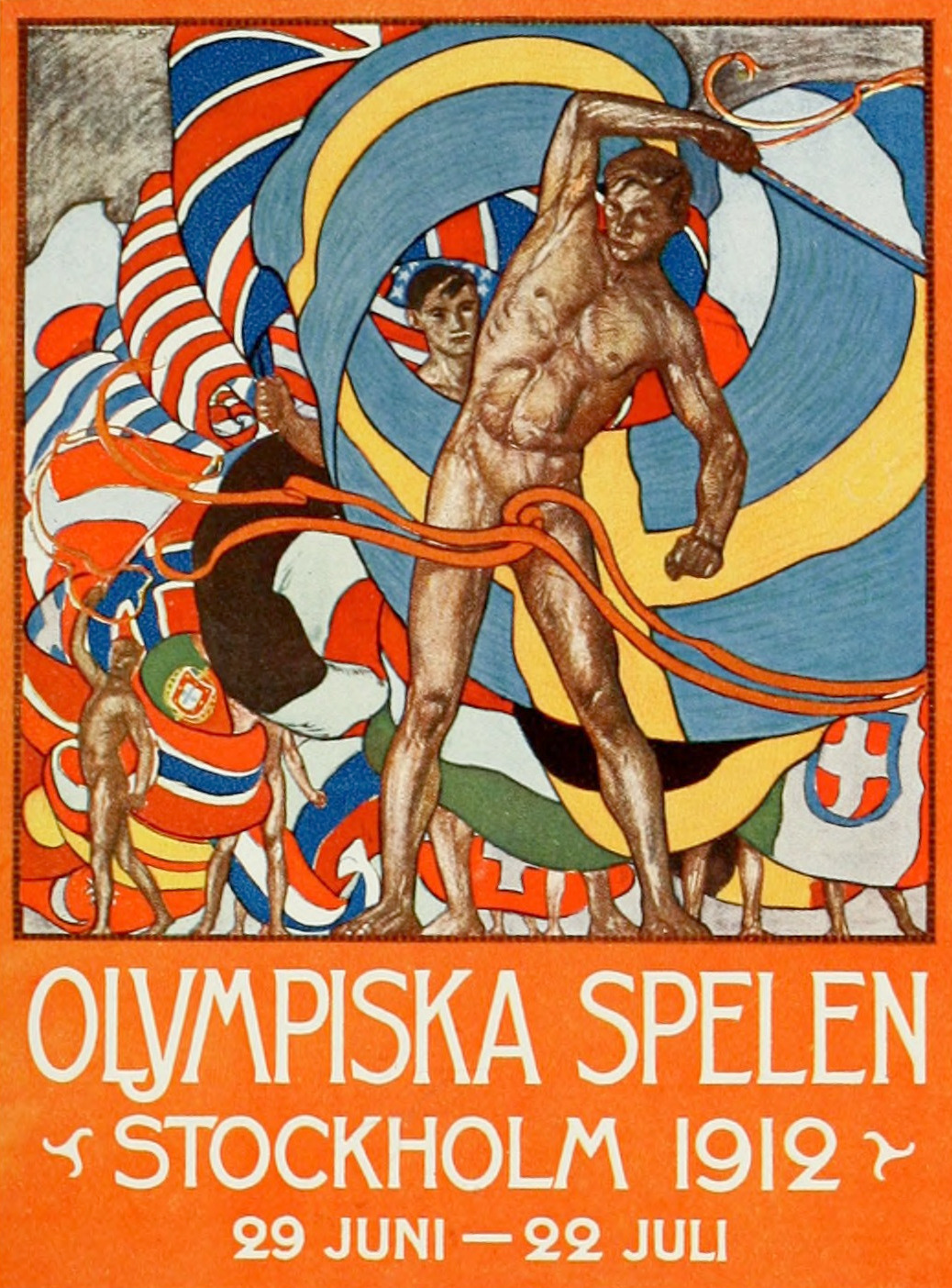
1912_Summer_Olympics_poster

Going au natural was considered not only natural, but beautiful, in ancient Greece. The nude athlete is a powerful image in Greece. It is said that when a runner named Orsippus of Megara lost his loincloth in the midst of a sprint, he was said to run even faster, gaining him victory and fame. Running naked became a competitive advantage.

As archaeologists like Heinrich Schliemann, who uncovered the site of ancient Troy in the late 19th century, captured the imagination of people the world over, the thinking and customs of the ancient Greece became idealized. The nude athlete in particular was de rigeur in posters advertising the early Olympic Games.

1920 antwerp olympics poster

In fact, from 1912 to 1936, the male body was the main feature of the Olympic poster, with the 1912 Stockholm Olympic poster being the most, how shall we say, intriguing, showing that there’s a lot you can do with a ribbon. And after World War I ravaged Europe, the Olympics came to Antwerp, Belgium in 1920, where the poster also employed a fully nude man, private parts covered this time by a swirling towel.

1924 Paris Olympics poster

The French were not so revealing, but the poster for the 1924 Paris Olympics did emphasize the bare chests and midriffs of virile young men ready to go into athletic battle. The poster for the 1928 Amsterdam Olympics was less suggestive, but still featured a yearning half-nude man.

Then, there are the prudish Americans, who featured a man of chiseled musculature, but whose torso was covered by a white t-shirt.

The Germans in 1936, the Brits in 1948 and the Finns in 1952 all did variations on a theme with the male body, until the Aussies came along and changed the look and feel dramatically. They removed the human, and replaced it with, what looks like a card, or invitation to the Olympic Games.

Nude guys were no longer a thing.

1932 Los Angeles Olympics poster

Willie Banks

Think San Diego, think sun and fun.

The inaugural ANOC World Beach Games are coming to San Diego in 2019. Wake boarding, beach volleyball, beach wrestling, beach handball, bouldering among many other events will be on display at Mission Beach. Mix sand and sun, with youth and sports and you get something less formal and more participative than the Olympics.

In fact, Chief Executive Officer of the ANOC World Beach Games Sand Diego 2019, Willie Banks, calls it the “anti-Olympics Games – fresh and fast paced, more community based, more of a festival feel.”

ANOC World Beach Games San Diego 2019 logoI had the opportunity to sit down with Banks in Tokyo as he was in town on business His career path is a model for athletes who wonder what to do after spending so much of their youth training and competing. Banks was one of the premier triple jumpers, breaking the world record in 1985 with a hop, skip and a jump of 17.97 at the USA Outdoor Track and Field Championships, a record that lasted over a decade.

Banks competed at the 1984 Los Angeles Olympics and the 1988 Seoul Olympics. In 1994, he was deputy venue director of the Rose Bowl for 8 games of the FIFA World Cup in the United States, where the finals between Brazil and Italy were held. In 1996, Banks was the director of athletes service at the Atlanta Olympics. And over the years, he has been a consultant to cities bidding to be Olympic hosts. Today, in addition to serving on the executive committee of the World Olympians Association, he runs his own company, HSJ Incorporated, which markets an artificial turf called Fieldturf in Japan and Taiwan.

Banks, who grew up in San Diego, is looking forward to bringing the world to his neighborhood. “The most important part of these Games is that we will have fun and the athletes and spectators will enjoy, which will build a wonderful brand,” he said.

Willie Banks and Roy_4
Willie Banks and me in Tokyo.
Geesink vs Kaminaga 2_Tokyo Olympics Special Issue_Kokusai Johosha
From the book, “Tokyo Olympics Special Issue_Kokusai Johosha”

それは1964年10月23日だった。

日本武道館は多くの人でごった返していた。しかしそこに漂っていたのは、諦めにも似た空気だった。東京オリンピック閉幕前日の事だった。

3人の柔道家・中谷 雄英、岡野 功、猪熊 功が3日ほど前に3階級で金メダルを獲得していたにも関わらず、今回、無差別級日本代表・神永 昭夫が、果たしてオランダ代表アントン・ヘーシンクを倒せるのか否か、それは半信半疑といったところだった。

なぜなら、ヘーシンクは1961年の世界大会で、日本人以外の選手として初めて優勝を果たし、世界を驚かせた人物だ。もっと言ってしまえば、ヘーシンクは予選ですでに神永に勝利している。日本中が予想を覆す大勝利を期待する一方、観衆が出来る事と言えば、体重120kg・身長2mを優に超す巨人と、体重102kg・身長180cmの日本人が、横に並んでいるのを見つめる事だけだった。そしてその武道館で、天皇皇后両陛下もご観覧されていた。

真の柔道家なら分かることであるが、柔道において、勝つためには体格よりも技、バランスそして筋肉の整合がより大事になってくる。しかしそうは言っても、多くの観衆は大きくて強靭な外国人選手が勝つのだろうと思っていた。それはまるで、大きく屈強なアメリカ軍とその同盟軍が、太平洋戦争で大日本帝国軍を打ち破ったのと同じことであろうと。

事実、ヘーシンクはいともたやすく神永を破り、日本中を落胆させた。

そして同じく10月23日の夕暮れ時、神永が敗北した日本武道館から13キロ南西に離れた駒沢オリンピック公園総合運動場体育館では、日本女子バレーボールチームが決勝戦に向けて準備を進めていた。彼女らもまた、大きく屈強なソビエト連邦代表の選手達に立ち向かわなければならなかった。

しかしこの場所で漂っていたのは、東洋の魔女ならきっとソビエト連邦チームを打ち負かしてくれる、そんな人々の思いであった。事実、1962年モスクワで行われた世界大会では、日本代表は窮地に追い込まれながらも勝利を収めている。それもあってか、その金曜日の夜、4つの局が試合放送する中、全日本国民と言っても過言ではない程の人たちがテレビの前にかじりつき、勝利の歓喜に沸く瞬間を、いまかいまかと待ちわびていた。

とはいえ、へーシングが神永を畳に沈めばかりで、それは同時に、数あるオリンピック競技の中で、唯一日本のお家芸である柔道で金メダルを独占するという願いも、同時に沈められたばかりであった。私たちはまだ強くないのか、いやいや、十分強いはずだ、、、多くの人が自問自答したことだろう。

女子バレーボール監督大松 博文は、この挑戦を受け入れ、数年をかけて、選手達の体格故の弱点や強さスピードを如何に補うかに取り組み、そして難易度の高い技の習得や根性を選手たちにたたきこんだ。そして日本代表は、ソビエト連邦代表にストレートで勝利し、ようやく日本国中が安堵と歓喜に満ち溢れた。15-11,15-8,そして一進一退の攻防の末、15-13で最終セットを奪取した。

Japan's Women's Volleyball team victorious 1964_Bi to Chikara
Japan’s Women’s Volleyball team victorious from the book, Bi to Chikara

そしてその金曜日の夜、2週間に及んだ東京オリンピック閉会式前夜、小柄の日本人女性たちが遥かに大きいソビエト連邦代表に勝利した事で、彼女たちの国がいかに認められ、そして尊敬に値するのかを世界に示す事となった。

神永の敗北が未だ心を痛めるも、インドネシアのボイコットを遺憾に思うも、北朝鮮が去ってしまっても、そしてもしかすると、太平洋戦争に敗戦し、あの日玉音放送から流れ出た恥辱のようなものも、決勝戦で最後のボールがコートに落ちた瞬間、きれいに洗い流されたのかもしれない 

その日、日本は生まれ変わった。若く、自信にあふれ、世界を牽引できる国として。


For English version of October 23, 1964: How Judo and Volleyball Transfixed and Transformed Japan within the Span of a Few Hours.

ramen oden yatai black and white
A late night bit of ramen or oden at a yatai in Japan.

The kindness the Japanese had for visiting foreigners during the 1964 Tokyo Olympics is legendary. I’ve written about how lost traveler’s checks were returned to a British journalist, how JTB saved the vacation of an Australian couple, and how Japan Self Defense Forces came to the rescue of the Netherlands’ Prince Bernhard, who lost his tobacco pouch.

All Japanese were united in ensuring that visiting foreigners left the country believing that Japan was the friendliest country in the world. Of course, in a society built on trust and assumptions that all people are intent on doing good, free riders and scam artists may sometimes think they are the one-eyed-king in the country of the blind. But if you’re going to cheat in such a society, you better be good.

An article in the October 3, 1964 edition of The Yomiuri tells the story of a scam artist wannabe who failed in his scam, but perhaps gained food for thought. Saburo Komuro walked up to a food stall outside in Kamata, and sat down for a hot bowl of “oden” on a cool October evening. He proceeded to mumble his way in explaining that he was in fact an Olympian on the Chinese Olympic judo squad.

Free Olympic Oden Leads to Arrest_The Yomiuri October 3 1964
The Yomiuri October 3 1964

Of course, the Japanese owner of the stall was very proud to be serving a visiting Olympian, and began to “lavish beer and oden on Komuro,” with complements. How could this food stall owner know that there were no judo competitors from Hong Kong or Taiwan, the only countries at the Tokyo Olympics related to China? Komuro was likely very pleased with himself, enjoying a lovely feast of boiled eggs, fishcakes, daikon in a warm broth, while bringing joy to this hard-working food stall owner.

But sometimes, anything that can go wrong, will go wrong.

A person who was actually Chinese sat down at the oden food stall. When told that he was sitting next to an Olympian from China, he immediately began talking in Chinese to Komuro, who of course couldn’t understand a word. It quickly dawned on the food stall owner that this was no Olympian sitting in front of him, only a fraud. A fight ensued, and in a weird twist, Komuro took off to the police box to explain how he had been wronged, only to be arrested.