Waldemar Baszanowski of Poland at the 1964 Tokyo Olympics.
It’s a game of grams. Waldemar Baszanowski of Poland and Valdimir Kaplunov of the Soviet Union battled through the three events that make up weightlifting competition: the military press, the snatch and the clean & jerk.
The world record holder at the time, Baszanowski, trailed behind two other favorites, teammate Marian Zielinski and Kaplunov, after the completion of the military press. But Baszanowski got back into a tie for the lead with the Russian after the snatch. In the final round, both Baszanowski and Kaplunov ended lifting the same weight in the clean and jerk, resulting in a world record tie, a total of 432.5 kg over the three weightlifting events.
After the final lift, the final ruling was out of their hand. Here’s how Neil Allen in his book, Olympic Diary Tokyo 1964, told the story.
The moment of victory was most unclear in the weightlifting over at Shibuya Hall where Poland’s Waldemar Baszanowski beat Russian Vladimir Kaplunov by the margin of 10.5822 oz. (300 grams) This was the difference in his body weight and that of Kaplunov and it was the only way of dividing two men who both broke the world lightweight record with a total lift of 953 1/2 lb. (432.5kg) Baszanowski held the previous record of 947 3/4 lb. (429.9kg) But it was only after an enervating tactical battle, and records beaten in all three movements, that he was able to give the mixed smile of relieve and exhilaration which is the right of the champion.
That’s right – the tiebreaker in weightlifting is the difference in body weight. The lighter of the two, in this instance was Baszanowski. Only three hundred grams separated gold from silver.
While Baszanowski would win gold convincingly four years later in Mexico City, Kaplunov in 1964 may have been wondering what he had for breakfast that fateful day.
The women’s pentathlon, like the men’s decathlon, are challenging endurance competitions that require capability in a variety of athletic disciplines. A significant weakness in one discipline could sink you. And like C. K. Yang in the decathlon, Mary Rand had difficulty throwing heavy things.
Rand was the brightest star of a resurgent British track and field team at the 1964 Tokyo Olympics. In fact, it’s stunning to think of the punishing schedule she had to compete in the long jump (October 14), in the pentathlon (October 16-17) and in the women’s 4X100 relay (October 20-21). So there are several factors one could take into account, for Rand’s results, including the heavy lifting she needed to do for TeamGB.
But in the end, Rand’s ability to heave a 4kg shot was her undoing.
The women’s pentathlon in 1964 was a two-day event that featured the 80-meter hurdles, the shot put, the high jump, the long jump and the 200 meter sprint. Against strong Soviet competition, as well as a fellow member of the British team, Rand won three of the five competitions: the high jump, the 200 meters, as well as the long jump, the event she was awarded gold only three days before.
In the first event, the 80-meter hurdles, the two Soviet athletes, Irina Press and Galina Bystrova, nipped Rand at the tape by 0.2 seconds. In other words, Rand had the best or second best scores in 4 of the 5 pentathlon competitions.
Here are the results of the 1964 women’s pentathlon.
You can clearly see that Rand’s shot put of 11.05 meters was poor, over 6 meters short of Irina Press’s toss. Each result in the pentathlon converts into points, and as you can see, Rand’s shot put score was 384 points behind Press’s score. The end result was that Rand was 211 total points off of Press’s total score. So let’s play the “what if” game. If Rand had thrown as well as her compatriot, Mary Peters, the additional 226 points would have given Rand the world record and the gold medal.
Irina Press, from the book Tokyo Olympiad Kyodo News Service
Press appeared to be both impressed and flummoxed with Rand, incredulous that Rand would not work harder to improve her shot putting, as Neil Allen implies in his book, Olympic Diary Tokyo 1964:
[Irina Press] does not possess the extraordinary natural talent of Mary Rand; but unlike the British girl she has no weakness in her athletics armoury. Mary beat the Russian in three of the five events but her shot putting, which has always been miserably poor, let her down yesterday and not even a superb long jump today could make up the deficit. At the medal presentation Irina Press told me she could not understand why Mary, with the minimum work, could not put the shot at least over 42 ft. (12.8 meters)
So second place it was for Mary Rand. With a gold in the long jump and a silver in the pentathlon, Rand thought out loud in an AP article from October 19, 1964 that “a bronze from the relay would complete the set.”
Unfortunately for her sprinting teammates, Rand got what she wished for.
Mary Rand, from the book, XVIII Olympiad Tokyo 1964 Asahi Shimbun
“I went to Rome in 1960,” Mary Rand explained in this video interview. “I was favored to win the long jump there. Did one of the best qualifying jumps but in the finals I ran through the pit and everything went wrong. And so when we came back to England, the headlines were ‘Flop Flop Flop’. I kinda thought I’m going to pack it in.”
In 1960, Mary Rand was expected to win the gold medal in the women’s long jump, but the 20-year-old cracked under pressure in Rome, and came home to unwanted and unwarranted attention from the press. Here’s how The Times described the press reaction in 1960. “British athletes, you should be ashamed of yourselves,” wrote one newspaper over photographs of those deemed to have failed. Bignal (Rand’s maiden name) was the star failure.”
Rand thought she was done with athletics. After all, she was married with a small daughter. But the call of competition was strong, and Rand found herself preparing the Tokyo Games. When she qualified for the British Olympic Squad, and landed in Tokyo, she was four years older and wiser. And yet, the demons of past failure were still in her head.
In this wonderful profile Rand in the Sunday Times as a run-up to the 2000 Sydney Games, the writer describes a joyful Rand the night before her long jump competition, singing a lullaby she would sing to the daughter she left in London, refusing to allow her roommates to sleep.
“Mary, for crying out loud,” says Mary Peters from the next bed. Her roommates cannot be angry. She sings so beautifully and even now, so late at night, her effervescence bubbles. “I’ll teach you,” she says, “come on, ‘I ullowoost to halowav an alawold banjalawo’, try it.” And so in this small room at the 1964 Olympic Games, four British athletes serenade themselves to sleep.
Sleep? Singing brings them to life. “Mary, I’m going to bang a nail into the wall,” says [Ann] Packer, “and from it I’ll hang the medal you’re going to win. It’ll inspire us to get the other ones.” It’s just a bit of fun but Mary Rand shivers at the mention of winning.
But according to the writer, Rand does not want to sleep, for silence forces her to hear the voices of doubt in her head:
What are you going to do tomorrow Mary, flop like you did in Rome four years ago?”
Outside, Mary hears the rain fall, so loud it could be hailstones: “What will that do to the cinder track, Mary?” She hates not being able to control the voices.
Alone in the darkness, Mary talks to God. “Please,” she pleads, “let me do well tomorrow.
Mary Rand, from the book XVIII Olympiad Tokyo 1964 Asahi Shimbun
But as it turns out, the 24-year-old version of Rand was made of stronger stuff. In the video interview, Rand reflected on her attitude as she readied herself for the women’s long jump competition, and her refusal to allow her competitors to psych her out during the practice period.
The hardest thing in long jumping in the Olympics is everybody is trying to get their run-ups. The Russians. The Poles. They’re all pushing and shoving, you know? So you have to be pretty tough. I got a couple of jumps in. It was really cold and windy. It was a little nervewracking because in the back of your mind ‘Oh my gosh, this happened four years ago.’ And I know the press were thinking, ‘Is she going to fall apart again.’ And everything went right.
Rand did not run through her mark. She did not foul. She did not crash and burn. In fact, Rand dominated from start to finish in the six rounds of the finals. In the first round, she broke the Olympic record with a leap of 6.59 meters, 35 centimeters further than Diana Yorgova of Bulgaria. In the fifth round, she broke the spirit of all competitors with a world record jump of 6.76 meters.
Like many British and American athletes who were not used to the metric system, she had no idea what that meant in feet and inches. The world record at that time was 21 ft 11.75 in so she had to dig into her bag for the meter to fee conversion table to learn that she became the first woman ever to exceed 22 feet – 22 feet 2 1/4 inches to be exact.
After the completion of the 1964 Tokyo Olympics, Queen Elizabeth had lunch with hundreds of Olympians from TeamGB a few days after their return from Japan, and was most taken with Mary Rand, the sensational triple medalist. Rand won gold in the women’s long jump, silver in the pentathlon and bronze as a member of the women’s 4X100 relay team, leading a resurgence in British track and field.
The Queen is reported to have measured out 22 feet, 2 inches (6.76 meters), the length of Rand’s world record jump that resulted in Great Britain’s first gold of the Tokyo Olympics. According to an October 28, 1964 AP article, the Queen told her son, Prince Andrew, that was the length Rand jumped to win the gold. “‘He just couldn’t believe that anyone could jump that far,’ the queen laughingly told Mrs. Rand at a buffet lunch at the palace Tuesday.”
Mary Rand with daughter
Not that I am expert on the British Royal Family, but clearly the Queen was taken with Rand. To be fair, many were. She was not only an Olympic champion, she was also perceived as wholesome (with a dash of sensuality). In 1964, she was married and had a daughter and had a reputation for being “nice”, which back then was more positive in nuance. But she also drew the attention of famous rock and rollers. “Apparently Mick Jagger said he’d like to date me,” she says (in this Mirror article). “I wish he’d asked! But then again I was married to my first husband at the time and the mother of a young daughter.”
An Italian journalist gave a melting look at the long legs and swinging hips as Mary walked across the grass, then surveyed again the world-record long jump on the indicator board and reluctantly handed me back my binoculars, misty by now. He shook his head in amazement and pronounced the accolade, “All that and a mother too!’
If it was the sheer femininity that struck first, next must come the almost effortless superiority of Mary Rand. Under the pressure of modern sport no British man or woman has ever won an Olympic victory with such authority. Here at last was our Elliott, our Zatopek, our Wilma Rudolph. Our goddess of the arena.
Mary Rand in Kimono with Ann Packer
The somewhat sexist comments of the era aside, Mary Rand had a rare combination of grace, power and independence that made her arguably one of the most popular women in Tokyo. Her willingness to speak her mind and not to follow the norm may have also intrigued people.
When she was 17 years old, she developed a relationship with young man from Thailand living in England, nearly marrying much to the chagrin of those around her. The “scandal” of this relationship resulted in her being expelled from school.
When she was preparing for the Tokyo Olympics, she worked at the postal office in a Guinness factory in London, which fortunately gave her the opportunity to both earn wages and train for the Olympics. And one time, her involuntary need to tell jokes got her in a little trouble: She said in the Mirror article: “One of the benefits I got there was a free Guinness in the work’s canteen at lunchtime. I jokingly told a reporter I had a half pint every day as part of my training routine. The next thing I knew there were headlines about my drinking and I got a long lecture from my coach about putting on weight.”
But Allen wrote in his book that people found Rand’s openness charming:
There are few athletes easier to interview for she is completely honest. And her great sense of fun never allows her to have a moment’s conceit about all her ability in so many events. In her greatest moment of all, in the Olympic interview room, she still had time to grin at the incredulous look on the continental journalist’s face when she said she’d ‘had a rub from Johnny’ just before the long jump. Johnny Johnson is, of course, the dedicated masseur to the British athletics team. To Mary, as always ‘life is a bit of a giggle.’
But now these days are gone, I’m not so self assured
Now I find I’ve changed my mind and opened up the doors.
Help! By John Lennon and Paul McCartney
In 1964, Japan was younger, so much younger than today. They were bursting with energy, building a new, modern country, one the world would soon see during the Olympics to be friendly, proud, caring, technologically advanced and joyful.
In 1964, the Beatles invaded America, their dream destination, their exuberance boundless – needing absolutely nobody’s help in any way. From their press conferences, to their hotel escapades, to their appearance on the Ed Sullivan show, to their trips to Washington DC and Florida, the four lads from Liverpool were the four mates Americans wanted to hang out with. And as Ron Howard’s film – The Beatles Eight Days a Week – shows, John, George, Paul and Ringo sincerely enjoyed hanging out with each other.
The Beatles Landing at Haneda Airport
I watched this film last week. I can’t say if it was a great film or not. But Howard rightfully kept all the attention on the Beatles and their music. As a lifelong fan, I could not help but smile incessantly throughout. The film, particularly the first half that focused on 1964, was a portrait of The Beatles as the personification of joyfulness.
The Beatles did not relegate their time to the US only. As it turned out, the record deals they agreed to actually paid them little, so they needed to tour to earn themselves the riches they deserved. In 1964, they premiered in the US in February, and then in the middle of the year, went on a 27-day tour of Denmark, Holland, Hong Kong, Australia and New Zealand, where they performed in a total of 37 shows. Then in August, they returned to the US and powered through a 30-concert tour in 23 cities. Everywhere they went, they were mobbed.
As brilliant author, Malcolm Gladwell, explained in Ron Howard’s film, The Beatles were a phenomenon that rode the wave of a new global teen culture, driven by the popularity of the Fab Four. When Olympians the world over gathered in Tokyo in October, 1964, the majority of the Olympians, many teenagers or only years removed from that age group knew The Beatles, and sang their songs.
Diana Yorgova, a Bulgarian long jumper who participated in the 1964 Tokyo Games, wrote to me that she would take a break from the intensity of her training by going to the music hall, a place inside the women’s dormitory. She would listen to the music she liked, and one of her favorite albums was “With the Beatles“, which had come out in November, 1963. While watching ikebana lessons nearby, and taking in the sweet fragrances of the flowers, she would listen to her favorite songs: All My Loving, Please Mister Postman, Hold Me Tight, I Wanna Be Your Man.
Ada Kok, a Dutch swimmer who won two silver medals at the 1964 Tokyo Olympics in the 100m butterfly and 4x100m medley, was also a Beatles’ fan. In the confines of the women’s dormitory, she told me that the Dutch and the Australians had a particularly raucous party after the swimmers celebrated their medal hauls. Kok said they celebrated by singing Beatles songs the entire time.
But alas, all good things….
The 1964 Tokyo Olympics is considered the last pure Games, the last innocent Olympics. Security was not an issue, doping was not so prevalent, the under-the-table sponsorship payments were not so obvious – a good time was had by all.
But the roiling geo-political and social undercurrents were just getting noticed. And as we saw at the Mexico City Olympics in 1968, with the massacre of hundreds just prior to the opening ceremonies, and the murders of 11 Israelis by Palestinian terrorists inside the Olympic Village at the Munich Olympics in 1972, the world had made its transition from joyfulness and purity to cynicism and insecurity.
But now those days are gone, and I’m not so self assured.
In 1966, The Beatles came to Tokyo, playing four shows on June 30 and July 1. After the amazing reception that foreigners got during the Olympics in October 1964, one would think the most popular people in the world would get the very best of welcomes from the Japanese. But as the Howard’s film showed, The Beatles walked into an ambush.
Scheduled to play the Budokan, opened in time for the Olympics, the Beatles would be the first musicians to perform there. The increasingly vocal right wingers in Japan did not take kindly to a group of foreigners coming to Japan to perform music that would, perhaps, despoil The Budokan, a venue they believed should be reserved for only Japanese martial arts. The shows went on, mixed in with the normal Beatlemania response, but tainted by a high level of security and caution for the Beatles in Japan.
Security at the Budokan
The second half of the 1960s was challenging for The Olympics, for the Beatles, for everybody. An Age of Innocence had ended.
Help me if you can, I’m feeling down
And I do appreciate you being round
Help me, get my feet back on the ground
Won’t you please, please help me, help me, help me, ooh
The competitor number for Andras Toro and his C-1 1000-meter competition at the 1964 Tokyo Olympics
When 1964 Tokyo Olympian, Andras Toro, rummaged through his decades of Olympian memorabilia with me last month, he uncovered his number. At his last Olympics representing his native Hungary as a canoeist, Toro wore the number 79, blue font on white material.
What caught my eye was that on the back of the material were the unmistakable pads of velcro. The reason it drew my attention is that I had always been bothered by the way athletes, particularly track and field athletes, have their numbers or names attached to their jerseys. They are sporting sleek, high performance jerseys, and yet their names or numbers are commonly printed on paper, and quite sloppily attached by safety pins. It’s not a big issue. It just doesn’t look cool.
There has to be a better way.
At every Olympics, organizers are always looking for better ways to do things. Perhaps someone deep down in one of the 1964 Tokyo Olympics planning teams thought that velcro was a better way to help identify athletes.
Velcro was developed in 1941 by a Swiss electrical engineer named George de Mestral. The iconic story is that on a walk with his dog in the woods, he came home with burrs stuck to his pants, which made him wonder. When he looked at the burrs closely, he noticed that the burrs had tiny hook-like tendrils, which somehow caught themselves in the tiny openings of his pants material. Out of that insight, de Mestral patented the fasterner idea called velcro, which is a combination of the French words “velours” (velvet) and “crochet” (hook).
Velcro was seen as a light, flexible, non-metallic way to attach or seal things. In 1968, NASA used velcro in their space suits, sample collection bags and on their lunar vehicles, increasing its geeky cool cred.
So attaching name and number plates to uniforms with velcro makes sense, initially. Why are we not using that space-age technology today? My guess is that using velcro is a bit of an operational pain because it requires two to tango – you need to place the “vel” on one thing and the “cro” on another. Toro’s number plate had the “vel”. I can’t imagine the organizers at Lake Sagami requiring all canoeists to wear a special jersey that had the hook pads…but I suppose they did.
And so, the old-school pin fasteners…now they’re beginning to make sense.
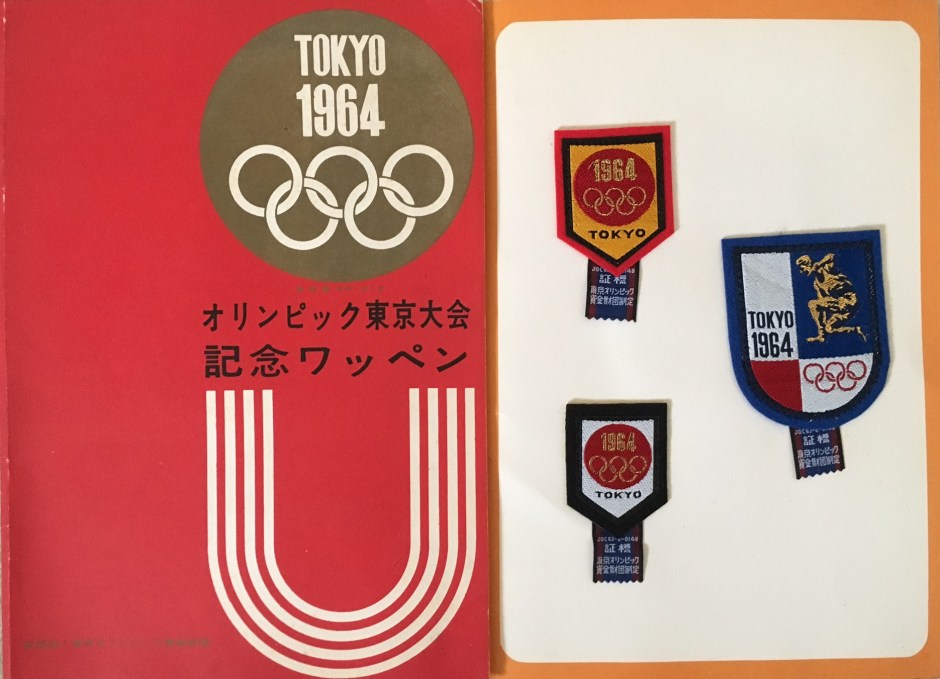
I was in Queens, New York a couple of weeks ago to clear out the home I grew up in. The house sold, we had to dump decades of stuff. One of the items that turned up and was most thankfully not thrown away was this commemorative collection of iron-on patches from the 1964 Tokyo Olympics. My father, who was on the NBC News team that helped broadcast the Tokyo Games, undoubtedly picked this up when he was there that October.
The title on the cover page called these items wappen (ワッペン), generally, iron-on patch, a word I was not familiar with. I learned that wappen is a German word that means “coat of arms”, which is why these Japanese patches have their particular shape and design.
This exercise made me think of all the foreign words that have become part of everyday Japanese, many that were imported during intense foreign interactions with the Japanese: the European influence in the Meiji Period, or the American occupation in the years after World War II.
Here are a few examples below:
Abekkumeans a man and a woman who are dating, or romantically involved – a couple, in short. This word comes from the most romantic of romance languages, French. Abekku is derived from avec, which means “with”.
Ankēto(アンケート) is the Japanese word for a survey, what you fill out when a company wants to know what you thought of its service, for example. This word comes from the Dutch word, enquête, which means “survey” as well, but originally derived from the French word of the same spelling that means “investigate”.
Arubaito (アルバイト), which means part-time work in Japanese, is often abbreviated to baito (バイト). It derives from the word arbeit in German, which means “work”.
Gipusu or gibusu (ギプス or ギブス), which means a plaster or plastic cast, used when one breaks a bone. This word comes from the German word gipsverband.
“Oh-rai, oh-rai, hai stoppu“, is one of my favorite Japanese phrases, which is essentially a phoneticized version of the English words, “All right, all right, OK, stop!” which you hear very often in Japan when a man is directing a large truck to continue to back up into a parking area. This was likely a phrase that Japanese heard a lot during the American occupation in the late 1940s and early 1950s.
Randosel(ランドセル) is the cute, leather daypack you see on the back of school children in Japan. It is derived from the Dutch word, ransel, or “backpack” in Dutch.
Tempura(天ぷら), that uniquely Japanese dish of deep-fried seafood or vegetables is actually an import from Portugal. The Portuguese have a similar dish called tempero or temperara, which was likely brought over to Japan by Portuguese sailors and missionaries centuries ago.
So now that you’re an expert in Japanese words borrowed from overseas vocabularies, here is your test. If you understand this, who knows, maybe you can fake your way through a Japanese conversation one day.
I left my arbaito to go to my manshon. On the way I stopped at the konbini to buy some bata and biru. I dropped my hankachi there accidentally, and was so worried because it was mother’s gift to me. My mazakon kicked into high gear, so I ran to the depaato to find another hankachi just like the one I had. Unfortunately, while I was running across the street, a basu startled me with his kurakushon, and I fell. I tore a hole in my pantsu. Even worse, I broke my arm and had to wear a gipusu for a month. “Oh, mistake!“
One year later, on October 10, 1964, Tokyo was reborn.
Japan was on the rise in the early 1960s and the XVIII Olympiad provided an opportunity for Japan to show the world that it was not only back on its feet, but sprinting!
Testing the Seiko timing system that automatically captures swim finish times
Chapter Two: Made in Japan: See the emergence of Seiko and IBM, taking Japan and the Olympics to the next level of technological achievement.
Traditional happi coats were distributed to Olympians.
Chapter Three: “Omotenashi”: See the myriad ways in which Japan made visitors welcome, and gape with admiration.
Japanese athletes training hard.
Chapter Four: International Sports Festival: See how the Japanese athletes trained and groomed for their big coming out party, and how overseas athletes were welcomed to Japan.
Yoshinori Sakai lighting the Olympic cauldron on October 10.
Thanks to those Tokyo Games 52 years ago, October 10 was declared a public holiday in Japan – Sports Day – and has become a time of the year when schools all over Japan put their children through a variety of sporting activities, with their proud parents cheering them on.
Ed Temple with, from left, Carla Mims, Edith McGuire, Vivian Brown and Wyomia Tyus at the women’s Olympic track and field tryouts on Randalls Island in New York City in 1964. Credit Ernie Sisto/The New York Times
Ed Temple was a black man who became a track coach for a women’s team in Tennessee, who overcame, along with the women on his teams, a severe lack of resources as well as significant racial prejudice in the deep south, to become one of the most historically impactful coaches in American track.
In a career of over 40 years at Tennessee State University, Temple coached 40 Olympians who garnered 13 gold, 6 silver and 4 bronze medals, including the belle of the 1960 Rome Games, Wilma Rudolph, and her successor at the 1964 Tokyo Games, Wyomia Tyus. At the 1960 games, the four members of the American women’s 4X100 team that blazed to gold were all members of Temple’s Tennessee State University team, affectionately known as the Tigerbelles. On September 22, 2016, Temple passed away at the age of 89.
To be black and female in the southern states in America was a challenge in a good part of the 20th century. Black athletes, whose competitions would take them all over the country, had to deal with long hours in cars hoping to find a place that would serve them food or put them up for the night, thanks to legally or socially enforced segregation along racial lines. David Maraniss, who wrote about Temple in his book, Rome 1960, said this in a Nashville newspaper interview in 2008:
We’re talking about the Jim Crow era, a period when the Tigerbelles . . . traveled through the deep South and endured harsh conditions to appear at meets. You look at what he accomplished and the obstacles he faced, and it’s simply one of the great triumphs in sports and history.
Cassius Clay and Ed Temple both appeared at the 1960 Rome Olympics
Temple believed that for a black woman to persevere and win in America at that time, they had to be disciplined and smart. Temple’s standards were high, so training on the team was painful. The Tigerbelles were locked into practices three times a day, starting at 5 in the morning, resuming at 9:30 am, and then again at 2pm, often times in the searing heat of summer. Tyus, who was crowned fastest woman in the world by winning the 100-meters in both Tokyo in 1964 and in Mexico City in 1968 said that Temple practices were “just brutal. I just thought, ‘this man has got to be crazy.’” The Tigerbelles wrote and sang a song that reflected their feelings towards Temple and his practices: “It’s So Hard to be a Tigerbelle”.
And yet, the Tigerbelles won. But simply winning wasn’t enough for Temple. He was not only their coach. He was their father and mentor, one who showed a bit of tough love and expected them to keep up with their studies. Tyus was interviewed in the book, Tales of Gold: An Oral History of the Summer Olympic Games Told by America’s Gold Medal Winners, and she wrote about Temple was a father to her.
Coach Temple was an advisor as well as a coach. My father died when I was only 15, so he became a father figure as well. He was very strict, and he was very tough. He used to say, “If we’re going to run, let’s run. If we’re going to be spectators, then let’s get up in the stands where we belong.” He also insisted that we train the European way, which to him meant “No play; just hard work.” When I look back on it, I sometimes wonder how I made it, but I also know that he was very good for us as women. He was always there to lend a helping hand, but if you needed to be reprimanded, he was also very good at that. And academics always came first with him. We had to have a C average to compete, but he always pushed us to do much better than that. His whole philosophy was that we were not going to be athletes all our live, so we had to take advantage of this opportunity to get a college education. We did, and he was always so proud of the fact that of the 40 of us who competed in the Olympics, 38 have college degrees.
Temple insisted that his Tigerbelles be smart, not only intellectually, but also fashionably. There was a school of thought at that time that blacks who wanted to succeed had to hold themselves up to a higher standard of behavior and appearance in order to simply get accepted in broader swathes of society. According to Maraniss in his book Rome 1960, Temple made sure his women looked good.
As the caravan approached its destination, an order would come from the front: “Get your stuff together.” This mean rollers off, lipstick on, everything brushed and straightened. The sprinters were a free-spirited group; some chafed at Coach Temple’s rules of behavior but grudgingly obliged. “I want foxes, not oxes,” he told them. The Tigerbelles had perfected the art of emerging from the least flattering conditions looking as fresh as a gospel choir, for which they were often mistaken.
Japan Tobacco 2011 ad series, entitled “Smoking Manners for Adults”; they had been releasing similar ads since the early 1960s.
When I first moved to Japan, the first pleasant surprise was the everyday practice of taking my shoes off before entering a home. After doing that for a while, it nearly disgusted me when I came back to New York where everywhere was parading around the house in the shoes that stepped in all kinds of you-know-what outside.
I also noticed how many white cars there were on the road, and that they gleamed with newness. Then I noticed all cars on the roads looked new, nary a dent or smidge of mud to be seen. And of course, you have to look hard to find garbage on the ground, even in highly congested megalopolis of Tokyo.
So it came as no surprise to read this short article in the October 11, 1964 Japan Times.
No Litterbugs
Spectators at the opening ceremony were generally well-mannered, garbage men at the National Stadium said Saturday night. Trash collected at the stadium after the opening rites was more than 12 tons, but there were few “litterbugs”, they said.
People were given a polyethylene trash bag at the entrance. Printed on the bag was a direction in English: “Please use this etiquette bag for tidying around you.”
Three hundred waste baskets and 250 ashtrays were placed in the stadium and most people used them. In addition, a finger-sized aluminum cylinder with a cap was given to each to be used as a portable ash tray.
When I read that last line about 18 months ago, it was a bit hard for me to imagine what that cylinder looked like….until last week, when I visited four-time Olympian, Andras Toro, in California. Toro, who was an Olympian in Japan in 1964, happened to have a couple, and they looked like this.
In the cylinder is a message from the benefactor, International Lions Club, District 302, based then in Nihonbashi Tokyo. It wasn’t a message against smoking, this despite a report the next day that four out of every ten youths started smoking before the age of 20, or the fears of cancer. No, it was a message of cleanliness, and fire prevention.
LET’S BANISH CIGARETTE BUTTS FROM ALL THE STREETS IN THE WORLD
This is a cigarette butt container. Please use it in the stand while watching games. Many of these were donated to Tokyo Olympic Games Organizing Committee by All Tokyo Lions Clubs of International Club 302 District and their members for you people coming to see the Olympic Games. We are advocating a campaign in an effort to
STOP THROWING BUTTS AWAY. SMOKE WHERE AN ASH-TRAY IS.
We are sure you may think it strange that we have to advocate such a thing now in the capital of Japan that is proud of being a civilized country. We don’t blame you at all if you do.
But, What a shame! There are not a few people as you see smoking while walking and throwing cigarette butts away in the streets in this biggest city in the world – Tokyo. Now we will present a very interesting fact to you. Take a look a t the following table indicating that FIRES CAUSED BY CIGARETTES are never, superseded by fires of other origins even in other notable cities in the world.
Well, what do you think. Surprising there are so many fires caused by cigarette, isn’t it? That is why we vote for and our sincerest and outspoken prayer…..LET’S BANISH FROM THE WORLD SMOKING AND THROWING BUTTS IN THE STREET.




You must be logged in to post a comment.