Opening Ceremonies 1964_Bi to Chikara
Opening Ceremonies 1964, from the book, Bi to Chikara

In Japan, my birthday used to always be a national holiday.

Two years after the Tokyo Olympics staged their grand opening ceremony on October 10, 1964, the Japanese government declared 10/10 a national holiday. When I lived in Tokyo from 1986 to 1994, my birthday was always a day off. Very often, schools all over Japan would hold sports festivals for their students and families, a significant cultural phenomenon in Japan.

In 2000, this holiday called Health and Sports Day was moved to the second Monday of October, to ensure that Japanese get that day off, so this holiday often falls on a day before or after October 10. This year, the second Monday is October 9.

With the start of the 2020 Olympics scheduled for Friday, July 24, government officials are considering a change in the law to make that day a national holiday, according to Asahi. Doing so would decrease the car and mass transportation traffic significantly, and allow people and vehicles related to the Olympics to move more efficiently that day, in addition to making it easier to implement security plans.

The government is considering a few options:

  • Make July 24, 2020 a public holiday, but not to make it an annual holiday
  • Move the public holiday held on the second Monday of October to July 24 (No!)
  • Move the public holidays of either Mountain Day (August 11) or Marine Day (third Monday of July) to July 24.
  • Create an additional annual public holiday on July 24 (That would get my vote!)

Japan has a reputation for being a workaholic culture, with the perception that people tend to log long hours at the office. In some companies and in certain departments, that is certainly the case. To the credit of the Japan press, they call out the worst companies (ブラック企業 burakku kigyō) for their culture of ridiculously long hours. And if you work in HR in Japan like I do, then you know that many companies have vacation utilization rates of 50% or less, ie: if you have 20 days of leave, you take only 10 days or less that year.

National Holidays in Japan

But the truth of the matter is, as residents here know, Japan has a high number of public holidays – officially 16 – more if you count the unofficial days off companies give their employees after New Years. As I understand it, only countries like India, China, Hong Kong, Colombia and the Philippines have more.

Because there are so many holidays, many clumped together so that Japanese can take as long as a week off twice in a year, many Japanese feel they can’t use up all their vacation days even if they wanted to. When I moved from Tokyo to Seattle, I felt this difference viscerally, shocked at how few public holidays there were in the US compared to Japan.

Japan is a public holiday paradise, and I hope that the government chooses to make July 24 a new and permanent holiday.

But please don’t touch my Health and Sports Day in October. It’s my special day.

running in heat

Imagine it’s Sunday, August 9, 2020, the final day of the Tokyo Olympics. The marathon has started, tens of thousands of people are lining the route, and the morning sun is radiating a furnace room of heat.

On August 9 this year (2017), the temperature hit a high of 37 degrees Celsius, or 98.6 degrees Fahrenheit. That’s hot man! And potentially dangerous for runners, as well as spectators. According to Makoto Yokohari, a professor of city planning at the University of Tokyo, in August the temperature at the location of the national stadium in Tokyo gets to 30 degrees at 7:30 am, and rises to the mid 30s in Asakusa, the mid-way point of the 2020 marathon. Yokohara adds in this article that much of the route, especially around the Imperial Palace, is not under shade.

Runner’s WorldFor runners, the fastest times often come in cool weather, in a range of 4.5 °C (40 °F) to about 13 °C (55°F), according to this analysis from Runner’s World. But when you run a marathon in hot weather, your body will rebel. According to this article from Scientific America, marathoners need blood to go in two directions at the same time – to your muscles to deliver oxygen and keep your muscles pumping, and to your skin so that your body can cool down. When it’s really hot, unfortunately, the blood that goes to the muscles that are getting a work out, gets even hotter, and the blood that gets to the surface doesn’t cool down. You sweat more, you dehydrate, and your body reacts with heat cramps, heat exhaustion, or even heatstroke.

The mother of all heat related illnesses. Your body temperature rises above 105 degrees F and it becomes a life-threatening situation. Most often, heatstroke results from untreated heat exhaustion, although it’s very possible for heatstroke to come about with no signs of heat exhaustion. Heatstroke is characterized by extreme fatigue and weakness, confusion and odd behavior, disorientation and finally unconsciousness. Your body’s regulatory system completely shuts down at this point, sweating ceases, and your skin becomes hot and dry. Unfortunately, it doesn’t end there. Convulsions and seizures can occur as your brain begins to shut down; coma and death are possible in the worst situations. GET OUT OF THE HEAT IMMEDIATELY! Seek medical attention, get in the shade, drink water, etc anything to get cooled down! You do NOT want to get to this point.

running in heat 2

For us pedestrians, succumbing to the heat is commonplace in August, according to Akio Hoshi, a professor of health science at Toin University of Yokohama. “The number of people transported by ambulance due to heatstroke or heat exhaustion has peaked in early August in recent years. So the Tokyo Olympics fall in the period with the highest risk,” Hoshi said.

The 1964 Tokyo Olympics were held in October, and the weather was primarily wet and cold….preferable conditions to the marathoners of 2020.

Mikako Kotani and synchronized swimmers in onsen
Mikako Kotani (front) and other former Olympians perform synchronized swimming in an Oita Prefecture
One of my most treasured memories was in the Fall of 1987, sitting in a hot spring in Hokkaido, the snow falling, the steam rising, and a beer in hand.

In addition to the great food and shopping, tourists are flocking to Japan for the country side, and in particular, enjoying onsen throughout the country. Once you (some of you) get over the embarrassment of getting naked with a whole bunch of strangers, you get yourself all clean in the shower area outside the bathing areas, and then you dip your toes into the water. And yes, it’s hot!

Some of the best onsen are in Kyuushu, a large island in the Western part of Japan. And to get Japanese and non-Japanese alike to venture beyond the cosmopolitan confines of Tokyo and Osaka, the government of Oita Prefecture started a campaign to promote their onsens….using Olympians.

In typical tongue-in-cheek Japanese fashion, the promotional videos portray Japanese synchronized swimmers performing in the onsens of Oita. The athletes include Mikako Kotani, who won two bronze medals at the 1988 Seoul Olympics, as well as Raika Fujii, silver medalist at the 2000 Sydney Olympics, and bronze medalist at the 1996 Atlanta Olympics. The campaign is called “shin-furo”, which is a word made up from “synchronized” and the Japanese word “furo”, which means bath.

“I hope viewers will enjoy the beautiful, thoroughly organized performance by former Olympians,” said Oita Prefecture spokesman Takahiro Miyazaki. “And at the same time, I hope people will also be attracted to Oita’s hot springs.”

Japan had a record 2.68 million visitors in Japan in July, well on its way to topping 2016’s record number of foreign tourists of 24 million, blowing past its original target of 20 million by 2020. The 2020 target has been re-set to 40 million visitors. For repeat visitors, the Oita onsens should certainly be a hot place to spring to.

Over 30,000 people crowded the streets of Shibuya near the famous zebra scramble to dance on August 5, 2017.

Of that huge crowd, in one of Tokyo’s most popular shopping and entertainment centers, 30 members of the Tokyo 2020 team dressed in yukata and happi coats performed a dance that was popular over 53 years ago. Reviving a hit song from that time, the organizers re-released an updated version of “Tokyo Gourin Ondo”(東京五輪音頭), which roughly translates to The Tokyo Olympic Dance Song.

bon odori
Tokyo 2020 Bon Odori in Shibuya

This song by Kouhei Fukuda, amidst the follow up to the 1964 Tokyo Olympics, helped created Olympic fever in Japan at that time.

It is mid August, in the heat of summer, when families often come together to visit and clean family gravesites. It is also an opportunity for neighborhoods to come together in a bon odori, which you can see in almost any neighborhood in Japan. And anyone can join in the dance.

Watch this video to see how the Tokyo Gourin dance is done.

Hiroshima torch relay
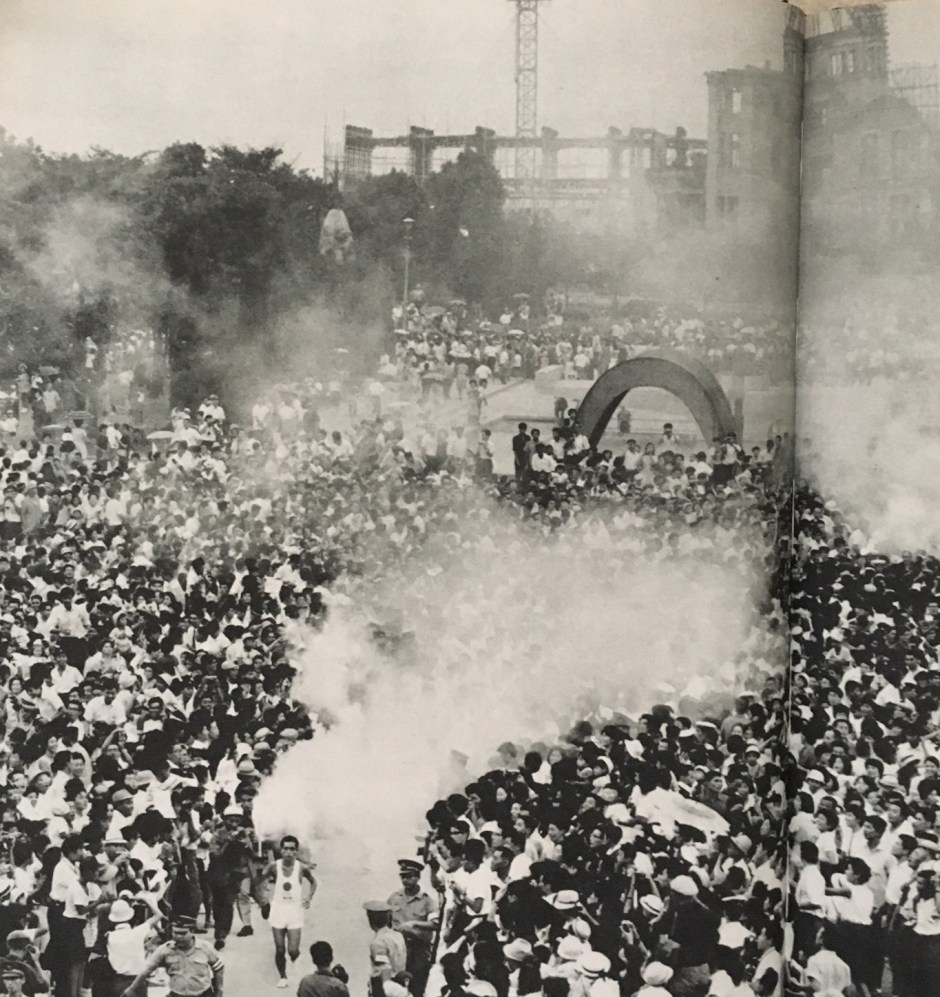
The torch relay passing through Hiroshima prior to the start of the 1964 Tokyo Olympics, from the book 1964 Tokyo Olympiad Kyodo News Agency

One thing certain about the dates of the Tokyo 2020 Olympics: July 24 to August 9, 2020. It will be hot and muggy!

One less obvious thing recently occurred to me about the dates. The final week of the Tokyo Olympics falls on the 75th anniversaries of the nuclear bombings of Hiroshima and Nagasaki.

Was it intended to bring attention to the worst days in Japanese history, during the proudest days of the nation’s history?

Of course it was. It’s impossible to imagine that no one in the Tokyo 2020 organizing committee or the IOC noticed that the closing ceremonies of the Olympics would take place on the day the second atomic bomb was dropped on Japan, thus expediting the eventual end of the war six days later.

On the contrary, the organizers must have thought that the final day of the Tokyo 2020 Olympics would be an opportunity to solemnly (and hopefully tastefully) implore the world that peace and love trump war and hate.

Such a closing ceremony would provide a poetic bookend to the opening ceremony of the 1964 Tokyo Olympics. Only 19 years removed from the end of WWW II, it was a 19-year-old student from Waseda University named Yoshinori Sakai who carried the sacred flame up the National Stadium’s steps to light the Olympic cauldron on October 10, 1964.

Sakai was born in Hiroshima on August 6, 1945, the very day that the Enola Gay dropped an atomic bomb called “Little Boy” on Sakai’s hometown.

All he was saying was give peace a chance.

Neymar nails the final penalty kick to win gold

On August 5, 2016, all eyes were on Rio de Janeiro.

Despite all the doomsayers’ diatribes about political corruption, the fears of the zika virus, the filth of Guanabara Bay, and the anemia of the Brazilian economy, the Games went on. And the Games were great!

Anthony Howe's Olympic sun

In the moving opening ceremony, the famed Brazilian love for music and dance were on display. Super model Gisele Bundchen strolled across the field to the tune of The Girl from Ipanema. The honor of lighting the Olympic cauldron was given unexpectedly to Athens marathoner Vanderlei Cordeiro de Lima, whose 2004 Olympic marathon was bizarrely interrupted by a defrocked Irish priest. And the cauldron de Lima lit was stunning, the fire’s light reflected magnificently in a shining, swirling structure of metal places and balls, creating a spectacular golden vision of the sun.

A bright spot for the IOC was highlighting the plight of the global refugee issue by forming an all-refugee team, an excellent idea!

And to be honest, from a sports perspective, if you bring the very best athletes in the world together, the drama of the competition will subsume almost all else (for good and for bad.)

For Brazilians, here were a few of their nation’s most inspirational stories, starting with Neymar’s winning penalty shot that sealed Brazil’s first even Olympic gold in soccer.

Here are a few other amazing stories I covered, particularly from a Asia/Japan perspective:

The Rio Olympics were far from perfect. But those Games a year ago today had its moments, many that will be remembered for decades.

No doubt, more await when we See You in Tokyo!

See you in Tokyo Rio Olympics

Multiple choice question:

The top activity for foreign tourists in Japan is:

  • a) Shopping  
  • b) Eating Japanese Food  
  • c) Getting Swallowed Up by Hundreds of People Wading Through the Famous Shibuya Scramble Crossing While Attempting to Take a Selfie  
  • d) Visiting All of the Sites/Buildings Godzilla has Knocked Down and Blazed to the Ground in His Career
  • e) All of the Above

According to the Japan Tourism Agency (JTA), which recently released the results of its Q1 2017 survey of foreign tourists visiting Japan, the answer is……

b) Eating Japanese Food

As explained in Terrie Lloyd’s blog, Terrie’s Take, “69.1% (of the foreign tourists surveyed) listed food as their top anticipated experience, followed 16 points further back by 52.5% wanting to go shopping. Perhaps even more importantly, the JTA’s survey of people exiting Japan lists the Number One experience during the trip as ‘Eating Japanese food’, which came in at an amazing 95.3%! Next after food was shopping, at 83.5%.”


Sushi
Three of my favorites!


Lloyd went on to provide interesting insight from the survey. He noted that the most popular Japanese dishes were sushi, ramen, Wagyu steak or sukiyaki. He also added that depending on the region from where the tourists come, the Japanese food of choice differs.

For travelers from Vietnam, India, Germany, Italy, Spain, Russia, Canada, or France, the number one choice is sushi.

For tourists from Taiwan, Thailand, Malaysia, China, Singapore, Indonesia, Philippines, United Kingdom, United States, or Australia, the number one craving is ramen.


And for those travelling foodies from South Korea or Hong Kong it’s all about the beef – wagyu steak or sukiyaki.

I can’t argue with sushi, ramen and Wagyu. Frankly, they are so good here, I’d eat any of those items only in Japan if I had the choice.


Wagyu
One of my very good dinners.
Kengo Kuma's Staidum
Kengo Kuma’s National Stadium design

One thousand and ninety six more days to the commencement of the 2020 Tokyo Olympics!

That’s 365 X 3 + 1. Don’t forget, 2020 is a leap year!

Three years hence from today, July 24, Tokyo will be welcoming the world to the biggest sports fest there is – The Summer Olympics.

The first country to ever host both the Summer Olympics and the Paralympics twice, Japan will be the focal point for sports from July 24 to August 9, 2020.

In 1964, Tokyo hosted the Olympics from October 10 to 24, for a total of 16 days, which was standard in the 1960s and 1970s. However, since Barcelona, the opening ceremonies was pushed one day earlier from Saturday to Friday, likely allowing for two full weekends of sporting events, and an opportunity to maximize television viewership.

Another difference between 1964 and 2020 is the timing. In 1964, the “Summer” Olympics were held in the Fall to avoid September monsoons. But this time, the Olympics will be held in the hottest period in Japan – late July and early August. This has been the general timing for the past eleven Summer Olympics, excluding a September Sydney Games and Seoul Games.

My guess is that the various international federations want consistency in Olympic scheduling so that their own world championships and Olympic trials do not end up in conflict. That would be the same for many school systems that go on holiday break during the summer months. And television broadcasters may also prefer to have the Olympics to fill what are usually filled with summer repeats.

But I speculate.

One thing is certain. The Summer Olympics are coming to Tokyo on July 24, 2020.

Hope to see you here.

And just in case you need to know, click here for the countdown to Tokyo 2020.

See you in Tokyo Rio Olympics
Tokyo’s Presentation at the Rio Olympic Closing Ceremonies
Zach Railey in a Finn

Outside of Title IX in America, one of the most powerful levers for gender equality in sports have been the IOC. As I mentioned in this post, the IOC has added new sports categories and re-shuffled events so that Tokyo 2020 will have a female-male participation rate of 48.8 to 52.2%. That’s up from a 44.2% female participation rate at the 2012 London Olympics.in this post

Take a look at this list of planned Tokyo 2020 events and you’ll see that there is equality in almost every sports category. Can’t say that for much of the work world!

Interestingly, there are a handful of events that are gender-specific. In other words, there are still events that only men can compete in, and some that only women can compete in. In part one of this series, I will look at the men-only events, and part two will feature the women-only events.

No Women Allowed

  • Greco-Roman Wrestling: There has never been an Olympic competition in Greco-Roman wrestling at the Olympics, and there are currently no international tournaments devoted to women in that sport. It is unclear to me why Greco-Roman wrestling, which disallows grabbing of legs and kicking of legs compared to freestlye wrestling, is not encouraged for women. One of most significant physical differences between men and women is muscle mass, particularly in the upper body, but no one is saying that men and women should compete against each other in Greco-Roman wrestling. While the IOC has pressured the United World Wrestling Federation to improve gender representation in their tournaments, Greco-Roman, for whatever reason, has not had a high female participation rate historically. The biggest challenge for the wrestling federation, as I understand it, is to increase the popularity of Greco-Roman wrestling for women so that they can put together a competitive enough field. This may take until after Tokyo 2020 to hit critical mass and allow for gender equality in Olympic wrestling.
  • Finn – One Person Dinghy: This sailing discipline is apparently the greatest sailing test for an individual. According to sailor Zach Railey in this article, “It is well documented that overall people throughout the world are getting bigger, stronger and fitter, and the Finn is really a true test of power, endurance, and mental strength. Anyone who has sailed a Finn in steep chop and 20 knots can tell you just how physically hard the boat is to sail.” So strength again emerges as a differentiator. And perhaps as a result, the number or women who compete in Finn has not reached critical mass. The question is, with the strength requirements for the Finn, is it too dangerous for the fairer sex? Who knows.
  • 50km Race-Walking: I can’t find any decent explanation for why the 50-km race walk is male only in the Olympics. Both men and women can compete in the 20-km race walk as Olympians. And women appear to have raced competitively in the 50k race walk in IAAF competitions through much of the 21st century. Who knows?
  • Rings: Again, men have the advantage in upper body strength vis-a-vis women. So perhaps the number of women competing in this gymnastics discipline never reached critical mass. And yet, according to this site, women competed in the rings (or as they used to be called, “the flying rings”, at the 1948 London Olympics as a part of the Women’s Team All Around competition. Women never competed in the rings again after the ’48 Games, and I don’t know why.
  • Pommel Horse: Hmmm….the pommel horse discipline in gymnastics appears to be a less popular discipline for men than say, the floor exercise, the rings or the parallel bar for example. This article explains that the pommel horse “caters to a different body type. Having long arms helps, giving the gymnast greater separation from the horse, and in turn, room for his hips and legs to swivel underneath him. And the basic motion – going around and around on a horizontal plane – is the opposite from the up-and-down motion of the bars, rings and vaults.” And yet, I can’t find any explanation as to why women have not traditionally competed except for the reason it’s true for the rings – greater requirements for upper body strength have discouraged women from training on the horse, and so a critical mass of women fit for competition may have never emerged. Again, who knows?


Woman on Rings

Monster Strike Kaekura memem
The Monster Strike mobile game ad in the Yamanote train in June, 2017.

I was on the Yamanote Line train when I looked up to see all in-car advertisements devoted to Japan’s #1 best-selling mobile game from 2016 – Monster Strike. I usually don’t care about mobile games, but the ad immediately caught my attention – animals in mid-stride racing together, on a dark black background.

It is exactly the same concept as the second of designer Yusaku Kamekura‘s poster in 1962, marketing the 1964 Tokyo Olympics to come.

Kamekura emblem design_2

That same evening, I see a television commercial for a logistics company called Kuroneko Yamato, with nearly the exact same design concept. Kuroneko means “black cat”, so with a black cat leading five Kuroneko transportation men in a sprint, they put the bodies in action on a yellow background instead. And yet the nod to Kamekura’s poster design is unmistakable.

Kuro Neko Shinka
Kuroneko Takkyubin Ad

After Kamekura settled on a design for their second Tokyo Olympics poster (click here to see the first design that won Kamekura the Olympic account), he assigned Osamu Hayasaki as the photographer, and Jo Murakoshi as the director of the project. The idea was to employ photography for the second photo, instead of the mainstream use of illustrations.

Their idea must have been to capture the idea of speed and power, so they arranged to have men from the US Military (from the airbase in Tachikawa as I believe someone once told me) dress in track gear, and move as if exploding from starting blocks. As this site explains, they employed four photographers to snap a shot of the runners in motion, in the dark, pressing the shutter button just as they flashed strobe lights.

It is said that it took over 80 takes to get just the right balance for that poster.

And over 50 years later, this meme lives on.

Rio Closing Ceremony_3
From the 2016 Rio Olympics closing ceremony video tribute to Tokyo 2020