C K Yang
Subject: Yang Chuan-Kwang. 1960 Olympics. Rome, Italy. Photographer- George Silk Time Life Staff merlin-1140594

They called him the Asian Iron Man, a title befitting the only Asian ever to set a world record in the decathlon, the ten-event, two-day athletic event that is as grueling an athletic competition there is.

As the first non-Westerner to set a world record for the decathlon in 1963, experts pegged C. K. Yang as a heavy favorite to win gold in Tokyo in 1964, and prompted this profile in the August, 1964 edition of the popular magazine, Boy’s Life. In this article, they wrote about Yang’s humble origins, a small, sickly boy. Not mentioned in the article was that he was born in the poorest, most isolated part of mainland Taiwan – Taidong.

So when the arguably greatest athlete in Asian history provides his list of key behaviors for training for championship performance, the readers of Boy’s Life might have taken note:

  • Determination.
  • Discipline yourself.
  • Practice with a purpose.
  • Don’t just run and run, and then go home.
  • Watch people running.
  • Appreciate what your coaches are doing for you.

Let ‘s look at a couple in detail:

Determination. “Want to do it, know that you can do it, then DO IT!”

Yang came up with Nike’s famous marketing phrase years before the company was created…but he knew from experience that being determined is a good part of the battle. When he made the cut to represent Taiwan in the Asian Games in 1954, he was probably going to compete in the broad jump or the high jump. When he went to his country’s training camp in preparation of the Asian Games, he began fiddling with other disciplines. Yang hurldle UCLAHe explained this in detail in this Sports Illustrated article:

Yang’s curiosity and competitive drive moved him to experiment with other events, hitherto strange to him. He set up a bicycle and used it as an impromptu hurdle. He read a Japanese book on hurdling – Yang speaks and reads Japanese fluently because of his schooling under the Japanese occupation – and studied its illustration. “I tried to bring the whole thing together in my mind,” he said, but his coach became irritated because Yang was not concentrating on his jumping. Yang said, “I told him I just can’t jump every day. If I practice hurdling today, maybe tomorrow I can jump more higher.” And I did. I jumped 2 or 3 inches higher.

And as the article continues, Yang did the same for javelin, the discus and the shotput, excelling in this new events to the point where the coach had to say, “How’d you like to try decathlon?”

Appreciate what your coaches are doing for you. Appreciate the fine equipment you have to work with, and then give your best. I came all the way to this country to take advantage of the coaching and equipment available here. Through track I have received an education, and because of this, I have given track everything I have.

Drake and Yang
Yang, and his coach at UCLA, Ducky Drake, to his right

In the Sports Illustrated article, Yang tells this touching story about how people need to have empathy for others who try so hard. He explained to the author of the article, Robert Creamer, that people made fun of him when he was about 15, and he suddenly grew. He was so tall and thin compared to his friends that people derisively nicknamed him “Bamboo”, and laughed at him, which Yang was understandably sensitive to. He told this story about how his baseball coach helped him gain his confidence.

In practice when I throw the ball I was – so funny form, you know? I couldn’t throw hard. The athletes start laughing at me. I was so happy to join them, and I was so embarrassed when they laugh at me. The coach was mad. He bawled them out who laughed, and he said, “if you laugh at people someday he will be much better than you are. You better not laugh at people. You never know. He have a long way to go, and maybe he can learn faster than you and someday laugh at you. Put yourself in that position. Suppose people laugh at you. How do you respond to them? How do you feel?” Said, “think about it.” And they didn’t laugh at me anymore.

C K Yang Sports Illustrated Cover
World’s Best Athlete – C. K. Yang December 23, 1963 X 9612 (X 9456) credit: Mark Kauffman – contract (BG Eric Schaal)

Before there was Jeremy Lin or Yao Ming, Tiger Woods or Se Ri Park, Nomo or Ichiro, or even Bruce Lee for that matter, there was C. K. Yang.

Iconic Asian athletes are far and few between, but Yang Chuang-Kwang, or C. K. Yang as he was popularly known, was called The Greatest Athlete in the World several times in the late 1950s and early 1960s.

Competing in three Olympics as a decathlete – Melbourne in 1956, Rome in 1960 and Tokyo in 1964, Yang of Taiwan set an indoor record for the pole vault in 1963, set the world record in the decathlon later that year, and still is the only Asian to ever hold the world record in that category. And in an epic, down-to-the-wire finish, Yang lost the gold medal to his best friend and biggest competitor, Rafer Johnson of the United States, at the Rome Summer Games.

He did not win the championship, but he made an entire nation, and quite possibly, an entire race proud. And there was one person in particular who was immensely proud – Mr S. S. Kwan.

Yang sat down with Robert Creamer of Sports Illustrated for a lengthy interview, and in this article, Yang expressed his keen gratefulness to Kwan, who was a successful architect and businessman who supported Yang’s development. In fact, Kwan, who was the president of the China National Amateur Athletic Federation in Taiwan, personally financed Yang’s travel and living expenses when Yang visited the United States to get experience in AAU meets.

Ducky Drake
Ducky Drake

Eventually, it was recommended that Yang stay in the US, where he enrolled at UCLA to train under the renowned coach, Ducky Drake, and become teammates with rising star, Rafer Johnson. Kwan supported it all.

“He (Kwan) was like a father, you know,” Yang told Creamer. “And then at Rome, I got second place, Mr. Kwan was so happy. I never saw him so happy as he was at Rome. He said, ‘Ahh! Now I have

Snell in 800 meters in Tokyo
Peter Snell ahead of George Kerr of Jamaica, Wilson Kiprugut of Kenya (bronze) and Bill Crothers of Canada (silver)

Peter Snell was confident. He had ran a time trial run of 800 meters in 1 minute and 47 seconds, a very fast time in 1964, despite the poor conditions of the track. This is when he knew he was peaking at the right time, and thought, not only could he win the 800, but also the 1500 meter competition at the Tokyo Olympics.

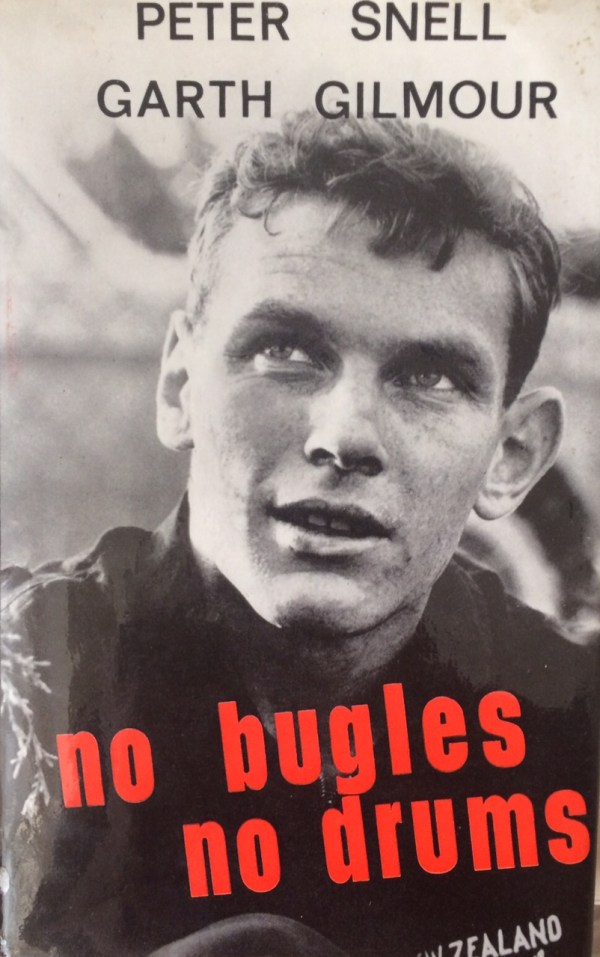
In the finals of the 800 meters, Snell drew the first lane, which he thought was unlucky because he would have to either “go like a madman and hit the front so you can maneuver with the field behind you and allow only as many pass as you want, or you can start slowly and try to work your race from the back of the field,” he wrote in his autobiography, No Bugles No Drums. “Either way can be troublesome and an in-between start can cause all sorts of jostling and tangling.”

With that understanding, Snell chose the first option with the intent of just trialing the lead runner, Wilson Kiprigut of Kenya, who was expected to jump out to a fast start. By sticking to the shoulder of the pacesetter, he would be able to avoid being boxed in and slowed. As it turned out, Kiprigut did not race out to the lead, and Snell ended up boxed in amidst a group at the front.

With 250 meters, Snell’s plan was to go all out. But he was trapped.

My pre-race plan had called for a sustained sprint from about 250-to-go. Now the whole position was confused. I was running easily within myself and, unlike Rome, where the circumstances were similar, I felt I was capable of dropping back out of the box, going around the field and still being able to challenge. That’s what I had to do. This involved two separate moves: a surge from the rear of the field to about fourth position with a clear run three or four wide which took me to the end of the back straight; then a second and final effort as I fought past Kiprugut and Kerr, who were locked together, and sprinted desperately into the curve. It was desperate because my plan had gone wrong and my run was coming late against fast finishers.

Snell on the victory stand_800 meters
Crothers, Snell and Kiprugut

But soon, desperation gave way to elation. Snell hit the tape, setting an Olympic record. Despite having to drop back and swing wide to take the lead, Snell still relaxed at the end, as he wrote, “subconsciously” holding back for the 1500 meter competition to come.

Watch this video highlighting Snell’s exciting victory in the 800 meter race in Tokyo.

Peter Snell
Peter Snell of New Zealand, from the book “The Olympic Century – XVIII Olympiad”


Peter Snell was the 800-meter Olympic champion, coming out of relative obscurity to set an Olympic record at the 1960 Olympic Games in Rome and win the gold medal. But in Tokyo in 1964, Snell was not only the favorite in the 800 meters, he and many others were expecting him to compete and win in the more glamorous 1500-meter race.

While our stereotypical view of Olympic champions are they are super confident and expect to win, the reality is that many oscillate between expectations of victory and the inevitability of disaster. Peter Snell of New Zealand may have exemplified the latter.

As British Olympic reporter, Neil Allen, noted in his book, Olympic Diary Tokyo 1964, Snell was shy and filled with doubt prior to the start of competition.

Two years ago the shy New Zealander and I had sat on the grass in Geraldon, Western Australia, and I had listened to him ponder, with worried brow, his problems in training for the forthcoming Commonwealth Games. Now he was behaving as though he was the last man in the world to hold the records for 800 meters, 880 yards and the mile, the last man you could imagine had won the Olympic 800 meter title four years ago.

“Running both events here might take it out of me, you know,” he said, staring at the ground. “My training was going so badly back at the beginning of last month that I got to the pitch where I couldn’t care less about the Olympics. There are times when you wonder how on earth you could run a 4:30 mile. You no longer have the ability to punish yourself.”

After a successful trial run in the 800 meters, Snell decided he would go for both the 800 and 1500 meter championships. He understood the ramifications of having to run heats in both races, with the possibility that the effort and strain of competing in both could mean doing poorly in both. And those doubts would not go away, as Snell wrote in his autobiography, No Bugles, No Drums.

My most nerve-racking period of the Games was the night before my first race. I’d made the decision to try for the double and promptly that night all sorts of doubts crowded into my mind in a sleep-wrecking procession. Quite seriously I wondered whether the decision was the right one. I felt I could produce a really good performance over 1500 meters. But if I ran in the 800 meters first, there was a strong possibility that not only could I run out of a place in that event – or even fail to qualify at all – I could find myself too tired for the 1500. I could, through tackling both, miss out on both. Was I being too greedy?

No Bugles No Drums

National Olympic Stadium and underground tunnell
Blueprint for the National Olympic Stadium for the 1964 Olympics, including underground tunnel. Source: Japan Sport Council

In his book, No Bugles No Drums, Olympic track legend, Peter Snell of New Zealand, wrote about an underground tunnel at the National Olympic Stadium, where he competed at the 1964 Olympic Games.

“Ten minutes before the gun, we were led through an underground tunnel which took us right underneath the track diagonally to a point at the beginning of the back straight. Then a walk around to the start.”

Ollan Cassell, lead runner on the US 4X400 men’s team that won gold in Tokyo, also noticed the underground tunnel. “The Japanese thought of everything,” he wrote in his book Inside the Five Ring Circus. “They even built a tunnel under the stadium track so athletes and official going to their events on the infield did not cross the track.”


National Olympic Stadium and underground tunnell 2
A picture of the 1964 tunnel at that time. Considerable work had been done afterwards to hide the pipes and cables. Source: Japan Sport Council

Cassell asked me to confirm that his memories were correct, so I did some digging. After a few emails exchanged between me and The Japan Sport Council, the government body that manages and operates some of the largest sports facilities in Japan, including the National Olympic Stadium, I was pleasantly surprised to get confirmation on the tunnel.

Not only that, the Japan Sport Council was kind enough to provide a schematic and photos.

An underground tunnel that allows officials and athletes to get to the infield or across the stadium without crossing a track seems like a great idea. You would think that all stadiums would be designed that way. But Cassell wrote to me that in fact Tokyo’s National Olympic Stadium was unique. “I have attended every Games since then, thru 1996 and never found anything like what they did. I missed 2000 and 2004 but attended all other games and did not hear anything about a tunnel from those who attended the 2000 and 2004 games.”

The National Olympic Stadium has been torn down, a new one set to rise (once a plan is finalized). But the old one apparently had a trick under its sleeve. It will be missed. To see what the stadium looked like just before it was torn down, check out these 360 views of the stadium.

National Olympic Stadium 360

Iolanda Balas in Tokyo_Tokyo Olympiad 1964_Kyodo News Service
From the book, XVIII Olympiad Tokyo 1964 Asahi Shinbum

One of the most dominant female athletes in history passed away this week. Iolanda Balaș was not only the first Romanian woman to win an Olympic gold medal, she was the sole world record holder of the high jump for over thirteen years, setting a new record 12 times in that span from June 1958 to July 1961.

Balaș won her first gold medal during that period at the Rome Olympics in 1960. She had not missed a jump in the entire competition, and so had extra jumps. After winning the competition at 1.73 meters, she went after the Olympic record. Leaping 1.77, 1.81 and 1.85 meters, she broke the Olympic record three times before calling it quits.

At Tokyo in 1964, Balaș did it again, not missing a jump, and winning the gold medal at the height of 1.82 meters. Again, with bullets to spare, she took a shot at the Olympic record and broke it twice, first at 1.86 meters, and then finally at 1.90. She reached this incredible height, apparently, despite a torn tendon.

Balaș was 79.

Watch her emerge victorious in Rome in this video.

Ikuko Yoda_Tokyo Olympics Special Issue_Kokusai Johosha 1
Ikuko Yoda, from the magazine Tokyo Olympics Special Issue_Kokusai Johosha
Ikuko Yoda (依田郁子) did not make the team to go to the Rome Olympic Games in 1960. So she went to Lake Sagami near Mt Fuji, took a large amount of sleeping pills, and attempted to end her life. However, she did not succeed.

Running the hurdles had become her life, and competing and winning in the Olympics was perhaps a way to make her complete. Recovering from the pain of Rome, she may have seen redemption in Tokyo, and recovered enough from her suicide attempt to begin training again. Over that 4-year period, Yoda set and re-set the Japan record for the 80-meter hurdles 12 times, becoming a powerful track and field hope for Japan at the Tokyo Olympics.

During the Tokyo Games, photographers tracked her every move. The famed director, Kon Ichikawa, had his movie cameras focused on Yoda more than other competitors for the film, Tokyo Olympiad. And Yoda ran excellently, easily making the cut in the first round of heats, running a personal best 10.7 seconds. In the semis, she again ran the course in 10.7 seconds and made it to the final 8.

In one of the closest finals in any Olympic foot race ever, Karin Balzer of Germany and Teresa Cieply of Poland finished the 8-meter race in 10.5 seconds, although Balzer was declared the winner. Pam Kilborn of Australia finished third with a time of 10.6 seconds. With a time of 10.7 seconds, Yoda finished fifth.

No doubt, this was a fantastic time and finish. In fact, she’s still the only Japanese female to enter the finals of any individual short-distance race in the history of international competition.

But she could not outrun her demons.

Ikuko Yoda_Asahi Graf_Oct 23
Ikuko Yoda, from the magazine Asahi Graf_Oct 23
After the 1964 Olympics, Yoda married. She had children. And as she entered her forties, she began to suffer from health issues. In 1983 she entered the hospital for knee and heart issues. And on October 14 of that year, nearly 19 years to the day when she fought but came in fifth in the 80-meter hurdles at the Tokyo Games, she hung herself in her own home.

She left no note. But she suffered from depression, and apparently had problems reconciling her images of perfection in whatever she was doing, and the reality around her. Here is how Robin Kietlinski, the author of Japanese Women and Sport explained it.

In spite of the paper-thin difference separating Yoda’s finishing time from those of the three medal winners, she had an incredibly difficult time handling the fact that she had trained so hard and did not come away with a medal. She was frequently described as a perfectionist (kanzenshugisha, kanpekishugisha) who could not bear when things did not go exactly as she planned. At a press conference immediately following the conclusion of the Tokyo Olympics, Yoda caused quite a stir when she reported that ‘I do not want to go through the pain of racing a second time. I will be retiring now. I do not even want to look at a track again.’ Shortly thereafter, she married a professor at the Tokyo University of Education (now Tsukuba University) and fully devoted herself to being a good housewife and later a caring mother to her children. According to her husband, she was as much a perfectionist when it came to running the household as she had been during her running career.

David Wottle on Winners Podium
02 Sep 1972, Munich, Germany — Hand over heart, America;s David Wottle stands on winner’s podium after receiving the Gold Medal in the Olympic men’s 800 meter race here today 9/2, with Soviet Silver Medal winner Evgeni Arzhanov in front of him, and Mike Boit (left) of Kenya, the Bronze medalist, behind. — Image by © Bettmann/CORBIS
You couldn’t miss him. In the finals of the 800 meter race at the 1972 Olympic Games in Munich, he was the only one wearing a cap. And he was all the way in the back of the pack.

But Dave Wottle did not remain in the back. The Kenyans were setting the pace. Then the Soviet star, Yevgeniy Arzhanov, took the lead with two hundred meters to go, and Wottle of Bowling Green State University is in fifth at the beginning of his kick. As the American broadcasters shout excitedly in this particularly partisan call, Wottle passes one runner after another until nipping the Soviet at the tape to win gold.

Most athletes would bask in the warmth of victory – either jumping in jubilation, or smiling endlessly with a quiet sense of accomplishment. Instead, Wottle wore an expressionless mask, perhaps one of shock. And when he stepped up to the winner’s podium, he made a mistake in etiquette that ruined this championship moment for him.

As the American national anthem played, Wottle forgot to remove his cap. And as he mentioned in this profile in the book, Tales of Gold, “I suppose what most people will remember about me as an Olympic athlete is that I was the one who wore a golf cap while running and also that I forgot to take it off on the victory stand. That episode just dampened my whole Olympic experience. I was never so embarrassed in my life! It should have been the happiest day but it wasn’t; I was simply too embarrassed to be totally happy.”

It was 1972, four years removed from the black-fisted protests of Tommie Smith and John Carlos on the medal podium in Mexico City, a time when the US was stuck in the quagmire of the Vietnam War, and only a few days before Palestinian terrorists broke into the Olympic Village, taking the Israeli team hostage, and eventually killing them. When people saw Wottle with his white cap on, and his right hand on his left breast, covering the USA patch, they may have wondered what he was protesting. The Vietnam War perhaps?

Wottle was mortified. He said he had absolutely no ill will in wearing the hat, that he simply forgot to take it off.

As Milton Richman wrote in the State Journal-Register, a local Springfield, Illinois newspaper, “The cap sells for 75 cents. You can get it for 35 cents wholesale. Dave Wottle wears it practically everywhere. He wears it when he runs. He wears it when he trains. He

Bud Collins and Dick Enberg
NBC announcer Bud Collins, left, with Dick Enberg in the television booth at the All England Club for the 1982 Wimbledon. Photo: Walter Looss JR. /Sports Illustrated/Getty Images

I was a big tennis fan when I was growing up in Queens, New York, getting lessons at Cunningham Park, and playing with friends on the awful concrete court on the grounds of the Queens General Hospital. And I remember in the 1970s watching Breakfast at Wimbledon on NBC, with Bud Collins, when Bjorn Borg was the dominant male tennis player of the time, routinely defeating Jimmy Connors, Guillermo Vilas and Roscoe Tanner. And I remember the epic five-setter in 1980 when John McEnroe lost to Borg at Wimbledon. Bud Collins was always there.

Collins passed away on March 4, 2016.

But what I just learned is that Bud Collins, who essentially began his journalistic career as a college student for his school paper, went, somewhat on a whim, to the 1948 London Olympic Games as a spectator. The goal was to cheer on a fellow Baldwin-Wallace College student, William Harrison Dillard.

A few years ago, Collins wrote this wonderful article for ESPN, recalling his early days in Berea, Ohio, where he literally delivered newspapers (Cleveland Plain Dealer) on the Baldwin-Wallace campus and its environs as a 14-year old. When he became a BW student, world-class hurdler Dillard also decided to join BW. Dillard could have gone to Ohio State, the alma mater of Jesse Owens, the last American to win Olympic gold in the 100 meters in 1936, but as Collins relates in the article, Dillard wanted to stay closer to home.

harrison dillard 1948
William Harrison Dillard in 1948 at the London Summer Games.


Collins continues to write this amazing story of how Dillard was pretty much expected to win gold in the 110 meter hurdles easily at the re-boot Olympics in 1948, the first Olympics since Berlin in 1936, postponed for 12 years due to world war. (in fact, Dillard served in the US military, seeing significant action on the Italian front.) But for some reason, at the Olympic trials, Dillard competed poorly and would not be asked to compete as a hurdler. He did place third in the 100 meters, so was put on the team to possibly compete in the 400-meter relay team.

So when young Bud Collins, and his editor on the school paper, decided to use their savings and borrow money so they could go to London, there was only a slim possibility of watching their buddy, “Bones” Dillard, compete at the 1948 Olympic Games. As it turned out, in a London still climbing out of the rubble of World War II, Dillard was crowned the fastest man in the world, and a budding journalist named Bud Collins was there.

Thank you Bud, for the memories.

Bolt in ANA commercial
Usain Bolt in first ANA commercial

World’s Fastest Man and two-time Olympic champion in the hundred meters, Usain Bolt earned $15,000 in track competitions in 2015, according to Forbes. But in terms of endorsements, the sprinter from Jamaica pulled in a cool $21 million.

Puma alone invests $9 million a year lacing Bolt up. Rio, more gold and deeper reservoirs of endorsements are potentially around the corner for Bolt in August.

Adding to those riches is ANA, otherwise known as All Nippon Airways, which just signed the six-time Olympic gold medalist to an endorsement deal. And the first use of the Bolt brand comes in this television commercial of Bolt dancing to the well-known pop song, “Tokio”, written by a band called “Tokio“.

At the end of the commercial, Bolt says “Bolt-un deru?” (ボルトんでる?) It’s a Japanese play on the phrase “bu-tton deru” (ぶっ飛んでる), which means “crazy”, but in this case probably means “going crazy” in a fun, exciting way. An ordinary way of saying it, more appropriately for ANA perhaps, is “taking off”.

So what do you think of Usain Bolt’s moves?