Roy_1965 maybe
Roy, around 1 years old

On May 1, 2015, I kicked off my blog, The Olympians, with the intent of providing at least one blog post every day. Here we are, 365 days, over 10,000 visitors, nearly 20,000 views later, and I have kept my promise. Many thanks to all those who have helped me along the way!

Below are 20 of my favorite posts in 2016:

  1. The 1962 Asian Games: How Cold War Politics Sparked Heated Debate, Leading to the Indonesian Boycott of the 1964 Games
  2. “Do it Again. Again. Again.”: The Uncompromising Mindset of an Olympic Champion
  3. The Dutch Boycott of the 1956 Olympic Games Part 2: Rehabilitation
  4. The Hijab and The Turban: Why American Fencer Ibtihaj Muhammad is Important  
  5. Dr Jega: The Fastest Man in Asia Learns that Life Works in Mysterious Ways
  6. Duke Kahanamoku Part 1: Surfing’s Johnny Appleseed Inspires Australia’s Pioneering Surfers and an Entire Sports Culture
  7. Japanese Face Off in Australia on the 15th Anniversary of Pearl Harbor
  8. Ken Sitzberger and Jeanne Collier: Diving’s Power Couple in 1964
  9. The Pain and Joy of Pain: Dick Roth and the Gold that Almost Wasn’t
  10. The Perfectionist’s Dilemma: The All-or-Nothing Life of Hurdler Ikuko Yoda
  11. Rare Canadian Gold in Tokyo: George Hungerford and Roger Jackson Win the Coxless Pairs
  12. The Record-Setting Row2Rio Team: Following in the Footsteps (Sea legs?) of Christopher Columbus
  13. Remembering the 3.11 Earthquake and Tsunami, My Ancestors, and the Tokyo Olympic Cauldron
  14. Sazae-san Part 3: Suicides and The Pressure Cooker of Japanese Education
  15. Simple is Best: Finally, The New Tokyo 2020 Olympic and Paralympic Logos
  16. Singaporean Cyclist Hamid Supaat and the Big Chill: Competing on the World Stage
  17. The “Six-Million-Dollar-Man” and “Real Steel” Scenarios: Science and Technology Blurring the Lines and Creating New Ones  
  18. Tommy Kono: Out of an Internment Camp Rises Arguably the Greatest Weightlifter of All Time    
  19. Unbroken: The Truly Epic Story of Louis Zamperini Finally Shown in Japan
  20. Worrying Willy and Paradise Pete: How the US Army Prepped Recruits for Japan in the 1950s

Click here for my favorite posts from 2015! Again, many thanks for all your support!

1964-tokyo
Manikavasagam Jegathesan of Malaysia (#415) at the 1964 Tokyo Olympics

Life is long, and full of complexity. As one can’t see the forest for the trees, one also can’t know how actions today will shape one’s situation months or years later. Manikavasagam Jegathesan of Malaysia was only 16 years old when he took center stage in the 1960 Rome Olympics, the first of three Olympiad appearances. Little did he know that his entire life would be shaped by the Games, particularly those in Tokyo in October of 1964.

“When the Rome Olympics started, every winner became my hero. I was so impressionable,” Jegathesan told me. “Livio Berrutti was the 200-meter champion, and he ran in sunglasses. I was targeting him. I was going to be him. From that point on, I never ran a race without dark glasses. In my first heat, I ran against Milkha Singh, the Flying Sikh. He was another hero.” Jegathesan did not make it beyond the first heat in Rome, and his Olympics competition was done.

1960-400 hts first round with milka
Jegathesan running a heat with Milka Singh at the 1960 Olympics

But when the Tokyo Olympics rolled around in 1964, Jegathesan was the fastest man in Asia, Asian Games champion in both the 100 and 200-meters. And when he crossed the tape at 20.5 seconds in Singapore a few months before the Olympics in a 200-meter race, there were hopes he could challenge for the finals in Tokyo.

Jegathesan took to the blocks first with the 100 meters, where he hoped to be the first Malaysian to make it beyond the first round. He made the cut with a time of 10.6 seconds, but was eliminated in the second round – which was OK. He got the nerves out of the way, and was ready to do damage in the 200-meter competition.

In round one of the 200-meter competition, Jegathesan ran toe to toe with Canadian superstar, Harry Jerome, who had already taken the bronze medal in the 100-meter finals. Then in the quarterfinals, Jegathesan ran against Paul Drayton, who eventually won silver in the 200 meters, and his hero, Livio Berruti, the 1960 200-meter champion from Italy. He finished just behind those two to qualify, becoming the first Malaysian to make it to the semi-finals. That would take place the next day, so Jegathesan was ready for a good night’s sleep.

But a good sleep never came. He awoke in the middle of the night, his throat sore, his body feverish. He could not sleep, his condition now feeding a growing anxiety about his prospects in the 200. When morning arrived, he took off for the stadium, angry that his chance at glory was at risk. Jegathesan ran as hard as he could, but finished last in his semi-final heat. He trooped on as a team member of the Malaysian 4×100-meter relay team, but ran poorly, and pulled out of the 4X400 meter relay.

His Tokyo Games finished, Jegathesan went to the Olympic Village infirmary and met the physician on call, Dr Yoshio Kuroda. The doctor diagnosed chicken pox, which is a contagious, uncomfortable disease. So the doctor ordered Jegathesan to bed in the hospital, and thus could not participate in the closing ceremonies. Jegathesan did go on to compete in the 1968 Games in Mexico City, where he made it again to the semi-finals of the 200-meter competition, and set the Malaysian record of 20.92 seconds, which still stands.

Time passed. Jegathesan completed his medical studies and went on to practice as a medical officer for the Malaysian government. In 2003, Dr. Jega, as he is now often called, was at an international athletics meet in Hyderabad, India. He was serving at the medical station for this event when in walked a man from Japan who took one look at him and said, “You’re the guy with chicken pox!” Dr Jega was reunited with his doctor at the Tokyo

Lee Calhoun in 1960
The finish of the 100m hurdles at the Olympic games in Rome in 1960, just won by Lee Calhoun from the USA ahead of Willie Mae also from the USA.

Lee Calhoun was the 110-meter hurdles champion at the 1956 Melbourne Games. And like many other athletes in the post-war years, he was not financially well off. He was about to get married, but he wanted to keep his dream alive of repeating his gold-medal success at the 1960 Rome Games.

For many athletes in America up until about the 1980s, this meant sacrifice, scrimping and saving to maintain just enough to get by and be able to train. In 1958, Calhoun intended to marry his college sweetheart, but was under no illusion of being able to afford anything special.

His fiancé, Gwen Bannister, had an idea. Based on a tip from Calhoun’s college coach, LeRoy T. Walker, Bannister would apply for participation on the popular game show, “Bride and Groom”. On this program from the 1950s, couples would actually get married, revel in their wedding gifts presented on the show, and then be sent off on an all-expenses paid honeymoon.

Bride and Groom_NBC title screenshot

As she explained to David Maraniss in his wonderful book Rome 1960: The Olympics that Changed the World, Bannister said that Calhoun was not a party to the idea, but was all for it when he heard about it. “If they enjoyed your letter, they would put you on the show. Mine must have been a humdinger,” Gwen told Maraniss. “I didn’t tell Lee about it until I knew for sure. He thought it was wonderful. We knew we didn’t have anything; didn’t even have a job. [But] it was my choice. Lee didn’t have anything to do with it.”

Lee Calhoun cardThen fell the heavy hand of the AAU, the Amateur Athletic Union, which was the overarching governing body for sports in America recognized by the IOC. Only a week before Lee Calhoun and Gwen Bannister were to be married on television, Dan Ferris of the AAU informed the couple that Calhoun would no longer be considered an amateur if he appeared on “Bride and Groom”. As Maraniss explained, “Calhoun was unduly benefiting from his status as an athlete and that the couple would not have been invited on Bride and Groom had he not been a track star.”

Calhoun thought the judgment was unfair, “that anyone could be on the TV show, not just athletes.” So Lee and Gwen rolled the dice and got married on Bride and Groom.

Calhoun was suspended from competing in track and field for a year. Fortunately, he was able to continue his Olympic journey after the suspension, go to Rome, and win gold in 110-meter hurdles.

Neal Horan pushing Vanderlei de Lima at the 2004 Athens Games Marathon

No Brazilian had ever won Olympic gold in the marathon, and there he was, in first place at the home of the marathon, Greece, competing in the 2004 Athens Summer Games.

With only 7 kilometers to go, Vanderlei Cordeiro de Lima was in the lead by a healthy 25 to 30 seconds when a man in a green vest, red skirt and green socks burst out of the crowd from de Lima’s right, grabbed de Lima and proceeded to push him all the way off the road and into the shocked crowd watching the race.

de Lima pushed his way out and back into the race, but lost a precious 15 to 20 seconds. And as you can see after he returned to the race, he was clearly disgusted with what had happened. (Be amazed as you watch the incident unfold around the 20 second mark in this video.)

In the end, de Lima was eventually passed by gold medalist Stefano Baldini of Italy and silver medalist Mebrahtom Keflezighi of the US. De Lima finished third, 42 seconds behind Keflezighi and 1 minute 16 seconds behind Baldini.

Would de Lima have won the marathon championship if not for literally being sidetracked? It’s hard to know. While the IOC declined an appeal by the Brazilian Athletics Federation to award de Lima with a gold medal, they did present him with the Pierre de Coubertin medal for sportsmanship. (The first one was awarded at the 1964 Tokyo Games.)

The perpetrator was Cornelius “Neil” Horan, a defrocked Roman Catholic priest from Ireland. Horan made the headlines the previous year by running onto the track at the 2003 British Grand Prix, running hard down the track in the direction of oncoming Formula 1 cars darting to their right to avoid Horan. (Be amazed again as Horan makes his appearance 10 seconds into the video below.)

Dorothy Tyler Odam in Berlin
Dorothy Odam-Tyler competing in Berlin in 1936.

Dorothy Odam-Tyler of London competed in four Olympics, which is an amazing fact. But she did so over a 20 year-period in a land devastated by war. A world record high jumper, Tyler-Odam won the silver medal in the 1936 and 1948 Olympics, the only athlete to have won medals before and after the Second World War.

World War II took place from 1939 to 1945, resulting in the deaths of over 60 million people. Quite ironically, the host cities selected for the XI Olympiad in 1936, the XII Olympiad in 1940, and the XIII Olympiad in 1944 were respectively Berlin, Tokyo and London – the capitols of the three of the most prominent players in the Second World War.

As it turned out, Olympics of 1940 and 1944 were cancelled due to war. In other words, the Olympic spirit, or rather the Olympic legend of suspending war in order to conduct an Olympiad was not able to overcome the nationalism and militarism of the mid-20th century.

In 1936, war was not imminent. Adolf Hitler had come to power in Germany, but had not yet made explicit his need for “elbow room”. Thus the 1936 Games in Berlin were his opportunity to show the world that the German way was the way of the future.

Dorothy Odam, as she was known in 1936, was still only 16 years old when she appeared in Berlin. According to Mike Fleet in his wonderful biography of the English high jumper entitled Thanks and No Thanks Mr Hitler, Odam-Tyler had an eye-opening experience. “The politically uniformed teenager had a further rude awakening, as hundreds of Hitler Youth members marched about proudly swinging their swastika armbands, many with shovels and brooms at the slope of their shoulders.”

thanks and no thanks mr hitler

Despite the militaristic atmosphere and the grandeur of the opening ceremonies, the teenager was able to keep her emotions intact, and battle to, essentially, a tie in the high jump. Utilizing a scissor-jump approach, Odam-Tyler was one of three of the remaining athletes to jump 1.6 meters on her first attempt. Only two others were able to clear that height, but not without failed attempts.

Unfortunately, the rules were not in Odam-Tyler’s favor, according to Fleet. In today’s world, Odam-Tyler would have been considered the winner for making the top height with the least number of missed attempts. But in 1936, they re-set the bar higher. In the next round, Ibolya Csak of Hungary was the only one to clear 1.62 meters. Odam-Tyler cleared 1.6 meters again, taking silver, and becoming the first British woman to win an Olympic medal.

During the war years, Odam-Tyler worked for the Royal Air Force in the war effort, still finding time to train. She was now married to Dick Tyler, but they were soon separated as he joined a tank regiment that served first in North Africa, and then in Burma. And fortunately, they both survived the war.

Dorothy Odam-Tyler was now 28, and the Olympic Games were scheduled for the summer of 1948 in London. Her motivation was to win gold and wipe out the memory of her loss in Berlin 12 years before. And despite the time that had been sacrificed to war instead of training and competition, the bar continued to be raised, literally, in what was a thrilling competition.

As the field thinned, only three remained at 1.62 meters, including American Alice Coachman and French women Micheline Ostermeyer. At 1.64, Ostermeyer failed to make the cut. Odam-Tyler and Coachman continued their duel. First they both cleared 1.66 meters, setting an Olympic record. Then they both cleared 1.68. But at 1.70 meters, both failed in their three attempts. Due to the tie-breaking rules, Coachman was declared the winner, and became the first black woman to win an Olympic gold medal.

As for Odam-Tyler, she won her two silver medals in two Olympiads 12 years apart, bookending one of the most violent and largest wars in the history of mankind. One could

electrically stimulated muscles_Cybathlon
Wheelchair racers whose legs are paralyzed, but whose leg muscles are electro-stimulated to move


We cringe when we hear about yet another doping case in sports. Dopers are cheaters! We hope that international bodies like World Anti-Doping Agency (WADA) can stay close with the shadow chemists who continue to devise new ways to mask the fingerprints of performance enhancing agents.

We thrill to see a double amputee sprint on carbon-fiber blades, but we worry if they will one day far outpace sprinters who race on legs they were born with. Unfair advantage!

The truth is science and technology, if it had a will of its own, is ever eager to advance, solve problems, and push the inside of the envelope. The infamous Oscar Pistorius was allowed to compete at the 2012 Olympics on his blades, running in the 400 meter and 4X400 meter competitions. Technology in this case did not afford the runner an advantage to take him to the elite levels of sprinting.

But we all know, it’s a matter of time. The “Six-Million Dollar Man” Scenario, where a given person with various prostheses and enhancements will be “better than he was. Better….stronger….faster.” The Six Million Dollar Man debuted on American television in 1973. If the main character, Steve Austin, wanted to participate in the 1976 Olympic Games, he would have won gold in almost every athletic event. Why he wasted time as a secret agent for the OSI is beyond me.

The Six Million Dollar Man

So what does the future hold? Clearly, engineers, scientists and entrepreneurs will continue to look for ways for people with disabilities to return to so-called “normalcy”. They will also look for ways to give “normal” people super-human abilities. In the case of organized sports, the nature of competition will continue to change. In fact, it already has.

When technology creates a totally different standard of performance, new competitions arise, as was explained in this Wired Magazine article from 2012.

When such devices are perfected to the point that they can be used for athletic purposes, we’ll be looking at an entirely new concept of sport. It’s doubtful the Olympics will ever feature exoskelletally assisted runners or weightlifters, but what’s to say that a different type of venue won’t arise for such a thing? “I think that once the technology is proven to exceed normal human function, then the stage will be set for the introduction of a whole new type of enhanced sporting entertainment,” said Matthew Garibaldi, director of the Orthotic and Prosthetic Centers for the Department of Orthopaedic Surgery at UC San Francisco.

In fact, two competitions that put technology front and center have emerged. As explained in this Inverse.com article, the Swiss Federal Institute of Technology in Zurich organizes a competition called the Cybathlon, the next one scheduled on October 6. It’s similar to the Paralympics, in which disabled people use technology, like a prosthesis, and the athlete

White City Stadium 1908

It is huge. Olympian in fact.

When it opened in time for the opening ceremonies of the 1908 London Games, The White City Stadium sat 68,000 people, although it could fit another nearly 30,000 standing spectators. It had an oval running track, about 7 meters wide. And between the running track and the stands was a cycling track that was another 11 meters wide.

Cycling at White Citsy Stadium_1908

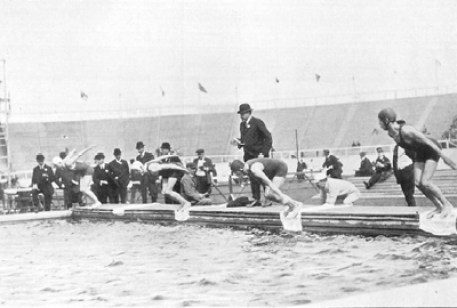
The oval tracks were so wide that, in addition to space for athletic events like archery and hammer throwing, there was enough room for a swimming and diving pool!

Swimming at White City Stadium_1908

Unfortunately, the 1908 Olympics was the stadium’s high point. In 1927, it was sold to the Greyhound Racing Association, literally going to the dogs. The stadium no longer exists, torn down in 1985 to make way for the headquarters of the BBC.

White City Stadium circa 1950s
BBC Television Centre takes shape in the late 1950s with White City Stadium nearby
TEN-SPO-SHARAPOVA
Russian tennis player Maria Sharapova speaks at a press conference in Los Angeles, on March 7, 2016.  / AFP / ROBYN BECK (Photo credit should read ROBYN BECK/AFP/Getty Images)

The world was shocked when world #11 and five-time grand slam singles champion, Maria Sharapova, was suspended from tennis competition for use of a banned substance, meldonium. The tennis world reacted with scorn for the former world #1 women’s tennis player:

  • John McEnroe: “It would be hard to believe that no one in her camp, the 25 or 30 people that work for her, or Maria herself, had (any) idea that (meldonium had been banned).”
  • Jennifer Capriati: “I didn’t have the high priced team of [doctors] that found a way for me to cheat and get around the system and wait for science to catch up.”

Capriati is making the most powerful case against doping from an athlete’s perspective. Taking banned or illegal drugs to enhance performance is cheating. And to not call out cheats is unfair to those who are not taking drugs that give advantage.

Sponsors dropped Sharapova like an overripe fruit with maggots inside. All except Head, the racquet manufacturer.

According to this statement from HEAD, “We question WADA’s decision to add meldonium to its banned substances list in the manner it did; we believe the correct action by WADA would have been to impose a dosage limitation only. In the circumstances we would encourage WADA to release scientific studies which validates their claim that meldonium should be a banned substance.”

WADA is the World Anti-Doping Association, the international governing body that establishes what athletes may or may not put into their bodies. The president of WADA, Dick Pound responded to HEAD’s statement to the BBC:

“First and foremost, Head is a manufacturer and seller of tennis rackets, among other things. So far as I’m aware, it’s not a medical expert and not in a position to amend the world anti-doping code. As for its view as a commercial racket seller as to whether meldonium should be on the list of prohibited substances or not, quite frankly I prefer the scientific opinion of medical experts to the commercial interest of somebody telling tennis rackets using a player who is subject to whatever discipline is called for under the world anti-doping code. A complete conflict of interest on its part, combined with a lack of knowledge of the particular substance.”

SPORTS-WADA-ESP-POUND
World Anti-Doping Agency (WADA) president Canadian lawyer Dick Pound / AFP PHOTO/PIERRE-PHILIPPE MARCOU (Photo credit should read PIERRE-PHILIPPE MARCOU/AFP/Getty Images)

That is a powerful and damning retort from Pound, whose efforts helped lead to the suspension of Russia’s entire track and field team from international competition, including the upcoming 2016 Rio Olympics.

And yet, this is what confuses me. There doesn’t seem to be any consensus among “medical experts” as to whether meldonium actually enhances performance in athletes.

This New York Times article explains the science of how meldonium works. In short, burning glucose in your body releases more energy than burning fat. The “science” states that meldonium will work to encourage the burning of glucose, not fat. So when you’re oxygen starved, a situation many high-performance athletes find themselves in when they exert themselves, the meldonium will give them a glucose burn and a bigger burst of oxygen.

Meldonium box
A box of meldonium pills, legally marketed as Mildronate primarily in Eastern Europe.

The same New York Times article, entitled “Effects of Meldonium on Athletes are Hazy“, quotes Dr Eric Brass of UCLA, who questions the correlation between meldonium and greater athletic performance.

“In general, if one is involved in short-duration, sprint-type activity, one tends to use glucose because it is more available and it is an efficient way to generate energy quickly,” said Dr. Eric Brass, a professor of medicine at U.C.L.A. Still, Brass said it was not clear if that was what was really happening in athletes. “The science behind many of these performance-enhancing compounds is limited, biased and subject to misinterpretation,” he said. Several of the studies on meldonium were done on rats and published only in Russian.

This is why doping stories outrage me and put me to sleep at the same time. I definitely

opening ceremony 1896 Olympics
Panathenaic Stadium a the 1896 Athens Olympics

Pierre de Fredy, Baron de Coubertin‘s dream had come true. He had a singular passion to revive the ancient Olympic games, bring nations together in peace, athleticism and sportsmanship, creating the first ever international sports body, the International Olympics Committee, and then organizing the first modern Olympic Games.

It was 120 years ago today when tens of thousands packed a stadium in Athens, Greece, the birthplace of the Olympics to witness an international sporting event of a scale never seen before. While only 10 nations and 64 athletes competed at the 1896 Athens Games, the 2012 London Games had over 200 nations represented and over 10,700 participants.

100m Athens 1896
100 meters at the Athens Games

With the first Olympiad, a bar was set with every finish. And from that point on, performance was measured on beating the best scores set at a global scale. Coubertin proposed the Latin words, “Citius, Altius, Fortius” as the Olympic motto, which means “Faster, Higher, Stronger”.

The Olympics created a revolution of sports measurement, creating new goals and aspirations for people all over the world. Below is a comparison of results in the years 1896 and 2012. Yes, this is a period of 116 years, but every year, thousands of people were driven by the very best scores established at international and then national sporting events.

1896 vs 2012 results

One of my favorite New York Times videos is one that explains how fast the fastest man in the world has become, comparing every Olympic champion since Thomas Burke in 1896 to Usain Bolt in 2012. As this video dramatically shows, Bolt would have beaten Burke by over 18 meters, or 60 feet!

Batman vs Superman

In the film, Batman Vs Superman, two iconic comic book characters are brought face to face, setting up the inevitable debut of the Justice League from the DC universe. In the series, the Avengers, countless super-heroes of the Marvel universe have been brought together much to the delight of geeks and fanboys.

In the 1912 Olympics in Stockholm, Sweden, there was a super-hero team up of sorts when Jim Thorpe and Duke Kahanamoku were selected for the US Olympic Team. Thorpe is considered one of the greatest athletes the world has ever known. At the 1912 Olympics, Thorpe won, amazingly, both the pentathlon and the decathlon.

Thorpe and Kahanamoku
Jim Thorpe(left) and Duke Kahanamoku (right) in 1912


Duke Kahanamoku of the then American territory of Hawaii helped popularize surfing beyond his Honolulu shores. At the 1912 Olympics, he won the 100-meter finals becoming the fastest swimmer in the world.

Like most super-heroes, Thorpe and Kahanamoku were the outsiders. The Native Indian Thorpe and the Hawaaiin Kahanamoku were relatively dark skinned, and were seen as exotic by mainstream America, as explained by David Davis in his wonderful biography of Kahanamoku called Waterman: The Life and Times of Duke Kahanamoku. Davis shared a typical headline from the Detroit Free Press, which accompanied a picture of Kahamoku and a black athlete, Howard Drew: Two Dark-Skinned Athletes with American Team”

The head of the US Olympic squad, John Sullivan, was typical of the times – he believed in the superiority of white athletes, and male athletes. But as Davis explained, he was also