Anton Geesink set the judo world on fire by defeating Koji Sone in the 1961 World Championships. The tall and imposing Dutchman was the first non-Japanese judoka to win in any weight-class in a world championship.
However, Geesink wasn’t satisfied with the way he won. He wrote in his book, My Championship Judo, that he used a “halfway trick” to put Sone to the ground before immobolising him for victory. He felt that despite being the world champion, he needed to continue to improve.
When Geesink visited Japan in 1963 at the invitation of Tenri University, which had some of the best judoka in the world, he learned that Ne-Waza, or ground technique, was the Judo of the future. “In fact, it was the finals of the open weight class competition at the 1964 Tokyo Olympics when Geesink took advantage of a failed Tai-Otoshi attempt by his opponent, Akio Kaminaga. Geesink instead ended up pushing the Japanese to the mat, immediately maneuvering for a Ne-Waza technique Geesink no doubt sharpened at Tenri University.
Geesink wrote in his book that in his time (the 1960s), Ne-Waza, or ground technique, was considered minor by many Japanese judoka purists. “They are – in my opinion – too romantic with their insistence on deciding the contest by a spectacular throw.” But he learned in Japan that for training to be successful, 60% of the time needed to be spent on Ne-Waza, and the remaining 40% on Tachi-Waza.
Here is how Geesink explains a particular Ne-Waza technique – the Kesa-Gatame:
My opponent is recumbent on his back. I am at his right side, my right leg stretched forward, resting on the outside of the foot. My left leg is bent, so that I sit in what one might call a hurdling posture (think of hurdle-racing). My right arm passes around his head, so that I can hold his upper-arm with my right hand. With my left arm I lock in his right arm, which is gripped around my body. My armpit presses against his wrist and with my left hand I grip him precisely under his elbow. Consequently my opponent’s right arm forms a right angle; his elbow sticks out.
Kesa Gatame, from the book, “My Championship Judo”
By concentrating my full weight on his trunk, resting only on the outside of my right foot and on the sole of my left foot, so that my buttocks have no contact with the ground, it has become impossible for him to move. If my opponent should succeed in resting the back of his head on the ground, he might be able to develop enough strength to free himself from my immobolising hold. To prevent this, I draw my right arm so tight that his head is moved forward, away from the ground. He has now become quite helpless, immobolised.
And when that actually happened in the finals of the open weight class at the 1964 Tokyo Olympics, when Geesink immobolised Kaminaga in this Kesa-Gatame hold, an entire country fell into collective shock.
Sasae Tsuri Komi Ashi 1, from the book “My Championship Judo”
In the second half of the 1950s, Anton Geesink made a commitment to improving his judo technique by training in Japan for 3-month periods. One of the techniques he learned in Japan was Sasae-Tsuri-Komi-Ashi, which literally means blocking, propping, lifting and pulling. Geesink called it the Lifting Leg Block, and it became yet another weapon in the Dutchman’s arsenal.
In the 1964 Tokyo Olympics, that is the technique Geesink used to handily defeat Ted Boronovskis of Australia in the semi-finals of the open weight competition.
Here is how Geesink explained this technique in his 1966 judo manual, My Championship Judo.
From Shizen-Tai I firmly advance my right foot to my opponent’s left leg and place this foot against the inside of his left foot almost as if I am trying to lift his leg. My opponent’s natural reflex will then be to raise that leg. My first aim has been attained: he has shifted his full weight on to one leg (his right) and on that leg I am now going to concentrate my attack. (in the picture) you can see how I have moved in; my body strongly inclined to the right, my right foot on the inside of his left foot; he has instinctively lifted his left foot (Picture 1).
Pressing my body tightly against his, I now raise my left arm towards me, thus pulling him forward, and – as with any other throw – place the elbow of my right arm against his left side. At the same time I put my left sole against the outside of his right ankle, my leg being practically straight. Thus his full weight is shifted towards his toes and he is, therefore completely off balance. By pulling my body still a little further to the left and by continuing to prop his right foot with my stretched left leg, I can easily bring him to the ground (Picture 2).
By developing the techniques of Okuri-Ashi-Harai, Uchi Mata, and Sasae-Tsuri-Komi-Ashi, Geesink became a well-rounded judoka. This development in technique, combined with his strength, led to a thunderclap heard throughout the judo world in 1961. Geesink became the first non-Japanese in any weight class to win the world championships. He did so in the open weight class by defeating some of the strongest Japanese judoka: Akio Kaminaga, Hitoshi Koga, and Koji Sone. And yet Geesink felt he still needed to evolve. See part 4 for why and how he developed his Ne-Waza capability.
Two curious notes about the new national stadium being built for the 2020 Tokyo Olympics:
The national stadium will be used only for soccer and rugby after the 2020 Games. The insight I may have gained from this Japan Times article is that multi-purpose stadiums – ones that might hold a wide variety of events like concerts and sports of different field configurations – can rack up costs due to field re-configurations that outweigh the variety of events that can be held at the stadium.
Having a steady stream of only soccer and rugby events is seen as a more financially beneficial strategy for the stadium.
And yet, for the Tokyo 2020 Olympics, the national stadium will be very multi-purpose. The intent was to hold track and field events as well as the soccer finals. But as this second Japan Times article indicates, the soccer finals, ironically, may be moved from the national stadium.
The finals is scheduled during the daytime of the final day of the 2020 Olympics. Fears of holding the soccer finals during the heat of day, the time consuming re-configuration required from field events to soccer, as well as a possible overlap with the end of another marquis event – the marathon may push the soccer finals to another stadium.
Fortunately for the organizers, they still have three years to figure this out.
Uchi Mata 1, from the book, “My Championship Judo”
In part one, we learned that Anton Geesink started his journey as a championship judoka by mastering leg work that resulted in swift victories. But in 1952, he realized that his opponents were preparing for Okuri-Ashi-Harai or De-Ashi-Harai legwork techniques. Opponents learned to keep their legs spread further apart so that Geesink would have greater difficulty planting his left foot over their right foot to start the process.
But when the legs are spread apart, the judoka is, according to Geesink, more vulnerable to a quick over-the-thigh throw, or the Uchi-Mata technique. In his 1966 book, My Championship Judo, Geesink explains the footwork required to throw his opponent, “wind-mill” like, to the mat.
From Shizen-Tai I again more in obliquely with my right foot, my right hand high on my opponent’s left lapel, my left hand on his right sleeve at elbow level. Turning backwards to the left I next draw my left foot to the right, in such a manner that the back of my body is against the front of my opponent. Meanwhile, I have with my left hand pulled him well towards me and against me, and slipped my right arm under his left arm-pit, as with Tsuri-Komi-Goshi (picture 1).
With a slight give in my knees, I now – from a supple, strong position – perform my Uchi-Mata. No sooner have I adjusted my left leg, than I swing my right leg forward and upward in order to make again – by speed and impetus – a sweeping “wind-mill” of it. In doing so, I stand somewhat springily on my left forefoot, my knee slightly bent. My opponent has now completely lost his balance because I have pulled him with me as I bend obliquely forward. My sweeping “wind-mill” straight back between his legs, and the movement of my trunk, which simultaneously bends forward – nose pointing to the ground – bring my opponent to the ground with an enormous sweep (picture 2).
Okuri Ashi Harai 1, from “My Championship Judo”. Geesink is the judoka in the background.
In 1964, when judo debuted at the Tokyo Olympics, it had already built up a strong international following. Still, the Japanese were the dominant competitors by far, and Japan was the mecca for judoka around the world.
The Judo community at the time was aware of the rise of Dutch judo giant, Anton Geesink, because of his surprise victory at the 1961 Judo World Championships in the open weight class, the only non-Japanese to ever win an international title at the time. But Geesink’s victory at the 1964 Tokyo Olympics let the entire world know that judo was very much an international sport.
After winning the gold medal at the Tokyo Olympics, Geesink put his energies into coaching others in judo. He wrote a book in Dutch called “Mijn Judo,” in 1966, which was translated into English the same year. I recently got a hold of that book, My Championship Judo, and saw that Geesink’s development as a judoka was a series of building blocks of techniques he learned throughout the 1950s and 1960s.
“My Championship Judo” is predominantly a training manual, explaining and showing in detail the key judo techniques. But at the end of the book, Geesink talks about how his development went through different phases of focus: Ashi-Waza (leg work) to Uchi-Mata (over-the-thigh throw) to Sasae-Tsuri-Komi-Ashi (which Geesink called “Lifting Leg Block”), and Ne-Waza (ground work). This four-part series will share Geesink’s insight into each of those techniques.
When Geesink was a teenage judo sensation in the Netherlands, he loved his leg work. He said that he played a lot of football where legwork was important, where speed and mobility were vital to success. Thus Geesink believed, is why he developed his Okuri-Ashi-Harai technique, a throw under the category of Ashi-Waza (leg technique), so early in his career.
Okuri Ashi Harai 2, from the book,”My Championship Judo”
Here’s how he explains the Okuri-Ashi-Harai technique in his book, My Championship Judo:
To perform Okuri-Ashi-Harai I have put my left leg closely round my opponent’s right leg in order to get my foot against the outside of his ankle. As he has not drawn his legs together, he can turn his right foot so far that my foot gets only as far as his instep. Now Okuri-Ashi-Harai has become impossible and I again product a combination. I quickly take my foot off his instep, place it about 2 inches in front of his toes and keep tugging at him, so that his full weight is transferred to his right leg. (See picture 1.) I have acquired a splendid position for O-Soto-Gari. I raise my right foot high to the front (picture 2) and with a terrific sweep of that leg I shear my opponent backwards of his feet (picture 3).
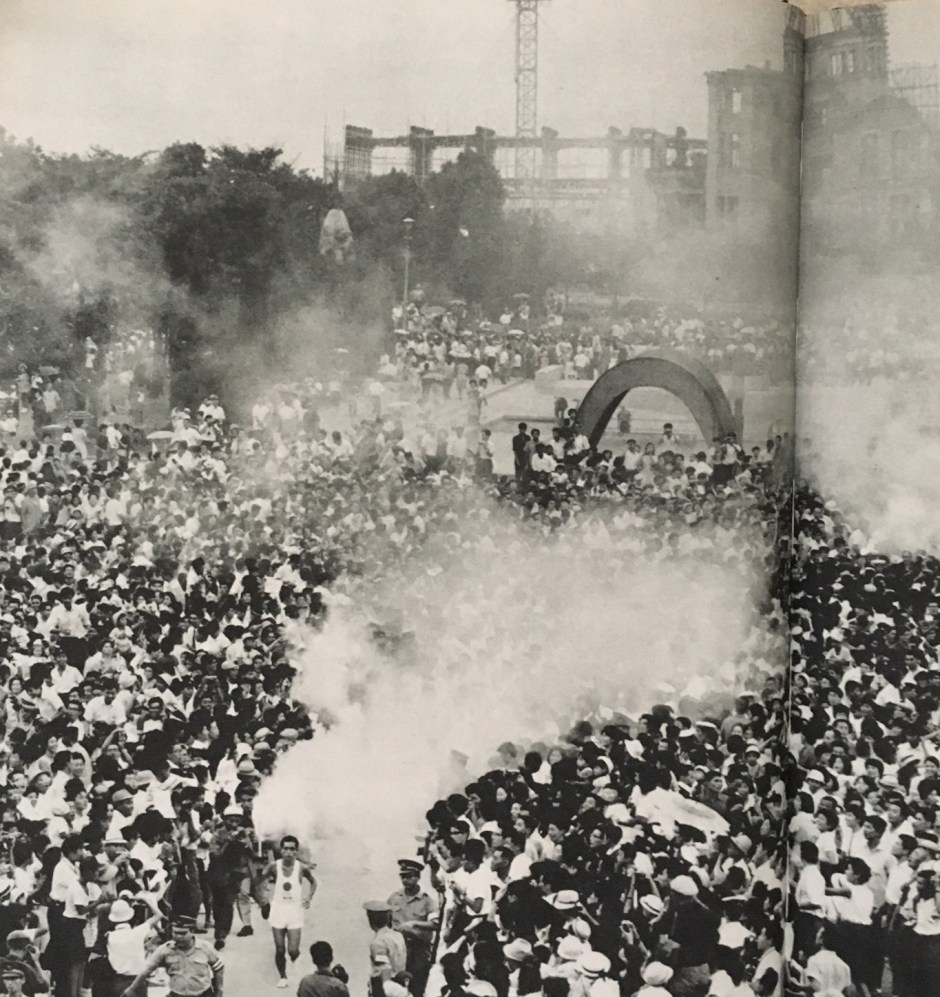
The torch relay passing through Hiroshima prior to the start of the 1964 Tokyo Olympics, from the book 1964 Tokyo Olympiad Kyodo News Agency
One thing certain about the dates of the Tokyo 2020 Olympics: July 24 to August 9, 2020. It will be hot and muggy!
One less obvious thing recently occurred to me about the dates. The final week of the Tokyo Olympics falls on the 75th anniversaries of the nuclear bombings of Hiroshima and Nagasaki.
Was it intended to bring attention to the worst days in Japanese history, during the proudest days of the nation’s history?
Of course it was. It’s impossible to imagine that no one in the Tokyo 2020 organizing committee or the IOC noticed that the closing ceremonies of the Olympics would take place on the day the second atomic bomb was dropped on Japan, thus expediting the eventual end of the war six days later.
On the contrary, the organizers must have thought that the final day of the Tokyo 2020 Olympics would be an opportunity to solemnly (and hopefully tastefully) implore the world that peace and love trump war and hate.
Such a closing ceremony would provide a poetic bookend to the opening ceremony of the 1964 Tokyo Olympics. Only 19 years removed from the end of WWW II, it was a 19-year-old student from Waseda University named Yoshinori Sakai who carried the sacred flame up the National Stadium’s steps to light the Olympic cauldron on October 10, 1964.
Sakai was born in Hiroshima on August 6, 1945, the very day that the Enola Gay dropped an atomic bomb called “Little Boy” on Sakai’s hometown.
Bob Hayes launching into the record books at the 1964 Tokyo Olympics in the 100-meter sprint finals, from the book The Spectacle of Tokyo Olympics.
Bob Hayes, a student at Florida A&M, was eating dinner in the university’s student union building when he heard that the campus police wanted to speak to him. When he found the police, they told him they were taking him to jail for robbery.
According to Hayes’ autobiography, Run, Bullet, Run, a friend named James Vickers said that he and Hayes had robbed a fellow student. Vickers held up a plastic gun and got what the student had: eleven cents and two sticks of gum. Hayes said he had no idea what the police were talking about, but he was carted off to the city jail, where Hayes stayed for 7 days without showering and changing clothes. With no money, no lawyer, no idea what to do, Hayes said he signed a confession and pleaded guilty in the hopes of getting out of jail.
When it was time for sentencing, Hayes’ coach, Jack Gaither made an appeal to the judge: “If you give me this boy for four years, I guarantee you he won’t get in trouble and he’ll make you proud of him.” Hayes was put on probation for ten years and had to report to a probation officer once a month. All that for eleven cents and two sticks of gum, taken with a plastic gun, by someone else.
Thanks to Gaither, Hayes had a fruitful college football career. He then went on to win two gold medals at the 1964 Tokyo Olympics, be crowned the fastest man in the world, and win a Super Bowl with the Dallas Cowboys, the first of only two people to have reached such heights. Retired from sports, Hayes anticipated a trip to the NFL Hall of Fame, thanks to the way he revolutionized American football, stretching defenses with his speed. Bob Hayes was on top of the world. Until the police came calling again.
It was the middle of the night in March, 1978, when the police banged vigorously on Hayes’ door. The police arrested him for selling drugs, and carted him off to the local jail. A man named Denny Kelly, described as an airline pilot and an undercover policemen in the Dallas area, where Hayes was living, apparently befriended Hayes, and little by little would ask for drugs. Hayes wrote that first he provided Kelly with methaqualone (also known as Quaaludes), and connected Kelly to people who could sell him cocaine. Hayes introduced Kelly to another person who would end up selling Kelly cocaine. As conversations and video of Kelly and Hayes were recorded, including one at Hayes office at a computer company he was working at.
Two pills of Quaaludes, apparently “sold” to Kelly when Hayes borrowed ten dollars from Kelly to pay for gas, as well as five grams of cocaine sold by a person introduced by Hayes in a case that suspiciously looked like entrapment – this should have resulted in a light sentence, slap on the wrist perhaps – but this was a second offense. Because Hayes had a previous arrest record in the case where he allegedly stole 11 cents and two sticks of gum, his case could have gone to a jury trial where, if convicted, Hayes could have gone to prison for many years. Even though his teammates all testified that Hayes was not a drug dealer, they knew that the risk of Hayes going to a jury, one that could have been packed with whites, was too great, so they encouraged him to plead guilty with the hopes of getting off lightly.
Unfortunately, the judge sentenced Hayes to five years in prison. No longer the iconic #22 wide receiver, Hayes was inmate number 290973 of the Texas prison system. Here’s how he described his life in prison in his autobiography:
After living the good life – a nice house, and the best hotels when I traveled – I found myself in an eight-by-ten foot cell for several weeks of orientation and then in a dormitory with about a hundred other inmates, most of whom were fifteen or so years younger than me, using a public shower like I had with the Cowboys and eating in amess hall. We had to be counted four times a day to make sure that none of us was missing and a count could take as long as an hour if someone was unaccounted for.
Being in prison taught me a little more about the values of life. I saw the things I was missing and how I always took things for granted. You don’t really miss freedom until you don’t have any choice. Just being able to get a glass of milk or a Pepsi whenever I wanted one meant so much more to me after I got out.
Fortunately for Hayes, he did not serve five years. His case was overturned on appeal, and he was free. In today’s terms, it appears to be a tough punishment for someone who only introduced another person to a very persistent undercover cop, and did not technically sell anything to anyone. And yet, his time in prison followed him like a dark cloud. At the 1984 Los Angeles Olympics, twenty years after Hayes’ triumphs in Tokyo, Hayes was shunned from the Games by the US Olympic Committee. And in this interview with Frank Gifford during ABC’s coverage of the Games, you can tell that Hayes is miffed at his treatment.
I’m in between jobs now. It has been very difficult for me. It very difficult to get someone to trust and believe in me now as a citizen because no one thinks of me in terms of my accomplishments. Just the drug conviction. Frank, I spent ten months in incarceration for a total of 700 dollars that I was indirectly involved in. I would love to get a good writer, like an Alex Haley, a director like a Norman Lear, and a TV network like an ABC, who can really get out there and show the American public what has happened to named athletes. Not only a named athlete but everyone. I want people to see what has happened. It has been a downhill situation. It’s very difficult to come out on top again when someone continues to kick you and stab you in the back, to redeem yourself.
When Hayes said he was on the stand, he had admitted: “I’m not the smartest guy in the world. If I was, I wouldn’t be up here. I’m guilty. I was wrong. I’ve paid the price in my image and my respect. People see me as Bob Hayes, dope dealer, not Bob Hayes, the citizen. It hurts.”
In his autobiography, Hayes went further: “My whole prison experience turned out to be a waste, a nightmare that never should have happened.”
When he passed away, the only man to win a gold medal and a Super Bowl ring, a man who disrupted NFL defenses with his speed and skill, was denied entry into the NFL Hall of Fame. Eventually, Hayes was inducted, albeit over 6 years after Hayes’ death. Thinking that he might eventually get in, he wrote a Thank You note that was read posthumously at the 2009 Hall of Fame Induction Ceremony:
You know I am not sure I am going to be around if I get into the Pro Football Hall of Fame so you must read this for me, I am not sure, I guess I am feeling sorry for myself at this time but you must remember everything I want you to do and say. Mother said you would do what I want because you always did. So read this for me.
I would like to thank everyone who supported me to get into the NFL Hall of Fame, the Dallas Cowboys organization, all of my team mates and everyone who played for the Cowboys, (thank the San Francisco 49rs [sic] too). Thank the fans all around the country and the world, thank the committee who voted for me and also the ones who may did not vote for me, thank Mother and my family, thank Roger Stauback [sic] and tell all my teammates I love them dearly.
Thank the Pro Football Hall of Fame, all the NFL teams and players, Florida A&M University, thank everyone who went to Mathew [sic] Gilbert High School, thank everyone in Jacksonville and Florida and everyone especially on the East Side of Jacksonville. Thank everyone in the City of Dallas and in Texas and just thank everyone in the whole world.
Bob Hayes, from the book Tokyo Olympiad 1964_Kyodo News Service
He was born on Third Street on the east side of Jacksonville, Florida. People called it Hell’s Hole.
The youngest of four, Bob Hayes remembers growing up chopping firewood to keep the house warm, his mother working as a maid to keep the children fed and clothed, and a father that made little effort to recognize his son.
In his, at times, brutally honest autobiography, Run, Bullet, Run, Hayes writes of his father George Sanders, who had an affair with Mary Hayes, while her husband, Joseph Hayes, was fighting in World War II in the US Navy. When Joseph returned, he accepted the situation. But when Sanders, who also went off to fight in World War II, came back, he rarely recognized Bob Hayes as his son. When Sanders was asked if Bob was his son, he would reply, “That’s what his mother says.”
And yet, his father needed his son. Sanders ran a shoe shine parlor in Hell Hole, but that was not his main source of revenue. In fact, as Hayes explained in his book, the shoe shine shop was a front for a numbers racket, and a lucrative one at that. Bob was helping out by manning the shoeshine parlor in the afternoons.
When Bob Hayes was in high school, the football coaches all thought Hayes was a potential talent and wanted the young man to be groomed into a star. But Sanders refused, putting his business ahead of Hayes’ potential. In the end, the assistant football coach, Earl Kitchings, and Jimmy Thompson, the head coach of the football team, visited Sanders to plead their case. When told no, a prominent alumni in Hayes’ high school, Josh Baker, stepped in and said he would fill in at the store while Hayes attended afternoon practice. At that stage, Sanders relented, and Hayes started practicing with the high school football team. Baker went to work…but for only two days. By then, Sanders couldn’t be bothered, and Hayes began a hall of fame football career.
And yet, Hayes yearned for his father’s support. And in his first year as a football player in high school, Hayes did not get that many touches, carrying the ball only 9 times as the team’s backup halfback. But there was that one play, when he took the hand off in his own end zone and scrambled for a 99-yard touchdown. “That’s when my father finally claimed me as his son.”
As Hayes grew up, one could say, like father, like son.
His first sexual experience, at the age of twelve, as he describes in his autobiography, was with his father’s girlfriend, a woman named Edith who was fifteen years older. At the age of sixteen, Hayes got a girlfriend pregnant, who had an abortion as they both felt they were not ready to take that next step as a parent.
During and after his days as an NFL star, Hayes would provide Quaaludes to women in order to have his way. “You give a female a lude, and all she knows how to say to you is yes.”
By the time he got to college, Hayes had two daughters, whom he did not raise. In fact, he was surprised one time after his football career had ended to have a woman in her early twenties come up to him and say, “You’re my dad.”
Hayes wasn’t a great father, which he readily admitted. When he and his then wife, Janice, had his first legitimate son, Bob Jr., he flew to Jacksonville to see his father George Sanders. Sanders had been in poor health since returning from the War in the Pacific. But a few hours before Hayes made it to Jacksonville, his father passed away.
Hayes won two gold medals and a super bowl championship, one of only two people to do that. He had the right coaches at the right time which helped him develop into a tremendous athlete. And yet, he never had the right coach in the game of relationships.
In The Long Run – US 5000-Meter Olympic Gold Medalist Tokyo 1964 is an autobiography by the first and only American to win the 5,000 meter finals in an Olympics, Bob Schul. Co-written by Laura Rentz Krause, In the Long Run tells the story from his childhood growing up in West Milton, Ohio, to his torturous training sessions under legendary coach Mihaly Igloi in California, to meeting high expectations of victory in Tokyo.
Mary Mary – An Autobiography of an Olympic Champion is by British long jump champion, Mary Rand. She was definitely one of the brightest stars at the 1964 Olympics. While expected to win gold in Rome, but didn’t, Rand redeemed herself in Tokyo, not only breaking the world record and winning gold in the long jump, but also taking silver in the pentathlon and bronze in the 4×100-meter women’s relay. An electrifying presence in person, Rand’s charm oozes through the pages as well.
No Bugles No Drums is an eloquent look of double middle-distance gold medalist, Peter Snell, the incredible double champion of the men’s 800 and 1500-meter middle-distance races at the ’64 Games. Written with Garth Gilmour, No Bugles No Drums is the appropriate title for a smart but understated athlete, who writes with wit and understated insight.
Robbie Brightwell and His Golden Girl is by Robbie Brightwell, the captain of the Great Britain’s track team at the 1964 Tokyo Olympics. It is the story not only of his journey to a fantastic silver medal anchoring the 4×400 relay team, but also of the journey of his wife, Ann Packer, who won gold in the 1500 and silver in the 400 meters (losing only to Betty Cuthbert). This is a story of self-discovery and leadership told with intelligence and charm.
Run, Bullet, Run: The Rise, Fall, and Recovery of Bob Hayes is the incredible story of the career of Bob Hayes, one of only two people to win both a gold medal and a Super Bowl championship. Co-written with Robert Pack, Run, Bullet, Run is the story of a young black American whose rise to Olympic gold and stardom as a Dallas Cowboys wide receiver was as stunning as his fall due to drugs and alcohol.
Wokini: A Lakota Journey to Happiness and Self-Understanding is by Billy Mills and co-written by novelist, Nicholas Sparks. Mills was one of the biggest stories of the 1964 Tokyo Olympics. Unlike Schul, who was pre-determined by the press to win the 5,000 meters, Mills was practically unapproached by the press, who hardly knew him. Mills went on to win the 10,000 meter finals in Tokyo in an incredible come-from-behind victory, inspiring Team America and millions around the world. Mills has gone on to great works in helping young Native American Indians in the United States, and wrote this inspirational parable of self discovery, Wokini.
I have searched far and wide for books in English about the 1964 Olympics, and have built a good collection of books by Olympians who competed in the Tokyo Olympiad.
My conclusion? Runners like to write! Of the 15 books written by ’64 Olympians I have purchased, 8 are by sprinting and distance track legends. But judoka and swimmers also applied their competitive focus to writing.
So if you are looking for inspiration in the words of the Olympians from the XVIII Olympiad, here is the ultimate reading list (in alphabetical order):
The Amendment Killer, is the sole novel in this list, a political thriller by Ron Barak, to be published in November of 2017. Barak was a member of the American men’s gymnastics team, who parlayed a law degree into a successful consulting business, as well as a side career as budding novelist.
Deep Water, is an autobiography of the most decorated athlete of the 1964 Tokyo Olympics, Don Schollander, who won four gold medals as the most dominant member of the dominant US men’s swimming team. Co-written with Duke Savage, Schollander writes intelligently of his craft, the technique and the psychological, finding a way for a swimmer strong in the middle distances, to sneak into victory in the 100-meter sprint.
Golden Girl is by one of Australia’s greatest track stars, Betty Cuthbert, whose life path from track prodigy in Melbourne, to washed-up and injured in Rome, to unexpected triumph in Tokyo is told compellingly in her autobiography.
See the remaining book list in my next post, Part 2.




You must be logged in to post a comment.