Ted Mittet surrendering his American team’s cowboy hat, gifted by President Johnson to the male Olympians
“Please send me many U.S.A. artifacts which I can use to trade with the Russians, Pols, etc. Emblems are especially desirable.”
So wrote Ted (Theo) Mittet to his family on October 4, 6 days prior to the start of the 1964 Tokyo Olympics. In addition to transforming into mini-United Nations, Olympic Villages become a mini-bartering economies where the currency of trade were pins, shoes, patches, shirts and hats.
As NBA All-Star and member of gold-medal winning USA men’s basketball team, Jeff Mullins, said, the most targeted American item were the cowboy hats the men received as part of their team kit.
Mittet, a bronze-medal winning member of a four-person rowing crew, had already given away his hat as you can see in the top photo, but he was still very active in the market. And for Americans, trading with the unknown and mysterious communists had a high level of cool cachet. As you can see, Mittet traded with fellow rowers from Cuba and the Soviet Union.
Another very unique rowing jersey is from the German team. During the Cold War, the IOC got the East and West German Olympic Committees and governments to agree to a united German team from 1956 to 1964. As explained here, not only did the teams agree to using Beethoven’s 9th Symphony as their national anthem, and an altered version of the East German black, red and gold striped flag with the Olympic rings in white placed in the middle red stripe.
This is where I need help. What is the nationality of the athlete Mittet traded with to get this red rowing jersey?
Imagine it’s Sunday, August 9, 2020, the final day of the Tokyo Olympics. The marathon has started, tens of thousands of people are lining the route, and the morning sun is radiating a furnace room of heat.
On August 9 this year (2017), the temperature hit a high of 37 degrees Celsius, or 98.6 degrees Fahrenheit. That’s hot man! And potentially dangerous for runners, as well as spectators. According to Makoto Yokohari, a professor of city planning at the University of Tokyo, in August the temperature at the location of the national stadium in Tokyo gets to 30 degrees at 7:30 am, and rises to the mid 30s in Asakusa, the mid-way point of the 2020 marathon. Yokohara adds in this article that much of the route, especially around the Imperial Palace, is not under shade.
Runner’s WorldFor runners, the fastest times often come in cool weather, in a range of 4.5 °C (40 °F) to about 13 °C (55°F), according to this analysis from Runner’s World. But when you run a marathon in hot weather, your body will rebel. According to this article from Scientific America, marathoners need blood to go in two directions at the same time – to your muscles to deliver oxygen and keep your muscles pumping, and to your skin so that your body can cool down. When it’s really hot, unfortunately, the blood that goes to the muscles that are getting a work out, gets even hotter, and the blood that gets to the surface doesn’t cool down. You sweat more, you dehydrate, and your body reacts with heat cramps, heat exhaustion, or even heatstroke.
The mother of all heat related illnesses. Your body temperature rises above 105 degrees F and it becomes a life-threatening situation. Most often, heatstroke results from untreated heat exhaustion, although it’s very possible for heatstroke to come about with no signs of heat exhaustion. Heatstroke is characterized by extreme fatigue and weakness, confusion and odd behavior, disorientation and finally unconsciousness. Your body’s regulatory system completely shuts down at this point, sweating ceases, and your skin becomes hot and dry. Unfortunately, it doesn’t end there. Convulsions and seizures can occur as your brain begins to shut down; coma and death are possible in the worst situations. GET OUT OF THE HEAT IMMEDIATELY! Seek medical attention, get in the shade, drink water, etc anything to get cooled down! You do NOT want to get to this point.
For us pedestrians, succumbing to the heat is commonplace in August, according to Akio Hoshi, a professor of health science at Toin University of Yokohama. “The number of people transported by ambulance due to heatstroke or heat exhaustion has peaked in early August in recent years. So the Tokyo Olympics fall in the period with the highest risk,” Hoshi said.
The 1964 Tokyo Olympics were held in October, and the weather was primarily wet and cold….preferable conditions to the marathoners of 2020.
Official Invitation to the White House for American Olympic medalists
He was invited by the Mayor to a celebration for Seattle Olympians on November 2, 1964. He was also invited to the White House by President Lyndon Johnson for a luncheon honoring American Olympic medalists on December 1, 1964.
But Ted (Theo) Mittet, in his mind, had bigger and better things to do – like travel throughout Japan: Yokohama, Kyoto, Hiroshima, Matsuyama, Beppu, Nagasaki, Niihama and Nara. The 22-year-old American rower from Seattle, Washington had helped a crew of four take the bronze medal in the rowing fours-without (which means four rowers without a coxswain). And while most of his teammates returned to the United States for parades and celebratory dinners, Mittet decided that hitchhiking and taking the train through Japan would be more fun. And based on the numerous letters exchanged between young Mittet and the Japanese he met along the way, all parties were better for that decision.
Thank you ever so much for your nice letter. It is more than you could imagine how happy I was to read your letter. I am glad to know that you stayed and travelled in Japan for two months after the Olympic Games were over. It is a wonderful and happy experience for me to have worked for the Tokyo Olympics, and we talk very often about the pleasant days during the Games. Since that time I have become much more interested in English, and I attend the English conversation classes once a week. Though I try my best it is still very hard for me to master it. Is there any idea or suggestion to learn it faster? – Hiroko Sho, a volunteer from Tokyo stationed at the offices of the US Olympic Team.
Ted Mittet surrendering his American team’s cowboy hat, gifted by President Johnson to the male Olympians
But more significantly, Mittet inspired people to dream of being a part of a bigger world.
When Mittet went to Matsuyama City in Ehime Prefecture, a place not many foreigners ventured to in the 1960s, he was invited to a high school to meet the students, three of whom screwed up the courage and effort to write to him. One was Kayoko Kurita, who wrote to Mittet of her dream.
You may be surprised to receive this letter from me but I met you in Matsuyama and spoke in English with you. Do you remember me? You gave me your name and address I was happy to receive it. You said you attend WASHINGTON UNIVERSITY in Seattle. I would like to be your pen pal, and would enjoy corresponding with you if you don’t mind. I hope we will become good pen pals.
And my dream is, ……………, but it isn’t come true, but I’ll tell you. I would like to study abroad in your country especially WASHINGTON or Indiana or Kentucky or there is no Japanese there. Your university is very good and very big excellent university, but I would like to go to High School or Junior in America, so I’m looking for a sponsor for me. But it’s very difficult to find. I wish I will.
Mittet met a university student from Osaka in Kyoto named Takanao Dojima, who volunteered to take Mittet on a tour of Kyoto’s most famous temples, Kinkakuji and Ryuanji. Dojima wrote Mittet in a letter the following year, saying “Probably nothing is more enjoyable than travelling. I want to go to America as well as you visited to Japan. But I haven’t money, I can’t to visit America.”
A Sophia University student and interpreter for the BBC during the Olympics, Masako Kajiki, possessed more advanced English skills than the average Japanese, and appeared to have the financial means to travel abroad. She wrote in mid-November, 1964 to Mittet of her role as Shylock’s daughter in an upcoming production of The Merchant of Venice, and her plans to travel to the United States.
Listening to various talks from my parents who have just come back from the States after three months’ travel in Europe and the States, I have long wanted to go to your country next summer session. I’m looking forward to visiting your country, though it’ll be only for 10 weeks. Seeing is believing.
Three months later, Kajiki was approaching her departure date for the United States. Kajiki had already sent her entire, very detailed itinerary that would take her from Haneda to Honolulu, and throughout the mainland – LA, Las Vegas, Dallas, Knoxville, DC, Pittsburgh, Cincinnati, Detroit, Chicago, New York, just to name a few in her nearly three-month cross-country adventure. In her letter, she is clearly conscious of her own accountability as teacher of things Japanese. For a young Japanese woman in the Sixties, she has a stronger and clearer point of view on America and Japan than the average Japanese. But in the end, she cannot contain the excitement of her ultimate goal – to see America for the first time, and Mr. Theodore Mittet again.
Official Invitation to a celebration for Olympians in Seattle, Washington, also turned down by Mittet.
I’m afraid, however, that after you have made the railway journey from Osaka to Tokyo, you’ll remember not only the ugliness of those cities, as seen from the train, but also the succession of advertisement billboards that so often interfered with your view of the enchanting countryside along the route. As you know Japan is surely losing our own tradition that our ancestors made unique one after they assimilated Oriental civilization and digested it. We have been, however, striving to keep up with American and European country and rebuild Japan what it is from a heap of ashes.
Without your country’s support, our country – indeed like many other countries such as Great Britain and France – would not have been able to regain the present strength in such a brief span of time. You can imagine then how anxiously I’m waiting for visiting the States. May 29th seems the longer in coming, because you are waiting for me!!
And then there was Hirokazu Okugawa, a student at the Department of Architecture at Kyoto University. Mittet was also a student of architecture at the University of Washington, and was introduced to a professor at Kyoto University named Dr. Nakamura. Okugawa was a student of Nakamura’s and they both sought a way to get Okugawa to the United States. In an initial letter to Mittet in mid-December 1964, Okugawa writes, “I would like to go to University of Washington next September, and I would like to study architecture more there. And Dr. Nakamura hopes that I study it there, and that I shall become an eminent architect. Would you introduce to your professor?”
So full of hope, Okugawa would realize that it wouldn’t be so easy to become a student in the US. Two months later, Okugawa has the name of the dean of the school of architecture at the University of Washington, and intends to state his case. But soon after, he received a letter from Mittet – now his unofficial career advisor at U of W, that dampens his spirits:
According to your letter, there is no probability of my admission for the degree to the master. My ability of English conversation is not enough to understand the lecture in the University. I am going to study hard English conversation this year.
But Okugawa has a dream. He can see himself going to the States, studying English hard, taking on any task to show he’s worthy of being a student in the United States, and continues to explore ways forward with Mittet. By the end of February, he and Mittet have decided that Okugawa should still officially apply to the University of Washington, and Mittet has sent the application form and information on all required documentation. Okugawa acts on the instructions, presumably to extreme exactitude, only to be disappointed again:
As mentioned in my previous letter, I received an application form for an admission. And I completed its form and my works in Kyoto University, and these letters were sent to the chairman Architectural Graduate Program. And also, my report in Kyoto University and three letters of recommendation were sent there.
But I received the letter from Director of Admission in which he said “It is too late for autumn 1965”.
HOW SHALL I DO? WHAT SHALL I DO?
CAN YOU HELP ME?
I BEG FAVOURITE ATTENTION.
If I can, I would like to work in architecture office, and then I would like to study in University of Washington the next year. How shall I do in order to do so? How shall I get working visa? I will be given about $1000 and the expense of transportation.
Would you please consult with the dean about my admission? I would like to know your professor, professor Nakamura’ friend. What is his name?
Looking forward your kind letter.
There is a tinge of desperation in young Okugawa’s typewritten letter. And only a week later in early May, Okugawa seems resigned to not getting into his dream school in 1965. Mittet, who has apparently responded quickly to Okugawa’s letters, when necessary by express mail, was encouraging and understanding. And indeed, hope was not lost because Okugawa informed Mittet that an official of University of Washington’s admissions stated that Okugawa could apply for enrollment in the Fall of 1966, with the condition that he take an English certification course that November.
I have received the beautiful picture of U. W. from you. The mountain covered with snows resembles Mr. Fujki in Japan. I was so glad that I showed it to many friends of mine, and I put it on the wall of my lodging house.
By the way, I took English proficiency examination on the 1st of May at A. C. C. (American Cultural Center). Fortunately I could do excellent, and the director kindly recommended me to your University. But Mr. Johnston has written to me, and said that I must not be expecting to enroll U. W. until autumn 1966, and I must take the English Examination (TEFL) on November.
When I heard these things, I was disappointed. But, I think I can study more English and architecture at Kyoto University (master courses) until autumn 1966. And I hope we discuss architecture in letters.
Did Okugawa eventually make it to Seattle, study at the University of Washington, and become an “eminent architect”? Who knows. Dreams are not goals of certitude – although they could be glowing embers of aspiration. In the case of 1964, the Olympics fanned those embers of the Japanese. In certain cases, a spark named Ted Mittet set the fire.
Mikako Kotani (front) and other former Olympians perform synchronized swimming in an Oita PrefectureOne of my most treasured memories was in the Fall of 1987, sitting in a hot spring in Hokkaido, the snow falling, the steam rising, and a beer in hand.
In addition to the great food and shopping, tourists are flocking to Japan for the country side, and in particular, enjoying onsen throughout the country. Once you (some of you) get over the embarrassment of getting naked with a whole bunch of strangers, you get yourself all clean in the shower area outside the bathing areas, and then you dip your toes into the water. And yes, it’s hot!
Some of the best onsen are in Kyuushu, a large island in the Western part of Japan. And to get Japanese and non-Japanese alike to venture beyond the cosmopolitan confines of Tokyo and Osaka, the government of Oita Prefecture started a campaign to promote their onsens….using Olympians.
In typical tongue-in-cheek Japanese fashion, the promotional videos portray Japanese synchronized swimmers performing in the onsens of Oita. The athletes include Mikako Kotani, who won two bronze medals at the 1988 Seoul Olympics, as well as Raika Fujii, silver medalist at the 2000 Sydney Olympics, and bronze medalist at the 1996 Atlanta Olympics. The campaign is called “shin-furo”, which is a word made up from “synchronized” and the Japanese word “furo”, which means bath.
“I hope viewers will enjoy the beautiful, thoroughly organized performance by former Olympians,” said Oita Prefecture spokesman Takahiro Miyazaki. “And at the same time, I hope people will also be attracted to Oita’s hot springs.”
Japan had a record 2.68 million visitors in Japan in July, well on its way to topping 2016’s record number of foreign tourists of 24 million, blowing past its original target of 20 million by 2020. The 2020 target has been re-set to 40 million visitors. For repeat visitors, the Oita onsens should certainly be a hot place to spring to.
A picture of Ted (Theo) Mittet, 2nd from left, by Takeko Honma, middle, in front of the National Gymnasium
When I first arrived in Japan in 1986, one of the most popular programs on television was “Naruhodo! The World (なるほど!ザ・ワールド),” a quiz program that showcased the beauty, excitement and uniqueness of the places around the world their reporters visited. This was entertainment, so their reporters were often loud and garish, shamelessly interacting with foreigners in goofball English, often emphasizing stereotypical or even non-representative quirks of a particular country or culture. The questions and insights of the reporters often revealed more about Japanese culture than the culture they were trying to represent.
Ted (Theo) Mittet was a 22-year-old American rower who decided to travel Japan after helping his four-without boat win the bronze medal at the 1964 Tokyo Olympics. As explained in Part 1, Mittet made many Japanese friends along the way, who exchanged letters with this young man from Seattle, Washington. Their questions to him said a lot about Japan at the time. Mittet wrote to his family describing the conversations he was having with Japanese all over the country.
I spent last evening with a very good Japanese friend’s family (his father speaks English, as does he) and was treated royally. Sukiyaki and tempura were served in unlimited quantities. After dinner we all discussed love and life and I am amazed at the similarity between East and West. My friend is anxious to learn about Christianity and I am anxious to learn about Buddhism. (He is studying Zen.) I certainly think that Buddhism makes more sense than Christianity. I plan to look into it a little further. – letter from Mittet to family in late October
While coming up the east side of the inland sea I stopped at the town of Niihama where I met three English teachers who asked me if I would speak at their school. I gladly accepted and as a result spent about three hours teaching English conversations to about 150 English students. The school offered me 3,000 badly needed yens, but being a true patriot I could not accept. You might say that it was my donation to the cultural exchange program. I was asked questions about the Beetles, the American date, President Johnson (damn!) and “What you think black man?” It was a wonderful experience and I gained much insight on Japanese life and thought. – letter from Mittet to family in late November
Religion, politics, race – all the things we were taught not to talk about in polite company. But many Japanese knew they had an exaggerated view of the world, and were eager to correct their perceptions. In the case of America, Mittet became their source.
Like the hundreds of others on the US Olympic squad, he got the training from the US State Department about how to conduct oneself properly in a foreign land as a representative of America. But one can argue, based on the letters he received from the many Japanese friends he made during his 2-month travels, Mittet was as much an American diplomat as those who sit in embassies around the world.
When travelling through Ashiya, a city near Kobe in Japan, Mittet met Mikio, a middle-aged man who saw the tall American in a crowded bus, and felt compelled to introduce himself. Like other Japanese energized by the influx of foreigners during the Olympics, and infused with a desire to warmly welcome them, Mikio went up to Mittet in the bus. “I remember first scene when I saw firstly you in the crowded bus,” he wrote in a letter to Mittet. “You are too tall, so you put your head on the bus ceiling. Then I felt too funny. (Excuse me.) But that time, I felt much friendly to you.”
Amazingly, not only did Mikio introduce himself, he invited Mittet to stay at his and his wife’s Eiko’s home overnight, where they ate and talked. But in the letter, Mikio admitted that he was still very curious, his English capability failing him in attempts to ask important questions:
It was first experience for me that I gave a lodge to a foreigner. I doubt I could make a full hospitality to you? It’s most sorry I could speak English very little. If I could speak it more fluently, I wished to ask about America things, and to tell and discuss about several problems of the war, current events and American colored man through all night. And about your life experience and philosophy.
Eiko and Mikio
Even more remarkably, Mikio found Mittet so earnest and trustworthy that he admitted to changing what he felt were prejudicial views of Americans.
I had had a prejudice for American through a few American I know, soldiers and seamen. I have thought American are a spending, war-like, uncultural and bright and cheerful nation. (Excuse me) However general Japanese people don’t think so as me.
I see and tell you, I found mistake. You are wonderful man with wit and culture. If there are many people as you in America, American will develop more and more in future. I hope you become young face of America. My dear Eiko in the room you slept, talk about memory of you.
Ted (Theo) Mittet in Tokyo, from the collection of Dick Lyon
It was as if 1964 was Year 1, and Japan was re-born.
Japan was young, energetic and full of hope. One of the biggest hits of 1964 in Japan was “Konnichi wa Akachan,” – “Hello, my sweet baby!” – a bouncy, happy tune of fresh starts.
Ted (Theo) Mittet was a 22-year old from Seattle, Washington, who qualified for the Tokyo Olympics as a rower on the US Olympic team, and came to Japan with eyes wide open. And he loved it from the start. “Japan is all that I expected and more,” he wrote to his parents a week before the start of the Olympics. “Its people are very friendly to say the least.”
Mittet was on a powerful rowing crew that took the bronze medal in the fours-without competition at the Tokyo Olympics. But while many of his teammates on Team USA went home, Mittet sold his air ticket to the States and travelled Japan. More importantly (to me), he wrote and received many letters. This was a time when people sent telegrams, when long-distance phone calls were expensive, and letters took days if not weeks to traverse the seven seas, pens were our keyboards, while boats, planes and people were our internet.
It was a time when getting a letter from the postman was sometimes a thrill.
I was very glad to see you letter beside my Mother’s Mirror and I cried my father “Received, Received”. My father was glad, too. My mother and brother were glad, too. I cried your letter’s news all over.my friends. I’m afraid you did not write to me soon. But I got your letter. I think happily.
The above was the opening of a letter from a high school student in Matsuyama City, Ehime Prefecture name Katsuhiro Matsuo, overjoyed to get another letter from the young American rower.
Katsuhiro Matsuo, high school student in Matsuyama, Ehime
Mittet travelled from Tokyo to Yokohama, then on to Kyoto. He passed through Hiroshima, Matsuyama, Beppu, Nagasaki, Niihama and Nara, before heading back to Yokohama and Tokyo. During his 2 months of travel in Japan, he wrote constantly and voluminously to family and friends in the US, as well as new acquaintances he met during the Olympics and his travels. The letters from the Japanese in particular reflect Japan’s excitement and curiosity about foreigners and their desire to welcome them to their country and their home.
In some cases, the Olympics may have given some Japanese the courage to break out of their normal shy shells and reach out to the world. Mittet was the closest to the outside world for these letter writers, and so they made what was likely an extraordinary effort to write letters in English.
Dear Theodore, I know how surprised you are to receive this letter from unknown friend in Japan. You visited Silk Center in Yokohama. Where I was working during Olympic season. You gave me your card. Oh, no. I required you to give it to me. Do you recollect me? If you could, I am glad. Ha Ha. It is difficult for you to recollect me because you met many people, did not you? – Junko Aoki, a student at Kanagawa University in Yokohama
Dear Theodore, You may be surprised to receive this letter from a complete stranger, but I met you at the Toda Rowing Course and talked with you for a few minutes. I gave you a little badge, do you remember me? I’m taking this liberty of writing to you with the sincere hope that you’ll accept me as your new Japanese friend. – Emiko Kobayashi, a high school student from Toda-machi, Saitama
The Tokyo Olympics were a rush of adrenaline for the Japanese, so many of them amazed and happy to be surrounded by so many foreigners from so many different countries. Mittet met a volunteer interpreter named Teruyo Wakui at Enoshima Station, not far from where she worked translating for the sailors competing in the nearby yachting events. Despite her fatigue, meeting Mittet proved to be another rush for this volunteer just after the end of the Tokyo Olympics.
When I happened to meet you at Enoshima station, I was rather tired after twenty days’ work. But I was so glad to meet you and to speak with you. In yachting game, there was no competition as you. Most of all the competitors of yachting were rather gentle and kind, and even the younger men were not as young as you. You are so young and full of dream and curiosity to many things of Japan.
After twenty days in yacht harbor, I suddenly remembered that youth is more wonderful than any other thing in this world. We can do anything without money, as we are young. And I think you have enough courage to do anything that you want, though you say you don’t have courage, but pleasure.
I don’t enjoy running. My preference is to read my kindle while exercising on an elliptical machine. But on the weekends, I will head out into the neighborhood, often climbing the stairs of road overpasses, and running through the residential area I live in.
I bought the Nike Apple Watch opportunistically in a recent visit to Portland where the lack of a sales tax makes big purchases attractive. My main objective was to upgrade on my Fitbit.
While the Apple Watch is cool, as all Apple products tend to be, the jury is still out regarding its utility as an exercise measurement tool. I’ve recently realized that not only does the Apple Watch lack the measurement tool that the Fitbit has to measure stairs climbed, it also does not automatically measure sleep time and patterns.
That’s a disappointment.
The revelation has been the Airpods! First, how does a one-size-fit-all headset stay in any person’s ears, I have no idea. But I can run and jump and the Airpods stay in place (although I sometimes feel better pushing them in on occasion).
Running without wires has been a revelation. With the Air Buds connecting to the Apple Watch via bluetooth, I can run relatively unencumbered without wires. For me, it was one of those nagging issues that, once removed, feels liberating.
Aska Cambridge Keeping Up with Usain Bolt in 4×100 Relay – click on image to see Olympic Channel’s “Games to Remember”
The Olympic Channel features a video that recalls images and moments from the 2016 Rio Olympics. Entitled “Games to Remember – Re-Experience Rio 2016: The Official Summary of the Rio2016 Olympic Games,” the video runs over 37 minutes long.
I started it, but was only going to watch it for a few minutes. I ended up watching the entire video, a collection of short clips of the events of each of the 16 days. And they are all stunning!
Slow mo, normal speed, tracking shots, overhead shots, long shots, all edited to highlight the aesthetics of epic poetry in motion, to accentuate the limits to which the athletes will stretch themselves, to remind us of the chills we experienced when viewing the very best in the world achieve the highest levels of physical achievement.
Go to this link. If you can, put it up on your big flatscreen TV. And revisit the joy of the 2016 Rio Olympics.
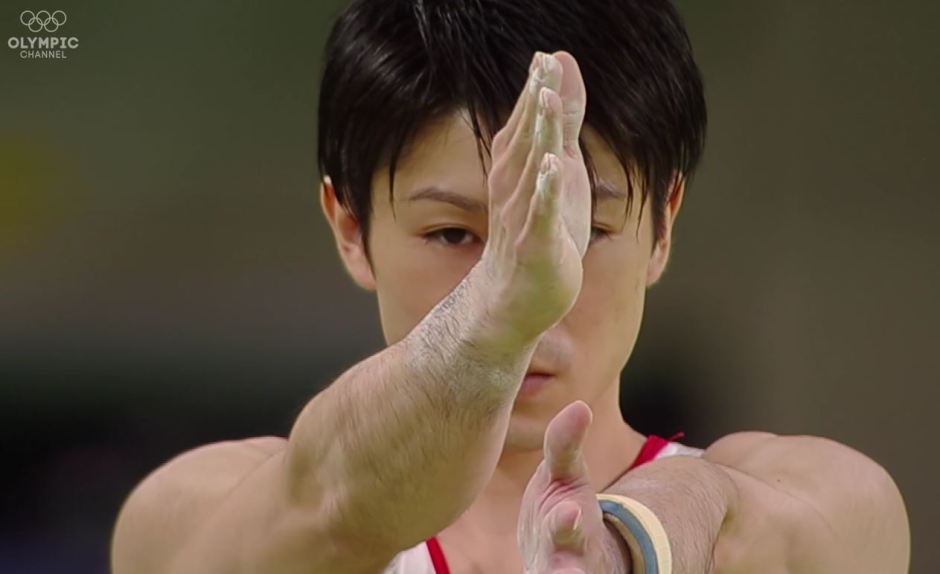
Kohei Uchimura – click on image to see Olympic Channel’s “Games to Remember”
Over 30,000 people crowded the streets of Shibuya near the famous zebra scramble to dance on August 5, 2017.
Of that huge crowd, in one of Tokyo’s most popular shopping and entertainment centers, 30 members of the Tokyo 2020 team dressed in yukata and happi coats performed a dance that was popular over 53 years ago. Reviving a hit song from that time, the organizers re-released an updated version of “Tokyo Gourin Ondo”(東京五輪音頭), which roughly translates to The Tokyo Olympic Dance Song.
Tokyo 2020 Bon Odori in Shibuya
This song by Kouhei Fukuda, amidst the follow up to the 1964 Tokyo Olympics, helped created Olympic fever in Japan at that time.
It is mid August, in the heat of summer, when families often come together to visit and clean family gravesites. It is also an opportunity for neighborhoods to come together in a bon odori, which you can see in almost any neighborhood in Japan. And anyone can join in the dance.
Watch this video to see how the Tokyo Gourin dance is done.
When Emil Zátopek, the Czech distance runner gave away one of his gold medals, he still had three other gold medals and a silver. Australian distance runner, Ron Clarke, a perennial gold-medalist-to-be, had to settle for a gold medal gifted to him, albeit from arguably the greatest distance runner ever.
Zátopek was not one for airs, and may have given all of his medals away if asked. But most Olympians would never part from their hard-won treasure.
And yet, when Olympians win medals at the Paris Olympics, they may have that opportunity.
The Paris Olympic Organizing Committee asked designer, Philippe Starck, to create the medals. Starck, who also designed the relay torch for the 1992 Albertville Winter Games, developed a medal that can be shared, literally. As you can see in the photos and the video, the medal is thicker than the traditional Olympic medal as three sections can be removed from it, each section a medal in its own right.
Presumably, the Olympian can keep the entire medal as is, or give the sections away, presumably to family members, strong supporters, sponsors, or close friends. The New York Times recently noted that this could be the way that coaches are finally recognized for their contributions to a victorious Olympian’s achievements as they do not receive medals.
“Today, more than ever, the truth is that you’re not winning alone, so I wanted this medal to reflect that,” said Starck. “If the winner wants to share it, they can share it.”
So at the Paris Olympics, most likely in the summer of 2024, Olympians can share their triumph in a way that is truly unique.




You must be logged in to post a comment.