This is part two of the photographs taken by Dick Lyon, member of the United States rowing team. After his four-man coxless team won the bronze medal at the Toda Rowing course, Lyon had the time to walk around Tokyo with his Bronica Camera. Here are a few of them:
Outside a candy store – It’s a common story during the 1964 Olympics: the best athletes in the world visibly sticking out in homogenous Japan, particularly those who hovered around 200 cm tall. Lyon’s rowing teammates, who joined him in these perambulations around the Olympic Village in Yoyogi, were no exception. Here is Lyon’s rowing mate, Theo Mittet, with two giggling women from the candy shop. Note Mittet’s fancy footwear.
A pub in Tokyo that appears to be connected to a racetrack – The signs appear to list names of horses and jockies. These “taishyuu sakaba” were low-cost drinkeries for the everyday salaried worker, whom, I suppose, had a love for the horses. This one lists all items as selling for 100 yen, or some 28 cents at the time.
A man studying the horse racing data of the day – This image of intent concentration belies the fact that the Japanese government ultimately decided that this form of gambling was a necessary form of recreation for the average citizen, as well as the well as the tax revenue it generated. The Japanese government thought briefly in the early 1960s about banning such forms of gambling, but thought better of it, according to this report.
Shimbashi Station – In 1964 and today, this was the hangout for salarymen where they ate and drank in the many tiny eateries underneath and near the train tracks.
Ginza and the San Ai Building – In 1964 and today, Ginza is the upscale shopping area of Tokyo, and has for a long time been considered the most expensive real estate in the world. A symbol of Ginza glitz and glamor has been the San Ai Building, a glass tower that has gleamed electric light since it opened in 1962, a couple of years before the Olympics.
A View from Tokyo Tower – In 1964, the Tokyo landscape around Tokyo Tower was flat. And yet, my guess is that 19 years before, at the end of the Second World War, after enduring considerable firebombing by allied planes, the landscape would have been considerably flatter. In less than two decades, Tokyo was re-built and transformed, a miraculous revival for the world to see.
Dick Lyon was in Japan for the 1964 Tokyo Olympics, and was a member of the bronze-medal winning team of the American coxless fours. And after a tense week of competition in the week of the Tokyo Olympiad, Lyon had a week to enjoy the Olympics as a spectator, and Japan as a tourist.
Lyon and his friends ventured into a public bath, bought sweets in a Ginza boutique, got around in subways and taxis, took the newly-launched Bullet Train to Kyoto, and climbed Mt Fuji.
Like so many athletes, Lyon bought a camera – a Bronica SLR, from a company called Zenza Bronica, founded by Zenzaburo Yoshino. Yoshino was fascinated by photography and cameras, and started a small camera store in Kanda, Tokyo, selling foreign cameras.
Eventually, Yoshino’s business became very popular among GI’s during the Allied post-war occupation of Japan. With profits from his store, Yoshino invested in a factory to manufacture luxury watch cases and lighters. Soon after he was also manufacturing cameras of his own design, the Bronica.
Lyon shared with me some of the pictures he took with his Bronica, a fascinating look into a time capsule from 1964.
Children on a street in Tokyo – It’s late October, and undoubtedly a tad chilly, but kids in Japan, then and now, are commonly seen wearing shorts in the Fall.
A little girl skipping rope – no social commentary here, just a wonderful shot of a girl having a fun time!
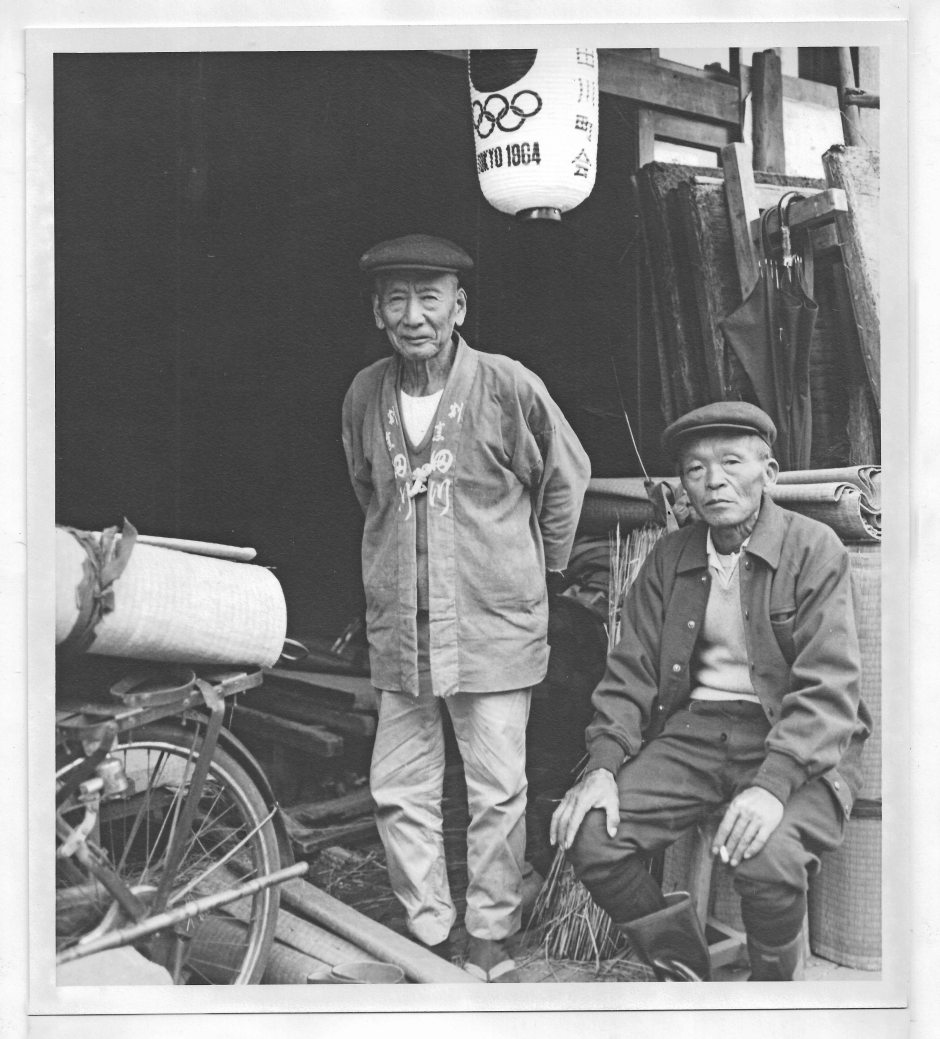
Two elderly gentlemen in Tokyo – this is likely in front of a small light manufacturing operation or repair shop, with two members of the commerce association of some town in Tokyo called Tagawa. I love the Olympic lantern – would love to find one that still exists!
A bricklayer at work – A wonderful shot of a day laborer, likely prepping the façade of a building for a set of steps, as an elderly lady looks on.
A day laborer taking a rest – This somewhat elderly man is wearing the shoes of the farmer or construction worker: the “tabi,” with its distinctive split-toe design. Since this is Tokyo, he was probably employed in construction. The hat, however, is a nice touch.
A man on his “Ri-ya-kaa”– Here’s a gentleman who owns his own business, or works for a business that needs to transport heavy items, like alcohol bottles, sacks of rice or bags of vegetables. This vehicle is called “ri-ya-kaa” based on an extrapolation of an English word: “side car”. The side car is the carriage that you sometimes see attached to a motorcycle. The Japanese figured if you can call that part a “side car”, then attaching something similar to the back could be called a “rear car”. (I didn’t know this!)
It’s 1964 and Ajinomoto is at the top of the world.
Housewives in the growing post-war economies were benefiting from advances in food sciences. In America, it was easy to bake a Betty Crocker cake, or create a Jell-O dessert, or slap together a meal with a Swanson’s TV dinner.
For those who actually had to cook, particularly in Asia, mother’s little helper came in a little glass bottle with white crystals. This chemical substance, when added to food, instantly transformed bland vegetables, soups of meats into something savory and tasty. Created in 1908 by a chemist named Kikunae Ikeda, who extracted an element of sea kelp, Ajinomoto (or “the essence of taste”) became a global phenomenon in the first half of the 20th century.
It started with post-Meiji Era housewives of the upper classes, who believed that to be Western and cultured, they had to cook meals themselves. When they learned how easy it was to enhance the flavor of their prepared meals by adding Ajinomoto, sales took off.
Because this was the era of Imperialism, and Japan had colonies in East Asia, Ajinomoto made its ways to the kitchens of Taiwan and China. Restaurants in Taiwan quickly became addicted to the use of Ajinomoto, and this particular flavor and brand became associated with quality. According to this fascinating history of Ajinomoto called A Short History of MSG – Good Science, Bad Science and Taste Cultures, by Jordan Sand, display of the container that Ajinomoto was shipped in became proof of the quality of that establishment.
Some Taiwanese restaurants and noodle shops helped market the product unsolicited. If the tabletop glass shaker symbolized Ajinomoto’s mature position in the metropolitan Japanese food system, in Taiwan it was the square, gold colored, one-kilogram can, which was first imported in 1928. Food vendors and noodle shops displayed these cans toshow customers they used Ajinomoto. Presumably they did so in part to announce they were not using an imitationbrand, several of which had appeared in the 1920s. The large gold cans had particular significance for individual consumers, too, since Taiwanese merchants began opening them in the shops and selling small quantities by weight.
Ajinomoto advertised in a Chinese magazine from the 1920s. From Ajinomoto kabushiki gaisha shashi [Company History of Ajinomoto Incorporated] (Ajinomoto kabushiki gaisha, 1971), volume 1.To succeed in China, Ajinomoto was marketed as the Buddha’s hand, again, according to Sand, and was particularly useful in making vegetarian food in China more palatable. And once something in China becomes popular or commonplace, it was only a matter of time before it made its way further abroad. The Chinese diaspora is one of the biggest, and when Chinese immigrants poured into America to help build the railroads, Chinese food became a staple of not only the migrants, but also the locals.
Fast forward to the 1960s, and this miracle food enhancer was at its peak, and beginning its descent. Rachel Carson’s Silent Spring educated the world on the unintended but dangerous consequences of pesticides in our ecosystem and our food supply, and more generally on man’s impact on nature. Eventually, people began to suspect that Ajinomoto, otherwise known as monosodium glutamate (MSG), was making people nervous because of its linkage to headaches, sweating, rapid heartbeats, sweating and even chest pain and nausea. In America, this particular ailment was informally called Chinese Restaurant Syndrome”, thanks to migrant cooks inordinate dependence on Ajinomoto.
Eventually, negative reactions to Ajinomoto in the United States spread to Japan. When the 1970s rolled around, Ajinomoto’s sales fell. Ajinomoto diversified and recovered, and today, Ajinomoto is certainly a giant among food manufacturers in Japan. But at the early parts of its existence, Ajinomoto was a company, by virtue of a single product, that had a significant global impact.
And in 1964, during the Tokyo Olympics, Ajinomoto was held up as one of Japan’s great success stories.
Billy Mills at the University of Kansas, from the collection of Billy Mills
It was a very hot day, and I was running in the back of the pack. As I came by Easton he said, “Billy, get up where you belong; get up in front.” Another lap went by, and I heard him say, or I thought I heard him say, “Get up where you belong or get off the track.” And I thought, You know, there’s a third way to do this, and it’s my way. I’m a senior in college. I can do it my way, which is to run in the back and come up slowly.
When Easton said that again, I walked off the track. He sent for me and said, “Why did you quit?” I answered, “Coach, I didn’t quit. You said to get up in front or get off the track. I got off the track.” “You quit,” he said. All the pressures I was feeling I took out on this man who was really trying to help me. By walking off the track I may have appeared to be protesting against my coach, but in reality was protesting against society. I don’t think he ever understood that.
Billy Mills, who would later take the world by surprise at the 1964 Tokyo Olympics, was an angry young man, as you can tell from his own words, published in the book, Tales of Gold. A Native American of the Lakota tribe, he developed into such a strong distance runner that he earned a scholarship to the University of Kansas. As described in a previous post, Mills struggled with the transition to life outside the reservation.
Coach Bill Easton
Bill Easton was the coach of the track team at the University of Kansas. During Coach Easton’s tenure at KU, from 1947 to 1965, his track teams won 39 conference championships, including eight years in a row from 1952-1959. By the time Billy Mills met the KU coach, Easton had the supreme confidence that comes from consistently winning. And yet, Mills and Easton were like oil and water. Mills felt that Easton was a symbol of all the barriers society threw in his face, and after the altercation described at the top of this post, Mills quit the track team.
I had a love-hate relationship with Easton. I wanted to please him, but I wanted to do things my way, the way I knew was best for me. And the hostility that grew out of all the blatant and subtle rejections that society was throwing at me I took out on him, and he really had no idea I was doing that. I was trying to find answers to questions I couldn’t even express, and my coach was not a sociologist or a psychologist. He couldn’t determine where I was coming from. So during my years at Kansas my track career languished.
After getting his degree in education, Mills joined the United States Marine Corps, and moved to the Marine Corp Base in Virginia, called Quantico, where he was immediately asked to join the track team. It was there he met former Annapolis track coach, Earl “Tommy” Thomson. Thomson was a gold medalist in the 110-meter hurdles, representing Canada at the 1920 Antwerp Olympics. But more importantly, as Mills told me, Thomson was a mentor.
Coach Easton, he broke me. Tommy Thomson, he was my mentor. He was totally deaf. He would read lips. He was the first white man I ever trusted. He helped me. He came up to me and said, ‘I don’t want to coach you. I’d like to be your mentor. But you have to let me inside,’ he said, holding his hand near my chest. I learned that word, ‘mentor,’ from my dad. He’s saying this in a gentle way. I believe the creator sent him to me because he’s talking like my dad.
In the exchange below, Mills is explaining to me that Thomson had a way of dealing with Mills’ sensitivities, and asking the right questions to get to the truth.
Thomson asked me, ‘what you do you want to do?’ I said ‘I want to go to the Olympics.’ He said, ‘Why the Olympics?’ I said, ‘Don’t you think I can?’ I’m defensive. He asked, ‘What do you want to do at the Olympics?’ I said, ‘Win a medal.’ He asked, ‘Why a medal?’ I replied, ‘Don’t you think I can?’ He said, ‘Which medal?’ I said to him, ‘I want to win the gold medal.’ He said, ‘Now we know.’
In the summer of 1964, Mills is running well approaching the Olympic trials. But in a race prior to the trials, Coach Easton is in the stadium. And for Mills, all he has to do is see Mills and he turns into a confused cacophony of emotions. He said that he confronted Easton and made it clear he did not want to see or hear him. “I cannot run in your presence. I could do well in Tokyo, but if I hear your voice, I will drop out.”
Billy Mills Crossing the finish line, from the book Tokyo Olympiad 1964_Kyodo News Agency
Easton stayed away. Mills went to Tokyo, and seemingly out of the blue, went on to become the first and only American to win the 10,000 meter race at the Olympics.
A day after the winning the gold medal, a Japanese woman came up to Mills with a letter, and asks him to open it. The letter was from Coach Easton.
Dear Billy, I saw the greatest race of my life. You are the greatest Jayhawker of all. It was an honor to coach you.
The woman then pointed out Easton, who had made the trip to Tokyo. “When I saw him, we grabbed each other and cried.”
Billy MIlls winning the 10,000 meter competition at the Tokyo Olympics, from the personal collection of Billy Mills
Billy Mills was 8 when his mother died – bewildered, scared, and angry. His father told little Billy that he had to look beyond his fear and his anger, because those emotions could destroy him. Instead, his father said, “you have broken wings. You need a dream to fix broken wings. Find your dreams son. It is the pursuit of your dreams that will heal you. If you do this you may have wings of an eagle.”
Shortly after that, his father told his son about a book about the Olympics, and told him that “Olympians are chosen by the Gods.” And Mills told me that little Billy liked that thought because if he became an Olympian, if he was chosen by the Gods, “maybe I’d be able to see my mom again.”
Billy Mills is clearly a spiritual person. He knows his parents, both of whom passed away when he was young, are looking over him. He believes in his darkest times, they are there to guide him. When he was attending the University of Kansas, his first attempt to live outside the reservation, he struggled to fit in. Mills told me that at one point in his time at KU he was feeling desperate, in fact, feeling as if the best solution was to take his own life.
Mohammed Gammoudi, Billy Mills and Ron Clarke on the Podium_Tokyo Olympiad 1964, from the book Tokyo Olympiad 1964_Kyodo News Agency
“I was a junior in college, and on the verge of suicide,” he said. “I was about to jump. But I started hearing energy. Underneath my skin, I felt energy that sounded like a word. ‘Don’t.’ It sounded like my dad’s voice.” Mills was shaken out of his desperation by this surprise message from his father. He stepped down and decided that suicide was not the answer. He recalled what his father told him when his mother died – that the pursuit of a dream heals broken souls. And that’s when Mills wrote down his dream. “Gold medal. Olympic 10,000-meter run.”
Mills is running in the 10,000 meter race at the 1964 Tokyo Olympics. He is in the top three, but he is low in energy, at this stage – a product of his low blood sugar condition. With 275 yards to go, he sees his chief competitors, the Australian Ron Clarke and the Tunisian Mohammed Gammoudi, about 10 yards ahead. Mills is in lane 4, and he’s passing stragglers in lane 1, but there’s another straggler in lane 5 – someone he remembers to this day.
Now I have to get by him. A thousands thoughts going through my head. Lift my knees. Lengthen my strides. Pump my arms. I’m doing that but I feel like I’m in slow motion. I move by the guy in lane 5. I glance at him and he glances at me. I see an eagle.
As he describes in this video interview, he believes the straggler could have been a German competitor. While there were two German competitors in the 10k race, their uniforms did not have an eagle insignia. Perhaps it was the lightheadedness that comes from expending every ounce of energy. Perhaps it was the low blood sugar. It does not matter. Mills saw an eagle, and that’s all he needed.
I make one final try coming out of the final curve. 85,000 people cheering, screaming, hearing nothing but my heart. I look as I go by the German and in the center of his singlet is an eagle. “Wings of an eagle!” back to my dad, when I’m small, 9, 10, 11 years of age. “Son you do these things, some day you’ll have wings of an eagle.” I may never be this close again. I’ve got to do it now. Wings of an eagle. And I felt the tape break across my chest.
Mills is the first and only American to win the 10K competition in the Olympics. His victory was a surprise to all, and was an inspiration to people around the world.
Jesse Owens was without a doubt the star of the 1936 Berlin Olympics. A black man winning four gold medals in Arayan Germany was interpreted as a symbol of America’s strength in diversity. And yet, when Owens returned to America, he struggled to earn a consistent income, unthinkable if he were a star today.
One way Owens earned a living – he was an owner of a Negro baseball league team, The Portland Rosebuds. In order to bring fans in, I suppose, he footraced against horses between games at double headers.
And yet, the single most decorated Olympian ever, including a record 23 gold medals, Phelps is engaging an even more absurd race….against a shark.
In promotion of Discovery Channel’s annual “Shark Week”, Phelps will swim a race against a great white shark on July 23, 2017.
What can I say? This is the height of absurdity.
I can see in my head what a race with a horse looks like. I cannot imagine what a race between a man and shark is. How long would the race be? Since sharks are always in motion, does this particular great white shark getting a running start, as it were? Are man and shark racing together, in the same ocean lane? If yes, I imagine that would motivate Phelps in a uniquely visceral way.
But the simple reason why this whole exercise is clearly a gimmick, according to this article, great white sharks reach speeds of 25-35 mph, while a swimmer of Phelps’ caliber tops out at 6.
Billy Mills at Haskell Institute, from the collection of Billy Mills.
He was one of the biggest stars of the 1964 Tokyo Olympics. He was the first American to win the 10,000 meters race in the Olympics. And the world press, particularly the American press, celebrated this surprise victory by a Marine lieutenant of Native American Indian stock (Lakota) with blaring headlines of glory.
And yet, when it was time for Billy Mills and his wife Pat to return home to the United States, he couldn’t get transportation to the airport. The Mills were leaving Tokyo a day before the end of the Games so would not be joining the USOC-arranged transport to the airport. When gold medalist Mills asked the USOC to help him get to the airport, they said they wouldn’t do so.
These were the days when only amateurs could participate in the Olympics, and many American athletes had to be very careful financially. Mills had maybe $1.50 in his pocket at the time, he said, so when turned down by his own country, he had no choice but to turn to the Japanese organizers. Mills told me the Japanese were surprised the Americans would not take care of one of their biggest stars. They picked up his bags, put them in “the largest, widest limousine I had ever seen, with Japanese and Olympic flags up front with an American flag on the back. We take off with two motorcycles escorting us to the airport. We left Japan in style,” said Mills to me, with a smile formed of true fondness.
Prior to departing for the 1964 Olympics, Mills said he was looking forward to seeing Japan, how people outside America act and think. In America, he told me he never felt like he fit in, which started when he was growing up, as revealed in the book, Tales of Gold.
There were quite a few white people living on the reservation; probably 1,000 of the 8,000 people there were white. At that time not many Indians were going off to college, so most of the educators were white people. And the whites controlled the economic base of the reservation. They operated the stores and, of course, ran the Bureau of Indian Affairs. Also, there was always the anthropologist who was working on his or her doctorate degree. They would come and study us for a summer and then go back and have a book published. We always resented being studied like some kind of insect.
Mills was advised by his father to compete in sports because “if I competed with the white man – with the dominant society – in sports, I could have fun at the same time.” So Mills tried basketball, tried boxing, before finding joy in running. And yet he could not find joy integrating into white society, feeling pressured into believing there was a zero sum game between the dominant Christian church on the reservation and his Lakota beliefs, which he could never separate himself from.
Patricia and Billy Mills in Tokyo, from the collection of Billy MIlls
When Mills arrived in Japan for the 1964 Summer Games, Mills felt an affinity for the Japanese. He told me that he understood the Japanese to be a proud people forced out of seclusion by foreign powers in the 19th century, and had only recently come out of a post-war occupation by the Allied powers, primarily General Douglas MacArthur and the United States.
In Japan, I saw people who were so courteous and polite. I knew underneath there had to be this anger. I could relate to the pain. Almost a sacredness of the way they contained the pain, and the respect they showed. They were like the elders I knew, who controlled their pain, and still showed respect to others.
In the 1983 film, Running Brave, the actor Robbie Benson portrays Billy Mills as an intense and tightly wound young man, who hides his emotions behind ambiguous smiles and blank expressions, only to let them out in raw displays of frustration and anger, usually in private.
When, in this film, the track coach of Kansas University comes out to Mills’ high school to see him run, and learns that Mills is native American Indian, the university coach says to the high school coach, within earshot of Mills, “You know as well as I do what happens to these Indian boys. They are gifted runners but they can’t take orders. They have no discipline. They’re quitters! Sooner or later, they all end up back at the reservation pumping gas or dead drunk or on skid row. You know that.”
When Mills’ Kansas University track team is invited to go to a fraternity party, he goes to the party with the joy of a first-time experience, only to be told that Indians aren’t allowed in the fraternity. When he begins dating a Caucasian co-ed at Kansas, he eventually grows frustrated that the parents of his girlfriend, later his wife Pat, did not openly accept Mills initially.
“In retrospect, I can understand now that some of that might have been not because I was an Indian, but because here I was, an orphan, raised in poverty, and the prospect that their daughter might have some security with me was very slim,” he wrote in Tales of Gold, which profiled him. “But at the time, I understood that they didn’t want their daughter to have anything to do with an Indian, even a part Indian.”
The gold medal at the 1964 Tokyo Olympics was an affirmation for Mills, that he was indeed worthy of his biggest dreams. His success at the Olympics provided Mills with a platform to help young Native Americans. In 1986, he and the founder of the Christian Relief Services Charities, Gene Krizek, formed a non-profit organization called Running Strong for American Indian Youth.
Running Strong helps to ensure that the survival needs of American Indians – food, water and shelter – are met. This NPO also develops and implements programs that perhaps Mills himself would have benefited from when he was a youth – development opportunities to help build self-esteem and purpose.
Mills often talks about how important it is for people to “look behind the hurt, the hate, the jealousy, the self-pity, all of those emotions that destroy you.” And in 1964, he told a New York Daily News reporter that his biggest memory from the Tokyo Olympics was the young man, Yoshinori Sakai, who carried the Olympic flame to the top of the National Stadium steps, to light the Olympic cauldron. Sakai was born on August 6, 1945 in Hiroshima, the day that an atomic bomb was dropped on his city. Sakai survived. He did not let hate or self-pity keep him down. Instead, at those 1964 Tokyo Olympics, Sakai elevated himself.
Billy Mills (center) and Ron Clarke (right) in 10000 meter run, from the book The Olympic Century – XVIII Olympiad – Volume 16
They met in London at the 2012 Olympics – old friends, old rivals. Mohammed Gammoudi from Tunisia and Billy Mills of the United States had raced against each other in an epic 10,000-meter race at the 1964 Tokyo Olympics, in which Mills came from behind to win in stirring fashion. American Olympians in particular remember that moment, whether they watched it live or on television, as if it were yesterday.
Gammoudi asked Mills if he remembered what he told him in Belgium. The two faced off in a 10,000 meter race in Belgium in which Gammoudi won. Gammoudi gave his old friend advice after the race – “more speed”. In other words, Mills told me he needed to “maintain a very fast pace, being right on the edge, just before tightening up. Maintaining a maximum pace, but still being able to sprint. I would practice running as fast as I could go without losing composure.”
Mohammed Gammoudi Ron Clarke and Billy MIlls in 10000 meters_Bi to Chikara
When Mills and Gammoudi met in Tokyo in October, 1964, they embraced as old friends even though they had met only three times. Mills said they respected each other, and hoped that both of them would ultimately celebrate on the victory stand. But so too thought Ron Clarke, their biggest rival in this competition, and the 10,000 meter world record holder.
At that time, Clarke is world famous, and expected to win. Nobody knows Billy Mills.
But with only two laps to go, Mills is still on Ron Clarke’s shoulder. Hypoglycemic, blood sugar nearly depleted, Mills feels he’s tiring. Then, Clarke looks back, and Mills takes that as a sign – “My God, he’s worried! If I could just stay with him, I have a chance. I have a chance.”
In the final lap, somehow, the Australian Clarke is boxed in front by a runner who’s been lapped, and Mills to his right. “I have Ron boxed in perfectly,” Mills explained of one of the most dramatic moments of the XVIII Olympiad. “He nudged me a little. I nudged him back. He then put his hand under my elbow and pushed me out. I thought I was going to fall. I went out and stumbled. I closed back on his shoulder. Gammoudi from Tunisia then broke between us.”
Gammoudi told Mills in London that he thought Mills was done – “my friend is off balance, and out of the race, but I must focus on Ron, the world record holder.” Gammoudi told Mills he believed it was the Tunisian’s moment to strike, when he elbowed his way through Clarke and Mills.
Mills said that coming around the final bend, in his low blood-sugar state, he could hear nothing but the throbbing of his heart, and feel nothing but a tingling sensation along his forearm, his vision coming and going, but someone pushing himself to give it “one more try.”
A couple of months before the Olympics, Mills is training in the United States, and he notes in his diary sometime in August that “I’m in great shape, must believe, believe I can run with the best in the world now, and I can beat them at Tokyo.” Mills believed that he could win it if he could imagine it. “The subconscious mind cannot tell the difference between reality or imagination,” Mills has said. “You focus for four years, dozens of times a day, visualizing, re-living the moment the way you want it to be. And then you win. And for one fleeting moment, you know you’re the best in the world.”
So there is Mills, in third, with thirty yards to go, thinking, “One more try, one more try.” And then “I can win, I can win, I can win.” And finally, “I won, I won, I won, I won.” And yet Mills is still in third place with 80 yards to go. Sprinting outside in the middle lanes, using precious energy to swing outside but also taking advantage of firmer ground on the rain-soaked cinder tracks, Mills lifts his legs and pumps his arms in an amazing sprint, the incredible finish described in gleeful shrieks by the American announcers: “Look at Mills! Look at Mills! Coming on! Mills is coming on! Oooh hoo hoo! What a tremendous accomplishment! Bill Mills wins the 10,000 meters in a tremendous upset!”
Mills crosses the finish line as the first and only American to win the 10,000 meter race at the Olympics. A Japanese official comes up to him and says, “Who are you?” Mills is struck with fear, thinking he had not run enough laps to complete the race. Reassured that he had indeed won, his friend from Tunisia came up to congratulate Mills.
Gammoudi smiled, and said to his friend, “too much speed.”
White House Menu 1964_from the collection of Dick Lyon
You’re at the White House, enjoying Breast of Chicken Georgina, Rice Pilaf and Eggplant Provençale. You’re seated at the table with Lynda Johnson, the daughter of the most powerful man in America at the time. But you’re also chatting at your table with some of the greatest athletes of 1964.
This is where Dick Lyon, bronze medalist in the coxless fours, found himself on Tuesday, December 1, 1964, at a fete for the US Olympic Team medalists who competed at the Tokyo Olympiad several weeks earlier, hosted by President Lyndon B. Johnson.
“We didn’t shake hands with President Johnson,” Lyon, a rower from California, told me. “He was probably meeting with General Westmoreland, or someone. It was a busy time for them. But we got to shake hands with the vice president, Hubert Humphrey.”
Dick Lyon with his bronze medal_from the collection of Dick Lyon
In addition to the president’s daughter and a staff member of the White House, those seated at Lyon’s table were some of the most celebrated athletes of the Olympics: 10,000 meters gold medalist Billy Mills, fastest man-in-the-world gold medalist Bob Hayes, 110-meter hurdles champion Hayes Jones, double-gold medalist swimmer Donna deVarona, as well silver and bronze medalists in the modern pentathlon, yachting, and shooting.
Lyon shared with me a picture of the actual menu, which he passed around the table for their signatures. Here are the names of those at Lyon’s table, just in case you aren’t experts in graphology.
The Monster Strike mobile game ad in the Yamanote train in June, 2017.
I was on the Yamanote Line train when I looked up to see all in-car advertisements devoted to Japan’s #1 best-selling mobile game from 2016 – Monster Strike. I usually don’t care about mobile games, but the ad immediately caught my attention – animals in mid-stride racing together, on a dark black background.
It is exactly the same concept as the second of designer Yusaku Kamekura‘s poster in 1962, marketing the 1964 Tokyo Olympics to come.
That same evening, I see a television commercial for a logistics company called Kuroneko Yamato, with nearly the exact same design concept. Kuroneko means “black cat”, so with a black cat leading five Kuroneko transportation men in a sprint, they put the bodies in action on a yellow background instead. And yet the nod to Kamekura’s poster design is unmistakable.
Kuroneko Takkyubin Ad
After Kamekura settled on a design for their second Tokyo Olympics poster (click here to see the first design that won Kamekura the Olympic account), he assigned Osamu Hayasaki as the photographer, and Jo Murakoshi as the director of the project. The idea was to employ photography for the second photo, instead of the mainstream use of illustrations.
Their idea must have been to capture the idea of speed and power, so they arranged to have men from the US Military (from the airbase in Tachikawa as I believe someone once told me) dress in track gear, and move as if exploding from starting blocks. As this site explains, they employed four photographers to snap a shot of the runners in motion, in the dark, pressing the shutter button just as they flashed strobe lights.
It is said that it took over 80 takes to get just the right balance for that poster.
And over 50 years later, this meme lives on.
From the 2016 Rio Olympics closing ceremony video tribute to Tokyo 2020




You must be logged in to post a comment.