Matthew Mitcham
Matthew Mitcham

All of the rows on either side of me faded to nothing. And all sounds completely dissipated. All that I could hear was the sound of the spray trickling onto the water. Time slowed down and it was just me and the dive.

Matthew Mitcham, with his back to the water atop the 10-meter platform, exhaled, and lept into the void. The Australian then executed a two and a half somersault with two and a half twists in the pike position, and nailed it. Liang Huo of China, who was in first up to the last dive, climbed the platform to execute the same dive, and was unable to deliver the precision of Mitcham. Huo fell to fourth, and Mitcham, to his wonder and surprise, took the gold medal. In fact, at these 2008 Beijing Olympics, Mitcham was the only non-Chinese to win gold in the 8 men’s and women’s diving competitions.

Mitcham won because he was able to execute a dive of the highest difficulty at the time. FINA judges rated Mitcham’s and Huo’s attempt at 3.8 degree of difficulty (D.D.). But as is true in sports that employ D.D. in their judging, like figure skating or aerial skiing, the bar will continue to rise. At the Beijing Olympics, you had to have a D.D. of well over 3. Today, it needs to be over 4.0. In fact, FINA has identified 13 dives that have a difficulty of over 4, compared to over 10 years ago when it was only 2.

So where are divers and coaches getting insight into new ways to twist and tumble to greater dives? That’s right – mathematicians.

This article from MIT’s Technology Review cites the research of William Tong and Holger Dullin of the University of Sydney in Australia in explaining how to design even more complex dives, ones that would not necessarily come intuitively to the most advanced divers. How did they do it? Here’s how Tong explains it on his University of Sydney site:

My doctoral thesis focused on optimal shape change control and achieved three primary goals: using the geometric phase to improve planar somersault performance, developing the mathematical framework to describe the twisting somersault, and innovating new dive sequences yet to be performed by real world athletes.

No, I can’t quite fathom that either. So the Technology Review article dumbs it down for us by explaining that Tong and Dullin have created a mathematical model for how a human body twists and turns in the air, with the expectation that they can propose new sequence of movements to increase the speed of these movements. Increasing speed is essential for the simple reason that the law of physics limits the time one can stay in the air after leaping off a ten-meter platform or a three-meter springboard – 1.43 seconds in a freefall to be precise. The diver can currently increase that to 1.6 seconds with his body movement.

Tong and Dunn have designed a dive that includes five twists and 1 1/2 somersaults that would take 1.8 seconds, based on their mathematical model, “assuming the diver generates only moderate levels of angular momentum during takeoff.”

This is longer than divers have in the air. But the pair say that there are various ways to make gains. An obvious way is to increase the amount of angular momentum during takeoff. Also, the diver spends a significant amount of time—0.4 seconds—with arms and legs stretched out to achieve the full 1½ somersaults. This could be reduced by taking a tucked or piked position (although their model is as yet unable to incorporate these positions).

This dive, labeled the 513XD dive, has never been executed. But the researchers say it is a matter of time. “By simulating the 513XD dive we hope to provide coaches and athletes with insight and motivation so that the dive may one day be executed in competition.”

Cotswold Games

Robbie Brightwell was a 16-year old student in Shropshire, England, and was straining to keep his eyes open while doing research in his local library when he came upon an old magazine and was struck by a picture of runners in a competition sometime in the late 19th century. As he related in his autobiography, Robbie Brightwell and His Golden Girl, he was surprised to see that in an area called Much Wenlock, not far from his own, there was a sporting event called “The Olympics”.

Intrigued, Brightwell, who went on to captain Britain’s track and field team at the 1964 Tokyo Olympics, began impromptu research into the Much Wenlock Games, and learned that Baron de Coubertin, at the age of 27, came to Much Wenlock and met an 81-year-old English physician, who planted the idea for what we now recognize as the Modern Olympics.

But as is true with any great endeavor, new ideas and initiatives are often built on earlier iterations. According to The Games: A Global History of the  Olympics by David Goldblatt, events held in both England and France could be considered precursors to Coubertin’s Olympics.

The Cotswold Games: In the early part of the 17th century, fairs and festivals were a common part of the English country lifestyle. One of the biggest in England was the Cotswold Games in Chipping Camden, a mixture of fun and sports, contests and gambling. As can be seen in the poster for the Cotswold Games, also known as the “Cotswold Olimpicks”, there was a mock castle created on a hill, in front of which was the main theater for the events. Developed by Robert Dover, a “charismatic and charming man”, the Cotswold Games featured “hare coursing and horse racing, wrestling and shin kicking, stick fighting and hammer throwing.” Dover established this country fair in 1612 and was able to organize the Cotswold Games for about 30 years. Unfortunately for Dover, and perhaps the community of Chipping Camden, the 1630s saw a shift from the hedonistic reign of King James I to a more conservative, puritanical approach of Oliver Cromwell, who overthrew the King in 1645. That put an end to the Cotswold Games.

The Republican Olympiad: When the French monarchy was overthrown in the French Revolution of 1789, leaders of the new republic were excited about change to come. One of the leaders of the revolution, Charles Gilbert Romme, devised a way to update the calendar for a new, enlightened France. With five days added to the year, with the inclusion of another day added to a Leap Year, which would take place every four years. According to Goldblatt, “Romme thought that the lead day might be a good occasion for staging public festivities and games: ‘we suggest calling it the French Olympiad and the final year the Olympics Year.” In 1796, the first Republican Olympiad was held in Paris, where hundreds of thousands came out for games, music, dancing, running and wrestling. Winners of competitions won wreaths of laurels, pistols, sabres, vases and watches. The Republican Olympiad continued for two more cycles, but died out before the start of the 19th century.

Benefit of Mr Kite and John Lennon
John Lennon in front of poster that inspired “Being for the Benefit of Mr. Kite”

Pablo Fanque’s Travelling Circus Royal: As Goldblatt noted, the Olympics were often more often associated with circuses in the 18th and 19th centuries in England. One of the most popular traveling circuses was called Pablo Fanque’s travelling Circus Royal, which offered an “unrivalled equestrian troupe” and ” new and novel features in the Olympian Games.” Pablo Fanque was said to be the most popular circus proprietor in a golden age of circuses in Victorian England, and was quite accomplished not only as an equestrian, but also as a master of the corde volante. But as you may be able to tell, Fanque’s association to the Olympics is peripheral at best. His association to The Beatles may be stronger. The album, Sergeant Pepper’s Lonely Hearts Club Band” featured a song called “Being for the Benefit of Mr. Kite“, the lyrics of which are primarily lifted from an 1843 poster marketing Fanque’s Circus Royal.

The Much Wenlock Olympian Games: Dr Penny Brookes of Shropshire, England, agreed with the thinking of the time, that it was important to promote “the moral, physical and intellectual improvement of the inhabitants of the town…by the encouragement of outdoor recreations and by the award of prizes annually at public meetings for skill in athletic exercises and industrial attainments.” The first Much Wenlock Olympic Games were held in 1850. While these Olympic Games were a rural fair, they also had a firm sporting focus. In addition to fun events like wheelbarrow and sack races, both amateurs and professionals competed in cricket, football, archery, hurdling, running, shooting, cycling and a pentathlon. Large cash prizes were awarded.

When Baron de Coubertin, was told about the Much Wenlock Olympic Games, he made it a point to visit and meet Dr Brookes, a seminal act in the origin story of the modern Olympic Games.

William Penny Brookes in 1876 Photo WENLOCK OLYMPIAN SOCIETY
Panagiotis Soutsos
Panagiotis Soutsos

He imagined the ghost of Plato, wandering the deplorable state of his home country of Greece, wondering where the proud, heroic Greece that he knew had gone?

Where are all your theaters and marble statues?

Where are your Olympic Games?

Panagiotis Soutsos was a journalist and editor for a newspaper in Greece, and in the afterglow of Greece’s independence from the Ottoman Empire, wrote the poem Dialogue of the Dead, in which the ghost of Plato emerges. Soutsos was a patriot, who saw the revival of the Olympic Games as a way to restore national pride. A Greek industrialist named Evangelos Zappas, who fought in the Greek war for independence, became wealthy enough to indulge Soutsos’ dream.

As David Goldblatt said in his book The Games; A Global History of the Olympics, Zappas wrote a letter to King Otto proposing to renovate the Panathenaic Stadium, a structure that had fallen into ruin, with his own funds, and re-launch the Olympic Games there.

Evangelos Zappas
Evangelos Zappas

Zappas would end up working with foreign minister Alexander Rangavis, who was less interested in a sports event, and more in a one-month exposition, one that focused on Greek agriculture, industry and education. Rangavis did not respond to Zappas’ idea, so Soutsos stepped up with an article publicizing Zappas’ Olympic dream, which got the ball rolling again. In the end, King Otto agreed to the organization of athletic competitions every four years to run parallel to expo. Though the Panathenaic Stadium was not ready, the first modern Olympics in Athens, Greece, commenced on November 15, 1859. Here’s how Goldblatt described it:

Held in a cobbled city square in Athens over three Sundays, there was running, horse and chariot races, discus and javelin competitions modelled on the ancient sources, as well as the climbing of a greasy pole. The games were opened by the king and queen, medals bearing the words “First Olympic Crown” were issued and prizes were plentiful. The crowds appear to have been large, and athletes came from across the Greek-speaking world to attend, but the organization was poor. Few spectators could actually see much of the events and, when the crowd pushed towards the front, the local press reported that one policeman who was supposed to keep order showed so much incompetence that his horse ran every which way and hit men and women.

Only 6 years later, Zappas passed away.

Airbnb in Hokkaido
Airbnb listings for Hokkaido, Japan

The Silicon Valley home-sharing accommodation business has faced first-mover angst. While customers seeking cheaper, more varied accommodations are using Airbnb more and more, the hotel industry in particular is pushing back, lobbying local governments to put a stop to these unregulated competitors.

Even in San Francisco, its home base, Airbnb faces pressure from the government to prove that the Airbnb hosts are indeed residences of the rooms they rent out, not companies that own various condos or houses and rent out rooms like hotels.

But Airbnb, while it has faced push back from authorities, have just been given a very bright green light in Japan. On Friday, March 10, the cabinet of Prime Minister of Shinzo Abe “approved rules…limiting home-sharing by private citizens to 180 days a year,” according to The Japan Times. Prior to this, hosting a room in your home to rent was essentially illegal in Japan.

The impact will be significant. According to this report, hotel vacancies in Tokyo are currently limited, as occupancy rates in recent years have consistently been over 80%, which has allowed the average daily rate (ADR) to climb significantly. With foreign tourist numbers expected to climb, and with the inevitable spikes in demand for hotel rooms for the World Rugby Cup scheduled for Tokyo in 2019 and the Olympics scheduled for Tokyo in 2020, there is continued fear of angry visitors from outside Tokyo and Japan screaming for hotel rooms, certainly with hopes of less expensive options.

Japan Hotel Performance 2007 to 2015

But also significantly, this is an opportunity to expand the number of accommodations available to travelers in the more remote parts of Japan where corporations are reluctant to invest, as well as put tourist money into the pockets of rural folks whose towns have been hollowed out by loss of youth, and a lack of energy to continue with the labor intensive agricultural business.

Japan hand, Terrie Lloyd, believes Airbnb Japan is going to grow the number of room listings significantly thanks to this law, which is expected to be passed easily in the not so distant future. And he believes the impact will be great:

  • People owning homes in areas under served by hotels (pick almost any countryside area in Japan) will now be able to step into the breech and offer accommodation with little/no development cost. This will significantly increase the flow of tourists out to more remote areas, which of course will be a shot in the arm for local economies.
  • 180 days a year means that the average household out in the countryside could make up to JPY900,000 or so a year (JPY5,000 average per night) that would have been impossible otherwise – and with very little outlay – thus offering a low barrier to entry per household.
  • There will be a regional property boom, at least in those areas which have visually attractive tourist assets, and this will encourage other regions who haven’t preserved their traditions to do more conservation work to pull visitors.
  • There will be a rebuilding boom, as relatives of hospitalized elderly and the recently deceased start to realize that instead of allowing a home to decay into a rotting ruin, it can be restored and rented out to local and foreign tourists.
  • There will be a surge in demand for rental cars, as the proximity of accommodation to the train station no longer determines where you want to travel.
  • There will be a surge in demand for services to maintain rooms and to look after foreign guests.

When I saw the CEO of Airbnb give a talk last year, I remember him waxing poetic about the possibilities for the graying countryside of Japan, where curious foreigners meet elderly entrepreneurs who gain a financial reward, and perhaps a personal reward in opening their homes up to the world.


Olympia ancient greece_artist's rendition
Artist’s rendition of the site of the ancient Olympia Games


Today, the modern-day Olympics are held over a two-week period, or 16 days because it covers three full weekends.

But back in the day, way way back in the day – say over 2500 years ago – The Olympia Games were a five-day affair, as is explained in the book, The Games: A Global History of the Olympics, by David Goldblatt.

Opening Day: Today, an athlete a judge or official and a coach take an oath symbolically for all athletes, judges and coaches at the opening ceremonies of an Olympiad, promising to uphold the spirit of sportsmanship. Here is the athlete’s oath, for example: “In the name of all competitors, I promise that we shall take part in these Olympic Games, respecting and abiding by the rules that govern them, committing ourselves to a sport without doping and without drugs, in the true spirit of sportsmanship, for the glory of sport and the honour of our teams.”

In the 5th century BC, athletes, trainers and their families took an oath “that they would be guilty of no foul play and that they would be fair and not accept bribes.” But as we find inconsistency at times between what athletes promise to do and what they actually do, we find human behavior hasn’t changed much over the millennia. According to Goldblatt, “there was plenty of cheating and plenty of bribery.” He went on to say that the many statues of Zeus that adorned the area of the sporting grounds were paid by with fined for rule breakers.

boxing in ancient greece
Greek boxer surrendering by raising of index finger

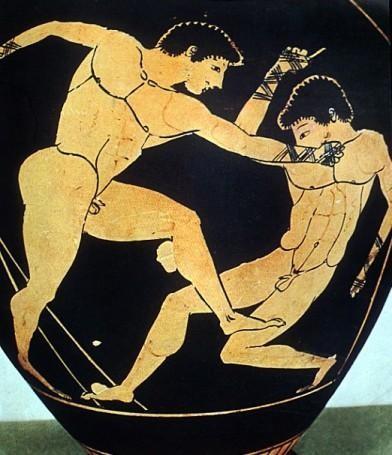
Day Two: According to Alan Carter’s book, The Olympic Glory That Was Greece, the second day was devoted to competitions for boys. The morning saw heats after heats of foot races as the qualifiers are shrunk down to the finalists. The victor receives a palm leaf, and his family and home town are honored by his grand accomplishment. The afternoon sees competitions in wrestling and boxing for the boys, as well as what could be considered a mixed-martial art called the pankration. Carter described it as “training for warriors who would be engaging in hand to hand confrontation with the enemy and Sparta was particularly associated with the sport.” In the pankration, you could bite or gouge eyes.

Day Three: On the third day, according to Carter, spectators enjoyed chariot races at the hippodrome. There were some six variants of chariot races – two and four-horse competitions, two mules, or foals as well – and they ran anywhere from 3,500 to 14,000 meters long. Below is a clip from the 1959 film Ben Hur, which is supposedly Rome in AD 26, over 680 years after the establishment of the four-horse chariot race. If the chariot races in Olympia were anything like this, I could see why this was a must-see event!

Day Four: Goldblatt wrote that day four was the day for generalists, when the pentathlon was held. The pentathlon then was made up of five events: the discus throw, the long jump, the javelin throw, a foot race and wrestling. According to Goldblatt, the competitors faced off in a footrace, the discus, the javelin and a jump that may have included weights. The winner was often determined after these four events. In the a winner could not be decided, wrestling was the tie breaker. The order and the way the winner was decided apparently is unclear and still debated.

Again, due to the sketchiness of the historical accounts, there is debate as to what happened on the fourth day. According to Carter, Day Four was a festive days, starting with the slaughter of 100 oxen in honor of Zeus. This was followed by the premier events, the stadion (200 yard foot race), the diaulos (400-yard foot race), followed by wrestling, boxing and pankration.

Day Five: Goldblatt wrote that day five is running, wrestling, boxing and “pankrating” (if I can turn that into a gerund). But Carter wrote that it is about pomp and circumstance, focusing on awarding the victors at the Temple of Zeus. The winners are announced with trumpets and declarations of their names and hometowns. They are given a palm leaf to hold and a wild olive branch to wear as a crown. After that, its feasting and partying into the night.

Running a stade in Greece
A picture of a stade in Greece, on my tour of Europe in August, 1985
It was the first week of August, 1985. I was in Greece. And it was hot.

On a tour of Europe with some 50 American students ranging in age from 15 to 50, I was tired after half a day in a boat and buses. We had left Corfu, where we got about the beautiful resort island on Vespas, caressed by cool breezes and enchanting vistas. When we arrived in Delphi, close to midnight, the camping grounds were not ready to receive us, so we slept on a gravel lot.

Delphi was home to the Oracle, a priestess of Pythia who consulted to the rich and famous from the 7th century BC to the 4th century BC. But we didn’t visit the Oracle. Perhaps, hot and tired, I didn’t care. We did visit an ancient sports stadium, where the professor leading this band of students arranged foot races for us.

In ancient Greece, the most common foot race was a stade, which is about 200 yards (180 meters), and which was the length of a stadium. Our professor had us race the length of the stadium…and back…essentially the length of four soccer pitches…in the August mid-day sun. Two of our number passed out. I don’t recall my race. Maybe I passed out too.

Our mighty tour leader, Prof. Emmanuel Fenz, cheering us on.
But if I had known then what I knew now, I would have been ecstatic to be there! This was Greece – the birthplace of the Olympics. And Delphi was home to one of four athletic competitions, collectively regarded as the Panhellenic Games:

  • The Pythian Games: based in Delphi, the Pythian Games were held in honor of Apollo every four years – this was the location where Apollo was said to have killed a monstrous python.
  • The Nemean Games: based in the northeastern part of the Peloponnese, Nemea is where the Nemean Lion lurked, slayed by Heracles; the Nemean Games were held biannually in honor of Zeus.
  • The Isthmian Games: named after the Isthmus of Corinth, a narrow strip of land which connects Peloponnese with the rest of Greece, the Isthmian Games were like the Nemean Games,  held the same two years as the Pythian Games; these games were held in honor of Poseidon.
  • The Olympian Games: located in an area called Olympia, near the town of Elis on the Peloponnese peninsula, this was the first of the four quadrennial Games, starting in the 8th century BC. Of the four Games, this was the biggest and most prestigious. While the Olympian Games are dedicated to Zeus, it is at the Temple of Hera where the custom of igniting the Olympic flame takes place.

The order of these Games were as follows:

  1. Olympian Games
  2. Isthmian Games
  3. Nemean Games
  4. Isthmian Games

Over time, the word “olympiad” became a unit of time, a four-year period, a historical point of reference no doubt noted by the founder of the modern Olympic Games, Baron de Coubertin.

For a wonderful modern-day journey of these four locales, read this New York Times article, An Olympic Odyssey: Where the Games Began, by Bill Hayes.


Anthony Nesty
Anthony Nesty in 1992

Suriname – a country so small, you may not have realized it was a country (to paraphrase John Oliver).

With a population of about 570,000 people, Suriname is the smallest country in South American, just north of South America’s largest country, Brazil. Since forming a national olympic committee, Suriname has sent small teams to the Olympics since 1960, although never forming a team larger than 7.

In 1988, Anthony Nesty was a 20-year-old swimmer, was one of six to represent Suriname at the Seoul Olympics. And represent he did!

Not only was Nesty the first ever Surinamese to place in the finals of an Olympic competition – the 100-meter butterfly – he took gold in a surprising finish. Watching this video clip from an American broadcast, the announcer mentions the American Matt Biondi who led the entire race, as well as Michael Gross of Germany and Jon Sieben of Australia – all proven champions. The only time Nesty’s name is mentioned is after the finish.

ANNOUNCER: They now have 10 meters to swim, Matt Biondi going for the gold. Jon Siebens coming hard on the outside. But Biondi looks like he’s going to take it to the wall. And they get….NESTY! Nesty finally takes in lane 3 at the very last moment!

Nesty is 5ft 11 in (1.8 meters) tall, and is significantly shorter than the 6ft 7 (2 meters) Biondi. In very real terms, Biondi has a 8 inch lead on Nesty at the start of every race. But at the finish of this finals, Biondi lost by the barest of margins because he glided in, instead of stroking in. “I was halfway between a stroke and trying to kick in and I decided to kick in,” said Biondi. “If I had to stroke, I might have touched with my nose.”

Nesty was born in Trinidad in 1967. His family moved to Suriname, about a thousand miles southeast, to Paramaribo, Suriname. While Nesty enjoyed soccer, his father encouraged his son to swim. Clearly his father saw something in his son’s stroke, but Suriname, a country about the size of Georgia, USA primarily covered in rain forests, was not rich in swimming pools. In fact there was only one 50-meter pool in the country.

Where he could, Nesty trained and got stronger, strong enough to be named one of only two to represent Suriname at the 1984 Los Angeles Olympics. Outclassed, the 16-year old finished in 21st place in the 100-meter butterfly, but as is explained in this article, he got a taste of the Olympics and wanted more, promising himself “to be more competitive next time around.” That commitment led to his acceptance at the Bolles Prep School in Florida, where world-class swimmers come to train and develop. Nesty developed so quickly he ended up breaking the prep school’s record for the 100-meter butterfly, set by Pablo Morales, who had a gold and two silvers, including one in the butterfly, at the 1984 Games.

He told the press in 1987 that he was not very well known in Suriname as he was now training in the United States.

“I’m proud, I guess,” says Nesty, who had the world’s 10th fastest time in the 100-meter freestyle, finishing 10th in the trials. He possibly has more fans in the United States than in Surname, a small nation in northern South America. “They respect me there, but I haven’t been there for over a year,” he said. “Suriname has a lot of military coups and political things. My dad told me if I stayed there much longer wouldn’t have much of a swimming career.”

Matt Biondi, Anthony Nesty, Andy Jameson
Matt Biondi, Anthony Nesty, Andy Jameson on the medals podium at the 1988 Seoul Olympics
But when Nesty returned from Seoul, Korea to Paramaribo, Suriname, he returned a conquering hero, greeted by 20,000 people at the airport and mobbed in the streets. His face was placed on commemorative stamps, coins and banknotes. And the indoor national stadium was named in his honor.

To this day, Nesty, with his gold in the 100-meter butterfly at the Seoul Olympics, as well as a bronze at the 1992 Barcelona Olympics, remains the sole Olympic medalist from Suriname.

Konjiki Tsukasa and Masa Akimoto _The Yomiuri_October 5, 1964
From The Yomiuri_October 5, 1964

Konjiki Tsukasa was on October 10. So he thought it would be great to get married on October 10. And since the Olympics were in town, why not get married at the National Stadium on October 10, 1964, the opening day of the Tokyo Olympics.

His fiance, Masa Akimoto, agreed.

But first they had to get tickets. According to an article in The Yomiuri on October 11, 1964, the couple had 70 friends apply for opening day tickets, perhaps the hottest tickets ever to go on sale in Japan at the time. The system at the time was to apply and get your names thrown in a lottery. Fortunately, two of their friends landed them a ticket each.

But now, in addition to a ticket for the priest, they needed two witnesses. Instead of trying to find two more tickets, Konjiki called the Japan Travel Bureau (JTB) many times to try to convince them to find two people who already had tickets to the Opening Ceremonies to be their wedding witnesses. According to an October 5 Yomiuri article, JTB personnel did not initially take the requests seriously, suspecting a possible scam. But Konjiki persisted, and finally convinced JTB to find two people who happened to be seated near Konjiki and Akimoto. JTB then provided an extra ticket for the priest.

Wearing red blazers with the Olympic emblem, likely similar to what the members of the Japanese Olympic team wore, the party of five entered the stadium at 10 am, about 5 hours prior to the start of the Games, and got hitched. They then proceeded to wait patiently, got to their seats for the Opening Ceremonies, and had one of the memorable wedding days a Japanese couple could possibly have.

That was one way to get in to see the Opening Ceremonies. The Yomiuri explained on October 11 another way…which did not end well. I’ll just let you read the report about these two students:

Two youths without tickets so eager to see the opening ceremony of the Olympic Games that they hid themselves in National Stadium before the event, were arrested before the start of ceremonies by patrolling policemen.

A 19-year-old boy from Tsuabame, Niigata-ken, whose name was withheld, entered the stadium Thursday (two days before) wearing a fake press armband, after showing a business card of a Niigata Nippo newspaper reporter.

A second youth, Shuro Iino, 21, freshman a Waseda University, was discovered hiding in a toilet at 11:15 pm Friday, after climbing over a fence.

Samurai Surfing

My friends know this: I’m addicted to Nissin Cup Ramen.

There’s something about the aroma after I’ve waited that obligatory 3-minutes for the hot water to soften the noodles and bind the various spices and ingredients in a flavor that instantly gratifies me. This is not a universal addiction to Cup Noodle. It has to be made in Japan – the ones manufactured elsewhere are probably catering to local tastes, and to my palate, pale in comparison.

I don’t believe they manufacture the King Size version anymore, but if they did, I’d buy.

Nissin Cup Ramen also tends to have the coolest commercials. One released in November, 2016 is not only super fun, it is appealing to the same demographic the Tokyo 2020 Olympics are trying to appeal to. In a somewhat tenuous take on The Seven Samurai, Nissin created a commercial that features athletes decked out in traditional armour that the West now associate with the warrior class known as the samurai.

And the seven featured in this commercial are magnificent! They surf, they skateboard, they pogo-stick over street vendors, they spin on their bikes, do acrobatic twists on skis to the amazement of the bewildered crows around them.

Over the decades, the IOC has worked with host countries to appeal to the youth, and ensure a market for their product for years to come. The X-Games, an ESPN-sponsored event featuring extreme sports, drove up the popularity of skateboarding and freestyle motocross. Thanks to growing popularity of these youth-driven activities, snowboarding became an Olympic sport in 1998, while BMX cycling debuted at the 2008 Olympics.

Tokyo 2020 will feature a bevy of new competitions that the organizers hope will build a new generation of Olympic fans, including surfing, skateboarding, and sports climbing.

Samura bike tricks

Keiko Fukuda_9th dan
Keiko Fukuda, Kodokan 9th dan, New York Times

She was tiny – 150 cm in height and 45 kg in weight – but Keiko Fukuda stood tall amidst the Pantheon of Judo greats. When she passed away in San Francisco at the age of 99, she was the last remaining connection to the roots of Judo, the founder, Jigoro Kano.

Fukuda was born of samurai stock in 1913, her father being Hachinosuke Fukuda, who was a master of jujutsu and Kano’s sensei. When Kano branched off and developed a new set of techniques and rules, he founded the discipline of Judo.

Judo in Japan has been a very male bastion since its inception. Judo associations in Japan have consistently been male dominated despite the rise of Japanese women judoka. But interestingly, Kano was a pioneer in gender equality, creating a women’s section of the Kodokan, the dojo Kano created in Tokyo. It was in 1926 when Kano started teaching judo to women, and in 1935, Fukuda was one of 24 women who trained at the Kodokan.

Fukuda was not only pioneering judo in Japan, she was doing so in America. She first traveled to America at the invitation of a judo club in Oakland, California in 1953, after she had achieved the highest rank a women could get – 5th dan. She taught judo for two years, and then came back to California 11 years later, eventually becoming the full-time judo instructor at Mills College, where she taught until 1978.

Keiko Fukuda_white striped black belt
Keiko Fukuda, wearing the black belt with the white stripe

In the 1960s, the glass ceiling for female judo was the 5th dan. But Fukuda’s friend and former student, Dr. Shelley Fernandez, was the president of the National Organization for Women in San Francisco, she petitioned the Kodokan to promote Fukuda to 6th dan. It worked, and Fukuda, as well as another woman named Masako Noritomi, were the first women ever granted a 6th dan.

So advances in women judo was taking place. And yet, one lingering symbol of stubborn male dominance persisted – the white stripe that ran the length of the “obi” for women black belts. You can see that belt around the waist of Fukuda in this picture below. While the International Judo Federation abandoned the black belt with white stripe to differentiate women from men, the All Japan Judo Federation has stuck to its traditional guns.

That is, until March 13. Finally, in 2017, 91 years after the pioneering founder of judo, Jigoro Kano, opened the doors to women, the All Japan Judo Federation decided to abolish the use of white stripes in women’s black belts.

Her amazing story has been told in a documentary released in 2012, called “Mrs. Judo – Be Strong Be Gentle Be Beautiful”.