Eiji Tsuburaya and his Ultraman creationsUltraman is 50 years old! He’s still battling kaiju! And he hasn’t aged a bit.
It was July 17, 1966 when the first episode of Ultraman aired on Japanese televisions. Since then, Ultraman has been re-packaged in close to 40 different television series or movies, and is an internationally recognized phenomenon, on the same level as Pokemon, Hello Kitty and Doraemon.
Ultraman is the brainchild of Eiji Tsuburaya, who at the time was producing a newly launched series called “Ultra-Q“, what might be called a Japanese version of the television series Twilight Zone or Outer Limits, which were popular in the early 1960s.
Ultra-Q was not unpopular, but the broadcaster, Tokyo Broadcasting System did some research and discovered that the kids loved the episodes with all of the giant monsters (known in Japanese as “kaijyu“). This was particularly true thanks to the popularity of the Godzilla movies. As it turned out, Tsuburaya understood that. After all, he was the co-creator of the Godzilla movies. So after the first season of Ultra-Q ended, Tsuburaya decided to devote his series to kaiju, by introducing a character that would forever defend the world from the bad ones.
In one of those quick feats of legerdemain, Tsuburaya changed the name of his series from Ultra-Q to Ultraman. Broadcast in color, Ultraman burst on to the scene, and thus was born a cultural icon that all Japanese in their 40s, 50s and 60s can remember with nostalgic bliss.
But where did Tsuburaya get the term “ultra” from? That takes us back a couple of more years to 1964 and the Tokyo Olympics. Japan had just begun its run of men’s gymnastics dominance, by winning the team gold at the 1960 Rome Summer Games. They were expected to do well on their home turf in 1964, but they knew they would have tough competition, particularly with the Soviet Union. In an interview of the Helsinki Olympics medalist and member of a committee dedicated to strengthening gymnastics in Japan, Tadao Uesako, the Japanese newspaper, Daily Sports, revealed Japan’s gymnastics strategy.
Men’s gold medal gymnastics team from Japan: Takashi Ohno, Takuji Hayata, Haruhiro Yamashita, Takashi Mitsukuri, Yukio Endo, from the book Tokyo Olympiad 1964, Kyodo News ServiceIn 1964, international scoring for gymnastics worked on a three-level scale of A, B and C, where level C was considered the highest level of difficulty for a particular discipline or routine. It was Uesako’s view that Japan’s gymnasts were aspiring to levels beyond C, or as he called it, “Ultra-C“. And from that article, another foreign word (or in this case, prefix) entered the Japanese lexicon.
So there you have it – Tsuburaya made the leap from “Ultra-C” to “Ultra-Q”, thanks to the Japanese men’s gymnastics squad that took gold, ultimately sticking the landing on Ultraman.
She grew up in Flint, Michigan, a city so poor and underserved that the local government doesn’t care their children are being poisoned by lead in the water. But she had a talent – to hit, and hit hard.
Claressa Shields is the world’s strongest female boxer in the middleweight class (75kg), and is a favorite to win gold at the 2016 Rio Olympics. In fact, she could become the first American to win boxing gold in two successive Olympics.
She is a marketing phenomenon heading into the Summer Games – the most recent being her appearance in the recent Sports Illustrated The Magazine’s Body issue, which features nude photos of some of the most famous athletes in the world. But it is the documentary, T-Rex, which tells the story of a fragile young girl turning into a determined woman and Olympic champion, that put her firmly on the American pop culture map.
Will she have strong competition at the Rio Games? Of course, she still has to be win her three or four contests. But as Shields stated recently in Slate’s sports podcast, Hang Up and Listen, she has fought all her known competition and beat them all at least once. And when she won the middleweight women’s world boxing championship on May 27 this year in Astana, Kazakhstan, she beat the only strong contender she had not faced, Nouchka Fontjin of the Netherlands.
She’s (Nouchka) pretty tall, she’s a heavy hitter. For the last two years, I just can’t wait to fight her. I can’t wait to run into her. She was ranked number 3 in the world, and when someone’s ranked that high, and I hadn’t fought them, there’s always some talk. I want to prove the doubters wrong, prove that I’m the best, prove that I cannot be beat by anybody. For the last two years, she’s been an opponent I’ve been hitting on in the gym against her because I thought she was top competition. I fought her in the worlds and dominated her, 3-0. She was competitive. But I was just great.
Shields is 74-1 in her career, a two-time world champion, gunning for a second Olympic gold. Chances of success? High.
But it was not to be. Not only did Yang fail to win gold, he fell to a disappointing fifth place. In fact, Yang was in ninth place at the end of day one, but had a very strong day two in which he won the 400-meter hurdles, pole vault and javelin throw events, clawing his way to fourth place before the final event. But Yang’s 13th-place finish in the final 1500-meter race meant that two Germans, a Russian and an American would finish ahead of him in the final placements.
A chance at a first-ever gold medal for Taiwan faded into that cool evening of October 20, 1964. Two explanations have been provided for Yang’s disappointing results: a recent change in the way scores were tallied for the decathlon, and Yang’s mysterious illness.
The decathlon scoring system was always considered complicated, as administrators have time after time adjusted the benchmarks and formulas to come up with scores that were perceived as fair so that athletes were satisfied with their points for a strong jump, or a speedy run, as well as with their points for a fantastic jump or a spectacular run. In 1964, the scoring tables were revised yet again. And the rule changes appeared to be heir apparent, Yang, at a disadvantage. Technology advancements in plastics resulted in the increasing prevalence of fiber-glass poles. Yang had mastered the new pole more quickly than others, enabling him to claim a world indoor record in the pole vault. As legendary New York Times sports writer, Arthur Daley, explained in a preview to the 1964 Olympic decathlon, the scoring revision hurt Yang.
“Not too long ago the International Amateur Athletic Federation updated and revised the decathlon scoring tables. This has hit Yang harder than most because he no longer can make a blockbuster score of fifteen hundred points in the pole vault. He still will be the decathlon favorite but not by the preponderant margin that once had been assigned to him. “
Daley went on to quote Yang that he wasn’t overly worried. “Of course I lose points by the new tables,” he said. “But I don’t think it will affect me over the whole thing.” Others, though, believed that Yang was indeed psychologically affected by the rule changes, particularly regarding the pole vault.
Willi Holdorf and C.K. Yang after the decathlon’s 1500-meter race in Tokyo 1964, from the book Tokyo Olympiad 1964 Kyodo News Service
Based on the revised scoring system, Yang’s world record of 9,121 points would convert to 8,087 points, which is significantly higher than gold medalist Willi Holdorf’s winning point total of 7,887. But clearly, at the 1964 Tokyo Olympics, Yang did not come close to his world-record times and distances of his 1963 world-record setting effort. The explanation at the time was that Yang was not 100% healthy. As his coach Ducky Drake said, Yang hurt his left knee about five weeks ago. He never got into shape and this was reflected in his performances.” Another report said that Yang was suffering from a cold.
But Yang’s buddy, Rafer Johnson, revealed in his book, The Best That I Can Be, a shocking explanation for Yang’s unexpected performance in 1964. Remember, this is the time of the Cold War, the Berlin Wall, Mao’s China and Chiang Kai-shek’s Taiwan.
In the 1970s, C. K. had dinner with a man from Taiwan’s counterpart to our FBI. They were talking about the 1964 Olympics when the man dropped a bombshell: C. K. had been poisoned, he said. Because of the tension with mainland China, Taiwan had assigned two bodyguard to C.K. at the Games. Despite that precaution, this man told him, a teammate had spiked C. K.’s orange juice at one of their meals. Shortly afterward, that athlete and two Taiwanese journalists defected to Red China. C. K. had always considered himself unlucky for having gotten ill at the wrong time. Instead, he may have been a victim of political warfare. “I was so angry I thought I would cry,” he told me.
Woah.
For more stories on C. K. Yang, see the following:
From the official report of the Tokyo Olympic Committee, The Games of the XVIII Olympiad Tokyo 1964
It was one of many proud and emotional moments for the Japanese, as 80,000 in the National Stadium stood for the playing of the Japanese national anthem at the Opening Ceremonies of the 1964 Tokyo Olympic Games. And then, breaking the crowd murmur and piercing the crisp blue Autumn sky were five jet planes of the Japanese Air Self-Defense Force. The crowd looked to the sky in awe to see the five jets skywriting the five rings of the Olympic movement.
Victor Warren of the Canadian field hockey team told me “it was magic! It was a beautiful start to a beautiful day.”
The jets over that Tokyo sky on October 10, 1964 represented precision, artistry, modernity and a profound understanding by the Japanese that the Olympics deserved big moments.
Will 2020 have a similar moment?
How about creating a man-made meteor shower?
A Japanese start up called Star-ALE (not the Manchester beer) is hoping to pull off the moment of the Tokyo 2020 Opening Ceremonies. The leaders of Star-ALE aren’t talking about launching rockets into the sky, but dropping man-made meteors from space! They call this spectacular piece of performance art SkyCanvas. “Making the sky a screen is this project’s biggest attraction as entertainment. It’s a space display,” said Star-ALE founder and CEO Lena Okajima.
What Star-ALE plans to do is to launch a series of microsatellites that will hold some 5,000 to 1,000 specially-created pellets. These pellets will circle about a third of the circumference of the earth before they begin their spectacular fiery burn into earth’s atmosphere some 35 to 50 kilometers above land. They plan to employ a variety of chemical concoctions that will result in a wide range of colors streaking the sky.
Star-ALE writes on their website that they plan to launch their first satellite in 2017, launching a new one every year after. By 2020, they expect to bring the heavens down on Japan for a spectacular start to the XXXII Olympiad.
Watch the concept video below to visualize the future.
Rein Aun of the Soviet Union (silver) Willi Holdorf of Germany (gold) and Hans-Joachim Walde of Germany (bronze)
To be honest, he looked more like an accountant than a decathlete. He had thinning hair and sloping shoulders, and wasn’t dominant in any of the ten events. And yet, at the 1964 Olympics in Tokyo, Willi Holdorf of Germany broke the US stranglehold on the decathlon to be the first non-American to win the prestigious event since 1928.
According to UPI, when the 24-year old student was asked by the press how it felt to be the “World’s Greatest Athlete”, Holdorf replied “‘Nicht ich, nicht ich’, vigourously shaking his head when the question of how it felt to be regarded the greatest of them all wad put to him. In slow, deliberate English, he conveyed the idea that he did not think of himself as No. 1, but genuinely believed (Bob) Hayes was the all-round best even though the speedy Floridian never even competed in the decathlon.”
While decathletes like Rafer Johnson and Bob Mathias had created an American stranglehold on this ten-discipline event of running, jumping and throwing, the overwhelming favorite to win gold in 1964 was the Asian Iron Man from Taiwan, C. K. Yang. Yang barely lost to his close friend and UCLA teammate at the 1960 Rome Olympic. The fight, they said, would be for silver. As it turns out, Holdorf won gold, while his German teammate, Hans-Joachim Walde took silver, and a third German finished sixth – an amazing result.
Willi Holdorf in the decathlon high jump, from the book The Olympic Century XVIII Olympiad:
Highly publicized changes to the decathlon rules prior to the Tokyo Olympics resulted in fewer points assessed to decathletes who had a specialization that was far superior to others in the field. In other words, if an athlete was dominant in a particular event, prior to 1964, they could get an outsized number of points and take an outsized lead. But that advantage was diminished with the rule change. Fortunately for the German squad, they had a decathlon coach, Friedel Schirmer, who had the philosophy to take advantage – consistency uber alles.
Returning home to Germany as a sickly solider after surviving captivity in the Soviet Union shortly after the end of World War II, Schirmer went on to become a seven-time all Germany champion in the decathlon, representing Germany as the flag bearer in the 1952 Helsinki Olympics. He placed eighth in those Olympics, but it was his philosophy that had such an impact that Germany would consistently medal in the Olympic decathlon in the years following 1964. Here’s how Carl Posey explained it in the book, The Olympic Century XVIII Olympiad:
Every elite decathlete’s score took a dip because of the table revisions, but the least affected was a group of Germans. These men were all coached by Friedel Schirmer, who stressed consistency in every event rather than excellence in one or two. Foremost among his protégés was Willi Holdorf, a balding, 24-year-old physical education student from Leverkusen. Holdorf took the decathlon lead after the first event, the 100-meter dash. He fell back as far as fourth place after the shot put and high jump, while the Soviet Union’s Mikhail Storozhenko surged to the front on the strength of a tremendous put. Holdorf regained the lead after the 400 meters and maintained it through the final five events. The gold medalist’s score of 7,887 points was well short of a record, nevertheless, the Tokyo Games validated Schirmer’s decathlon philosophy. Germans claimed three of the top six spots, and Schirmer-trained athletes would dominate the event for the rest of the decade.
Willi Holdorf after the decathlon 1500-meter race, from the book, Tokyo Olympiad Kyodo News Service
Sports Illustrated in their November 2, 1964 issue explained that Schirmer had studied up on Soviet and American training techniques and after becoming coach of the German decathlon squad worked them hard in a series of biweekly training and competitive sessions, gearing them for Tokyo. In the end, as is the case in many decathlons, it came down to the tenth and final event, the 1500-meter race. Like Johnson in 1960, Holdorf did not need to win, but he needed to do well enough to maintain his point lead.
In Tokyo, Holdorf took an early lead and held it, though as the exhausting 1,500-meter run, the final event, began, three men were still close enough to beat him. Particularly dangerous were Russia’s Rein Aun and America’s Paul Herman, both of whom could run much faster 1,500s than the German. “I knew that I could win if I could stay within 60 meters of Aun and 100 meters of Herman,” said Holdorf, a tall, balding blond who is built like a wedge of custard pie standing on its point. Aun took an immediate lead, with Herman in desperate pursuit and Holdorf gradually falling farther and farther behind. But at the finish Holdorf, tottering half-conscious over the line, was close enough to salvage victory from Aun by the narrow margin of 45 points.
We’re a little less than a month away and the intense fear of the zika-virus has diminished over the past few months. Part of the reason is that mosquitos, which transmit the zika-virus to humans, flourish in hot weather, and Brazil is in its cool season in August.
Still, athletes and National Olympic committees are taking measures where they can. I’ve noted three basic strategies: protection, abstention and just-in-case measures.
Protection: The US Olympic Committee will be issuing long-sleeved shirts and long pants to their athletes, as well as a six-months supply of condoms post Olympics as the virus can be transmitted through sexual fluids. The Australian Olympic Committee is providing their athletes with condoms specially treated with an anti-viral coating. The Korean Olympic Committee is not only providing long-sleeved shirts and long pants to their athletes, they are infusing the fabrics with mosquito repellent. To ensure everyone in Rio has mosquito repellent, Rio’s Olympic Organizing Committee just signed up SC Johnson as an official Olympic sponsor, which means that thousands of bottoles of the mosquito repellent OFF! Will be distributed to athletes, staff and volunteers.
Abstention: Despite calls by a prominent Canadian doctor to postpone the Rio Olympics, the World Health Organization did not endorse a ban, although they are strongly recommending pregnant women from travelling to zika-infested areas like Brazil, as well as to abstain from sex for at least 8 weeks after returning from zika-infested areas. If they do not experience such symptoms as rash, fever, arthralgia, myalgia or conjunctivitis after 8 weeks, they are likely uninfected. A handful of athletes have withdrawn for the Rio Olympics citing concerns regarding the zika virus, including the top four golfers in the world: #1 Jason Day of Australia, #2 Dustin Johnson of the US, #3 Jordan Spieth of the US, and #4 Rory McIlroy of Ireland, among others.
Just-in-Case Sperm Freezing: 2012 London Games long jump gold medalist Greg Rutherford initially expressed the strong possibility of not going to the Rio Games. But now that Rutherford has frozen his sperm, and has ensured the possibility of having children without the risk of zika-infection, he is now re-considering his participation. Spanish NBA star, Pau Gasol, is also considering freezing his sperm in order to have a greater of peace of mind if going to Rio.
Average temperatures in Rio de Janeiro over 12 months
In the end, for the majority of the athletes, many athletes are going because the cool weather means a significant drop in risk. According to the New York Times, three-time gold medalist beach volleyball player Kerri Walsh Jennings already participated in a tournament in Rio in March and her precautions were effective. “I took my essential oils, I’m going to bring my Honest bug repellent, and I escaped all mosquito bites until the very last day. And I came home, and I didn’t get Zika.”
With the Rio Olympics in August in the middle of the Brazilian winter, she feels confident that the zika virus will not be a threat.
What a lot of athletes may also privately admit is that they are not going to let a tiny mosquito deny them a chance at glory after years of grueling training.
Maureen O’hara, John Sheffield, Johnny Weissmuller and Cheeta
Johnny Weissmuller won five gold medals in swimming over two Olympics in Paris (1924) and Amsterdam (1928). But Weissmuller became globally famous after he was recruited by Hollywood to act out on film the iconic Edgar Rice Burroughs‘ character, Tarzan.
In 1958, Weissmuller had essentially retired from acting and was enjoying the life of renowned Hollywood celebrity, and was playing at a celebrity golf tournament in one of the hotspots for American celebrities – Havana, Cuba. As this article from The Smithsonian explains, “by the 1950s Cuba was playing host to celebrities like Ava Gardner, Frank Sinatra and Ernest Hemingway. But the advent of cheap flights and hotel deals made the once-exclusive hotspot accessible to American masses. For around $50—a few hundred dollars today—tourists could purchase round-trip tickets from Miami, including hotel, food and entertainment. Big-name acts, beach resorts, bordellos and buffets were all within reach.”
Havana, Cuba in the 1950s
The Smithsonian goes on to explain that “the sugar boom that had fueled much of Cuba’s economic life was waning, and by the mid-’50s it was clear that expectations had exceeded results. With no reliable economic replacement in sight, Cubans began to feel the squeeze. Poverty, particularly in the provinces, increased.” It was very Americanization of Cuba and the diminishing economic prospects in this impoverished Caribbean nation that was an offense to a growing band of revolutionaries, headed by Fidel Castro.
According to the son of Johnny Weissmuller, Johnny Weissmuller Jr, in his book, My Father, Tarzan, the Olympian was headed to the golf tournament when he and his friends were stopped by Castro’s guerrilla troops. Foreigners were susceptible to being kidnapped by the Revolutionaries, so Weissmuller was at significant risk when his car was stopped and his guards disarmed. According to the now legendary story, Weissmuller decided to identify himself in the clearest manner possible – by beating his chest with his fists and letting rip his trademark Tarzan yell.
Suddenly the guerrillas realized they were in the midst of Hollywood royalty. They dropped their guns, shouted “”Es Tarzan! Es Tarzan de la Jungla! Bienvenido!”, shook the Ape-man’s hand, and got his autograph. Not only did Weissmuller make it to the golf tournament, he got a revolutionary escort to a golf course, the symbol of American capitalism.
On July 6, double-amputee Olympian Oscar Pistorius, was sentenced to six years in prison for murder. The South African, who competed in the 400-meter sprint at the 2012 London Olympics, was convicted for firing four bullets into his bathroom door, killing his girlfriend Reena Steenkamp on Valentine’s Day three years ago.
In this high-profile long-running set of trials, Pistorius claimed someone had intruded his home and that he fired his gun fearful for his life. Many feel that Pistorius was let off easy, his six years not coming close to what many thought would be a 10- to 15-year sentence.
In the long history of the Olympics, Pistorius joins a small group of Olympians who served time for murder, according to one my favorite go-to books, The Book of Olympic Lists, by David Wallechinsky and Jaime Loucky. In their list of 20 Olympians Who Did Time in Prison, there are four other Olympians who went to the slammer for murder.
Dr. James Snook
James Snook: Snook was a member of the gold medal winning US Free Pistol Shooting team at the Antwerp Games in 1920. At the age of 48, then a professor of veterinary medicine at Ohio State, Snook confessed to the murder of his mistress, Theora Hix. He was put to death in the electric chair after being found guilty of taking a hammer to Hix after violent sex at a rifle range.
Humberto Mariles
Humberto Mariles: This two-time gold medalist and bronze medalist equestrian from Mexico competed at the 1948 Games in London and the 1952 Games in Helsinki. One August summer day, Mariles experienced an extreme fit of road rage when another motorist forced him off the road. According to Wallenchinsky and Loucky, “at the next traffi light Mariles pulled out a gun and shot the man.” Mariles was sent to prison but was pardoned by the President of Mexico.
Ludovit Platchetka
Ludovit Plachetka: Plachetka was a middleweight boxer from the Czech Republic who won his first match at the 1996 Atlanta Olympics against a boxer from Swaziland before being eliminated by a boxer from Uzbekistan. According to Wallechinsky and Loucky, Plachetka went from Olympian to felon in less than a year. Apparently he was in an ongoing dispute with his girlfriend over visitation rights of their child that escalated to the point where Plachetka shot to death the mother of his girlfriend. He would have shot his girlfriend if not for gun jamming at that moment. The former boxer/bouncer was sentenced to 13 years.
As for Pistorius, six years may seem like a long time for him. But a top sports officials in South Africa has said the sentence includes time served, and that with good behavior could be out in time to train and participate in the 2020 Tokyo Paralympic Games.
According to the Daily Mail, “Tubby Reddy, CEO of South Africa’s Sports Confederation and Olympic Committee, said he had ‘no problem’ with the idea of the ‘Blade Runner’ returning to the national team and representing his country at the highest level – despite widespread condemnation of Pistorius’ crime and six year sentence.”
There are 12 silver medals from the 1972 Munich Olympics packed away in a storage room inside the Olympic Museum in Lausanne, Switzerland. These medals have remained unclaimed for over 40 years.
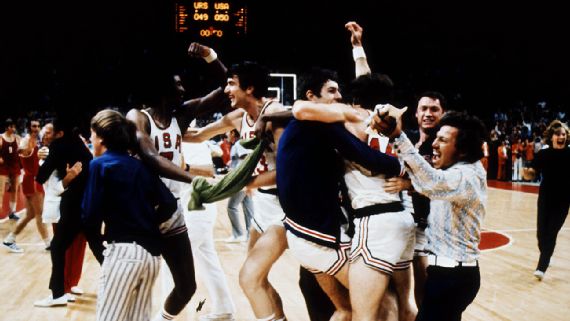
The IOC insists these medals belong to the 12 members of the US men’s basketball team, who lost to the Soviet Union 51-50. This was the Soviet Union’s “Do-you-believe-in-miracles” moment. After all, up to that finals game on September 10, 1972, the US Men’s basketball team had a record of 63-0 in Olympic competition.
But a confluence or circumstances and a last-second comedy of errors turned the men’s basketball finals in Munich into one of sports’ history’s most intriguing and controversial moments. In fact, a young Bob Costas refers to this game twenty years later at his 1992 Barcelona Olympics broadcast as “so controversial, so galling, still so difficult to accept.”
US Men’s basketball team celebrating prematurely.
To be fair, the Soviet Union at the time had a strong, experienced team, and the US team were a collection of college greats, which meant they were very young and did not play extensively together until the year of the Olympics. Unfortunately for legendary coach, Hank Iba, UCLA center, Bill Walton, chose not to play on the team, which made the US team more vulnerable to the Soviet’s bulk up front.
Additionally, according to guard Tom Henderson, the coach had made a strategic error by playing a slow-down game even though the US had a team of “young deers” who “should have run them back to Russia.” So at the half they were down 26-21, and losing into the second half. But with 8 minutes left, the Americans began to run and score. With scant time left and a point behind, shooting guard Doug Collins was undercut while driving to the basket, slamming into the basket base. Woozy, Collins stepped up the free thrown line and knocked down the free throws to give the Americans a 50-49 lead with seconds left.
How many seconds left? That’s the gist of the controversy. And while I could attempt to explain it here, it really is very complicated. There are actually a large number of micro-actions that had to take place before a time-out was officially recognized according to rules at the time, and the compressed time frame and high stakes of the moment made it close to impossible to ensure clarity. And in fact, there were three separate in-bound plays. In other words, the play was re-done…twice. (Read details here).
Soviets celebrating their “Do-you-believe-in-miracles” moment
After the initial inbound play right after the second free throw, the Soviets appeared to have one second left. In the first re-do, the Soviets were awarded three seconds, which gave them time to set up a play. They inbounded, the Soviets rushed as time slipped away, threw a meaningless pass, and suddenly, the Americans were celebrating on the court with dozens of other officials and spectators. Unfortunately, in all the chaos, the time-keeper had kept the clock at one second remaining, failing to revert the clock back to 3 seconds. Again, without
Men and women do not compete against each other in too many sporting events. There is mixed pair figure skating, and mixed pairs tennis, but pairs are competing against each other on equal ground, gender wise. However, until 1992, both men and women could compete against each other in Olympic shooting events.
Learning how to shoot from her father, and honing her skills as an instructor in the US Army, Margaret Murdock was always aiming to compete on the Olympic stage. Having just missed qualification for the Olympics in 1968, and then not being able to compete in 1972 with the birth of a child, Murdock won a spot on the US Olympic shooting team and was eager to finally face off against the best in the three-position small bore rifle event.
Murdock’s teammate, Lanny Bassham, was considered a favorite to win, but at the end of the first part of the competition, shooting at 50 meters while prone on the ground, Murdock was one point off the lead, while, Bassham and Germany, Werner Seibold, were another point behind them. In the second stage, called the offhand position, which in layman’s terms, is the standing position, Murdock again shot well, but was one point off the leader, Seibold. Bassham fell back, and was four points off the leader.
Margaret Murdock
In the kneeling stage, the final part of the competition, the riflemen and riflewoman had to wait for the final scores to be posted. According to this account by William Parkerson, history had been made.
When the kneeling stage was completed, no one was sure where the frontrunners had finished, and a large crowd began to swell around the public scoreboard outside the range. The tension increased as score after score was posted, but none next to the names of any of the leaders. Finally Murdock’s mark appeared . . . an 1162.
After what seemed more like hours than minutes, Bassham’s score went up . . .1161. Margaret Murdock was mobbed immediately by well-wishers, including her parents, sister and her five-year-old son Brett, who wasn’t sure what to make of the cheering and the tears. Seibold’s score had yet to appear, and in fact it was the last mark to be posted. When the 1160 finally went up, a second round of congratulations appeared in order for the Kansas nursing student who had become the first woman to earn a shooting medal in Olympic history.
Unfortunately for Murdock, those results were not official. According to the director of the












You must be logged in to post a comment.