Business was good enough for the Tryhorns at their store in Australia that they thought they should take a plane to Japan and see the sights, as well as the XVIII Olympiad in Tokyo. On Friday, October 9, the day before the start of the Olympics, the couple from Victoria disembarked from their floating hotel and transportation, the P&O Orient liner Oriana, to walk about Yokohama.
Unfortunately, as they saw the sites in Isezaki-cho, Mrs Tryhorn was pickpocketed. According to the October 15, Mainichi Daily News, in her stolen purse were train tickets for a limited express of the New Tokaido Line, a coupon for the Kyoto International Hotel, and a notice of remittance addressed to the Hongkong & Shanghai Banking Corp.
According to The Japan Times on October 20, the Metropolitan Police Department had actually been in the midst of a campaign to thwart pickpockets, starting a preventive program over three months previously to round up suspected pickpockets and keep them off the streets. By the time the Olympics began in October, they had arrested over 230 pickpockets. As a result, the number of pick pocket incidents dropped from 400 in April, 1964 to 120 in September when tourists and people related to the Olympics started arriving in Tokyo.
Unfortunately, the police didn’t catch the guy that picked the Tryhorns. The Japan Travel Bureau (JTB) , led by the manager of the South Pier Yokohama JTB branch, took it upon themselves to make it right for the Tryhorns. They collected money from the JTB staff so that they could buy new train tickets to Kyoto. They called the hotel in Kyoto to ensure that the Tryhorns could stay without the need for their coupon. And they called the bank to ensure that the couple could pick up their cash with the remittance paper when they came back to Yokohama.
When the child was born, the midwife told the expected parents, “It’s a boy!” Then a few minutes later, the midwife said, “it’s a girl, after all.”
Dora Ratjen was born on November 20, 1918. When she was in her teenage years, Ratjen began to compete in sports, strong enough to take fourth place at the 1936 Berlin Olympics in the high jump. And at the age of 20, she won a gold medal at the European Athletics Championships with a world record high jump of 1.67 meters. But the previous world record holder, Dorothy Tyler-Odam, said what everyone else thought, “she’s not a woman, she’s a man.”
On September 21, 1939, a train conductor reported that there was a man dressed as a woman in his train. Ratjen was pulled off the train and questioned by the police. He showed official papers that proved his female gender, but a doctor quickly concluded that Ratjen was a man. The German government returned Ratjen’s gold medal. As it turned out, Dora Ratjen had always thought he was a man, and eventually changed his name to Heinrich, a name he had until he passed away in 2008. In 2009, the German magazine, Der Spiegel, revealed these details about Ratjen’s sexual ambiguity.
The New York Times recently had a fantastic piece on gender ambiguity, and the humiliation a small group of athletes have had to endure to confirm their gender. The truth is, it is not clear cut as to whether certain people are definitively a man or a woman. Tests over the decades have looked at chromosomes, hormones, genetalia or reproductive organs, but there are still many cases where the gender of a given person is unclear. According to the Times, experts use the term “intersex” to describe such cases, but that may be the only thing they agree upon.
Estimates of the number of intersex people vary widely, ranging from one in 5,000 to one in 60, because experts dispute which of the myriad conditions to include and how to tally them accurately. Some intersex women, for instance, have XX chromosomes and ovaries, but because of a genetic quirk are born with ambiguous genitalia, neither male nor female. Others have XY chromosomes and undescended testes, but a mutation affecting a key enzyme makes them appear female at birth; they’re raised as girls, though at puberty, rising testosterone levels spur a deeper voice, an elongated clitoris and increased muscle mass. Still other intersex women have XY chromosomes and internal testes but appear female their whole lives, developing rounded hips and breasts, because their cells are insensitive to testosterone. They, like others, may never know their sex development was unusual, unless they’re tested for infertility — or to compete in world-class sports.
Over the decades, there have been plenty of claims of gender cheating in sport. People say, if she looks like a man, he must be a man. And due to the measures of testing in the past, women have had to go through humiliating tests, and have been shamed as cheats, Polish sprinter, Ewa Klobukowska, a case in point in the 1960s.
But there is a blurred space between men and women, an area still not fully understood by scientists or authorities – the intersex gender.
I lived in Bangkok and Singapore for over 13 years, where it is summer year round, and the temperatures are commonly in the low to mid 30’s Celsius (high 80’s Fahrenheit), and sometimes high 30’s Celsius (100+ Fahrenheit). And for every single one of those years, I had a nice big swimming pool within 10 meters of my apartment.
Jumping into the pool was an absolute delight!
But not for high-performance swimmers, athletes who have trained by jumping into water 12 degrees (20 Fahrenheit) colder than their body temperature, since they were kids. The bracing shock apparently never goes away.
“The worst part about being a swimmer? Jumping in the pool.”
“Jumping into the water when It’s 6am in the winter – it is the last thing you want to do.”
“It’s the worst part of any swimmer’s day.”
Click on the above picture or go to this link and see grown men and women revert back into little kids just thinking about it.
John Oliver in his program, Last Week Tonight, takes complex issues and explains them simply and, often times devastatingly, with humor. Recently, he took on the topic of doping.
It is powerful, and hysterical.
One early scene, Oliver shows an American anti-doping official observing an athlete urinate to show the world the humiliating extremes authorities feel they have to go to prevent cheating.
An anti-doping official watching an athlete pee.
He quotes the former head of top world anti-doping regulator (WADA), Dick Pound, saying that no matter what processes you have in place to prevent doping and cheating, if there’s a will there’s a way.
“The machinery is all there. The question is, do people really want it to work. You can do hundreds of thousands of tests and catch nobody if you don’t want to catch anybody. Yeah. People don’t want it to work.”
Oliver goes on to show the dismay of athletes who feel they are competing fruitlessly against cheaters, and don’t know what to do about it. Alysia Montaño came in fifth in the 800 meter race at the 2012 Olympic Games, losing to three people from countries (Russia and Kenya) whose anti-doping authorities have been deemed inadequate. Montaño states that she felt she was “racing against robots”, and wondered at her predicament “What am I doing here? What’s the point?”
The 20-minute piece, every minute worth watching, builds to a glorious finish with a fantastically funny spoof of the inspirational profile of an Olympic athlete. Please watch this video.
From John Oliver’s faux inspirational athlete profile.
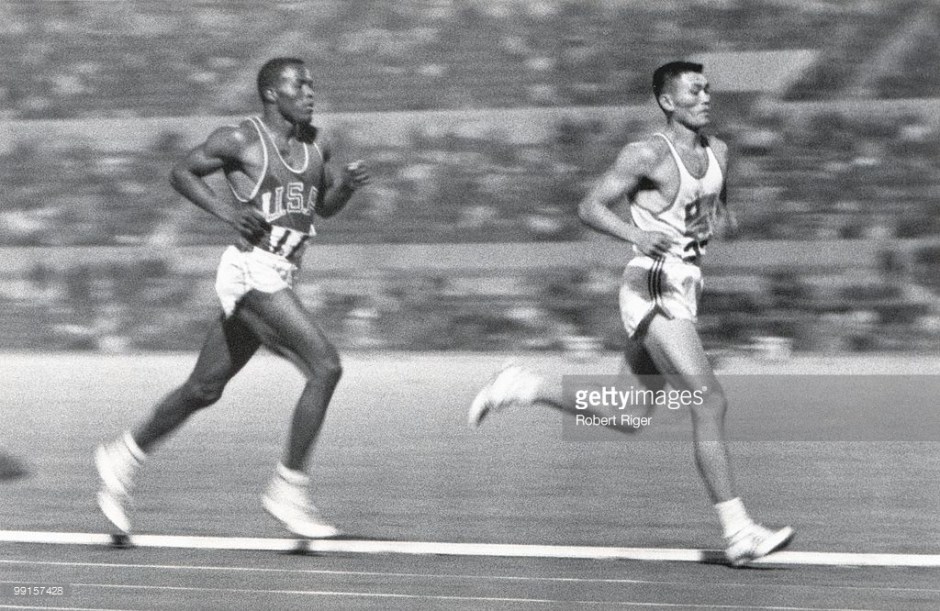
CK Yang and Rafer Johnson after the completion of the 1500 meter race and the decathlon at the 1960 Rome Olympics.
Rafer Johnson was expected to win gold in the decathlon at the 1960 Rome Olympics. Intelligent, articulate, powerful and handsome, he was selected with great favor to be the US Olympic team’s captain, and flag bearer in the opening ceremonies.
Johnson came close by taking silver in the decathlon in 1956, so he was hungry for victory in 1960. But the decathlon is grueling, both physically and mentally – ten running, throwing and jumping events over two long days. On top of that, his biggest rival was a very close friend, the up-and-coming C. K. Yang from Taiwan. Despite very little English language capability, Yang moved to California to train under UCLA coach Ducky Drake, and train with Johnson, who immediately helped Yang with English, introduced him to his friends, took him to activities and parties, and trained with him.
As Johnson wrote in his autobiography, The Best That I Can Be, they were more than just good friends – they brought the best out in each other.
C. K. taught me a lot, especially about the pole vault, which he was so good at that he later broke the world record. I helped him too, especially with the weight events – javelin, discus, and shotput. We worked side by side, pushing each other like teammates with a common purpose, spotting each other’s weaknesses and helping to correct them. Each of us understood a basic truth: If I help him be the best he can be, he’ll help me be the best I can be. We never faltered in this belief, even at the height of our competition.
It was an overcast and humid day on September 5, 1960 when the decathlon commenced. First up was the 100 meters, which did not start well for Johnson. Even in the decathlon, there are heats, and in Johnson’s heat, the decathletes dealt with four false starts, and in one of them Johnson had already sprinted 40 meters before realizing that someone else had jumped the gun. “I was so bothered by the distraction that I lacked sharpness when we finally ran the race,” recalled Johnson. In the decathlon, there is a scoring system that assesses points to times or distance. His time of 10.9 seconds was 0.3 seconds off his best, or a difference of 132 points. In contrast, Yang won his heat in 10.7 seconds, placing him 86 points in the lead.
In the long jump, Yang again bested Johnson, thus increasing his lead to 130 points. But then it was time for the shotput, Johnson’s strength to Yang’s weakness. Predictably, a powerful throw by Johnson, and a throw that merited 14th best by Yang put Johnson in first place by 143 points. After waiting through a two-hour thunderstorm, the athletes had to re-start their motors. Johnson edged Yang in the high jump. And at 11 pm that evening, they lined up for the 400 meters, where Yang defeated Johnson by 0.2 seconds. By the end of Day One, Johnson had a slim lead of 55 points.
Wrote Johnson in his autobiography, “nearly fifteen hours after taking the field that morning, I collapsed into a seat on the bus and returned to the Olympic Village. By the time I got to sleep it was after 1:00 A. M. Five hours later, I awakened tired and sore. After a light breakfast, I boarded a bus to the stadium. The pressure inside me was intense. I was the favorite, the world-record holder, the captain of my team, trying to complete the quest I had begun nearly ten years earlier.”
On Day 2, Yang burst out of the blocks to best everyone in the 110 hurdles. Johnson’s fifth place finish immediately catapulted Yang back into first place overall. Fortunately, the next event was a throwing event, a weakness of Yang’s. The Asian Iron Man as Yang was called finished 11th in the discus, returning Johnson back to the top.
Next was Yang’s best event, the pole vault. As a world record holder in the indoor pole vault, it was expected that Yang would finish first. But Johnson stayed close with a third-place finish and clung to a 24-point advantage, a narrow one at best. Then Johnson threw his javelin a little more than a meter and a half longer than Yang, giving Johnson a slim 58-point lead heading into the final event – the 1,500 meter race.
Clearly, the deviser of the decathlon rules was a sadist, placing the longest running event at the end. Almost all the other events required an intense burst of energy. Even the 400 meter race finished in less than a minute. The 1,500 meter race would be nearly 5 minutes of pain and exhaustion. Neither had to win the race, they just had to finish in front of the other. In order to overcome his 58-point deficit, Yang had to beat Johnson by about 10 seconds. In fact, Yang’s best time in the 1500 was 13 seconds better than Johnson’s best, so Yang had a legitimate chance to come from behind to win gold.
Ducky Drake was in Rome as the coach of the Taiwan track and field team, and thus was Yang’s coach at the Olympics. And yet, as David Maraniss explained in his book, Rome 1960, Drake was impartial, imparting the right advice to his two stars as they readied themselves for the 1500 meter race, in which they would run together.
Johnson’s confidence was not shaken now, but he needed more advice, so he approached his coach a the edge of the stands. How should he run this most important race of his life? Drake had already thought it through. “The key thing is that when C. K. tries to pull away – and he will try – you have to stay with him. At some point C. K. will look back to see where you are, and you have to be there. If he opens up, you have to do with him. You cannot let him build that yardage.”
Easier for Drake to say than for Johnson to do, but still it was a sound plan, perhaps the only plan that could save him. Rafer nodded in agreement and walked back toward the track. About halfway there, he turned and saw none other than C. K. approaching the same spot at the edge of the stands. Ducky, after all, was his coach too. “Ducky said to me, ‘C.K., you run as fast as you can. Rafer cannot keep up with you!” Yang later recalled.” At that moment, Drake was like a master chess player competing against himself. He saw the whole board and was making the best moves for both sides.
Again, after a long day, the runners pulled up to the starting blocks at 9:20 pm. Both Johnson and Yang knew that the outcome of the 1500 would determine the winner of the title – World’s Greatest Athlete. Halfway through the race, Johnson was not far behind
Stephen Colbert, like his former boss Jon Stewart and his former colleague, John Oliver, has a wit as sharp as Occam’s razor. It is often a joy to listen to him dissect an issue. In the above video clip, his dissection of the state of the Rio Olympics felt more like a vivisection. Here are a few examples:
I’m pumped for the Rio Games. They are less than two months away…or never…because yesterday Rio’s acting governor warned “the Olympics could be a big failure.”
Many of the venues are still unfinished, possibly because more than ten billion dollars in construction contracts went to just five firms, all of which are currently under investigation for price fixing and kickbacks. This has already led to top executives and politicians being jailed or charged…although the plus side for those executives – the prisons won’t be completed until 2036.
Experts don’t expect an increase in arrests during the Olympics in part because police patrols may grind to a halt because they can’t afford to buy fuel. Though with any luck the problem will solve itself when the cars are stolen. These budget shortfalls led first responders to stage protests all over Rio yesterday, including one at the airport where police held a sign that read: Welcome to Hell. Police and firefighters don’t get paid, whoever comes to Rio de Janeiro will not be safe.
Hell. It explains why they’re changing the Olympic logo from three people holding hands to two guys mugging the other guy.
Malcolm Gladwell said so in his enlightening book, Outliers, so it must be true. “The idea that excellence at performing a complex task requires a critical minimum level of practice surfaces again and again in studies of expertise. In fact, researchers have settled on what they believe is the magic number for true expertise: ten thousand hours.”
So inspired was Dan McLaughlin, a commercial photographer from Portland, Oregon, he decided to quit his profession and commit to learning how to play golf by practicing for 10,000 hours to see if he could become a professional golfer. This from a man whose golf experience up till then consisted of two visits to a driving range as a child.
So on June 27, 2009, McLaughlin began his journey, and tracked it on his site, The Dan Plan. And in 2012, when McLaughlin was the 2,500 hour mark, Golf.com writer, Alan Bastable met McLaughlin, and was impressed with his progress. McLaughlin had a 10 handicap, and according to Bastable, was energetic, enthusiastic and committed. At that stage, the plan was to hit 10,000 hours of practice in 2016, by which time he hoped to be a pro golfer.
Fast forward to November, 2015, and McLaughlin finds himself stuck on pause. Bastable caught up with McLaughlin to find the golfer recovering from back injuries with rest, as well as working hard to improve his financial situation. While the press and corporate sponsors are intrigued by this Quiotic dream, they are not showering him with as much attention as he would like. But more damaging has been the injuries to his back, which has McLaughlin contemplating surgery.
As McLaughlin said in this November post in his blog, he wrote about his frustration in dealing with his injury. “My back has been improving steadily and there was one week where I was able to play three rounds of golf with minimal pain. Then there are days where I swing a club once and it feels like I have reverted 3 or 4 weeks in my recovery. It’s not a half full – half empty situation, it’s more as if the cup has sprung a small leak and water is flowing in haphazardly.”
McLaughlin has hit the hard wall of reality. And one hopes that he is able to recover from his back ailments and resume his journey because his original reason for starting this journey resonates with me. Here’s how McLaughlin explained it in this interview with Bastable:
I’m interested in seeing whether somebody could do it, and how far they can go. In our culture, we’re kind of fascinated by the idea…not quite manifest destiny, but the ability to transform, and how far one can go, is it talent or hard work, and which trumps the other, and how much human potential we all have.
I suppose McLaughlin’s premise is that in the nature vs nurture debate, nurture (or deliberate practice in this case) can “trump” nature, or the genes that assign specific physical attributes to you. Here’s what David Epstein wrote in his fascinating book, The Sports Gene: Inside the Science of Extraordinary Athletic Performance, about why that thinking appeals to so many people:
The “practice only” narrative to explain Tiger Woods has an obvious attraction: it appeals to our hope that anything is possible with the right environment, and that children are lumps of clay with infinite athletic malleability. In short, it has the strongest possible self-help angle and it preserves more free will than any alternative explanation.
And yet, Epstein explains that the 10,000-hour idea is more rule of thumb than rule.
…one man’s 3,000-hours rule was another man’s 25,000-and-counting-hours rule. The renowned 10,000-hours violin study only reports the average number of hours of practice. It does not repot the range of hours required for the attainment of expertise, so it is impossible to tell whether any individual in the study actually became an elite violinist in 10,000 hours, or whether that was just an average of disparate individual differences.
In other words, 10,000 hours is an average, and there must be other reasons to explain why some people achieve mastery faster than others, or why two people raised in similar
He won six medals in one day, including three gold and two silver medals, at the Third Olympiad, the 1904 St Louis Olympics.
This despite his competitors having a leg up on him. Literally.
The St Louis Summer Games was the first time medals had been awarded to the top three finishers of an event, and it was also the first time that an athlete had performed with a leg prosthesis. American, George Eyser, had lost his left leg in an accident involving a train, so he ambulated and competed using a wooden leg.
At the top of the page is a picture of the prosthesis, which I admit, looks pretty good for early 20th century medical technology. Even so, try to imagine Eyser running fast enough or jump high enough on that wooden leg. Try to imagine him sticking a dismount off of the horizontal bar. I can’t. And yet, he won gold in the parallel bars, long horse vault, as well as the 25-foot rope climbing events, took silver in the pommel horse, and bronze in the horizontal bar. At the least the last activity mentioned didn’t require so much from the legs.
Natalie du Toit
It wasn’t until 2008 when the second athlete with a prosthesis for a leg performed in the Olympics – Natalie du Toit, a swimmer from South Africa who competed in the 10 kilometer swimming marathon. More famously another South African, double-amputee Oscar PistoriusOscar Pistorius, ran in the 400-meter race at the 2012 London Olympics on carbon-fiber prosthetics. Those j-shaped modern engineering miracles and Pistorius’ athletic ability earned the runner the very cool nickname, Blade Runner, once upon a time.
It is Eyser alone, of this incredible trio of athletes, who stands firmly as Olympic champion.
Your child is talented – talented enough to make it to the highest levels of competition, like the Olympics. You’ve driven her countless hours to and from practice, begged time off from work yet again to be with her at a meet, cried out when she fell, massaged her creaky calves to make the pain go away, wept as she was carted off for surgery, and went bananas upon the moment of her triumph.
The video at the top of the page is of the parents of Aly Raisman, who won gold medals in the team and floor women’s gymnastics competitions at the 2012 London Olympics. The expressions, the body language, the sounds of the parents are so explicit that we cannot help but feel their anxiety. We understand that these parents have had their fair share of sacrifice, pain and joy. As the writer of the book, The Secret Olympian wrote, that is the price of athletic success for many.
To make it in sport you need others to sacrifice their goals. To make it in sport you need others to sacrifice their time, and often money, for you to make it. I didn’t speak to a single Olympian who didn’t recognize the huge burden they were to their parents when growing up. My parents spent thousands of hours at weekends and week-nights, driving me to and from training and to races across the country, and spent thousands of pounds on coaching, training camps and kit (and sating my excessive appetite!)
The parents of Aly Raisman will be featured in an upcoming television series in America called “Gold Medal Families”. In it, Raisman’s mother is quoted as saying:
“Time is such a precious commodity, and the impact on family time was tough,” says Lynn, whose daughter is looking to make the team for a second time in July after winning gold in the floor exercise event in London in 2012. “Around the time Aly was 10, she reached a level where her coach did not want her out of the gym during school vacations. There were a number of times where my husband took her siblings away … and I stayed home with Aly. There were birthdays, holidays and family gatherings she missed because she had [to go to the] gym. Even just regularly missing daily family dinners was hard.”
Aly Raisman was in St Louis for the US Olympic Team Trials in gymnastics. On June 26th, Raisman, at the rather elderly age of 22, won a spot on the American team headed to Rio in August. Can her parents stand the pressure?




You must be logged in to post a comment.