from-1964-to-2020
A sign at Haneda Airport in Tokyo, the point of arrival of most Tokyo Olympians in 1964

Bob Schul planted the seed in my brain.

At the end of a wonderfully long interview in early 2015, the 1964 gold medalist of the 5,000 meter track competition mentioned it would be nice if Olympians who participated in the 1964 Tokyo Games could return to the Tokyo for the 2020 Games. He wasn’t suggesting that the government or anyone pay for their expenses. He was just wondering, wouldn’t it be nice if they could get assistance in finding accommodations or meals, for example.

That would be nice.

But it would be nicer, frankly, incredibly inspiring actually, to find a way to bring ALL 1964 Tokyo Olympians back in 2020. I have interviewed over 70 Olympians from the 1964 Tokyo Summer Olympics. I would estimate well over 90% of them, without prompting, described their time in Japan and at the Olympics as a wonderful and special experience. Many have said they would love to come back to Japan for a visit, particularly in 2020.

Imagine the stories that these Olympians would tell about 1964, about their memories of Japanese graciousness, resiliency, efficiency, and pride. There is little doubt that bringing the 1964 Olympians would result in a mutual lovefest. There could be opportunities for fundraisers dedicated to the 1964 Olympians, educational opportunities for Olympians to share their memories at schools or museums. And it would be another opportunity for embassies and chambers of commerce to embrace their heroes from 1964, reliving their stories, and reinforcing cultural impressions.

How many Olympians would that be? Allow me to make assumptions (and use admittedly somewhat cold and clinical language about life expectancy).

logos-1964-and-2020

According to this article in The Daily Mail, British athletes were offered free admission to certain events at the 2012 London Olympics. It was estimated that around 125 Olympians were eligible (ie: still alive). Since there were 404 Brits representing their nation at the 1948 Games, one could say that 31% of that group of Olympians were alive in 2012.

But the gap between the 1964 Olympics and the 2020 Olympics is smaller – 56 years to be exact. In other words, assuming an average Olympian age of 25, most 1964 Olympians would be in their mid-70s to mid-80s. Because of that, we could assume that more than 31% of all 1964 Tokyo Olympians could be healthy and ambulatory and interested in coming to Japan in 2020. For the sake of generating an estimate, let’s say 40%. That would mean, of the 5,151 worldwide Olympians who participated in the 1964 Games, a little over 2,000 Olympians could be here in Japan in 2020!

But alas, this is still only a dream. If London organizing committee’s offer were expanded to all 4,100 Olympians from 1948, it’s possible they would have had to extend their offer to over 1,200 Olympians. I am not aware of such a program to bring all the 1948 Olympians back to the 2012 Games, but I imagine the organizing committee considered it, and I’m sure they knew the challenges. How do you contact all those Olympians? How would you finance it? At a time of peak capacity for the city, how do you accommodate so many people who deserve respectful attention and may have special needs due to their age?

Good questions all.

But it all starts with a dream.


日本語

vera-casalavska_tokyo-olympics-special-issue_kokusai-johosha
Vera Casalavska, from the book, Tokyo Olympics Special Issue_Kokusai Johosha

It was 2011, at the gymnastics World Championships in Tokyo, and a special luncheon was held at the Olympic Stadium. Abie Grossfeld, an assistant coach of the US men’s gymnastics team in 1964, was at that luncheon, and remembers when Vera Caslavska entered the room. “All stood up and gave her a standing ovation,” he wrote. “That’s the respect we all gave her.”

Caslavska was the Queen of gymnastics in the 1960s, taking the reins from legendary Russian gymnast, Larisa Latynina. After Latynina won consecutive golds in the All-Arounds in Melbourne in 1956 and in Rome in 1960, Caslavska did the same in Tokyo in 1964 and then in Mexico City in 1968. In addition to a team silver medal in Rome, Caslavska (pronounced cha-SLAF-ska), won a total of 11 medals in her Olympic career, including 7 gold medals. She is the most decorated Olympian from Czechoslovakia, before or after her country broke apart.

takashi-ono-abie-grossfeld-vera-caslavska-and-yuri-titov
Takashi Ono, Vera Caslavska, Abie Grossfeld, and Yuri Titov at the World Gymnastics Championships in Tokyo, 2011; from Abie Grossfeld

She was also immensely popular due to her beauty queen looks. As a former coach described her, she was “like someone you’d take to the high school prom. She had a big bouffant hairstyle and a very womanly body.” Right after the Olympic Games in Mexico City, she married fellow Czech Josef Odlozil in a Roman Catholic ceremony in Mexico City, an event that “was mobbed by thousands of supporters,” cementing her hold on the public imagination.

On August 30, 2016, Vera Caslavska of Prague, passed away. She was 74 years old.

In the 1960s, as gymnasts began blending athleticism and balleticism, Caslavska seemed to find the right balance. Muriel Grossfeld, a member of the US women’s gymnastics team, and she told me that in the 1960s, judges were trying to find the right standard to judge gymnasts. “Until we got the new scoring system, scoring was like a pendulum. One time the more artistic gymnast won, but maybe the next time the more athletic gymnast won. I think Caslavaska blended both very well.”

Why was she so good? As Muriel Grossfeld told me, “she worked hard. She was a perfectionist. Her work ethic was enormous. I remember her working on routine after routine on the beam. 40 times a day!” Makoto Sakamoto was also a member of the US men’s gymnastics team in the 1960s and agreed with Muriel Grossfeld’s assessment. Sakamoto was at a dual US-Czech gymnastics meet in the winter of 1964 where he saw Caslavska compete. He told me he admired the professionalism and preparation of Caslavska.

“I was sixteen and she was about 21 years old.  We both won the all-around  title, but what I remember most about her was the way she prepared for her performances.  Instead of having her coach carry the heavy vaulting board, she did it by herself. When the uneven bar snapped in half  during one of her performances, she just waited patiently until a replacement bar could be installed.  Then she performed her routine without any mistakes.”

Sakamoto also remembers when Caslavska dominated at the 1968 Mexico City Olympics. He had been training in Tokyo and was actually in the hospital recovering from a ruptured achilles tendon when he “witnessed on black and white television one of the most moving artistic performances” he had ever experienced: Caslavska’s floor exercise routine at the Mexico City Games, performed to the “magic rhythm of the Mexican Hat Dance.” Muriel Grossfeld, who was in Mexico City agreed, telling me “that was a very smart song selection, was fun and built a lot of enthusiasm in the arena.”

She was so dominant in the 1960s that Caslavska is still the only gymnast, male or female to have won gold in every individual artistic gymnastic discipline. As 1984 Olympic gold medalist, Bart Connor, recently said about Caslavska, “She was one of the most dominant gymnasts of her time, balanced in all the events and completely comparable to someone like Simone Biles.”

Kousei Inoue in Rio
Japan’s Men’s Judo Team coach in Rio, Kosei Inoue

At the 2012 London Olympics, the men’s judo team from Japan did not win a single gold medal. Of the seven weight classes, the Japanese took two silver and two bronze medals in arguably their worst showing since judo premiered at the 1964 Tokyo Olympics.

At the 2016 Rio Olympics, the men’s judo team from Japan won two golds, and equally important, scored a medal in each of the 7 weight classes. The last time Japan medaled in all classes? 1964.

If this is the return to the glory years for Japan, just in time for the pressure to really build for Japanese athletes at the Tokyo2020 Games, then the men’s judo coach, Kosei Inoue, deserves top judo kudos. Inoue, gold medalist in 100kg weight class at the Sydney Games, was at those 2012 Games as an assistant coach, and he observed a judo team in chaos, according to this Gendai Business article (in Japanese).

Judoka were confused as the team of coaches were not specifically assigned to weight classes, so the judoka were uncertain whose coaching they should follow. Judoka were bullied excessively. Injured judoka were threatened with being dropped from the team. As a result of that and particularly the results in London, the coach was fired, and Inoue was asked to take over the team.

Japan's Judo Gold Medalists
Judo gold medalists Mashu Baker (left), Shohei Ono (center) and Haruka Tachimoto pose during a news conference at the Foreign Correspondents’ Club of Japan on Tuesday. | KYODO

According to various sources, Inoue brought a winning mindset to the men’s judo team, focused the coaching on technique and playing to the strengths of each judoka, improving judoka’s strength, showing them to think outside of the Japan box, and emphasizing open communication between coaches and judoka.

Inoue ensured that his training sessions were not random and chaotic, but were focused on themes, like “technique”, or “finishing strong”. He also ensured that the judoka had their own coaches, and their own development plans. As gold medalist, Mashu Baker said in this Japan Times article, “After the London Olympics, Coach Inoue took over and I have had the pleasure of training under him. I don’t know what it was like in 2012, but I can say that under Coach Inoue we have had very personalized training which really looks at making the most of the skills of each individual athlete.”

According to a story on the television news program, Bankisha! (バンキシャ!), during the Rio Olympics, Inoue realized that while technique is important, foreigners did tend to be physically stronger, particularly in the heavier weight classes. Inoue ensured that his judoka were also improving their overall strength so that they would not be wrestled out of competitions.

Inoue also thought that the way non-Japanese fought in the judo dojo was important to understand. He thought it was important that his team know that the Russians developed their techniques from Sambo, a Russian wrestling sport, and that Brazilians developed their s from jiu-jitsu.

“The world is progressing fast. You’ve got to be aware of it,” Inoue said in this Japan Times article prior to the Rio Games. “Japan’s judo has been trying to do things its own way, as if Japan was the be-all and end-all of everything.”

Inoue may have gained this insight thanks to the Japan Olympic Committee, which selected Inoue to live in the UK, learn English, see how Europeans train in judo. Perhaps the JOC saw the coaching potential in Inoue, and believed the international experience would be of benefit. Inoue spent two years in the UK, including time in Edinburgh, Scotland with George Kerr, the president of the British Judo Association, and London, teaching at the famed Budokwai.

“I felt strong pride at what I’d done,” Inoue recalled in the Japan Times article. “But once I stepped out of my country, I didn’t understand the language and the environment. Their coaching style was totally different (in Europe). I felt like I had been taken down a peg. It was tough for me, but eventually, I began to think I was immature, that I didn’t know anything. The world is so big. So when people ask me what the best experience from being abroad was, I always tell them that I realized how ignorant I was.”

Inoue even sent his judoka, Ryunosuke Haga and Masashi Ebinuma, to train overseas on their own, to build their self-reliance and mental toughness, and they both secured bronze medals for Japan.

Inoue was shaping into the ideal coach for Japan’s national team. He knew what it was to be a champion in Sydney. He knew what it was like to be humbled in Athens, when he didn’t medal. He realized that the world offered a treasure trove of lessons that would

gabby douglas rio
Gymnast Gabby Douglas in Rio.

The Twitterverse can be very petty.

After the US women’s team dominated the team gymnastics competition and won gold at the Rio Olympics, gymnast Gabby Douglas got hit by a social media storm. Why? Because she did not have her hand over her heart during the medal ceremony.

One of the uglier images that made the rounds was an image of two photos placed in contrast to each other: one of the US women’s gymnastics team and the other of the US 4×100 men’s freestyle swim team. The top caption was “Understand the difference”. Under a picture of the swim team, in which Ryan Held is wiping tears from his eyes, are the words “took hand off of heart momentarily to hide tears of pride, joy, and accomplishment.” Underneath the picture of the US women’s gymnastics team, which shows Gabby Douglas with her hands at her side, are the words “blatant disrespect”.

Douglas is an American star of the 2012 London Olympics, a member of arguably the hardest working gymnastics team in history, who has spent countless days and hours in practice and pain to help bring golden glory to the US again in Rio. Here she was, being ripped apart online because she did not have her hand on heart.

The onslaught was so swift and vicious, Douglas felt compelled to apologize:

In response to a few tweets I saw tonight, I always stand at attention out of respect for our country whenever the national anthem is played. I never meant any disrespect and apologize if I offended anyone. I’m so overwhelmed at what our team accomplished today and overjoyed that we were able to bring home another gold for our country!

Douglas had no reason to apologize. Fortunately, the better angels of the Twitterverse nature agreed, and came to Douglas’ defense.

David Wottle on Winners Podium
David Wottle at the Muinch Games in 1972, Munich, Germany  Image by © Bettmann/CORBIS

But we’ve seen this movie before.

  • In 1968 at the Mexico City Olympics, Tommie Smith and John Carlos were expelled from the Olympic Games after their respective first and third-place finishes in the 200-meter finals because they lowered their heads and raised their fists in protest of the state of Blacks in America.
  • In 1972 at the Munich Olympics, Dave Wottle won the 800-meter finals in dramatic fashion. At the awards ceremony, he stood at attention, his hand on heart and his trademark white golf cap on head during the playing of the American national anthem. Well, tongues wagged, and the press kept asking Wottle if he was protesting something. Wottle replied very sheepishly that he simply forgot he was wearing it. Wottle is lucky that the Internet was not a factor our lives yet.
  • And for decades, the simple act of carrying the flag in the opening ceremony was a matter of consternation for Americans. Perhaps it’s the fact that America was born out of war of independence from a King in Europe. But it became customary for the flag bearer leading the American team in an Olympic opening ceremony would not dip their flag to the host country’s leader as sign of respect. While Americans dipped and not dipped over the decades, the USOC then decided in 1936 after the Berlin Games to make it policy for the US flag bearer not to dip.

In 1964, during the Tokyo Olympic Games, then head of the International Olympic Committee, Avery Brundage, went as far as to recommend that the medal ceremony be dropped from the Olympics. According to a AP report, Brundage said at a press conference that “he doesn’t want national flags raised and anthems played after medal performances in the various sports because they only help to generate extreme nationalism.”

Brundage hopes to eliminate olympics victory ceremony
October 24, 1964 AP

Americans can have thin skins. Raw interpretations of what acts, what behaviors, what words are viewed as patriotic are openly voiced at the water cooler, in the press, and of course in the 21st century, most flamboyantly on the internet. This is true in sports competitions between nations as it is true in the political discourse of the US presidential campaign.

Perhaps it’s fruitless to say that calmer heads should prevail, other cheeks should be turned. But for what it’s worth, President Abraham Lincoln said it best. America’s 16th president presided over one of the most politically tumultuous periods in American history, and in his first inaugural address on March 4, 1861, he addressed a country on the verge of civil war. The quote below are the most famous from that address, and resonate today:

We are not enemies, but friends. We must not be enemies. Though passion may have strained, it must not break our bonds of affection. The mystic chords of memory will swell when again touched, as surely they will be, by the better angels of our nature.

Abraham Lincoln

Sasson and El Shehaby
Or Sasson of Israel extending a hand to fellow judoka Islam El Shehaby of Egypt, to no avail.

The man in blue lay on the mat, a victim of a well-played seoi-nage, staring at his fingers for over ten seconds, while the man in white stood waiting.

When they faced each other, the Israeli, Or Sasson (in white) looked to the referee and bowed to the Egyptian, Islam El Shehaby (in blue). El Shehaby did not return the bow, which is essentially a requirement at the end of a judo bout. Sasson, who eventually won bronze in the  +100kg class, then walked up to El Shehaby and extended his hand, but the Egyptian judoka turned away and refused to shake his hand.

Was this a personal gripe? Was this a geo-political spat? However you look at it, El Shehaby earned significant points in quest of the title of Rio’s Biggest Sore Loser.

Close behind is American goaltender, Hope Solo, who was in net when the vaunted and heavily favored US women’s soccer squad lost to Sweden on penalty kicks. She was rightly proud of her team for showing “a lot of heart” for coming back to tie Sweden 1-1 late in the match, but then lost control of her emotions (again) by saying post-match that the Swedes played like “bunch of cowards.”

When we perform at the highest levels and win, win so often that losing is hard to come to grips with, words and actions can sometimes be unpredictable at best, shameful at worst. At the 2010 Winter Olympics, reigning champion in men’s figure skating, Evgeni Plushenko of Russia, lost to American, Evan Lysack. Plushenko’s reaction: “I was positive I won. I suppose Evan needs a medal more than I do. Maybe it’s because I already have one.”

Back in 1964, at the Tokyo Olympics, South Korean boxer Dong Kih Choh was suddenly disqualified in the first round of his bout against Stanislaw Sorokin of the Soviet Union. He was so peeved that he grabbed a chair, and refused to leave the ring for about an hour.

Dong Kih Choh 1
Dong Kih Choh, south Korean Featherweight, from XVIII Olympiad Volume 10

And then there is the infamous American ice hockey squad. In 1996, the NHL and the IOC came to an agreement that enabled NHL pros to participate in the Olympics. At the 1998 Nagano Winter Games, the Americans, which included such stars as Brett Hull and Jeremy Roenick, performed miserably, winning only one game against a weak Belarus squad. After getting thumped by the Czech squad, the eventual gold medalists, the Americans are said to have washed away their sorrows in alcohol. Not sated by liquor, they turned to vandalism: smashing chairs, chucking fire extinguishers off the balcony, and causing several thousand dollars in damage. Equally distasteful  – no one on the team acknowledged any bad behavior.

A few weeks later, team captain Chris Chelios sent the Nagano Olympic committee a check for $3,000, and wrote in a letter, “I want to take this opportunity to apologize to the people of Japan, the Japanese Olympic committee, the USOC, and to all hockey fans throughout the world. Bitter frustration at our own level of play caused a few team members to vent their anger in a way which is not in the tradition of NHL/Olympic sportsmanship.”

Well, at least they apologized.

I kinda doubt we’ll see an apology from El Shehaby and Solo…..

Katselli and sacred flame 1
Aleka Katselli creating the sacred flame, from the book Tokyo Olympiad 1964, Kyodo News Service

Aleka Katselli was 12 when she was handpicked to be a priestess of the Temple of Hera in Olympia, Greece. She was with the High Priestess, Koula Prastika, who lit the first sacred flame for the Olympics in 1936, which then travelled by torch to Berlin, where it was used to light the Olympic cauldron – the first time this ceremony had taken place.

Katselli and sacred flame 4
Katselli holding the sacred flame aloft, from the magazine Orimpiku Tokyo Taikai Tokushyuu, No. 2, by Tokyo Shimbun

As a child in 1936, Katselli remembers little. But in 1956, Katselli was 28 when she became high priestess, and was responsible for generating a flame from the sun, and making sure this sacred flame was passed to the long line of torch bearers who would transport the gift of Prometheus to a land that would embark on world peace through sport.

For Katselli, when she created the flame for the 1956 Melbourne Games, she viscerally understood how sacred the moment was, and how she felt the presence of Zeus, who ruled as king of the gods on Mount Olympus. Katselli in fact felt that at that moment, her body had transubstantiated, and that even before lighting the torch, she was glowing both in body and soul.

Katselli and sacred flame 3
From the book Tokyo Olympiad 1964, Kyodo News Agency

Katselli also created the sacred flame that travelled throughout EurAsia to Tokyo in 1964, and was invited by the Tokyo organizing committee to attend the Tokyo Games. As she explained to The Mainichi Daily News in an article from October 15, 1964:

Lighting the Olympic flame is one of the most sacred moments of my life. What is important is to believe, to believe in the bottom of your heart that what I do at this moment is very sacred. You must believe. Especially here in Japan, when they say the flame is sacred, they really believe it as I believe it.

She told The Mainichi Daily News that the ceremony in Olympia is “not just a dance. It is a solemn walk which must be choreographed with the utmost dignity, grace and precision. Participants begin rehearsing the steps one week before the actual ceremony.”

It is likely that Katselli appeared that she truly believed the flame to be sacred. High Priestesses are often from the acting profession so that they can display a regal bearing worthy of channeling spirits from the beginning of time.

In fact, Katselli was a prominent actress in Greece, starring in the film of the 1962 Greek Tragedy, Electra, written by Euripedes, which could be considered base material for Shakespeare’s Hamlet. Katselli portrayed Queen Klytemnestra, who conspired with King Aegisthos to murder her previous husband, King Agamemnon.

Katselli also had a role in the 1960 film, Never on Sunday, which many Olympians at the 1964 Tokyo Olympics would have been familiar with. Produced for the film of the same name, “Never on Sunday”, would win an Oscar for Best Original Song, the first ever for a foreign-language film, and would go on to become a pop classic covered by Bing Crosby, Lena Horne, Doris Day and Andy Williams among many others. Enjoy the version below by Connie Francis.


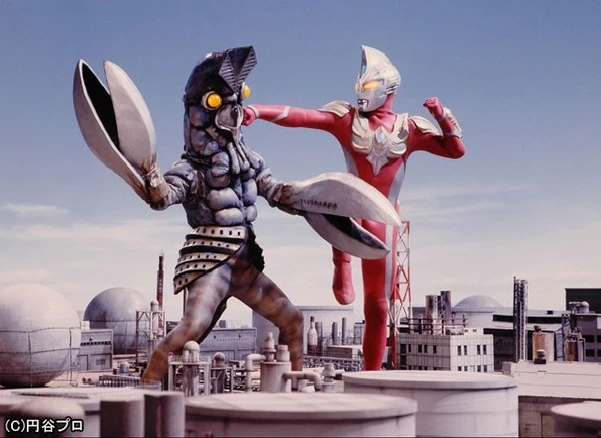
Eiji Tsbarya and his Ultraman creations
Eiji Tsuburaya and his Ultraman creations
Ultraman is 50 years old! He’s still battling kaiju! And he hasn’t aged a bit.

It was July 17, 1966 when the first episode of Ultraman aired on Japanese televisions. Since then, Ultraman has been re-packaged in close to 40 different television series or movies, and is an internationally recognized phenomenon, on the same level as Pokemon, Hello Kitty and Doraemon.

Ultraman is the brainchild of Eiji Tsuburaya, who at the time was producing a newly launched series called “Ultra-Q“, what might be called a Japanese version of the television series Twilight Zone or Outer Limits, which were popular in the early 1960s.

Ultraman baltan seijin

Ultra-Q was not unpopular, but the broadcaster, Tokyo Broadcasting System did some research and discovered that the kids loved the episodes with all of the giant monsters (known in Japanese as “kaijyu“). This was particularly true thanks to the popularity of the Godzilla movies. As it turned out, Tsuburaya understood that. After all, he was the co-creator of the Godzilla movies. So after the first season of Ultra-Q ended, Tsuburaya decided to devote his series to kaiju, by introducing a character that would forever defend the world from the bad ones.

In one of those quick feats of legerdemain, Tsuburaya changed the name of his series from Ultra-Q to Ultraman. Broadcast in color, Ultraman burst on to the scene, and thus was born a cultural icon that all Japanese in their 40s, 50s and 60s can remember with nostalgic bliss.

But where did Tsuburaya get the term “ultra” from? That takes us back a couple of more years to 1964 and the Tokyo Olympics. Japan had just begun its run of men’s gymnastics dominance, by winning the team gold at the 1960 Rome Summer Games. They were expected to do well on their home turf in 1964, but they knew they would have tough competition, particularly with the Soviet Union. In an interview of the Helsinki Olympics medalist and member of a committee dedicated to strengthening gymnastics in Japan, Tadao Uesako, the Japanese newspaper, Daily Sports, revealed Japan’s gymnastics strategy.

Ohno Hayata Mitsukuri Endo Yamashita
Men’s gold medal gymnastics team from Japan: Takashi Ohno, Takuji Hayata, Haruhiro Yamashita, Takashi Mitsukuri, Yukio Endo, from the book Tokyo Olympiad 1964, Kyodo News Service
In 1964, international scoring for gymnastics worked on a three-level scale of A, B and C, where level C was considered the highest level of difficulty for a particular discipline or routine. It was Uesako’s view that Japan’s gymnasts were aspiring to levels beyond C, or as he called it, “Ultra-C“. And from that article, another foreign word (or in this case, prefix) entered the Japanese lexicon.

So there you have it – Tsuburaya made the leap from “Ultra-C” to “Ultra-Q”, thanks to the Japanese men’s gymnastics squad that took gold, ultimately sticking the landing on Ultraman.

Happy Birthday Ultraman!

CK Yang pole vauilting
Asian Iron Man C.K. Yang in his strongest decathlon event – the pole vault.

He had barely lost, losing by a mere 58 points in the decathlon to his best friend, Rafer Johnson, at the 1960 Rome Olympic Games. Using the 2nd place finish as motivation, C. K. Yang went on to break the world record in April, 1963, and was viewed as the heavy favorite for gold at the 1964 Summer Games in Tokyo.

But it was not to be. Not only did Yang fail to win gold, he fell to a disappointing fifth place. In fact, Yang was in ninth place at the end of day one, but had a very strong day two in which he won the 400-meter hurdles, pole vault and javelin throw events, clawing his way to fourth place before the final event. But Yang’s 13th-place finish in the final 1500-meter race meant that two Germans, a Russian and an American would finish ahead of him in the final placements.

A chance at a first-ever gold medal for Taiwan faded into that cool evening of October 20, 1964. Two explanations have been provided for Yang’s disappointing results: a recent change in the way scores were tallied for the decathlon, and Yang’s mysterious illness.

The decathlon scoring system was always considered complicated, as administrators have time after time adjusted the benchmarks and formulas to come up with scores that were perceived as fair so that athletes were satisfied with their points for a strong jump, or a speedy run, as well as with their points for a fantastic jump or a spectacular run. In 1964, the scoring tables were revised yet again. And the rule changes appeared to be heir apparent, Yang, at a disadvantage. Technology advancements in plastics resulted in the increasing prevalence of fiber-glass poles. Yang had mastered the new pole more quickly than others, enabling him to claim a world indoor record in the pole vault. As legendary New York Times sports writer, Arthur Daley, explained in a preview to the 1964 Olympic decathlon, the scoring revision hurt Yang.

“Not too long ago the International Amateur Athletic Federation updated and revised the decathlon scoring tables. This has hit Yang harder than most because he no longer can make a blockbuster score of fifteen hundred points in the pole vault. He still will be the decathlon favorite but not by the preponderant margin that once had been assigned to him. “

Daley went on to quote Yang that he wasn’t overly worried. “Of course I lose points by the new tables,” he said. “But I don’t think it will affect me over the whole thing.” Others, though, believed that Yang was indeed psychologically affected by the rule changes, particularly regarding the pole vault.

Willi Holdorf and C. K. Yang in 1964
Willi Holdorf and C.K. Yang after the decathlon’s 1500-meter race in Tokyo 1964, from the book Tokyo Olympiad 1964 Kyodo News Service

Based on the revised scoring system, Yang’s world record of 9,121 points would convert to 8,087 points, which is significantly higher than gold medalist Willi Holdorf’s winning point total of 7,887. But clearly, at the 1964 Tokyo Olympics, Yang did not come close to his world-record times and distances of his 1963 world-record setting effort. The explanation at the time was that Yang was not 100% healthy. As his coach Ducky Drake said, Yang hurt his left knee about five weeks ago. He never got into shape and this was reflected in his performances.” Another report said that Yang was suffering from a cold.

But Yang’s buddy, Rafer Johnson, revealed in his book, The Best That I Can Be, a shocking explanation for Yang’s unexpected performance in 1964. Remember, this is the time of the Cold War, the Berlin Wall, Mao’s China and Chiang Kai-shek’s Taiwan.

In the 1970s, C. K. had dinner with a man from Taiwan’s counterpart to our FBI. They were talking about the 1964 Olympics when the man dropped a bombshell: C. K. had been poisoned, he said. Because of the tension with mainland China, Taiwan had assigned two bodyguard to C.K. at the Games. Despite that precaution, this man told him, a teammate had spiked C. K.’s orange juice at one of their meals. Shortly afterward, that athlete and two Taiwanese journalists defected to Red China. C. K. had always considered himself unlucky for having gotten ill at the wrong time. Instead, he may have been a victim of political warfare. “I was so angry I thought I would cry,” he told me.

Woah.

For more stories on C. K. Yang, see the following:

Willi Holdorf on medal stand
Rein Aun of the Soviet Union (silver) Willi Holdorf of Germany (gold) and Hans-Joachim Walde of Germany (bronze)

To be honest, he looked more like an accountant than a decathlete. He had thinning hair and sloping shoulders, and wasn’t dominant in any of the ten events. And yet, at the 1964 Olympics in Tokyo, Willi Holdorf of Germany broke the US stranglehold on the decathlon to be the first non-American to win the prestigious event since 1928.

According to UPI, when the 24-year old student was asked by the press how it felt to be the “World’s Greatest Athlete”, Holdorf replied “‘Nicht ich, nicht ich’, vigourously shaking his head when the question of how it felt to be regarded the greatest of them all wad put to him. In slow, deliberate English, he conveyed the idea that he did not think of himself as No. 1, but genuinely believed (Bob) Hayes was the all-round best even though the speedy Floridian never even competed in the decathlon.”

While decathletes like Rafer Johnson and Bob Mathias had created an American stranglehold on this ten-discipline event of running, jumping and throwing, the overwhelming favorite to win gold in 1964 was the Asian Iron Man from Taiwan, C. K. Yang. Yang barely lost to his close friend and UCLA teammate at the 1960 Rome Olympic. The fight, they said, would be for silver. As it turns out, Holdorf won gold, while his German teammate, Hans-Joachim Walde took silver, and a third German finished sixth – an amazing result.

Willi Holdorf_The Olympic Century
Willi Holdorf in the decathlon high jump, from the book The Olympic Century XVIII Olympiad:

Highly publicized changes to the decathlon rules prior to the Tokyo Olympics resulted in fewer points assessed to decathletes who had a specialization that was far superior to others in the field. In other words, if an athlete was dominant in a particular event, prior to 1964, they could get an outsized number of points and take an outsized lead. But that advantage was diminished with the rule change. Fortunately for the German squad, they had a decathlon coach, Friedel Schirmer, who had the philosophy to take advantage – consistency uber alles.

Returning home to Germany as a sickly solider after surviving captivity in the Soviet Union shortly after the end of World War II, Schirmer went on to become a seven-time all Germany champion in the decathlon, representing Germany as the flag bearer in the 1952 Helsinki Olympics. He placed eighth in those Olympics, but it was his philosophy that had such an impact that Germany would consistently medal in the Olympic decathlon in the years following 1964. Here’s how Carl Posey explained it in the book, The Olympic Century XVIII Olympiad:

Every elite decathlete’s score took a dip because of the table revisions, but the least affected was a group of Germans. These men were all coached by Friedel Schirmer, who stressed consistency in every event rather than excellence in one or two. Foremost among his protégés was Willi Holdorf, a balding, 24-year-old physical education student from Leverkusen. Holdorf took the decathlon lead after the first event, the 100-meter dash. He fell back as far as fourth place after the shot put and high jump, while the Soviet Union’s Mikhail Storozhenko surged to the front on the strength of a tremendous put. Holdorf regained the lead after the 400 meters and maintained it through the final five events. The gold medalist’s score of 7,887 points was well short of a record, nevertheless, the Tokyo Games validated Schirmer’s decathlon philosophy. Germans claimed three of the top six spots, and Schirmer-trained athletes would dominate the event for the rest of the decade.

Willi Holdorf after 1500 meter race
Willi Holdorf after the decathlon 1500-meter race, from the book, Tokyo Olympiad Kyodo News Service

Sports Illustrated in their November 2, 1964 issue explained that Schirmer had studied up on Soviet and American training techniques and after becoming coach of the German decathlon squad worked them hard in a series of biweekly training and competitive sessions, gearing them for Tokyo. In the end, as is the case in many decathlons, it came down to the tenth and final event, the 1500-meter race. Like Johnson in 1960, Holdorf did not need to win, but he needed to do well enough to maintain his point lead.

In Tokyo, Holdorf took an early lead and held it, though as the exhausting 1,500-meter run, the final event, began, three men were still close enough to beat him. Particularly dangerous were Russia’s Rein Aun and America’s Paul Herman, both of whom could run much faster 1,500s than the German. “I knew that I could win if I could stay within 60 meters of Aun and 100 meters of Herman,” said Holdorf, a tall, balding blond who is built like a wedge of custard pie standing on its point. Aun took an immediate lead, with Herman in desperate pursuit and Holdorf gradually falling farther and farther behind. But at the finish Holdorf, tottering half-conscious over the line, was close enough to salvage victory from Aun by the narrow margin of 45 points.

Hayes Boston Carr in Tokyo _ Getty
Members of the Japanese press interview three US track stars (left to right): Bob Hayes, Ralph Boston and Henry Carr, shortly after the first contingent of the US Olympic team arrived here September 29th; Getty Images

I am enjoying the book, Inside the Five-Ring Circus, by 1964 Olympian, Ollan Cassell, and I recently read this delicious tidbit about double-gold medalist Olympic legend, Bob Hayes.

In 1964, the fastest man in the world in 200 meters was Henry Carr. As Cassell explained, Carr won the US trials for the 200 meters in New York in the Spring. But the US Olympic track and field authorities held a second trial in Los Angeles in the summer, and Carr was unfortunately out of condition, finishing fourth in the trials. Since the top three qualified for the Olympic squad, Carr was unexpectedly off the team.

In stepped Hayes, who happened to finish third in the 200 meters, and had already qualified for Tokyo in the 100 meters. Hayes ceded his spot to Carr on the 200-meter team, and Carr got his motor running, training twice a day to get ready for Tokyo. As Cassell wrote, “everyone on the team was indeed grateful to Bob.”

Inside Five Ring Circus CoverHayes of course went on to take gold in the 100 meters and 4×100 relay in spectacular fashion. But his gracious act continued to pay dividends. Rejuvenated, Carr was looking strong prior to his races, in shape, and ready to win. Not only did Carr set an Olympic record in the 200 meters, he anchored the US men’s 4×400 relay team, blazing to a world record finish.

Perhaps thanks to that fateful decision by Bob Hayes, fellow track mates Mike Larrabee and Henry Carr won their second gold medals of the Tokyo Olympics, while Cassell and teammate Ulis Williams took home gold as well. Wrote Cassell in his book, “standing on the victory podium, receiving a gold medal and watching the USA flag rise on the highest pole made me feel it was all worth it.”

Thanks Bob!

NOTE: In Hayes’ autobiography, “Run, Bullet, Run,” Hayes writes that he indeed did finish third in the trials cited above, but that since Carr had won in the initial trials at Randall’s Island, “(Carr) retained his place on the team, and I was bumped out of a spot in the 200-meter race.” Hayes doesn’t refer to relinquishing his spot (although it still could have been a factor.)