The 5.5 meter boat, Roy, (far right) sailing in the 1964 Tokyo Olympics. (Photo by Fusanori Nakajima)Ryoichi “Roy” Yamaguchi was a pioneer in sailing in Japan, establishing Japan’s first competitive fleet of yachts in the 1950s, and was instrumental in developing a generation of sailors in Japan. As the Tokyo Olympics were approaching in 1963, he commissioned marine architects Sparkman and Stephens to create a 5.5 meter boat to be entered into the 1964 Olympics sailing competition. Yamaguchi would then captain it in the Games.
But just as the boat was completed, Yamaguchi passed away on September 22, 1963 at the age of 42. Yamaguchi was not only one of the biggest figures in Japan sailing, he was also the president of a Japanese engineering firm called Tomoe Kogyo, which was apparently going to be the sponsor for the boat, and the provider of the JPY15 million for the boat’s construction. With Yamaguchi’s death, it was unclear whether Tomoe Kogyo would continue its sponsorship with the loss of the captain.
According to the Mainichi Daily News Article from October 9, 1964, a friend of Yamaguchi’s came to the rescue. Danish yachtsman, Kaj Wolhardt, a long-time friend of Yamaguchi, bought the completed boat for JPY5million, and then donated it to Japan. Apparently efforts for the leaders of Tomoe Kogyo to reimburse Wolhardt fell on deaf ears. But as a result, the boat commissioned by Yamaguchi was in Japan.
In stepped another friend of Yamaguchi and employee of Tomoe Kogyo, Fujiya Matsumoto, who took over the leadership of the boat so that it could be entered into the 5.5 meter sailing competition at the Tokyo Olympics. He decided to name the boat “Roy”, after the nickname Yamaguchi picked up in his international travels.
In fact, according to the article, a portrait of Roy Yamaguchi would be in the hull of the boat. Wolhardt flew to Japan for the Tokyo Olympics, so he could pay his respects, and see the “Roy” sail into competition.
Ryoichi “Roy” Yamaguchi second from left standing. Fujiya Matsumoto bottom left.According to an obituary on Yamaguchi in this sailing newsletter from 1963, Yamaguchi was the most influential person in sailing in Japan, and not only had an impact on what kinds of boats would compete in the 1964 Olympics, he nearly single-handedly developed snipe and dragon class sailing in Japan at the time.
An ad from the book, Tokyo Olympics Official Souvenir 1964The Imperial Hotel in Tokyo in the 1960s was a stunning structure. Designed by the legendary architect, Frank Lloyd Wright, the Imperial Hotel’s lava rock facing, the abundance greenery and the dominant reflection pool makes me think of Angkor Wat or the Taj Mahal on a more intimate scale.
Known in Japan as the Teikoku Hotel, the Wright designed structure was built in the early 1920’s, opening up on September 1, 1923, the day of Japan’s most powerful earthquake ever, one that resulted in the flattening of Tokyo and over 140,000 deaths. Wright had already left Japan several months before, but was proud when told that the Imperial Hotel remained standing.
The ad above was published in the 1964 Tokyo Olympics Official Souvenir book, an item recently rescued from the damp and dingy garage of my old house in Queens we recently sold. The text in the ad makes the classic Japanese pitch to westerners, how their offerings are a perfect blend of East meets West.
While the ad was placed to attract guests, there was actually little need for advertising. A tremendous shortage of hotel rooms in Tokyo were expected during the 1964 Olympics. According to the official report of the Tokyo Olympic Organizing Committee post-Olympiad XVIII, the International Olympic Committee, the various national Olympic committees and international sports federations were going to send a significantly large number of foreign guests to Tokyo, and they would be in need of a dwindling number of accommodations in September and October, 1964.
Worried about meeting the needs of their important guests, the Imperial Hotel agreed, in 1962, to allocate 250 beds for the International Olympic Committee and the national Olympic committees. 750 beds were set aside by the Daiichi Hotel for the various international sports federations and their visitors. Nearly 600 additional beds were also reserved for the dignitaries by nine other hotels, including the Hotel New Otani, Fairmont Hotel and the Haneda Tokyu Hotel.
In the years and months leading up to the Games, the hotels tried hard to get the various committees and federations to provide more exact numbers of guests. The hotels were facing increasing pressures to accommodate more tourists, but they had already made commitments for the Olympic officials. Special liaison offices were created in each hotel to help confirm the exact number of guests who were planning to arrive.
In the end, many of the hotels got screwed, or perhaps a better way to say, they took one for the team. The Fairmont Hotel and Haneda Tokyu Hotel ended up filling 26% of the allocated rooms for national Olympic committee members and their guests, clearly given overly ambitious numbers. Other hotels suffered the same fate, although the Imperial Hotel, no doubt hosting the crème de la crème of the International Olympic Committee, were able to achieve 93% occupancy of rooms allocated to the Olympic and sports federation officials.
By the late 1960s, the Wright-designed structure was falling into decay, part of the building sinking into its foundation. The number of rooms was woefully short of economic viability for a downtown Tokyo hotel as well. The hotel was closed at the end of 1967, and demolished to make way for a high-rise structure.
For those nostalgic for the Wright-designed hotel, take a trip to Inuyama in Aichi prefecture, near Nagoya. There is a place called Meiji-mura, of the Meiji Village Museum, where historic buildings from Japan’s past are reconstructed, restored and preserved, including the entrance and facade of the Imperial Hotel.
The façade and reflection pool of the original Imperial Hotel in Meiji-mura
Waldemar Baszanowski of Poland at the 1964 Tokyo Olympics.
It’s a game of grams. Waldemar Baszanowski of Poland and Valdimir Kaplunov of the Soviet Union battled through the three events that make up weightlifting competition: the military press, the snatch and the clean & jerk.
The world record holder at the time, Baszanowski, trailed behind two other favorites, teammate Marian Zielinski and Kaplunov, after the completion of the military press. But Baszanowski got back into a tie for the lead with the Russian after the snatch. In the final round, both Baszanowski and Kaplunov ended lifting the same weight in the clean and jerk, resulting in a world record tie, a total of 432.5 kg over the three weightlifting events.
After the final lift, the final ruling was out of their hand. Here’s how Neil Allen in his book, Olympic Diary Tokyo 1964, told the story.
The moment of victory was most unclear in the weightlifting over at Shibuya Hall where Poland’s Waldemar Baszanowski beat Russian Vladimir Kaplunov by the margin of 10.5822 oz. (300 grams) This was the difference in his body weight and that of Kaplunov and it was the only way of dividing two men who both broke the world lightweight record with a total lift of 953 1/2 lb. (432.5kg) Baszanowski held the previous record of 947 3/4 lb. (429.9kg) But it was only after an enervating tactical battle, and records beaten in all three movements, that he was able to give the mixed smile of relieve and exhilaration which is the right of the champion.
That’s right – the tiebreaker in weightlifting is the difference in body weight. The lighter of the two, in this instance was Baszanowski. Only three hundred grams separated gold from silver.
While Baszanowski would win gold convincingly four years later in Mexico City, Kaplunov in 1964 may have been wondering what he had for breakfast that fateful day.
The women’s pentathlon, like the men’s decathlon, are challenging endurance competitions that require capability in a variety of athletic disciplines. A significant weakness in one discipline could sink you. And like C. K. Yang in the decathlon, Mary Rand had difficulty throwing heavy things.
Rand was the brightest star of a resurgent British track and field team at the 1964 Tokyo Olympics. In fact, it’s stunning to think of the punishing schedule she had to compete in the long jump (October 14), in the pentathlon (October 16-17) and in the women’s 4X100 relay (October 20-21). So there are several factors one could take into account, for Rand’s results, including the heavy lifting she needed to do for TeamGB.
But in the end, Rand’s ability to heave a 4kg shot was her undoing.
The women’s pentathlon in 1964 was a two-day event that featured the 80-meter hurdles, the shot put, the high jump, the long jump and the 200 meter sprint. Against strong Soviet competition, as well as a fellow member of the British team, Rand won three of the five competitions: the high jump, the 200 meters, as well as the long jump, the event she was awarded gold only three days before.
In the first event, the 80-meter hurdles, the two Soviet athletes, Irina Press and Galina Bystrova, nipped Rand at the tape by 0.2 seconds. In other words, Rand had the best or second best scores in 4 of the 5 pentathlon competitions.
Here are the results of the 1964 women’s pentathlon.
You can clearly see that Rand’s shot put of 11.05 meters was poor, over 6 meters short of Irina Press’s toss. Each result in the pentathlon converts into points, and as you can see, Rand’s shot put score was 384 points behind Press’s score. The end result was that Rand was 211 total points off of Press’s total score. So let’s play the “what if” game. If Rand had thrown as well as her compatriot, Mary Peters, the additional 226 points would have given Rand the world record and the gold medal.
Irina Press, from the book Tokyo Olympiad Kyodo News Service
Press appeared to be both impressed and flummoxed with Rand, incredulous that Rand would not work harder to improve her shot putting, as Neil Allen implies in his book, Olympic Diary Tokyo 1964:
[Irina Press] does not possess the extraordinary natural talent of Mary Rand; but unlike the British girl she has no weakness in her athletics armoury. Mary beat the Russian in three of the five events but her shot putting, which has always been miserably poor, let her down yesterday and not even a superb long jump today could make up the deficit. At the medal presentation Irina Press told me she could not understand why Mary, with the minimum work, could not put the shot at least over 42 ft. (12.8 meters)
So second place it was for Mary Rand. With a gold in the long jump and a silver in the pentathlon, Rand thought out loud in an AP article from October 19, 1964 that “a bronze from the relay would complete the set.”
Unfortunately for her sprinting teammates, Rand got what she wished for.
After the completion of the 1964 Tokyo Olympics, Queen Elizabeth had lunch with hundreds of Olympians from TeamGB a few days after their return from Japan, and was most taken with Mary Rand, the sensational triple medalist. Rand won gold in the women’s long jump, silver in the pentathlon and bronze as a member of the women’s 4X100 relay team, leading a resurgence in British track and field.
The Queen is reported to have measured out 22 feet, 2 inches (6.76 meters), the length of Rand’s world record jump that resulted in Great Britain’s first gold of the Tokyo Olympics. According to an October 28, 1964 AP article, the Queen told her son, Prince Andrew, that was the length Rand jumped to win the gold. “‘He just couldn’t believe that anyone could jump that far,’ the queen laughingly told Mrs. Rand at a buffet lunch at the palace Tuesday.”
Mary Rand with daughter
Not that I am expert on the British Royal Family, but clearly the Queen was taken with Rand. To be fair, many were. She was not only an Olympic champion, she was also perceived as wholesome (with a dash of sensuality). In 1964, she was married and had a daughter and had a reputation for being “nice”, which back then was more positive in nuance. But she also drew the attention of famous rock and rollers. “Apparently Mick Jagger said he’d like to date me,” she says (in this Mirror article). “I wish he’d asked! But then again I was married to my first husband at the time and the mother of a young daughter.”
An Italian journalist gave a melting look at the long legs and swinging hips as Mary walked across the grass, then surveyed again the world-record long jump on the indicator board and reluctantly handed me back my binoculars, misty by now. He shook his head in amazement and pronounced the accolade, “All that and a mother too!’
If it was the sheer femininity that struck first, next must come the almost effortless superiority of Mary Rand. Under the pressure of modern sport no British man or woman has ever won an Olympic victory with such authority. Here at last was our Elliott, our Zatopek, our Wilma Rudolph. Our goddess of the arena.
Mary Rand in Kimono with Ann Packer
The somewhat sexist comments of the era aside, Mary Rand had a rare combination of grace, power and independence that made her arguably one of the most popular women in Tokyo. Her willingness to speak her mind and not to follow the norm may have also intrigued people.
When she was 17 years old, she developed a relationship with young man from Thailand living in England, nearly marrying much to the chagrin of those around her. The “scandal” of this relationship resulted in her being expelled from school.
When she was preparing for the Tokyo Olympics, she worked at the postal office in a Guinness factory in London, which fortunately gave her the opportunity to both earn wages and train for the Olympics. And one time, her involuntary need to tell jokes got her in a little trouble: She said in the Mirror article: “One of the benefits I got there was a free Guinness in the work’s canteen at lunchtime. I jokingly told a reporter I had a half pint every day as part of my training routine. The next thing I knew there were headlines about my drinking and I got a long lecture from my coach about putting on weight.”
But Allen wrote in his book that people found Rand’s openness charming:
There are few athletes easier to interview for she is completely honest. And her great sense of fun never allows her to have a moment’s conceit about all her ability in so many events. In her greatest moment of all, in the Olympic interview room, she still had time to grin at the incredulous look on the continental journalist’s face when she said she’d ‘had a rub from Johnny’ just before the long jump. Johnny Johnson is, of course, the dedicated masseur to the British athletics team. To Mary, as always ‘life is a bit of a giggle.’
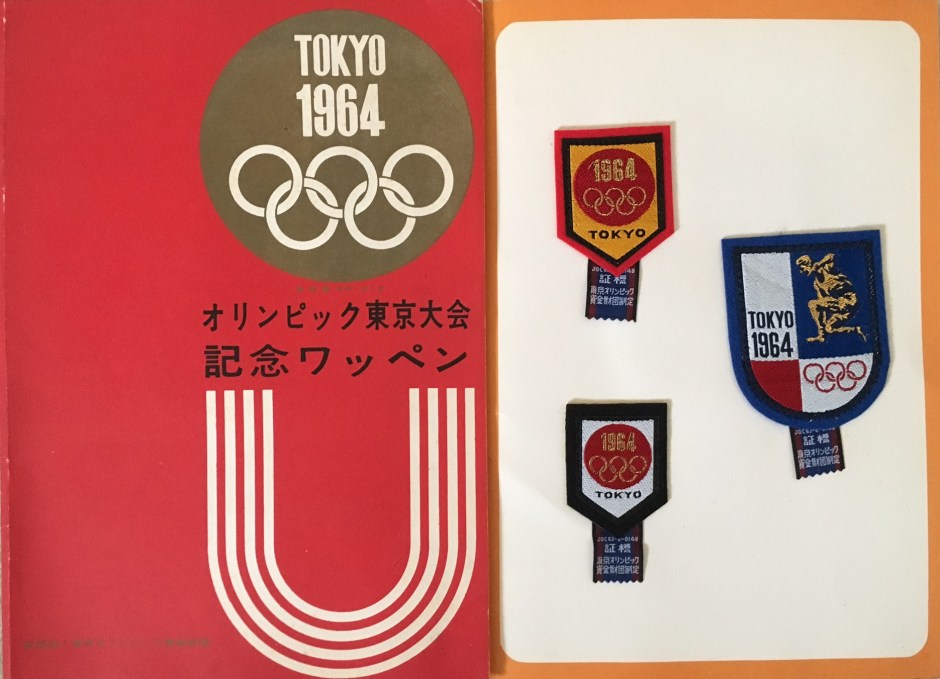
I was in Queens, New York a couple of weeks ago to clear out the home I grew up in. The house sold, we had to dump decades of stuff. One of the items that turned up and was most thankfully not thrown away was this commemorative collection of iron-on patches from the 1964 Tokyo Olympics. My father, who was on the NBC News team that helped broadcast the Tokyo Games, undoubtedly picked this up when he was there that October.
The title on the cover page called these items wappen (ワッペン), generally, iron-on patch, a word I was not familiar with. I learned that wappen is a German word that means “coat of arms”, which is why these Japanese patches have their particular shape and design.
This exercise made me think of all the foreign words that have become part of everyday Japanese, many that were imported during intense foreign interactions with the Japanese: the European influence in the Meiji Period, or the American occupation in the years after World War II.
Here are a few examples below:
Abekkumeans a man and a woman who are dating, or romantically involved – a couple, in short. This word comes from the most romantic of romance languages, French. Abekku is derived from avec, which means “with”.
Ankēto(アンケート) is the Japanese word for a survey, what you fill out when a company wants to know what you thought of its service, for example. This word comes from the Dutch word, enquête, which means “survey” as well, but originally derived from the French word of the same spelling that means “investigate”.
Arubaito (アルバイト), which means part-time work in Japanese, is often abbreviated to baito (バイト). It derives from the word arbeit in German, which means “work”.
Gipusu or gibusu (ギプス or ギブス), which means a plaster or plastic cast, used when one breaks a bone. This word comes from the German word gipsverband.
“Oh-rai, oh-rai, hai stoppu“, is one of my favorite Japanese phrases, which is essentially a phoneticized version of the English words, “All right, all right, OK, stop!” which you hear very often in Japan when a man is directing a large truck to continue to back up into a parking area. This was likely a phrase that Japanese heard a lot during the American occupation in the late 1940s and early 1950s.
Randosel(ランドセル) is the cute, leather daypack you see on the back of school children in Japan. It is derived from the Dutch word, ransel, or “backpack” in Dutch.
Tempura(天ぷら), that uniquely Japanese dish of deep-fried seafood or vegetables is actually an import from Portugal. The Portuguese have a similar dish called tempero or temperara, which was likely brought over to Japan by Portuguese sailors and missionaries centuries ago.
So now that you’re an expert in Japanese words borrowed from overseas vocabularies, here is your test. If you understand this, who knows, maybe you can fake your way through a Japanese conversation one day.
I left my arbaito to go to my manshon. On the way I stopped at the konbini to buy some bata and biru. I dropped my hankachi there accidentally, and was so worried because it was mother’s gift to me. My mazakon kicked into high gear, so I ran to the depaato to find another hankachi just like the one I had. Unfortunately, while I was running across the street, a basu startled me with his kurakushon, and I fell. I tore a hole in my pantsu. Even worse, I broke my arm and had to wear a gipusu for a month. “Oh, mistake!“
Ulis WIlliams, Henry Carr, Mike Larrabee and Ollan Cassell
The first heat went well. The American 4X400 relay team at the 1964 Tokyo Olympics won handily against the Soviet Union and France, finishing a full 2 seconds ahead of the Soviets. Henry Carr led off, followed by Ollan Cassell, Mike Larrabee and Ulis Williams.
Thus, America was favored to take gold. After all, Carr was the gold medalist in the 200 meter finals. Mike Larrabee was the gold medalist in the 400 meter finals. Williams was a finalist and placed fifth in the 400-meter finals, while Cassell nearly qualified for the 400-meter finals.
And yet, Williams was worried. He wasn’t feeling right. He told me that he had run in the LA Times Indoor Track Meet in January of 1964, and had injured himself. “The track was slanted, so I ran in that leaning way you do in indoor tracks and pulled a muscle, right off the bone,” Williams told me. “I really never got back into top shape. I still ran some of my better times, but because I placed fifth in the 400-meter finals the day before, psychologically, I wasn’t sure. I had doubts.”
Williams ran the anchor leg on the team, and in fact had always run the anchor leg in his career. Even at Arizona State University, where he and Carr were teammates on the track team, he had always run anchor. But he was concerned enough to ask the US track coach, Bob Giegengack, to hold a team meeting before the 4X400 relay finals.
“I told the team I was not feeling how I would like to feel, and didn’t feel I was running my best, that I wanted to make sure that we had the best chance to win the gold medal.” In other words, he implied that he might not be the best choice as anchor for the finals and that he would run in any place the coach wanted him to run.
After Williams made that statement, Giegengack asked the others if they had any comments. Williams said that Carr stepped up and said “I don’t care where I run. I am just going to take care of business.” According to Williams, Carr made that statement with such confidence that everyone in the room thought, “With that attitude, you anchor.”
Henry Carr takes 4×400 team to gold, from the book, Tokyo Olympics Special Issue_Kokusai Johosha
So with the decision to replace Carr with Williams as the anchor, 400-meter champion Larrabee spoke up and said he wanted to run second. According to Williams, it is a common tactic to place your fastest runner second, and so Larrabee thought that he could give a significant lift by building a lead in the first half of the race. With those two decisions, Williams slotted into the third leg, and Cassell took the opening leg.
And the rest is history. Although there was a slight hiccup in one of the exchanges, the Americans won gold in the world record time of 3:00.7 seconds, with Henry Carr blazing to the tape, the team finishing essentially a second faster than the teams from Great Britain and Trinidad and Tobago.
Andras Toro and me.Andras Toro, four-time Olympian, was one of the most dramatic stories of the 1964 Tokyo Olympics. At the age of 24, as his dream of realizing a medal in the 1000-meter singles canoeing event evaporated on Lake Sagami in the semi-finals, the Hungarian made the fateful decision to defect from his homeland, Hungary, to a new land, the United States.
Toro is writing a book on his life and times, and I had the great honor of meeting him in Northern California a few days ago. I will write more detailed posts on his life in the future….but first, let me share some of the memorabilia of an Olympian.
The first photo is of Toro’s bronze medal and jersey he won at the 1960 Rome Olympics in the 500-meter doubles canoeing competition.
The next is a certificate of his fourth place finish in his canoeing event at the 1964 Tokyo Olympic Games. It has the signatures of the head of the Tokyo Olympics organizing committee, Daigoro Yasukawa, and the head of the International Olympic Committee, Avery Brundage. There must have been thousands of these documents. I wonder if they actually signed each one…
Here is a gift sent to him and other Olympians, a traditional Japanese wooden doll, known as “kokeshi“, which was a gift of a student’s association. You can see this particular doll was sent to Toro from a junior high school in Miyagi Prefecture.
The fairly large silk “furoshiki” below was likely handed to many visiting Olympians to the Tokyo Games. A furoshiki is a piece of square material which is a traditional way of wrapping items, like a bento box, with the corners coming together in a knot. This particular furoshiki was also a way for sporting goods manufacturer to market their company.
How about this lovely bottle opener that states it’s a gift of Shinjuku, which is an area where the Olympic Games were being held. The back of the box explains that currency in the time of the Edo Period (some 400 to 500 years ago) were oval in shape and made of gold, and that this particular bottle opener was a talisman of luck. Strangely, the item is called a “can opener”, so luck will definitely be needed if that’s what you’re trying to open.
And of course, there are pins galore. As I have written about previously, trading pins is a common activity at the Olympics. Toro appears to have hundreds if not thousands of pins accumulated over decades of Olympics.
After Toro gained American citizenship, he went on to compete in canoeing as a member of Team USA, as well as fulfill other roles as a canoeing coach for a Team USA and as an executive within the US Olympic Committee.
Ollan Cassell signing the 1964 Tokyo Olympics poster in Rio; from the collection of Ollan Cassell
The doomsayers had their say – the Rio Olympics, under the crushing weight of the poor economy, scandals, environmental and health scares, worries of security, would fail.
Ollan Cassell has seen it all. As a member of the 4X400 US men’s track relay team at the 1964 Tokyo Olympics, as well as in his role as the executive director of the Amateur Athletic Union, the American governing body for 17 sports in his time, Cassell has been to every Olympics since 1964, excepting the Athens Olympics in 2004.
So when he arrived in Rio, he read all the stories about the problems. He certainly noticed the empty stands. And he put up with the traffic snarls that paralyzed the city during the Games. But Cassell knew that once the Games started, the problems would fade to the background.
The org committee was broke, the country is in a mess. They threw their president out. They didn’t have the finances to get things done. But like all the other Olympics, for the athletes with medals on the line, they‘re ready to compete. Regardless of what the situation is, once the Olympics roll around the athletes are ready. The athletes are focused on competing and wining regardless of what’s going on. When the lights go on, and the gun goes off, the press writes about how great the games are.
And what was the most amazing event Cassell witnessed? “The most spectacular event I saw in Brazil was that 400 meter world record (set by Wayde van Niekerk). I couldn’t imagine anyone could go 43.3 seconds. It’s like going 21.5 for two 200s!”
Ollan Cassell at Christ the Redeemer; from the collection of Ollan Cassell
As was true with the world cup in Brazil, there were about 75000 to 80000 soldiers. I felt safe. No one in my group had been robbed or held up. The military was patrolling all the time. When you went out into the streets, sightseeing, you would see the military trucks with open beds and machines guns driving through the area. It was like an armed camp, but you felt safe. They had barriers in the sightseeing areas, big steel barriers the kind police use when they want to direct car and foot traffic into certain area. They were imposing. But that’s been true at all the Games. In London, they had barriers to make sure you went where they wanted you to go.
As for the environmental or health issues, to Cassell, it wasn’t an issue. “I didn’t hear of anyone getting sick because of the water. And I saw only one mosquito, which my granddaughter killed.”
But perhaps, one of the most satisfying parts of an Olympian’s life is to re-connect with the Olympian fraternity.
It’s a special feeling – being an Olympian. There are so few of us compared to the population of the world. In Olympic Villages there are about 10,000 Olympians, which is a select group. In the United States, there are about 5,000 living Olympians, with quite a few in their 90s. So it’s wonderful to see old friends and Olympians at these events.
It’s not an uncommon story. The shy or sickly child finds his way through sport. Bob Schul was not born with gregarious social graces, and tended to stick to himself. In the sixth grade, one of his few social interactions was playing tag with his fellow students, where he learned something important. “I found out I could get away and they couldn’t catch me.”
It was a childhood insight that would lead Schul to distance running, to the track team at Miami University of Ohio, a tutorship under Mihaly Igloi, the legendary track coach from Hungary, and gold medal glory at the 1964 Tokyo Olympics. Schul would become the first and only American to win the 5,000-meter race in Olympic history.
But first, Schul had to discover himself.
He knew he was a fast runner. But as he developed as an athlete, he and his coaches also learned he was tough, as well as toughminded. Schul addressed students his alma mater in 2014, and told them a couple of stories from his youth that spoke to a powerful internal drive.
In high school, Schul joined the football team – that’s American football, a sport in which you wear heavy padding and helmets and you launch yourself as projectiles into each other. As Schul told me, he was 155 cm tall and weighed only 59 kilos, and his teammates were 70 to 90 kilos heavy. “I had no business playing football.” He said that his high school was small, but his football team was very good, league champs in the previous five or so years.
There he was in a team practice, lined up in a Statue of Liberty, as a right end. The ball was snapped, he came off the line and back to the quarterback who handed him the ball. Schul swept left and tried to turn the corner when a defender crashed into Schul’s right side. Schul staggered to his feet, and likely in today’s game, might have sat down, if not for a play, for the rest of the game. Schul was back in the huddle, and played out the scrimmage, getting hit time and time again by the bigger boys. It was year’s later when talking with university football players that Schul actually had a hip pointer, and that players wore special foam protection for the hip, because “you can’t play with a hip pointer.” But Schul did, taking the punishment.
Bob Schul in high school
After graduating from high school, Schul enrolled at his neighborhood university, Miami of Ohio. He was not there on a scholarship. And in when he started, he was just fortunate to get a job washing dishes in the school dorm. But he was on the track team, and through the years, he worked himself into star status. It was April, 1964, only half a year from the Tokyo Olympics. Miami of Ohio was hosting a dual meet with a track team from Bowling Green State University in Ohio. Schul decided that he would go for it, he would try to break the four-minute mile.
Roger Bannister had already accomplished that milestone, as it were, ten years previously, but no one had ever done it before in Ohio. So when Schul let it be known he was going for it on his home track, the buzz began. First things first, the track was a mess, particularly the inside track which had gotten messy due to the Spring rains. In the days before all-weather tracks, people ran on tracks that were composed of rocks or waste product formed into chunks and broken down more finely. The rain had washed bigger chunks of rock onto the inside track. The excess cinder had to be carted off and the track smoothed before the event. Schul told officials this needed to be done and volunteered to help.
As it turned out, nobody came out to clear the track, so he started doing it himself. He

 According to the Mainichi Daily News Article from October 9, 1964, a friend of Yamaguchi’s came to the rescue. Danish yachtsman, Kaj Wolhardt, a long-time friend of Yamaguchi, bought the completed boat for JPY5million, and then donated it to Japan. Apparently efforts for the leaders of Tomoe Kogyo to reimburse Wolhardt fell on deaf ears. But as a result, the boat commissioned by Yamaguchi was in Japan.




You must be logged in to post a comment.