He arrived at Haneda Airport in May of 1958, camera bulbs popping and microphones thrust towards him. He was driven to The Dai-ichi Hotel escorted by police on motorcycles, greeted by fans asking for autographs.
Having recently broken the Asian speed records in both the 400 meters and 200 meters, Milkha Singh was a sports hero throughout Asia, and was in Tokyo to compete in the 1958 Asian Games.
Eyes bleary and bloodshot from a long flight from Calcutta, India, Singh still was amazed when he arrived in Japan, as he described in his autobiography, The Race of My LIfe. “I was thrilled to have been given a chance to visit Japan, a country I admired for the tenacious way they had rehabilitated themselves after the devastation wrought by the Second World War. When we landed at Tokyo Airport, our eyes were dazzled by the brightness of the multicolored lights. The puddles of water that had collected after a recent shower glowed with the reflection of the lights as well.”
It was at these Asian Games where Singh established his famous rivalry with Pakistani, Abdul Khaliq, the fastest 100-meter sprinter in Asia at the time. According to Singh, when Singh was first introduced to Khaliq at the hotel, with a friendly warning to watch out for Singh in the 200 meters, “Khaliq shot back, ‘I have met and run races with many a Tom, Dick and Harry like him. They are no match for me.”
On Day 2 of the Asian Games, Singh was favored to win the 400-meter race, which he did fairly handily. His time of 46.6 seconds was an Asian record, which the Japanese crowd greeted with an eruption of cheers. “I felt my hair stand on end and a shiver of delight ran through me,” he wrote. And when he saw the Indian flag rise high, he wrote that “it was the most stirring moment in my life and I was filled with great patriotic fervour seeing the Tricolor fluttering in the open blue sky.”
But his defining moment of truth was still to come.
The 200-meter competition was held the next day. Khaliq of Pakistan had won the 100-meter finals. Singh of India had won the 400-meter finals. Thus, bragging rights for fastest man in Asia would be determined in Asian Games 200-meter finals.
After the starting gun was fired, and the six sprinters made their way up the straightaway, Khaliq and Singh were essentially neck and neck at the 100-meter mark. With Singh on the innermost lane and Khaliq a couple of lanes to Singh’s right, they both knew it was going to be a fight to the finish.
Despite focusing on our running, we were each aware of the other’s progress and were pushing ourselves and our utmost limits. It was fast, it was furious, it was neck-to-neck. There was high drama. About three or four yards from the finishing line, I pulled a muscle on my right leg. Then my legs got entangled and I tripped and tumbled over the finishing line. At that very moment, Khaliq breasted the tape too.
From Singh’s autobiography, The Race of My Life.
It took about 30 minutes for the judges to analyze the photographs taken at the finish line from multiple angles. In the end, the judges determined Singh the victor. “I was now Asia’s best athlete!”
Japan leveraged these 1958 Games, showing off its new National Stadium and its ability to run a major international sports competition. The next year, Tokyo was selected to host the 1964 Summer Olympics. Singh would go on to take gold at the 400 meters at the Commonweatlh Games in London, and earn the moniker, The Flying Sikh, and become a favorite to be the first Asian to win a gold in track at the 1960 Rome Olympics.
In the early 1960s, Milkha Singh, along with C. K. Yang emerged as the great Asian hopes in athletics.
Milkha Singh returns from Tokyo to India, from The Race of My Life
Official Invitation to the White House for American Olympic medalists
He was invited by the Mayor to a celebration for Seattle Olympians on November 2, 1964. He was also invited to the White House by President Lyndon Johnson for a luncheon honoring American Olympic medalists on December 1, 1964.
But Ted (Theo) Mittet, in his mind, had bigger and better things to do – like travel throughout Japan: Yokohama, Kyoto, Hiroshima, Matsuyama, Beppu, Nagasaki, Niihama and Nara. The 22-year-old American rower from Seattle, Washington had helped a crew of four take the bronze medal in the rowing fours-without (which means four rowers without a coxswain). And while most of his teammates returned to the United States for parades and celebratory dinners, Mittet decided that hitchhiking and taking the train through Japan would be more fun. And based on the numerous letters exchanged between young Mittet and the Japanese he met along the way, all parties were better for that decision.
Thank you ever so much for your nice letter. It is more than you could imagine how happy I was to read your letter. I am glad to know that you stayed and travelled in Japan for two months after the Olympic Games were over. It is a wonderful and happy experience for me to have worked for the Tokyo Olympics, and we talk very often about the pleasant days during the Games. Since that time I have become much more interested in English, and I attend the English conversation classes once a week. Though I try my best it is still very hard for me to master it. Is there any idea or suggestion to learn it faster? – Hiroko Sho, a volunteer from Tokyo stationed at the offices of the US Olympic Team.
Ted Mittet surrendering his American team’s cowboy hat, gifted by President Johnson to the male Olympians
But more significantly, Mittet inspired people to dream of being a part of a bigger world.
When Mittet went to Matsuyama City in Ehime Prefecture, a place not many foreigners ventured to in the 1960s, he was invited to a high school to meet the students, three of whom screwed up the courage and effort to write to him. One was Kayoko Kurita, who wrote to Mittet of her dream.
You may be surprised to receive this letter from me but I met you in Matsuyama and spoke in English with you. Do you remember me? You gave me your name and address I was happy to receive it. You said you attend WASHINGTON UNIVERSITY in Seattle. I would like to be your pen pal, and would enjoy corresponding with you if you don’t mind. I hope we will become good pen pals.
And my dream is, ……………, but it isn’t come true, but I’ll tell you. I would like to study abroad in your country especially WASHINGTON or Indiana or Kentucky or there is no Japanese there. Your university is very good and very big excellent university, but I would like to go to High School or Junior in America, so I’m looking for a sponsor for me. But it’s very difficult to find. I wish I will.
Mittet met a university student from Osaka in Kyoto named Takanao Dojima, who volunteered to take Mittet on a tour of Kyoto’s most famous temples, Kinkakuji and Ryuanji. Dojima wrote Mittet in a letter the following year, saying “Probably nothing is more enjoyable than travelling. I want to go to America as well as you visited to Japan. But I haven’t money, I can’t to visit America.”
A Sophia University student and interpreter for the BBC during the Olympics, Masako Kajiki, possessed more advanced English skills than the average Japanese, and appeared to have the financial means to travel abroad. She wrote in mid-November, 1964 to Mittet of her role as Shylock’s daughter in an upcoming production of The Merchant of Venice, and her plans to travel to the United States.
Listening to various talks from my parents who have just come back from the States after three months’ travel in Europe and the States, I have long wanted to go to your country next summer session. I’m looking forward to visiting your country, though it’ll be only for 10 weeks. Seeing is believing.
Three months later, Kajiki was approaching her departure date for the United States. Kajiki had already sent her entire, very detailed itinerary that would take her from Haneda to Honolulu, and throughout the mainland – LA, Las Vegas, Dallas, Knoxville, DC, Pittsburgh, Cincinnati, Detroit, Chicago, New York, just to name a few in her nearly three-month cross-country adventure. In her letter, she is clearly conscious of her own accountability as teacher of things Japanese. For a young Japanese woman in the Sixties, she has a stronger and clearer point of view on America and Japan than the average Japanese. But in the end, she cannot contain the excitement of her ultimate goal – to see America for the first time, and Mr. Theodore Mittet again.
Official Invitation to a celebration for Olympians in Seattle, Washington, also turned down by Mittet.
I’m afraid, however, that after you have made the railway journey from Osaka to Tokyo, you’ll remember not only the ugliness of those cities, as seen from the train, but also the succession of advertisement billboards that so often interfered with your view of the enchanting countryside along the route. As you know Japan is surely losing our own tradition that our ancestors made unique one after they assimilated Oriental civilization and digested it. We have been, however, striving to keep up with American and European country and rebuild Japan what it is from a heap of ashes.
Without your country’s support, our country – indeed like many other countries such as Great Britain and France – would not have been able to regain the present strength in such a brief span of time. You can imagine then how anxiously I’m waiting for visiting the States. May 29th seems the longer in coming, because you are waiting for me!!
And then there was Hirokazu Okugawa, a student at the Department of Architecture at Kyoto University. Mittet was also a student of architecture at the University of Washington, and was introduced to a professor at Kyoto University named Dr. Nakamura. Okugawa was a student of Nakamura’s and they both sought a way to get Okugawa to the United States. In an initial letter to Mittet in mid-December 1964, Okugawa writes, “I would like to go to University of Washington next September, and I would like to study architecture more there. And Dr. Nakamura hopes that I study it there, and that I shall become an eminent architect. Would you introduce to your professor?”
So full of hope, Okugawa would realize that it wouldn’t be so easy to become a student in the US. Two months later, Okugawa has the name of the dean of the school of architecture at the University of Washington, and intends to state his case. But soon after, he received a letter from Mittet – now his unofficial career advisor at U of W, that dampens his spirits:
According to your letter, there is no probability of my admission for the degree to the master. My ability of English conversation is not enough to understand the lecture in the University. I am going to study hard English conversation this year.
But Okugawa has a dream. He can see himself going to the States, studying English hard, taking on any task to show he’s worthy of being a student in the United States, and continues to explore ways forward with Mittet. By the end of February, he and Mittet have decided that Okugawa should still officially apply to the University of Washington, and Mittet has sent the application form and information on all required documentation. Okugawa acts on the instructions, presumably to extreme exactitude, only to be disappointed again:
As mentioned in my previous letter, I received an application form for an admission. And I completed its form and my works in Kyoto University, and these letters were sent to the chairman Architectural Graduate Program. And also, my report in Kyoto University and three letters of recommendation were sent there.
But I received the letter from Director of Admission in which he said “It is too late for autumn 1965”.
HOW SHALL I DO? WHAT SHALL I DO?
CAN YOU HELP ME?
I BEG FAVOURITE ATTENTION.
If I can, I would like to work in architecture office, and then I would like to study in University of Washington the next year. How shall I do in order to do so? How shall I get working visa? I will be given about $1000 and the expense of transportation.
Would you please consult with the dean about my admission? I would like to know your professor, professor Nakamura’ friend. What is his name?
Looking forward your kind letter.
There is a tinge of desperation in young Okugawa’s typewritten letter. And only a week later in early May, Okugawa seems resigned to not getting into his dream school in 1965. Mittet, who has apparently responded quickly to Okugawa’s letters, when necessary by express mail, was encouraging and understanding. And indeed, hope was not lost because Okugawa informed Mittet that an official of University of Washington’s admissions stated that Okugawa could apply for enrollment in the Fall of 1966, with the condition that he take an English certification course that November.
I have received the beautiful picture of U. W. from you. The mountain covered with snows resembles Mr. Fujki in Japan. I was so glad that I showed it to many friends of mine, and I put it on the wall of my lodging house.
By the way, I took English proficiency examination on the 1st of May at A. C. C. (American Cultural Center). Fortunately I could do excellent, and the director kindly recommended me to your University. But Mr. Johnston has written to me, and said that I must not be expecting to enroll U. W. until autumn 1966, and I must take the English Examination (TEFL) on November.
When I heard these things, I was disappointed. But, I think I can study more English and architecture at Kyoto University (master courses) until autumn 1966. And I hope we discuss architecture in letters.
Did Okugawa eventually make it to Seattle, study at the University of Washington, and become an “eminent architect”? Who knows. Dreams are not goals of certitude – although they could be glowing embers of aspiration. In the case of 1964, the Olympics fanned those embers of the Japanese. In certain cases, a spark named Ted Mittet set the fire.
A picture of Ted (Theo) Mittet, 2nd from left, by Takeko Honma, middle, in front of the National Gymnasium
When I first arrived in Japan in 1986, one of the most popular programs on television was “Naruhodo! The World (なるほど!ザ・ワールド),” a quiz program that showcased the beauty, excitement and uniqueness of the places around the world their reporters visited. This was entertainment, so their reporters were often loud and garish, shamelessly interacting with foreigners in goofball English, often emphasizing stereotypical or even non-representative quirks of a particular country or culture. The questions and insights of the reporters often revealed more about Japanese culture than the culture they were trying to represent.
Ted (Theo) Mittet was a 22-year-old American rower who decided to travel Japan after helping his four-without boat win the bronze medal at the 1964 Tokyo Olympics. As explained in Part 1, Mittet made many Japanese friends along the way, who exchanged letters with this young man from Seattle, Washington. Their questions to him said a lot about Japan at the time. Mittet wrote to his family describing the conversations he was having with Japanese all over the country.
I spent last evening with a very good Japanese friend’s family (his father speaks English, as does he) and was treated royally. Sukiyaki and tempura were served in unlimited quantities. After dinner we all discussed love and life and I am amazed at the similarity between East and West. My friend is anxious to learn about Christianity and I am anxious to learn about Buddhism. (He is studying Zen.) I certainly think that Buddhism makes more sense than Christianity. I plan to look into it a little further. – letter from Mittet to family in late October
While coming up the east side of the inland sea I stopped at the town of Niihama where I met three English teachers who asked me if I would speak at their school. I gladly accepted and as a result spent about three hours teaching English conversations to about 150 English students. The school offered me 3,000 badly needed yens, but being a true patriot I could not accept. You might say that it was my donation to the cultural exchange program. I was asked questions about the Beetles, the American date, President Johnson (damn!) and “What you think black man?” It was a wonderful experience and I gained much insight on Japanese life and thought. – letter from Mittet to family in late November
Religion, politics, race – all the things we were taught not to talk about in polite company. But many Japanese knew they had an exaggerated view of the world, and were eager to correct their perceptions. In the case of America, Mittet became their source.
Like the hundreds of others on the US Olympic squad, he got the training from the US State Department about how to conduct oneself properly in a foreign land as a representative of America. But one can argue, based on the letters he received from the many Japanese friends he made during his 2-month travels, Mittet was as much an American diplomat as those who sit in embassies around the world.
When travelling through Ashiya, a city near Kobe in Japan, Mittet met Mikio, a middle-aged man who saw the tall American in a crowded bus, and felt compelled to introduce himself. Like other Japanese energized by the influx of foreigners during the Olympics, and infused with a desire to warmly welcome them, Mikio went up to Mittet in the bus. “I remember first scene when I saw firstly you in the crowded bus,” he wrote in a letter to Mittet. “You are too tall, so you put your head on the bus ceiling. Then I felt too funny. (Excuse me.) But that time, I felt much friendly to you.”
Amazingly, not only did Mikio introduce himself, he invited Mittet to stay at his and his wife’s Eiko’s home overnight, where they ate and talked. But in the letter, Mikio admitted that he was still very curious, his English capability failing him in attempts to ask important questions:
It was first experience for me that I gave a lodge to a foreigner. I doubt I could make a full hospitality to you? It’s most sorry I could speak English very little. If I could speak it more fluently, I wished to ask about America things, and to tell and discuss about several problems of the war, current events and American colored man through all night. And about your life experience and philosophy.
Eiko and Mikio
Even more remarkably, Mikio found Mittet so earnest and trustworthy that he admitted to changing what he felt were prejudicial views of Americans.
I had had a prejudice for American through a few American I know, soldiers and seamen. I have thought American are a spending, war-like, uncultural and bright and cheerful nation. (Excuse me) However general Japanese people don’t think so as me.
I see and tell you, I found mistake. You are wonderful man with wit and culture. If there are many people as you in America, American will develop more and more in future. I hope you become young face of America. My dear Eiko in the room you slept, talk about memory of you.
Ted (Theo) Mittet in Tokyo, from the collection of Dick Lyon
It was as if 1964 was Year 1, and Japan was re-born.
Japan was young, energetic and full of hope. One of the biggest hits of 1964 in Japan was “Konnichi wa Akachan,” – “Hello, my sweet baby!” – a bouncy, happy tune of fresh starts.
Ted (Theo) Mittet was a 22-year old from Seattle, Washington, who qualified for the Tokyo Olympics as a rower on the US Olympic team, and came to Japan with eyes wide open. And he loved it from the start. “Japan is all that I expected and more,” he wrote to his parents a week before the start of the Olympics. “Its people are very friendly to say the least.”
Mittet was on a powerful rowing crew that took the bronze medal in the fours-without competition at the Tokyo Olympics. But while many of his teammates on Team USA went home, Mittet sold his air ticket to the States and travelled Japan. More importantly (to me), he wrote and received many letters. This was a time when people sent telegrams, when long-distance phone calls were expensive, and letters took days if not weeks to traverse the seven seas, pens were our keyboards, while boats, planes and people were our internet.
It was a time when getting a letter from the postman was sometimes a thrill.
I was very glad to see you letter beside my Mother’s Mirror and I cried my father “Received, Received”. My father was glad, too. My mother and brother were glad, too. I cried your letter’s news all over.my friends. I’m afraid you did not write to me soon. But I got your letter. I think happily.
The above was the opening of a letter from a high school student in Matsuyama City, Ehime Prefecture name Katsuhiro Matsuo, overjoyed to get another letter from the young American rower.
Katsuhiro Matsuo, high school student in Matsuyama, Ehime
Mittet travelled from Tokyo to Yokohama, then on to Kyoto. He passed through Hiroshima, Matsuyama, Beppu, Nagasaki, Niihama and Nara, before heading back to Yokohama and Tokyo. During his 2 months of travel in Japan, he wrote constantly and voluminously to family and friends in the US, as well as new acquaintances he met during the Olympics and his travels. The letters from the Japanese in particular reflect Japan’s excitement and curiosity about foreigners and their desire to welcome them to their country and their home.
In some cases, the Olympics may have given some Japanese the courage to break out of their normal shy shells and reach out to the world. Mittet was the closest to the outside world for these letter writers, and so they made what was likely an extraordinary effort to write letters in English.
Dear Theodore, I know how surprised you are to receive this letter from unknown friend in Japan. You visited Silk Center in Yokohama. Where I was working during Olympic season. You gave me your card. Oh, no. I required you to give it to me. Do you recollect me? If you could, I am glad. Ha Ha. It is difficult for you to recollect me because you met many people, did not you? – Junko Aoki, a student at Kanagawa University in Yokohama
Dear Theodore, You may be surprised to receive this letter from a complete stranger, but I met you at the Toda Rowing Course and talked with you for a few minutes. I gave you a little badge, do you remember me? I’m taking this liberty of writing to you with the sincere hope that you’ll accept me as your new Japanese friend. – Emiko Kobayashi, a high school student from Toda-machi, Saitama
The Tokyo Olympics were a rush of adrenaline for the Japanese, so many of them amazed and happy to be surrounded by so many foreigners from so many different countries. Mittet met a volunteer interpreter named Teruyo Wakui at Enoshima Station, not far from where she worked translating for the sailors competing in the nearby yachting events. Despite her fatigue, meeting Mittet proved to be another rush for this volunteer just after the end of the Tokyo Olympics.
When I happened to meet you at Enoshima station, I was rather tired after twenty days’ work. But I was so glad to meet you and to speak with you. In yachting game, there was no competition as you. Most of all the competitors of yachting were rather gentle and kind, and even the younger men were not as young as you. You are so young and full of dream and curiosity to many things of Japan.
After twenty days in yacht harbor, I suddenly remembered that youth is more wonderful than any other thing in this world. We can do anything without money, as we are young. And I think you have enough courage to do anything that you want, though you say you don’t have courage, but pleasure.
Anton Geesink set the judo world on fire by defeating Koji Sone in the 1961 World Championships. The tall and imposing Dutchman was the first non-Japanese judoka to win in any weight-class in a world championship.
However, Geesink wasn’t satisfied with the way he won. He wrote in his book, My Championship Judo, that he used a “halfway trick” to put Sone to the ground before immobolising him for victory. He felt that despite being the world champion, he needed to continue to improve.
When Geesink visited Japan in 1963 at the invitation of Tenri University, which had some of the best judoka in the world, he learned that Ne-Waza, or ground technique, was the Judo of the future. “In fact, it was the finals of the open weight class competition at the 1964 Tokyo Olympics when Geesink took advantage of a failed Tai-Otoshi attempt by his opponent, Akio Kaminaga. Geesink instead ended up pushing the Japanese to the mat, immediately maneuvering for a Ne-Waza technique Geesink no doubt sharpened at Tenri University.
Geesink wrote in his book that in his time (the 1960s), Ne-Waza, or ground technique, was considered minor by many Japanese judoka purists. “They are – in my opinion – too romantic with their insistence on deciding the contest by a spectacular throw.” But he learned in Japan that for training to be successful, 60% of the time needed to be spent on Ne-Waza, and the remaining 40% on Tachi-Waza.
Here is how Geesink explains a particular Ne-Waza technique – the Kesa-Gatame:
My opponent is recumbent on his back. I am at his right side, my right leg stretched forward, resting on the outside of the foot. My left leg is bent, so that I sit in what one might call a hurdling posture (think of hurdle-racing). My right arm passes around his head, so that I can hold his upper-arm with my right hand. With my left arm I lock in his right arm, which is gripped around my body. My armpit presses against his wrist and with my left hand I grip him precisely under his elbow. Consequently my opponent’s right arm forms a right angle; his elbow sticks out.
Kesa Gatame, from the book, “My Championship Judo”
By concentrating my full weight on his trunk, resting only on the outside of my right foot and on the sole of my left foot, so that my buttocks have no contact with the ground, it has become impossible for him to move. If my opponent should succeed in resting the back of his head on the ground, he might be able to develop enough strength to free himself from my immobolising hold. To prevent this, I draw my right arm so tight that his head is moved forward, away from the ground. He has now become quite helpless, immobolised.
And when that actually happened in the finals of the open weight class at the 1964 Tokyo Olympics, when Geesink immobolised Kaminaga in this Kesa-Gatame hold, an entire country fell into collective shock.
Sasae Tsuri Komi Ashi 1, from the book “My Championship Judo”
In the second half of the 1950s, Anton Geesink made a commitment to improving his judo technique by training in Japan for 3-month periods. One of the techniques he learned in Japan was Sasae-Tsuri-Komi-Ashi, which literally means blocking, propping, lifting and pulling. Geesink called it the Lifting Leg Block, and it became yet another weapon in the Dutchman’s arsenal.
In the 1964 Tokyo Olympics, that is the technique Geesink used to handily defeat Ted Boronovskis of Australia in the semi-finals of the open weight competition.
Here is how Geesink explained this technique in his 1966 judo manual, My Championship Judo.
From Shizen-Tai I firmly advance my right foot to my opponent’s left leg and place this foot against the inside of his left foot almost as if I am trying to lift his leg. My opponent’s natural reflex will then be to raise that leg. My first aim has been attained: he has shifted his full weight on to one leg (his right) and on that leg I am now going to concentrate my attack. (in the picture) you can see how I have moved in; my body strongly inclined to the right, my right foot on the inside of his left foot; he has instinctively lifted his left foot (Picture 1).
Pressing my body tightly against his, I now raise my left arm towards me, thus pulling him forward, and – as with any other throw – place the elbow of my right arm against his left side. At the same time I put my left sole against the outside of his right ankle, my leg being practically straight. Thus his full weight is shifted towards his toes and he is, therefore completely off balance. By pulling my body still a little further to the left and by continuing to prop his right foot with my stretched left leg, I can easily bring him to the ground (Picture 2).
By developing the techniques of Okuri-Ashi-Harai, Uchi Mata, and Sasae-Tsuri-Komi-Ashi, Geesink became a well-rounded judoka. This development in technique, combined with his strength, led to a thunderclap heard throughout the judo world in 1961. Geesink became the first non-Japanese in any weight class to win the world championships. He did so in the open weight class by defeating some of the strongest Japanese judoka: Akio Kaminaga, Hitoshi Koga, and Koji Sone. And yet Geesink felt he still needed to evolve. See part 4 for why and how he developed his Ne-Waza capability.
Okuri Ashi Harai 1, from “My Championship Judo”. Geesink is the judoka in the background.
In 1964, when judo debuted at the Tokyo Olympics, it had already built up a strong international following. Still, the Japanese were the dominant competitors by far, and Japan was the mecca for judoka around the world.
The Judo community at the time was aware of the rise of Dutch judo giant, Anton Geesink, because of his surprise victory at the 1961 Judo World Championships in the open weight class, the only non-Japanese to ever win an international title at the time. But Geesink’s victory at the 1964 Tokyo Olympics let the entire world know that judo was very much an international sport.
After winning the gold medal at the Tokyo Olympics, Geesink put his energies into coaching others in judo. He wrote a book in Dutch called “Mijn Judo,” in 1966, which was translated into English the same year. I recently got a hold of that book, My Championship Judo, and saw that Geesink’s development as a judoka was a series of building blocks of techniques he learned throughout the 1950s and 1960s.
“My Championship Judo” is predominantly a training manual, explaining and showing in detail the key judo techniques. But at the end of the book, Geesink talks about how his development went through different phases of focus: Ashi-Waza (leg work) to Uchi-Mata (over-the-thigh throw) to Sasae-Tsuri-Komi-Ashi (which Geesink called “Lifting Leg Block”), and Ne-Waza (ground work). This four-part series will share Geesink’s insight into each of those techniques.
When Geesink was a teenage judo sensation in the Netherlands, he loved his leg work. He said that he played a lot of football where legwork was important, where speed and mobility were vital to success. Thus Geesink believed, is why he developed his Okuri-Ashi-Harai technique, a throw under the category of Ashi-Waza (leg technique), so early in his career.
Okuri Ashi Harai 2, from the book,”My Championship Judo”
Here’s how he explains the Okuri-Ashi-Harai technique in his book, My Championship Judo:
To perform Okuri-Ashi-Harai I have put my left leg closely round my opponent’s right leg in order to get my foot against the outside of his ankle. As he has not drawn his legs together, he can turn his right foot so far that my foot gets only as far as his instep. Now Okuri-Ashi-Harai has become impossible and I again product a combination. I quickly take my foot off his instep, place it about 2 inches in front of his toes and keep tugging at him, so that his full weight is transferred to his right leg. (See picture 1.) I have acquired a splendid position for O-Soto-Gari. I raise my right foot high to the front (picture 2) and with a terrific sweep of that leg I shear my opponent backwards of his feet (picture 3).
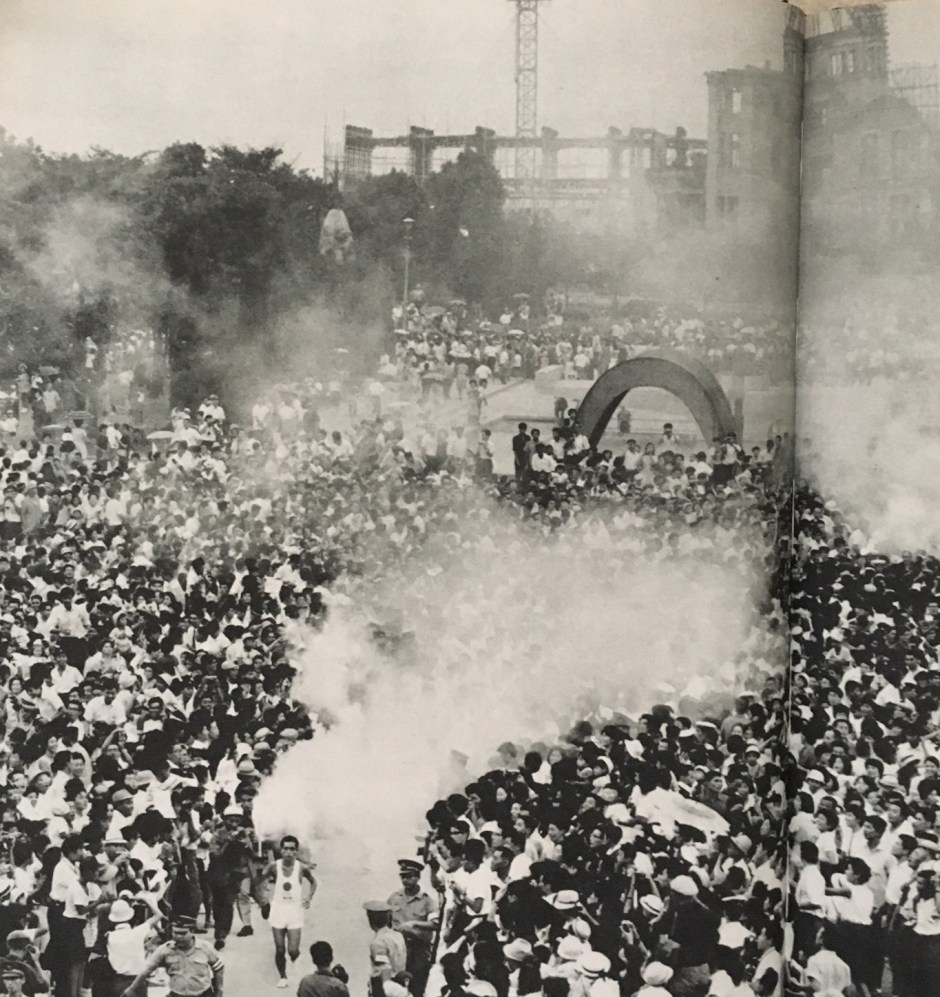
The torch relay passing through Hiroshima prior to the start of the 1964 Tokyo Olympics, from the book 1964 Tokyo Olympiad Kyodo News Agency
One thing certain about the dates of the Tokyo 2020 Olympics: July 24 to August 9, 2020. It will be hot and muggy!
One less obvious thing recently occurred to me about the dates. The final week of the Tokyo Olympics falls on the 75th anniversaries of the nuclear bombings of Hiroshima and Nagasaki.
Was it intended to bring attention to the worst days in Japanese history, during the proudest days of the nation’s history?
Of course it was. It’s impossible to imagine that no one in the Tokyo 2020 organizing committee or the IOC noticed that the closing ceremonies of the Olympics would take place on the day the second atomic bomb was dropped on Japan, thus expediting the eventual end of the war six days later.
On the contrary, the organizers must have thought that the final day of the Tokyo 2020 Olympics would be an opportunity to solemnly (and hopefully tastefully) implore the world that peace and love trump war and hate.
Such a closing ceremony would provide a poetic bookend to the opening ceremony of the 1964 Tokyo Olympics. Only 19 years removed from the end of WWW II, it was a 19-year-old student from Waseda University named Yoshinori Sakai who carried the sacred flame up the National Stadium’s steps to light the Olympic cauldron on October 10, 1964.
Sakai was born in Hiroshima on August 6, 1945, the very day that the Enola Gay dropped an atomic bomb called “Little Boy” on Sakai’s hometown.
It was September 19, 1965 at the Cotton Bowl in Texas. The Dallas Cowboys opened up their season at home against the 1964 title game runners up, The New York Giants. Over 59,000 fans came out to watch their ‘boys, and it also happened to be the debut of the two Tokyo Olympians, and arguably two of the fastest men in the world: Cowboy receiver Bob Hayes, the 100-meter gold medalist and Giant defensive back Henry Carr, the 200-meter gold medalist.
As Hayes told the story in his autobiography, Run, Bullet, Run, the Cowboy were up 24-2 on the Giants. The Cowboys had the ball, second and 4 from the Giants 45 (in other words, 45 yards from the end zone and a touchdown). Dallas quarterback, Don Meredith, tossed a somewhat wobbly ball into the right flat that Hayes caught. He waited for his blockers, spied an opening, and headed for the goal line.
Carr and his teammate Jim Patton had a bead on Hayes and converged on the Bullet at the 25 yard line, “but when they reached that point, I was already 5 yards past them. “I’ve never seen this in the NFL, where defensive backs judge the angle and then get there and are lost, “Dallas head coach Tom Landry said.
Remarking on the same play, Cowboys’ personnel director Gil Brandt said something similar – “The guy changed pro football.”
As they say, speed kills. According to this video, #2 Bob Hayes Top Ten Fastest Players (in the NFL), Hayes was revolutionary. His speed stretched the field like no one had done before. Man to man was the de rigeur defense, but coaches had to develop new zone schemes to contain the Bullet.
According to Dallas quarterback, Roger Staubach, who played with Hayes in the latter half of the Bullet’s career, ” He got these guys from man-to-man, they played a lot more zone, and I think he was kind of a game changer.” Remember, this was the age when defenders could do almost anything they wanted to a wide receiver short of armed robbery. So to create space, Hayes made the quick screen a thing of beauty.
Watch his highlights in this video:
Over 11 seasons and 132 games, the double gold medalist and running back from Florida A&M, caught 371 passes, 71 for touchdowns, and in the 1970 and 1971 seasons, averaged 26.1 and 24 yards per catch respectively.
“He wasn’t just a guy with great speed, he had very good hands, and I wish I could have played with him longer,” Staubach said. “I don’t know of any other world class sprinter who can take that speed and transform it into football. Because speed is really, really a great asset, but there’s still more to it, and Bob had that world class speed and he played enough football where he knew how to run routes.”
PS: You may be wondering, as many on the video did, why Hayes was #2, and not #1, here is the NFL’s answer.
Not as catchy as Death and Taxes, or Love and Marriage – but they go together like a horse and carriage.
In fact, novelists swarm to politics and corruption like moths to flames. Staring into that flickering fire is former Olympian, Ron Barak, who is about to publish a novel, The Amendment Killer.
Barak was a member of the US Men’s Gymnastics team at the 1964 Tokyo Olympics. And while he was also an NCAA champion with the gymnastics team at the University of Southern California, his studies at USC were arguably more critical to his long-term career: a BS in physics and a Juris Doctor of Law.
Barak became a lawyer in the 1970s, among other things, representing athletes as their agent, including football greats Bubba Smith and Ahmad Rashad. Most of Barak’s career was devoted to real estate law, and witnessed first-hand the rise of Japan’s economic influence in the 1980s when the yen overpowered the dollar and Japanese corporations bought up landmark properties and brands overseas.
But as Barak eventually understood, he had a knack for storytelling, and answered a dare from some friends to write a novel. His first novel was a “whodunnit” murder mystery set in D. C. – as Barak puts it, “a story of a political system gone awry and those who felt compelled to fix it.”
Barak’s latest political thriller, The Amendment Killer, hits bookstores in November. Let’s ask Barak a few questions about the book and the journey to his third career (writing following sports first and law second).
What is your novel about?
Modern day Washington, D.C, misconduct on the part of our political representatives has never been worse. In this backdrop, frustrated citizens form a tax-exempt watchdog foundation, The National Organization For Political Integrity (NoPoli), to remind our governmental leaders that they are there to serve, not to be served.
In short order, the membership ranks of NoPoli swells to hundreds of thousands of Americans disgusted by our abhorrent government. NoPoli sponsors and convenes a Constitutional Convention at which a 28th Amendment to the Constitution is adopted to criminalize political abuse and corruption.
Offended by the sudden demise of their many perks and the threat of incarceration, Congress challenges the Amendment and asks the U.S. Supreme Court to invalidate it on an expedited basis. Because of the fundamental importance of the Amendment, the Supreme Court agrees to hear and decide the case in one televised week.
As the nine justices take the bench to hear oral argument, the justice expected to cast the deciding vote, Arnold Hirschfeld, receives a text that begins “We have your granddaughter. Here’s what you need to do.” Hirschfeld is warned that his granddaughter will be killed by the end of the one week expedited process if the Amendment is not defeated by the Court—or if word even gets out that his granddaughter is being held to control the outcome of the case.
What is the relevance of your novel to today?
I write first and foremost to entertain my readers, but also to “blur the line between reality and fiction.” In the case of The Amendment Killer, there are at least three such relevant intersections of reality and fiction:
First, the novel is particularly timely (“ripped from the headlines” some might say), addressing our highly dysfunctional U.S. government. It does this through my hypothetical 28th Amendment to the U.S. Constitution criminalizing abuse and corruption on the part of our political representatives, which Congress asks the Supreme Court to invalidate. Using my legal background, as well as my political knowledge, I actually drafted such an amendment on my website.
Second, I introduced diabetes into the novel because, like my young protagonist, Cassie, 30 million Americans today are diabetic. That’s one in ten Americans. That’s epidemic and another highly relevant issue today.
Third, there are serious ethical issues in the story. Cassie’s grandfather, the Supreme Court justice holding the swing vote in the case, must decide whether he can sacrifice the best interests of the country, and his duty as a Supreme Court justice, to save his granddaughter’s life. Are the best interests of the country worth his young granddaughter’s life?
Tell me about the character Cassie and why you wanted to create a character who has diabetes?
Part of the reason is that I wanted to draw attention to a disease that is at epidemic levels in the country (and the world) today. It is a subject I know well because I’m diabetic. My wife, Barbie, and I have also committed 50% of the proceeds of The Amendment Killer to diabetes research and education. There are millions in the world today who are diabetic but don’t know it—until it is too late for them. That’s tragic because diabetes can be intelligently well managed today. We have Olympic gold medalists who are diabetic. We have NFL and NBA athletes who are diabetic. Diabetes, if well managed, does not at all have to be a death sentence. Several prominent national diabetes organizations are solidly behind The Amendment Killer because they think Cassie is a poster child for diabetic youngsters. And The Amendment Killer is coming out in November, which is National Diabetes Month!
What inspired you to become a novelist? Were there indications as a youth that you had a storytelling gene?
I wrote my first novel on a dare from some friends. Being somewhat competitive, a trait perhaps attributed to my gymnastics days, I couldn’t turn my back on the challenge. As I wrote that first novel, I discovered that I loved it. I’ve worked hard ever since to learn how to write properly so that I could develop and continue this new pursuit. Some have commented that I simply transitioned from physical gymnastics to mental gymnastics. I don’t know about that, but writing is definitely easier on the joints than physical gymnastics, especially at my age today. I don’t know if I had a storytelling gene, but I actually might have. As a little kid, my dad used to tell stories to my younger brother and me. He had an incredible imagination and a genuine patience in his storytelling. Maybe some of that rubbed off on me because I have discovered how much fun I find it to weave a story. It presents an opportunity to create mystery but to inject humor at the same time. That’s a mix I really enjoy.
What writers have inspired you? Why?
The list is long. I love to read and have for years. I read mostly fiction, but I do occasionally read some non-fiction too. I read to be entertained. Perhaps that’s why I write to entertain. Examples in no particular order are Ian Fleming (James Bond novels, I’ve read every one), John Grisham (I’ve read probably about half of his), Michael Connelly (I’ve read most of his), Lee Child (Jack Reacher novels, I’ve read most of them), Daniel Silva (I’ve read most of his), David Baldacci (I’ve read most of his), Vince Flynn (read most of his too), Robert North Patterson (read most of his), Scott Turow (I’ve read most of his), John Lescroart (I’ve read most of his), Greg Isles (I’ve read most of his). I have also read a lot of Stephen King. And I’ve read a miscellany of lesser known novelists. I’m sure I’ve missed some. As for why, these authors have a few things in common: most of all, they can tell a great story. Beyond that, they keep you guessing and turning the pages.
How has being a 1964 Tokyo Olympian impacted your career?
In countless ways. First, training brought discipline and commitment into my life at a young age, when I didn’t otherwise exhibit much of that and neither did my friends. Second, it was an absolute joy. Third, it provided great education; I got to travel around the world, and I learned how to handle celebrity, not to let it get out of proportion. Fourth, it was a great source of self-confidence and self-esteem; it helped me know that if I put my mind to something, and worked hard at it, I could usually accomplish it. Fifth, along the way, it has opened doors that might not otherwise have opened. (Note: I used numbers here, but I am not prioritizing these things and don’t think I could.) So, in terms of my career, while I was at the near top of my law school class, my Olympic career got me more job offers than might otherwise have been the case, a combination of the celebrity and the maturity and people skills. It didn’t make me a better lawyer, but strong work habits learned in sport probably did.
Stay tuned for the November 1 launch of The Amendment Killer!




You must be logged in to post a comment.