This is part two highlighting the powerful black and white photos of the opening day ceremonies of the 1964 Tokyo Olympics, 53 years ago yesterday. The photo above, from this series compiled by Fuji Film, captured one of the most dramatic moments of the Tokyo Games.
The sacred flame that lit the Olympic cauldron, which burned for the 16 days of the Tokyo Olympics, was initially lit 51 days earlier on August 21 in Olympia, Greece. The flame then travelled through 12 countries in Eurasia, including Turkey, Lebanon, Iran Thailand, Malaysia and Taiwan, before landing in Japan. The flame was distributed to four torches, which then made their way through all prefectures in Japan. The four flames came together in Tokyo and the final torch bearer was Yoshinori Sakai, a university runner selected because he happened to be born on August 6, 1945 in Hiroshima, the day the world entered the nuclear war age.
After the Olympic cauldron was lit, the flag bearers of the 93 nations formed a semi-circle around the lectern, where Japanese gymnast Takashi Ono, stood. Ono, a veteran participating in his fourth Olympics, who accumulated 5 golds and 13 total medals since the 1952 Helsinki Games, delivered the athlete’s oath.
In the name of all competitors, I promise that we shall take part in these Olympic Games, respecting and abiding by the rules that govern them, in the true spirit of sportsmanship, for the glory of sport and the honor of our teams.
After the oath, 8,000 pigeons were released. I’m sure it was a spectacular image on television and in the newspapers and magazines, but it was a bit of an annoyance to athletes and spectator alike who tried and failed to dodge the guano bombs of the birds who were probably less than thrilled with being cooped up in cages and then suddenly released into the air above the stadium. One athlete told me that the water pressure in the Olympic Village dropped drastically as everyone showered at the same time to rid themselves of their unwanted opening day souvenir.
October 10, 1964. In the annals of 20th century Japanese history, it was truly a day to remember.
It was minutes before the commencement of the 1964 Tokyo Olympics, the flags of 93 nations rising into a clear blue sky. The above photo was snapped and compiled into a set of photos by Fuji Film commemorating the XVIII Olympiad’s opening ceremony, which began at 2pm on Saturday, October 10, 1964, 53 years ago today.
The athletes would have to deal with cold and wet conditions for much of the Tokyo Olympics, but that day, the 5,500 athletes marched into the National Stadium under perfect conditions. As tradition has it, the host nation’s team marches into the Stadium last. Expectations were high for Team Japan, with a goal set of 15 gold medals. They actually achieved 16, third best after the US and USSR.
The President of the Organizing Committee for the Games, Daigoro Yasukawa, can be seen above introducing the International Olympic Committee President, Avery Brundage. In the official report which offered a post mortem of the Games from an operational perspective, Yasukawa expresses gratitude to the people of Japan.
…it was because Japanese in all walks and interests of life worked together in close and harmonious cooperation—all with one basic goal—that these Games might be an unqualified success. This spirit permeated into the Organizing Committee, and was to be found also in the sports associations and the many cooperating organizations involved. This surely is the only factor that enabled success in our organization efforts.
At the end of the Second World War, in the aftermath of the Hiroshima and Nagasaki bombings, the Emperor’s voice was heard over the radio for the first time by his Japanese subjects. The Emperor asked his people to surrender, to “bear the unbearable, and endure the unendurable.” Nineteen years later, the Emperor is presiding over the Olympics, an event symbolizing peace and unity, in a city that was unrecognizable from its bombed-out shell in 1945. As noticed in this Japan Times article, the scene depicted in this photo may have been striking to many Japanese as the only person standing in the stadium was the Emperor – a role reversal of sorts in a very different time.
After the Emperor declared the XVIII Olympiad open, the Olympic Flag was brought into the stadium by Japanese self-defense forces, the embroidered satin flag initially brought in by the Mayor of Rome, the site of the XVII Olympiad. The flag was raised exactly 15.21 meters into the air. That was the distance Mikio Oda hopped, skipped and jumped to win the gold medal in the triple jump at the 1928 Amsterdam Olympics, Japan’s first ever gold medal.
Imagine it’s October 9, 1964 and you have this ticket to the Opening Ceremonies of the 1964 Tokyo Olympics on the next day.
This is the day over 5,000 athletes and the entire population of Japan has been waiting for – the start of a new Japan.
And by the looks of it, your ticket is in a prime location – Q-57, 5 UPP. I’m not 100% sure where that seat is on the map provided on the back of the ticket, but my guess is the area I highlighted in blue.
If it is indeed that section, you are in an honored section. Since the design of this ticket is different from the tickets generally sold, these may be for special guests, as indicated by the word “SPECIAL” written on the ticket’s map.
Special perhaps because in 5 UPP, Q-57, you will be seated very near the center of the stadium, almost directly opposite the Olympic cauldron, where a teenager from Hiroshima, born on the day an atomic bomb was dropped on his city, would climb the steps and light the Olympic flame.
Less than 50 meters in front and below you will be seated Emperor Hirohito, who will launch the Games.
And thousands of the world’s best athletes will march into the stadium by your seat, as if they are marching for you.
Don’t lose that ticket. It’s going to be quite a show.
When József Sütő lined up for the marathon at the 1964 Tokyo Olympics, the Hungarian didn’t know any of the other 67 competitors in the race, except for the then-world record holder, American Buddy Edelen, and the reigning Olympic champion from Ethiopia, Abebe Bikila.
When Sütő hit the halfway point in the marathon, Bikila was indeed firmly in the lead. Slightly behind him was Jim Hogan of Ireland. Ron Clarke of Australia was third, but pressing hard on Clarke were Sütő, Kokichi Tsuburaya of Japan, and Demissie Wolde of Ethiopia.
“Mr. Tsuburaya was in this group, but I did not know at the time who he was,” Sütő explained in an interview with me. “I saw of course that he is Japanese but I did not know more.”
József Sütő (77), Kenji Kimihara (73) on the day of the memorial run, photo by Rajzó-Kontor Kornélia
And yet, it was that race that established a life-long tie between those two runners, who never met except in that single competition on October 21, 1964. Fifty years later, Sütő would return to Japan and pay respects to the Japanese marathoner who won the bronze medal at the Tokyo Olympics, and then subsequently and sadly took his own life four years later.
At this own expense, Sütő flew out to Japan to attend the 32nd Tsuburaya Memorial Meet, an annual series of running events held in the city of Sukagawa, Fukushima, the hometown of Kokichi Tsuburaya. This was October, 2014, which meant that he would be running in the memorial only two days before the 50th anniversary of the marathon of the Tokyo Olympics.
As explained in this article, Sütő ran in the 5k race, and at the age of 78, ran it in a respectable 27 minutes and 8 seconds. More importantly, he ran it in the race with teenage boys, aged 13 to 15. Sütő understands symbolism, the importance of being a role model, which is why he ran with the boys. When Sütő was growing up in Hungary, his hero was Sándor Iharos, one of the best distance runners in the world in the mid-1950s, a world record holder in the 1500-, 2,000- and 5,000-meter distances.
But Sütő also understands how he represents history, and his linkage to Japan and the 1964 Olympics, one of the defining moments of its history in the 20th century, as well as to the marathon itself. He had arrived in Tokyo on October 18th and was immediately whisked north to Sukagawa. He ran the race on October 19th. On October 20th, he attended a tour of the museum dedicated to the memory of Kokichi Tsuburaya, and then returned to Tokyo for a meeting with representatives of Japan’s National Olympic Committee on October 21st.
The meeting began at 3pm, and exactly 17 minutes into the meeting, Sütő interrupted the conversation by saying “Gentlemen, 50 years ago on this date and at this moment I was taking the turn into the Olympic stadium….and I’ll cross the finish line in a moment!”
I’ve only had the opportunity to exchange emails through an intermediary/translator named Rajzó-Kontor Kornélia, who kindly offered to assist me in communicating with Sütő . Through Rajzó-Kontor’s help, as well as the brilliant articles she wrote on Sütő’s visit to Japan in 2014, I can see that Sütő appreciates the enormity of Japan’s moment in 1964, and as he learned after leaving the Tokyo Olympics, the physical and mental trials Tsuburaya endured after the Tokyo Games. Sütő never met Tsuburaya, but he knows him, and likely wishes he could embrace him.
After completing his race at the Tsuburaya Memorial Meet that beautiful October day, he revealed his thoughts to reporters, as explained by Rajzó-Kontor:
Sütő told the local television viewers the same thing he had said in the cemetery the day before; that he had been thinking of Tsuburaya and thanking him as he ran. Sütő said he believed he would have run the distance “hand in hand” with Tsuburaya, were he still alive.
NOTE: Many, many thanks to Rajzó-Kontor Kornélia for the time she took to translate my questions from English to Hungarian, personally meet with József Sütő, and then translate his responses from Hungarian back to English.
In 1964, one of the more powerful track and field teams at the Tokyo Olympics was the team from Poland. Jozef Szmidt won his second straight gold in the triple jump. Andrzej Badenski took bronze in a tough men’s 400-meter competition, and the Polish men from the 100-meters relay team took silver behind the Americans.
The 4×100 women’s relay team did even better, streaking to gold and an (apparent) world record in Tokyo. The women who ran the second leg was Irena Kirszenstein Szewinska. The then-20-year-old from Warsaw was starting a career that would carry her through five consecutive Olympiads. In that period, she captured an amazing total of seven Olympic track and field medals.
In addition to her gold medal in the 100-meter relays and a silver in the 200 meters, she was a silver medalist in the long jump as well. But she was indeed a sprinter at heart, and set 10 world records in the 100 meters, 200 meters and the 400 meter sprints.
At the 1968 Mexico City Olympics, she won her first individual sprinting gold medal in the 200-meter sprint finals in come-from-behind style. Seemingly behind 4 or 5 other runners, when she hit the straightaway, she accelerated and pulled away with ease, as you can see in the video below.
After winning a bronze medal in the 200 meters at the Munich Olympics in 1972, Kirszenstein Szewinska reinvented herself. In 1973, she began competing in the longer 400 meters, and as her IAAF Hall of Fame profile page states, “she quickly proved very adept at the new distance. The following year she became the first woman to break 50 seconds over one lap of the track.”
“My favorite event was the 200 meters because deep down I felt like a sprinter,” she said in this short video on the Polish Olympian. “My heart always belonged to sprint. Nevertheless, I always treated the 400 meters as a long spring, and that’s why I was successful at that distance as well.”
Szewińska pulling away in the 400 meter finals at Montreal
In Montreal, at the age of 30, she punished the competition, set a world record, and won her most satisfying gold medal.
“I had been running for 20 years. During that time, there were many important moments. But I suppose the most important moment of all of them was the last gold medal I won at the Montreal Games for the 400 meters.”
One of the greatest women track and field stars of the 20th century, Kirszenstein Szewinska has continued her career in sports as an administrator, including Vice-President (1995-1999) then Executive Board Member (1999-2003) of the World Olympians’ Association (WOA), member of the International Association of Athletics Federation (IAAF) Women’s Committee (1984-2007).
The majority of Japanese have considered themselves middle class for decades, speaking to the highly meritocratic nature of Japan’s society. This is part three of Faces of Tokyo, a series of posts on how Dentsu explained the Japanese to the rest of the world, in a book called “Tokyo Olympics Official Souvenir 1964.” They did so with a collection of profiles of people, who represented a wide variety of professions.
These profiles represented the average person in Japan, who served the growing Japanese population during Japan’s greatest economic expansion – the 1960s.
Taxi Driver:Taxi drivers had a reputation for reckless driving habits – often labeled kamikaze drivers by the foreign press. But it was a living, and not such an easy one. As the profile explained, “the traffic jams of Toyo are among the world’s worst. Day and night 930,000 taxi drivers suffer from bad roads, long labor hours and other inconveniences. But if you’re lucky, maybe you get in the back of the cab of Mr Tadashi Yamamoto, who was recognized as an “Excellent” driver.
Stewardess:As Dentsu wrote, becoming an actress, stewardess or a fashion model “form the triumverate of the modern Japanese teenager’s dream.” Hisako Miki, a 24-year-old stewardess for Japan Airlines, was living that dream. Taking care of passengers on the international routes, conversing politely in English with foreigners, bringing back gifts to her family and friends from the world over, Miki was enjoying a life of relative glamour, that likely would lead to the right marriage – a pilot perhaps.
Traffic Guard: Tokyo in the 1960s was crowded, dusty and noisy. But someone had to stand in the middle of the roads so that children could cross the roads safely and get to and from school. Teruko Yokote was a 45-year old traffic guard, whose whistle, hand gestures and stern looks kept impatient drivers at bay. Traffic guards, as the profile explains, were a recent addition to the work force, an attempt to diminish the problem of car accidents involving children.
Student: Dentsu tells us that all those young boys walking around in black slacks, jackets and hats looking like military men are actually students. Student uniforms for both girls and boys, for some reason, are based on 19th century Western European naval designs. The interesting political commentary regarding the Waseda University student aside, the Japanese student is the shining example of middle class meritocracy in the country. Students take tests, and the better the scores, the better the school, the better the job, and hopefully the better the life.
The American government, yet again is trying to sell American cars in Japan. But a reputation of poor quality and poor mileage (unfounded perhaps) result in poor re-sale value. No matter what the government does, Japanese citizens do not want to buy American cars.
In fact, the people who used to buy the long, sleek American cars were the Yakuza, or at least that was the perception.
Chevrolet Impala
But when I look at the ads for cars in the weeks of the 1964 Tokyo Olympics, me – a non-driver without a license – I do admit, I lust.
Above and below are the ads from October 10 and 17 editions of The Saturday Evening Post, the weeks of the 1964 Tokyo Olympics. George Lucas’ film, American Graffiti, portrayed the youthful car culture of 1962 Modesto California, which showcases automobiles primarily from the 1950s and 1960s. And again, I’m no car expert, but you get a sense that in 1964 cars were getting longer and sleeker – rounded edges giving way to sharper angles.
Take a gander at the American cars of ’64, as seen through the eyes of the readers of The Saturday Evening Post. Which one gets your motor running, makes you wanna head out on the highway, lookin’ for adventure, and whatever comes your way…..
Buick Electra 225Pontiac Grand Prix
Ford Galaxie 500, Fairlane 500 Sports Coupe and Mustang Hardtop
In 1964, the world came to Japan for the 1964 Tokyo Olympics, and to most foreigners, particularly from the West, the Japanese were not familiar, foreign perceptions ranging from warlike to exotic to friendly.
The Japanese were intent in facilitating the positive image of the Japanese. In the book, “Tokyo Olympics Official Souvenir 1964”, the publisher Dentsu produced a section called “Faces of Tokyo”, to encourage specific perceptions of the Japanese:
That the Japanese are indeed uniquely Japanese
That the Japanese are international
That the Japanese are middle class.
Uniquely Japanese
The Housewife: Apparently the modern-day housewife of Japan in 1964 is beautiful, loves weekend outings with the family, and wears kimono designed by her husband. Somehow, Dentsu is trying to portray the typical Japanese housewife as beautiful, modern and well to do.
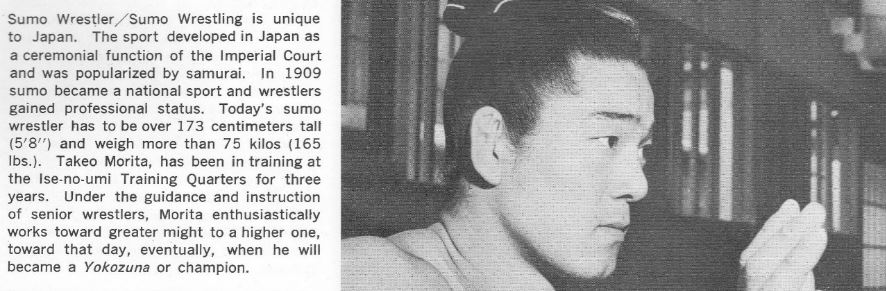
The Sumo Wrestler: The profiled wrestler was still a relative unknown, but Takeo Morita, who later became known as Fujinokawa Takeo, made it to the heights of sekiwake in the very Japanese sport of sumo. Dentsu explains that sumo emerged out of imperial court functions to become a national sport in the early 20th century. (Real)
The Geisha: The profile here is undecipherable in English – I’m sure this is from a vague description of what it means to be a geisha by a translator who likely gave up and just threw a bunch of English words together….
The Buddhist Priest:This profile introduces the resident priest of Zojoji, Buddhist temple in Tokyo Shiba Koen, very near Tokyo Tower. Not only is he a priest, but he is a Doctor of Philosophy, honorary president of a Japanese university, and through his many books, a go-to guy in Japan to understand Buddhism.
The Flower Arrangement Sensei:Although true less and less today, the expertise and techniques of specific skills and trades were handed down from one generation to another very deliberately, often from parent to child, as was the case with flower arranger, Kasumi Teshigawara, featured here. My guess is that the reference to her brother is famed film director, Hiroshi Teshigawara.
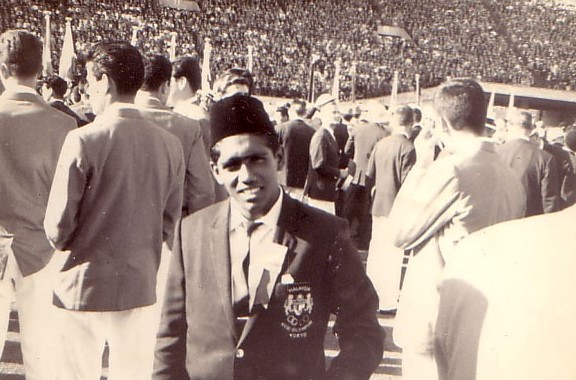
Kunalan at the 1964 Tokyo Olympics Opening Ceremonies
It was the summer of 1964 and Singapore was in crisis.
Singapore’s leader, Lee Kuan Yew, had brokered a deal with the British Government and the leadership of Malaya to be included in a nation called Malaysia, established in 1963. This was not a match made in heaven. Racial tensions were part and parcel of the daily lives in the region between Singapore, which was a mixture of Indian, Malay and Chinese, but had a predominant population of ethnic Chinese, and the rest of the Malaya Federation, which was primarily Bumiputra and Islamic.
In July and September, Singapore felt the political tension born of the delicate balancing act that brought Singapore and Malaya together, and at times, the tension boiled over. Race riots broke out where shophouses were burned down, police and military were called out to restore order and enforce curfews, and people were beaten and killed.
This is the atmosphere in which athletes in Malaysia and Singapore were preparing for the 1964 Tokyo Olympics. Canagsabai Kunalan was a promising 21-year-old sprinter, talent spotted only a year before by the Malaysia track coach, Tan Eng Yoon. After a successful sprinting debut in 1963, Tan believed Kunalan was ready for the Tokyo Olympics, and recommended him for the 4X100 relay team, along with Mazland Hamzah, John Daukom, and Mani Jegathesan.
3 weeks prior to Tokyo – standing: Tan Eng Yoon and Stan Wright; sitting (L to R): Kunalan, Wong Fey Wan, Kuda Ditta, M Jegathesan, and Dilbagh Singh
But the make-up of the 4X100 relay team did not sit well with Wong Fey Wan. Another talented sprinter, Wong defended his record, and called out Kunalan publicly in the press:
I beat Kunalan in the 100 m finals in the national championships in which I finished second to Jegathesan, and I beat him again in the Government Services Meet in the 100 m final on Saturday in which I finished third…. I am willing to race against Kunalan again to prove I am the better man over 100 m. If I am wrong I will quit athletics.
Coach Tan did favor Kunalan, perhaps for his work ethic, perhaps for the belief that Kunalan was stronger around the curves and a better choice as back up for the relays. Maybe Wong did not have the political support as he was self-taught and did not have the benefit of a coach lobbying his case as Tan did for Kunalan. Maybe race was influential. As explained through Kunalan’s state of mind at the time in the biography, “C. Kunalan – Singapore’s Greatest Track and Field Athlete”, Kunalan was unhappy.
Whatever the true reason for Wong’s exclusion – be it sporting or political, this incident affected Kunalan, who regarded this as “one of the saddest moments” of his running career. He never knew for sure whether he had been chosen on the basis of merit, but he wished that Wong had been chosen instead, knowing how much Wong had been looking forward to competing at the Olympic Games.
It was Kunalan instead who went to Tokyo. Just three days before his 22nd birthday, the Malaysian 4×100 team finished last in their round one heat, and that was that.
While Kunalan had no control over the make-up of the 4×100 Malaysian relay team, during a period of racial and political strife in his country, he did indeed have control over more important, personal decisions – with whom he would marry.
Kunalan and me
Teammates in track, Kunalan first met Chong Yoong Yin, captain of the Raffles Girls School track team, and a member of the Malaysia national track team. They had track in common, but to their parents, little else. Kunalan was ethnic Indian and was brought up in the Hindu religion. When Kunalan had returned from the Tokyo Olympics and his parents realized that his relationship with the ethnic Chinese woman, Yoong Yin, was still intact, they gave their son an ultimatum: “leave that Chinese girl or never return home again.”
Kunalan walked out.
Yoong Yin received the same ultimatum from her father and her uncle. And she too left home, joining her mother, who was estranged from her father.
Distraught after being shunned by their own families, they struggled momentarily, wondering what would happen. But Kunalan in the end was resolved. “We’ll have our own friends who will accept us.”
Engaged in October 1965, with a wedding date set for October 1966, the parents of Kunalan and Yoong Yin eventually saw that there was no fighting the bond between the two. Kunalan’s father surprised his son with a visit, and said he would bless the union, but only if Yoong Yin would take on an Indian name and convert to Hinduism. Fortunately, that was not a problem for Yoong Yin, and the two sprinters were married in a Hindi ceremony. Subsequently a Chinese wedding dinner was held by Yoong Yin’s mother.
Fifty-two years later, Kunalan and Yoong Yin are still happily married. And Kunalan proudly proclaims that diversity and the need to be inclusive of all races and nationalities is vital to world peace. “I am not nationalistic,” he told a Singaporean magazine. “I am more of an internationalist.”
His children, a blend of Indian and Chinese DNA and heritage, have lived their parents’ creed, marrying members of other nationalities. Kunalan is proud of to be an inter-racial grandparent.
He remembers 1964. He recalls seeing the worst in the race riots of Singapore, and the best in the gathering of the world’s best athletes in Tokyo. And he believes that we are capable, through sports, to co-exist in peace and love.
Opening Ceremonies 1964, from the book, Bi to Chikara
In Japan, my birthday used to always be a national holiday.
Two years after the Tokyo Olympics staged their grand opening ceremony on October 10, 1964, the Japanese government declared 10/10 a national holiday. When I lived in Tokyo from 1986 to 1994, my birthday was always a day off. Very often, schools all over Japan would hold sports festivals for their students and families, a significant cultural phenomenon in Japan.
In 2000, this holiday called Health and Sports Day was moved to the second Monday of October, to ensure that Japanese get that day off, so this holiday often falls on a day before or after October 10. This year, the second Monday is October 9.
With the start of the 2020 Olympics scheduled for Friday, July 24, government officials are considering a change in the law to make that day a national holiday, according to Asahi. Doing so would decrease the car and mass transportation traffic significantly, and allow people and vehicles related to the Olympics to move more efficiently that day, in addition to making it easier to implement security plans.
The government is considering a few options:
Make July 24, 2020 a public holiday, but not to make it an annual holiday
Move the public holiday held on the second Monday of October to July 24 (No!)
Move the public holidays of either Mountain Day (August 11) or Marine Day (third Monday of July) to July 24.
Create an additional annual public holiday on July 24 (That would get my vote!)
Japan has a reputation for being a workaholic culture, with the perception that people tend to log long hours at the office. In some companies and in certain departments, that is certainly the case. To the credit of the Japan press, they call out the worst companies (ブラック企業 burakku kigyō) for their culture of ridiculously long hours. And if you work in HR in Japan like I do, then you know that many companies have vacation utilization rates of 50% or less, ie: if you have 20 days of leave, you take only 10 days or less that year.
But the truth of the matter is, as residents here know, Japan has a high number of public holidays – officially 16 – more if you count the unofficial days off companies give their employees after New Years. As I understand it, only countries like India, China, Hong Kong, Colombia and the Philippines have more.
Because there are so many holidays, many clumped together so that Japanese can take as long as a week off twice in a year, many Japanese feel they can’t use up all their vacation days even if they wanted to. When I moved from Tokyo to Seattle, I felt this difference viscerally, shocked at how few public holidays there were in the US compared to Japan.
Japan is a public holiday paradise, and I hope that the government chooses to make July 24 a new and permanent holiday.
But please don’t touch my Health and Sports Day in October. It’s my special day.






You must be logged in to post a comment.