All Japanese were united in ensuring that visiting foreigners left the country believing that Japan was the friendliest country in the world. Of course, in a society built on trust and assumptions that all people are intent on doing good, free riders and scam artists may sometimes think they are the one-eyed-king in the country of the blind. But if you’re going to cheat in such a society, you better be good.
An article in the October 3, 1964 edition of The Yomiuri tells the story of a scam artist wannabe who failed in his scam, but perhaps gained food for thought. Saburo Komuro walked up to a food stall outside in Kamata, and sat down for a hot bowl of “oden” on a cool October evening. He proceeded to mumble his way in explaining that he was in fact an Olympian on the Chinese Olympic judo squad.
The Yomiuri October 3 1964
Of course, the Japanese owner of the stall was very proud to be serving a visiting Olympian, and began to “lavish beer and oden on Komuro,” with complements. How could this food stall owner know that there were no judo competitors from Hong Kong or Taiwan, the only countries at the Tokyo Olympics related to China? Komuro was likely very pleased with himself, enjoying a lovely feast of boiled eggs, fishcakes, daikon in a warm broth, while bringing joy to this hard-working food stall owner.
But sometimes, anything that can go wrong, will go wrong.
A person who was actually Chinese sat down at the oden food stall. When told that he was sitting next to an Olympian from China, he immediately began talking in Chinese to Komuro, who of course couldn’t understand a word. It quickly dawned on the food stall owner that this was no Olympian sitting in front of him, only a fraud. A fight ensued, and in a weird twist, Komuro took off to the police box to explain how he had been wronged, only to be arrested.
Straigh Four finals at the 1964 Tokyo Olympics: 1 -Denmark, 2 – Great Britain, 3 – USA; from the collection of Theo Ted Mittet
If you think about it, we rowed together for over 3,000 miles in an intense period of several months. We rowed differently from others, we had our own thing. And here comes Geoff. He was on the Harvard team we had beaten him in the US Olympic Trials. He was an alternate, so he was wearing his blazer walking around the Ginza, having a gay old time….and then suddenly he’s told, “you’re in a boat. Get ready!”
That was Phil Durbrow, who suddenly, in the first heat of the straight four (aka coxless four) rowing competition at the Tokyo Olympics, coughed up blood and collapsed, stopping their shell dead in the water. The crew from the Lake Washington Rowing Club (LWRC), who believed, up to that moment, that they had the team and the swing to take gold, simply willed the boat across the finish line. Finishing meant being eligible for the repechage, but they would have to do so without Durbrow. Durbrow of Menlo College explains.
I sat behind Ten Nash, who was a very powerful rower. I sat behind him and my job was to even things out. Now, suddenly, Geoff had to sit behind Ted and figure out how to fit in the best he can, in maybe, two or three rowing sessions before the finals. Rowing is wonderful when there is no excess baggage. All in the boat who have to act like one, and think the same things and feel the same things and respond in the same way, balance each other perfectly. They need to be aware of currents and winds and course, and the competitors – It’s an incredibly complicated thing if you were to do it with your left side of your brain. But actually, you do it with your right side of your brain. It’s like going down the highway on the other car’s bumper doing 70 miles per hour thinking little about it. Geoff didn’t really have time to get all that.
And yet, Geoff Picard, the alternate, did.
Picard was from Harvard, training under the famed coach Harry Parker, who taught a totally different stroke technique to his rowers. According to Lyon, Pocock taught the LWRC rowers to slow down before the catch, the moment the oar hits the water, extending their reach further than the average crew, and driving fast. The Harvard rowers were trained to be slower with the hands right after the release and faster on the catch.
In the repechage, the US coxless four (which means four rowers without a coxswain), were up against France, Japan and Australia. France kept pace with the Americans for 1,500 meters, but the re-jigged team with Picard in the shell, pulled away in the final 150 yards to win by two boat lengths. Picard seemed to fit in well enough. But according to Nash, in Mallory’s book, “with our different west coast technique and rhythm, he told me he never totally felt in synch.”
With that victory, America was heading into the finals. The reality was, the repechage was only the second time the four had rowed together – would they really be able to come together in only two days and win a medal? As a matter of fact, Picard filled in admirably, giving the team a chance for a medal.
In the finals on October 15, at the Toda Rowing Center, Nash, Picard, Lyon and Mittet made a valiant effort. They fell behind quickly in the first 250 meters, in fifth behind the Netherlands, Denmark, Britain and Germany. According to Nash, the four began falling into synch, and started to move ahead, making up water on Denmark who had taken the lead. In fact, at the 1,500-meter mark, the US crew was actually in second, just in front of the Brits.
But in the final 250 meters, the Danes held on for gold. The Brits had a bit more in the tank than the American team, grabbing silver. The American team, despite the calamity of Durbrow’s sudden exit in the first heat, still managed to grab the bronze medal.
Nash bemoaned his tactical error to start the team out aggressively at the start, which may have contributed to a loss of rhythm in the early stages. But they all knew they were fortunate to get a bronze medal. “We were very thankful to have a man of Geoff’s quality as an alternate,” Lyon told me. “Another 20 to 30 strokes, we could have come together in time….”
Bronze medalists Ted Nash, Geoff Picard, Dick Lyon and Theo Ted Mittet; from the collection of Theo Mittet.
Durbrow remembers those mixed emotions of October, 1964. “I never did see them win the bronze,” said Durbrow. “I was in a pretty deep funk. I had been trying to get to the Olympics since I was 16, and I was in a great position to do something significant.” Instead, Durbrow left Tokyo dissatisfied. To add insult to injury, the army immediately ordered him back into service in Laos.
But time heals and Durbrow has moved on, as have his teammates. One day, some 52 years later, Durbrow got a package in the mail. It was from Ted Nash, and inside the box was his bronze medal from the 1964 Tokyo Olympics, and a short note saying that he wanted Durbrow to have it. “Without you, our boat might not have even got to the Olympics at all.”
Mittet, remembering those days of glory half a century ago, understood that those hard days of training, the pain, the excitement, the heartbreak were all worth it for the lasting memories and the friendships forged as brothers in arms.
Yes, we have earned honor as competitors. But, we have been given so much more from our chosen sport over our life time. How could we have imagined this in our youth? Let us always remember those who encouraged us, nurtured us and mentored us along the way. If we are lucky, we have had the opportunity to do the same for others. Perhaps we have done so unknowingly – because of who we have become “deep down.”
Receiving their bronze medals; from the collection of Theo Mittet.
Theo Ted Mittet, Dick Lyon, Geoff Picard, Ted Nash at Toda Rowing Center; from the collection of Theo Ted Mittet.
Catch. Drive. Release. Recovery. The four phases of the rowing stroke are simple. The ability for more than two people at a time to execute them in synch is not.
When the straight four crew from the Lake Washington Rowing Club arrived in Tokyo for the 1964 Summer Olympics, they were in synch and they were ready. “We believed we had a great chance to win gold,” reflected Theo (Ted) Mittet), who sat in the bow.
As Dick Lyon, who sat in the number two seat in front of Mittet in the shell, told me, after winning the US Trials, the team of Ted Nash, Phil Durbrow, Lyon and Mittet were running very fast times – doing 500-meter sprints in 1 minute 27 or 28 seconds, which was better than the times Nash’s gold medal winning team at the 1960 Rome Olympics.
Left, Geoff Picard and Bob Schwartz of the Harvard crew and Theo with back to picture, in the Tokyo Olympic dining hall; from the collection of Theo Ted Mittet.
When the crew from America lined up against Great Britain, the Netherlands, Argentina and Italy, they were raring to go. The stroke, Nash, got Team USA off to a flying start, and at the halfway mark of 1,000 meters, Nash and his team were “open water,” (more than a length) up on second place Britain. The Americans had, what they call, swing. Until disaster struck.
As Nash recalled in Peter Mallory’s book, The Sport of Rowing, with the US shell comfortably ahead, the rower behind him, Durbrow, suddenly coughed up blood on and over Nash’s right shoulder. Lyon told me that at the 1,200-meter mark, the boat suddenly turned sideways, and he could see that Durbrow was having trouble breathing. “He was swinging in his seat and he had no power in his arms,” said Lyon. Here’s how the situation was described in Mallory’s account:
Nash: The boat slowed and we stopped. We came to a complete stop. Then Phil said, “I’m okay. Let’s go.” We were screaming by everybody once again, but Phil had a second episode of blood loss, and the guys in the bow, who could see his condition, yelled down to me, “Phil’s really hurting. Please paddle.”
Mittet: I remember the absolute disbelief of watching Phil’s blade falter. How could this be? What was wrong? Our feelings and concerns shifted totally to Phil in an instant – we knew that this was serious.
This was a disaster. The coxless four from the USA still managed to cross the finish line. In fact, they completed their heat with a time of 6:56.40, over 5 seconds ahead of the Netherlands. Britain finished first and advanced to the finals, but because Nash’s team recovered enough to finish, they were still eligible for the repechage, a second chance for all the crews that did not finish first in their heat.
And yet, Durbrow was in the hospital. The team that only magically came together after trying countless variations of 17 different people, was now forced to re-make the team with an alternate, Geoff Picard, who was in Tokyo for just such a scenario. With the finals only two days away, Nash’s straight four were no longer expecting to win gold, and were feeling that a medal of any color would be wishful thinking at best.
And yet, expectation and reality, as they saw, and would eventually see, are often at odds. In the case of the LWRC coxless four, recovery followed quickly upon release.
Nash, Picard, Lyon and Mittet in Tokyo; from the collection of Dick Lyon.
Ted Nash, Phil Durbrow, Dick Lyon and Ted Mittet in Seattle; from the collection of Dick Lyon.
It didn’t bode well in New York.
Four men from the Lake Washington Rowing Club (LWRC) in temperate Seattle came to hot and muggy New York to compete in the US rowing trials on August 29, 1964.
Ted Nash was the veteran and star of the crew of the straight four without coxswain. He had won gold for the United States in the straight four rowing competition at the 1960 Rome Olympics, the only American team to win gold. Dick Lyon, Phil Durbrow and Theo (Ted) Mittet filled out the boat, coming together in a very short time to compete in Tokyo for the 1964 US Olympic rowing squad.
But first they had to win the trials, held at Orchard Beach Lagoon in New York.
At the US rowing trials at Orchard Park, New York, kneeling in front of teammates: Ted Nash, Phil Durbrow, Dick Lyon and Theo (Ted) Mittet; from the collection of Dick Lyon.
According to Stanford University rower, Lyon, the crew from LWRC got in a practice start with a team from the Detroit Boat Club, just before the heats were to begin. Ted Nash broke the edge of his oar blade on one of the maple flagpoles floating on Styrofoam that formed the lane lines. “We barely made it back to the line in time after sprinting back to the NYAC boathouse to get another oar,” Lyon was quoted in the book, The Sport of Rowing, by Peter Mallory.
After winning their heat, Lyon told me that as the team was preparing for the final, Mittet said quite urgently that he had to pee, which meant that he had to sprint 100 yards to the boathouse, and then another 100 yards back. Mittet made it back to the line in time for the start, and they got in a couple of hard sprints in just before engaging in one of the toughest physical activities one can do – 2,000 meters of rowing to absolute exhaustion.
Rowing as a team is very difficult. It’s not a matter of getting the best rowers together in a shell and expecting them to perform. It’s more a matter of finding a group of rowers that feels a rhythm, that leads to a seemingly effortless flow, and results in unchained speed.
Durbrow was in Laos with the US Army when he got his orders to report to Stan Pocock in Seattle. Pocock was the coach of the Lake Washington Rowing Club and Durbrow’s coach at Menlo College and Melbourne Olympian, Duvall Hecht, had strongly recommended Durbrow. When Durbrow arrived in Seattle, he felt like the odd man out. Pocock was looking for the men who would build a powerful crew of eight, as the eights are the heavyweight class of rowing, and thus the glamour event in rowing competitions. Durbrow joined 16 others who were already competing in two squads of eights, wondering where a 17th would fit in.
And yet, try as he might, Pocock could not find the right mix of eight, his teams losing to squads that were not Olympic quality. So in early July, Pocock agreed to disband the crews of eight so that the rowers could find the right combinations of pairs and fours. Nash quickly grouped with Lyon, and when Durbrow got on the scene, they found a natural to sit behind Nash, the powerful stroke. So Nash, Durbrow and Lyon would try any and every combination of the remaining 14 rowers at Lake Washington, and met mainly with disappointment.
Mittet, who grew up on the shores of Lake Washington, and had rowed from the age of 16, was late to the LWRC trials. By the time the eights were disbanded, most of the small boat team decisions had already been made, except for the straight four. But when Mittet jumped into the shell with Nash, Durbrow and Lyon, “from the first stroke, I was awakened to a level of rowing that I had never imagined possible,” as Mallory quoted Mittet as saying. Mallory also quoted Durbrow as saying, “we were trying every conceivable combination of oarsmen in a number of fours that went out every day. Boats that I expected to be super fast felt heavy or ungainly, but one time, Ted Nash, Ted Mittet, Dick Lyon and I went out together with Nash stroking, it felt light and quick.”
The three would continue to experiment with other rowers to sit at the back of the scull, but whenever they rotated to Mittet, they found their rhythm and speed again. After countless combinations, Nash made the decision at the end of July to add Mittet to complete the team of four, and commit to getting ready for the Olympic trials to be held 6 weeks later.
When Nash and his three teammates got to New York for the Olympic trials, they felt confident. Lyon told me that the game plan was to explode off the start with a powerful 40-plus stroke per minute rhythm, and then to ease down to 35 or 36 after a minute, which is about 350 meters of the 2,000-meter race. But Nash, who sat at the stern of the boat as the stroke, the rower who sets the pace, decided to maintain a high pace. Lyon said that for the first 1,000 meters, the crew kept the pace around 39 strokes. “We had never practiced for that long,” Lyon told me. “I don’t remember that we talked about this, but Ted is an extraordinarily enthusiastic person, so we just kept it up for the first 1,000 meters.”
The crew of Nash, Durbrow, Lyon and Mittet won handily, beating the Harvard crew by nearly 3 seconds with a time of 6 minutes and 23.1 seconds.
From the collection of Dick Lyon.
“We were extremely fit,” Lyon said. “We were doing two or three workouts a day, including work outs with weights, running stairs. There were naps in between those thousands of miles of rowing.”
The team was confident. The rowed together exquisitely. The handily won the US trials. They believed they had a great chance for gold in Tokyo. And yet, they heard some great times coming out of Europe – 6 minutes and 19 seconds in one case.
And of course, there is always the unexpected. A shocking turn of events awaited the straight four team in Tokyo.
1964年、ザ・ビートルズはアメリカを席巻する。彼らの前途は、そしてどこまでも続くその成功は、誰からの助けも必要としていなかった。彼らの記者会見からもわかる事がだが、彼らの宿泊先での悪ふざけ、エド・サリバンショーへの出演や、ワシントンDC・フロリダへの旅といったリバプールから来たこの4人の若者は、アメリカ人が一緒に街へ繰り出したいと願う友の様な存在であった。ロン・ハワード監督の映画、「The Eight days a Week」に映るのは、ジョン、ジョージ、ポール、そしてリンゴの4人が、共に過ごす時間を心から楽しんでいる姿である。
1964年、ブルガリアの走り幅跳び選手として東京オリンピックに参加していたダイアナ・ヨーゴバは、私に宛てた手紙の中でこう話している。きつい練習の合間に取る休憩時、彼女は女子寮の中にあったミュージックホールへ行き、好きな音楽を聴いた。彼女のお気に入りの一つが「With the Beatles」というアルバムで、これは1963年11月に発売されたものであった。傍らで行われている生け花レッスンを横目で見ながら、そこから漂う花の香りを楽しみつつ、彼女はお気に入りの曲を聴いた。All My Loving, Please Mister Postman, Hold me Tight, I Wanna Be Your Man.
I recently bought a copy of Life Magazine’s October 30, 1964 edition, featuring a young Don Schollander staring off into the distance, his four gleaming gold medals draped around his neck. (Read about that here.) But equally interesting to me were the ads in the magazine, a time capsule containing artifacts of a consumer goods era long gone.
Polaroid: Polaroid saw the future was in instant images. Why wait days to get your print photos when Polaroid could do it in 60 seconds? Polaroid is still around, albeit more as a novelty. Although you can’t tell in this ad, this Polaroid Color Pack Camera expanded like an accordion, and appears very popular amidst the biggest names in rock and roll according to this site. Polaroid’s brand and IP is now owned by “The Impossible Project,” an organization dedicated to keeping Polaroid’s instant film legacy and business alive, a decade after Polaroid gave up on instant film cameras.
Encyclopaedia Britannica: Did you own a set of that massive collection of Western-centric knowledge? My family did. I remember chucking it into a dumpster as we cleared out the detritus of 20th century knowledge management, replaced ruthlessly by the Internet. The last paper version of this massive set of tomes – all 32,640 pages – was published in 2010.
Yellow Pages: This was a directory of telephone numbers and addresses amassed by AT&T, a tome published every year to help find the contact information of a business in your area. This tome too is now a relic of the past – see Encyclopaedia Britannica.
Admiral: In the early 1960s, Admiral was one of the leading names in electronics, famous for their televisions, radios and record players among a vast lineup of products. In their heyday, Admiral helped lead the transition from vacuum tube technology to transistors. Today, Admiral is still around as a television brand marketed by a company based in Taiwan. More interestingly, vacuum tube amplifiers today are all the rage.
Winston: I had thought that you couldn’t advertise cigarettes or tobacco products in American magazines, so I thought I’d highlight this antiquated ad for Winston Filter Cigarettes, with its iconic slogan, “Winston tastes good…like a cigarette should!” That ad made Winston the best-selling cigarette in the world in 1966, two years after this ad. While advertising tobacco products on the television and radio was banned in America in 1971, apparently, companies can still advertise tobacco products in magazines and newspapers. However, tobacco companies can get significant blow back if they try.
I was fortunate to enjoy a walking tour of Meiji Jingu (aka Meiji Shrine) through my university alumni group on a beautiful autumn Saturday morning recently. We were led on the tour by a Shinto priest at Meiji Jingu, Taisuke Kadosaki, who provided a wonderful description of the shrine’s history and customs as we ambulated through what is often called the lungs of Tokyo.
Here are a few of the fun facts gained on the tour:
Omotesando: a street akin to the Champs-Élysées in Paris or 5th Avenue in New York, Omotesando leads up to Meiji Jingu, and literally means “the entrance of the path to the shrine.”
80,000 Shinto Shrines in Japan: Most shrines in Japan are over a thousand years old. Meiji Jingu is yet to turn 100.
Kami: Shinto shrines are places to pay respects to “kami,” translated as a mixture of such words as spirit, angel, or deity of nature, things or people. There are kami for the wind, for rice, for rivers and for emperors. For example, famed anime character Totoro is a tree kami. The kami at the heart of Meiji Jingu is Emperor Meiji, who died in 1912.
Not Quite Nature’s Handiwork: In 1916, work was begun for a shrine dedicated to Emperor Meiji after his death. Over 100,000 trees from all over Japan were transplanted in a desolate part of Tokyo called Yoyogi. In other words, the woods inside Meiji Jingu – a symbol of Japan’s love for nature – is completely man made.
Pointing to Amaterasu, the Sun kami.
Sake and Rice: On the shady peaceful dirt path through the woods on the way to the shrine halls, you see barrels of sake on your right and casks of wine on your left. Sake is made from rice, a staple of Japan, and was granted from the sun kami, Amaterasu at the beginning of time. Rice and rice wine are two key offerings to “kami”. The casks of wine represent the modern era Emperor Meiji helped usher into Japan.
Red Wine: In the late 19th century and early 20th century, Emperor Meiji opened up Japan to the West with treaties, Western clothes, and wine. In fact, when his doctor informed the Emperor that he had diabetes and should diminish his sake intake, the good doctor recommended red wine in its place. Once the wineries of Burgundy in France heard about that, they sent bottles of their best red wine to Emperor Meiji every December.
A Most Popular Place After New Year’s Day: In 1920, Meiji Jingu welcomed 500,000 people when it opened. Every year, 10 million people visit Meiji Jingu, the first 3 million in the first three days of the year coming to make wishes for the new year.
100th Birthday: In 2020, Meiji Jingu will have its 100th birthday. It is currently going through a renovation, the most apparent part is the re-plating of the copper rooves of the shrine’s halls. What most people will remember are light green rooves, the product of copper oxidating over decades. The very day of our tour, the roof of the main hall was uncovered, displaying a bright and shiny copper finish.
Put Your Name on Meiji Jingu for 3,000 Yen: If you want to help finance the renovation of Meiji Shrine, you can donate JPY3,000 for a copper plate that will adorn the roof of one of the halls of the shrine. On one side of the plate, you can write your wish for the future and your name.
My tiny bit of Meiji Jingu.
One of the wonderful insights shared by Kadosaki-san on the tour was about the Japanese, and whether they are religious or not.
“Many Japanese will say, ‘I’m not religious’. But in reality,” Kadosaki-san told us, “our daily lives are very close to Shinto.” He then cited several examples:
Children dressed up for Shichi-Go-San and new-born babies are brought to shrines to celebrate their growth and health
Cars are brought to shrines to be blessed.
Weddings are held at shrines. In fact, eighteen wedding ceremonies were scheduled the day of my tour.
Kadosaki-san also explained that from the moment the sun rises, people are sweeping the shrine grounds, cleaning floors, and wiping rails and handles. Washing the hands and rinsing the mouth inside the shrine grounds is also a custom. If you assume Japan is a culture of cleanliness, it’s possible this culture emerged from the practices and beliefs of the shrine.
If you’re in Japan, or planning a trip, you may want to visit peaceful and rejuvenating Meiji Shrine, or one of the other 80,000 shrines in Japan.
For a more detailed explanation of Kadosaki-san’s description of Shintoism and Meiji Jingu, click here.
I’ve decided on a Christmas present for myself – a trip to South Korea for the 2018 Winter Olympics!
I woke up one morning a couple of weeks ago thinking – South Korea is only 2 hours away by plane, February is manageable workwise, and I’m a total fanatic about the Olympics – why not go?
So, I’m going. But I had to make some decisions based on information only on the Internet.
Rooms were hard to figure out. Nothing but guest houses with shared space, or really expensive hotel rooms seemed available. Then, Airbnb came to the rescue! I found a private room not far from the Olympic Stadium, and the hosts speak English!
And finally, I had to buy my plane ticket, which was the easiest of the tasks. After I arrive in Seoul, I will take a train from Incheon to Jinbu Station, check in, and have a day to acclimate to the surroundings.
How cold will it be? Will tickets for all events be relatively easy to attain? How convenient is transportation between the various sites? Will I make further inroads in my understanding of the Olympic bureaucracy, and expand my Olympic network? Will the Games actually be exciting?
She was on the verge of winning the 1993 Wimbledon Championship, up 6-7, 6-1, 4-1, and 40-30 in the third set, a point away from taking a commanding 5-1 lead over Steffi Graf. Jana Novotna then double faulted, and proceeded to melt down.
Ten minutes later, Graf had won the final set 7-6 and taken her fifth Wimbledon championship. Novotna, who let glory slip through her fingers, could do nothing but cry on the shoulder of the Duchess of Kent, as the tennis world cried with her.
The tennis world cried again, as three-time Olympic medalist Jana Novotna died on November 19, 2017. She was only 49, succumbing to cancer.
Novotna’s career was hardly shattered by her dramatic loss in London in 1993. Encouraged by the Duchess of Kent, she came back five years later to win the 1998 Wimbledon singles championship. But when I review her grand slam tennis record, I was amazed at how many championships she won in doubles and mixed doubles: 4 doubles and mixed doubles championships at the Australian Open, 5 doubles championships at the French Open, 5 doubles and mixed doubles championships at Wimbledon, and 4 doubles and mixed doubles championships at the US Open.
In other words, Novotna had a total of 17 grand clam championships, although 16 were in doubles. I thought, wow, that’s a lot of grand slam championships….until I saw the list of tennis players who had more grand slam titles. There were 20 people ahead of her.
What I found interesting is that of the 20 people ahead of her, most had decent balance between singles and doubles championships – people like Margaret Court, the all team leader at 64, with 24 singles championships and 40 doubles championships, or Serena Williams with 23 singles and 16 doubles championships. There were a few like Graf and Chris Evert who basically focused on winning singles championships. But the majority on the list piled up their championships in the doubles arena, like Novotna.
Is there a difference in mentality and skill sets for singles players vs doubles players? According to this blog post from the website Talk Tennis at Tennis Warehouse, there are significant differences between the two.
Successful singles players have powerful first and second serves, love to pound it back and forth from the baseline, and aim for the corners, while successful doubles players are cat-like in front of the net, are skilled at drop shots and lobs, and tend to hit to the middle of the court. The post goes on to describe what it’s like when a person who has a singles mentality plays doubles, and vica versa. Here are a few:
Singles guy playing doubles (with 3 doubles players), singles guy…
after his partner serves, he begins immediately retreating to the baseline (where he’s comfy)
after his partner returns serve, he begins immediately retreating to the baseline (where he’s comfy)
serves rocket first (and second) serves (rather than slowing the speed and getting the first serve in)
make no consideration to serve down the middle to capitalize on his netman’s poaching prowess
way too many low-percentage shots (when other available for typical doubles player)
poor volley skills make him the target of every possible ball until he gets to the baseline
Doubles guy playing singles player, doubles guy…
serves second serves like doubles (slower) only to find singles man has a field day crushing them for winners
used to covering half of 36′ doubles = 18′ but now has to cover 27′
that extra 9′ makes the “alleys” twice as big and he gets passed a ton by the singles player smoking them DTL or CC
baseline exchanges are short because singles guy is looping/spinning the ball like mad with nice pace and Doubles guy is not used to that
doubles guy can’t seem to get to the net because singles guy’s pinning ’em to the baseline — so who’s gonna win?
Paul Maruyama is an Olympian, a member of the judo team, representing the USA at the 1964 Tokyo Olympics. Paul Maruyama is also an author, and the story he has to tell is personal…and incredible.
This is the story of the approximately 1.5 million Japanese who were essentially abandoned in the northern part of China, then called Manchuria, after the Pacific War. Overrun by the military of the Soviet Union, which had just declared war on Japan, Japanese military men and civilians alike were rounded up and sent to labor camps in the Soviet Union, while women and children were left in highly insecure and unsafe circumstances, including robbery and rape.
Maruyama wrote about this time in history because his father actually played a major role in ensuring safe passage of the 1.5 million Japanese in China back to Japan. In his book, Escape from Manchuria, Maruyama tells the incredible story of how his father, Kunio Maruyama, and his friends, Hachiro Shinpo and Masamichi Musashi worked together to get to Tokyo and meet General Douglas MacArthur, and convince him to send military ships to China and repatriate their countrymen.
When producers from NHK, the giant government broadcaster, read the Japanese version of Paul Maruyama’s book, they recognized the incredible human drama amidst the geo-political churn of post-war China and Japan, and decided to produce a two-part dramatization of those events.
On consecutive Saturdays of March 24 and 31 of 2018, NHK will broadcast their dramatized version of “Escape from Manchuria.” The Japanese title of the drama is “Doko ni mo Nai Kuni,” which I suppose can be loosely translated to “A Country that is Nowhere.”
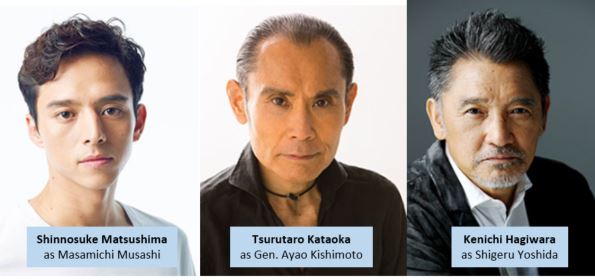
In addition to filming in China, NHK has invested in talent, recruiting some of the biggest names in Japanese television and film. Seiyo Uchino (内野聖陽) will play Paul’s father, Kunio Maruyama, while Yoshino Kimura (木村佳乃) will portray Paul’s mother, Mary Maruyama. Other well known actors like Taizo Harada (原田泰造), Misako Renbutsu (蓮佛美沙子), Shinnosukke Matsushima (満島真之介), Tsurutaro Kataoka (片岡鶴太郎), and Kenichi Hagiwara (萩原健一) fill out the all-star cast.
Prior to a recent trip to Japan, Maruyama made a sortie to Shanghai, China, where he was able to observe filming on a studio lot. A street was re-created to look like a Japanese community in Shenyang, complete with store front signs in Japanese and Chinese, filled with despairing Japanese citizens, and aggressive Russian soldiers. Maruyama, who was in Manchuria with his family at the age of six, took on the scene with wonder and pride, filled with emotion.
“When I see this set and the recreation of streets of Manchuria, the actors, all the extras, the staff, here because of a book I wrote, it’s kind of overwhelming. But I’m happy because we’re able to tell a part of Japanese history that is not well known.”


You must be logged in to post a comment.