The crowds were out on Omotesando to see a repeat of history. Photo by Roy Tomizawa
When Japan Air Self-Defence Force’s acrobat jet team, The Blue Impulse, flew across that beautiful blue sky on October 10, 1964, Japan ooh-ed and ah-ed.
It was a spectacular moment on a spectacular day as Japan welcomed the world to a country, not bowed and backward, but proud and modern.
Victor Warren, a member of the Canadian field hockey team, was on the filed during the 1964 Opening Ceremonies. “I’ll never forget,” he said. “It stuck in my mind – five jets in the air which drew the Olympic rings. It was magic. It was terrific. It was a beautiful start to a beautiful day.”
On July 23rd, a little bit before 1 pm, the organizers hoped to capture that magic again. I made my way to Harajuku, near the entrance to Meiji Shrine. As I got close to the intersection in front of the main train station, the sidewalk got more congested.
Blue Impulse about to ring the sky. Photo by Roy Tomizawa
The place was packed. People filled the overpasses and the sidewalks, looking upwards, hoping to pick up telltale sounds of approaching jet engines. And then suddenly, there they appeared from the north, five jets in formation. Way up high amidst puffy white clouds and a light blue sky, the jets made a couple of passes. Their third time through, they flew in individually, spewing colored smoke.
In 1964, you could see the rings and their colors clearly. But the clouds seemed to get in the way in the 2021 version. People ooh-ed and ah-ed, but in an uncertain way. I could see the rings formed partially, but I never saw five fully formed rings in the sky.
The crowd applauded, politely.
More importantly, there was a crowd. And they were excited to connect to the spirit and energy of 1964.
Just watch this clip from the movie, “Always – Sunset on Third Street ’64.” This scene captures that moment in Japan perfectly.
As the protagonist in the film clip says, “and now, finally, it’s the Olympics!”
(For better pictures of the 2020 sky writing, go here.)
It was Thursday, July 22. I was walking around Ariake in Koto ward, the land-filled man-made part of Tokyo Bay right off of Shinagawa.
I had an appointment at the Villa Fontaine Grande Tokyo Ariake Hotel, so afterwards, I took a walk.
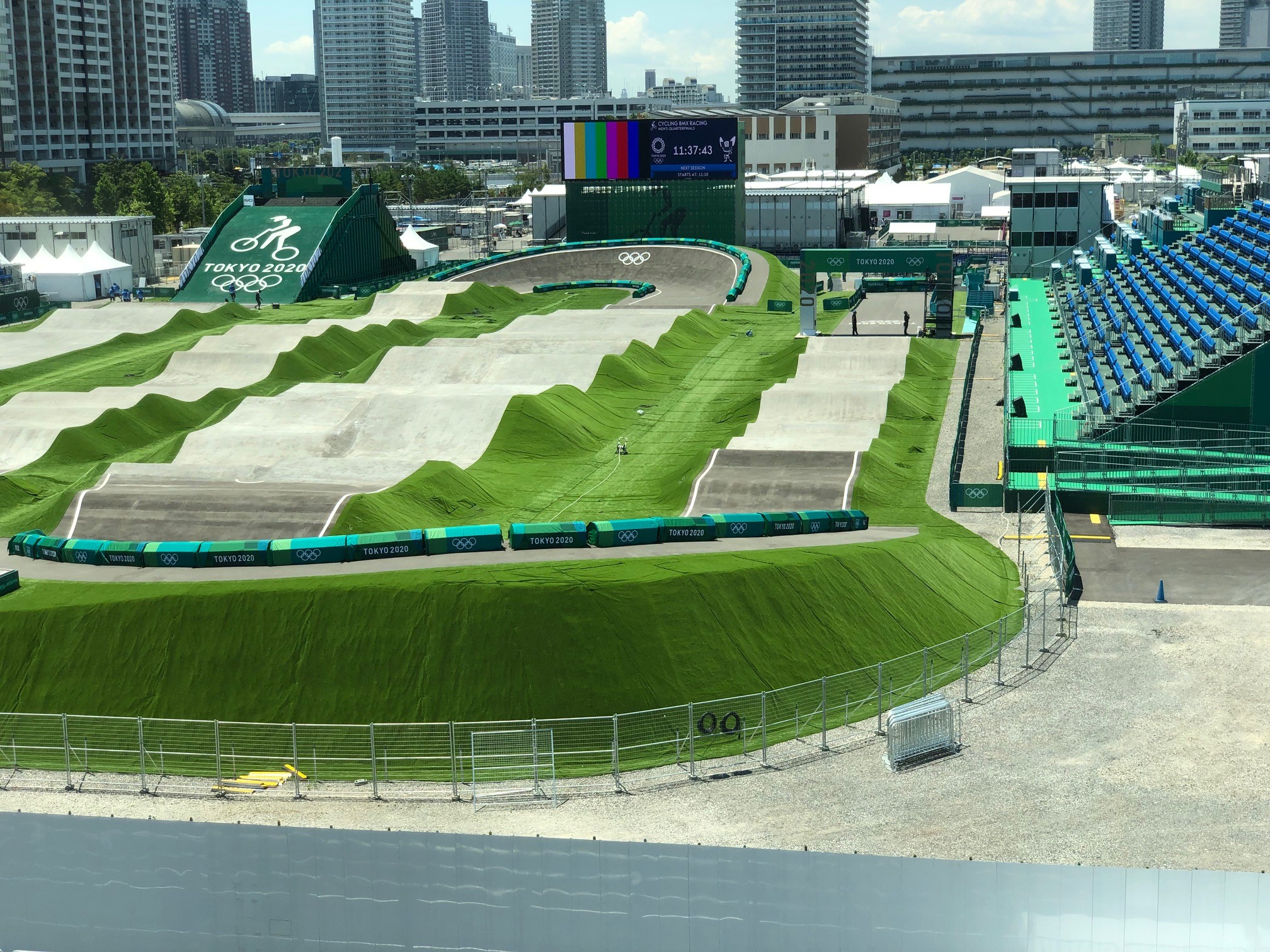
Ariake Urban Sports Park – If you stand inside the Ariake Tennis no Mori Station, you can probably watch BMX racing for free!
Around me were the Ariake Arena where volleyball will be featured, the Ariake Gymnastics Center, the Ariake Urban Sports Park for BMX and skateboarding competitions, and the Ariake Tennis Park.
I was right in the middle of a huge concentration of Olympic arenas. It was the day before the Opening Ceremonies of the XXXII Olympiad. And it felt like I was walking around a ghost town.
Ariake Gymnastics Center
Oh, you could see people walking here and there. But under normal circumstances, I imagine I should have been surrounded by thousands on this day, a public holiday to boot.
Tourists, volunteers, staffers, officials, journalists and athletes from Olympics past should have been wandering around sipping cold Coca Colas, trading pins, and taking selfies.
Sponsors should have had booths or centers to educate, entertain and give out prizes to giggling kids and adults alike. But not during these Olympics. Most sponsors have toned down their affiliation to the Games. Toyota announced only a few days ago that they would not run Tokyo2020-related TV commercials.
No one looking at this great signage….
I passed by the Panasonic Center, a place for tourists to learn about future Panasonic products and ideas. It’s in a prime spot, right on the corner of a park near so much of the action, selected probably just for these Olympic Games.
Except for a picture of Naomi Osaka, you wouldn’t have known that Panasonic was a Global TOP Sponsor of the Olympics and Paralympics.
Panasonic Center – great location, timing however….
Next to the Panasonic Center, floral versions of Miraitowa and Someity, the mascots of the Tokyo2020 Olympics and Paralympics, stood behind fences, looking a little worse for wear these days.
When he arrived in Tokyo on May 1, 2021, he felt fine – ready to compete in the race of his life, to determine whether he was coming back to Tokyo for the Olympics in July. And since his times in the single sculls were good to enough qualify, he felt he had a shot to do well at this Asia and Oceania rowing qualifier, to become the first rower from Saudi Arabia to compete in the Olympics.
But on May 2, he felt a slight pain. “It’s a sore ab,” thought Husein Alireza, so not a worry. But then it was May 5, time to race, and Alireza was in significant pain. The doctor there told him he had a stress fracture of the rib, and he probably shouldn’t race. To Alireza, there was no question – he raced.
And then Husein went back to the UK, where scans revealed his left lung had collapsed during the race and needed to have surgery, in fact fairly invasive lung surgery in early June, with painful post-op recovery. Then began the negotiation with the doctor, who told him he had to rest for two months. Not being able to train for two months would mean no trip to Tokyo, so doctor and patient got it down to 2 weeks.
Husein’s dream to compete in Tokyo was still alive.
As for the question of qualification, he had to wait. Olympic qualification in rowing is a complex process predominantly dependent on the qualifier results, as well as on the boat selection of other nations. The process took about two weeks. Two nail-biting weeks.
Husein’s coach Bill Barry is a veteran rowing coach, a member of the Great Britain coxless four rowing team that took silver at the 1964 Tokyo Olympics. Qualification for Tokyo 2020 would mean Barry would be the first person ever to attend the Olympics in the same city as an athlete and a coach.
Alireza would be the first Olympic rower in his nation – a critical step to increasing the popularity of rowing in not only Saudi Arabia, but across the Middle East where rowing is an unknown sport. After all, the Arabian Desert, 2.3 million square miles of sand, covers almost the entirety of Saudi Arabia. There is plenty of space to play football, but not to row.
So, when the final rankings were confirmed and the phone call came in late May that Alireza had qualified and was going to the Olympics, he realized he was no longer in injury recovery mode, but in training mode.
Bill Barry and Husein Alireza
Every effort had to be made so that he could perform his best at the Olympics. But with the injury, the surgery and the reduced lung capacity, Husein realized that he wouldn’t be able to do his best. He could, however, overcome the challenges and represent, not just to bring meaning to his seemingly endless and exhaustive training, but also to his family and his country.
“Competing at the Olympics would be historic for my country while also honoring my family who’ve done so much for me,” Alireza told me. “It means the world. There is no greater honor than to represent your country on the biggest spectacle of all. It’s a moment I wish I could’ve shared with my late mother, Salma.”
“It’s very exciting being at the forefront of a new sport in the Kingdom,” he continued. “When I went back home last year, we organized an indoor rowing championship. I was pleasantly surprised at the number of youngsters in both genders asking so many questions and showing interest.”
As if to emphasize the impact Husein is having, he recently learned he would be the flag bearer for Team Saudi Arabia during the opening ceremonies of the Tokyo2020 Olympics.
Alireza realizes he has an opportunity to grow a sport not just in Saudi but in the Middle East Region. He knows he must raise funds, which means he has to educate people in the Saudi Olympic Committee and other relevant agencies. The funds are needed firstly to create a place where people can train in Saudi Arabia.
Fortunately, the Saudi Rowing Federation found a narrow strip of water located in a housing development in the northern part of the city Jeddah and is getting approval for its use as a rowing facility. “It’s close to the city, it is a perfect 2k rowing course, and that’s where the center of Saudi rowing will be.”
But first things first. Alireza has to get ready for the Olympics.
Barry said, “you need to understand that rowing is the toughest of all sports. It requires the most training to get aerobic conditioning and strength. People on the rowing team train 11 months of the year, 3 times a day, at least 4 days a week. A typical day might be sculling 16k in a boat, 16k on the rowing machine, one and half hours on weights. That’s a typical day. Scientifically, rowers breathe more oxygen in one minute than in any other sport.”
Alireza broke down how much effort went into that one race – a 2-kilometer sprint which takes a little over 7 minutes. “I rowed 30,000 kilometers,” said Alireza. “Eight hours of training went into every one second of my qualification race, which equals 15 kilometers for every 1 meter. In other words, the race was rehearsed 15,000 times.”
And when you row in a single scull for a country that has no rowing tradition, it is not just painful, it’s lonely, and Alireza wants to make sure that future generations of Saudi rowers feel strength in numbers.
“When I travel to an international race,” he told me. “In front of me I can see the Thai team, or the Japan team, having a great time together. Team spirit and camaraderie is a powerful thing, while I do my warm ups alone in silence envisioning coming back with a Saudi team one day.”
Barry, who is making history himself by being one of the very few to be credentialed for the two Olympics in the same host city (1964 and 2020), understands the importance of Husein Alireza.
“Husein is putting rowing on the map in Saudi Arabia.”
The XXXII Olympiad’s opening ceremony is the evening of Friday, July 23 in Tokyo.
But the Tokyo Olympics actually begin on the morning of Wednesday, July 21, in Fukushima. It’s the women who kick off the Games, when Japan takes on Australia in softball from 9 am (JST) at Azuma Baseball Stadium. In fact, there will be three opening round softball matches in Fukushima on July 21, as well as three more on July 22.
Women’s soccer will also debut on the two days prior to the Opening Ceremonies, with Great Britain taking on Chile in Sapporo, Hokkaido, China battling Brazil in Miyagi, Sweden against the US in Tokyo, and a second match in Hokkaido in the evening, pitting Team Japan against Team Canada.
As Tokyo and neighboring prefectures Chiba, Saitama, Kanagawa, as well as Osaka and Okinawa are under varying forms of a State of Emergency, spectators have been banned from Olympic events in those areas.
Fukushima and Hokkaido prefectures are not in a State of Emergency, but officials there chose to also ban spectators from the softball matches at Azuma Stadium, as well as soccer matches at Sapporo Dome.
As of this writing, however, a limited number of fans will be allowed to attend the football matches in Miyagi Stadium, which is in Rifu, Miyagi. The governor of Miyagi, Yoshihiro Murai, has held steadfast in his desire to have fans in the stands.
The governor cites the fact that on July 24, the women from China and Zambia compete in a soccer match at Miyagi Stadium, while on the same day there will be a warm up match for Team Japan’s men’s baseball team at Rakuten Seimei Park in nearby Sendai, Miyagi, which is scheduled to have about 13,000 fans. (Professional baseball in Japan has allowed limited number of spectators throughout the year.)
Spectators, as of this writing, appear also to be allowed for soccer matches in Ibaragi and cycling events at Izu Velodrome in Shizuoka.
So, if you want to attend a live Olympic event, try to get a ticket to soccer matches at Miyagi Stadium on July 21, 24, 27, 28, 30, or 31, or at Ibaragi Kashima Stadium on July 22, 25, 27, 30, 31, August 2, 3 or 5. Cycling at Izu Velodrome will be from August 2-8.
We all thought – what a party Tokyo2020 is going to be!
When a rugby team can carry the nation on its broad shoulders, what would it be like in Japan during the Olympics, when Japanese stars go for gold in track, tennis, gymnastics, badminton, wrestling, baseball, swimming and many other sports?
In 2019, we were months away from witnessing the greatest Olympics in history.
Tokyo2020 tickets were the hottest in the world. The ticket lottery in Japan was way oversubscribed. As I wrote in December, 2019, “in the latest round of the lottery for Tokyo 2020 Olympic tickets for residents in Japan, there were 23 million requests for tickets….chasing 1 million tickets.”
Volunteer registrations too were oversubscribed. More than 200,000 people applied to be volunteers for Tokyo2020, well over the target of 80,000.
In January of 2020, the Japan Tourism Agency announced that Japan had 31.9 million visitors from overseas in 2019, establishing new record for the 7th year in a row. The government was seeing such explosive growth in foreign tourists that they doubled their 2020 target from 20 million to 40 million in 2016.
The 2019 Rugby World Cup showed the world how impactful sports tourism can be in Japan. This EY Report on the economic impact of RWC2019 explained that 242,000 inbound tourists purchased 28% (approx 490,000) of all tickets in a tournament of 48 matches, all of which were essentially sold out. And they loved their experience in Japan – 75% of visiting foreigners who came to watch rugby replied they “absolutely want to come again.”
In 2019, we were anticipating that Tokyo2020 was going to be the cherry on top, the opportunity for Japan to subtly and outlandishly boast how wonderful a destination Japan is. The organizers were going to have an opportunity to hold up Tokyo2020 as an example of a Games in the mould of 1964 Tokyo or 1992 Barcelona – an Olympics that served the economy, not an economy that served the Olympics.
But then, the Diamond Princess entered the port of Yokohama on February 3, 2020, a daily reality program that introduced Japan to the fear of the unknown virus. On March 11, the NBA season ended suddenly, and Tom Hanks announced he and his wife had COVID-19. And finally, a day after Team Canada and Team Australia announced on March 23 they would not go to Tokyo that July, the Games were postponed for a year.
COVID-19 has upended the lives of billions of people around the world. The angst of whether to hold, postpone or cancel the Tokyo Olympics and Paralympics should never be put on level of the horrible loss so many have experienced during the pandemic.
And yet, I do at moments, quietly lament the current state of the Games.
The debut of Karate in the Budokan! The 4X100 men’s relay finals at the new National Stadium! Men’s and Women’s gold medal round at Saitama Super Arena! I bought those tickets!
Alas and alack, my tickets to those events and many more, disappeared like sand castles in the rain.
On March 9, the Japanese government decided to exclude overseas spectators from attending the Games, but still holding out hope that the infection rates would drop low enough to allow for spectators already in Japan.
Those hopes were dashed on Thursday, July 8. The organizers of Tokyo2020 announced that spectators will not be allowed at Olympic events in Tokyo, after Prime Minister Yoshihide Suga announced a fourth State of Emergency (SOE) from Jul 12 to August 22.
With the number of daily infections trending upwards, Suga said that “we must take stronger steps to prevent another nationwide outbreak.”
There will continue to be debate over the COVID impact of tens of thousands of athletes, support staff and administrators visiting from overseas for the Olympics, to be held from July 23 to August 8. But the Games will go on in empty stadiums and arenas.
Not what we imagined during the euphoria of the 2019 Rugby World Cup. Twelve stadiums across Japan, from Sapporo to Shizuoka, from Osaka to Oita, were packed with enthusiastic fans from Japan and over 240,000 overseas visitors, who spent multiple days and weeks enjoying the 6-week party. Television ratings for the Japan-Scotland match that sent the Brave Blossoms into the Top 8 was an incredible 53.7%. And the news showed video of hundreds of screaming fans in public viewing sites across the country every day.
The 2020 Tokyo Olympics will not be the 2019 Rugby World Cup.
But there is a new hope.
The State of Emergency ends on Sunday, August 22. The opening ceremony of the 2020 Tokyo Paralympics is Tuesday, August 24.
As of today, about 29% of people in Japan have had at least one vaccination dose. That’s 57 million shots. If Japan continues an average of a million per day for another month, the numbers of fully vaccinated will shoot up from its current 19% of the population now.
The growing ratio of the vaccinated, combined with the state of emergency discouraging opportunities for super-spreader events, it’s possible the infection rates drop enough to ease the collective anxiety of Japanese society. it’s possible the mood in August will be different from July. It’s possible, that at the end of the current state of emergency, citizens, corporations and government alike will look for opportunities to take steps toward normalcy.
Who knows? The 2020 Tokyo Paralympics may be kicking off at just the right time. The Paralympics may be the opportunity that fans, both domestic and international, are allowed into the stadiums and arenas. Full capacity at venues may be a stretch, but seeing fans in the new National Stadium will be a welcome sight.
And I have tickets to the opening and closing ceremonies of the Tokyo Paralympics.
These are comments from Toshiya Kakiuchi, the president of Mirairo, a universal design consultancy based in Tokyo, who gave a talk on June 28, 2021 at Mirairo House. Relegated to a wheelchair since elementary school, Kakiuchi started Mirairo at the age of 21 in 2010.
Today, Mirairo provides consulting services to some of the biggest names in the Japanese corporate world, with a strong focus on marketing research relevant to disabled consumers.
When Tokyo won the bid for the 2020 Olympics, a lot changed.
The Tokyo Metro and Toei Subway systems had wheelchair accessible elevators in 70% of all stations in 2014. It is now up to 95.3%. There are now maps available online that provide a lot of details about locations in Tokyo that are or are not barrier free. I can see a lot of TV commercials and programs that feature disabled people.
In 2013, companies didn’t know how to cater to the disabled. We have taught them about universal design. We helped them understand by experiencing what it is like to be disabled. The awareness of the need to be barrier free has grown, and many now realize we need to design products and services without creating barriers.
In some ways, the pandemic has helped improve understanding of the disabled. Because COVID has changed the way we work, I no longer have to apologize for teleworking. But there is a bigger issue. The need for social distance has meant the number of people visible on the streets has decreased significantly, including the disabled. The problem is, the less frequently society sees the disabled out and about, the less society may care about the disabled.
There still a lot to do, but Japan has changed since 2013. People’s attitude towards me has changed. I think that is because of Tokyo’s drive to become barrier free before the start of Tokyo2020.
Mirairo House
Kakiuchi gave these comments on Monday, June 28, 2021 at Mirairo House, an area on the 5th floor of Marui Department Store in Kinshicho, Tokyo managed by Mirairo.
Mirairo House is dedicated to providing space for providers to market products and services to the disabled, and hopefully sparking greater innovation among their business partners.
1964 Olympic gymnast, Shuji Tsurumi, gets ready for his torch lighting. (photos by Roy Tomizawa)
Like so much about this year’s Tokyo2020 run up, the Tokyo2020 torch relay is not a joyous event.
The crowds are small, as required.
The cheering is muted, as required.
But the show goes on, as required.
Compliance is running the show. It’s safe. It’s just not…..fun.
Having said that, it was wonderful to see two-time Olympian, six-time medalist, Shuji Tsurumi, who won 1 gold medal and 3 silver medals in men’s gymnastics for Team Japan at the 1964 Tokyo Olympics!
As has been the case in other prefectures, the running displays on the public roads were cancelled, replaced by “torch kiss” ceremonies, where torch bearers are brought together to have their torch lit by the flame of another. By removing this act from the roads, the organizers can control the number and behavior of the spectators.
On the afternoon of Saturday, July 3, ceremonies were held for torch bearers from Chiba prefecture in Matsudo Central Park, very near Matsudo Station in Chiba . At the 4pm ceremony, Tsurumi was the first person on stage, befitting his legendary Olympic record.
Tsurumi’s torch was lit by a staff member on stage.
Another resident of Chiba, Asako Yanase arrived, and Tsurumi tilted his torch towards the tip of Yanase’s torch in an igniting “kiss.” This was followed by “kisses” to nine other torchbearers, a group photo, and then an exit to ready the stage for another 11 torchbearers.
Spectators were by invitation only, and the overall numbers were limited, so guests could stay as socially distant as they preferred. But the atmosphere was low key, a sign of things to come for the actual Games.
With limited to no spectators expected in a few weeks, the athletes will have to psyche themselves up.
Welcome to Tokyo2020.
The Quiet Games.
Shuji Tsurumi, fittingly with torches from both 2020 and 1964.
The closer we get to the start, the farther we grow apart. Will Tokyo2020 be the Inclusion Games, or the Exclusion Games? Here’s an article I wrote for “Tokyo Updates.”
She was five years old, and she watched the 1984 Los Angeles Olympics with amazement.
Jackie Joyner Kersee! Carl Lewis!
And so Megumi Ikeda thought one day, this little girl from Nanyo, Yamagata in northern Japan would be as fast and as cool as Jackie Joyner-Kersee.
As it turned out, Ikeda (née Harada) simply didn’t have the athletic gifts to excel in track and field. And yet, the flame of high performance can be sparked in unexpected ways. Ikeda would go on to represent Japan at the 2004 Athens Olympics and the Beijing Olympics in individual épée fencing.
Fencing is an old sport, but it is not a money-making sport. People don’t fill arenas around the world to watch fencing, wrestling, weightlifting, curling, hammer throwing, cross-country skiing, or the luge.
But every four years, billions of people watch the Summer and Winter Olympic Games.
Art inspires
Why do so many people watch the Olympics?
So many people watch the Olympics because they become witness to the very best athletes in the world. Human senses are lifted to their keenest. Human physicality is stretched to its limits. Human desire swells up from the deepest recesses of one’s will.
Sport, like painting, singing, dancing, acting and writing is an act of human expression. Like a sculptor in an attic, a rock band in a basement, or actors in a park, kids on the street playing football are expressing themselves.
At the Olympics, sport is art. The Olympics provide highly skilled, highly trained athletes an… (to read more, click on this link.)
Bill Barry and the rower he is coaching, Husein Alireza, the first rower to represent Saudi Arabia in the Olympics, at the 2020 Games.
Bill Barry was back in Tokyo. A silver-medalist for Great Britain in the coxless four rowing competition at the 1964 Tokyo Olympics, Barry flew into Japan as the coach of one of the rowers competing to qualify for Tokyo2020.
Amidst a State of Emergency in Tokyo, around 100 athletes, coaches and staff from 25 countries converged on Tokyo Bay for the Asia and Oceania Olympic and Paralympic Rowing Qualifier, which took place at the Sea Forest Waterway from May 5 to 7, 2021.
Barry was grateful to be here. Chungju, Korea was originally scheduled to host this qualifier in 2020, but they cancelled it with the onset of the COVID-19 pandemic. Shanghai was a possible venue before China declined to host. That’s when the Japanese government stepped in and made the qualifier possible.
“It’s a miracle it took place,” said Barry, was the national rowing coach for Great Britain at the Athens, Beijing and London Olympics. “It was turned down in Korea and China and the Japanese government came to the rescue. That’s fantastic, considering the feelings of concern of the Japanese people.”
Except for a windy Wednesday of “white horse” waves, which forced organizers to postpone the competition one day, the event’s conditions and organization were perfect. “It’s been great,” said Barry, who was coaching Husein Alireza, a rower from Saudi Arabia. “The people have bent over backwards. It’s been incredibly well organized, to the last detail.”
Perhaps unsurprisingly, there was one reported case of a staff person from Sri Lanka who tested positive for COVID on May 5. According to World Rowing, safety protocol kicked in, and other members of the Sri Lanka team were immediately tested.
Members of the Japan Rowing Association medical team treating Husein.
The competitors and related coaches and staff are all a part of an extended bubble that envelops the visitors from airport to hotel to venue to hotel to airport, a smaller scale example of the more complex bubble that will protect the 15,000 plus athletes and para-athletes and support personnel this summer for Tokyo2020.
Barry said that the visiting teams spent three hours at Haneda Airport, going from station to station, answering questions, getting a covid test and filling in forms.
“I gave my address, telephone and email information many times,” said Barry. “They checked everything. Security was super tight. But it’s got to be done and done properly. And it was.”
Barry said they had to download three applications onto their phones, one that was to indicate where you were, and two others where one had to self-report on one’s health, and in Barry’s case, also one to report on the health of one’s team.
From Haneda Airport, the teams were transported in individual buses to the Hearton Hotel on the edge of Tokyo Bay. They were not allowed to leave the hotel except for travel to the rowing venue. Protocol required the wearing of masks and social distance (of course), travel only within teams, one person per hotel room, meals taken alone, and repeated testing.
The only two places these rowers saw: the Hearton Hotel and the rowing venue.
“We were tested when we arrived, the day before a racing event, and when we left,” said Barry. “Since the day my rower was competing was postponed, I had to get tested twice for competitions.”
The morning after the competition ended on May 7, Barry was headed to the airport and home. He was grateful to be back in Japan, and optimistic about Japan’s ability to host the Olympics.
“You wouldn’t think there was a problem,” he said. “Everyone enjoyed it. Everybody praised the organization, the volunteers, the Japanese Government, Japan Rowing Association, they all put on a great show.”
Since Barry could not leave the hotel except for the rowing venue, this is all he saw in his time in Tokyo.
 The crowds were out on Omotesando to see a repeat of history. Photo by Roy Tomizawa
 Blue Impulse about to ring the sky. Photo by Roy Tomizawa


You must be logged in to post a comment.