Go to Rio with the Olympics on 7 App

Images of ordinary people jumping over fences, getting ready for a row on the river, kids in judo gear, elderly people on a swim…oh yes they’re watching something on their mobile phones or tablets…and the song is “I Go to Rio.”

To the average viewer in Australia, it’s just another ad during the Olympic season.

At least that’s what the Australian Olympic Committee (AOC) claimed in court over the past year. The AOC has rights to select local sponsorships which goes to funding the development of athletes in Australia. In 2016, they had signed Optus to a ten-year sponsorship, which replaced Telstra as an official sponsor, known as an “Australian Olympic Team Partner.”

With a sponsor spending millions for a long-term relationship with the AOC and the Olympic brand, the AOC has an obligation to protect against so-called ambush marketing, ads or campaigns that associate with the Olympics even though they did not pay for the rights to do so. The AOC viewed this advertisement as a prime example of ambush marketing, and filed a lawsuit against Telstra when they started broadcasting the commercial just prior to the start of the 2016 Rio Olympics.

Part of the issue was the statement made by the voiceover on the commercial: “This August, for the first time ever, you can watch every event in Rio live with the Olympics on Seven app and Telstra on Australia’s fastest mobile network.” In essence, the AOC saw this as piggybacking off of another official sponsor, Seven West Media, which is the network with rights to broadcast the Olympics.

Additionally, the advertisement ended with the text, “Official Technology Partner of Seven’s Olympic Games Coverage.” According to this article in the Sydney Morning Herald, the lawyer representing the AOC explained that Telstra modified that statement and even added a disclaimer that it was not an official sponsor of the Olympic Games, which I presume means that the AOC is arguing Telstra was aware that the audience might be confused  regarding their relationship to the Olympics.

In the end, the Full Court of the Federal Court put an end to the AOC’s fight against Telstra on October 25, 2017 by ending AOC’s appeal against a judgment of a lower court that found in favor of Telstra. Here is the explanation as provided by the Sydney Morning Herald:

The full court agreed with Federal Court judge Michael Wigney who, in regards to the Telstra-Samsung promotion, found “the only hint that the advertisements related in any way to the Rio Olympic Games is the “I go to Rio” soundtrack.”

 “The primary judge found that this reference does not make the advertisement misleading or deceptive as contended by the AOC. We find no error in that conclusion.

The Full Court also upheld Justice Wigney’s finding that a “reasonable person viewing the advertisements would not necessarily know about or recollect Telstra’s previous sponsorship of the Australian Olympic team, let alone turn his or her mind to that fact when viewing the commercial”.

“As to Seven’s advertisements, he (Justice Wigney) found that they simply confirm that Telstra’s sponsorship arrangement is with Seven. Those findings of fact were open to the primary judge,” Full Court judges Andrew Greenwood, John Nicholas and Stephen Burley found.

Why does this all cause concern to the AOC, and perhaps other NOC’s establishing long-term sponsorships? It’s in the first paragraph of the Sydney Herald article:

What is a multimillion-dollar sponsorship worth if your key competitor can muscle in on your exclusive rights?

Not much according to a recent decision by the Full Court of the Federal Court. 

Long Jump in meters

Whenever I write a story on an American high jumper, long jumper or a discus thrower, I have to go through the painful back-and-forth conversion between feet and meters, inches and centimeters.

It used to be the holy grail in the United States and Britain to run a mile in fewer than four minutes, until Roger Bannister broke it, which broke the mental barrier and allowed others to blast through the four-minute wall. Today, however, no one really cares about the mile, as the standard racing distance is the 1,500 meters, which is a little less than a mile.

Now, track and field in the US has generally gone metric. For example, the USA Outdoor Track and Field Championships hold the same distance running events that other countries do: 100 meters, 800 meters, 5,000 meters, 110 meter hurdles etc. In fact, the organization, USA Track and Field, adopted distances using the metric system in 1974.

They were ahead of their time apparently, because in 1975, the US Congress passed an act that states preference for the metric system of weights and measures, which was followed by an executive order from President Gerald Ford. Essentially, the entire world had already adopted the metric system. Politicians and businessmen alike wanted the US to get with the international game plan. However, for some reason, probably related to a tremendous resistance to change, the act and the order were watered down by stating that adoption was voluntary.

What was this resistance? Listen to this fantastic podcast on design, 99 Percent Invisible, and their story on America’s implementation of the metric system, titled “Half Measures.” History professor, Stephen Mihm is quoted as saying in the podcast that interestingly, uncommon bedfellows united to resist –  astronomers, theologians and industrial engineers:

But abandoning the U.S. customary system did not sit well with a lot of people, including an influential group of “astronomers, theologians, and cranks,” Mihm explains. “And keep in mind that those categories which we consider separate and distinct today were not at this time.” This group spun together scientific arguments with other wild and nonsensical ideas, and developed a theory that to abandon the inch was to go against God’s will. Converting to metric, they argued, would be tantamount to sacrilege.

But the real core resistance to metrication came from a different group entirely: some of the most innovative industrialists of their day. Engineers who worked in the vast machine tool industry had built up enormous factories that included everything from lathes to devices for cutting screw threads — and all of these machines were designed around the inch. The manufacturers argued that retooling their machines for a new measurement system would be prohibitively expensive. They also argued there was an “intuitiveness” to the customary system that made it ideal for shop work.

Imperial Metric Conversion for cooking
Imperial – Metric Conversion for Cooking

This reluctance to fully shifting to the metric system can result in engineering miscalculations, sometimes with tragic or costly consequences:

  • In 1983, an Air Canada Flight ran out of fuel mid-flight because the ground crew and the flight crew all calculated fuel requirements in pounds instead of liters, granted this mistake happened just after the Canadian government required conversion to the metric system. Fortunately, the pilots managed an incredible “dead-stick” landing, gliding safely to a nearby airstrip.
  • In 1999, NASA lost a $125 million Mars Climate Orbiter spacecraft because engineers in Lockheed Martin calculated thruster data in pounds to NASA while NASA engineers were making their calculations in metric units called “newtons.”
  • In 2003, a car on the Space Mountain roller coaster ride at Tokyo Disneyland derailed due to a broken axle, resulting in the injury of 12. Apparently, new axle parts ordered in 2002 were measured in inches as opposed to millimeters, making the new axles off spec.

In the end, there are bigger issues than the momentary confusion of trying to know how far 5,000 meters is in feet or miles. And to be fair, American institutions have gradually adopted the metric system due to its partnerships and obligations internationally.

And yet, the fact that America still clings officially to inches, quarts and Fahrenheit can be a pain. Don’t we know that we are shooting ourselves in the 20.48 centimeter (aka foot)?

Nat Geo_The Albion jazz cabaret
Mirror reflects the gaudy glare of a subterranean café on the Ginza. The Albion, a favorite of foreign visitors, features frantic jazz blared over loudspeakers, with house lights that blink eerily to the rhythm. Waitresses in white-satin toreador pants dance, rather than walk, about their chores.

This is part three exploring the words of William Graves, and photos of Winfield Parks, staff of the monthly magazine National Geographic. Graves and Parks spent weeks, if not months in Japan, uncovering the insight that would make Japan in 1964 comprehensible to the West.

In the pictures in this post, Graves and Parks try to help us understand the “leisure boom” of the times, and to show us how Tokyoites played. As (the predominantly male) Western journalists at the time often did, they focused on the night life. Graves tracked down a woman named Reiko, who worked as a hostess at a nightclub called Hanabasha.

In Tokyo nightclub slang, Reiko is what is known as a toranshista garu – “transistor girl” – one who, as the name suggests, is small, compact, and full of energy.

The dance floor resembled the platform at Shinjuku Station in rush hour, so Reikko and I settled for a napkin-sized table in a corner. We talked of Tokyo’s reija boomu – the “leisure boom” – and the city’s fantastic wealth.

“This year, most richest one,” Reiko began. “Japanese call this Year of Tatsu – Year of Dragon. Dragon stand for rich.”

NatGeo_asakusa
Tokyo at play invades Asakusa, a vast neon-trimmed amusement and shopping district that rivals the famed Ginza. Stalls sell everything from cameras to Buddhist funerary images. Advertisement beneath a merchant’s shop sign offers bargains in suits.
Nat Geo_Shichi Go San Cafe Asakusa
Stately chorus line strikes a graceful pose of Shichi-go-san Café in the Asakusa amusement district. Low-priced restaurants in this area serve as an inexpensive substitute for geisha houses, where dinner, rice wine, classical dancing, and song can cost $100 a person. These dancers, who double as waitresses, perform beneath a canopy of artificial maple leaves.
Nat Geo_driving range
Head down, spike heels set, a lunch-hour golfer tees off at the three level driving range in downtown Shiba Park. Tokyo’s fastest-growing sport, gorufu counts fanatics among corporation presidents and salesgirls. Post-war American influence on women extends far beyond fashions and golf links. From voteless status before 1947, Japanese women have risen to fill presidencies of colleges, cabinet posts, and seats in the Diet.
Nat Geo_kids playing in park
Breathtaking leap lifts a Tokyo schoolgirl twice her height on Japan’s high-flying version of the seesaw. Instead of straddling a plank, young enthusiasts grasp the bars and soar in standing position. Like many Japanese, these pupils enjoy freedom from prewar uniforms and taboos against coeducation.
Nat Geo_playing ball on the docks
Start of a mighty swing promises a hit in a dock workers’ lunch-hour game. During spring and summer, noon whistles signal pick-up games in parks, dead-end streets, and eve on rooftops.

Nat Geo_shipbuilder

This is part two of a series on the October 1964 National geographic article called “Tokyo The Peaceful Explosion,” a fascinating portrait of Tokyo on the eve of the 1964 Tokyo Olympics. Staff writer, William Graves, and staff cameraman Winfield Parks provide a mosaic of life in the most populated city in the world at the time.

Change in Japan was fast and furious. In a conversation between Graves and an economist and editor for NHK, Hiroshi Narita (whom Graves calls “Nick”), they try to understand the secret of the emerging Japanese miracle.

I mentioned what everyone notices first about Tokyo – its fantastic prosperity. Shop windows were full, crowds on the streets were handsomely dressed, and thousands on thousands of sleek Japanese cars choked the streets. Nick nodded happily.

“Even to Americans, the figures are staggering,” he said. “In construction, Tokyo starts 800 major new buildings a year, more than two a day. The city’s – and Japan’s – economic growth rate runs about 10 percent a year, the highest in the world. In 1959 the rate rose to almost 18 percent; now people are talking about the recession.” He smiled.

“We have a stock market, too, and it’s doing just what yours is. Since 1949, for example, a share of Canon Camera Company stock has multiplied 865 times in value.”

“What’s behind it all?” I asked, trapping an elusive piece of shrimp with a chopstick.

“We are,” Nick said simply. “The Japanese people. You’ll get other answers – postwar aid, protective tariffs, new markets in Asia, and all of these things have helped. But basically the boom is built on Japanese brains, skill, and fantastic energy.”

Nat Geo_car factory
America-bound, a gleaming new truck rolls through the assembly line of the Nissan Motor Company automotive works between Tokyo and Yokohama. Of more than a million Japanese cars and trucks produced yearly, Nissan makes one in five. Bright-red paint brands this vehicle an export; japan reserves the color for its fire engines.
Nat Geo_electronics factory
Miniature television undergoes inspection at Sony Corporation, Tokyo’s astronomically successful postwar electronics manufacture. With 15 million sets in operation, Japan ranks second only to the United States in television ownership.
Nat Geo_railway construction
Sparks from a welder’s torch shower a streetcar track. To spare daytime traffic, repair crews work from dusk to dawn.
Nat Geo_fish market
Shed-full of tuna, fresh from the sea, awaits purchasers at the dockside Central Wholesale Market in Tokyo. An immense distribution center, the market handles 1,800 tons of fish and 3,300 tons of vegetable every day. To examine fish quality in the shed’s gloom, buyers wield flashlights, their badges of office.
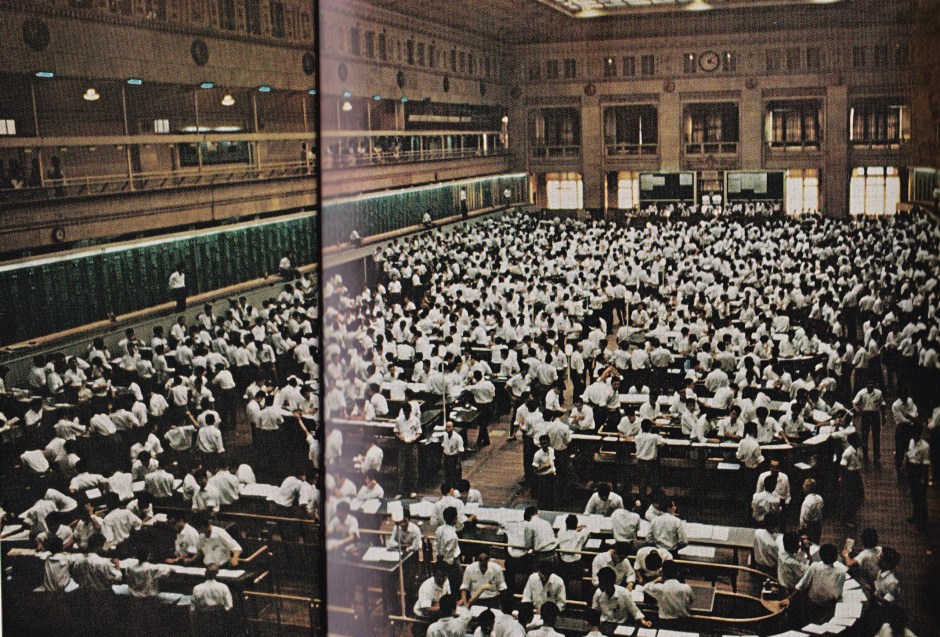
Nat Geo_Tokyo Stock Exhcange
Wall-to-wall carpet of white shirts hides the floor of Tokyo’s Stock Exchange, barometer of Japan’s explosive postwar growth. Some stocks sell for 800 times their 1950 values.
Nat Geo_city official
Shoji Koyama headed the Tokyo Metropolitan Assembly in 1963 sharing administration of the capital with a governor, Ryotaro Azuma. Portraits of past Assembly presidents line a wall of his chamber in the Metropolitan Government Office. Mr. Koyama now serves in the Diet, Japan’s national legislature. Though it includes almost 11 percent of Japan’s population, Tokyo until recently had less than 5 percent representation in the Diet. A revision in apportionment laws has raised the percentage to 7.
NatGeo_crowded train
“Sumimasen – very sorry….” Railway guards in a Tokyo station pack rush-hour cars to bursting with hapless commuters. Skyrocketing population threatens to cripple the Japanese capital; even now its 10,500,000 residents make it the world’s largest city. Long-suffering Tokyoites joke grimly about their city’s “crush hour.” Miraculously, scenes such as this morning jam a the Shinjuku Station produce few injuries.

Tokyo is not a city. Tokyo…is an explosion.

The crowds, the traffic, the lights, the smog, the noise, the peace, the plenty, the interplay of East and West, the exotic…. William Graves, staff writer for the monthly magazine, National Geographic, stayed in Tokyo for weeks if not months with cameraman Winfield Parks in an attempt to paint a picture of Tokyo in 1964 with words and photos.

Tokyo is not easy to love at first sight. In daylight, from the air, it resembles an enormous coffee stain, blotting the green velvet of the surrounding farm country. Seen from the ground, it lies blurred under layers of smog – a city wrapped in soiled cotton wood.

At night, however, Tokyo bursts through its somber wrapping. Then the city is aflame with neon, its low hills pulsing like great beds of coals, with crimsons, lavenders, greens, and golds of flashing electric signs announcing nightclubs, coffee bars, truck tires, television sets, cameras – everything that Tokyo owns or makes in some 57,000 factories.

Here are a few of the pictures and words from that National Geographic article, a portrait of an explosion.

Nat Geo_young women in red
Gone are wooden clogs and traditional kimono. Among Japanese young women, high heels and chic-knee-length dresses are everyday attire. Tokyo’s huge Ginza department stores tempt shoppers with top European designs. Copies in inexpensive Japanese cottons and rayons have all but driven classic styles from sight. Young Tokyo saves the conservative kimono and sashlike obi for ceremonial days or family occasions. Sign beneath American fashion magazines advertises a gift shop called “Yours.”
Nat Geo_smoggy Tokyo Harbor
Curtain of smog over Tokyo Harbor gives a coppery cast to the waterfront, one of many centers for the Japanese shipbuilding industry, now the world’s largest. Desperate for living space, Tokyo dumps its fresh trash into the bay and covers it with soil to create new land.
Nat Geo_danchi
Like immense cinder blocks, low-cost apartment houses rise amid factories and oil-storage tanks. Danchi, as Tokyoites call the developments, ease the crushing pressure of Tokyo’s housing shortage. Families with moderate incomes may rent a bedroom, kitchen, and living room for $20 a month.
Nat Geo_the home
Husband enjoys his ease, just as his father did, while wife clears the dishes I their three-room apato. Tokyoites call them and their neighbors danchi zoku – “apartment-house tribe.”
Nat Geo_traffic
Grill-to-bumper flood chokes a Tokyo street. During rush hours it may take half an hour to negotiate a downtown block. Beginners’ tests are strict but, once licensed, drivers develop an individual style. A sharp horn blast signifies, “Look out! I am about to do something extraordinary.”


Nat Geo_cars vs people
Evasive Action lifts a pedestrian clear of the pavement in his dash for safety. Tokyo traffic – dodging risks are high: on the city’s streets, a thousand die in a year.
Nuzman under arrest
A grim-faced Carlos Nuzman left his home wearing a dark business suit in the Rio heat as he was escorted by police. (Source: AP)

He was a member of the Brazilian men’s volleyball team at the 1964 Tokyo Olympics.

After serving as the head of the Brazilian Volleyball Confederation, he was selected as the president of the Brazilian Olympic Committee and a member of the International Olympic Committee (IOC).

And in his role as head of the Rio de Janeiro Organizing Committee, he led the bid process that resulted in the selection of Rio de Janeiro for the XXXI Olympics in 2016.

But today, Carlos Nuzman is a man under arrest on bribery and fraud charges. A French investigation into the activities of former IAAF head and IOC member, Lamine Diack, who is under detention in France, have uncovered evidence that indicates vote buying during the bid process for the 2016 Games.

The Daily Mail cites the Brazilian press stating “Nuzman is accused of being the link between Brazilian businessman Arthur Cesar de Menezes Soares Fiho, nicknamed ‘King Arthur’, and Diack for bribes to African IOC members ahead of the 2009 vote which awarded the Games to the South American city.”

In early September, it was reported by AP that Brazilian authorities searched Nuzman’s house, uncovering $150,000 in cash in five different currencies, as well as three passports: a Brazilian, Russian and a diplomatic passport. According to this more recent AP report, Nuzman “amended his tax declaration to add about $600,000 in income, according to the arrest order,” and that “in Nuzman’s last 10 years as Brazilian Olympic Committee president, his net worth increased 457 percent, according to invLamine Diackestigators.”

Following Nuzman’s arrest, the IOC suspended him from his honorary membership in the IOC, and has been released from duties in the IOC coordination commission overseeing preparations for the 2020 Tokyo Olympics, according to the Daily Mail. Not only has Nuzman been impacted, the IOC has suspended the Brazilian Olympic Committee, frozen that organization’s funds, and will not allow it to vote on Olympic matters.

IOC Vice President John Coates and President of Tokyo 2020 Olympic and Paralympic organising committee Yoshiro Mori attend a news conference in Tokyo
International Olympic Committee (IOC) Vice President John Coates (L) and President of the Tokyo 2020 Olympic and Paralympic organizing committee Yoshiro Mori attend a news conference in Tokyo on Wednesday. Photo: REUTERS

The budget for the 2020 Tokyo Olympics ballooned from $7.5 billion, presented during the bid process in 2013, to $30 billion a few years later.

Conscious of the distaste the citizens of most major cities have for holding an Olympic Games, the International Olympic Committee has been working hard to get the Tokyo Olympic Organizing Committee to slash the budget. Currently it stands around $12 billion. But John Coates, who is the head of the IOC’s Coordination Commission for the 2020 Tokyo Olympics, wants to get the number down further.

“That’s the target that we think should be achievable not just by Tokyo but by all summer organizing committees,” said Coates, referring to the new goal of $11 billion. “What we are trying to do is create a situation where there is no strain on the public purse.”

A likely target of the budget knife is the Olympic Village, where Coates believes that the level of service can be diminished enough to reduce the budget significantly.

For example, The Washington Post said Coates gave an example of “shortening the length of time athletes are allowed to stay,” or to make beds transferrable, “which would mean shuffling athletes or team staff out early to make room for those who might be competing later in the Games.”

Another example, explained in Japan Today, is cutting staff for the Olympic family lounges, which according to Coates, operate at only 40% capacity on average.

However, Rich Perelman, editor of the Sports Examiner calls Coates out on the challenge of trying to nickle-and-dime down the costs of the Olympic Village by focusing on service. He points to the fact that the number of athletes have risen every Olympics since 2004. The Rio Olympics hosted 11,238 athletes, well over the 10,500 recommended in the Olympic Charter.

The 2020 Tokyo Olympics are expected to have a higher count. And while there are hints that the IOC wants the various national olympic committees to cut the number of participating athletes and officials, Perelman points out that the IOC is contributing to the increased headcount by encouraging the introduction of new sports, like surfing, sport climbing and skateboarding.

The IOC and the Tokyo 2020 organizers are further complicit in exacerbating the costs for the coming Games by adding – unnecessarily – five sports, 18 events and 474 more athletes (not to mention support staff – to the Games program because the events will supposedly “appeal to youth.”

Fuji Film 6_Sakai lights the cauldron

This is part two highlighting the powerful black and white photos of the opening day ceremonies of the 1964 Tokyo Olympics, 53 years ago yesterday. The photo above, from this series compiled by Fuji Film, captured one of the most dramatic moments of the Tokyo Games.

The sacred flame that lit the Olympic cauldron, which burned for the 16 days of the Tokyo Olympics, was initially lit 51 days earlier on August 21 in Olympia, Greece. The flame then travelled through 12 countries in Eurasia, including Turkey, Lebanon, Iran Thailand, Malaysia and Taiwan, before landing in Japan. The flame was distributed to four torches, which then made their way through all prefectures in Japan. The four flames came together in Tokyo and the final torch bearer was Yoshinori Sakai, a university runner selected because he happened to be born on August 6, 1945 in Hiroshima, the day the world entered the nuclear war age.

Fuji Film 7_Takashi Ono delivers Olympic oath

After the Olympic cauldron was lit, the flag bearers of the 93 nations formed a semi-circle around the lectern, where Japanese gymnast Takashi Ono, stood. Ono, a veteran participating in his fourth Olympics, who accumulated 5 golds and 13 total medals since the 1952 Helsinki Games, delivered the athlete’s oath.

In the name of all competitors, I promise that we shall take part in these Olympic Games, respecting and abiding by the rules that govern them, in the true spirit of sportsmanship, for the glory of sport and the honor of our teams.

Fuji Film 8_Ten thousand pigeons released

After the oath, 8,000 pigeons were released. I’m sure it was a spectacular image on television and in the newspapers and magazines, but it was a bit of an annoyance to athletes and spectator alike who tried and failed to dodge the guano bombs of the birds who were probably less than thrilled with being cooped up in cages and then suddenly released into the air above the stadium. One athlete told me that the water pressure in the Olympic Village dropped drastically as everyone showered at the same time to rid themselves of their unwanted opening day souvenir.

October 10, 1964. In the annals of 20th century Japanese history, it was truly a day to remember.

Fuji Film 10_Aerial view of the National Stadium

Fuji Film 1_Hoisting of the 97 participating nations' flags

It was minutes before the commencement of the 1964 Tokyo Olympics, the flags of 93 nations rising into a clear blue sky. The above photo was snapped and compiled into a set of photos by Fuji Film commemorating the XVIII Olympiad’s opening ceremony, which began at 2pm on Saturday, October 10, 1964, 53 years ago today.

Fuji Film 2_Japanese Delegation Entering the Stadium

The athletes would have to deal with cold and wet conditions for much of the Tokyo Olympics, but that day, the 5,500 athletes marched into the National Stadium under perfect conditions. As tradition has it, the host nation’s team marches into the Stadium last. Expectations were high for Team Japan, with a goal set of 15 gold medals. They actually achieved 16, third best after the US and USSR.

Fuji Film 3_IOC President Avery Brundage's Welcome

The President of the Organizing Committee for the Games, Daigoro Yasukawa, can be seen above introducing the International Olympic Committee President, Avery Brundage. In the official report which offered a post mortem of the Games from an operational perspective, Yasukawa expresses gratitude to the people of Japan.

…it was because Japanese in all walks and interests of life worked together in close and harmonious cooperation—all with one basic goal—that these Games might be an unqualified success. This spirit permeated into the Organizing Committee, and was to be found also in the sports associations and the many cooperating organizations involved. This surely is the only factor that enabled success in our organization efforts.

Fuji Film 4_Emperor Hirohito opens the Games

At the end of the Second World War, in the aftermath of the Hiroshima and Nagasaki bombings, the Emperor’s voice was heard over the radio for the first time by his Japanese subjects. The Emperor asked his people to surrender, to “bear the unbearable, and endure the unendurable.” Nineteen years later, the Emperor is presiding over the Olympics, an event symbolizing peace and unity, in a city that was unrecognizable from its bombed-out shell in 1945. As noticed in this Japan Times article, the scene depicted in this photo may have been striking to many Japanese as the only person standing in the stadium was the Emperor – a role reversal of sorts in a very different time.

Fuji Film 5_Hoisting of the Olympic Flag

After the Emperor declared the XVIII Olympiad open, the Olympic Flag was brought into the stadium by Japanese self-defense forces, the embroidered satin flag initially brought in by the Mayor of Rome, the site of the XVII Olympiad. The flag was raised exactly 15.21 meters into the air. That was the distance Mikio Oda hopped, skipped and jumped to win the gold medal in the triple jump at the 1928 Amsterdam Olympics, Japan’s first ever gold medal.

Opening Ceremonies Ticket_front

Imagine it’s October 9, 1964 and you have this ticket to the Opening Ceremonies of the 1964 Tokyo Olympics on the next day. 

This is the day over 5,000 athletes and the entire population of Japan has been waiting for – the start of a new Japan.

And by the looks of it, your ticket is in a prime location – Q-57, 5 UPP. I’m not 100% sure where that seat is on the map provided on the back of the ticket, but my guess is the area I highlighted in blue.

Opening day

If it is indeed that section, you are in an honored section. Since the design of this ticket is different from the tickets generally sold, these may be for special guests, as indicated by the word “SPECIAL” written on the ticket’s map.

Special perhaps because in 5 UPP, Q-57, you will be seated very near the center of the stadium, almost directly opposite the Olympic cauldron, where a teenager from Hiroshima, born on the day an atomic bomb was dropped on his city, would climb the steps and light the Olympic flame.

Less than 50 meters in front and below you will be seated Emperor Hirohito, who will launch the Games.

And thousands of the world’s best athletes will march into the stadium by your seat, as if they are marching for you.

Don’t lose that ticket. It’s going to be quite a show.