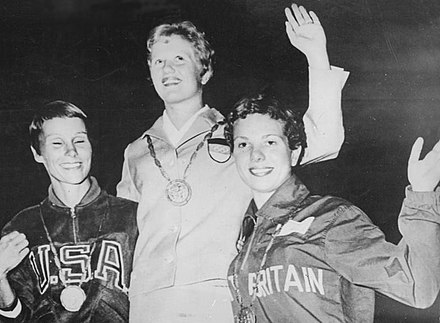
paula-jean-myers-ingrid-kraemer-and-elizabeth-ferris-in-rome
Paula Jean Myers, Ingrid Kraemer and Elizabeth Ferris in Rome springboard finalists

She started diving off a low board at the age of five, even before she knew how to swim. Starting from the age of eleven, she would join her friends at the Dresden diving club a few times a week and stay there until the early evening. Those were the early days of young Ingrid Engel-Krämer, who would unexpectedly become one of the stars of the 1960 Rome Olympics, winning gold in both the women’s 3-meter springboard and 10-meter platform diving competitions.

David Maraniss, in his seminal book Rome 1960: The Olympics That Changed the World, profiled Engel-Krämer, explaining that at the time, Americans were the dominant force in diving. In fact, until Engel-Krämer broke the streaks, women from Team USA had taken both gold and silver in the previous seven summer Olympics in the 10-meter platform, and gold in the previous 8 Olympiads in the 3-meter springboard.

In the springboard, Engel-Krämer was a runaway train, showing off a precision in her technique that she would become renown for. As Maraniss noted in a Die Welt article, she was so far ahead in the springboard that “she could have jumped into the water with only a little grace in the last round, and she would have won the gold medal.”

Could this wunderkind repeat in the 10-meter platform? Paula Jean Myers-Pope was confident that she would win back American glory in diving. And while the springboard event was a cakewalk for Engel-Krämer, the platform competition was a gritty end-to-end battle. As Maraniss explained, it came down to the final dives for both.

ingrid-engel-kraemer-rome-1960
Enjoying Rome.

Both Engel-Krämer’s and Myers-Pope’s dives were, as I understand it, similar – a backward flip followed by two-and-a-half somersaults. Myers-Pope apparently hit the water with more splash than Engel-Krämer, who entered the water, as Maraniss describes, with a “quiet snap into the blue pool”. Additionally, the judges felt that Engel-Krämer’s dive had a higher degree of difficulty, which brought protests from the US. But in the end, Engel-Krämer earned her second gold medal, and not by a small margin.

There was a time when little Ingrid was scared to ascend the tower, fearful of the fall and the pain. In fact, her skin was considered somewhat sensitive to the impact on the water. Her father crafted special vests made of rubber foam to protect her back and stomach. “I wasn’t courageous at all,” she was quoted as saying. “I had to work hard on it and only bit by bit managed to overcome it.” Even in Rome, according to Maraniss, it was the fear of pain that drove her to focus her thoughts on how to dive perfectly to minimize the impact of the water on her skin.

But in Rome in 1960, Engel-Krämer was the blonde sensation, the teenager who broke the American stranglehold on diving, and as the Western press referred to her as, the Dresden Doll.


ten-foot-tower_nyt
Could you stare into the abyss from 10 meters above, and leap? This video from the New York Times shows that the average person could not. (Click on the image.)
pat-hickey
Pat Hickey

I suppose selling tea wasn’t quite doing it for Minoru Ikeda. This enterprising tea dealer from Utsunomiya, Tochigi was indicted during the 1964 Tokyo Olympics for scalping tickets, according to The Japan Times of October 20, 1964.

Ikeda bought the tickets fair and square, 60 through his local Japan Travel Bureau office and through direct mail orders to the Tokyo Olympic Committee. Apparently he pulled in a cool JPY150,000 in profit, re-selling four third -lass track and field tickets for the outrageous price of JPY10,000 each. I actually have a third-class ticket from those Games, and it states the price is JPY1,000. According to the article, Ikeda sold 52 more tickets for another JPY200,000.

But that pales in comparison to the reports that came out of the 2016 Rio Olympics when a senior member of the International Olympic Committee, Pat Hickey, was arrested on August 17, 2016, for ticket touting, or scalping.

Hickey was imprisoned for 11 days in Bangu Prison, and was released, primarily due to the fact that he was a 71-year-old in poor health, and his passport had been taken away. After about 4 months in Brazil, Hickey was allowed to return to Ireland, no longer the head of the Olympic Council of Ireland (OCI), a position he had resigned soon after his arrest.

scalping
The Japan Times, October 20, 1964.

Hickey had been the head of the OCI since 1989 and had apparently ruled Irish Olympics with a firm hand. And as an executive board member of the IOC, Hickey received such benefits as a USD900 per diem during Olympic Games. But that apparently wasn’t enough. Since Hickey apparently he collaborated with the organizations that was responsible for the selling of Olympic tickets in Ireland, he and Kevin Mallon (another person arrested in Rio), had access to the most valuable tickets at the Rio Games, the opening and closing ceremonies.

According to The Guardian, police seized over a thousand such tickets, which would could be sold at exorbitant prices. The article claims that Mallon’s company, THG, was looking to pull in a profit of USD10 million. That is definitely an improvement on JPY200,000, even accounting for inflation!

Hickey, who asserts his innocence in the charges, is awaiting the start of court deliberations on his case in Rio. If found guilty he could face prison time.

president-trump-signing-executive-order
U.S. President Donald Trump (C) signs an Executive Order establishing extreme vetting of people coming to the United States after attending a swearing-in ceremony for Defense Secretary James Mattis (R). Reuters/Carlos Barria
When the IOC formed a team of refugee athletes to compete at the Rio Olympics, to highlight the plight of stateless people globally, it was an act for which the IOC was rightfully praised. Through its existence, the modern-day Olympics have symbolized and strived to model tolerance and inclusion.

In recent history, countries that have enforced state-sponsored discrimination have been banned from participating in the Olympic Games. South Africa was banned from the 1964 Tokyo Olympics due to its apartheid laws, and was not allowed back until apartheid ended, re-entering the Games at the 1992 Barcelona Games.

Indonesia was suspended from the IOC, prior to the 1964 Tokyo Olympics. The Asian Games were hosted in Jakarta, Indonesia in 1962, and then-president Sukarno refused entry of athletes from Israel and Taiwan. IOC president Avery Brundage insisted that the Olympics were an opportunity to bring all nations’ athletes together, not split them apart, and so suspended Indonesia from the IOC.

Sukarno responded by creating an alternative sports tournament called The Games of the New Emerging Forces (GANEFO), which of course, did not include athletes from Israel and Taiwan. The IOC then banned any athletes who competed at the GANEFO games from participating at the 1964 Tokyo Olympics. Unwilling to pull their GANEFO athletes, both Indonesia and North Korea boycotted the Games.

As we have heard recently, President Donald Trump has made entry to America off limits to citizens from seven countries: Iran, Iraq, Libya, Somalia, Sudan, Syria and Yemen – Muslim countries all. The American government is stating that protecting its borders is vitally important to its security, and inferring that anyone who is a Muslim, particularly from those seven countries, are potential terrorists.

To me, this executive order runs contrary to the spirit of the Olympics. And while this may be a low rung on the totem pole of priorities related to immigration and national security, I wonder if the Los Angeles bid for the 2024 Olympics is at risk. Will President Trump’s ban, and his rhetoric of America first put a damper on IOC members’ enthusiasm for an Olympics in a country where tolerance and inclusion become lesser values?

I think that is a possibility.

emil-zatopek-in-pain
“He runs like a man who has just been stabbed in the heart.”

It sounds too good be true – Hollywood script perfect.

The balding veteran, past his prime, and yet a threat in the back of the minds of the favorites, gets himself ready at the starting line of the marathon. This wasn’t Finland. It is Australia, where it is 30 degrees celsius, a good dozen degrees hotter, and where Emil Zátopek won the marathon to cap an unprecedented sweep of golds in the 5k, 10k and marathon at the 1952 Olympics.

Like a weary warrior, about to lead his troops, one more time into the breach, he is said to have uttered these famous words to his fellow competitors: “Men, today we die a little.”

According to Richard Askwith, author of a brilliant biography of Zátopek , it is unclear if Zátopek said these words at that moment, but based on his deep understanding of the man, he believes he could have said them. “It is hard to think of a neater encapsulation of his spirit: his cheerful camaraderie; his dry humour; and his slightly bonkers bravado in the face of the agonies of his sport. It was also, in context, a starkly accurate prognosis.”

When Zátopek finished the marathon in sixth place, his Olympic career was over. At the age of 34, Zátopek , who over three Olympiads since 1948, became perhaps the most famous athlete in the world, and a beloved hero in his home country of Czechoslovakia. And while one marathon finished, another one would begin.

The Cold War in Europe was reaching frigid temperatures. Just prior to the 1956 Melbourne Games, the Soviet Union had sent troops into Budapest, Hungary to quell an uprising. Twelve years later, Soviet troops would enter Prague, Czechoslovakia for similar reasons. As described in my previous post on Zatopek, the folk hero of Czechoslovakia, when the tanks entered the Czech capital, was at the center of the invasion, shouting in protest for all to see, moving from tank to tank in an attempt to talk sense (in Russian) into the Soviet soldiers. While Zatopek had no noticeable impact on the Soviet presence, his own role in these protests were noticed by the authorities.

With the reformist government in Czechoslovakia brought to heel, and a Soviet-friendly regime in place, Zátopek’s life was turned upside down. Due to his legendary status, he was not sent to a labor prison, nor did he end up deceased. Instead, he found himself out of a job, no longer a member of the Czechoslovakian Army or the Communist Party. He was, as Askwith explained in this synopsis of his book, Today We Die a Little!: The Inimitable Emil Zátopek, the Greatest Olympic Runner of All Time, a pariah. He could not find work easily. His name was scrubbed from the history books, his many sporting accomplishments – a source of immense pride to Czech leaders and citizens alike up to that time – only to be uttered in whispers.

While Zátopek was one of the most beloved personalities in sports the world over, in Czechoslovakia, friends and relatives were reluctant to go near him. The only work he could find tended to be isolated and hard, which likely caused Zatopek to drink heavily. His marriage suffered and he aged quickly. As Askwith poignantly shows in the synopsis article, he had lost his joie de vivre.

Once, near the village of Lytomysl, a local woman sent her son to present him with a small gift, a piece of smoked meat. The boy was shocked by the disheveled figure who opened the maringotka door. “I am not the Zátopek you used to know,” confessed Emil, bottle in hand.

But like a marathon, eventually over time, you get closer to the goal you long for. Zátopek endured a public shunning and an unofficial banishment to the hinterlands for some five years. But he was not forgotten outside Czechoslovakia. When the Summer Olympics were to be held in Munich in 1972, Zátopek was invited. When the foreman of his mining team refused to allow Zátopek leave for three weeks to be the guest of honor of the world’s greatest sporting fest, back-channel discussions went into hyperdrive, and finally Zátopek was allowed to leave the country and be celebrated in Germany.

emil-zatopek-funeral
The funeral of Emil Zatopek

A year later, Zátopek was invited to attend the funeral of famed Finnish runner, Pavel Nurmi. His quick and uneventful visit to Finland, coupled with a sudden flow of requests to have Zátopek be a guest of honor at this meet or that, made Czech officials realize that lying about Zátopek’s availability was becoming an unnecessary burden. Zátopek was not going to flee and embarrass the country, and was in fact, reminding the world that Zátopek was a legendary athlete from Czechoslovakia.

Zátopek never returned to folk hero status in Czechoslovakia, even after the so-called Velvet Revolution of 1989,when then President Vaclav Havel awarded Zátopek the “Order of the White Lion”, officially rehabilitating his reputation. But when he passed away in 2000, the outpouring of respect and love for the ungainly and misproportioned runner from Kopřivnice was immense.

Zátopek’s life-long marathon had ended. But as Juan Antonio Samaramnch, then president of the International Olympic Committee said upon the posthumous awarding of the Pierre de Coubertin medal to Zátopek, “Emil was a living legend. And a legend never dies.”

juan-antonio-samaranch-at-emil-zatopeks-funeral
Juan Antonio Samaranch (second from right), President of the International Olympic Committee, attends the funeral of Czech runner Emil Zatopek December 6, 2000 at the National Theater in Prague, Czech Republic. December 06, 2000
emil-zatopek-in-front-of-tanks
Emil Zátopek during the Soviet invasion

It was July, 1952. The Czech national team had already departed for Helsinki, Finland to take part in the Olympic Games. But their most famous team member, Emil Zátopek , was not on the plane. His wife, Dana, was an emotional wreck, wondering what was happening with her husband? Was he in trouble? Was he in prison?

Zátopek was actually at the airport and ready to head for the Games when he learned that a teammate, Stanislav Jungwirth, was denied the credentials to leave Czechoslovakia. According to the book, Today We Die a Little!: The Inimitable Emil Zátopek, the Greatest Olympic Runner of All Time, Jungwirth’s father was in prison for political offenses, and so the Czech powers that be thought the father’s son would a flight risk.

According to the books’ author, Richard Askwith, In the post-war period, with the growing tensions of the Cold War, the socialist Czech government was highly sensitive to criticism and fearful of defections; in fact, they had arrested the entire ice hockey team – the reigning world champions – before they departed for a tournament in London as players were said to be singing disrespectful songs, and worse, contemplating defection.

But Zátopek was outraged, and would not stand for this level of authoritarian heavy handedness, particularly in regards to a teammate. Zátopek was actually a member of the government, an officer in the Czech Army. But he also had an independent streak, one that grew wider and brighter as his global fame as a track phenomenon grew. He gambled that his name and reputation were bigger than the collective pride of the Czech government by informing the authorities that he too would not fly to Helsinki and participate in the Olympics if Jungwirth was forced to remain in Czechoslovakia.

Askwith stated that Jungwirth pleaded with Zátopek to go to Helsinki, not wanting to be the reason that Czechoslovakia’s greatest athlete did not go to the Olympics. And yet, Zátopek insisted.

News of Jungwirth’s exclusion emerged the evening before the athletes were due to fly, when they turned up at the Ministry of Sport to collect their travel documents. Jungwirth was devastated to find that there were none for him, but quickly accepted that making a scene would only make matters worse. But Emil was incandescent. ‘No way,’ he told the officials. “If Standa does not go, nor will I.” Then he stormed out, leaving his paperwork behind him. The next day, on the morning of the flight, Jungwirth implores Zátopek to calm down. Emil insists on standing his ground. He gives Jungwirth his team outfit and tells him to return it to the Ministry when he returns his own. Then he goes off to train alone at Prague’s Strahov stadium.

emil-zatopek-in-protests
Zatopek addresses crowds during the Prague Spring of 1968, which was brutally repressed by Soviet. Photos: Marathon man

Somehow, Zátopek’s gamble pays off. Jungwirth is given his papers so he and Zátopek can take off for Helsinki. But the risk was significant. Zátopek could have lost his job in the military or even worse, his freedom.

Perhaps less personally impactful, but more relevant to the world of sports, Zátopek would have lost a chance at glory – which as it turns out was the singular greatest Olympics for a single track and field athlete. Zatopek won the 10,000 meter and 5,000 meter competitions, as well as the marathon within an 8-day period. No one had ever done that before. No one since.

This was at the time, an extreme act of political defiance. Up to that point, Captain Zátopek was an officer who essentially did as the military instructed him. As Askwith writes, “thanks to his fame and achievements, he was an irresistible instrument of Party propaganda: a one-man solution to the problem of national morale. Proclaiming the Party line – often in speeches that had been written for him – became as crucial a part of his duties as winning races.”

In fact after Helsinki, he would continue to toe the Party Line. But there were limits.

Many years after the Zátopek’s Olympic swan song at the 1956 Melbourne Games and his retirement from international competition, Zatopek was still a very popular personality

chen-shih-hsin
Chen Shih-hsin of “Chinese Taipei”

At the 2004 Athens Olympics, Chen Shih-hsin won Taiwan’s first ever gold medal. But as the taekwando lightweight stood on the podium after accepting her medal, neither the national anthem she listened to, nor the flag she saw rising were Taiwanese. They were symbols of a compromise Taiwan accepted when the IOC agreed to have Taiwan compete under the name “Chinese Taipei”, recognition that the People’s Republic of China was the only lawful representative of China.

National flags and anthems can be problematic at times because of the emotion they evoke.

We learned of another example recently.

One of the golfers in the world, Rory McIlroy, decided to forego with the Rio Olympics in August, stating that his concerns over the zika virus were enough to keep him home. McIlroy was not alone in that decision, but it was only recently learned that the mosquito-borne virus was not his chief issue. He stated recently in an interview with the Sunday Independent that the IOC told him that if he decided to attend the Rio Games he would have to decide under which flag he would compete: the flag of Great Britain or of Ireland.

rory-mcilroy-in-northern-ireland
Rory McIlroy

McIlroy is from Northern Ireland, which is part of the United Kingdom, but not part of Great Britain. I won’t go into the politics of this area, primarily because I don’t understand it well enough to try. But McIlroy felt the decision to participate in the Olympics was a decision to openly declare allegiance to a particular sovereignty, something he felt uncomfortable with.

“Not everyone is driven by nationalism and patriotism,” he told the Independent. “All of a sudden it put me in a position where I had to question who I am. Who am I? Where am I from? Where do my loyalties lie? Who am I going to play for? Who do I not want to piss off the most?” he said.

“I started to resent it and I do. I resent the Olympics Games because of the position it put me in, that’s my feelings towards it, and whether that’s right or wrong, it’s how I feel.”

Apparently, McIlroy explained his feelings in a series of texts to his friend and gold medalist of the Rio Olympic golf competition, Justin Rose.

Justin, if I had been on the podium (listening) to the Irish national anthem as that flag went up, or the British national anthem as that flag went up, I would have felt uncomfortable either way. I don’t know the words to either of them; I don’t feel a connection to either flag; I don’t want it to be about flags; I’ve tried to stay away from that.


president-bush-and-senator-ben-nighthorse-campbell
President Bush and Senator Campbell


Ben Nighthorse Campbell was a member of the first American team to compete in the fledgling judo competition at the 1964 Tokyo Olympics. In order to prepare for the Olympics, he moved to Japan to train, where he said he was the outsider, the newcomer. “You learn by watching and doing whatever the newbies did. I scrubbed uniforms, toilets. And they’re watching you. If you’re willing to do it, they treat you with respect.”

That’s not an easy thing to do – to subsume your ego for the greater good of your ultimate goals and earn the respect and assistance of others. Campbell told me most other Americans could or would not do so, and did not continue with their training in Japan, excepting two other Americans at Meiji on his Olympic squad: Paul Maruyama and Jim Bregman.

So many factors result in the seemingly random way successful people and leaders emerge. In addition to his high level of physical skills, Campbell’s emotional intelligence – his ability to show respect and humility in a new cultural milieu, to build relationships that will help him drive toward his and his colleagues’ goals – appears to be a key factor in the success he has had through his life. Campbell would serve in the House of Representatives and the US Senate for nearly 20 years. Broadly speaking, success is due to a mixture of skills, naturally gifted through DNA or developed through experience and effort, as well as circumstance and how one reacts to it.

While Campbell said that training in Japan was tough, in some ways, he had gone through even more challenging experiences as a child. He was the son of Albert Campbell who suffered from alcoholism, and of Mary Vierra, who had to live and work in a sanatorium much of her life due to her contraction of tuberculosis. Since his father struggled to find work, as did many during the Great Depression, and his mother could have only minimal contact with her children due to the contagiousness of her disease, both Ben and his sister Alberta Campbell had a nomadic childhood of foster homes and orphanages.

According to Campbell’s biography, Ben Nighthorse Campbell: An American Warrior, the siblings grew up hungry, feeling abandoned, and had to negotiate the randomly rough relationships of life in the orphanage – situations ranging from disciplinary beatings and haranguing for not washing one’s hands to fear of sexual abuse. And because the orphanages would keep males and females separate, Ben and Alberta could not support each other as brother and sister during these complex emotional times.

ben-campbell-and-his-sister-alberta_from-an-american-warrior
Siblings Ben and Alberta, from the book Ben Nighthorse Campbell: An American Warrior

As it turns out, Ben and Alberta had different reactions to these trying times. At the age of 44, Alberta overdosed and died on a potent combination of sleeping pills and alcohol. Ben somehow found lessons of life in his childhood struggles, as noted in his biography.

Sadly Alberta seems to have crumbled under the same pressure that made Ben strong. Although the orphanage experience may have contributed to her destruction, Ben thinks he benefited in some ways, “‘That must have been so terrible,’ people always tell me, but as I look back on it I think it was one of the best things that happened to me. It made me very self-reliant and independent. If you have nobody to rely on, then you have got to do it yourself.”

These were not lessons that were learned over night. An underachiever in school who would have run-ins with the police on occasion, Campbell eventually learned after a 2-week stint in juvenile lock up that he needed greater discipline and direction in his life. Campbell was 17 when he decided to enroll in the United States Air Force, where he served in The Korean War, and sharpened his judo acumen.

But there was always an inner dialogue taking place within Campbell, a key ingredient in honing a potent emotional intelligence. After the Tokyo Olympics, Campbell began to more strongly identify with his native Indian roots. As he explained in his biography, his father was Cheyenne, a native Indian tribe based in the Great Plains of the United States. Native Indians were an oft-discriminated peoples, and so Campbell kept his Cheyenne connection quiet, revealing it to his son only in his love for making jewelry. But it became important for Campbell, the Olympian, to better understand who his ancestors were, and thus who he was.

ben-nighthorse-campbell-on-motorcycle

Campbell learned of his connection to a family line named Black Horse, and developed a deeply personal relationship with the Cheyenne. As successful people do, he understood the story of his life, how he connected to the past, and his obligations to his people in the present and the future. His love of the outdoors and art was not a random interest but a connection to a culture he was ingrained within to a degree he was not conscious of until late in adult life.

Self awareness in leadership is key. Campbell’s coach on the US men’s judo team of 1964, legendary judoka Yoshihiro Uchida, believed that Campbell was inspired to understand his roots during his time in Japan, according to Campbell’s bio:

I believe the time he spent there was a period where he learned a great deal more about himself as an American and as a Native American, because only when confronted with another culture do you truly begin to question and appreciate your own heritage.

Campbell is retired from politics, but running a successful jewelry business and still in good health and expectant to return to Japan in 2020, as are his teammates from the men’s judo team. For a kid from California, who grew up without a home, he now has three, real and symbolic – one in Colorado, another in Montana where his of Cheyenne family reside, and a third in Tokyo, where years of hard work first began to blossom.


tokyo-gourin-ondo-2

A New Year’s Eve tradition in Japan is to watch NHK’s “Kouhaku”, which is a five-hour songfest of live music that continues on until just before midnight. This is a light-hearted battle between women singers and bands (“kou” or “red”) and male singers and bands (“haku” or “white”).

This year, singer Kouhei Fukuda performed the 1963 hit, “Tokyo Gourin Ondo”(東京五輪音頭), which roughly translates to The Tokyo Olympic Dance Song.

In 1963 and 1964, the year of the Tokyo Olympics, Tokyo Gourin Ondo would go on to sell 1.3 million records, and in some ways, made the singer of that song, Haruo Minami, the face of the Tokyo Olympics. Minami was already a well known singer in Japan, performing the popular music of the time which would later be referred to as enka. Minami stood out because he performed in kimono, which was not common for men in the 1950s.

But what makes Minami very interesting is his war past, or more accurately, his post-war past. At the age of 20 in 1944, Minami (probably under his actual name Bunji Kitazume), was drafted into the Japanese Imperial Army in Manchuria. Just after the Pacific War ended in August, 1945, Minami and hundreds of thousands of other Japanese were captured by the Soviet Union army. Minami eventually served four years of hard labor in Khaborosk, which is in Siberia.

japanese_soldiers_returning_from_siberia_1946
Repatriated Japanese soldiers returning from Siberia wait to disembark from a ship at Maizuru, Kyoto Prefecture, Japan in 1946
Although about 60,000 of approximately 600,000 Japanese POW died in the Siberian labor camps, Minami stayed alive until 1949 when he was allowed to return to Japan.

According to a music critic, it is said that Minami sang this song with such passion because of how hard Japan has worked to re-build after the war, and nobody understood that more than a man who returned from the labor camps of Siberia.

Here is Haruo Minami performing “Tokyo Gourin Ondo” at Kouhaku, on either December 31, 1963 or 1964.

the-beatles-ascending-the-stage-at-the-budokan

My focus in this post is primarily on Japan, so get your Japanese cultural lessons here:


Usain Bolt and the Holy Redeemer

    Usain Bolt and the Holy Redeemer

The bigger picture at the Rio Olympics:

Cambridge Bolt and Brommel