From Sainbury’s Christmas Truce commercial marking the 100th anniversary of this WWI phenomenon
There was a time when war had rules and etiquette. And even between combatants in the trenches, a shared sense of humanity could invoke momentary pauses in our base desires to fight and kill when under threat.
Like the Ancient Olympics, when hostilities between warring states would cease before, during and just after the Olympic Games, there was a similar phenomenon on Christmas Day, 1914, along the Western Front of the war between the French, German and Brits. This was the first year of World War I, one of the most horrific wars in the history of mankind, resulting in the deaths of some 16 million people. But in those early days of the war, the soldiers still held out hope that common sense would win out.
Sainsbury’s, the British supermarket chain, created a commercial in 2014 that re-enacted a scene of the so-called Christmas Truce that may have happened in multiple places along the Western Front, where British and German soldiers huddled in cold, dark trenches, waiting for gunshot or snap of a twig to send them into battle.
Based on diaries from soldiers, the commercial’s producer pieced together an archetypal scene: singing of Christmas songs in the night in German and English, a soldier mustering courage to tip toe into No Man’s Land, others discovering their own need to connect with his fellow man on a day where good will toward men was more than just a bible quotation.
In this beautifully told story, the enemies allow their better angels to rise as they greet each other, share song and drink, and consume their nervous energy in impromptu games of football on land already drenched in their comrades’ blood.
Here’s the re-enactment of that holy night 102 years ago today.
May this day be a very Merry Christmas to one and all.
Lilesa winning the silver medal in the marathon at the 2016 Rio Olympics
As he crossed the finish line, he made two fists, raised his arms and crossed them, forming an “X”. Feyisa Lilesa was resolute, sending a clear message of defiance to the Ethiopian government, one of the more oppressive regimes in Africa.
“I decided three months before Rio if I win, and get a good result, I knew the media would be watching, the world would finally see and hear the cry of my people,” Lilesa said (to the New York Times), speaking through an interpreter in a measured, calm but defiant tone. “People who are being displaced from their land, people who are being killed for asking for their basic rights, I’m very happy to stand in front of you as their voice,” he said.
He won the silver medal in the marathon at the 2016 Rio Olympics, but he also realized that with his very visible protest, he would not be able to go home. According to Human Rights Watch, tens of thousands have been arrested, and hundreds have been killed in the past year. Lilesa naturally believes a similar fate would be his if he went home, despite his Olympic glory.
Four months later in Hawaii at the Honolulu Marathon, Lilesa came in fourth, but was as defiant as ever.
Lilesa after coming in fourth at the Honolulu Marathon in Hawaii
As he is quoted here, Lilesa has had no contact with the Ethiopian government, which is said to have been elected to power under suspect circumstances, and has been using oppressive methods to crackdown on opposition, starting in 2005 with the state of Oromia. Lilesa is from Oromia.
“For me, nobody has talked with me, not the Ethiopian government. If you support only him, he supports you. If you blame him, he kills you,” Lilesa said, referencing Prime Minister Hailemariam Desalegn. “If you are talking about somebody they will automatically kill you. After I come to the U.S., many people have been killed. Many people, after I showed the sign, many people have died.”
After the Rio Olympics in August, Lilesa came straight to the United States, and has lived primarily in Flagstaff, Arizona. He wants to return to Ethiopia, as he fears for his family and his people in Oromia. But he does not believe the environment is right yet for his return.
It was 1960, when a barefooted Ethiopian named Abebe Bikila took the world by surprise to win the marathon at the 1960 Olympics. He defended his championship at the 1964 Tokyo Olympics. And since 1960, with the barefooted Ethiopian as its role model, runners from Africa have won the Olympic marathon 8 of the past 15 times, 4 times by an Ethiopian.
As is stated in this article, more than anything else, Lilesa wants to return the silver medal to its rightful place in Ethiopia.
Right now, the silver medal is safe at home in Flagstaff. But, Lilesa said, its eventual resting spot is in the heart of Ethiopia. He hopes to one day pass on the medal to his native land. “In Ethiopia, when Ethiopian people will get their freedom, this will be my gift,” he said. “This Olympic medal, I give for the memorial for the dead people and for those to get their freedoms. This is my gift to the Ethiopian people.”
The Republic of China Olympic Team competing at the 1960 Olympics “Under Protest”
On December 2, 2016, Donald Trump took a phone call from the president of Taiwan, Tsai Ing-wen. She was simply offering her congratulations to the American president-elect. And yet, this simple phone call established the possibility of a radically different Sino-American diplomatic relationship.
Wang Dong, an associate professor at the School of International Studies at Peking University, was quoted in The New York Times as saying, “this is a wake-up call for Beijing — we should buckle up for a pretty rocky six months or year in the China-U.S. relationship. There was a sort of delusion based on overly optimistic ideas about Trump. That should stop.”
In fact, it was 38 years ago today (December 15) when then President Jimmy Carter officially recognized The People’s Republic of China, and Beijing as the sole government of China. A year later, the US cut off ties with Taiwan.
But in the 1950s and the 1960s, neither the People’s Republic of China (PRC), nor The Republic of China (ROC) in Taiwan were officially recognized by the United States. The International Olympic Committee, however, recognized both. The IOC invited the PRC and the ROC to the 1952 Helsinki Olympics. The ROC withdrew in protest of PRC’s Olympic debut. In subsequent Olympics, the ROC decided to participate, so it was the PRC’s turn to boycott the Games, which they did until 1980. In 1952, the president of the International Olympic Committee (IOC), Avery Brundage, was viewed by the PRC as a puppet of the United States.
Brundage was the president of the IOC in the 1950s and 1960s, and had to deal first hand with the China issue. As the head of the Olympic Movement, and thus symbolic proselytizer of the Olympic Charter, Brundage wanted to “contribute to building a peaceful and better world” by ensuring as many different nations participate in friendly sports competition. In his mind, he needed a logical way to bring both the PRC and the ROC to the Games.
Avery Brundage
To that end, he got the IOC to vote and approve a decision that would force the ROC Olympic Committee to change their name from The Republic of China to either Taiwan or Formosa, which is another name for the island of Taiwan. According to David Maraniss and his seminal book, Rome 1960: The Olympics That Changed the World, Brundage’s argument was that the smaller ROC was in effect not able to represent the vast majority of China.
Brundage and the Marquess of Exeter, the strongest Western proponent of the name change within the IOC, said it was a practical decision arrived at free from ideological pressure and without political overtones. The political act came from those who insisted on calling it China when it was not China, they argued. “We cannot recognize a Chinese committee in Taiwan any more than we can recognize an Italian committee in Sicily or a Canadian committee in Newfoundland,” Brundage said.
As Brundage quickly found out, the United States government was not keen on the IOC interfering in international diplomacy, and viewed Brundage, to his surprise, as a communist sympathizer. As Maraniss wrote, “the U. S. government, which recognized Chiang’s Nationalist China but not Mao’s mainland government, viewed this as a major symbolic victory for the communist bloc, and thought Brundage had been naïve and manipulated by the Soviets, who had initiated the proposal.”
Brundage was a puzzled man. He believed himself to be a staunch anti-communist. And yet he found his name bandied about in the press as a communist sympathizer, with calls for his resignation from the IOC. But Brundage remained in role. The ROC competed as Formosa at the 1960 Olympics, and Taiwan at the 1964 Olympics.
In 1979, after the United States officially recognized the PRC, the IOC recognized the Chinese Olympic Committee from the PRC, and passed a resolution that the ROC team from Taiwan be designated Chinese Taipei at subsequent Olympics.
So you can understand why Taiwan hasn’t felt all that respected in the latter half of the 20th century. And this has continued despite the fact that Taiwan emerged as one of the great Asian economic stories in the past 30 years, and is currently the 22nd largest economy according to the IMF.
So the phone call that was accepted by President-elect Donald Trump was not just a simple courtesy call. For the tiny island nation of Taiwan, aka The Republic of China, it was a gesture of respect and recognition.
You can bet, though, this political football game is far from over.
Fidel Castro has passed away. But his legacy for the love of sport continues.
Cuba has the 65th largest GDP in the world today. It has the 78th largest population in the world at 11.2 million people. And yet, in the Americas, only America and Canada have garnered more total Olympic medals than the small island nation of Cuba. Incredibly, in the period from the 1976 Olympics in Montreal to the 2004 Olympics in Athens, Cuba finished in the top 11 medal count. At the Barcelona Olympics in 1992, only the United Team (the former Soviet bloc), the United States, Germany and China got more than Cuba’s 31 total medals.
Clearly, this Caribbean nation has punched way above its weight class, and not just in boxing where Cuba is most famous. In 20 Olympic Games, Cuba has won 79 gold medals, 67 silver medals and 70 bronze medals in judo, athletics, wrestling and of course baseball. By comparison, India, which has a population over a hundred times larger, and the fifth largest GDP in the world, has competed in four more Olympics than Cuba, and yet has totaled only 28 medals.
And according to articles after President Castro passed away on November 25, 2016, Castro had a hand in turning Cuba into a sports power – and it doesn’t appear to be via state-sponsored doping systems. According to this article, sports became a social phenomenon due to state-sponsored institutions.
After Castro entered Havana on Jan. 1, 1959, the revolutionary government approved and implemented a nationwide plan to improve the nation’s sports practice, resulting in free and universal access to sports schools for every citizen.
In 1961, Cuba created the National Institute of Sports, Physical Education and Recreation which was placed in charge of promoting sports for children, adults and even the elderly on the island. The state-run program was also charged with improving the quality of service in its sports facilities, manufacturing its own equipment and conducting research in sports science.
But Cuba’s biggest sports cheerleader was, according to the New York Times, was el presidente himself.
“I think Fidel Castro legitimately liked sports,” said David Wallechinsky, the president of the International Society of Olympic Historians. “One got the sense with East Germany, for example, that it really was a question of propaganda and that government officials didn’t have that obsession with sport itself that Fidel Castro did.” Whatever hardships they endured, Cubans could take pride in their sports stars.
But of course, during Cuba’s hey day in the 1970s and 1980s, in the heat of the cold war, Castro could not help but use Cuba’s great sporting achievements as a tool in the battle for geo-political mindshare. Of course, as the Times points out, propaganda is often just propaganda, a smokescreen behind which you hide the uglier shades of truth.
Yet it was primarily baseball, along with boxing and other Olympic sports, that came to symbolize both the strength and vulnerability of Cuban socialism. Successes in those sports allowed Mr. Castro to taunt and defy the United States on the diamond and in the ring and to infuse Cuban citizens with a sense of national pride. At the same time, international isolation and difficult financial realities led to the rampant defection of top baseball stars, the decrepit condition of stadiums and a shortage of equipment.
Fidel Castro boxing great, Teofilo Stevenson in 1984
So for every great sporting star who remained in Cuba, like three-time Olympic heavyweight champion,Teófilo Stevenson, or Javier Sotomayor, still the world record holder in the high jump, there have been many who defected, often to their neighbor to the north, the United States.
What does the future bring? Will the recent thawing of relations initiated by presidents Raul Castro and Barack Obama continue to allow greater travel and expanded opportunities for cross-border business and cultural exchange? Or will President-elect Donald Trump reverse the thaw? Will that have any impact on sports in Cuba?
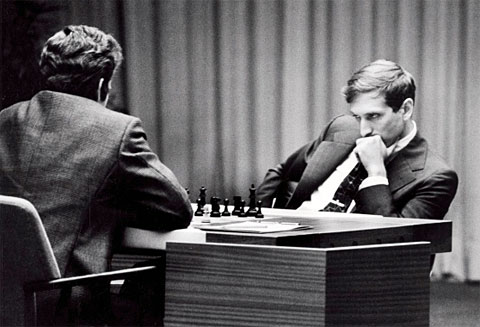
Boris Spassky and Bobby FisherI was only 8, going on 9.
My sports consciousness was not yet developed. Although the New York Mets had won the World Series in 1969, the New York Knicks had won the NBA Championships in 1970, and the New York Jets won the Super Bowl in 1970, I don’t have any memories of those amazing moments in New York sports history.
It was chess that first got my competitive juices flowing.
It was July, 1972, and before the Munich Olympics took center stage, the biggest global “sporting” event of the year was the World Chess Championship. Yes. Chess.
I owned and treasured this book as a kid.Bobby Fischer was taking on Boris Spassky for chess supremacy in Reykjavik, Iceland. But it was more than a chess match. It was the Cold War, and the 1972 championship featured an opportunity for a maverick chess savant from Brooklyn, New York, Bobby Fischer, to take down the best chess player in the Soviet Union, and thus the world, Boris Spassky.
I had learned chess from my father and I played games with friends at schools, so I was proficient enough to follow along. But chess players weren’t the only ones tuning into public television to watch two people sit at a table and not move most of the time – a good part of the American public were as well. Why? Because it was democracy vs communism, capitalism vs socialism, America vs the Soviets.
It was not just my sports consciousness that was switched on, it was a political consciousness. Like everyone around me, I wanted the American to beat the Russian. Bobby Fischer was my genius boy from New York. I had his book, Bobby Fischer Teaches Chess. I even went to chess classes at the famed Manhattan Chess Club where he had played.
I just watched the film, Pawn Sacrifice, and it brought back those memories of my youth. The film went into the quirks and paranoia of Fischer, which is today well documented and known, but for me, a kid from Queens, I had no idea. All I knew was that Fischer had to beat Spassky.
Viktor Chizhikov is bitter, even today. His creation, Misha the Bear, emerged as the best out of 40,000 submissions for a contest to select the mascot for the 1980 Moscow Olympics.
The mascot born out of the Communist bloc’s greatest power, the Soviet Union, ironically became the first to be a globally commercial success. And Chizhikov said that he was promised the copyright, didn’t get it, and thus never saw any royalties from the stuffed toys, t-shirts and television programs related to Misha the Bear. “I hate to talk about mascots,” he told The Wall Street Journal. “This is like a thorn in my heel.”
The renowned author of over 100 children’s books in the Soviet Union, Chizhikov insists he was promised copyright ownership over Misha. He has taken various parties to court for use of Misha, particularly over television programs that feature the famous bear.
And when the Winter Olympics came to Russia in 2014, Chizhikov was indignant over one of the Sochi mascots, Mishka the Bear. According to Inside the Games, he told a radio program the following:
It’s exactly the same as mine: the eyes, the nose, the mouth, the smile, though it’s askew. They pulled around all the details of my bear.The eyes are rounded the same way, the nose is a little altered and the smile has the same characteristics.
I can’t help but wonder what property rights or IP rights law was like in the Soviet Union, a state based on the ideology that the means of production are socially owned. But Chizhikov may be tilting at windmills, or at least fighting the wrong front. According to the Wall Street Journal article, it is not the national organizing committee that owns the IP rights to such items as the design of a mascot, it is the International Olympic Committee (IOC).
In the end, Chizhikov said he received about 2,000 rubles (about USD1,600 at the time) for his original design of Misha…as well as credit for kicking off the race for commercial cash, even before the famously profitable 1984 Los Angeles Olympics.
The headlines in the United States in the late 1970s and early 1980s was of economic malaise, Three Mile Island, the Iran hostage crisis, the Soviet invasion of Afghanistan and the presidential campaign pitting incumbent Jimmy Carter against Ronald Reagan.
It was the Cold War, and the temperature was below zero. And yet, then president of stuff toy manufacturer and importer, Dakin & Co., Harold A. Nizamian, thought the planned mascot for the 1980 Moscow Olympics was charming. So he bought the license to create a stuffed bear and began producing and selling “Misha the Bear“.
Dakin began producing 240,000 Misha the Bear toys a month in early 1979, and the bear was selling. According to this Inc. article, Nizamian implies that he had global licensing rights as he claims the “the Russians were delighted and tried to buy it from us”.
But when the United States government announced that America would boycott the Moscow Olympics in protest of the Soviet invasion of Afghanistan, and forbade American companies to do business in relation to the Olympics, orders were cancelled, and Misha was suddenly a victim of a bear market.
I actually had one of those bears. I remember getting a whole bunch of Moscow Olympic swag because NBC had the US broadcast rights for those Games, and my father was working for NBC at the time.
What’s fascinating about Misha the Bear is that ironically, this lasting symbol of the Soviet Union is one of the best known of all Olympic mascots in the world, its image gracing t-shirts, coffee mugs, pins, posters, and toys. In other words, the Soviet Union created the first commercially viable and globally popular Olympic mascot.
According to the Huffington Post, “no other mascot has done more for its country than Misha from Moscow. As the smiling tiny bear touted as Russia’s cuddly ambassador to the world, Misha served as a warm child-friendly sight as the peak of the Cold War. His image, starkly different from the traditionally gruff bear common in Russian lore, propelling Olympic merchandise sales forward while 55 nations boycotted the games.“
It is said that Misha the Bear’s farewell during the Closing Ceremonies was one of the most memorable moments of the 1980 Moscow Games.
As for Dakin, Nizamian had $1 million dollar’s worth of Misha the Bear sitting in his warehouse. So what did he do?
Nizamian decided to give the bear a new nationality and a new lease on life. He removed the belt and reintroduced Misha in an assortment of T-shirts. “I Am Just A Bear,” one read; another proclaimed “U.S.A. Olympic Hockey Bear,” trading on the stunning victory by the United States at the winter Olympics. “It moved fairly well,” he explains. “We were able to dispose of about half of our stock by using that vehicle.” Dakin donated another 100,000 bears to the Special Olympics, a competition for handicapped children, and sold the final 100,000 to liquidators.
Certification of proof of a world record in the freestyle 100 meters for Cocky Gastelaars of the Netherlands_from the collection of Cocky Gastelaars
She was the fastest swimmer in the world. On March 3, 1956, the Dutch swimmer, Cocky Gastelaars, swam the 100-meter freestyle in 1 minute and 4.2 seconds. The record had been held by fellow Dutch swimmer, Willy den Ouden for two decades until then.
Above is a certificate that Gastelaars received from the FINA, the international swimming governing body.
When she broke a world record, Gastelaars told me that special evenings were organized for her, and that she got lots of presents, like food baskets or a pen. She even got a dog.
In early 1956, Gastelaars and her coach knew that the world record was vulnerable, and they planned and trained with a vision of breaking that record. When a person is believed to be on the verge of breaking records, very often the community is alerted so that official timers and lots of witnesses are on hand.
“I made progress every month.” she told me. “I knew it was coming. I broke the record in Amsterdam in a swimming event against other Dutch competitors. It was rather big crowd for the time. My mom and friends were there. My father had to work. He was running an operation of 36 big boats, but he stayed near the telephone. As it turned out, the station interrupted regular radio programming, and my father was able to hear the broadcast on the radio.”
Cocky Gastelaars with trainer Dries Peute after breaking world record March 3, 1956
Five weeks later, Gastelaars did it again.
Eight months later, Gastelaars was primed to win gold at the 1956 Melbourne Olympics….when the unthinkable happened. The Netherlands government decided to boycott the Olympics, joining Spain and Switzerland in a protest of the Soviet Union invasion of Hungary. As you can imagine, members of the Dutch Olympic squad were shocked, angry and devastated by the news. Gastelaars never took off for Australia. At the peak of her powers as the fastest swimmer in the world, she was not allowed to prove her championship mettle because of two countries that had nothing directly to do with either Australia or the Netherlands.
I was so sad. All the swimmers were. We trained every day together. When the Games (for us )was cancelled, (our dream) was all gone. So we just went back to school. We didn’t say much. People asked us how we feel, but we didn’t talk about it. I felt awful. You work so hard for something and suddenly it’s over. We definitely would have had a lot of chances for medals. In fact, after the Olympics, we held relays in the Netherlands in all the Olympic events. I think we broke three world records in the relays, and the women’s medley.
With the ouster of the owner of the Los Angeles Clippers, Donald Sterling, two years ago, and the more visible acts of support for causes like Black Lives Matter, the NBA appears to have more of an activist bent than most North American sports leagues. Thus, the reaction by NBA players and coaches to the election of Donald Trump for the presidency of the United States has been more predictable.
Gregg Popovich, one of the most successful coaches in NBA history, had this to say: “Right now I’m just trying to formulate thoughts. It’s too early. I’m just sick to my stomach. Not basically because the Republicans won or anything, but the disgusting tenure and tone and all of the comments that have been xenophobic, homophobic, racist, misogynistic.”
… all of a sudden you’re faced with the reality that the man who’s gonna lead you has routinely used racist, misogynist, insulting words. That’s a tough one. That’s a tough one. I wish him well. I hope he’s a good president. I have no idea what kind of president he’ll be because he hasn’t said anything about what he’s going to do. We don’t know. But it’s tough when you want there to be some respect and dignity, and there hasn’t been any. And then you walk into a room with your daughter and your wife who have basically been insulted by his comments and they’re distraught. Then you walk in and see the faces of your players, most of them who have been insulted directly as minorities, it’s very shocking. It really is.
Coach Kerr openly stated the million dollar question in team sports – how does a coach coach a team of whites, blacks and hispanics who are united by team purpose, but possibly divided by national purpose?
The NFL has a similar ratio of black players to the NBA. But the press has reported more comments from coaches in support of President-Elect Trump, compared to the NFL. Certainly, the most famous case is the coach of the New England Patriots, Bill Belichick, who tends to be tightlipped about anything he believes not relevant to his football team, and play on the field. And yet, Trump quoted a letter from Belichick to Trump on the eve of the presidential election, clearly seeing an opportunity to get more votes in the New England states.
My guess is Belichick would have preferred to keep the contents of his letter quiet, but when confronted, he did explain his relationship with Trump at a news conference. “Our friendship goes back many years. Anybody who spends more than five minutes with me knows I’m not a political person. My comments are not politically motivated. I have a friendship with Donald.”
The New England Patriots’ organization is famous for the strict control it imposes on its players in regards to talking with the press, and very little has been heard from the players, except for their star quarterback, Tom Brady, who is also known as a long-time personal friend of Donald Trump.
In terms of football, the words of Belichick and Brady are the most important on the team. But when your coach, your star quarterback and even the owner of the team are friends of Trump, what impact will this have on the team fabric, likely made up of a number of players who view Trump as a racist?
Rex Ryan and Donald Trump
The Buffalo Bills are not the New England Patriots. The Bill’s head coach, Rex Ryan, has openly supported Trump, even giving speeches for Trump at rallies in Buffalo.
“There’s so many things I admire about Mr. Trump, but one thing I really admire about him is—you know what—he’ll say what’s on his mind,” Ryan said in this Bleacher Report article. “And so many times, you’ll see people—a lot of people—want to say the same thing. But there’s a big difference: They don’t have the courage to say it. They all think it, but they don’t have the courage to say it. And Donald Trump certainly has the courage to say it.”
When Ryan was the coach of the New York Jets, my hometown team, it was clear that Ryan was seen as a player’s coach, the kind of guy you would run through the wall for. But supporting Trump may have an impact on team dynamics. In that same Bleacher Report article, a couple of Bills’ players were quoted anonymously that their coach’s comments did not sit well with them.
“Rex is such an open-minded guy, a really good person,” said the player, who asked not to be identified, fearing repercussions from the Bills. “But the fact he could back someone as closed-minded as Trump genuinely shocked me.” The player, who is black, emphasized that teammates’ frustration with their coach’s public endorsement was not universal. But in private discussions, he said, “Some of the African-American players on the team weren’t happy about Rex doing that.”
Indeed, said another black player on the Bills who requested anonymity to speak freely about tensions swirling with a combination of protests led by Colin Kaepernick and a combustible candidate: “I see Trump as someone who is hostile to people of color, and the fact that Rex supports him made me look at him completely differently, and not in a positive way.”
What’s interesting, although predictable perhaps, was the reaction of a particular player on the team, Richie Incognito. “I think that he can help this nation get back to a world superpower,” Incognito told B/R’s Tyler Dunne. “Where I think he could help is putting us first again and having that—it’s my mentality, too—having that tough attitude where you put America first and everyone’s thinking we’re the greatest nation in the world. Don’t mess with America. That toughness is where I identify with him.”
Incognito, a Caucasian, was suspended from his former team, the Miami Dolphins, after being identified as one of three harassers of a black teammate, Jonathan Martin, who asked to leave the team. It appears that Incognito’s bullying of Martin was incessant and racist, and included members of Martin’s family.
In the end, those who oppose Trump have had to come to grips with reality.
Doc Rivers, the head coach of the Los Angeles Clippers, said in this article that we need to accept and then take action, not just complain.
Listen, Donald Trump is going to be fine, all right, as president. That’s something I never thought I’d have to say, honestly. But at the end of the day he will be because I just believe America overall works. There’s a Congress and a Senate and it’s gonna work out. But if you don’t like it, you have two years from now to change it. Not (to change the) president, but you can change the Congress and you can change the Senate. So if you don’t like it, change it. And you change it by either running for office or voting… Don’t get mad — go do something.




You must be logged in to post a comment.