Before Tokyo governor Yuriko Koike came on the scene, the projected overruns for the 2020 Tokyo Olympic budget was expected to take the overall budget to USD30 billion.
Soon after Governor took office, she stated she was determined to cut that budget down to size, vowing not to strap Tokyo taxpayers with any “white elephants”. In partnership with the International Olympic Committee, which feared that ballooning costs would further discourage cities from bidding for Olympics in the future, Koike began asking a lot of questions about the budget.
The IOC then encouraged that a four-party group be created to drive the budget down. For the past year, members of the IOC, Tokyo 2020, Governor Koike and representations from the Japanese national government have been working to ensure a budget of USD15 billion or less. On May 31, 2017, Tokyo2020 organizers that the budget has been reduced to USD12.9 billion, according to Around the Rings.
In comparison to another mature city, the 2012 London Olympics ended up costing USD19 billion.
One of the major hurdles of finalizing the budget was determining who would fund the construction of temporary facilities in venues outside Tokyo, where events like baseball and soccer would be played, for example. In the recently agreed-upon budget, local governments in seven prefectures (Hokkaido, Miyagi, Fukushima, Saitama, Chiba, Kanagawa and Shizuoka) and four cities (Sapporo, Saitama, Chiba and Yokohama) will pay only for costs related to “medical services and security transportation to and from venues, but that Tokyo will cover costs for temporary facilities for venues outside of the Japanese capital”, according to Inside the Games.
Another potentially very good decision by the four-party task force, according to this Tokyo 2020 document, was to create a committee made up members of the four parties to monitor costs. This Management Committee for Collaborative Projects will look to optimize resources and further reduce costs with reviews held on a regular basis.
Feyisa Lilesa with his wife Iftu, son Sora and daughter Soko, after winning the 2017 United Airlines NYC Half (photo by Jane Monti for Race Results Weekly)
Since the time he left Rio de Janeiro, with a silver medal in the marathon from the Summer Olympic Games, Feyisa Lilesa has not been able to enjoy the triumphant return home to an adoring populace like most other Olympian medalists.
Instead, he lives a life a self-exile.
When he crossed the line to finish his marathon achievement in Rio, he crossed another line by extending his arms and crossing them in the shape of an X, with fists clenched. It was a clear sign to his country men and women in Ethiopia that Lilesa was outraged with his government, his arms raised in protest against his country’s leaders for the treatment of the country’s largest ethnic group which he belongs to – the Oromo. According to reports, hundreds of Oromo have been killed by Ethiopian troops, and thousands of others have been injured, arrested or disappeared, according to a report by Human Rights Watch.
While the Ethiopian government has said Lilesa would be welcome back with arms wide open, he does not believe that. And in his new home in the arid desert of Arizona in the United States, in his lonely jogs, he is constantly reminded that a government agent of Ethiopia might be lurking to do him harm.
“There is nothing I could do to stop it if someone wanted to do something to me out there,” he says through an interpreter in a May 1 Sports Illustrated article. “I am alone, just like I am alone in this country. All I can do is stay strong and keep going.”
The time I first wrote about Lilesa in December, 2016, he truly was all alone, as he left his family behind when he defected to the United States. And according to the Sports Illustrated article, a remarkable interview, his wife, Iftu, let him know what a painful decision he had made when he first talked with her on the phone.
When Iftu called, he could not pick up the phone. He didn’t know what to say. It took him two days to call her back. There was fear and anger in her voice. “Why didn’t you tell us what you were doing?” she demanded. “You gave us this good life, and now our lives aren’t as good. What plan did you have? You’ve risked everything. Why did you make this decision?” She knew her husband had been pained for years. She knew that he felt stifled, that he’d kept quiet for fear of reprisal. She knew he had visited imprisoned protesters and had given clothing and training shoes to needy Oromo. Deep inside, she knew the answers to her questions.
She knew what is in his heart. And according to this fascinating article, Lilesa was thinking that he could make a difference if he was able to get a medal in Rio. This act of defiance was not a spontaneous act of a tired athlete who had just run hard for over two hours. It was premeditated.
Preparing for Rio, Lilesa felt desperate to call attention to a crisis largely ignored by the international community. He needed a medal. Only gold, silver and bronze finishers would get significant media coverage. He had won big races in Europe, the United States and Asia, including the Tokyo Marathon at the start of 2016. But he wasn’t a heavy favorite in Rio. His time in Tokyo had been 2:06:56, only the 31st-fastest marathon of the year. Rio would be the race of his life — a race for his people. He kept his plan a secret, even from his wife and children. If he’d told them, he would have been swallowed by emotion. If he had felt Iftu’s sorrow, he might have lost his nerve.
Feyisa Lelisa reunited with his familyafter six months of self exile
But he did not lose his nerve. And when given other opportunities – the Honolulu Marathon in December, 2016, or the London Marathon in April, 2017, Lilesa will cross his arms to show he is still thinking of his family members and friends who have suffered and perished. But now, he no longer is running this political marathon alone. On Valentine’s Day of 2016, Lilesa was re-united with his wife and children.
On Feb. 14 — six months after Feyisa said goodbye to them in Africa — his children leap into his arms in the Miami International Airport. Soko, a girl sharp and willful, seems beyond her years. Sora stands close. Near the baggage claim in the bright airport, they laugh and tease, and Feyisa picks them up and cuddles them. Moments later, he holds Iftu in a tight embrace. Tears stream from her brown eyes. With both hands, he wipes them away. Tears well in his own eyes, but he does his best to stand straight and keep them from falling.
Lelisa feels that tears will demonstrate weakness, for he does not want the government to believe that he is succumbing to the pressure.
Lelisa is not weak. He is stronger. But he is not happy.
“It is much better now, with my wife and children,” Lilesa says. “But if you put this on a scale of 1 to 100, I am only at 15 percent happiness. I am in exile, not for myself first and foremost but for my people. And my people are suffering. Going through hell. The situation has gotten worse. I have told you that right now I do not want to cry. The day I will cry is when my people win justice and freedom. That day, I cry nonstop, out of joy.”
In a sprint, seconds count. And in sprints in the pool, swallowing water can cost seconds. “I had always dreaded swallowing a mouthful of water,” said legendary swimmer, Johnny Weissmuller, quoted in David Fury’s biography, Twice the Hero.
There he was, in his best event at the 1928 Amsterdam Olympics, perhaps singing his swan song as an amateur athlete. At the turn of the mid-way point in the 100-meter race, Wesismuller did what he feared – he gulped a mouthful of water. “I felt like blacking out. I swallowed the stuff and lost two valuable yards. Lucky for me, we still had some forty meters to go – with only ten or so, I’d never have made it.”
But make it he did, winning the gold medal in the 100 meters in Olympic record time. He added another gold in the 4×200 meter relay. The only reason he didn’t win three golds, as he did in 1924, was because his coach asked him to join the water polo team instead of the 400-meter race, a competition he would likely have won.
Still, Weissmuller won five gold medals over two Olympics, and was again, one of the great stars of the 1928 Amsterdam Olympics. Queen Wilhelmenia of Holland was there to award Weissmuller his gold medals, as well as a special award for his overall athletic excellence.
Weissmuller went on to live a full life as one of the world’s most renowned figures. (Even rebel soldiers in Havana, Cuba recognized him.) He starred as Tarzan in 12 films, made a fortune in Billy Rose’s Aquacade, and married five times. His second wife of two years, the short and sultry Lupe Vélez played quite the contrast to the tall and easygoing Weissmuller.
In the book, Tarzan, My Father, the author, Johnny Jr told of an epic fight between the couple. They were staying in a suite at the Claridge Hotel in London. Vélez had gone to bed and Weissmuller retired to a quiet book. But according to Weissmuller, his wife awoke suddenly, grabbed a shoe and began hitting her husband repeatedly over the head with hit.
I leaped out of bed and tried to grab her and calm her down. She ran out of the room, into the hallway, screaming at the top of her lungs, “Socorro! Help mee! Murrder!” U was wearing only my pajama top and was naked as a jaybird from the waist down, but I ran down the hall hoping to catcher her and try to stop this uproar. Suddenly, to my right, a door opened, and a matronly lady in nightcap and gown stared at me in wonder. I nodded, mumbled an apology of some sort, and continued the chase. On the second turn around the corridor, the matronly lady shouted at me, “Faster Johnny! You’ll catch her the next time around, I’m sure!”
Johnny Weissmuller and Lupe Vélez, from the book, Twice a Hero
He did indeed catch her, reeled her back to the room, and went to sleep. Unfortunately, the next morning, they found an eviction notice slipped under their door. By that time, the couple had made up, laughed off the incident and the eviction, packed their bags and were about to leave their room to check out when they got a knock on their door. It was the manager, who explained somewhat sheepishly that there was a reverse in their decision and that they were welcome to stay in the hotel as long as they wished. What did the manager say?
It seems, sir, that last night you passed the door of Queen Wilhemina of the Netherlands, and she spoke with you. She informs me that she once presented you with two gold medals following the Olympic games, as well as one of her own. It appears that she has a great fondness for you, and she quite firmly stated that if you leave, she is leaving also. I do apologize again, sir, and I hope that you will do us the honor of remaining.
Weissmuller lived a charmed life, and apparenly always got the royal treatment.
For example, the front page of the Riverside Daily Press on July 24, 1935 blared across the full length of the front page, “Gay Cocktail Parties Result in Dismissal of Eleanor Holm Jarrett”.
Under the word “Ousted”, was a lithe Eleanor Holm in a skin-tight swimsuit posing like a Hollywood starlet. The caption read “Eleanor Holm Jarrett, attractive night club queen-swimmer who was dropped from the American Olympic team for indulging in liquor and parties contrary to training rules.” The article started with a provocative lead – “The one member of the American Olympic swimming team who appeared the most certain to win a title, Mrs. Eleanor Holm Jarrett, prepared to return home today.”
Holm was the Olympic champion in the 100-meter backstroke, having won gold convincingly at the 1932 Los Angeles Games. Married to a jazz band leader, Art Jarrett, and very much used to the life as a celebrity, Holm did not take to the third-class accommodations on the SS Manhattan, which was transporting the US Olympic team to Europe and the Berlin Olympics.
According to The Book of Olympic Lists, by David Wallechinsky and Jaime Loucky, Holm – a veteran of two Olympiads – she wanted to be where the officials and the press were: first class. When an executive of the company that owned the SS Manhattan invited Holm up to first class for a party, the only Olympian invited, she of course said yes.
Quick to accept, she stayed up until six a.m., matching drinks with the sportswriters. She had to be helped back to her cabin. The next day there was much joking and wisecracking among the non-Olympic first-class passengers about the “training techniques” of the US team. Embarrassed US Olympic officials issued Holm a warning, but she was defiant and continued to drink in public off and on for the next few days. When advised by friends to moderate her behavior, she reminded them that she was “free, white, and 22”.
Wallenchinsky and Loucky described further examples of Holm’s drunken adventures on the SS Manhattan. On the evening of July 23, shortly before reaching Europe, the ship’s doctor found Holm “in a deep slumber which approached a state of coma”, which he diagnosed as acute alcoholism. The next morning, the American Olympic team manager woke Holm up and informed her that American Olympic Committee had voted to remove her from the team.
The next day, the press included the official announcement from Avery Brundage, the US Olympic Committee chairman. “Mrs. Eleanor Holm Jarrett has been dropped from the Olympic team and her entry has been withdrawn on account of violation of training rules. I wish to emphasize that there is no reflection in any way upon the entire team.” According to the press, Holm was requested to return to the United States.
Unfortunately for Brundage, Holm was immediately hired by news gatherer, the Associated Press to write a column, presumably about anything she wanted (presumably since she felt her Olympic career was over and her amateur status no longer a requirement). With press credentials, Holm was in Berlin to stay, and with her star power, she was at all of the biggest social gatherings. According to Holm in the book, Tales of Gold, Brundage didn’t like playing second fiddle to her.
A funny sidelight to Brundage kicking me off the team was that I was invited to everything in Berlin, and he would be there, too. He would be so miserable because I was at all these important functions. I would ignore him – like he wasn’t even alive. I really think he hated the poor athletes. How dare I be there and taking away his thunder? You see, they all wanted to talk to me.
Eleanor Holm at the press gallery at the 1936 Berlin OlympicsHolm said she hung out with Herman Goering, and regularly got autographs from Adolph Hitler. She claimed that famed documentarian, Leni Riefenstahl, filmed her in the pool, although that footage was apparently left on the cutting floor. Despite the socializing, Holm wrote that she trained every day just in case she was reinstated to the team. In the end, however, Brundage would not budge and the world watched a Dutch woman named Nida Senff win gold in the backstroke.
Holm would go on to divorce Jarrett and marry a man named Billy Rose, who produced a hugely popular music, dance and swim show called Billy Rose’s Aquacade, where she would become an even brighter star, swimming with fellow Olympic champions Johnny Weissmuller and Buster Crabbe.
Holm passed away in 2004 at the age of 90, her star dimmed by the passage of time. But in the mid-20th century, during the Depression and War years, there were few brighter stars than Eleanor Holm.
Tensions between North Korea and South Korea are high. With multiple missile tests in 2017, North Korea is believed to have the capability to drop nuclear bombs on South Korea and Japan today.
The symbolic and real divide between North and South is the demilitarized zone, aka the DMZ – a 4-km wide no-man’s land that serves as a buffer between highly armed military forces on both sides. Families have been reunited through this land route from North to South. But in the times when athletes travel to events where both North and South Koreans compete, they have done so by sea or by air. Most recently, a South Korean women’s soccer team went to North Korea, and a North Korean women’s hockey team went to South Korea for respective tournaments.
When the PyeongChang Winter Games commence in February, 2018, North Korean athletes will walk through the DMZ for the first time, according to Lee Hee-beom, head of The PyeongChang Organizing Committee for the 2018 Olympic & Paralympic Winter Games (POCOG).
South Korea will welcome North Korea and when they decide to come, the South Korean government will allow them to come by road. And when they have supporting teams, the (South) Korean government will allow them to come by ship. All nations are very welcome, including North Korea and Russia. We want it to be the peace games.
No North Koreans have yet qualified for the PyeongChang Games, so it likely would not be a parade of athletes marching through the DMZ. But as Lee has said, the optics are the key. “Symbolically, to maintain peace in the Korean peninsula, their participation is very important, and for the success of the Olympic Games.”
I don’t know what it is like at the DMZ. But in June, 1985, I walked through a highly secured border checkpoint separating East and West Berlin, a place known then as Checkpoint Charley on the West Berlin side. I remember white walls and towers, military men with machine guns, and deathly silence. As a typical 22-year-old wise-cracking New Yorker, who liked to joke about everything, I found myself in a state of intense suppression, as I see in my diary of that time.
Checkpoint Charley on the eastern side is hardly intimidating in appearance, but you feel the intensity of the situation. You can’t take pictures, and for me the hardest part, you keep your snide remarks to yourself. There is dead silence as you walk through the cement corridors. A single watchtower glances at the grounds, but the electricity of the moment prevented me from snapping a noisy picture. The guard inside the customs office joked with Fenz, and that helped ease the tension, but the sensation of freedom was never so exhilarating when you realized that you were through. Violently spattered with graffiti, the wall (on the West Berlin side) remains a moving testament to the shackled human soul.
Roy after walking through Checkpoint Charley to West Berlin and freedom
The first ever winner of the marathon, Spyridon Louis, was said to have made a pit stop at his uncle’s tavern for a glass of wine before winning gold at the 1896 Athens Olympics.
But discus thrower, Jules Noël, was a beneficiary of the US government’s decision to suspend the importation and imbibing of alcohol.
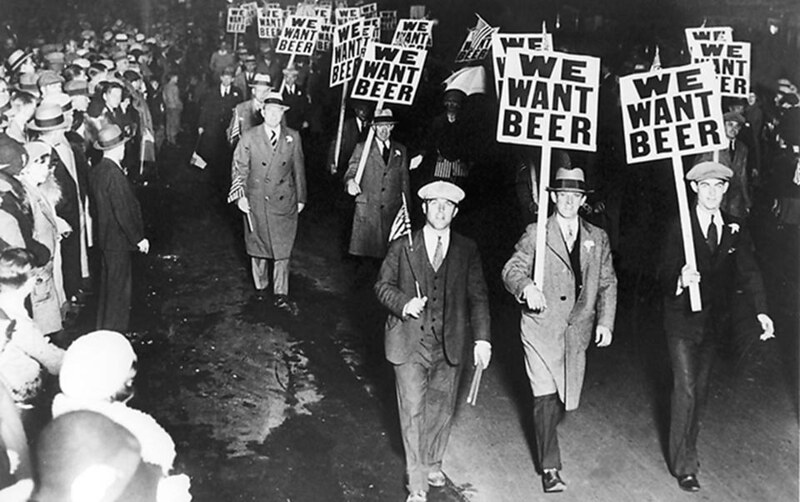
From 1920 to 1933, it was illegal to produce, import, transport and sell alcoholic beverages. This teetotaler era in the United States, known as Prohibition, happened to be in force during the 1932 Olympics hosted in Los Angeles, California. But according to David Wallechinsky and Jaime Loucky in their book, The Book of Olympic Lists, “in the interests of international goodwill the US government suspended its prohibition against alcoholic beverages to allow French, Italian and other athletes to import and drink wine.”
Anti Prohibition Protest in New York City in 1932.
Frenchman, Noël, believed that “wine was an essential part of his diet,” according to sports-reference.com. Apparently, the world record holder and eventual gold medalist in the discus throw, John Anderson, led nearly the entire competition. But in the fourth and final round, after Anderson’s leading throw of 49.49 meters, Noël was reported to send a discus way past Andersen’s best throw at the time. But apparently, “the officials were watching the pole vault and did not see it land. Noël was given an extra throw but could not produce his top throw again and he would eventually place fourth.”
Before his mighty but unofficial throw, Noël was said to be “swigging champagne with his compatriots in the locker room between rounds at the discus event.”
The Posto da Torre is a busy gas station in Brazil’s government seat of Brasilia. Before 2013, Posto da Torre (Tower Gas Station) was just one of many of gas stations in the capitol. After 2013, Posto da Torre became the symbol of corruption in Brazil.
A drug investigation by police into a money exchange shop located on the Posta da Torre property revealed that billions of dollars secretly skimmed from the accounts of Petrobras, Brazil’s state oil enterprise, as well as construction companies, were moved into the hands and accounts of Brazil’s most prominent politicians. In fact, over 100 of Brazil’s top politicians have been implicated in what is today called Operation Car Wash, known in Portuguese as Operação Lava Jato.
One of the more well-known names caught up in web of Operation Car Wash is former mayor of Rio de Janeiro, Eduardo Paes, whose name has appeared on lists of people receiving payments from construction companies, presumably related to the development projects for the 2016 Rio Olympics. According to this post from Inside the Games, Paes is alleged to have received over USD5 million from from engineering giant Odebrecht.
Paes, who ended his role as mayor at the end of 2016, has denied wrongdoing, calling allegations “absurd”.
Former Brazil President, Henrique Cardoso is also under investigation for taking bribes from Odebrecht, has spoken recently about Operation Car Wash and its significance. “Car Wash has played a very important role in Brazil because it lifted the lid, which was necessary. But that will not resolve things immediately. It is a process,” he said in this Reuters article. “How do you change a culture? With time and by setting a good example – there is no other way.”
An interesting aside: there is no car wash in Posto da Torre. As The New York Times cheekily point out, the closest this Brasilia gas stop has to a car wash is a laundromat. At any rate, it is money that gets washed, not cars. When politicians will come clean is anyone’s guess.
Adolph Kiefer center in the pool with naval personnel
At the age of 15, Adolph Kiefer set his first world record.
At the age of 16, he was the first person in the world to swim the 100-yard backstroke in less than a minute. As this article states, Kiefer held every backstroke record there was for 15 years.
And in 1936, at the age of 18, he won the gold medal in the men’s 100-meter backstroke, setting Olympic records in the heats and the finals. He had a streak of over 200 consecutive victories in the back stroke, and in his career, lost only twice.
At the age of 98, on May 5, 2017, Kiefer passed away in his home state of Illinois.
The great swimming coach from Hawaii, Soichi Sakamoto, was inspired by Kiefer, and got tremendous insight in technique by watching film of the Chicago native. Here is how Julie Checkoway, in her wonderful book, The Three-Year Swim Club, describes Kiefer through the eyes of Sakamoto:
When he filmed backstroker Adolph Kiefer, he found in him the same relaxation – in Kiefer’s legs, his rolling arms, his outstretched but loosened palms and fingers, a catch that seemed effortless, a recovery that took no time at all. For too long Sakamoto had believed that Kiefer had merely been a talented natural whom Stan Brauninger had discovered in a concrete culvert in Chicago; Kiefer was talented, all right, but he hadn’t become the world record holder in the backstroke without a technique that was, to Sakamoto, nothing less than genius.
After the 1936 Berlin Olympics, there was anticipation of so much more Olympic glory for Kiefer – but like others of his generation, the war years intervened. That did not, however, stop Kiefer from making an even bigger impact. After the Japanese attack on Pearl Harbor, Kiefer joined the Navy. As Checkoway, revealed, Kiefer was shocked to hear that 50% of the soldiers who perished at Pearl Harbor did so by drowning. And yet, when soldiers returned to his port in Norfolk Virginia, he was surprised to hear that learning how to swim was still not a priority.
At his insistence, Kiefer was sent to Washington DC to make a case for institutionalized swimming instruction. Kiefer made a strong case. “What good [is] a 5-man gun crew,” Kiefer asked the Navy brass, “if one of those 5 couldn’t swim and fell in? With one man drowned, what good [is] a 5-man weapon?” Kiefer got the funding and set up a training center for naval swimming instructors. As Checkoway explained, Kiefer was so well known and so well liked, he had little trouble rounding up some 1,200 swimmers to teach survival swimming, who would in turn train every naval sailor how to swim.
One day, while Kiefer was training, Hitler came by with an entourage of Nazi officials, including the powerful Hermann Göring. Hitler had learned of Kiefer’s German heritage and wanted to meet him.
“I remember him being a small man with a small hand,” Kiefer told the Times columnist Ira Berkow in 2000, “and his handshake wasn’t a firm one. Then he spoke to the interpreter, and I was told he said something like, ‘This young man is the perfect example of the true Aryan.’”
Kiefer added: “At the time, I was honored to meet this important head of state. But if I knew then what I know now about Hitler, I should have thrown him into the pool and drowned him. I even can’t stand the name Adolph now. But I’m stuck with it.”
At the 1964 Tokyo Olympics, the Olympic Village was more than serviceable. It was an actual neighborhood.
The neighborhood was called Washington Heights, an American military compound designed to make American soldiers and their families feel like they never left America, as you can see in the video above. If you watch until the 1:18 minute mark, you’ll see Washington Heights before it was transferred from the US Government to the Japanese government for the purpose of being re-fashioned into an Olympic Village.
I got my hands on a booklet that was published by the Organizing Committee of the 1964 Olympics, called “XVIII Olympiad Official Bulletin No. 12”. This booklet, published in November 1963 to update officials on the progress of the organizing committee, featured pictures and blueprints of the dorm rooms in the Olympic Village.
Here are the descriptions from that bulletin with the images. If you’re an Olympian from 1964, let me know your memories of living in those former military family quarters.
There are two types of housing facilities: one is a ferro-concrete four-storied building of a dormitory type, and the other, an independent wooden house of one or two stories. The men’s quarters will consist of these two kinds of housing, while the quarters for women will be of the dormitory type especially prepared for the fair sex.
Ferro concrete four story dorm
Each floor of the dormitory is of the same plan and has 18 bedrooms and a common bath and toilet facilities. There will be a total of 69 bedrooms per building. A central heating system is provided, but the temperatures in October in Japan will not require its operation. The staircases and corridors are covered with asphalt tile, the walls with plaster, and the ceilings with sound-absorbing materials.
Each bedroom, 25.5 square meters in area, faces the corridor on one side and has windows on the other. Lockers will be prepared along one of the two blank walls, in addition to beds (three beds in a room on the average), desks chairs and boxes for small articles will be provided, in each bedroom. For comfortable living conditions, bedside lamps have been installed, and insect nets and curtains are attached to the windows.
There are nine types of independent housing units. One frame house is composed of one to four housing units of one or two types. The combination of such unites varies 50 different ways. A house may be of one to four unites of the same types and another house may be of two to four unites of two different types. Building may be of one storied, while the others may be two storied. Although the types of houses are quite varied, the interior décor is limited to only nine types.
One-story wooden house dorm
The outside of those houses is covered with cement mortar, and the roofs are tiled. A-1 Type house is the simplest; it is one-storied and has four bedrooms and a utility room. One of the two doors leads to the entrance hall and the other to the utility room. Eight persons will be accommodated in each house of this type.
In the larger two-storied B-1a Type house are four bedrooms, the rest being almost the same as in the A-1 Type. Nine athletes are to be provided with lodgings in this type of house. The wood floor is covered with a carpet, and the (board) walls are painted. The ceiling is covered with fibre board. These houses will be furnished in the same way as the dormitory rooms and wardrobe closets will be added, if necessary.
Each house has a gas hot furnace for heating, and the room for the chef de mission is equipped with a telephone. The utility room contains a gas heater and a sink.
Canagasabai Kunalan, the writer, Anwarul Haque and Hamid Supaat at the Singapore Cricket ClubWe gathered at the prestigious Singapore Cricket Club on May Day, and enjoyed fish and chips and beef Guinness pie reminiscing about 1964. I had the honor of having lunch with three Singaporean Olympians who went to the Tokyo Olympiad:
Canagasabai Kunalan, who held the fastest 100-meter time in Singapore for over 30 years, and competed under the Malaysian flag at the 1964 Olympics, as well as under the Singaporean flag in 1968,
Hamid Supaat, who competed in the grueling individual cycling road race in the chilly hills of Hachioji at the 1964 Tokyo Olympics, as written about here, and
Anwarul Haque, who was a goalie on the 1964 Malaysian field hockey team, went on to become a lawyer, as well as serving eight years as president of the Singapore Cricket Club, where we ate and reminisced.
In 1964, Singapore was undergoing political upheaval, having gained independence from Britain in 1963, and joining a federation of states that became Malaysia. Previous to that, Singapore had been a colony since Stamford Raffles arrived on the tiny island in 1819 to claim it as a trading post for the East Indies Company and the British empire.
Before independence, Singapore was a bustling harbor town, its population growing quickly, but still relatively small at 1.5 to 1.8 million in the first half of the 1960s. So it’s quite understandable that in the sports history of Singapore, only 5 medals have been won by Singaporeans in the history of the Olympics, the first one – Singapore’s first silver – in 1960 and the last one – Singapore’s first gold – in 2016.
Tan Howe Liang wins silver at RomeTan Howe Liang migrated with his family from southern China to Singapore and at an amusement park saw an exhibition of weightlifters and was hooked. He joined a weightlifting club, and soon became internationally competitive, finishing ninth in the lightweight category at the 1956 Melbourne Olympics, and then gaining confidence by winning gold at the 1958 Commonwealth Games, the 1958 Asian Games and the 1959 SEAP Games. In Rome, Howe Liang brought glory to Singapore with a silver medal in the lightweight category.
Even earlier, at the 1948 London Olympics, Singapore had a representative as a part of British crown colonies. His name was Lloyd Oscar Valberg, and he competed in the high jump as Singapore’s sole athlete in the first Olympics after the Second World War. Valberg came in 14th. But he set the Singapore record for the high jump at the age of 17, and is a symbol of how far Singapore has come. Valberg’s nephew was Colin Schooling, and his son saw his famous relative as a role model.
Inspired by his grand uncle, Joseph Schooling went on to take gold in the 100-meter butterfly in one of the most dramatic races at the 2016 Rio Olympics. Schooling beat a very strong field, including his childhood idol, Michael Phelps to win Singapore’s first gold medal.




You must be logged in to post a comment.