Police investigate a pickup truck used in an attack on the West Side Highway in Manhattan_Reuters
On Tuesday, October 31, 2017, Sayfullo Saipov rented a truck in Passaic, New Jersey, and less than an hour later around 3pm was barreling down the scenic Hudson River Bike Path, mowing down runners, pedestrians and bikers alike. Victims and fatalities were found at different points along this 10-block killing spree, finally ending when his truck crashed into a school bus parked outside Stuyvesant High School.
Saipov was gunned down and captured by police who happened to be in that area investigating another incident. By the time the day ended, 6 people were killed on the spot, with two more dying later in the day.
This was the worst terrorist attack on New York City since September 11, 2001.
I feel pained at the loss of life and the inability to make sense of the murderous actions of this terrorist in my home town of New York, the frustration heightened by the fact that Saipov was apprehended outside my high school alma mater. Stuyvesant was only four blocks from the World Trade Towers, and thus ended up serving as a triage center for those injured and dying after the 9/11 attacks. On Tuesday, it served yet again as a backdrop to incomprehensible hatred.
A few weeks ago, the Economist Intelligence Unit (EIU) published their 2017 Safe Cities Index. In the dimension of “Personal Security”, which reflects the level of urban crime, violence or the likelihood of terrorism, New York City ranked 25th out of 60 cities surveyed. After seeing citizens run down on a bike path on a sunny afternoon, one might wonder why that ranking isn’t worse.
But on the whole, when EIU looks at all factors of security relevant to big cities, including digital, health and infrastructure safety, New York City ranks fourth safest in the world for cities with populations of 15 million or more.
At the top of the list, as the safest of the biggest cities, is Tokyo. In fact, Tokyo continues as the safest city in the world, maintaining its EIU reign since 2015. With the coming 2020 Tokyo Olympics, the public and private sectors in Japan are both working on measures to improve security, particularly in regards to digital security. While bombs and gun attacks are concerns, even in super safe Japan, great attention is being paid to ensuring Japan’s power grids, transportation systems, and digital platforms are not compromised now, or doing the 2020 Tokyo Olympics.
The Japanese are highly detail oriented and biased towards checking and re-checking for points of weakness and flaw, which is something I and many others can take comfort from if we dare to think about how creative and diabolical terrorist and crime organizations can be.
And yet, how do you protect against someone renting a truck and plowing into a crowd?
Rudy Scholz closes down France’s Henri Galau during the infamous 1924 final
Which national team has been the most successful in Olympic rugby history?
The United States.
Not known for its rugby prowess today, a team from America has taken gold twice in the Olympics. Of course, rugby union was an Olympic event only four times – 1900, 1908, 1920 and 1924. After that, rugby did not make an Olympic appearance until the 2016 Rio Olympics. America took gold at rugby’s last Olympic appearance in the 20th century – the 1924 Paris Olympics.
Why rugby no longer made the Olympic list of eligible sports after 1924 is unclear to me. Maybe it was a challenge to amass large teams for overseas competition at the time, as only three teams participated in the Paris Games: host France, Romania, and the United States. The American team was, I believe, primarily a squad of 22 from Stanford University, which had to raise $20,000 to pay for their travel to Europe, their training in England and their time in France.
Another reason may have been that unseemly gamesmanship left a sour taste in the mouths of the IOC.
According to Wikipedia, the Americans apparently were initially refused entry into the country, but still forced their way off their ship. The Americans claim that seasickness and the long trip made them very eager to disembark, while the French immigration officials viewed the Americans as “streetfighers and saloon brawlers.” Indeed there was apparently a fight at the docks between Americans and Frenchmen, getting the rugby rivalry off to a roaring start.
What followed, according to reports, was the following:
Games between local French clubs and the visiting American squad were suddenly cancelled.
The American team was told to hold their workouts on open lots near their hotel instead of proper fields of play.
The Americans were denied permissions to film their first match against Romania under the pretext that a French company had sole rights to film all rugby matches (although they were eventually given permission to do so)
And just to sprinkle salt on the wounds, the Americans returned to their rooms to find about $4000 worth of cash and possessions stolen despite a guard being on duty, according to this site.
Apparently, captain Norman “Cleaveland and his teammates were not very happy, and because of their treatment in the press, the American side was now being cursed and spat upon on in the streets of Paris. The American expatriate community in Paris was even staying well clear of them.”
Since there were only three teams, there were only three rugby matches actually played at the 1924 Olympics: France vs Romania, US vs Romania, and France vs the US. Both France and American handled Romania handily. So the press quite happily had their dream grudge match, a finals between the US and France. Here’s how this article describes the setting:
May 18th started as another hot day in an unseasonably warm string of spring days in Paris. A crowd of between 35,000 and 40,000 people gathered for the rugby final and the awarding of the first medal of the 1924 Olympic Games. As the team entered the stadium from a tunnel, they noted that the Olympic officials had elected to install a tall wire fence around the stadium to restrain the crowd. The American side wore white uniforms, blue belts, and white stockings hooped with red and blue. An American shield was sewed to the front of their jumpers. Wearing white shorts and blue stockings, the French took the field in their famous blue jumper badged with a cock.
All in all, a fairly normal start….except perhaps for the tall wire fence. Very quickly in the match, one of the speedy French players, Adolphe Jauguery, was flattened by an American winger named “Left” Rogers. Jauguery was taken off the field, unconscious and bleeding, and the crowd quickly turned on the Americans.
In the end, Team USA won the gold medal in a hard-fought match 17-3. The American press in Paris, were of course sympathetic and supportive of their American boys.
The headline for this Associated Press report from May 18, 1924, was “Americans Win Double Victory.”
The American Olympic Rugby football team won two great victories today at the Colombes stadium. The first was their defeat of France in the Olympic Rugby match, 17 to 3. The second was a victory over themselves in not losing their tempers under great provocation from what was termed by spectators as unfair and unjust a crowd as ever attended a sporting event. The American players were booed and hissed throughout the game, at the raising of the American flag on the Olympic flagpole was the occasion for a demonstration of booing and catcalling and the strains of the American national anthem were almost drowned out by the din raised by the seemingly infuriated spectators.
And just in case Americans weren’t outraged enough, here is the kicker. Not only was the unsportsmanlike conduct by the French in the battle on the pitch, the American claimed the same was true in the stands.
A fist fight then broke out in the stands and degenerated into a battle royal in which gold headed canes were freely used. The Americans were outnumbered and furthermore, they carried no canes with which to retaliate. When the police managed to disentangle the combatants, B. F. Larse of Provo, Utah and Gideon William Nelson of DeKalb Ill, two American students in Paris, were found to have been knocked out. Both men had to be carried out of the stand. Nelson was unconscious for an hour. When he recovered, it is said, he began looking for a bewhiskered man who carried a heavy cane.
As mentioned in a post previously, France, Austria and Germany are giving serious consideration to not attending the 2018 PyeongChang Winter Olympics in South Korea due to concerns of North Korean terrorism, or even North Korean ballistic missiles launched during the Games.
The aggressive tone of words exchanged recently between the leaders of North Korea and the United States have done little to calm the nerves of South Koreans, Japanese and Chinese alike, let alone athletes expecting to attend the Games that start on February 9.
On September 29, Ryom Tae-Ok and Kim Ju-Sik of The Democratic People’s Republic of Korea, aka North Korea, performed well enough at the Nebelhorn Trophy competition in Obertsdorf, Germany, which also served as a qualifying event for the 2018 PyeongChang Olympics. As the New York Times explained, the pair took sixth place in the tournament, but “more important, they finished third among a subset of pairs from countries seeking five available Olympic spots.
In other words, they didn’t necessarily squeak in, or get favorable treatment to earn a spot.
While the final decision is up to the North Korean Olympic Committee to approve their entry to the Olympics, they have up till now funded the pair’s training in Canada, under Canadian coach Bruno Marcotte. It would be hard to imagine the North Korean OC deciding not to give the go ahead after training these promising skaters overseas, seeing them improve significantly from their top 15 finish at the world championships last year, to cracking what is arguably the top ten in the world.
If Ryom Tae-Ok and Kim Ju-Sik and other North Korean athletes and coaches are in PyoengChang next February, that may put the athletes, coaches and officials of other countries at ease. The thinking of some is that the North Korean leader may be less likely to attack South Korea if he is cheering on his countrymen and women south of the border, according to the New York Times.
“It’s kind of an insurance policy to have them there,” said Ted Ligety, a two-time gold medalist in Alpine skiing from the United States.
“North Korea is my biggest worry,” Choi Moon-soon, the governor of Gangwon Province in South Korea, where the 2018 Olympics will take place, said in a recent interview. “It’s not because of North Korea making an impact on the Olympics, it’s that if North Korea can participate, then it will make a great contribution for our goal of hosting a Peace Olympics, and it will be a great selling point.”
Will other North Koreans qualify? Will the IOC and the various international sports federations ease up the standards to allow borderline North Korean athletes to compete? Will it matter?
A police officer practices disposing of a bag supposedly containing an explosive during an antiterror drill at Prince Chichibu Memorial Rugby Ground in Tokyo on Monday. Photo: KYODO
On September 25, police ran a simulation based on a scenario – what if terrorists planted a sarin gas bomb in an office building during the 2020 Tokyo Olympics?
About a thousand people were involved in this massive drill to see whether anti-terrorist plans on paper have any founding in reality. The drill was held not far from where the new national Olympic stadium is being built in Tokyo. Some 800 people were evacuated from the area and a bomb disposal team, using a robotic arm, successfully removed a bag that was said to hold a bomb.
These kinds of drills are important to gauging feasibility of anti-terrorist plans and readiness of relevant security and safety groups. But when it comes to the 2018 PyeongChang Winter Games, which is to commence on February 9, there are nations that are beginning to think no anti-terrorist plans or level of readiness of security personnel that will comfort them.
Thanks to the belligerent talk and the test launches of ballistic missiles by the North Korean government in recent months, France and Austria are saying they may turn down their invitation to the upcoming Winter Games, as quoted here.
We will never put our team in danger. If it gets worse and we do not have their security confirmed, our French team will stay here. – Laura Flessel, Sports Minister of France.
If the situation gets worse and the security of the athletes is no longer guaranteed, we will not go to South Korea. – Karl Stoss, the head of Austrian Olympic Committee.
Germany is also reportedly mulling a decision to not send their athletes to South Korea.
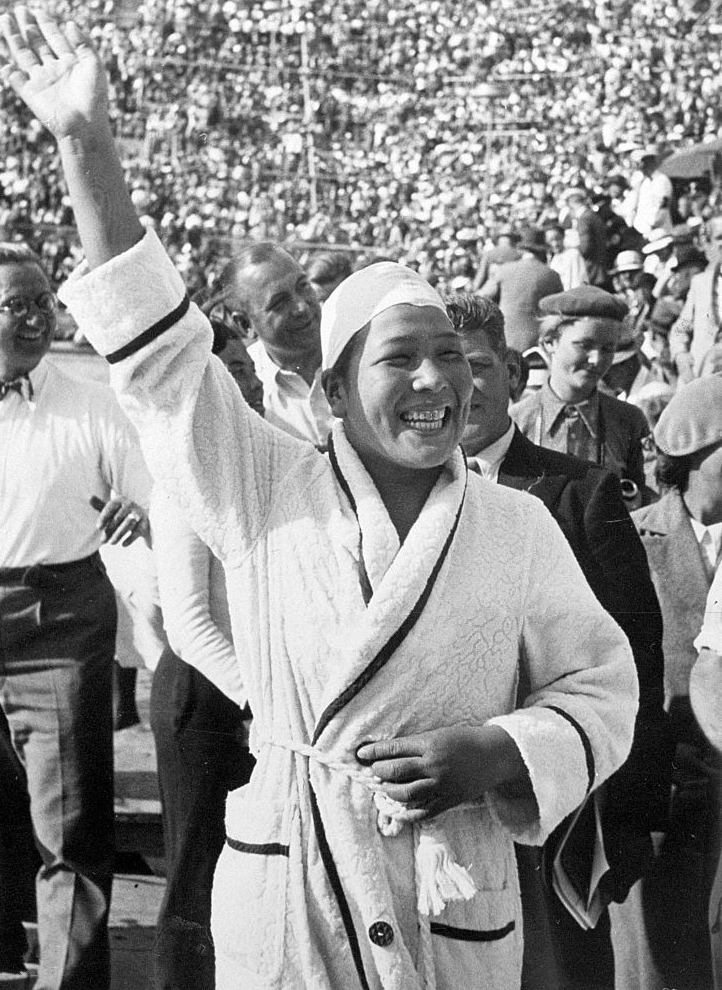
Hideko Maehata waving to the crowd after winning gold in Berlin
It was a slight, perhaps. The first and most famous of films about the Olympics – Leni Riefenstahl’s documentary about the 1936 Berlin Olympics, entitled Olympia, did not include the winner of the women’s 200-meter breast stroke. That’s because the winner was a Japanese, Hideko Maehata, who beat out a German named Martha Genenger.
But that’s OK. When Maehata returned to Japan after her gold-medal winning performance in Berlin, she was a national celebrity. Eight other Japanese won gold medals at the Berlin Games, but they may not have gotten the media attention that Maehata did. As Robin Kietlinski explains in her seminal book, Japanese Women and Sport, national radio was bringing the world to all of Japan, led by Nihon Hoso Kyokai, or NHK. Established in 1924, Maehata’s race was one of the first events to be covered live, broadcasted to Japan via satellite.
And according to Kietlinski, they had the man who brought the excitement of the moment alive for Japanese listeners – Kasai Sansei – whose shrieks of excitement and shouts of “Maehata ganbare” brought the swimming stadium of the Imperial Sports Field in Berlin to the homes of people all across Japan. In this NHK documentary, Maehata’s cousin, Tomizo Hase, was asked about his recollections of listening to that famous radio broadcast:
We were all nervous, out palms sweating. We said to each other, we really hope she wins. There were about 10 people inside and many more outside. What a heavenly feeling it was. Some of us cried in joy, saying she’s done great.
In her book, Kietlinski provides a transcript in English of that broadcast. To listen in Japanese and get the sense of excitement Japanese felt in 1936, go to the 25 second mark of the video below.
Maehata and Genenger are side by side. Ah, Maehata pulls ahead! She’s in the lead! She’s a little bit ahead. Fifty meters down. 100 meters down. Fifty meters left to go. Maehata is a little bit ahead! Ah, Genenger is coming. Come on, come on! Maehata is in danger, she’s in danger! Go for it! Maehata go for it!
They turned, the swimmers just now turned and Maehata holds onto a slight lead. C’mon Maehata. Go for it! (Repeated four more times) Forty meters left to go. (Repeated four times) Maehata is ahead! Maehata is ahead! Genenger is coming. It’s just a very small lead by Maehata. Go for it Maehata! (Repeated four times) Twenty-five meters left to go! Maehata’s lead is small, it’s very small! Maehata! Go for it Maehata! (Repeated eleven times)
Maehata is in the lead! (Repeated six times) Five meters left to go! Four meters left! Three meters, two meters. Maehata is ahead! Maehata has won! (Repeated eighteen times) By a small margin Maehata is the champion! Thank you Ms Maehata, the Japanese flag will fly today. Thank you! For the first time in the history of women’s swimming the Japanese flag will fly.
Hideko Maehata (center) on the Podium with Martha Genenger (right) and Inge Sorensen of Denmark (left)
Hideko Maehata swam 10,000 meters a day. So taking the two-week boat trip from Japan to the West Coast of the United States was a piece of cake for the native of Wakayama, Japan. It was the last 200 meters, in the pool, that were going to be painful.
After winning her heat in the 200-meter breaststroke by nearly 3 seconds, she lined up for the finals. And in a tough-fought nail biter, a 16-year old Australian named Clare Dennis set an Olympic record and edged out Maehata by a tenth of a second.
According to Robin Japanese Women and Sport, in her book Japanese Women and Sport, Maehata was welcomed back home in Japan as a hero, but the 18-year-old, while proud was disappointed. Was it worth training so hard again, and trying again for gold in 1936, or should she put an end to the long hours in the water and get married as society at the time required. Kietlinski explained that Maehata received letters from her fans making both sides of the argument.
According to this NHK mini-documentary of Maehata’s life, it was the Mayor of Tokyo at that time, Hidejiro Nagata. Nagata, proud of Japan’s incredible accomplishments at the 1932 Los Angeles Olympics, was putting together his plan for Tokyo to host the 1940 Olympics, met the returning Maehata and insisted that she go for it again in Berlin.
If only you had won that gold medal. It’s so frustrating. Don’t forget the bitter taste of defeat. Let it drive you to do better four years from now at the Berlin Olympics.
And so, Maehata decided to aim for gold and glory at the 1936 Berlin Olympics. She doubled her regimen, swimming 20 kilometers a day, the water hiding the tears of pain. She noted that her victory in LA was denied by such a tiny margin that perfecting her start was essential. She worked on her launch from the starting block by practicing 100 starts a day, her toes bleeding from the wear and tear.
The training was so grueling I cried as I swam. But at those times, I reminded myself that if I failed to overcome the pain, and fall short in Berlin, I would be the laughing stock of Japan.
And so, despite being cheered on by thousands as she boarded the ship for Europe and ultimately Berlin in 1936, she did so with considerable anxiety. In fact, as the NHK video explains, based I believe on what she described in her own autobiography, she found herself alone on the deck of the ship, looking over the waves, thinking that if she did not win, she would jump into the ocean on the return trip and kill herself.
This was the first Olympics in Berlin, otherwise known as the Nazi Olympics as it was presided over by der Führer, Adolph Hitler. The home field advantage for the German athletes was significant, and Maehata’s biggest competitor in the 200-meter breast stroke was a 20-year-old from Krefeld, Germany, Martha Genenger.
Genenger sent the first warning shot, winning her first round heat in 3:02.9 seconds, setting an Olympic record. Maehata fired back in her first round heat with a time one second better, re-setting the Olympic record. In the semi-finals, no records were set, but no other competitor came anywhere close to Genenger’s or Maehata’s times. The finals were to be a showdown between the German and the Japanese.
It was 4pm on August 11, 1936. Maehata was in lane 6. Genenger was in lane 7. Even in the early part of the race, Maehata pulled ahead. And for the remainder of the 150 meters, Maehata clung to the lead. When her hand touched the wall, she was not sure who had won.
When I reached the finish line I l gasped for breath and looked across at the next lane and saw that Genenger was already there. And I thought I had lost.
In fact, Maehata had persevered by a mere sixth tenths of a second. She had fulfilled the command of the Mayor of Tokyo. She had realized the dreams of an entire nation.
And she could get on with her life. In 1937, Maehata married a doctor, retiring from swimming. She raised two children, and when she greater flexibility after her children grew up, she started a swimming school in 1967. She saw that after the war, the Japanese were weak in swimming. She felt that she could contribute by focusing on mothers, teaching them the joys of swimming. If mothers understand and enjoy swimming, she believed, so will their children.
Maehata suffered a stroke while teaching, at 68. She was told she would never walk again, which was fuel for her competitive fire. So she pushed herself. “I still have the drive inside,” she said in the NHK documentary. “When I have a tough day, I recall my days as a competitive swimmer, and it’s like someone is yelling at me that I have to be stronger. The fact that I am still alive and active today is thanks to that inner strength.” Amazingly, a year later, Maehata returned to the pool and resumed her coaching duties.
In 1995, at the age of 80, Maehata, one of the most famous sports figures of the early 20th century in Japan, passed away.
The pace set by the Kenyans was relentless. The thin air of Mexico was punishing. Favorite Jim Ryun, weakened by a bout with mononucleosis, was whipped by 3 seconds, as Kip Keino dashed to a gold-medal finish in the 1,500 meters at the Mexico City Olympics.
Thirteen seconds after Keino crossed the finish line, Josef Odlozil of Czechoslovakia, finished in twelfth place. It was a poor finish compared to his silver medal at the 1964 Tokyo Olympics, but in the end, Odlozil won the bigger prize.
At the end of the 1968 Olympics, Odlozil married compatriot, and one of the darlings of the Mexico City Games, Vera Caslasvska. The Czech gymnast who won three gold medals in Tokyo, did even better in Mexico City with four more golds. Thousands of people came out to the Mexico City Cathedral to wish the Olympic couple well.
Their marriage was to last not quite 20 years, ending in divorce in 1987. Those 20 years must have been filled with mini dramas, as Odlozil apparently worked for the Czech Army, while Caslavska struggled to establish a productive career after returning from Mexico City. She had supported anti-government movements, and protested against the Soviet invasion after the so-called Prague Spring. Caslavska was not allowed to leave the country or get coaching work.
Odlozil and Caslavska had two children, a boy named Martin and girl named Radka. It appears that relations between father and son were poor, possibly leading to a tragic conclusion.
On August 7, 1993, Odlozil was in a placed called “U Cimbury”, described as a “disco-restaurant” in this post from Once Up a Time in the Vest. As it turned out, Odlozil’s estranged son Martin was also present. Words were exchanged. Punches were thrown. Odlovil fell to the ground, hitting his head, and subsequently fell into a prolonged coma. A little over a month later on September 10, 1993, Odlovil died.
Vera Caslavska and Josef Odlozil Prague Castle_ALAMY
His son Martin was sentenced to four years in prison for murder.
His wife, Vera, fell into depression and was rarely seen in public.
Was Josef looking for his son Martin? Was it true that Martin, upon seeing his father, went to the DJ and request a song called “Green Brains” that was considered offensive to members of the Czech Army? Did Martin, in a fit of rage, go to his father’s car and vandalize it?
All the eyewitnesses were said to be drunk. The only thing that was clear – father and son were in the same place where a fight took place, and Odlovil fell to the floor unconscious.
From the Fall of 1968 to the Fall of 1993, a 25-year drama came to a horrific close.
Being an Olympic champion shields us not from the slings and arrows of outrageous fortune.
Chinese Cultural Minister Luo Shugang Education, Culture, Sports, Science and Technology Minister Yoshimasa Hayashi and South Korean Culture, Sports, and Tourism Minister Do Jong-hwan
Think about it. The next three Olympic Games will be held in Asia:
2018 Winter Olympics: PyeongChang, South Korea
2020 Summer Olympics: Tokyo, Japan
2022 Winter Olympics: Beijing, China
In the history of the modern Olympiad, the majority of host cities selected for both Summer and Olympic Games have been in Europe. In the period of 1896 to 1952, only three of the first 20 Olympiads were held outside Europe, the others in the USA. From 1956 to 2016, the diversity of host cities improved, with only 50% of the Olympiads held in Europe.
But for the first time, three Olympiads in a row will be held in Asia. In the world of diplomacy, that smells like opportunity. So when the culture ministers of Japan, China and South Korea met in Kyoto for their annual meeting of minds in August, 2017, they announced that they will organize joint events to spread the depth and beauty of East Asian culture within the three countries in connection to the upcoming Olympiads in Asia.
While the specifics of the plan are to be determined by an “experts’ body” to be set up, it was agreed that five cities in each of the three countries would be identified as locales for these cultural exhibitions and exchanges. In fact, according to this Japan Today article, this is an expansion of an initiative called the Culture Cities of East Asia Program, that had started in 2014. China’s Changsha and South Korea’s Daegu are already hosting such events. Next year, Japan’s Kanazawa will be host.
Efforts to strengthen copyright protections for cultural products
Continued trilateral dialogue on preserving the intangible cultural heritage of all three countries.
Support of UNESCO’s International Research Center for Intangible Cultural Heritage in the Asia-Pacific Region, which works to protect, preserve and promote intangible culture such as traditional music, dance, performing arts and craftsmanship.
Examples of “intangible cultural heritage” in Japan would be noh, washoku (traditional Japanese food), and washi (traditional hand-made paper).
With so much geo-political tension in the region, exacerbated by the sabre-rattling of North Korea, there is a belief that diplomacy, through the promotion of the respective nations’ cultural heritage, can promote the cause of peace, according to Kyoto mayor, Daisaku Kadokawa.
The East Asian region shares a long history of exchanges. Here in Kyoto, you can see and feel the cultural elements of the region. The power of culture can help bring the region together, and lead to peace.
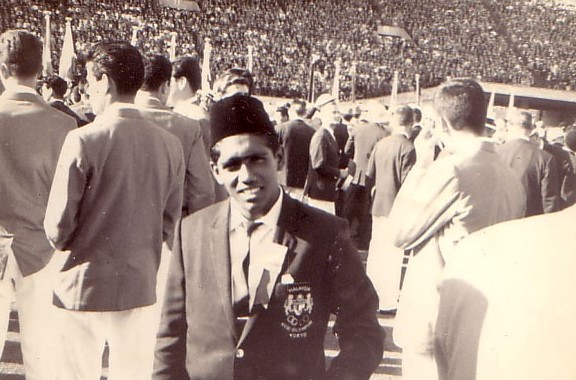
Kunalan at the 1964 Tokyo Olympics Opening Ceremonies
It was the summer of 1964 and Singapore was in crisis.
Singapore’s leader, Lee Kuan Yew, had brokered a deal with the British Government and the leadership of Malaya to be included in a nation called Malaysia, established in 1963. This was not a match made in heaven. Racial tensions were part and parcel of the daily lives in the region between Singapore, which was a mixture of Indian, Malay and Chinese, but had a predominant population of ethnic Chinese, and the rest of the Malaya Federation, which was primarily Bumiputra and Islamic.
In July and September, Singapore felt the political tension born of the delicate balancing act that brought Singapore and Malaya together, and at times, the tension boiled over. Race riots broke out where shophouses were burned down, police and military were called out to restore order and enforce curfews, and people were beaten and killed.
This is the atmosphere in which athletes in Malaysia and Singapore were preparing for the 1964 Tokyo Olympics. Canagsabai Kunalan was a promising 21-year-old sprinter, talent spotted only a year before by the Malaysia track coach, Tan Eng Yoon. After a successful sprinting debut in 1963, Tan believed Kunalan was ready for the Tokyo Olympics, and recommended him for the 4X100 relay team, along with Mazland Hamzah, John Daukom, and Mani Jegathesan.
3 weeks prior to Tokyo – standing: Tan Eng Yoon and Stan Wright; sitting (L to R): Kunalan, Wong Fey Wan, Kuda Ditta, M Jegathesan, and Dilbagh Singh
But the make-up of the 4X100 relay team did not sit well with Wong Fey Wan. Another talented sprinter, Wong defended his record, and called out Kunalan publicly in the press:
I beat Kunalan in the 100 m finals in the national championships in which I finished second to Jegathesan, and I beat him again in the Government Services Meet in the 100 m final on Saturday in which I finished third…. I am willing to race against Kunalan again to prove I am the better man over 100 m. If I am wrong I will quit athletics.
Coach Tan did favor Kunalan, perhaps for his work ethic, perhaps for the belief that Kunalan was stronger around the curves and a better choice as back up for the relays. Maybe Wong did not have the political support as he was self-taught and did not have the benefit of a coach lobbying his case as Tan did for Kunalan. Maybe race was influential. As explained through Kunalan’s state of mind at the time in the biography, “C. Kunalan – Singapore’s Greatest Track and Field Athlete”, Kunalan was unhappy.
Whatever the true reason for Wong’s exclusion – be it sporting or political, this incident affected Kunalan, who regarded this as “one of the saddest moments” of his running career. He never knew for sure whether he had been chosen on the basis of merit, but he wished that Wong had been chosen instead, knowing how much Wong had been looking forward to competing at the Olympic Games.
It was Kunalan instead who went to Tokyo. Just three days before his 22nd birthday, the Malaysian 4×100 team finished last in their round one heat, and that was that.
While Kunalan had no control over the make-up of the 4×100 Malaysian relay team, during a period of racial and political strife in his country, he did indeed have control over more important, personal decisions – with whom he would marry.
Kunalan and me
Teammates in track, Kunalan first met Chong Yoong Yin, captain of the Raffles Girls School track team, and a member of the Malaysia national track team. They had track in common, but to their parents, little else. Kunalan was ethnic Indian and was brought up in the Hindu religion. When Kunalan had returned from the Tokyo Olympics and his parents realized that his relationship with the ethnic Chinese woman, Yoong Yin, was still intact, they gave their son an ultimatum: “leave that Chinese girl or never return home again.”
Kunalan walked out.
Yoong Yin received the same ultimatum from her father and her uncle. And she too left home, joining her mother, who was estranged from her father.
Distraught after being shunned by their own families, they struggled momentarily, wondering what would happen. But Kunalan in the end was resolved. “We’ll have our own friends who will accept us.”
Engaged in October 1965, with a wedding date set for October 1966, the parents of Kunalan and Yoong Yin eventually saw that there was no fighting the bond between the two. Kunalan’s father surprised his son with a visit, and said he would bless the union, but only if Yoong Yin would take on an Indian name and convert to Hinduism. Fortunately, that was not a problem for Yoong Yin, and the two sprinters were married in a Hindi ceremony. Subsequently a Chinese wedding dinner was held by Yoong Yin’s mother.
Fifty-two years later, Kunalan and Yoong Yin are still happily married. And Kunalan proudly proclaims that diversity and the need to be inclusive of all races and nationalities is vital to world peace. “I am not nationalistic,” he told a Singaporean magazine. “I am more of an internationalist.”
His children, a blend of Indian and Chinese DNA and heritage, have lived their parents’ creed, marrying members of other nationalities. Kunalan is proud of to be an inter-racial grandparent.
He remembers 1964. He recalls seeing the worst in the race riots of Singapore, and the best in the gathering of the world’s best athletes in Tokyo. And he believes that we are capable, through sports, to co-exist in peace and love.
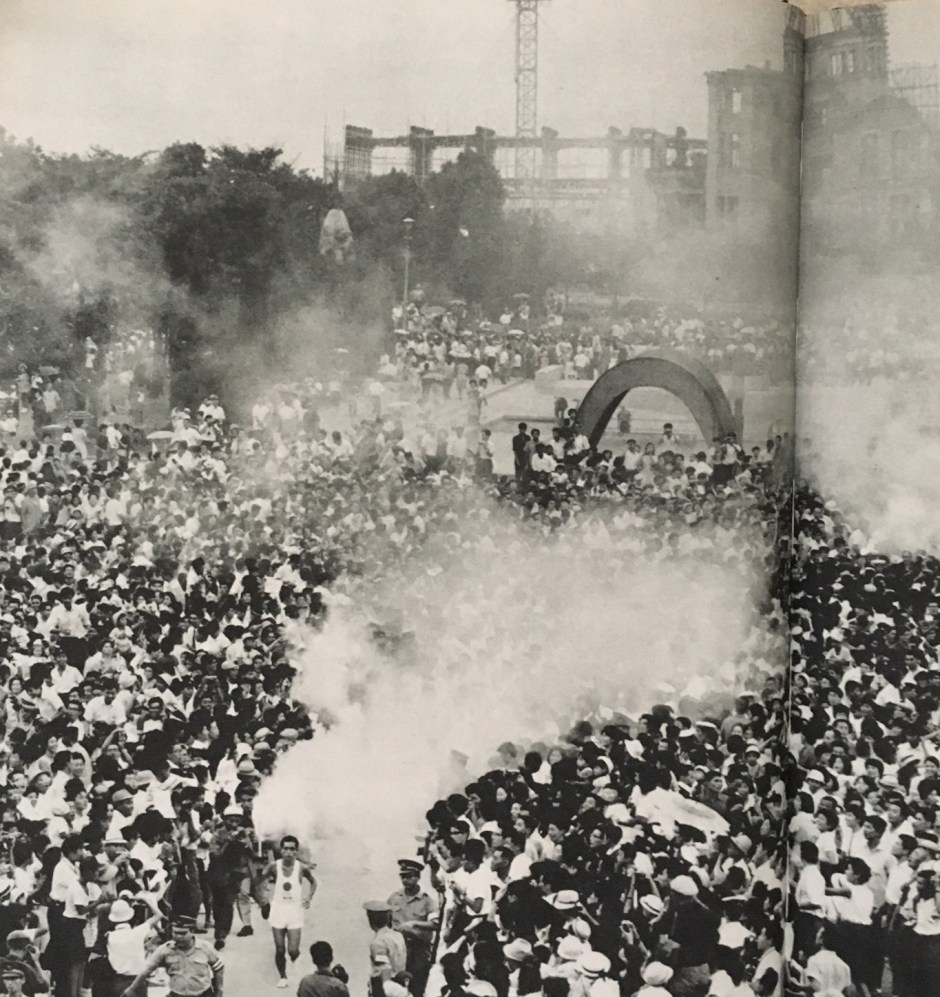
The torch relay passing through Hiroshima prior to the start of the 1964 Tokyo Olympics, from the book 1964 Tokyo Olympiad Kyodo News Agency
One thing certain about the dates of the Tokyo 2020 Olympics: July 24 to August 9, 2020. It will be hot and muggy!
One less obvious thing recently occurred to me about the dates. The final week of the Tokyo Olympics falls on the 75th anniversaries of the nuclear bombings of Hiroshima and Nagasaki.
Was it intended to bring attention to the worst days in Japanese history, during the proudest days of the nation’s history?
Of course it was. It’s impossible to imagine that no one in the Tokyo 2020 organizing committee or the IOC noticed that the closing ceremonies of the Olympics would take place on the day the second atomic bomb was dropped on Japan, thus expediting the eventual end of the war six days later.
On the contrary, the organizers must have thought that the final day of the Tokyo 2020 Olympics would be an opportunity to solemnly (and hopefully tastefully) implore the world that peace and love trump war and hate.
Such a closing ceremony would provide a poetic bookend to the opening ceremony of the 1964 Tokyo Olympics. Only 19 years removed from the end of WWW II, it was a 19-year-old student from Waseda University named Yoshinori Sakai who carried the sacred flame up the National Stadium’s steps to light the Olympic cauldron on October 10, 1964.
Sakai was born in Hiroshima on August 6, 1945, the very day that the Enola Gay dropped an atomic bomb called “Little Boy” on Sakai’s hometown.






You must be logged in to post a comment.