Operation Christmas Message

Over 200,000 people have been killed during an ongoing conflict in Colombia that pits the government, paramilitary groups and crime organizations against left-wing groups as FARC (Revolutionary Armed Forces of Columbia) and ELN (The National Liberation Army). For over fifty years, guerillas hiding deep in the jungle have been playing a deadly cat-and-mouse game, and the government has tried everything to bring them out of the jungles and send them home to their families.

They have even tried an advertising campaign, the likes of which you might see in a mall or on YouTube, to market a company or its products. In this case, the campaign has been powerfully effective.

The goal has been to get FARC and ELN guerrillas to demobilize, and thus weaken the guerrilla bands. The appeal has been to their hearts. And what better way to appeal to the hearts of Colombians is through Christmas and soccer. As explained in this December 11, 2016 60 Minutes report, the Colombian military hired a creative ad executive named Jose Miguel Sokoloff in 2006 to create a campaign that would convince members of FARC to go home.

On December 10, 2010, the military and Sokkoloff launched an advertising campaign called “Operation Christmas,” in which 9 very tall trees were decorated with lights that would only turn on if the motion-detection sensor noticed movement in that area. So if a FARC guerilla walked by one of those designated trees, it would light up like the proverbial Christmas Tree. At the same time, another light would shine on a sign that read:

If Christmas can come to the jungle, you can come home. Demobilize. At Christmas, everything is possible.

As Sokoloff explained in 60 Minutes, “What we did was try to make coming back home for Christmas an important thing. And we knew that if we put up these Christmas trees with that sign up there, we would touch the hearts of the guerrillas, ‘cause my heart was touched. And they went and they did it.”

The result of that campaign was that over 300 guerillas, about 5% of the total, left the jungle and surrendered.

The following year, the Colombian military staged “Operation Rivers of Light,” another campaign to reach further into the jungle by floating plastic balls that contained messages and gifts to the guerillas. They also lit up with soft purple light, to send another powerful message of peace and beauty into the heart of the jungle. Some 7,000 of those balls resulted in the demobilization of another 180 guerillas.

Another campaign was also launched in 2011, in conjunction with the 2011 FIFA U-20 World Cup, which happened to be hosted by Colombia from July 29 to August 20. As Sokoloff said, football moves this country. Football is our passion.” So during this campaign, soldiers had thousands of soccer balls signed by players and celebrities and fans. Theses balls – all with a sticker saying “Demobilize. Let’s play again” – were thrown from helicopters into the jungle, resulting in another wave of guerillas leaving the jungle.

Sokoloff claims that over eight years of this campaign, 18,000 guerillas have come home, and got FARC to the bargaining table.

Still FARC and ELN fight for survival in the jungles, soldiers and guerillas die. But still negotiations continue as the government and FARC look to find peace.

Perhaps it will be quiet today in Colombia, for it is Christmas, and family calls.

Life Magazine_Emperor and Empress 3

These are fascinating pictures of Emperor Hirohito and the Empress in the summer of 1964. Taken from the September 11, 1964 issue of Life Magazine, these black and white photos reveal the Emperor to be a somewhat ordinary man, grandfatherly, academic. In fact, the couple looks like they’re having fun looking for mollusks.

The magazine even quotes the Emperor describing the “umi ushi” they found. “This is an easygoing chap, not in the least alarmed at being caught.”

Life Magazine_Emperor and Empress 1

Americans who saw this set of pictures in Life Magazine were probably surprised to see a totally different Emperor Hirohito. Perhaps their memory of him was a leader who sent suicide dive bombers to attack Pearl Harbor, or drove soldiers to kill themselves in the name of the Emperor rather than be captured by Allied forces. But to see the Emperor at all in the 1960s was due to efforts by the Supreme Command of the Allied Powers (SCAP), the entity that governed Japan in the post-war years, as well as members of the Japanese government.

After World War II, in the immediate aftermath of Japan’s defeat at the hands of overwhelming American military firepower, one would think there would be too much concern over what to eat, where to sleep, and how they will cope the next day for people to care about the Emperor, and whether the imperial family as an institution should be maintained.

And yet, support for continuing the imperial throne was strong, a survey in October, 1945 revealing “widespread enthusiasm or deep awe and veneration comparable to that of the war years,” according to John Dower in his seminal book, Embracing Defeat. While forceful calls for the dethronement of Emperor Hirohito and elimination of the imperial system in Japan were common in America and other allied nations, the head of SCAP, General Douglas MacArthur, agreed that it was important to keep the emperor in place.

Life Magazine_Emperor and Empress 2

Dower quoted a memo from Brigadier General Bonner Fellers to MacArthur about the reasons why the Emperor should remain as a symbol of Japan, emphasizing the fact that the Emperor, by going on the radio and announcing Japan’s defeat and need to lay down arms, “hundreds of thousands of American casualties were avoided and the war terminated far ahead of schedule.” in the case of trying the Emperor for war crimes, Fellers argued that “the governmental structure would collapse and a general uprising would be inevitable.”

SCAP was therefore insistent that Hirohito remain as Emperor, and not be tried for war crimes. In place of a deity as the head of Japan, SCAP sought to “humanize” the Emperor. A big part of those efforts were sending the Emperor on tours across the nation to meet the people in 1946. SCAP made sure pictures were taken and film was shot to document the Emperor walking amidst his people, a scenario unthinkable during and before the war years.

Life Magazine_Then Crown Prince Akihito Crown Princess Michiko and Current Crown Prince
Then Crown Prince Akihito Crown Princess Michiko and Current Crown Prince
Alexander Zubkov (L) and Alexey Voyevoda
Alexander Zubkov (L) and Alexey Voyevoda of Russia team 1 celebrate on the podium during the medal ceremony for the Men’s Two-Man Bobsleigh on day ten of the Sochi 2014 Winter Olympics at Medals Plaza on February 18, 2014 in Sochi, Russia. Unfortunately for Voyevoda, Zubkov was DQ’ed.

After finishing 11th in the medal standings at the 2010 Vancouver Winter Olympics, with a total of only 15 medals and 3 gold medals, Russia made a commitment to do better in their home country for the 2014 Sochi Winter Olympics. In fact, Russia, finished at the top of the medal table with 33 total medals, including 13 gold medals.

Flash forward to 2017, and the table has turned.

After a review of the McLaren report on Russian state-sponsored doping prior to the Sochi Games, the IOC on December 5, 2017, banned the Russian National Olympic Committee from its participation in the 2018 PyeongChang Olympics. This decision means that no official team can represent Russia, but individuals from Russia can apply to participate in PyoengChang as a member of the Olympic Athletes of Russia (OAR), assuming it can be shown they were not part of the Russian doping machine.

As you can see in these tables from an NBC Sports article, Russia has suddenly plummeted in the Sochi medal tables from first to fifth. In the current standings, the USA is at the top of the overall medal count at 28, while Norway takes the lead in gold medals with 11.

Sochi Medal Rankings Top Five

This may not be the final revision. The IOC could decide to move other competitors up the medal ranks to replace the disqualified athletes. While the possible revisions below are dramatic, they actually would not have any further impact on the top five standings, although Latvia would move up from 23rd overall to 20th, thanks to the addition of 2 bronze medals.

  • Biathlon (women’s sprint): Russian silver medalist, Olga Vilukhina, was disqualified. Vita Semerenko of the Ukraine and Karin Oberhofer of Italy could move up to silver and bronze.
  • Biathlon (women’s relay): Members of the silver-medal winning Russian team, Olga Vilukhina, Yana Romanova and Olga Zaitseva, were disqualified. Norway could move up to silver, Czech Republic to Bronze.
  • Bobsleigh (two-man): Alexandr Zubkov was disqualified and stripped of his gold medal, which was unfortunate for his teammate Alexey Voyevoda, who was not disqualified. In this case, Switzerland could move up to gold, while the US could end up with a silver. Latvia might win bronze in this case.
  • Bobsleigh (four-man): As three of the four members of the Russian bobsleigh team, Alexandr Zubkov, Alexey Negodaylo and Dmitry Trunenkov, were disqualified, again Voyevoda appears to get stripped of his gold without being disqualified. Latvia and the US could move up to gold and silver. Another Russia team could have taken bronze, but they also had disqualified members on the team, which opens up the possibility of fifth place Great Britain taking bronze.
  • Cross-country skiing (men’s 50k freestyle): As written in an earlier post, Alexander Legkov and Maxim Vylegzhanin were disqualified, allowing Russian country man Ilia Chernousov to potentially trade his bronze medal for gold, with Martin Johnsrud Sundby of Norway and Sergei Dolidovich of Belarus moving up to silver and bronze.
  • Cross-country skiing (men’s team sprint): Like the 50k freestyle, Vylegzhanin’s DQ results in the stripping of Russia’s silver medal. Sweden and Norway could move up to silver and bronze.
  • Skeleton (men’s): Gold medalist, Alexander Tretyakov, was disqualified, leaving the door open for Martins Dukurs of Latvia to take gold, and American Matthew Antoine to take silver. Another Latvian, Tomass Dukurs, finished in fourth so is hoping for a medal as well.
  • Skeleton (women’s): Bronze medalist Elena Nikitina was disqualified, opening the door for a new bronze medalist, Katie Uhlaender of the US.
  • Speed skating (women’s 500-meters): Olga Fatkulina, was stripped of her silver medal, which means that Margot Boer of the Netherlands could claim silver, and Zhang Hong of China could be awarded a bronze.
Maxim Vylegzhanin, Alexander Legkov, Ilya Chernousov, XXII Olympic Winter Games in Sochi
Maxim Vylegzhanin, Alexander Legkov, Ilya Chernousov, XXII Olympic Winter Games in Sochi © Alexander Vilf / Sputnik

It was a proud moment for a proud nation.

Three Russians stood on the medal podium in the 50k freestyle cross-country skiing competition, on the last day of the 2014 Sochi Olympics. In a spectacular finish to a grueling race, Russia’s Alexander Legkov and a few others broke the pack of about 30 skiiers for a final push.

And the push was up a steep incline before entering the stadium. Legkov pushed past the finish line after a tough 1 hour 46 minutes and 55.2 seconds, only 0.7 seconds ahead of compatriot, Maxim Vylegzhanin, and 0.8 seconds ahead of another Russian, Ilia Chernousov.

As Russian teammate, Sergey Gamuzov, gushingly exclaimed in this article, “Russia power, Alexander Legkov, the power of Russia! It was wonderful day!”

That was then. This is now.

In late December, 2016, Legkov and Vylegzhanin were suspended by the International Ski Federation after their names came up in the now-famous McLaren report on state-sponsored doping in Russia, particularly during the lead up to the 2014 Sochi Olympics in Russia. The IOC made it official by giving Legkov and another Russian skier, Evgeniy Belov, on November 1, and four more Russian cross-country skiers on November 9, including Vylegzhanin, lifetime bans in Olympic competition. They will also have to forfeit the medals they won.

There is very little written about it, but for some reason, third-place winner, Ilia Chernousov, has not been implicated in the doping scandal, so for now, he retains his bronze medal. And while no decision has been made in distribution of medals, it’s very possible that the 4th and 5th place winners in the Sochi 50k cross country ski competition – Martin Johnsrud Sundby of Norway and Sergei Dolidovich of Belarus – could receive medals, with Chernousov becoming the gold-medalist.

Sochi 50k cross country ski medal standings

Predictably, the Russian skiers are not happy, as written in the Russian English news site, RT.

“Foreign officials are trying to put pressure on our country,” said Alexander Legkov, who was stripped of his 50km gold and 4x10km relay silver earlier this month by the International Olympic Committee. “The athletes are pawns in this game, and easiest to punish.”

“I haven’t got the faintest idea of any state-sponsored doping system,” said Legkov, who insists that he competed fairly, and always worried about his clear samples being contaminated.

“It’s hard when people don’t believe you. You open up to people and tell them the truth, but they are closed to you,” added Maksim Vylegzhanin, who had three Sochi silvers taken away from him.

On December 5, the International Olympic Committee (IOC) banned the Russian National Olympic Committee from the 2018 PyeongChang Winter Olympics, taking a significantly bolder stance than they did at the 2016 Rio Olympics when they only delegated that decision to the international sports federations.

As the actual team was not banned, individual Russian athletes will still likely be able to apply for participation on their own if it can be shown they were not involved in the state-doping program for the 2014 Sochi Winter Olympics. If they are allowed to join the PyoengChang Olympics, they will participate under the banner of OAR (Olympic Athlete from Russia), and if they win a gold medal, they will hear the Olympic Anthem, not the Russian anthem.

Several days later, the head of the International Fencing Federation (FIE) and billionaire Russian national, Alisher Usmanov, wrote a letter to the IOC with an appeal. While Usmanov makes no defense of those athletes who have used doping as a systematic part of their training and development, he claims that those Russian athletes who are “clean” should not be treated unfairly.

Even though discrimination in any shape or form contradicts the principles of the Olympic Movement, the IOC’s decision certainly does put clean Russian athletes on an uneven playing field with athletes from other countries. Having gone through the purgatory of the Olympic qualifications, clean Russian athletes will (a) have to wait for months for the final decisions by the special commission of the IOC, (b) be deprived of the customary support of the NOC of Russia, and (c) most importantly, be denied the right to see their national flag and hear their national anthem.

What is interesting, and perhaps ironic, is the appeal to fairness:

One of the principles of Roman law states: “Nullum crimen, nulla poena sine culpa”. (“No guilt – no punishment”.) The innocent shall not be punished and put down to knees. This approach violates the basic human rights and undermines the trust in law and justice. Athletes dedicate their rather short life in sport for this one moment when they can see their country’s flag in the sky and hear the sound of their national anthem. This is the pinnacle of their glory, their personal conquest of Everest.

This very principle of fairness is what got the Russian sports machine in trouble. The well-documented state-sponsored doping regime in Russia may have very well resulted in the cheater assuming the medal podium. When a doper wins a medal, clean athletes are deprived of the glory of claiming gold, and the potential of financial gains among other things. Clean athletes who finish fourth, fifth or sixth are deprived of receiving any medal and thus public recognition.

I understand Usmanov’s appeal. And he is actually right. However, a little more empathy about how other athletes feel about the Russia doping scandal could have helped.

US Ambassador to the United Nations Nikki Haley

Members of the PyeongChang Winter Olympics Organizing Committee must be pulling their hair out.

On December 5, the IOC banned the Russia national team from the upcoming winter games. In reaction to losing representatives from one of the biggest and best national teams, president of the organizing committee, Lee Hee-beom, was quoted as saying, he didn’t expect the IOC “to go this far.”

Then on December 8, U. N. Ambassador from the United States, Nikki Haley, apparently raised the possibility of Team USA declining their invitation to the PyeongChang Winter Olympics due to fears that North Korea will create such an environment of uncertainty about safety that Americans would not be safe in South Korea.

Haley’s comments prompted perceived backtracking by officials as White House press secretary, Sarah Huckabee Sanders was quoted as saying that “no official decision has been made” about America not going to PyeongChang.

What’s interesting is how the press kind of over-reacted to Haley’s comments, in my view, reading a bit too much into the tea leaves. According to SB Nation, Haley’s quote was actually a very indirect reference to the Olympics.

Haley saying that U.S. involvement is an “open question” was part of a larger quote — one that could hint at the topic never being raised in the first place.

“There’s an open question. I have not heard anything about that, but I do know in the talks that we have — whether it’s Jerusalem or North Korea — it’s about, how do we protect the US citizens in the area?”

By saying “I have not heard anything about that” Haley’s answer seems to imply that no discussion is taking place on whether the U.S. will skip the games. Her saying it’s an “open question” is making the rounds, however, and that’s what people are picking up on.

Earlier in the month, National Security Advisor to the US government, H. R. McMaster said, “Yes” to the question if Americans should feel safe about going to the Winter Olympics in Korea next year. But one word alone from McMaster will not diminish the fear.

McMaster tweet

In recent months, France, Austria and Germany have also expressed concerns about safety in Korea, and raised the possibility of not going to the Winter Games in February. And with Russia out and America hinting at an exit as well, the PyeongChang is looking, quite possibly, at winter of discontent.

僕が若く、今よりずっと若かった頃は

誰かの助けを必要とする事なんて何もなかった

でもいつしかそんな日々は流れ、僕は自信を失ってしまった

気が付けば僕の考えは変わり、そしてその扉を開けたんだ

Help! By John Lennon and Paul McCartney


1964年、日本は若かった。今よりも遥かに若かった。活気に溢れ、建物は新しく、近代的な国。世界がオリンピックを通して目にする事になるその国は、友好的で誇り高く、思いやりがあり、高い技術力を持ち、そして陽気であった。

1964年、ザ・ビートルズはアメリカを席巻する。彼らの前途は、そしてどこまでも続くその成功は、誰からの助けも必要としていなかった。彼らの記者会見からもわかる事がだが、彼らの宿泊先での悪ふざけ、エド・サリバンショーへの出演や、ワシントンDC・フロリダへの旅といったリバプールから来たこの4人の若者は、アメリカ人が一緒に街へ繰り出したいと願う友の様な存在であった。ロン・ハワード監督の映画、「The Eight days a Week」に映るのは、ジョン、ジョージ、ポール、そしてリンゴの4人が、共に過ごす時間を心から楽しんでいる姿である。

the-beatles-landing-at-haneda
The Beatles Landing at Haneda Airport


私がこの映画を観たのは、つい先週の事だ。その映画が良作なのか駄作なのかはさておき、ハワード監督はザ・ビートルズとその音楽に徹底的にこだわっていた。筋金入りのビートルズファンとしてみれば、鑑賞中は終始顔がほころんでしまう。作品の中で、活動の前半期にあたる1964年に焦点をあてた辺りは、彼らの愉快さをそのまま体現させたようなザ・ビートルズのポートレートとなっている。

ザ・ビートルズは、なにもアメリカでだけ時間を費やしていたわけではない。結論から言うと、彼らが交わしたレコード契約の報酬は決して十分なものではなく、自らツアーに出て、彼らが本来受け取るに相応しい金額を、自分達で稼がなければならなかった。1964年2月、彼らはアメリカで初公演を行い、その年の半ばには、デンマーク、オランダ、香港、オーストラリア、そしてニュージーランドを巡る27日間のツアーを開催。このツアーで彼らは計37公演を行った。そして8月にはアメリカに戻り、23都市30公演を決行。彼らは行く先々で、ファンに揉みくちゃにされるのである。


 the-beatles-ascending-the-stage-at-the-budokan

 著明な作家マルコム・グラッドウェルは、ロン・フォワード監督の作品の中で、ザ・ビートルズとは、この才能あふれる4人の人気が、新しいグローバルな10代文化の波に乗って起こした社会現象であると話している。1964年の10月、世界中のオリンピック選手が東京に集結した際、そのほとんどの選手が10代またはそれに近い年齢層であったため、ザ・ビートルズを知っているのはもちろんの事、彼らの歌もよく歌われていた。

 1964年、ブルガリアの走り幅跳び選手として東京オリンピックに参加していたダイアナ・ヨーゴバは、私に宛てた手紙の中でこう話している。きつい練習の合間に取る休憩時、彼女は女子寮の中にあったミュージックホールへ行き、好きな音楽を聴いた。彼女のお気に入りの一つが「With the Beatles」というアルバムで、これは1963年11月に発売されたものであった。傍らで行われている生け花レッスンを横目で見ながら、そこから漂う花の香りを楽しみつつ、彼女はお気に入りの曲を聴いた。All My Loving, Please Mister Postman, Hold me Tight, I Wanna Be Your Man.

 アダ・コック、オランダの水泳選手で1964年東京オリンピック100mバタフライと4×100mメドレーにて、銀メダルを2つ獲得した選手だが、彼女もまたビートルズファンの一人である。女子寮で彼女が私に話したのは、オランダ代表選手とオーストラリア代表選手は、メダルを獲得した際に、とりわけ騒々しいパーティーを開いていたそうだ。彼らはビートルズを歌いながら、夜通し祝っていたという。

 しかしだ・・・いつまでもいいことばかりではない・・・。

 1964年の東京オリンピックは、最後の純真な大会だと考えられている。最後の清廉潔白なるオリンピック。警備が最重要課題に上がる事もなければ、ドーピングが流行っていたわけでもない。スポンサーへのワイロの支払が、堂々と行われていたわけではない。皆が楽しい時間を過ごしていた。

 しかし地政学的な情勢が、そして社会の奥底でうごめく何かが、少しずつ明るみになろうとしていた。1968年メキシコオリンピックで、開会式直前に犠牲者数百人にも及ぶ大虐殺が行われ、1972年ミュンヘンオリンピックの選手村では、パレスチナのテロリストによって、11人のイスラエル人が殺害されている。世界はオリンピックを歓喜と純真から、冷笑と憂いに変えてしまった。

でもいつしかそんな日々は流れ、僕は自信を失ってしまった

1966年、ビートルズは初来日し、6月30日と7月1日に計4公演を行う事になった。1964年10月、オリンピック参加の為に来日した外国人選手たちがそうであった様に、彼らもまた手厚い歓迎を受けた。彼らをよく知らない人たちから見れば、きっと世界一の有名人が、日本国民から最大級のもてなしを受けていると思ったであろう。しかし、ホワード監督の作品によれば、どうやらそうでもなかったようだ。

オリンピックに間に合うように建設された日本武道館で、ビートルズはミュージシャンとして初めて公演を行う事になっていた。しかし、右派の人たちからみれば、そもそも武道館は武道家達のものであり、そこに外国人のミュージシャンが突然やってきて音楽を演奏する・・・武道館が乗っ取られるのではないか・・・そんな思いから、彼らの事を快く思っていなかった。公演はビートルズマニアの絶叫の中、無事に幕を閉じたのだが、そこには厳戒な警備と、滞在中は十分に気を付けるようにと、ビートルズにも警告が出されていた。

security-at-the-budokan-for-the-beatles
Security at the Budokan


1960年代後半は、オリンピックにとっても、ビートルズにとっても、そして私たちにとっても、試練の時となった純真な時代は終わったのだ。

For English Version of The Beatles Eight Days a Week: The Fab Four and the Olympics in 1964, Transitioning from Joy and Purity to Cynicism and Insecurity


Paul Maruyama and Roy
The author and Olympian, Paul Maruyama, and me.

Paul Maruyama is an Olympian, a member of the judo team, representing the USA at the 1964 Tokyo Olympics. Paul Maruyama is also an author, and the story he has to tell is personal…and incredible.

This is the story of the approximately 1.5 million Japanese who were essentially abandoned in the northern part of China, then called Manchuria, after the Pacific War. Overrun by the military of the Soviet Union, which had just declared war on Japan, Japanese military men and civilians alike were rounded up and sent to labor camps in the Soviet Union, while women and children were left in highly insecure and unsafe circumstances, including robbery and rape.

Seiyo Uchino and Yoshino Kimura

Maruyama wrote about this time in history because his father actually played a major role in ensuring safe passage of the 1.5 million Japanese in China back to Japan. In his book, Escape from Manchuria, Maruyama tells the incredible story of how his father, Kunio Maruyama, and his friends, Hachiro Shinpo and Masamichi Musashi worked together to get to Tokyo and meet General Douglas MacArthur, and convince him to send military ships to China and repatriate their countrymen.

When producers from NHK, the giant government broadcaster, read the Japanese version of Paul Maruyama’s book, they recognized the incredible human drama amidst the geo-political churn of post-war China and Japan, and decided to produce a two-part dramatization of those events.

On consecutive Saturdays of March 24 and 31 of 2018, NHK will broadcast their dramatized version of “Escape from Manchuria.” The Japanese title of the drama is “Doko ni mo Nai Kuni,” which I suppose can be loosely translated to “A Country that is Nowhere.”

Taizo Harada and Misako Renbutsu

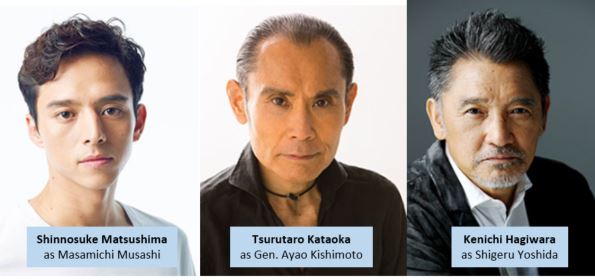
In addition to filming in China, NHK has invested in talent, recruiting some of the biggest names in Japanese television and film. Seiyo Uchino (内野聖陽) will play Paul’s father, Kunio Maruyama, while Yoshino Kimura (木村佳乃) will portray Paul’s mother, Mary Maruyama. Other well known actors like Taizo Harada (原田泰造), Misako Renbutsu (蓮佛美沙子), Shinnosukke Matsushima (満島真之介), Tsurutaro Kataoka (片岡鶴太郎), and Kenichi Hagiwara (萩原健一) fill out the all-star cast.

Prior to a recent trip to Japan, Maruyama made a sortie to Shanghai, China, where he was able to observe filming on a studio lot. A street was re-created to look like a Japanese community in Shenyang, complete with store front signs in Japanese and Chinese, filled with despairing Japanese citizens, and aggressive Russian soldiers. Maruyama, who was in Manchuria with his family at the age of six, took on the scene with wonder and pride, filled with emotion.

“When I see this set and the recreation of streets of Manchuria, the actors, all the extras, the staff, here because of a book I wrote, it’s kind of overwhelming. But I’m happy because we’re able to tell a part of Japanese history that is not well known.”

Shinnosuke Matsushima Tsurutaro Kataoka Kenichi Hagiwara

My Kamekura Yusaku original 1964 Poster

Yusaku Kamekura designed a series of four posters for the 1964 Tokyo Olympics. The first one was printed in 1961, a simple yet powerful construct of red circle on white, balanced in the bottom half of the poster with the Olympic logo and the words “Tokyo 1964” in gold.

I finally secured one of these vintage posters last week. It is striking in its simplicity. And it struck a chord with the Japanese as well.

While the “Hinomaru” flag has represented Japan on ships and in international events since the late 19th century, the red circle on white was only made the national flag by law in August 1999. Due to the powerful connection to the Japanese state in the war years, the occupying leadership group overseeing Japan’s occupation after the end of WWII – The Supreme Commander for the Allied Powers or SCAP – restricted display of the hinomaru significantly.

But in 1961, as Tokyo Olympic fever was beginning to rise, Kamekura released his red-circle-on-white poster on Japan. He claimed that his design had nothing to do with the Japanese flag. According to the article, Rebuilding the Japanese Nation at the 1964 Tokyo Olympics, Satoshi Shimizu quotes Kamekura as saying:

I drew a large red circle on top of the Olympic logo. People may have considered that this large red circle represented the hinomaru, but my actual intention was to express the sun. I wanted to create a fresh and vivid image through a balance between the large red circle and the five-ring Olympic mark. I thought that it would make the hinomaru look like a modern design.

In my view, it’s a lame explanation as the hinomaru is also a representation of the sun. To say the red circles on the poster and the flag are different is confusing. To most people, what the Kamekura’s fist ’64 Olympics poster represented was Japan’s traditional flag. In fact, as Japan continued to step out of the shadow of post-war subjugation, symbols of Japan’s past continued to make a comeback, as explained by Christian Tagsold in his article, “The Tokyo Olympics: Politics and Aftermath.”

The restoration of national pride that was staged in 1964 involved the deliberate rehabilitation of classical national symbols, especially the tennō himself (the emperor), the hinomaru (or Rising Sun) flag, the kimigayo (“His Majesty‘s Reign”) anthem, and the army. The method of their revival was to free them of their wartime associations and present them instead as symbols of peace. This was made possible by embedding them in the Olympic Games’ own narrative and by introducing new national symbols.

The power of the red-circle-on-white symbol was felt in Okinawa, a part of Japan that had been placed under American military control after the war and was still a US territory in the 1960s. The American government routinely denied requests by schools for example, to fly the hinomaru flag.

My Kamekura Yusaku original 1964 Poster 2

And yet, there was, apparently support by the Japanese public for an eventual return of the Okinawan islands to Japan. And since he Okinawa Athletic Association, was recognized as a part of the japan Athletic Association, the Torch Relay Special Committee that the torch relay should take place in all Japanese prefectures, even former ones like Okinawa., according to Shimizu. In fact, they made Okinawa the landing place for the Olympic flame after it completed its Southeast and East Asia journey.

When the Olympic flame arrived in a plane at Naha Airport in Okinawa from Taipei, the headlines claimed that the torch had arrived in Japan. Thousands of torch bearers had signed up to carry the torch for five days in Okinawa, and all of the torch bearers in Okinawa and throughout Japan would be wearing Kamekura’s design on their white tank-top shirt.

In addition, when the first runner pulled into Ounoyama Athletic Stadium after securing the flame at Naha Airport, 40,000 spectators were there to cheer him on, witness the lighting of an Olympic cauldron, the hoisting of the Hinomaru flag, and the playing of the national anthem, Kimigayo.

It would take another 8 years before Okinawa was returned to Japan by the United States, but in 1964, it appears, that thanks to the power of the Tokyo Olympics, and perhaps Kamekura’s famous first poster, the hinomaru flag and Kimigayo had been returned to Japan amidst the golden glow of the Olympics.

Kristallnacht
The Day after Kristallnacht

Dr. Ludwig Guttmann is the undisputed father of the Paralympic Games.

But in the fascinating fantasy world of “What If” speculation, the Paralaympic Movement may have had a different, perhaps more delayed progression through time had Guttmann met a different fate in the increasingly scary build up to World War II in Germany.

In 1938, Guttmann was the medical director of a Jewish Hospital in Breslau, which at the time was part of Germany. On November 9, German paramilitary and citizens walked unimpeded through cities across Germany smashing the glass windows of Jewish-owned stores, buildings and synagogues. Called Kristallnacht, this pogrom led to the death of dozens of Jews, and the arrest of tens of thousands of Jewish men.

On that Night of Broken Glass, 64 Jewish men were admitted into Guttman’s hospital. While many were injured, some were not and were simply looking for refuge from the violent rampage. According to this interview of Guttmann’s daughter, Eva Loeffler, Guttmann admitted all to the hospital regardless of whether they were injured or not, at great personal risk.

My father said they must all be allowed in, whether they were ill or not and they were all admitted to beds on the wards. The next day the Gestapo came round to see my father, wanting to know why such a large number of admissions had happened overnight. My father was adamant that all the men were sick and said many of them were suffering from stress. He took the Gestapo from bed to bed, justifying each man’s medical condition. Apparently he also pulled faces and grimaced at the patients from behind the Gestapo’s back, signaling to them to pull the same expressions and then saying, “Look at this man; he’s having a fit.”

Poppa Guttman Celebration, Stoke Mandeville.
Eva Loeffler the daughter of Paralympic Games founder Sir Ludwig Guttmann appointed as the Mayor of the Paralympic Village by London 2012

Of the 64, only four were carted away by the Gestapo, the remaining 60 allowed to escape incarceration or death for another day.

Guttmann was Jewish, and thus could easily have been arrested, which would likely have led to death in a concentration camp. But he not only saved the lives of dozens, he saved himself. Despite the fact that he was Jewish, Guttmann was one of the foremost authorities in neuro medicine, and was thus still highly valued by the German government. In fact, in order to exercise influence with a potential ally in the Portuguese, the Nazi regime dispatched Guttmann to Portugal so that he could treat a close friend of the Portuguese prime minister, António de Oliveira Salazar. The German authorities then re-issued Guttmann’s passport (as all Jews had their passports confiscated), and then send him to Portugal.

After finishing his work in Portugal, Guttmann made a significant trip to London, where he met members of the Society for the Protection of Science and Learning. This particular group at the time was devoted to obtaining visas for Jewish academics in Germany to come to England. In fact, according to Guttman’s daughter, Loeffler, the society had already sent a visa to the relevant Berlin authorities informing them that Guttmann has already been offered a research post at the Radcliffe Infirmary in Oxford. When Guttmann returned to Germany, he was presented with an opportunity that could secure his family’s long-term safety, or accelerate his family’s demise.

It was 1939 and I was six years old. I remember I was abnormally frightened at the time; I used to cry a lot. Even as a small child I picked up the fear and sadness felt by my parents. Although Jews were allowed to take out some furniture, clothes and linen they were not allowed to take any money, gold silver or jewelry. But the official who was supervising us came round the day before and told my mother ‘I shall be an hour late tomorrow’. It was obviously a hint that we might pack what we wanted; but my mother was too frightened to take anything forbidden as she thought it could be a trap.

Dr Ludwig Guttmann 2nd from left
Dr. Ludwig Guttmann (2nd from left) with Prof Otfrid Foerster and hospital staff at the Wenzel-Hancke Hospital, Breslau, Germany, 1920s Wellcome Library, London

Fortunately, it was not a trap.

Five years later, Guttmann was asked to run the National Spinal Injuries Center at Stoke Mandeville Hospital in Buckinghamshire, England, which led to his revolutionary work on treatment of the disabled, and the eventual birth of the Paralympic Movement.

But what if Guttmans’s pleas and gesticulations before the Gestapo in the aftermath of the Night of Broken Glass had ended in his incarceration?

What if those 60 Jewish men were not allowed to live another day, to have a chance to survive the war and have families, grandchildren, and great grandchildren?

What if Guttmann was not alive to emigrate to England, and join Stoke Mandeville Hospital?

Would there be a Paralympic Games as we know it today?